Strategic Management &
Planning
BY :
J.Chandrashekar Reddy
H.Sudheer Reddy
Overview of Presentation
 Definitions & Concepts
 SWOT Analysis
 Developing the Plan
 Defining the Strategies
 Implementing the Plan
 Monitoring & Evaluation
2sudheer_730@yahoo.com
Definitions & Concepts –
Strategic Management
Strategic Management is concerned
with:
• making decisions about an organization’s
future direction for growth, renewal and
transformation and
• implementing those policies.
• The strategic management process can
be broken into two phases – strategic
planning and strategy implementation.
3sudheer_730@yahoo.com
Definitions & Concepts –
Strategic Planning
Strategic Planning is making decisions
about:
• Determining the organization’s mission;
• Formulating policies to guide the organization in
establishing objectives, choosing a strategy,
and implementing the chosen strategy;
• Establishing long-range and short-range
objectives to achieve the organization’s
mission;
• Determining the strategies that are to be used
in achieving the organization’s mission
4sudheer_730@yahoo.com
Definitions & Concepts –
Strategy Implementation
Strategy Implementation is concerned with:
 Developing the organizational structure to achieve
the strategy;
 Identifying & quantifying the resources required to
support the achievement of the objectives
 Ensuring that the activities necessary to accomplish
the strategy are performed effectively
 Monitoring the effectiveness of the strategy in
achieving the organization’s objectives.
5sudheer_730@yahoo.com
Definitions & Concepts –
Mission/Vision
 Mission is the reason for which the
organization exists & what it will do. It
describes the products/services to be
supplied, the markets to be served and
the technology to be applied, if critical.
 Vision Statement answers the
question, What do we want to
become? It is futuristic and long term.
6sudheer_730@yahoo.com
The SWOT Analysis –
The Internal Environment
 Strengths
 Weaknesses
 Value systems
 Culture
 Staffing – human resource management
 Organizational Capital
 Support systems in the operating environment
 Financial capital
7sudheer_730@yahoo.com
The SWOT Analysis –
The External Environment
 Opportunities
 Threats
 The changing environment
 The demand for new products & competition
 The economic environment
 Availability of resources
 The culture of the population
 The regulatory framework
8sudheer_730@yahoo.com
Developing the Plan
 Develop a mission & a vision. The Statistics Act
establishes the broad operation framework; the strategic
plan will make operational the continual development of
the Institution;
 The need to define official statistics and what constitutes
NSS and the role of the NSO;
 Understand the environment in which the NSO operates
– the internal and the external environments, centralised
vis-à-vis decentralised operations within the NSS, who
are the participants, etc;
 Build in the need for stakeholder, users & producers
participation in the planning and implementation process.
Staff members, at all levels, must be included in the
planning process;
 Incorporate IT as value added to products and services.
Note: IT is an enabler not a solution 9sudheer_730@yahoo.com
Our Mission & Vision
 Our Mission
“To provide relevant, timely and accurate
statistical information and technical
services, consistent with international
standards, to our national and international
clients.”
 Our Vision
“To be a learning organisation that is on the
cutting edge of technology and is
responsible to the needs of our clients.”
10sudheer_730@yahoo.com
Defining the Strategies
6 Strategic Areas with 9 Strategic Objectives
1. Consolidate HO Operations
 Reduce costs & improve internal communications
1. Operational Efficiencies
 Strengthen Human Resource Management Functions
 Create an organizational structure that is flexible to
support the work of the institute
1. Developing the Service Culture
 Institute client service culture & practices for all products
& programmes
 Develop & implement efficient business processes
11sudheer_730@yahoo.com
Defining the Strategies cont’d
4. Improved Technology Platform
 Strengthen the technology required to support
the systems & increase efficiencies
4. Improved Statistical Products &
Methodology
 Understanding user requirements & translate
into new products or enhance existing products
 Strengthen legal framework
6. Acquire Financing
 Acquire financing & TA to facilitate change
12sudheer_730@yahoo.com
Implementing the Plan
 Establish priorities
 Consider the available resources – IT, human, financial,
physical environment, etc, in determining the
implementation period and the strategies to be
implemented
 It is not necessary to tackle all the strategies at the same
time – a phased approach is acceptable
 Seek technical support in the planning and
implementation processes if the expertise is not
available in-house
 Acknowledge small gains in the process and share the
achievements
 Use the Plan as a marketing tool to seek support for
technical assistance and financial aid.
13sudheer_730@yahoo.com
Monitoring & Evaluation
 Periodic review of the implementation process
 Obtain feedback from staff/clients/stakeholders
 Provide regular feedback to major stakeholders,
including staff
 Document and communicate the lessons learnt
 Acknowledge and share results - achievements and
failures
 Continuous monitoring and review of objectives
Remember that the Strategic Management
process is a continuous cycle. It does not end.
The real objective is continual improvement!
14sudheer_730@yahoo.com
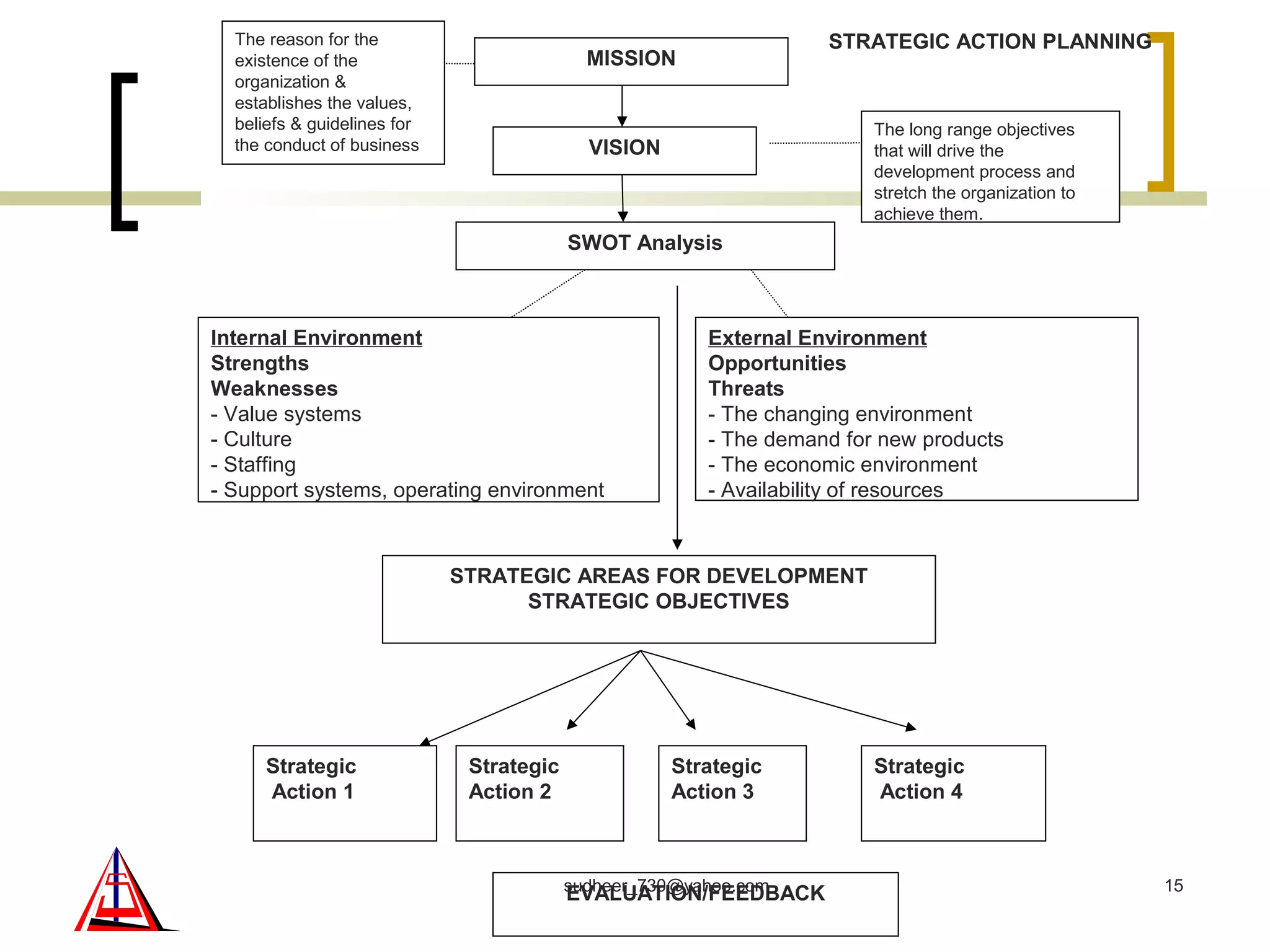
STRATEGIC ACTION PLANNING
SWOT Analysis
VISION
STRATEGIC AREAS FOR DEVELOPMENT
STRATEGIC OBJECTIVES
Strategic
Action 4
Strategic
Action 3
MISSION
Internal Environment
Strengths
Weaknesses
- Value systems
- Culture
- Staffing
- Support systems, operating environment
The long range objectives
that will drive the
development process and
stretch the organization to
achieve them.
External Environment
Opportunities
Threats
- The changing environment
- The demand for new products
- The economic environment
- Availability of resources
Strategic
Action 2
Strategic
Action 1
EVALUATION/FEEDBACK
The reason for the
existence of the
organization &
establishes the values,
beliefs & guidelines for
the conduct of business
15sudheer_730@yahoo.com
Thank you

Stratagic management

  • 1.
    Strategic Management & Planning BY: J.Chandrashekar Reddy H.Sudheer Reddy
  • 2.
    Overview of Presentation Definitions & Concepts  SWOT Analysis  Developing the Plan  Defining the Strategies  Implementing the Plan  Monitoring & Evaluation 2sudheer_730@yahoo.com
  • 3.
    Definitions & Concepts– Strategic Management Strategic Management is concerned with: • making decisions about an organization’s future direction for growth, renewal and transformation and • implementing those policies. • The strategic management process can be broken into two phases – strategic planning and strategy implementation. 3sudheer_730@yahoo.com
  • 4.
    Definitions & Concepts– Strategic Planning Strategic Planning is making decisions about: • Determining the organization’s mission; • Formulating policies to guide the organization in establishing objectives, choosing a strategy, and implementing the chosen strategy; • Establishing long-range and short-range objectives to achieve the organization’s mission; • Determining the strategies that are to be used in achieving the organization’s mission 4sudheer_730@yahoo.com
  • 5.
    Definitions & Concepts– Strategy Implementation Strategy Implementation is concerned with:  Developing the organizational structure to achieve the strategy;  Identifying & quantifying the resources required to support the achievement of the objectives  Ensuring that the activities necessary to accomplish the strategy are performed effectively  Monitoring the effectiveness of the strategy in achieving the organization’s objectives. 5sudheer_730@yahoo.com
  • 6.
    Definitions & Concepts– Mission/Vision  Mission is the reason for which the organization exists & what it will do. It describes the products/services to be supplied, the markets to be served and the technology to be applied, if critical.  Vision Statement answers the question, What do we want to become? It is futuristic and long term. 6sudheer_730@yahoo.com
  • 7.
    The SWOT Analysis– The Internal Environment  Strengths  Weaknesses  Value systems  Culture  Staffing – human resource management  Organizational Capital  Support systems in the operating environment  Financial capital 7sudheer_730@yahoo.com
  • 8.
    The SWOT Analysis– The External Environment  Opportunities  Threats  The changing environment  The demand for new products & competition  The economic environment  Availability of resources  The culture of the population  The regulatory framework 8sudheer_730@yahoo.com
  • 9.
    Developing the Plan Develop a mission & a vision. The Statistics Act establishes the broad operation framework; the strategic plan will make operational the continual development of the Institution;  The need to define official statistics and what constitutes NSS and the role of the NSO;  Understand the environment in which the NSO operates – the internal and the external environments, centralised vis-à-vis decentralised operations within the NSS, who are the participants, etc;  Build in the need for stakeholder, users & producers participation in the planning and implementation process. Staff members, at all levels, must be included in the planning process;  Incorporate IT as value added to products and services. Note: IT is an enabler not a solution 9sudheer_730@yahoo.com
  • 10.
    Our Mission &Vision  Our Mission “To provide relevant, timely and accurate statistical information and technical services, consistent with international standards, to our national and international clients.”  Our Vision “To be a learning organisation that is on the cutting edge of technology and is responsible to the needs of our clients.” 10sudheer_730@yahoo.com
  • 11.
    Defining the Strategies 6Strategic Areas with 9 Strategic Objectives 1. Consolidate HO Operations  Reduce costs & improve internal communications 1. Operational Efficiencies  Strengthen Human Resource Management Functions  Create an organizational structure that is flexible to support the work of the institute 1. Developing the Service Culture  Institute client service culture & practices for all products & programmes  Develop & implement efficient business processes 11sudheer_730@yahoo.com
  • 12.
    Defining the Strategiescont’d 4. Improved Technology Platform  Strengthen the technology required to support the systems & increase efficiencies 4. Improved Statistical Products & Methodology  Understanding user requirements & translate into new products or enhance existing products  Strengthen legal framework 6. Acquire Financing  Acquire financing & TA to facilitate change 12sudheer_730@yahoo.com
  • 13.
    Implementing the Plan Establish priorities  Consider the available resources – IT, human, financial, physical environment, etc, in determining the implementation period and the strategies to be implemented  It is not necessary to tackle all the strategies at the same time – a phased approach is acceptable  Seek technical support in the planning and implementation processes if the expertise is not available in-house  Acknowledge small gains in the process and share the achievements  Use the Plan as a marketing tool to seek support for technical assistance and financial aid. 13sudheer_730@yahoo.com
  • 14.
    Monitoring & Evaluation Periodic review of the implementation process  Obtain feedback from staff/clients/stakeholders  Provide regular feedback to major stakeholders, including staff  Document and communicate the lessons learnt  Acknowledge and share results - achievements and failures  Continuous monitoring and review of objectives Remember that the Strategic Management process is a continuous cycle. It does not end. The real objective is continual improvement! 14sudheer_730@yahoo.com
  • 15.
    STRATEGIC ACTION PLANNING SWOTAnalysis VISION STRATEGIC AREAS FOR DEVELOPMENT STRATEGIC OBJECTIVES Strategic Action 4 Strategic Action 3 MISSION Internal Environment Strengths Weaknesses - Value systems - Culture - Staffing - Support systems, operating environment The long range objectives that will drive the development process and stretch the organization to achieve them. External Environment Opportunities Threats - The changing environment - The demand for new products - The economic environment - Availability of resources Strategic Action 2 Strategic Action 1 EVALUATION/FEEDBACK The reason for the existence of the organization & establishes the values, beliefs & guidelines for the conduct of business 15sudheer_730@yahoo.com
  • 16.