ASSESSING “PATIENT
SAFETY RISK” BEFORE
THE INJURY OCCURS:
AN INTRODUCTION TO
“SOCIOTECHNICAL-
PROBABILISTIC-RISK
MODELLING” IN HEALTH
CARE
-D A MARX, A D SLONIM
Saurabh Khurana
MS Industrial Engineering
Clemson University
Health Care
Introduction
 Since 1 July 2001 the Joint Commission on Accreditation of
Healthcare Organizations (JCAHO) has required each hospital to
conduct at least one proactive risk assessment annually.
 Failure modes and effects analysis (FMEA) was recommended
as one tool for conducting this task.
 This paper examines the limitations of FMEA and introduces a
second tool used by the aviation and nuclear industries to examine
low frequency, high impact events in complex systems.
 The adapted tool, known as sociotechnical probabilistic risk
assessment (ST-PRA), which provides an alternative for
proactively identifying, prioritizing, and mitigating patient safety
risk.
 The uniqueness of ST-PRA is its ability to model combinations of
equipment failures, human error, at risk behavioral norms, and
recovery opportunities through the use of fault trees.
 While ST-PRA is a complex, high end risk modelling tool, it
provides an opportunity to visualize system risk in a manner that
is not possible through FMEA.
 It has become clear that health care is a high risk, error prone
industry. It is not dissimilar from other industries in which lives may
be at risk.
 Patient safety problems is a major concern for healthcare
institutions around the world. The healthcare community must
learn from other industries that are concerned with low
frequency, high risk events to reduce medical errors.
 Clinical processes includes interactions between patients,
providers, and technologies. An analysis of these processes,
provide insights, into variability and potential for medical errors.
 Innumerable ‘‘human factors’’ such as practitioner fatigue and
overwork contribute to poor patient outcomes.
 One must capitalize on the knowledge and tools provided by
other industries to improve patient safety.
RISK MODELLING WITHIN
HEALTH CARE
Overview
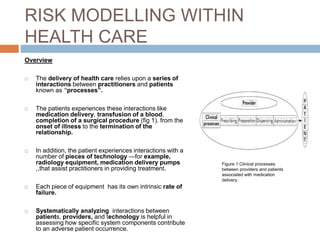
 The delivery of health care relies upon a series of
interactions between practitioners and patients
known as ‘‘processes’’.
 The patients experiences these interactions like
medication delivery, transfusion of a blood,
completion of a surgical procedure (fig 1). from the
onset of illness to the termination of the
relationship.
 In addition, the patient experiences interactions with a
number of pieces of technology —for example,
radiology equipment, medication delivery pumps
,,that assist practitioners in providing treatment.
 Each piece of equipment has its own intrinsic rate of
failure.
 Systematically analyzing interactions between
patients, providers, and technology is helpful in
assessing how specific system components contribute
to an adverse patient occurrence.
Figure 1 Clinical processes
between providers and patients
associated with medication
delivery.
Probabilistic Risk Assessment
 Probabilistic risk assessment (PRA) is a tool that is a hybrid between
the process analysis techniques and decision support models.
 It originated in the mid 1970s as a tool to improve the safety of nuclear
power plants and has been applied in aerospace to manufacturing
and natural disaster.
 PRA is a tool that allows an “assessment of risk” and a
“prioritization” of risk reduction interventions based upon
sequences with highest probability of occurrence.
 It assists in testing of the reliability of a complex system to achieve
risk reduction.
 PRA has advantages over FMEA since it considers multiple
combinations of failures and allows identification of critical failure
paths.
Health Care vs Industries
 Healthcare, is different from other industries in many ways. It depends upon human
interaction between a patient and practitioner during illness and recovery.
 This interaction is emotionally significant and essential for recovery. However, it is this
‘‘humanness’’ in health care that is also responsible for some of the safety problems.
 Unlike computers and machines, Practitioners need to eat, drink, sleep, and have
bathroom breaks. They also have personal lives and stresses that may alter their focus
while they are caring for patients.
 These ‘‘human factors’’ are important considerations when mapping patient safety
problems. The ability to include ‘‘sociotechnical’’ effects into the PRA model
improves its use as a “tool” to facilitate patient safety.
 It provides an opportunity for the hospital to update its risk model continuously. The
“living risk model” then becomes the basis for decision making, allowing hospital to
quantify system risk and to identify, the relative merits of any patient safety change
before implementation.
 Decisions in health care are made with a consideration of the risk,
benefits, costs and outcomes.
 In decision analysis, a problem is disaggregated into its component
parts to allow for its improved understanding.
 A model is built in which the relationships and probabilities of the
components are identified and linked.
 PRA allows hospital management in decision making and keep a balance
between safety improvements & other priority such as cost, timeliness,
technical feasibility.
 PRA has the ability to model complex systems, assess risk points,
and develop strategies for intervention based upon the probability of
an undesirable event occurring.
 In this way, PRA advances the qualitative work of FMEA and RCA
into a quantitative sphere.
THE PROCESS OF PROBABILISTIC
RISK ASSESSMENT
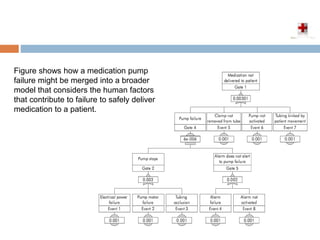
Figure shows how a medication pump
failure might be merged into a broader
model that considers the human factors
that contribute to failure to safely deliver
medication to a patient.
 PRA uses a ‘‘top down’’ approach that
identifies the undesirable outcome to be
modelled first.
 It then investigates all combinations of process
failures that may lead up to this event.
1) Identifying the Outcome Of Interest
2) Assembling the Fault Tree
 Fault trees is the tools used in PRA for visualizing risk.
They illustrate the robustness and the vulnerability of
the system.
 They begin with the identification of the ‘‘top level
event’’ or outcome of interest.
 Fault trees are then populated by three principal
elements: “Basic Events”, ‘‘AND’’ gates, and ‘‘OR’’
gates.
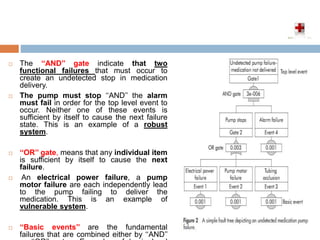
 The ‘‘AND’’ gate indicate that two
functional failures that must occur to
create an undetected stop in medication
delivery.
 The pump must stop ‘‘AND’’ the alarm
must fail in order for the top level event to
occur. Neither one of these events is
sufficient by itself to cause the next failure
state. This is an example of a robust
system.
 ‘‘OR’’ gate, means that any individual item
is sufficient by itself to cause the next
failure.
 An electrical power failure, a pump
motor failure are each independently lead
to the pump failing to deliver the
medication. This is an example of
vulnerable system.
 ‘‘Basic events’’ are the fundamental
failures that are combined either by ‘‘AND’’
3) Developing the Model
 Developing fault trees in health care involves assembling a multidisciplinary
team familiar with the processes and outcomes under analysis to act as the
model builders.
The work then proceeds in two steps:-
 First, the team works with a fault tree software package to identify the
combinations of failures that lead to the undesired outcome.
 If the top level- outcome of interest is ‘‘medication delivered to the wrong
patient’’, the team begins by brainstorming all the potential steps/ways that
can lead it.
 This allows the team to recognize the risk points and to build ways for
mitigating the risk points.
 A typical hospital model would include more than 500 errors, contributing
behaviors, and equipment failures, and 150–250 combinations of failures
that would lead to wrong medication delivery.
4) Adding Probability Estimate
 The major advantage fault trees /PRA over FMEA is its
probabilistic analyses.
 Once the tree structure is developed, the team begins the
second part of model development by adding probability
estimates to the basic events.
 In practice, most healthcare systems do not have actual failure
rate data for the underlying events. The top level events are
often be benign and underestimated in occurrence data.
 The teams often have limited information on human error and
equipment failure rates available to them.
 Every basic event must has a non-zero probability of
occurrence.
 Nonetheless, the risk modelling team must estimate the rates
of occurrence based upon the experience of the team and/or
the published rates in the literature.
 The team then adjust its estimate in an upward or downward
direction before deciding the final estimate.
Example
• Example of the probability estimation task, calculating a
rate for failure for checking armbands when
dispensing medications.
• This is a commonplace AT-RISK behavior that is not
easy to identify in post-event investigations.
• Despite policies and procedures to direct the nurses to
check the patient identification band prior to medication
administration, for a variety of reasons, they fail
universally to accomplish this safety check.
• Once the probability estimates are assigned throughout the fault
tree, the probabilities for each gate are calculated based upon
how the events are related to each other through the ‘‘AND’’ and
‘‘OR’’ gates.
• These gates in the tree provide the mathematical basis for
analyzing combinations of failures.
• The ‘‘AND’’ gates, the probabilities of basic events are multiplied
together, and for the ‘‘OR’’ gates the probabilities are added
together, with the overlap then subtracted so as not to double
count for the condition when both failures occur simultaneously.
• Many fault tree programs create a set report that allows the teams
to identify commonalties and prioritize their risk reduction
strategies.
Once the teams identify the combinations of failures, three
options available to them for intervention:
1) Intervene through human factors methodologies: by
changing system that promote risk behaviors by basic human
error rates.
2) Alter the structure of the fault tree itself by building into
the system methods to double checks and recovery, thereby
making the system less vulnerable and more robust.
3) Create ‘‘forcing functions’’ which are system design that
cannot be overlooked or bypassed—for example, the
creation of different connectors on intravenous pump
tubing and enteral feeding pump tubing which are capable to
prevents catastrophic events, regardless of how tired the
practitioner may be.
 Once the interventions for particular risk combinations are identified,
the fault tree model can be updated to reflect the relative influence of
a specific interventions on the top level event.
 Additionally, as the healthcare system begins to collect actual
occurrence data , the model can be updated with these data to
provide real time estimates.
 In this way, events that occur within the system, even after the model is
built, serve to inform and update the risk model. The result is a ‘‘living
document’’ that can be updated as continuing event, audit, or focus
group data better evaluate the risk.
 By asking a series of questions such as: ‘‘Did the model predict the
failure path represented by the event?’’ and ‘‘Does the event
provide any information to update the risk model?’’, risk
management decisions are made from the risk model and not merely
by reacting to a single event.
5) Improving the Model
6) Adding Socio-technical Components
to the Fault Tree
 The designer has produced an outstanding product design whose
output is concordant with a six sigma level of reliability (three
defects per million).
 In the healthcare setting, human behaviors and errors are very
important contributors to failure of the system. As a result, the fault
tree looks quite different from one from manufacturing .
 In the hospital the top level event is generally characterized as a
failure to provide the patient with the intended care.
 In this fault tree, three human errors and one patient factor are
estimated for the purpose of this exercise. The analysis illustrate the
influence of single dominant human errors against the more robust
design of the pump.
 These human components are important considerations in the
vulnerability of a healthcare system. Incorporating them into the PRA
REFERENCES
 The Wright Brothers, http://www.time.com/time/time100/scientist/profile/ wright.html (accessed 10 July 2003).
 Military Procedure MIL-P-1629. Procedures for performing a failure mode, effects and criticality analysis 9 November 1949.
 Federal Aviation Administration. System design analysis. Advisory Circular 25.1309-1A, 21 June 1988.
 Kohn LT, Corrigan JM, Donaldson MS, eds. Institute of Medicine. To err human: building a safer health system. Washington,
DC: National Academy Press, 2000.
 Leape LL, Bates DW, Cullen DJ, et al. Systems analysis of adverse drug events. JAMA 1995;274:35–43.
 http://www.rootcauseanalyst.com (accessed 25 January 2003).
 http://www.fmeainfocentre.com (accessed 25 January 2003).
 Joint Commission on Accreditation of Healthcare Organizations. Medical errors, sentinel events, and accreditation. A report to
the Association of Anesthesia Program Directors, 28 October 2000.
 Roos NP, Black CD, Roos LL, et al. A population-based approach to
 monitoring adverse outcomes of medical care. Med Care 1995;33:127–38.
 Institute of Medicine. Crossing the quality chasm: a new health system for the 21st century. Washington, DC: National Academy
Press, 2001.
 Linerooth-Bayer J, Wahlstroem B. Applications of probabilistic risk assessments: the selection of appropriate tools. Risk Analysis
1991;11:239–48.
 Anon. Data 3.5 for Healthcare. Williamstown, Massachusetts: Tree Age Software, 1999.
 Hayns MF. The evolution of probabilistic risk assessment in the nuclear industry. Process Saf Environ Prot 1999;77:117–42.
 Garrick BJ, Christie RF. Probabilistic ri0sk assessment practices in the USA for nuclear power plants. Saf Sci 2002;40:177–201.
 Moore DRJ, Sample BE, Suter GW, et al. Risk based decision making: the East
 Fork Poplar Creek case study. Environ Toxicol Chem 1999;18:2954–8.
 Caruso MA, Cheok MC, Cunningham MA, et al. An approach for using risk assessment in risk informed decisions on plant specific
changes to the licensing

ST-PRA

  • 1.
    ASSESSING “PATIENT SAFETY RISK”BEFORE THE INJURY OCCURS: AN INTRODUCTION TO “SOCIOTECHNICAL- PROBABILISTIC-RISK MODELLING” IN HEALTH CARE -D A MARX, A D SLONIM Saurabh Khurana MS Industrial Engineering Clemson University
  • 2.
  • 3.
    Introduction  Since 1July 2001 the Joint Commission on Accreditation of Healthcare Organizations (JCAHO) has required each hospital to conduct at least one proactive risk assessment annually.  Failure modes and effects analysis (FMEA) was recommended as one tool for conducting this task.  This paper examines the limitations of FMEA and introduces a second tool used by the aviation and nuclear industries to examine low frequency, high impact events in complex systems.  The adapted tool, known as sociotechnical probabilistic risk assessment (ST-PRA), which provides an alternative for proactively identifying, prioritizing, and mitigating patient safety risk.  The uniqueness of ST-PRA is its ability to model combinations of equipment failures, human error, at risk behavioral norms, and recovery opportunities through the use of fault trees.  While ST-PRA is a complex, high end risk modelling tool, it provides an opportunity to visualize system risk in a manner that is not possible through FMEA.
  • 4.
     It hasbecome clear that health care is a high risk, error prone industry. It is not dissimilar from other industries in which lives may be at risk.  Patient safety problems is a major concern for healthcare institutions around the world. The healthcare community must learn from other industries that are concerned with low frequency, high risk events to reduce medical errors.  Clinical processes includes interactions between patients, providers, and technologies. An analysis of these processes, provide insights, into variability and potential for medical errors.  Innumerable ‘‘human factors’’ such as practitioner fatigue and overwork contribute to poor patient outcomes.  One must capitalize on the knowledge and tools provided by other industries to improve patient safety.
  • 5.
    RISK MODELLING WITHIN HEALTHCARE Overview  The delivery of health care relies upon a series of interactions between practitioners and patients known as ‘‘processes’’.  The patients experiences these interactions like medication delivery, transfusion of a blood, completion of a surgical procedure (fig 1). from the onset of illness to the termination of the relationship.  In addition, the patient experiences interactions with a number of pieces of technology —for example, radiology equipment, medication delivery pumps ,,that assist practitioners in providing treatment.  Each piece of equipment has its own intrinsic rate of failure.  Systematically analyzing interactions between patients, providers, and technology is helpful in assessing how specific system components contribute to an adverse patient occurrence. Figure 1 Clinical processes between providers and patients associated with medication delivery.
  • 6.
    Probabilistic Risk Assessment Probabilistic risk assessment (PRA) is a tool that is a hybrid between the process analysis techniques and decision support models.  It originated in the mid 1970s as a tool to improve the safety of nuclear power plants and has been applied in aerospace to manufacturing and natural disaster.  PRA is a tool that allows an “assessment of risk” and a “prioritization” of risk reduction interventions based upon sequences with highest probability of occurrence.  It assists in testing of the reliability of a complex system to achieve risk reduction.  PRA has advantages over FMEA since it considers multiple combinations of failures and allows identification of critical failure paths.
  • 7.
    Health Care vsIndustries  Healthcare, is different from other industries in many ways. It depends upon human interaction between a patient and practitioner during illness and recovery.  This interaction is emotionally significant and essential for recovery. However, it is this ‘‘humanness’’ in health care that is also responsible for some of the safety problems.  Unlike computers and machines, Practitioners need to eat, drink, sleep, and have bathroom breaks. They also have personal lives and stresses that may alter their focus while they are caring for patients.  These ‘‘human factors’’ are important considerations when mapping patient safety problems. The ability to include ‘‘sociotechnical’’ effects into the PRA model improves its use as a “tool” to facilitate patient safety.  It provides an opportunity for the hospital to update its risk model continuously. The “living risk model” then becomes the basis for decision making, allowing hospital to quantify system risk and to identify, the relative merits of any patient safety change before implementation.
  • 8.
     Decisions inhealth care are made with a consideration of the risk, benefits, costs and outcomes.  In decision analysis, a problem is disaggregated into its component parts to allow for its improved understanding.  A model is built in which the relationships and probabilities of the components are identified and linked.  PRA allows hospital management in decision making and keep a balance between safety improvements & other priority such as cost, timeliness, technical feasibility.  PRA has the ability to model complex systems, assess risk points, and develop strategies for intervention based upon the probability of an undesirable event occurring.  In this way, PRA advances the qualitative work of FMEA and RCA into a quantitative sphere.
  • 9.
    THE PROCESS OFPROBABILISTIC RISK ASSESSMENT
  • 10.
    Figure shows howa medication pump failure might be merged into a broader model that considers the human factors that contribute to failure to safely deliver medication to a patient.
  • 11.
     PRA usesa ‘‘top down’’ approach that identifies the undesirable outcome to be modelled first.  It then investigates all combinations of process failures that may lead up to this event. 1) Identifying the Outcome Of Interest
  • 12.
    2) Assembling theFault Tree  Fault trees is the tools used in PRA for visualizing risk. They illustrate the robustness and the vulnerability of the system.  They begin with the identification of the ‘‘top level event’’ or outcome of interest.  Fault trees are then populated by three principal elements: “Basic Events”, ‘‘AND’’ gates, and ‘‘OR’’ gates.
  • 13.
     The ‘‘AND’’gate indicate that two functional failures that must occur to create an undetected stop in medication delivery.  The pump must stop ‘‘AND’’ the alarm must fail in order for the top level event to occur. Neither one of these events is sufficient by itself to cause the next failure state. This is an example of a robust system.  ‘‘OR’’ gate, means that any individual item is sufficient by itself to cause the next failure.  An electrical power failure, a pump motor failure are each independently lead to the pump failing to deliver the medication. This is an example of vulnerable system.  ‘‘Basic events’’ are the fundamental failures that are combined either by ‘‘AND’’
  • 14.
    3) Developing theModel  Developing fault trees in health care involves assembling a multidisciplinary team familiar with the processes and outcomes under analysis to act as the model builders. The work then proceeds in two steps:-  First, the team works with a fault tree software package to identify the combinations of failures that lead to the undesired outcome.  If the top level- outcome of interest is ‘‘medication delivered to the wrong patient’’, the team begins by brainstorming all the potential steps/ways that can lead it.  This allows the team to recognize the risk points and to build ways for mitigating the risk points.  A typical hospital model would include more than 500 errors, contributing behaviors, and equipment failures, and 150–250 combinations of failures that would lead to wrong medication delivery.
  • 15.
    4) Adding ProbabilityEstimate  The major advantage fault trees /PRA over FMEA is its probabilistic analyses.  Once the tree structure is developed, the team begins the second part of model development by adding probability estimates to the basic events.  In practice, most healthcare systems do not have actual failure rate data for the underlying events. The top level events are often be benign and underestimated in occurrence data.  The teams often have limited information on human error and equipment failure rates available to them.  Every basic event must has a non-zero probability of occurrence.  Nonetheless, the risk modelling team must estimate the rates of occurrence based upon the experience of the team and/or the published rates in the literature.  The team then adjust its estimate in an upward or downward direction before deciding the final estimate.
  • 16.
    Example • Example ofthe probability estimation task, calculating a rate for failure for checking armbands when dispensing medications. • This is a commonplace AT-RISK behavior that is not easy to identify in post-event investigations. • Despite policies and procedures to direct the nurses to check the patient identification band prior to medication administration, for a variety of reasons, they fail universally to accomplish this safety check.
  • 17.
    • Once theprobability estimates are assigned throughout the fault tree, the probabilities for each gate are calculated based upon how the events are related to each other through the ‘‘AND’’ and ‘‘OR’’ gates. • These gates in the tree provide the mathematical basis for analyzing combinations of failures. • The ‘‘AND’’ gates, the probabilities of basic events are multiplied together, and for the ‘‘OR’’ gates the probabilities are added together, with the overlap then subtracted so as not to double count for the condition when both failures occur simultaneously. • Many fault tree programs create a set report that allows the teams to identify commonalties and prioritize their risk reduction strategies.
  • 18.
    Once the teamsidentify the combinations of failures, three options available to them for intervention: 1) Intervene through human factors methodologies: by changing system that promote risk behaviors by basic human error rates. 2) Alter the structure of the fault tree itself by building into the system methods to double checks and recovery, thereby making the system less vulnerable and more robust. 3) Create ‘‘forcing functions’’ which are system design that cannot be overlooked or bypassed—for example, the creation of different connectors on intravenous pump tubing and enteral feeding pump tubing which are capable to prevents catastrophic events, regardless of how tired the practitioner may be.
  • 19.
     Once theinterventions for particular risk combinations are identified, the fault tree model can be updated to reflect the relative influence of a specific interventions on the top level event.  Additionally, as the healthcare system begins to collect actual occurrence data , the model can be updated with these data to provide real time estimates.  In this way, events that occur within the system, even after the model is built, serve to inform and update the risk model. The result is a ‘‘living document’’ that can be updated as continuing event, audit, or focus group data better evaluate the risk.  By asking a series of questions such as: ‘‘Did the model predict the failure path represented by the event?’’ and ‘‘Does the event provide any information to update the risk model?’’, risk management decisions are made from the risk model and not merely by reacting to a single event. 5) Improving the Model
  • 20.
    6) Adding Socio-technicalComponents to the Fault Tree  The designer has produced an outstanding product design whose output is concordant with a six sigma level of reliability (three defects per million).  In the healthcare setting, human behaviors and errors are very important contributors to failure of the system. As a result, the fault tree looks quite different from one from manufacturing .  In the hospital the top level event is generally characterized as a failure to provide the patient with the intended care.  In this fault tree, three human errors and one patient factor are estimated for the purpose of this exercise. The analysis illustrate the influence of single dominant human errors against the more robust design of the pump.  These human components are important considerations in the vulnerability of a healthcare system. Incorporating them into the PRA
  • 21.
    REFERENCES  The WrightBrothers, http://www.time.com/time/time100/scientist/profile/ wright.html (accessed 10 July 2003).  Military Procedure MIL-P-1629. Procedures for performing a failure mode, effects and criticality analysis 9 November 1949.  Federal Aviation Administration. System design analysis. Advisory Circular 25.1309-1A, 21 June 1988.  Kohn LT, Corrigan JM, Donaldson MS, eds. Institute of Medicine. To err human: building a safer health system. Washington, DC: National Academy Press, 2000.  Leape LL, Bates DW, Cullen DJ, et al. Systems analysis of adverse drug events. JAMA 1995;274:35–43.  http://www.rootcauseanalyst.com (accessed 25 January 2003).  http://www.fmeainfocentre.com (accessed 25 January 2003).  Joint Commission on Accreditation of Healthcare Organizations. Medical errors, sentinel events, and accreditation. A report to the Association of Anesthesia Program Directors, 28 October 2000.  Roos NP, Black CD, Roos LL, et al. A population-based approach to  monitoring adverse outcomes of medical care. Med Care 1995;33:127–38.  Institute of Medicine. Crossing the quality chasm: a new health system for the 21st century. Washington, DC: National Academy Press, 2001.  Linerooth-Bayer J, Wahlstroem B. Applications of probabilistic risk assessments: the selection of appropriate tools. Risk Analysis 1991;11:239–48.  Anon. Data 3.5 for Healthcare. Williamstown, Massachusetts: Tree Age Software, 1999.  Hayns MF. The evolution of probabilistic risk assessment in the nuclear industry. Process Saf Environ Prot 1999;77:117–42.  Garrick BJ, Christie RF. Probabilistic ri0sk assessment practices in the USA for nuclear power plants. Saf Sci 2002;40:177–201.  Moore DRJ, Sample BE, Suter GW, et al. Risk based decision making: the East  Fork Poplar Creek case study. Environ Toxicol Chem 1999;18:2954–8.  Caruso MA, Cheok MC, Cunningham MA, et al. An approach for using risk assessment in risk informed decisions on plant specific changes to the licensing