Policy Based Validation of SAN Configuration 
SATWIK KUMAR 
1RV13CS141 
Department of Computer Science and Engineering 
R V College of Engineering, Bangalore
Presentation Outline 
INTRODUCTION 
Storage Area Network 
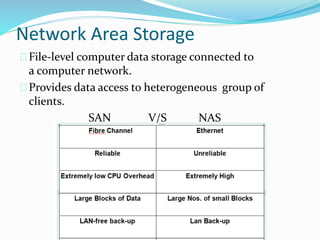
Network Area Storage 
SAN v/s NAS 
BODY 
Awareness of global effects of the product/topic 
Understanding of economic factors 
Awareness of contemporary issues 
Understanding of Professional Issues 
Literature survey 
Data Structures 
Computer Organization and Architecture 
Digital Logic and Design 
Discrete Mathematical Structure 
Future work for next Phase 
REFERENCES
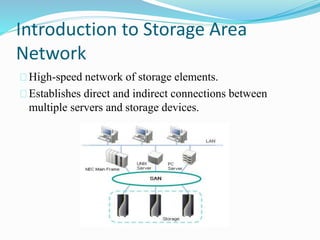
Introduction to Storage Area 
Network 
High-speed network of storage elements. 
Establishes direct and indirect connections between 
multiple servers and storage devices.
Network Area Storage 
File-level computer data storage connected to 
a computer network. 
Provides data access to heterogeneous group of 
clients. 
SAN V/S NAS
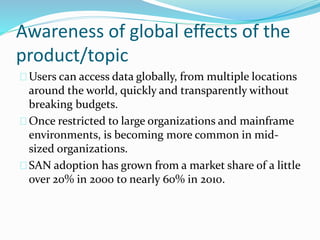
Awareness of global effects of the 
product/topic 
Users can access data globally, from multiple locations 
around the world, quickly and transparently without 
breaking budgets. 
Once restricted to large organizations and mainframe 
environments, is becoming more common in mid-sized 
organizations. 
SAN adoption has grown from a market share of a little 
over 20% in 2000 to nearly 60% in 2010.
Understanding of economic factors 
Increasing Number of Enterprises 
Increasing Requirements on Data Availability. 
Reduced cost of external storage. 
Best and Superior performance. 
High Degree of Fault Tolerance.
Awareness of contemporary issues 
Installation of SAN is still a highly complex and 
lengthy procedure. 
A poorly designed SAN can itself be a single point of 
failure for large volume of data. 
Incompatibility issues.
Understanding of Professional Issues 
One of the key challenges of SAN management is the 
large number of configuration problems that are 
encountered when 
(a) adding/removing devices in an existing SAN. 
(b) provisioning new storage. 
(c) upgrading firmware or device drivers. 
(d) trying to ensure a certain level of reliability and 
security in the SAN.
Literature survey 
Data Structures 
Hard Coding 
It is a software development practice in which 
program is directly written into the source code 
manually. 
This may cause a program bug. 
It is difficult for a human to determine conflicts 
between rules, assign priorities, and specify the 
sequence of execution of the rules.
Digital Logic and Design 
Fibre Channel Protocol 
It is a transport protocol that predominantly 
transports commands over Fibre Channel networks. 
Provides the highest performance levels. 
Designed for mission-critical applications. 
Cost of components is relatively high. 
Relatively difficult to implement and manage.
Computer Organization and 
Architecture 
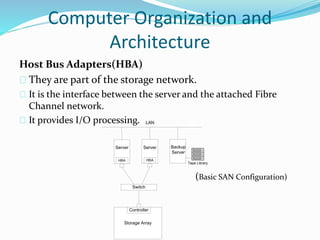
Host Bus Adapters(HBA) 
They are part of the storage network. 
It is the interface between the server and the attached Fibre 
Channel network. 
It provides I/O processing. 
(Basic SAN Configuration) 
LAN 
Tape Library 
HBA HBA 
Switch 
Controller 
Storage Array 
Backup 
Server 
Server Server
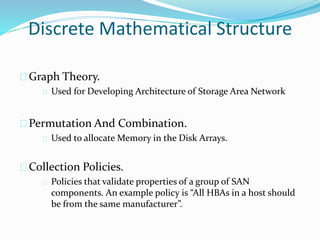
Discrete Mathematical Structure 
Graph Theory. 
Used for Developing Architecture of Storage Area Network 
Permutation And Combination. 
Used to allocate Memory in the Disk Arrays. 
Collection Policies. 
Policies that validate properties of a group of SAN 
components. An example policy is “All HBAs in a host should 
be from the same manufacturer”.
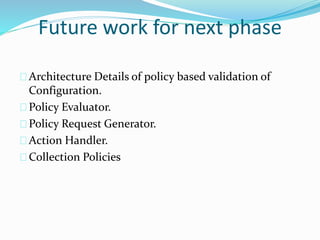
Future work for next phase 
Architecture Details of policy based validation of 
Configuration. 
Policy Evaluator. 
Policy Request Generator. 
Action Handler. 
Collection Policies
References 
[1]http://ieeexplore.ieee.org/xpl/Policy-Based Validation of SAN 
Configuration 
[2] M. Bearden, S. Garg, and W. J. Lee. Integrating Goal 
Specification in Policy Based Management. In Proc. of IEEE 
Policy 2001, January 2001. 
[3] R. Chadha, Y.-H. Cheng, T. Cheng, S. Gadgil, A. Hafid, K. 
Kim, G. Levin, N. Natarajan, K. Parmeswaran, A. Poylisher, 
and J. Unger. PECAN: Policy-enabled configuration across 
networks. In Proc. of IEEE Policy 2003, June 2003. 
[4] http://en.wikipedia.org/wiki/Network-attached_storage. 
[5] http://en.wikipedia.org/wiki/Storage_area_network.
Thank You

Storage area network (san)

  • 1.
    Policy Based Validationof SAN Configuration SATWIK KUMAR 1RV13CS141 Department of Computer Science and Engineering R V College of Engineering, Bangalore
  • 2.
    Presentation Outline INTRODUCTION Storage Area Network Network Area Storage SAN v/s NAS BODY Awareness of global effects of the product/topic Understanding of economic factors Awareness of contemporary issues Understanding of Professional Issues Literature survey Data Structures Computer Organization and Architecture Digital Logic and Design Discrete Mathematical Structure Future work for next Phase REFERENCES
  • 3.
    Introduction to StorageArea Network High-speed network of storage elements. Establishes direct and indirect connections between multiple servers and storage devices.
  • 4.
    Network Area Storage File-level computer data storage connected to a computer network. Provides data access to heterogeneous group of clients. SAN V/S NAS
  • 5.
    Awareness of globaleffects of the product/topic Users can access data globally, from multiple locations around the world, quickly and transparently without breaking budgets. Once restricted to large organizations and mainframe environments, is becoming more common in mid-sized organizations. SAN adoption has grown from a market share of a little over 20% in 2000 to nearly 60% in 2010.
  • 6.
    Understanding of economicfactors Increasing Number of Enterprises Increasing Requirements on Data Availability. Reduced cost of external storage. Best and Superior performance. High Degree of Fault Tolerance.
  • 7.
    Awareness of contemporaryissues Installation of SAN is still a highly complex and lengthy procedure. A poorly designed SAN can itself be a single point of failure for large volume of data. Incompatibility issues.
  • 8.
    Understanding of ProfessionalIssues One of the key challenges of SAN management is the large number of configuration problems that are encountered when (a) adding/removing devices in an existing SAN. (b) provisioning new storage. (c) upgrading firmware or device drivers. (d) trying to ensure a certain level of reliability and security in the SAN.
  • 9.
    Literature survey DataStructures Hard Coding It is a software development practice in which program is directly written into the source code manually. This may cause a program bug. It is difficult for a human to determine conflicts between rules, assign priorities, and specify the sequence of execution of the rules.
  • 10.
    Digital Logic andDesign Fibre Channel Protocol It is a transport protocol that predominantly transports commands over Fibre Channel networks. Provides the highest performance levels. Designed for mission-critical applications. Cost of components is relatively high. Relatively difficult to implement and manage.
  • 11.
    Computer Organization and Architecture Host Bus Adapters(HBA) They are part of the storage network. It is the interface between the server and the attached Fibre Channel network. It provides I/O processing. (Basic SAN Configuration) LAN Tape Library HBA HBA Switch Controller Storage Array Backup Server Server Server
  • 12.
    Discrete Mathematical Structure Graph Theory. Used for Developing Architecture of Storage Area Network Permutation And Combination. Used to allocate Memory in the Disk Arrays. Collection Policies. Policies that validate properties of a group of SAN components. An example policy is “All HBAs in a host should be from the same manufacturer”.
  • 13.
    Future work fornext phase Architecture Details of policy based validation of Configuration. Policy Evaluator. Policy Request Generator. Action Handler. Collection Policies
  • 14.
    References [1]http://ieeexplore.ieee.org/xpl/Policy-Based Validationof SAN Configuration [2] M. Bearden, S. Garg, and W. J. Lee. Integrating Goal Specification in Policy Based Management. In Proc. of IEEE Policy 2001, January 2001. [3] R. Chadha, Y.-H. Cheng, T. Cheng, S. Gadgil, A. Hafid, K. Kim, G. Levin, N. Natarajan, K. Parmeswaran, A. Poylisher, and J. Unger. PECAN: Policy-enabled configuration across networks. In Proc. of IEEE Policy 2003, June 2003. [4] http://en.wikipedia.org/wiki/Network-attached_storage. [5] http://en.wikipedia.org/wiki/Storage_area_network.
  • 15.