Stop Measuring
Seat Time
A n I n t r o d u c t i o n t o
C o m p e t e n c y - B a s e d L e a r n i n g
Rh o, I n c. - Le arn in g & P e rform an ce
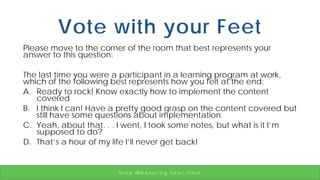
Vote with your Feet
Please move to the corner of the room that best represents your
answer to this question:
The last time you were a participant in a learning program at work,
which of the following best represents how you felt at the end:
A. Ready to rock! Know exactly how to implement the content
covered
B. I think I can! Have a pretty good grasp on the content covered but
still have some questions about implementation.
C. Yeah, about that. . . I went, I took some notes, but what is it I’m
supposed to do?
D. That’s a hour of my life I’ll never get back!
S t o p M e a s u r i n g S e a t T i m e
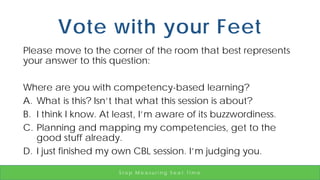
Vote with your Feet
Please move to the corner of the room that best represents
your answer to this question:
Where are you with competency-based learning?
A. What is this? Isn’t that what this session is about?
B. I think I know. At least, I’m aware of its buzzwordiness.
C. Planning and mapping my competencies, get to the
good stuff already.
D. I just finished my own CBL session. I’m judging you.
S t o p M e a s u r i n g S e a t T i m e
@greggarner87
@pjholmes99
Learning & Performance Specialist
Rho, Inc.
Middle school teacher, instructional
coach, digital innovations coach
Director, Learning & Performance
Rho, Inc.
Teacher, Principal, Executive Director for
Professional Learning
Phil
Greg
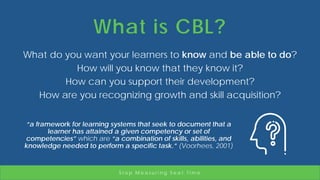
What is CBL?
What do you want your learners to know and be able to do?
How will you know that they know it?
How can you support their development?
How are you recognizing growth and skill acquisition?
“a framework for learning systems that seek to document that a
learner has attained a given competency or set of
competencies” which are “a combination of skills, abilities, and
knowledge needed to perform a specific task.” (Voorhees, 2001)
S t o p M e a s u r i n g S e a t T i m e
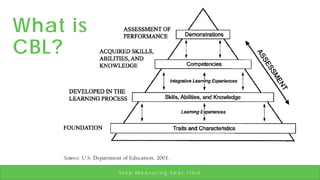
What is
CBL?
S t o p M e a s u r i n g S e a t T i m e
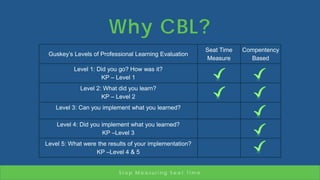
Why CBL?
S t o p M e a s u r i n g S e a t T i m e
Guskey’s Levels of Professional Learning Evaluation
Seat Time
Measure
Compentency
Based
Level 1: Did you go? How was it?
KP – Level 1
Level 2: What did you learn?
KP – Level 2
Level 3: Can you implement what you learned?
Level 4: Did you implement what you learned?
KP –Level 3
Level 5: What were the results of your implementation?
KP –Level 4 & 5
Story Time
Turn ‘n’ Talk
What examples do you have from your work?
Identify when you could have used CBL instead of a
seat-time approach.
S t o p M e a s u r i n g S e a t T i m e
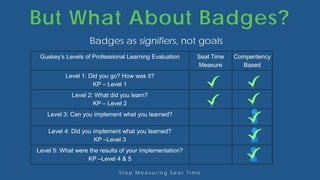
But What About Badges?
Badges as signifiers, not goals
S t o p M e a s u r i n g S e a t T i m e
Guskey’s Levels of Professional Learning Evaluation Seat Time
Measure
Compentency
Based
Level 1: Did you go? How was it?
KP – Level 1
Level 2: What did you learn?
KP – Level 2
Level 3: Can you implement what you learned?
Level 4: Did you implement what you learned?
KP –Level 3
Level 5: What were the results of your implementation?
KP –Level 4 & 5
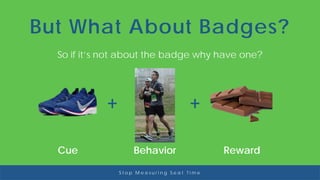
So if it’s not about the badge why have one?
S t o p M e a s u r i n g S e a t T i m e
But What About Badges?
Cue
+
Reward
+
Behavior
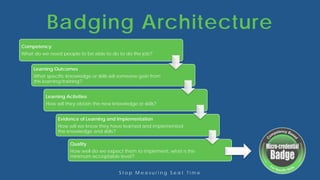
Badging Architecture
S t o p M e a s u r i n g S e a t T i m e
Competency
What do we need people to be able to do to do the job?
Learning Outcomes
What specific knowledge or skills will someone gain from
this learning/training?
Learning Activities
How will they obtain the new knowledge or skills?
Evidence of Learning and Implementation
How will we know they have learned and implemented
the knowledge and skills?
Quality
How well do we expect them to implement, what is the
minimum acceptable level?
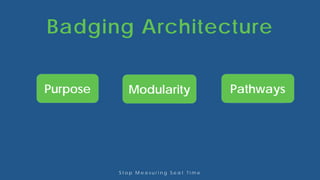
Badging Architecture
S t o p M e a s u r i n g S e a t T i m e
StacksPathwaysGranularityExpiry ModularityPurpose
Lessons Learned
Based on what you’ve heard and what you know…
What’s next?
S t o p M e a s u r i n g S e a t T i m e
Stop Measuring Seat Time: An Introduction to Competency-Based Learning

Stop Measuring Seat Time: An Introduction to Competency-Based Learning

  • 1.
    Stop Measuring Seat Time An I n t r o d u c t i o n t o C o m p e t e n c y - B a s e d L e a r n i n g Rh o, I n c. - Le arn in g & P e rform an ce
  • 2.
    Vote with yourFeet Please move to the corner of the room that best represents your answer to this question: The last time you were a participant in a learning program at work, which of the following best represents how you felt at the end: A. Ready to rock! Know exactly how to implement the content covered B. I think I can! Have a pretty good grasp on the content covered but still have some questions about implementation. C. Yeah, about that. . . I went, I took some notes, but what is it I’m supposed to do? D. That’s a hour of my life I’ll never get back! S t o p M e a s u r i n g S e a t T i m e
  • 3.
    Vote with yourFeet Please move to the corner of the room that best represents your answer to this question: Where are you with competency-based learning? A. What is this? Isn’t that what this session is about? B. I think I know. At least, I’m aware of its buzzwordiness. C. Planning and mapping my competencies, get to the good stuff already. D. I just finished my own CBL session. I’m judging you. S t o p M e a s u r i n g S e a t T i m e
  • 4.
    @greggarner87 @pjholmes99 Learning & PerformanceSpecialist Rho, Inc. Middle school teacher, instructional coach, digital innovations coach Director, Learning & Performance Rho, Inc. Teacher, Principal, Executive Director for Professional Learning Phil Greg
  • 5.
    What is CBL? Whatdo you want your learners to know and be able to do? How will you know that they know it? How can you support their development? How are you recognizing growth and skill acquisition? “a framework for learning systems that seek to document that a learner has attained a given competency or set of competencies” which are “a combination of skills, abilities, and knowledge needed to perform a specific task.” (Voorhees, 2001) S t o p M e a s u r i n g S e a t T i m e
  • 6.
    What is CBL? S to p M e a s u r i n g S e a t T i m e
  • 7.
    Why CBL? S to p M e a s u r i n g S e a t T i m e Guskey’s Levels of Professional Learning Evaluation Seat Time Measure Compentency Based Level 1: Did you go? How was it? KP – Level 1 Level 2: What did you learn? KP – Level 2 Level 3: Can you implement what you learned? Level 4: Did you implement what you learned? KP –Level 3 Level 5: What were the results of your implementation? KP –Level 4 & 5
  • 8.
  • 9.
    Turn ‘n’ Talk Whatexamples do you have from your work? Identify when you could have used CBL instead of a seat-time approach. S t o p M e a s u r i n g S e a t T i m e
  • 10.
    But What AboutBadges? Badges as signifiers, not goals S t o p M e a s u r i n g S e a t T i m e Guskey’s Levels of Professional Learning Evaluation Seat Time Measure Compentency Based Level 1: Did you go? How was it? KP – Level 1 Level 2: What did you learn? KP – Level 2 Level 3: Can you implement what you learned? Level 4: Did you implement what you learned? KP –Level 3 Level 5: What were the results of your implementation? KP –Level 4 & 5
  • 11.
    So if it’snot about the badge why have one? S t o p M e a s u r i n g S e a t T i m e But What About Badges? Cue + Reward + Behavior
  • 12.
    Badging Architecture S to p M e a s u r i n g S e a t T i m e Competency What do we need people to be able to do to do the job? Learning Outcomes What specific knowledge or skills will someone gain from this learning/training? Learning Activities How will they obtain the new knowledge or skills? Evidence of Learning and Implementation How will we know they have learned and implemented the knowledge and skills? Quality How well do we expect them to implement, what is the minimum acceptable level?
  • 13.
    Badging Architecture S to p M e a s u r i n g S e a t T i m e StacksPathwaysGranularityExpiry ModularityPurpose
  • 14.
    Lessons Learned Based onwhat you’ve heard and what you know… What’s next? S t o p M e a s u r i n g S e a t T i m e