How to Successfully Utilize
Immersive and Experiential
Training
Dr. Holly A. Sullenger: DrHollySpeaks@gmail.com
Brian Sakofsky, M. Ed.: bsakofsky@gmail.com
Monotone
One-Sided
Death-By-PowerPoint
No Training Transfer
Life Without Immersive or
Experiential Training
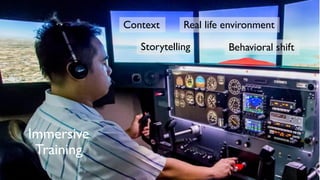
Immersive
Training
Real life environment
Behavioral shiftStorytelling
Context
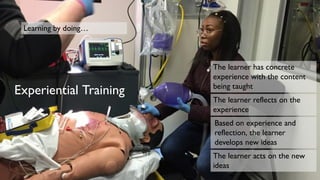
Experiential Training
The learner acts on the new
ideas
Learning by doing…
Based on experience and
reflection, the learner
develops new ideas
The learner reflects on the
experience
The learner has concrete
experience with the content
being taught
Success with
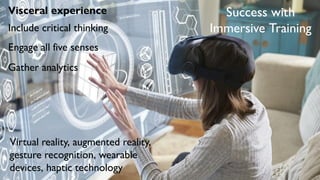
Immersive Training
Gather analytics
Engage all five senses
Include critical thinking
Visceral experience
Virtual reality, augmented reality,
gesture recognition, wearable
devices, haptic technology
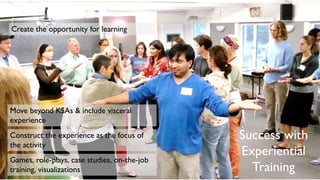
Success with
Experiential
Training
Create the opportunity for learning
Move beyond KSAs & include visceral
experience
Construct the experience as the focus of
the activity
Games, role-plays, case studies, on-the-job
training, visualizations
Benefits of Bringing
Immersive or
Experiential Training
to Your Organization
Includes any geographically
displaced workforce
Eliminates risk
Allows for immediate feedback
Promotes repetition and retention
with reflection
Connects concepts to the
workplace
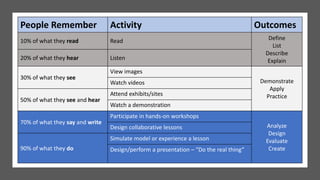
People Remember Activity Outcomes
10% of what they read Read Define
List
Describe
Explain20% of what they hear Listen
30% of what they see
View images
Demonstrate
Apply
Practice
Watch videos
50% of what they see and hear
Attend exhibits/sites
Watch a demonstration
70% of what they say and write
Participate in hands-on workshops
Analyze
Design
Evaluate
Create
Design collaborative lessons
90% of what they do
Simulate model or experience a lesson
Design/perform a presentation – “Do the real thing”
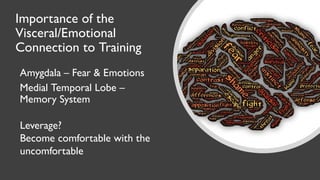
Importance of the
Visceral/Emotional
Connection to Training
Amygdala – Fear & Emotions
Medial Temporal Lobe –
Memory System
Leverage?
Become comfortable with the
uncomfortable
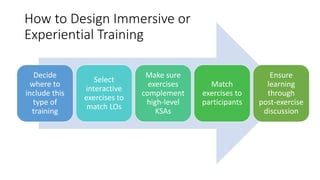
How to Design Immersive or
Experiential Training
Decide
where to
include this
type of
training
Select
interactive
exercises to
match LOs
Make sure
exercises
complement
high-level
KSAs
Match
exercises to
participants
Ensure
learning
through
post-exercise
discussion
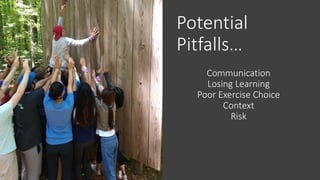
Potential
Pitfalls…
Credit: Daily Mail
Communication
Losing Learning
Poor Exercise Choice
Context
Risk
Contact Holly:
DrHollySpeaks@gmail.com
Website:
www.DrHollySpeaks.com
Contact Brian:
bsakofsky@gmail.com

How to Successfully Utilize Immersive and Experiential Training