STOICHIOMETRY
What is stoichiometry?
Stoichiometry is the
quantitative study of
reactants and products in
a chemical reaction.
What You Should Expect
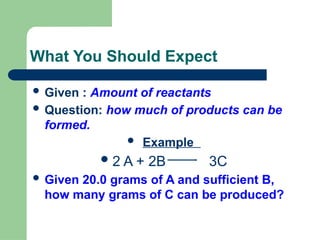
 Given : Amount of reactants
 Question: how much of products can be
formed.
 Example
2 A + 2B 3C
 Given 20.0 grams of A and sufficient B,
how many grams of C can be produced?
What do you need?
You will need to use
i. molar ratios,
ii. molar masses,
iii. balancing and interpreting equations, and
iv. conversions between grams and moles.
Note: This type of problem is often called "mass-mass."
Steps Involved in Solving Mass-Mass
Stoichiometry Problems
 Balance the chemical equation correctly
 Using the molar mass of the given substance,
convert the mass given to moles.
 Construct a molar proportion (two molar
ratios set equal to each other)
 Using the molar mass of the unknown
substance, convert the moles just calculated
to mass.
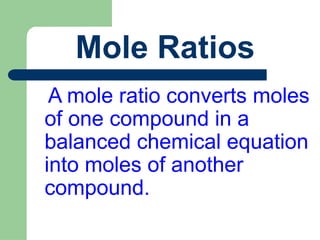
Mole Ratios
A mole ratio converts moles
of one compound in a
balanced chemical equation
into moles of another
compound.
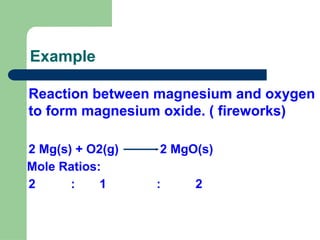
Example
Reaction between magnesium and oxygen
to form magnesium oxide. ( fireworks)
2 Mg(s) + O2(g) 2 MgO(s)
Mole Ratios:
2 : 1 : 2
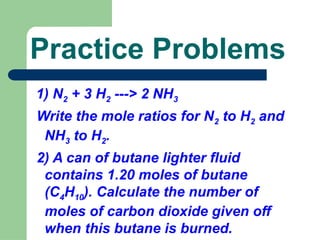
1) N2 + 3 H2 ---> 2 NH3
Write the mole ratios for N2 to H2 and
NH3 to H2.
2) A can of butane lighter fluid
contains 1.20 moles of butane
(C4H10). Calculate the number of
moles of carbon dioxide given off
when this butane is burned.
Practice Problems
Mole-Mole Problems
Using the practice question 2) above:
Equation of reaction
2C4H10 + 13O2 8CO2 + 10H2O
Mole ratio
C4H10 CO2
1 : 4 [ bases]
1.2 : X [ problem]
By cross-multiplication, X = 4.8 mols of CO2 given off
Mole-Mass Problems
Problem 1: 1.50 mol of
KClO3 decomposes. How
many grams of O2 will be
produced? [k = 39, Cl =
35.5, O = 16]
2 KClO3 2 KCl + 3 O2
Three steps…Get Your
Correct Answer
Use mole ratio
Get the answer in moles and then
Convert to Mass. [Simple Arithmetic]
Hello!
If you are given a mass in the problem,
you will need to convert this to moles
first. Ok?
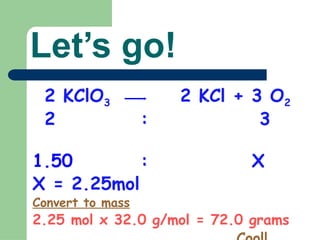
Let’s go!
2 KClO3 2 KCl + 3 O2
2 : 3
1.50 : X
X = 2.25mol
Convert to mass
2.25 mol x 32.0 g/mol = 72.0 grams
Try This:
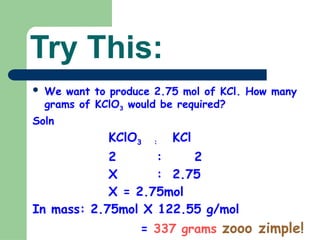
 We want to produce 2.75 mol of KCl. How many
grams of KClO3 would be required?
Soln
KClO3 : KCl
2 : 2
X : 2.75
X = 2.75mol
In mass: 2.75mol X 122.55 g/mol
= 337 grams zooo zimple!
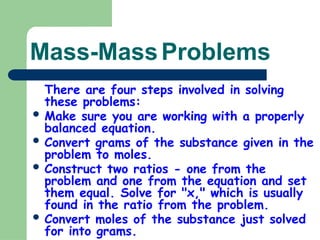
Mass-MassProblems
There are four steps involved in solving
these problems:
 Make sure you are working with a properly
balanced equation.
 Convert grams of the substance given in the
problem to moles.
 Construct two ratios - one from the
problem and one from the equation and set
them equal. Solve for "x," which is usually
found in the ratio from the problem.
 Convert moles of the substance just solved
for into grams.
Just follow mass-
mass problem to
the penultimate
level
Mass-Volume Problems
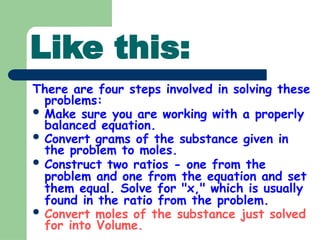
Like this:
There are four steps involved in solving these
problems:
 Make sure you are working with a properly
balanced equation.
 Convert grams of the substance given in
the problem to moles.
 Construct two ratios - one from the
problem and one from the equation and set
them equal. Solve for "x," which is usually
found in the ratio from the problem.
 Convert moles of the substance just solved
for into Volume.
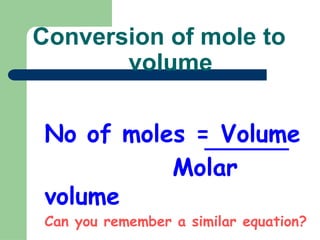
Conversion of mole to
volume
No of moles = Volume
Molar
volume
Can you remember a similar equation?
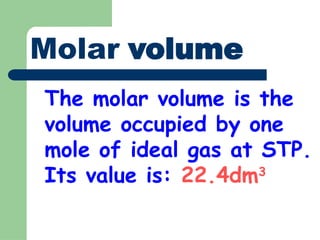
Molar volume
The molar volume is the
volume occupied by one
mole of ideal gas at STP.
Its value is: 22.4dm3
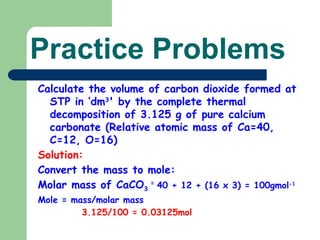
Practice Problems
Calculate the volume of carbon dioxide formed at
STP in ‘dm3
' by the complete thermal
decomposition of 3.125 g of pure calcium
carbonate (Relative atomic mass of Ca=40,
C=12, O=16)
Solution:
Convert the mass to mole:
Molar mass of CaCO3
=
40 + 12 + (16 x 3) = 100gmol-1
Mole = mass/molar mass
3.125/100 = 0.03125mol
Practice Problems
As per the equation,
Mole ratio 1 : 1
problem 0.03125mol X
X = 0.03125mol of CO2
Convert mole to volume [slide 17]
Volume = (0.03125 x 22.4)dm3
This powerpoint was kindly donated to
www.worldofteaching.com
http://www.worldofteaching.com is home to over a
thousand powerpoints submitted by teachers. This is a
completely free site and requires no registration. Please
visit and I hope it will help in your teaching.

Stoichiometryforclasss11_ubb.pptx_28.09.24

  • 1.
  • 2.
    What is stoichiometry? Stoichiometryis the quantitative study of reactants and products in a chemical reaction.
  • 3.
    What You ShouldExpect  Given : Amount of reactants  Question: how much of products can be formed.  Example 2 A + 2B 3C  Given 20.0 grams of A and sufficient B, how many grams of C can be produced?
  • 4.
    What do youneed? You will need to use i. molar ratios, ii. molar masses, iii. balancing and interpreting equations, and iv. conversions between grams and moles. Note: This type of problem is often called "mass-mass."
  • 5.
    Steps Involved inSolving Mass-Mass Stoichiometry Problems  Balance the chemical equation correctly  Using the molar mass of the given substance, convert the mass given to moles.  Construct a molar proportion (two molar ratios set equal to each other)  Using the molar mass of the unknown substance, convert the moles just calculated to mass.
  • 6.
    Mole Ratios A moleratio converts moles of one compound in a balanced chemical equation into moles of another compound.
  • 7.
    Example Reaction between magnesiumand oxygen to form magnesium oxide. ( fireworks) 2 Mg(s) + O2(g) 2 MgO(s) Mole Ratios: 2 : 1 : 2
  • 8.
    1) N2 +3 H2 ---> 2 NH3 Write the mole ratios for N2 to H2 and NH3 to H2. 2) A can of butane lighter fluid contains 1.20 moles of butane (C4H10). Calculate the number of moles of carbon dioxide given off when this butane is burned. Practice Problems
  • 9.
    Mole-Mole Problems Using thepractice question 2) above: Equation of reaction 2C4H10 + 13O2 8CO2 + 10H2O Mole ratio C4H10 CO2 1 : 4 [ bases] 1.2 : X [ problem] By cross-multiplication, X = 4.8 mols of CO2 given off
  • 10.
    Mole-Mass Problems Problem 1:1.50 mol of KClO3 decomposes. How many grams of O2 will be produced? [k = 39, Cl = 35.5, O = 16] 2 KClO3 2 KCl + 3 O2
  • 11.
    Three steps…Get Your CorrectAnswer Use mole ratio Get the answer in moles and then Convert to Mass. [Simple Arithmetic] Hello! If you are given a mass in the problem, you will need to convert this to moles first. Ok?
  • 12.
    Let’s go! 2 KClO32 KCl + 3 O2 2 : 3 1.50 : X X = 2.25mol Convert to mass 2.25 mol x 32.0 g/mol = 72.0 grams
  • 13.
    Try This:  Wewant to produce 2.75 mol of KCl. How many grams of KClO3 would be required? Soln KClO3 : KCl 2 : 2 X : 2.75 X = 2.75mol In mass: 2.75mol X 122.55 g/mol = 337 grams zooo zimple!
  • 14.
    Mass-MassProblems There are foursteps involved in solving these problems:  Make sure you are working with a properly balanced equation.  Convert grams of the substance given in the problem to moles.  Construct two ratios - one from the problem and one from the equation and set them equal. Solve for "x," which is usually found in the ratio from the problem.  Convert moles of the substance just solved for into grams.
  • 15.
    Just follow mass- massproblem to the penultimate level Mass-Volume Problems
  • 16.
    Like this: There arefour steps involved in solving these problems:  Make sure you are working with a properly balanced equation.  Convert grams of the substance given in the problem to moles.  Construct two ratios - one from the problem and one from the equation and set them equal. Solve for "x," which is usually found in the ratio from the problem.  Convert moles of the substance just solved for into Volume.
  • 17.
    Conversion of moleto volume No of moles = Volume Molar volume Can you remember a similar equation?
  • 18.
    Molar volume The molarvolume is the volume occupied by one mole of ideal gas at STP. Its value is: 22.4dm3
  • 19.
    Practice Problems Calculate thevolume of carbon dioxide formed at STP in ‘dm3 ' by the complete thermal decomposition of 3.125 g of pure calcium carbonate (Relative atomic mass of Ca=40, C=12, O=16) Solution: Convert the mass to mole: Molar mass of CaCO3 = 40 + 12 + (16 x 3) = 100gmol-1 Mole = mass/molar mass 3.125/100 = 0.03125mol
  • 20.
    Practice Problems As perthe equation, Mole ratio 1 : 1 problem 0.03125mol X X = 0.03125mol of CO2 Convert mole to volume [slide 17] Volume = (0.03125 x 22.4)dm3
  • 21.
    This powerpoint waskindly donated to www.worldofteaching.com http://www.worldofteaching.com is home to over a thousand powerpoints submitted by teachers. This is a completely free site and requires no registration. Please visit and I hope it will help in your teaching.