Dr. S. N. Shringare
Assistant Professor
School of Chemical Sciences
Punyashlok Ahilyadevi Holkar Solapur
University Solapur
Chemical Reactors
Chemical reactors
The reactors, in which chemicals are made in industry, vary in size from a few cm3 to the
vast structures. For example, kilns that produce lime from limestone may be over 25 metres high
and hold, at any one time, well over 400 tonnes of materials. The design of the reactor is determined
by many factors but of particular importance are the thermodynamics and kinetics of the chemical
reactions being carried out.
The two main types of reactor are termed batch and continuous.
Batch reactors
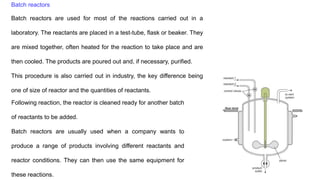
Batch reactors are used for most of the reactions carried out in a
laboratory. The reactants are placed in a test-tube, flask or beaker. They
are mixed together, often heated for the reaction to take place and are
then cooled. The products are poured out and, if necessary, purified.
This procedure is also carried out in industry, the key difference being
one of size of reactor and the quantities of reactants.
Following reaction, the reactor is cleaned ready for another batch
of reactants to be added.
Batch reactors are usually used when a company wants to
produce a range of products involving different reactants and
reactor conditions. They can then use the same equipment for
these reactions.
Continuous reactors
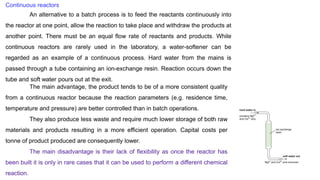
An alternative to a batch process is to feed the reactants continuously into
the reactor at one point, allow the reaction to take place and withdraw the products at
another point. There must be an equal flow rate of reactants and products. While
continuous reactors are rarely used in the laboratory, a water-softener can be
regarded as an example of a continuous process. Hard water from the mains is
passed through a tube containing an ion-exchange resin. Reaction occurs down the
tube and soft water pours out at the exit.
The main advantage, the product tends to be of a more consistent quality
from a continuous reactor because the reaction parameters (e.g. residence time,
temperature and pressure) are better controlled than in batch operations.
They also produce less waste and require much lower storage of both raw
materials and products resulting in a more efficient operation. Capital costs per
tonne of product produced are consequently lower.
The main disadvantage is their lack of flexibility as once the reactor has
been built it is only in rare cases that it can be used to perform a different chemical
reaction.
Types of continuous reactors
Industry uses several types of continuous reactors.
Tubular reactors
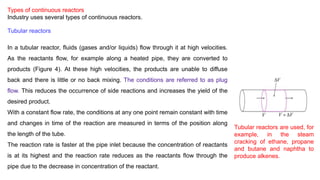
In a tubular reactor, fluids (gases and/or liquids) flow through it at high velocities.
As the reactants flow, for example along a heated pipe, they are converted to
products (Figure 4). At these high velocities, the products are unable to diffuse
back and there is little or no back mixing. The conditions are referred to as plug
flow. This reduces the occurrence of side reactions and increases the yield of the
desired product.
With a constant flow rate, the conditions at any one point remain constant with time
and changes in time of the reaction are measured in terms of the position along
the length of the tube.
The reaction rate is faster at the pipe inlet because the concentration of reactants
is at its highest and the reaction rate reduces as the reactants flow through the
pipe due to the decrease in concentration of the reactant.
Tubular reactors are used, for
example, in the steam
cracking of ethane, propane
and butane and naphtha to
produce alkenes.
Fixed bed reactors
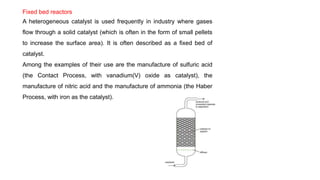
A heterogeneous catalyst is used frequently in industry where gases
flow through a solid catalyst (which is often in the form of small pellets
to increase the surface area). It is often described as a fixed bed of
catalyst.
Among the examples of their use are the manufacture of sulfuric acid
(the Contact Process, with vanadium(V) oxide as catalyst), the
manufacture of nitric acid and the manufacture of ammonia (the Haber
Process, with iron as the catalyst).
Fluid bed reactors
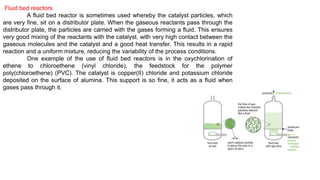
A fluid bed reactor is sometimes used whereby the catalyst particles, which
are very fine, sit on a distributor plate. When the gaseous reactants pass through the
distributor plate, the particles are carried with the gases forming a fluid. This ensures
very good mixing of the reactants with the catalyst, with very high contact between the
gaseous molecules and the catalyst and a good heat transfer. This results in a rapid
reaction and a uniform mixture, reducing the variability of the process conditions.
One example of the use of fluid bed reactors is in the oxychlorination of
ethene to chloroethene (vinyl chloride), the feedstock for the polymer
poly(chloroethene) (PVC). The catalyst is copper(II) chloride and potassium chloride
deposited on the surface of alumina. This support is so fine, it acts as a fluid when
gases pass through it.
Continuous stirred tank reactors, CSTR
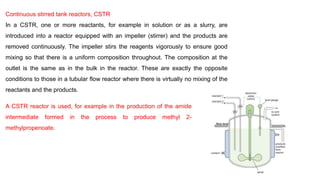
In a CSTR, one or more reactants, for example in solution or as a slurry, are
introduced into a reactor equipped with an impeller (stirrer) and the products are
removed continuously. The impeller stirs the reagents vigorously to ensure good
mixing so that there is a uniform composition throughout. The composition at the
outlet is the same as in the bulk in the reactor. These are exactly the opposite
conditions to those in a tubular flow reactor where there is virtually no mixing of the
reactants and the products.
A CSTR reactor is used, for example in the production of the amide
intermediate formed in the process to produce methyl 2-
methylpropenoate.

Chemical reactors_by Dr Umesh Barache.ppt

  • 1.
    Dr. S. N.Shringare Assistant Professor School of Chemical Sciences Punyashlok Ahilyadevi Holkar Solapur University Solapur Chemical Reactors
  • 2.
    Chemical reactors The reactors,in which chemicals are made in industry, vary in size from a few cm3 to the vast structures. For example, kilns that produce lime from limestone may be over 25 metres high and hold, at any one time, well over 400 tonnes of materials. The design of the reactor is determined by many factors but of particular importance are the thermodynamics and kinetics of the chemical reactions being carried out. The two main types of reactor are termed batch and continuous.
  • 3.
    Batch reactors Batch reactorsare used for most of the reactions carried out in a laboratory. The reactants are placed in a test-tube, flask or beaker. They are mixed together, often heated for the reaction to take place and are then cooled. The products are poured out and, if necessary, purified. This procedure is also carried out in industry, the key difference being one of size of reactor and the quantities of reactants. Following reaction, the reactor is cleaned ready for another batch of reactants to be added. Batch reactors are usually used when a company wants to produce a range of products involving different reactants and reactor conditions. They can then use the same equipment for these reactions.
  • 4.
    Continuous reactors An alternativeto a batch process is to feed the reactants continuously into the reactor at one point, allow the reaction to take place and withdraw the products at another point. There must be an equal flow rate of reactants and products. While continuous reactors are rarely used in the laboratory, a water-softener can be regarded as an example of a continuous process. Hard water from the mains is passed through a tube containing an ion-exchange resin. Reaction occurs down the tube and soft water pours out at the exit. The main advantage, the product tends to be of a more consistent quality from a continuous reactor because the reaction parameters (e.g. residence time, temperature and pressure) are better controlled than in batch operations. They also produce less waste and require much lower storage of both raw materials and products resulting in a more efficient operation. Capital costs per tonne of product produced are consequently lower. The main disadvantage is their lack of flexibility as once the reactor has been built it is only in rare cases that it can be used to perform a different chemical reaction.
  • 5.
    Types of continuousreactors Industry uses several types of continuous reactors. Tubular reactors In a tubular reactor, fluids (gases and/or liquids) flow through it at high velocities. As the reactants flow, for example along a heated pipe, they are converted to products (Figure 4). At these high velocities, the products are unable to diffuse back and there is little or no back mixing. The conditions are referred to as plug flow. This reduces the occurrence of side reactions and increases the yield of the desired product. With a constant flow rate, the conditions at any one point remain constant with time and changes in time of the reaction are measured in terms of the position along the length of the tube. The reaction rate is faster at the pipe inlet because the concentration of reactants is at its highest and the reaction rate reduces as the reactants flow through the pipe due to the decrease in concentration of the reactant. Tubular reactors are used, for example, in the steam cracking of ethane, propane and butane and naphtha to produce alkenes.
  • 6.
    Fixed bed reactors Aheterogeneous catalyst is used frequently in industry where gases flow through a solid catalyst (which is often in the form of small pellets to increase the surface area). It is often described as a fixed bed of catalyst. Among the examples of their use are the manufacture of sulfuric acid (the Contact Process, with vanadium(V) oxide as catalyst), the manufacture of nitric acid and the manufacture of ammonia (the Haber Process, with iron as the catalyst).
  • 7.
    Fluid bed reactors Afluid bed reactor is sometimes used whereby the catalyst particles, which are very fine, sit on a distributor plate. When the gaseous reactants pass through the distributor plate, the particles are carried with the gases forming a fluid. This ensures very good mixing of the reactants with the catalyst, with very high contact between the gaseous molecules and the catalyst and a good heat transfer. This results in a rapid reaction and a uniform mixture, reducing the variability of the process conditions. One example of the use of fluid bed reactors is in the oxychlorination of ethene to chloroethene (vinyl chloride), the feedstock for the polymer poly(chloroethene) (PVC). The catalyst is copper(II) chloride and potassium chloride deposited on the surface of alumina. This support is so fine, it acts as a fluid when gases pass through it.
  • 8.
    Continuous stirred tankreactors, CSTR In a CSTR, one or more reactants, for example in solution or as a slurry, are introduced into a reactor equipped with an impeller (stirrer) and the products are removed continuously. The impeller stirs the reagents vigorously to ensure good mixing so that there is a uniform composition throughout. The composition at the outlet is the same as in the bulk in the reactor. These are exactly the opposite conditions to those in a tubular flow reactor where there is virtually no mixing of the reactants and the products. A CSTR reactor is used, for example in the production of the amide intermediate formed in the process to produce methyl 2- methylpropenoate.