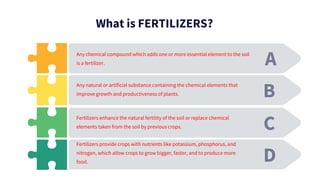
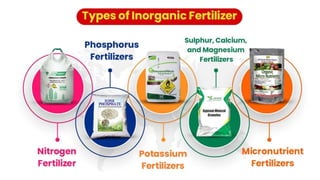
What is FERTILIZERS?
A
B
C
D
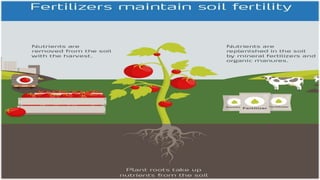
Any chemical compound which adds one or more essential element to the soil
is a fertilizer.
Any natural or artificial substance containing the chemical elements that
improve growth and productiveness of plants.
Fertilizers enhance the natural fertility of the soil or replace chemical
elements taken from the soil by previous crops.
Fertilizers provide crops with nutrients like potassium, phosphorus, and
nitrogen, which allow crops to grow bigger, faster, and to produce more
food.
ROADMAP SLIDE
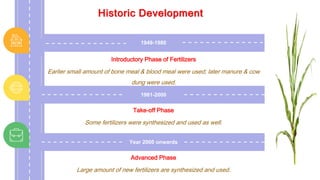
Historic Development
Introductory Phase of Fertilizers
Earlier small amount of bone meal & blood meal were used; later manure & cow
dung were used.
1949-1980
Take-off Phase
Some fertilizers were synthesized and used as well.
1981-2000
Advanced Phase
Large amount of new fertilizers are synthesized and used.
Year 2000 onwards
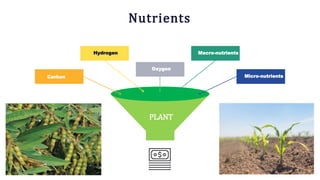
Nutrients
Oxygen
Macro-nutrients
Hydrogen
Carbon Micro-nutrients
PLANT
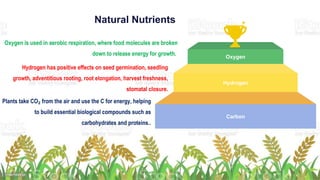
Plants take CO₂ from the air and use the C for energy, helping
to build essential biological compounds such as
carbohydrates and proteins..
Carbon
Hydrogen
Oxygen
Hydrogen has positive effects on seed germination, seedling
growth, adventitious rooting, root elongation, harvest freshness,
stomatal closure.
Oxygen is used in aerobic respiration, where food molecules are broken
down to release energy for growth.
Natural Nutrients
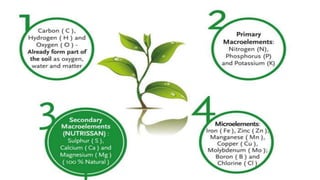
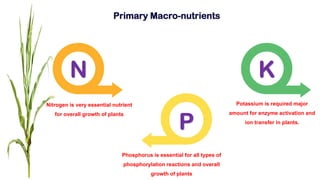
N
Nitrogen is very essential nutrient
for overall growth of plants
Phosphorus is essential for all types of
phosphorylation reactions and overall
growth of plants
Potassium is required major
amount for enzyme activation and
ion transfer in plants.
Primary Macro-nutrients
P
K
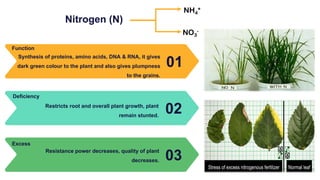
Nitrogen (N)
01
Synthesis of proteins, amino acids, DNA & RNA, it gives
dark green colour to the plant and also gives plumpness
to the grains.
Function
02
Restricts root and overall plant growth, plant
remain stunted.
Deficiency
03
Resistance power decreases, quality of plant
decreases.
Excess
NO3
-
NH4
+
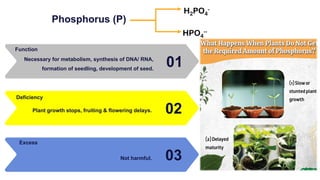
Phosphorus (P)
01
Necessary for metabolism, synthesis of DNA/ RNA,
formation of seedling, development of seed.
Function
02
Plant growth stops, fruiting & flowering delays.
Deficiency
03
Not harmful.
Excess
HPO4
--
H2PO4
-
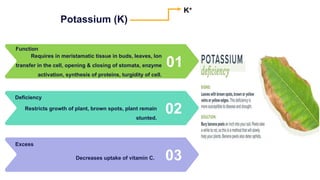
Potassium (K)
01
Requires in meristamatic tissue in buds, leaves, Ion
transfer in the cell, opening & closing of stomata, enzyme
activation, synthesis of proteins, turgidity of cell.
Function
02
Restricts growth of plant, brown spots, plant remain
stunted.
Deficiency
03
Decreases uptake of vitamin C.
Excess
K+
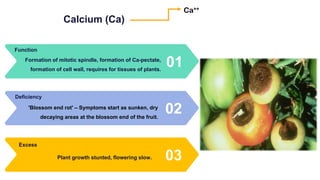
Calcium (Ca)
01
Formation of mitotic spindle, formation of Ca-pectate,
formation of cell wall, requires for tissues of plants.
Function
02
'Blossom end rot' – Symptoms start as sunken, dry
decaying areas at the blossom end of the fruit.
Deficiency
03
Plant growth stunted, flowering slow.
Excess
Ca++
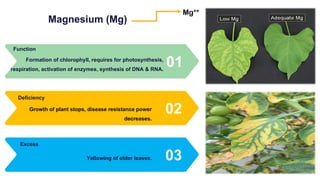
Magnesium (Mg)
01
Formation of chlorophyll, requires for photosynthesis,
respiration, activation of enzymes, synthesis of DNA & RNA.
Function
02
Growth of plant stops, disease resistance power
decreases.
Deficiency
03
Yellowing of older leaves.
Excess
Mg++
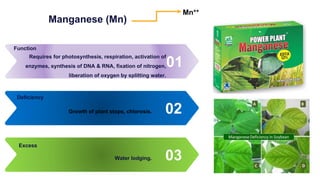
Manganese (Mn)
01
Requires for photosynthesis, respiration, activation of
enzymes, synthesis of DNA & RNA, fixation of nitrogen,
liberation of oxygen by splitting water.
Function
02
Growth of plant stops, chlorosis.
Deficiency
03
Water lodging.
Excess
Mn++
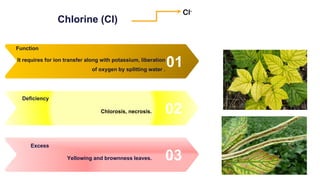
Chlorine (Cl)
01
It requires for ion transfer along with potassium, liberation
of oxygen by splitting water .
Function
02
Chlorosis, necrosis.
Deficiency
03
Yellowing and brownness leaves.
Excess
Cl-
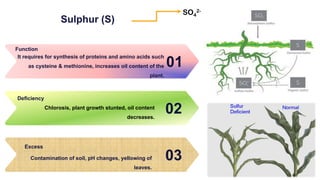
Sulphur (S)
01
It requires for synthesis of proteins and amino acids such
as cysteine & methionine, increases oil content of the
plant.
Function
02
Chlorosis, plant growth stunted, oil content
decreases.
Deficiency
03
Contamination of soil, pH changes, yellowing of
leaves.
Excess
SO4
2-
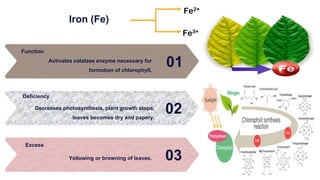
Iron (Fe)
01
Activates catalase enzyme necessary for
formation of chlorophyll.
Function
02
Decreases photosynthesis, plant growth stops,
leaves becomes dry and papery.
Deficiency
03
Yellowing or browning of leaves.
Excess
Fe3+
Fe2+
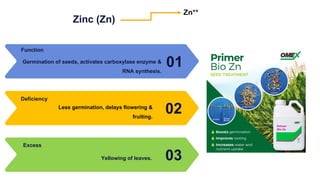
Zinc (Zn)
01
Germination of seeds, activates carboxylase enzyme &
RNA synthesis.
Function
02
Less germination, delays flowering &
fruiting.
Deficiency
03
Yellowing of leaves.
Excess
Zn++
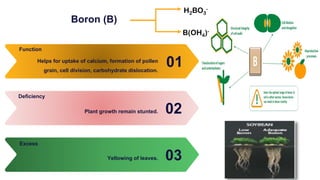
Boron (B)
01
Helps for uptake of calcium, formation of pollen
grain, cell division, carbohydrate dislocation.
Function
02
Plant growth remain stunted.
Deficiency
03
Yellowing of leaves.
Excess
B(OH4)-
H2BO3
-
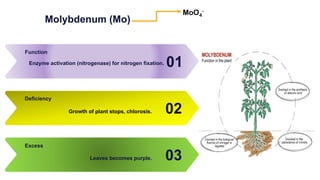
Molybdenum (Mo)
01
Enzyme activation (nitrogenase) for nitrogen fixation.
Function
02
Growth of plant stops, chlorosis.
Deficiency
03
Leaves becomes purple.
Excess
MoO4
-
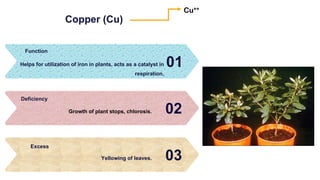
Copper (Cu)
01
Helps for utilization of iron in plants, acts as a catalyst in
respiration.
Function
02
Growth of plant stops, chlorosis.
Deficiency
03
Yellowing of leaves.
Excess
Cu++
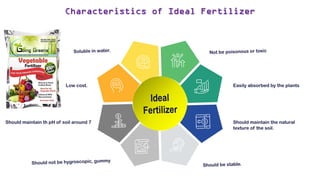
Characteristics of Ideal Fertilizer
Should maintain th pH of soil around 7 Should maintain the natural
texture of the soil.
Low cost. Easily absorbed by the plants
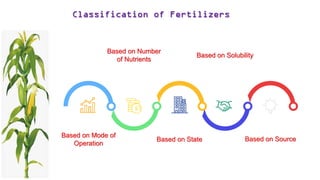
Based on Source
Based on Solubility
Based on State
Based on Number
of Nutrients
Based on Mode of
Operation
Classification of Fertilizers
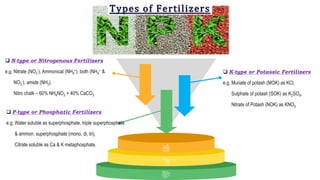
Types of Fertilizers
 K-type or Potassic Fertilizers
e.g. Muriate of potash (MOK) as KCl,
Sulphate of potash (SOK) as K2SO4,
Nitrate of Potash (NOK) as KNO3
YOUR TITLE
 N-type or Nitrogenous Fertilizers
e.g. Nitrate (NO3
-), Ammonical (NH4
+), both (NH4
+ &
NO3
-), amide (NH2).
Nitro chalk – 60% NH4NO3 + 40% CaCO3
YOUR TITLE
 P-type or Phosphatic Fertilizers
e.g. Water soluble as superphosphate, triple superphosphate
& ammon. superphosphate (mono, di, tri),
Citrate soluble as Ca & K metaphosphate.
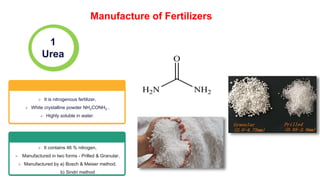
Manufacture of Fertilizers
1
Urea
 It is nitrogenous fertilizer,
 White crystalline powder NH2CONH2 ,
 Highly soluble in water.
 It contains 46 % nitrogen,
 Manufactured in two forms - Prilled & Granular,
 Manufactured by a) Bosch & Meiser method,
b) Sindri method
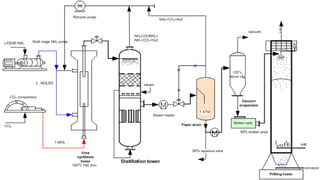
Raw materials: NH3 (liq.) and
CO2 (g)
Temperature : 180-185oC
Pressure: 180-200 atm
Ist step: Carbamate formation
IInd step: Urea conversion
Urea can be produced in solid forms
(prills, granules, pellets or crystals)
or as solutions.
Developed by Carl Bosch & W.
Meiser in 1922
Urea plant using ammonium carbamate, Fixed Nitrogen
Research Laboratory (FNRC), California 1930.
2 NH3 + CO2 ⇌ [NH4]+[NH2COO]− (ΔH = −117 kJ/mol at 180 atm and 180 °C)
[NH4]+[NH2COO]− ⇌ CO(NH2)2 + H2O (ΔH = +17.5 kJ/mol at 180–185 °C)
Bosch - Meiser method
01
2
Raw materials: NH3 (liq.) and
CO2 (liq.)
Temperature: 180-182oC
Pressure: 170-200 atm
Conversion is 37%
Unreacted CO2 is recycled
Urea can be produced in solid forms
(prills, granules, pellets or crystals)
or as solutions.
Developed at Sindri, India
2 NH3 + CO2 + H2O (NH4) 2CO3
(NH4) 2CO3 + 2 HNO3 2NH4NO3 + CO2 + H2O
Sindri method
02
2 NH3 + CO2 ⇌ [NH4]+[NH2COO]− (ΔH = −117 kJ/mol at 180 atm and 180 °C)
[NH4]+[NH2COO]− ⇌ CO(NH2)2 + H2O (ΔH = +15.5 kJ/mol at 180–185 °C)
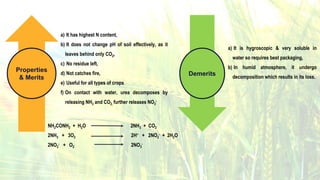
Properties
& Merits
Demerits
a) It has highest N content,
b) It does not change pH of soil effectively, as it
leaves behind only CO2,
c) No residue left,
d) Not catches fire,
e) Useful for all types of crops
f) On contact with water, urea decomposes by
releasing NH3 and CO2, further releases NO3
-
a) It is hygroscopic & very soluble in
water so requires best packaging,
b) In humid atmosphere, it undergo
decomposition which results in its loss.
NH2CONH2 + H2O 2NH3 + CO2
2NH3 + 3O2 2H+ + 2NO2
- + 2H2O
2NO2
- + O2 2NO3
-
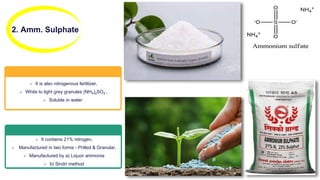
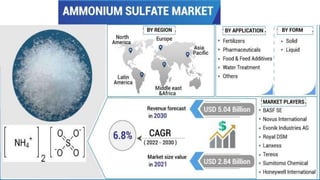
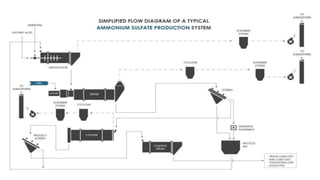
2. Amm. Sulphate
 It is also nitrogenous fertilizer,
 White to light grey granules (NH4)2SO4 ,
 Soluble in water.
 It contains 21% nitrogen,
 Manufactured in two forms - Prilled & Granular,
 Manufactured by a) Liquor ammonia
 b) Sindri method
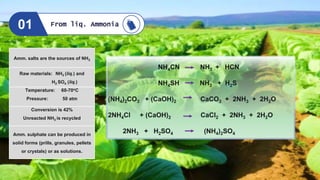
From liq. Ammonia
01
Raw materials: NH3 (liq.) and
H2 SO4 (liq.)
Temperature: 60-70oC
Pressure: 50 atm
Conversion is 42%
Unreacted NH3 is recycled
Amm. sulphate can be produced in
solid forms (prills, granules, pellets
or crystals) or as solutions.
Amm. salts are the sources of NH3
NH4CN NH3 + HCN
NH4SH NH3 + H2S
(NH4)2CO3 + (CaOH)2 CaCO3 + 2NH3 + 2H2O
2NH4Cl + (CaOH)2 CaCl2 + 2NH3 + 2H2O
2NH3 + H2SO4 (NH4)2SO4
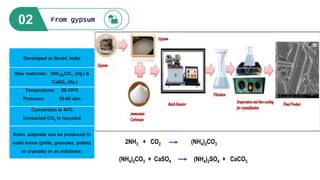
02 From gypsum
Raw materials: (NH4)2CO3 (liq.) &
CaSO4 (liq.)
Temperature: 50-70oC
Pressure: 50-60 atm
Conversion is 44%
Unreacted CO2 is recycled
Amm. sulphate can be produced in
solid forms (prills, granules, pellets
or crystals) or as solutions.
Developed at Sindri, India
2NH3 + CO2 (NH4)2CO3
(NH4)2CO3 + CaSO4 (NH4)2SO4 + CaCO3
Properties
& Merits
Demerits
a) It is less hygroscopic than urea,
b) It is useful for synthesis of other ammonium
salts,
c) It is available in the form of nitrates to plants,
d) It reacts with lime in the soil & forms ammonium
hydroxide which is used by nitrifying bacteria for
conversion into nitric acid and nitrate, the bases
in the soil reacts with nitric acid & forms
Ca(NO3)2 & KNO3,
e) Useful for all types of crops.
a) It should not be applied along with
germination period of seed as it is
harmful for seeds,
b) Hazardous to animals as well as some
plants.
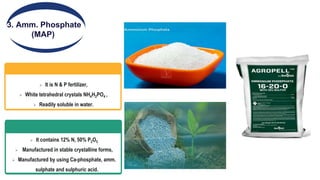
3. Amm. Phosphate
(MAP)
 It is N & P fertilizer,
 White tetrahedral crystals NH4H2PO4 ,
 Readily soluble in water.
 It contains 12% N, 50% P2O5
 Manufactured in stable crystalline forms,
 Manufactured by using Ca-phosphate, amm.
sulphate and sulphuric acid.
Manufacturing
(MAP)
Manufactured by the action of sulphuric
acid on the mixture of Ca-phosphate &
amm. sulphate
Raw materials: Ca3(PO4)2 (liq.) &
(NH4)2 SO4 (liq.)
Temperature: 60-70oC
Pressure: 2 atm
It can also prepared by the action of
anhydrous ammonia on phosphoric acid
Amm. phosphate can be produced in solid
crystalline forms
Ca3(PO4)2 + (NH4)2SO4 + 2H2SO4 2NH4H2PO4 + 3CaSO4
NH3 + H3PO4 NH4H2PO4
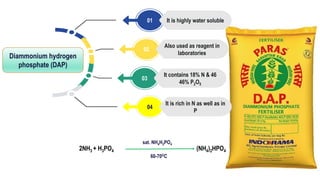
It is highly water soluble
01
It contains 18% N & 46
46% P2O5
03
It is rich in N as well as in
P
04
Also used as reagent in
laboratories
02
Diammonium hydrogen
phosphate (DAP)
2NH3 + H3PO4 (NH4)2HPO4
sat. NH4H2PO4
60-70OC
Superphosphate
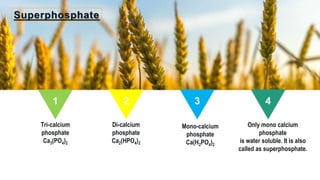
1 2 3 4
Tri-calcium
phosphate
Ca3(PO4)2
Mono-calcium
phosphate
Ca(H2PO4)2
Di-calcium
phosphate
Ca2(HPO4)2
Only mono calcium
phosphate
is water soluble. It is also
called as superphosphate.
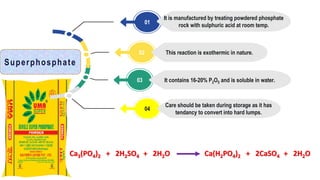
It is manufactured by treating powdered phosphate
rock with sulphuric acid at room temp.
01
It contains 16-20% P2O5 and is soluble in water.
03
Care should be taken during storage as it has
tendancy to convert into hard lumps.
04
This reaction is exothermic in nature.
02
Superphosphate
Ca3(PO4)2 + 2H2SO4 + 2H2O Ca(H2PO4)2 + 2CaSO4 + 2H2O
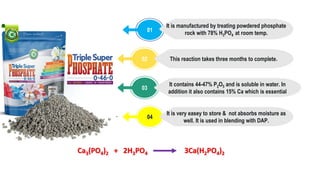
It is manufactured by treating powdered phosphate
rock with 78% H3PO4 at room temp.
01
It contains 44-47% P2O5 and is soluble in water. In
addition it also contains 15% Ca which is essential
03
It is very easey to store & not absorbs moisture as
well. It is used in blending with DAP.
04
This reaction takes three months to complete.
02
Triple Superphosphate
(TSP)
Ca3(PO4)2 + 2H3PO4 3Ca(H2PO4)2
COMPANY STRATEGY
Pollution caused by Fertilizers
YOUR TITLE 03
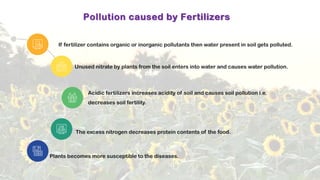
If fertilizer contains organic or inorganic pollutants then water present in soil gets polluted.
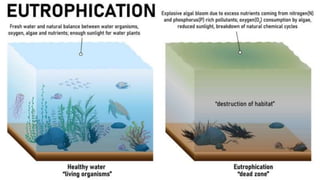
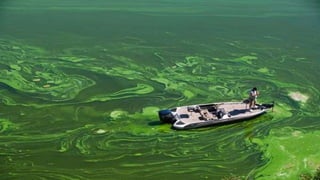
Unused nitrate by plants from the soil enters into water and causes water pollution.
Acidic fertilizers increases acidity of soil and causes soil pollution i.e.
decreases soil fertility.
The excess nitrogen decreases protein contents of the food.
Plants becomes more susceptible to the diseases.
B.Sc._Fertilizers_ubb_25.09.24_____________________

B.Sc._Fertilizers_ubb_25.09.24_____________________

  • 2.
    What is FERTILIZERS? A B C D Anychemical compound which adds one or more essential element to the soil is a fertilizer. Any natural or artificial substance containing the chemical elements that improve growth and productiveness of plants. Fertilizers enhance the natural fertility of the soil or replace chemical elements taken from the soil by previous crops. Fertilizers provide crops with nutrients like potassium, phosphorus, and nitrogen, which allow crops to grow bigger, faster, and to produce more food.
  • 3.
    ROADMAP SLIDE Historic Development IntroductoryPhase of Fertilizers Earlier small amount of bone meal & blood meal were used; later manure & cow dung were used. 1949-1980 Take-off Phase Some fertilizers were synthesized and used as well. 1981-2000 Advanced Phase Large amount of new fertilizers are synthesized and used. Year 2000 onwards
  • 6.
  • 8.
    Plants take CO₂from the air and use the C for energy, helping to build essential biological compounds such as carbohydrates and proteins.. Carbon Hydrogen Oxygen Hydrogen has positive effects on seed germination, seedling growth, adventitious rooting, root elongation, harvest freshness, stomatal closure. Oxygen is used in aerobic respiration, where food molecules are broken down to release energy for growth. Natural Nutrients
  • 9.
    N Nitrogen is veryessential nutrient for overall growth of plants Phosphorus is essential for all types of phosphorylation reactions and overall growth of plants Potassium is required major amount for enzyme activation and ion transfer in plants. Primary Macro-nutrients P K
  • 10.
    Nitrogen (N) 01 Synthesis ofproteins, amino acids, DNA & RNA, it gives dark green colour to the plant and also gives plumpness to the grains. Function 02 Restricts root and overall plant growth, plant remain stunted. Deficiency 03 Resistance power decreases, quality of plant decreases. Excess NO3 - NH4 +
  • 11.
    Phosphorus (P) 01 Necessary formetabolism, synthesis of DNA/ RNA, formation of seedling, development of seed. Function 02 Plant growth stops, fruiting & flowering delays. Deficiency 03 Not harmful. Excess HPO4 -- H2PO4 -
  • 12.
    Potassium (K) 01 Requires inmeristamatic tissue in buds, leaves, Ion transfer in the cell, opening & closing of stomata, enzyme activation, synthesis of proteins, turgidity of cell. Function 02 Restricts growth of plant, brown spots, plant remain stunted. Deficiency 03 Decreases uptake of vitamin C. Excess K+
  • 13.
    Calcium (Ca) 01 Formation ofmitotic spindle, formation of Ca-pectate, formation of cell wall, requires for tissues of plants. Function 02 'Blossom end rot' – Symptoms start as sunken, dry decaying areas at the blossom end of the fruit. Deficiency 03 Plant growth stunted, flowering slow. Excess Ca++
  • 14.
    Magnesium (Mg) 01 Formation ofchlorophyll, requires for photosynthesis, respiration, activation of enzymes, synthesis of DNA & RNA. Function 02 Growth of plant stops, disease resistance power decreases. Deficiency 03 Yellowing of older leaves. Excess Mg++
  • 15.
    Manganese (Mn) 01 Requires forphotosynthesis, respiration, activation of enzymes, synthesis of DNA & RNA, fixation of nitrogen, liberation of oxygen by splitting water. Function 02 Growth of plant stops, chlorosis. Deficiency 03 Water lodging. Excess Mn++
  • 16.
    Chlorine (Cl) 01 It requiresfor ion transfer along with potassium, liberation of oxygen by splitting water . Function 02 Chlorosis, necrosis. Deficiency 03 Yellowing and brownness leaves. Excess Cl-
  • 17.
    Sulphur (S) 01 It requiresfor synthesis of proteins and amino acids such as cysteine & methionine, increases oil content of the plant. Function 02 Chlorosis, plant growth stunted, oil content decreases. Deficiency 03 Contamination of soil, pH changes, yellowing of leaves. Excess SO4 2-
  • 18.
    Iron (Fe) 01 Activates catalaseenzyme necessary for formation of chlorophyll. Function 02 Decreases photosynthesis, plant growth stops, leaves becomes dry and papery. Deficiency 03 Yellowing or browning of leaves. Excess Fe3+ Fe2+
  • 19.
    Zinc (Zn) 01 Germination ofseeds, activates carboxylase enzyme & RNA synthesis. Function 02 Less germination, delays flowering & fruiting. Deficiency 03 Yellowing of leaves. Excess Zn++
  • 20.
    Boron (B) 01 Helps foruptake of calcium, formation of pollen grain, cell division, carbohydrate dislocation. Function 02 Plant growth remain stunted. Deficiency 03 Yellowing of leaves. Excess B(OH4)- H2BO3 -
  • 21.
    Molybdenum (Mo) 01 Enzyme activation(nitrogenase) for nitrogen fixation. Function 02 Growth of plant stops, chlorosis. Deficiency 03 Leaves becomes purple. Excess MoO4 -
  • 22.
    Copper (Cu) 01 Helps forutilization of iron in plants, acts as a catalyst in respiration. Function 02 Growth of plant stops, chlorosis. Deficiency 03 Yellowing of leaves. Excess Cu++
  • 23.
    Characteristics of IdealFertilizer Should maintain th pH of soil around 7 Should maintain the natural texture of the soil. Low cost. Easily absorbed by the plants
  • 24.
    Based on Source Basedon Solubility Based on State Based on Number of Nutrients Based on Mode of Operation Classification of Fertilizers
  • 26.
    Types of Fertilizers K-type or Potassic Fertilizers e.g. Muriate of potash (MOK) as KCl, Sulphate of potash (SOK) as K2SO4, Nitrate of Potash (NOK) as KNO3 YOUR TITLE  N-type or Nitrogenous Fertilizers e.g. Nitrate (NO3 -), Ammonical (NH4 +), both (NH4 + & NO3 -), amide (NH2). Nitro chalk – 60% NH4NO3 + 40% CaCO3 YOUR TITLE  P-type or Phosphatic Fertilizers e.g. Water soluble as superphosphate, triple superphosphate & ammon. superphosphate (mono, di, tri), Citrate soluble as Ca & K metaphosphate.
  • 27.
    Manufacture of Fertilizers 1 Urea It is nitrogenous fertilizer,  White crystalline powder NH2CONH2 ,  Highly soluble in water.  It contains 46 % nitrogen,  Manufactured in two forms - Prilled & Granular,  Manufactured by a) Bosch & Meiser method, b) Sindri method
  • 28.
    Raw materials: NH3(liq.) and CO2 (g) Temperature : 180-185oC Pressure: 180-200 atm Ist step: Carbamate formation IInd step: Urea conversion Urea can be produced in solid forms (prills, granules, pellets or crystals) or as solutions. Developed by Carl Bosch & W. Meiser in 1922 Urea plant using ammonium carbamate, Fixed Nitrogen Research Laboratory (FNRC), California 1930. 2 NH3 + CO2 ⇌ [NH4]+[NH2COO]− (ΔH = −117 kJ/mol at 180 atm and 180 °C) [NH4]+[NH2COO]− ⇌ CO(NH2)2 + H2O (ΔH = +17.5 kJ/mol at 180–185 °C) Bosch - Meiser method 01
  • 29.
  • 32.
    Raw materials: NH3(liq.) and CO2 (liq.) Temperature: 180-182oC Pressure: 170-200 atm Conversion is 37% Unreacted CO2 is recycled Urea can be produced in solid forms (prills, granules, pellets or crystals) or as solutions. Developed at Sindri, India 2 NH3 + CO2 + H2O (NH4) 2CO3 (NH4) 2CO3 + 2 HNO3 2NH4NO3 + CO2 + H2O Sindri method 02 2 NH3 + CO2 ⇌ [NH4]+[NH2COO]− (ΔH = −117 kJ/mol at 180 atm and 180 °C) [NH4]+[NH2COO]− ⇌ CO(NH2)2 + H2O (ΔH = +15.5 kJ/mol at 180–185 °C)
  • 33.
    Properties & Merits Demerits a) Ithas highest N content, b) It does not change pH of soil effectively, as it leaves behind only CO2, c) No residue left, d) Not catches fire, e) Useful for all types of crops f) On contact with water, urea decomposes by releasing NH3 and CO2, further releases NO3 - a) It is hygroscopic & very soluble in water so requires best packaging, b) In humid atmosphere, it undergo decomposition which results in its loss. NH2CONH2 + H2O 2NH3 + CO2 2NH3 + 3O2 2H+ + 2NO2 - + 2H2O 2NO2 - + O2 2NO3 -
  • 34.
    2. Amm. Sulphate It is also nitrogenous fertilizer,  White to light grey granules (NH4)2SO4 ,  Soluble in water.  It contains 21% nitrogen,  Manufactured in two forms - Prilled & Granular,  Manufactured by a) Liquor ammonia  b) Sindri method
  • 36.
    From liq. Ammonia 01 Rawmaterials: NH3 (liq.) and H2 SO4 (liq.) Temperature: 60-70oC Pressure: 50 atm Conversion is 42% Unreacted NH3 is recycled Amm. sulphate can be produced in solid forms (prills, granules, pellets or crystals) or as solutions. Amm. salts are the sources of NH3 NH4CN NH3 + HCN NH4SH NH3 + H2S (NH4)2CO3 + (CaOH)2 CaCO3 + 2NH3 + 2H2O 2NH4Cl + (CaOH)2 CaCl2 + 2NH3 + 2H2O 2NH3 + H2SO4 (NH4)2SO4
  • 37.
    02 From gypsum Rawmaterials: (NH4)2CO3 (liq.) & CaSO4 (liq.) Temperature: 50-70oC Pressure: 50-60 atm Conversion is 44% Unreacted CO2 is recycled Amm. sulphate can be produced in solid forms (prills, granules, pellets or crystals) or as solutions. Developed at Sindri, India 2NH3 + CO2 (NH4)2CO3 (NH4)2CO3 + CaSO4 (NH4)2SO4 + CaCO3
  • 40.
    Properties & Merits Demerits a) Itis less hygroscopic than urea, b) It is useful for synthesis of other ammonium salts, c) It is available in the form of nitrates to plants, d) It reacts with lime in the soil & forms ammonium hydroxide which is used by nitrifying bacteria for conversion into nitric acid and nitrate, the bases in the soil reacts with nitric acid & forms Ca(NO3)2 & KNO3, e) Useful for all types of crops. a) It should not be applied along with germination period of seed as it is harmful for seeds, b) Hazardous to animals as well as some plants.
  • 41.
    3. Amm. Phosphate (MAP) It is N & P fertilizer,  White tetrahedral crystals NH4H2PO4 ,  Readily soluble in water.  It contains 12% N, 50% P2O5  Manufactured in stable crystalline forms,  Manufactured by using Ca-phosphate, amm. sulphate and sulphuric acid.
  • 42.
    Manufacturing (MAP) Manufactured by theaction of sulphuric acid on the mixture of Ca-phosphate & amm. sulphate Raw materials: Ca3(PO4)2 (liq.) & (NH4)2 SO4 (liq.) Temperature: 60-70oC Pressure: 2 atm It can also prepared by the action of anhydrous ammonia on phosphoric acid Amm. phosphate can be produced in solid crystalline forms Ca3(PO4)2 + (NH4)2SO4 + 2H2SO4 2NH4H2PO4 + 3CaSO4 NH3 + H3PO4 NH4H2PO4
  • 43.
    It is highlywater soluble 01 It contains 18% N & 46 46% P2O5 03 It is rich in N as well as in P 04 Also used as reagent in laboratories 02 Diammonium hydrogen phosphate (DAP) 2NH3 + H3PO4 (NH4)2HPO4 sat. NH4H2PO4 60-70OC
  • 44.
    Superphosphate 1 2 34 Tri-calcium phosphate Ca3(PO4)2 Mono-calcium phosphate Ca(H2PO4)2 Di-calcium phosphate Ca2(HPO4)2 Only mono calcium phosphate is water soluble. It is also called as superphosphate.
  • 45.
    It is manufacturedby treating powdered phosphate rock with sulphuric acid at room temp. 01 It contains 16-20% P2O5 and is soluble in water. 03 Care should be taken during storage as it has tendancy to convert into hard lumps. 04 This reaction is exothermic in nature. 02 Superphosphate Ca3(PO4)2 + 2H2SO4 + 2H2O Ca(H2PO4)2 + 2CaSO4 + 2H2O
  • 46.
    It is manufacturedby treating powdered phosphate rock with 78% H3PO4 at room temp. 01 It contains 44-47% P2O5 and is soluble in water. In addition it also contains 15% Ca which is essential 03 It is very easey to store & not absorbs moisture as well. It is used in blending with DAP. 04 This reaction takes three months to complete. 02 Triple Superphosphate (TSP) Ca3(PO4)2 + 2H3PO4 3Ca(H2PO4)2
  • 47.
    COMPANY STRATEGY Pollution causedby Fertilizers YOUR TITLE 03 If fertilizer contains organic or inorganic pollutants then water present in soil gets polluted. Unused nitrate by plants from the soil enters into water and causes water pollution. Acidic fertilizers increases acidity of soil and causes soil pollution i.e. decreases soil fertility. The excess nitrogen decreases protein contents of the food. Plants becomes more susceptible to the diseases.