Basic math tools:
Stocks, flows, and financial statements

          juliohuato@gmail.com


            August 30, 2011
Topics


Stocks and flows


Accounting fundamentals
Stocks and flows


   In economics (as in the physical sciences), empirical observations
   and measurements are made either at a point in time or over a
   period of time. As a result, the basic variables can be either
   stocks or flows. A stock measure refers to the value of a variable
   at a given point in time. A flow measure refers to the value of a
   variable over a given period of time. On top of these basic
   measures, a host of derivative measures (e.g. ratios of flows to
   flows, flows to stocks, stocks to flows, and stocks to stocks) can
   be determined. This distinction is extremely useful in accounting,
   economics, and finance.
Stocks and flows

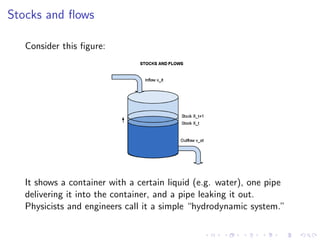
   Consider this figure:


   It shows a container with a certain liquid (e.g. water), one pipe
   delivering it into the container, and a pipe leaking it out.
   Physicists and engineers call it a simple “hydrodynamic system.”
Stocks and flows

   Basically, we can measure the performance of this system by
   measuring
       the amount of liquid in the container at given points in time
       (e.g. on Sundays at noon, on the last day of each month) and
       the amount of water that flows through the container over
       given periods of time (e.g. a week, a month).
   Then, by combining both forms of measurement, we get a richer
   view of the functioning of the system. The stock measures may
   help us correct errors in the measurement of flows or, vice versa.
   (The term stock has several meanings in economics. It also refers
   to the “equity” or legal ownership of a company traded in the
   market. The context should make it clear when we use the term in
   one or the other sense.)
The algebra of stocks and flows

   Let the upper-case letters denote stocks and the lower-case ones
   flows. Let Xt be the amount of water in the vessel at point in time
   t, xit the amount of water flowing into the vessel during the
   month, and xot the amount of water flowing out of the vessel
   during the month. Then:

                             Xt+1 = Xt + xit − xot
   The amount of water in the container at t + 1 is equal to the
   amount of water in the container at t plus the water that got in it
   during period (t, t + 1) minus the water that leaked out during the
   same period.1


      1
       Assume no evaporation or, alternatively, that the water leaked out in the
   period includes evaporated water.
The algebra of stocks and flows


   Example: On November 1 (t = 0), the amount of water in the
   container is 10 gallons (X0 = 10). The water flowing into the
   vessel during November is 40 gallons (xit = 40) and the water
   flowing out of the vessel is 39 gallons (xot = 39). Calculate the
   amount of water in the container on December 1:

               X1 = X0 + xi1 − xo1 = 10 + 40 − 39 = 11.
   If the stock of water on December 1 is any different from (greater
   than or less than) the result above, we have made errors in our
   measurements. The new measure of the water level can help us
   correct them.
Some accounting

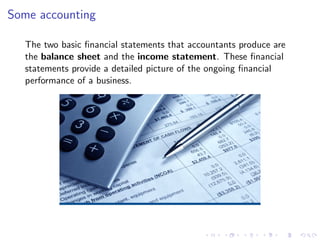
  The two basic financial statements that accountants produce are
  the balance sheet and the income statement. These financial
  statements provide a detailed picture of the ongoing financial
  performance of a business.
Balance sheet
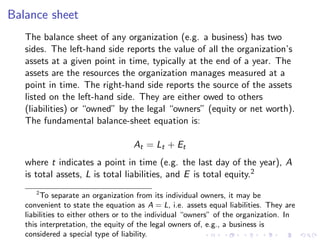
   The balance sheet of any organization (e.g. a business) has two
   sides. The left-hand side reports the value of all the organization’s
   assets at a given point in time, typically at the end of a year. The
   assets are the resources the organization manages measured at a
   point in time. The right-hand side reports the source of the assets
   listed on the left-hand side. They are either owed to others
   (liabilities) or “owned” by the legal “owners” (equity or net worth).
   The fundamental balance-sheet equation is:

                                   At = Lt + Et
   where t indicates a point in time (e.g. the last day of the year), A
   is total assets, L is total liabilities, and E is total equity.2
       2
         To separate an organization from its individual owners, it may be
   convenient to state the equation as A = L, i.e. assets equal liabilities. They are
   liabilities to either others or to the individual “owners” of the organization. In
   this interpretation, the equity of the legal owners of, e.g., a business is
   considered a special type of liability.
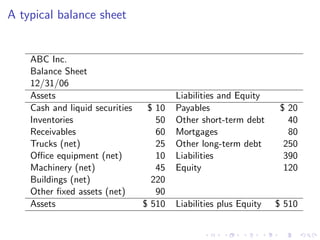
A typical balance sheet


    ABC Inc.
    Balance Sheet
    12/31/06
    Assets                               Liabilities and Equity
    Cash and liquid securities    $ 10   Payables                   $ 20
    Inventories                     50   Other short-term debt        40
    Receivables                     60   Mortgages                    80
    Trucks (net)                    25   Other long-term debt        250
    Office equipment (net)            10   Liabilities                 390
    Machinery (net)                 45   Equity                      120
    Buildings (net)                220
    Other fixed assets (net)         90
    Assets                       $ 510   Liabilities plus Equity   $ 510
Income statement
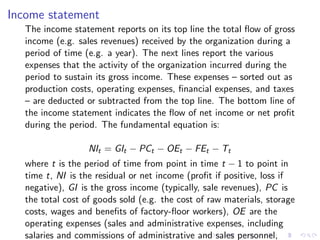
   The income statement reports on its top line the total flow of gross
   income (e.g. sales revenues) received by the organization during a
   period of time (e.g. a year). The next lines report the various
   expenses that the activity of the organization incurred during the
   period to sustain its gross income. These expenses – sorted out as
   production costs, operating expenses, financial expenses, and taxes
   – are deducted or subtracted from the top line. The bottom line of
   the income statement indicates the flow of net income or net profit
   during the period. The fundamental equation is:

                   NIt = GIt − PCt − OEt − FEt − Tt
   where t is the period of time from point in time t − 1 to point in
   time t, NI is the residual or net income (profit if positive, loss if
   negative), GI is the gross income (typically, sale revenues), PC is
   the total cost of goods sold (e.g. the cost of raw materials, storage
   costs, wages and benefits of factory-floor workers), OE are the
   operating expenses (sales and administrative expenses, including
   salaries and commissions of administrative and sales personnel,
Income statement

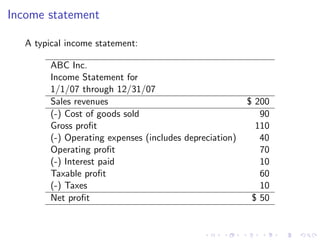
   A typical income statement:

         ABC Inc.
         Income Statement for
         1/1/07 through 12/31/07
         Sales revenues                                   $ 200
         (-) Cost of goods sold                              90
         Gross profit                                        110
         (-) Operating expenses (includes depreciation)      40
         Operating profit                                     70
         (-) Interest paid                                   10
         Taxable profit                                       60
         (-) Taxes                                           10
         Net profit                                         $ 50
Summary


  Note that:
      all items in the balance sheet are stock measures (“water in a
      container” at a point in time),
      all items in the income statement are flow measures (“water
      that flows in/our” over a period of time),
      the balance sheet and the income statement are related in
      multiple ways,
      assets are “positive water stocks” while liabilities and equity
      items are “negative water stocks” (if that makes sense), and
      sale revenues are “positive water flows” and costs and
      expenses are “negative water flows’.’
Summary
  Every time an organization conducts an operation or transaction,
  every time a business takes raw materials from its inventories and
  have its workers process them on the factory floor, every time its
  sales people sell a batch of goods or its administrative personnel
  orders a shipment from its suppliers, every time a payment is made
  or received, there is “water” flowing from one balance-sheet
  container into another one. At the end of the given period (and
  beginning of the next period), the balance sheet reports the
  adjusted levels of “water” in each container at that point in time.
  Also at the end of the given period (beginning of the next), each
  spurt of “water” that flowed from container to container during
  the period is added up (aggregated) into its respective category
  and recorded in the income statement. The legal owners of the
  organization (if a corporation, the legal owners are called
  stockholders) pay most attention to the level of “water” in their
  equity “container.”

Stocks, flows, financial statements

  • 1.
    Basic math tools: Stocks,flows, and financial statements juliohuato@gmail.com August 30, 2011
  • 2.
  • 3.
    Stocks and flows In economics (as in the physical sciences), empirical observations and measurements are made either at a point in time or over a period of time. As a result, the basic variables can be either stocks or flows. A stock measure refers to the value of a variable at a given point in time. A flow measure refers to the value of a variable over a given period of time. On top of these basic measures, a host of derivative measures (e.g. ratios of flows to flows, flows to stocks, stocks to flows, and stocks to stocks) can be determined. This distinction is extremely useful in accounting, economics, and finance.
  • 4.
    Stocks and flows Consider this figure: It shows a container with a certain liquid (e.g. water), one pipe delivering it into the container, and a pipe leaking it out. Physicists and engineers call it a simple “hydrodynamic system.”
  • 5.
    Stocks and flows Basically, we can measure the performance of this system by measuring the amount of liquid in the container at given points in time (e.g. on Sundays at noon, on the last day of each month) and the amount of water that flows through the container over given periods of time (e.g. a week, a month). Then, by combining both forms of measurement, we get a richer view of the functioning of the system. The stock measures may help us correct errors in the measurement of flows or, vice versa. (The term stock has several meanings in economics. It also refers to the “equity” or legal ownership of a company traded in the market. The context should make it clear when we use the term in one or the other sense.)
  • 6.
    The algebra ofstocks and flows Let the upper-case letters denote stocks and the lower-case ones flows. Let Xt be the amount of water in the vessel at point in time t, xit the amount of water flowing into the vessel during the month, and xot the amount of water flowing out of the vessel during the month. Then: Xt+1 = Xt + xit − xot The amount of water in the container at t + 1 is equal to the amount of water in the container at t plus the water that got in it during period (t, t + 1) minus the water that leaked out during the same period.1 1 Assume no evaporation or, alternatively, that the water leaked out in the period includes evaporated water.
  • 7.
    The algebra ofstocks and flows Example: On November 1 (t = 0), the amount of water in the container is 10 gallons (X0 = 10). The water flowing into the vessel during November is 40 gallons (xit = 40) and the water flowing out of the vessel is 39 gallons (xot = 39). Calculate the amount of water in the container on December 1: X1 = X0 + xi1 − xo1 = 10 + 40 − 39 = 11. If the stock of water on December 1 is any different from (greater than or less than) the result above, we have made errors in our measurements. The new measure of the water level can help us correct them.
  • 8.
    Some accounting The two basic financial statements that accountants produce are the balance sheet and the income statement. These financial statements provide a detailed picture of the ongoing financial performance of a business.
  • 9.
    Balance sheet The balance sheet of any organization (e.g. a business) has two sides. The left-hand side reports the value of all the organization’s assets at a given point in time, typically at the end of a year. The assets are the resources the organization manages measured at a point in time. The right-hand side reports the source of the assets listed on the left-hand side. They are either owed to others (liabilities) or “owned” by the legal “owners” (equity or net worth). The fundamental balance-sheet equation is: At = Lt + Et where t indicates a point in time (e.g. the last day of the year), A is total assets, L is total liabilities, and E is total equity.2 2 To separate an organization from its individual owners, it may be convenient to state the equation as A = L, i.e. assets equal liabilities. They are liabilities to either others or to the individual “owners” of the organization. In this interpretation, the equity of the legal owners of, e.g., a business is considered a special type of liability.
  • 10.
    A typical balancesheet ABC Inc. Balance Sheet 12/31/06 Assets Liabilities and Equity Cash and liquid securities $ 10 Payables $ 20 Inventories 50 Other short-term debt 40 Receivables 60 Mortgages 80 Trucks (net) 25 Other long-term debt 250 Office equipment (net) 10 Liabilities 390 Machinery (net) 45 Equity 120 Buildings (net) 220 Other fixed assets (net) 90 Assets $ 510 Liabilities plus Equity $ 510
  • 11.
    Income statement The income statement reports on its top line the total flow of gross income (e.g. sales revenues) received by the organization during a period of time (e.g. a year). The next lines report the various expenses that the activity of the organization incurred during the period to sustain its gross income. These expenses – sorted out as production costs, operating expenses, financial expenses, and taxes – are deducted or subtracted from the top line. The bottom line of the income statement indicates the flow of net income or net profit during the period. The fundamental equation is: NIt = GIt − PCt − OEt − FEt − Tt where t is the period of time from point in time t − 1 to point in time t, NI is the residual or net income (profit if positive, loss if negative), GI is the gross income (typically, sale revenues), PC is the total cost of goods sold (e.g. the cost of raw materials, storage costs, wages and benefits of factory-floor workers), OE are the operating expenses (sales and administrative expenses, including salaries and commissions of administrative and sales personnel,
  • 12.
    Income statement A typical income statement: ABC Inc. Income Statement for 1/1/07 through 12/31/07 Sales revenues $ 200 (-) Cost of goods sold 90 Gross profit 110 (-) Operating expenses (includes depreciation) 40 Operating profit 70 (-) Interest paid 10 Taxable profit 60 (-) Taxes 10 Net profit $ 50
  • 13.
    Summary Notethat: all items in the balance sheet are stock measures (“water in a container” at a point in time), all items in the income statement are flow measures (“water that flows in/our” over a period of time), the balance sheet and the income statement are related in multiple ways, assets are “positive water stocks” while liabilities and equity items are “negative water stocks” (if that makes sense), and sale revenues are “positive water flows” and costs and expenses are “negative water flows’.’
  • 14.
    Summary Everytime an organization conducts an operation or transaction, every time a business takes raw materials from its inventories and have its workers process them on the factory floor, every time its sales people sell a batch of goods or its administrative personnel orders a shipment from its suppliers, every time a payment is made or received, there is “water” flowing from one balance-sheet container into another one. At the end of the given period (and beginning of the next period), the balance sheet reports the adjusted levels of “water” in each container at that point in time. Also at the end of the given period (beginning of the next), each spurt of “water” that flowed from container to container during the period is added up (aggregated) into its respective category and recorded in the income statement. The legal owners of the organization (if a corporation, the legal owners are called stockholders) pay most attention to the level of “water” in their equity “container.”