Elasticity
juliohuato@gmail.com
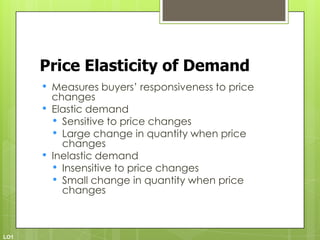
Price Elasticity of Demand
      •   Measures buyers’ responsiveness to price
          changes
      •   Elastic demand
          • Sensitive to price changes
          • Large change in quantity when price
            changes
      •   Inelastic demand
          • Insensitive to price changes
          • Small change in quantity when price
            changes


LO1
Price Elasticity of Demand Formula


       Percent change in Quantity
Ed =    Demanded of Product X
        Percent change in Price
             of Product X
Price Elasticity of Demand Formula

Price Elasticity of Demand Formula

      • It is in percentages
        • Unit free measure
        • Compares responsiveness across
          products
      • Eliminates the minus sign
        • Easier to compare elasticities

LO1                                        4-5
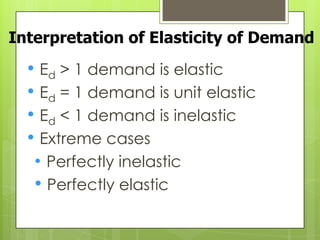
Interpretation of Elasticity of Demand
  • Ed > 1 demand is elastic
  • Ed = 1 demand is unit elastic
  • Ed < 1 demand is inelastic
  • Extreme cases
   • Perfectly inelastic
   • Perfectly elastic
Extreme Cases
    P                D1
                           Perfectly
                           inelastic
                           demand
                           (Ed = 0)


    0


        Perfectly inelastic demand
Extreme Cases
    P


                                    D2
                        Perfectly
                        elastic
                        demand
                        (Ed = ∞)

    0

        Perfectly elastic demand
Total Revenue Test

Total Revenue Test
  • Increase price with elastic demand: orange gain is less than blue
  loss
  •Decrease price with elastic demand: orange loss is less than blue
  gain
  •Elastic demand forces sellers to lower prices
           P
           $3


                      a
            2


                                              b
            1
                                                  D1


                0   10      20      30      40         Q
Total Revenue Test
 • Increase price with inelastic demand: orange gain is more than blue loss
 • Decrease price with inelastic demand: orange loss exceeds blue gain
 • With inelastic demand, sellers can increase prices and gain


                   P
                     $4
                                   c


                       3


                       2


                                            d
                       1
                                                D2
                       0      10       20             Q
Total Revenue Test
  • With unit elastic demand: increasing or
  decreasing price leaves R unchanged
              P
              $3           e


                  2


                                         f
                  1
                                             D3


                  0   10       20   30            Q
Total Revenue Test
Price Elasticity of Demand for Movie Tickets as Measured by the Elasticity
Coefficient and the Total-Revenue Test
          (1)                                    (3)          (4)          (5)
   Total Quantity of                         Elasticity      Total       Total
Tickets Demanded per            (2)         Coefficient    Revenue      Revenue
  Week, Thousands        Price per Ticket       (Ed)       (1) X (2)      Test
           1                    $8                          $8,000
           2                    7               5.00        14,000     Elastic
           3                    6               2.60        18,000     Elastic
           4                    5               1.57        20,000     Elastic
           5                    4               1.00        20,000     Unit Elastic
           6                    3               0.64        18,000     Inelastic
           7                    2               0.38        14,000     Inelastic
           8                    1               0.20         8,000     Inelastic
Elasticity and Total Revenue
                                $8                                 Elastic
                                 7 a                                Ed > 1
                                 6   b
                                 5     c                         Unit Elastic
                  Price          4       d                          Ed = 1
                                 3         e                      Inelastic
                                 2           f                      Ed < 1
                                 1             g
                                                       h    D
                                      0 1 2 3 4 5 6 7 8
                                        Quantity Demanded
       (Thousands of Dollars)


                                $20
                                 18
           Total Revenue


                                 16
                                 14
                                 12
                                 10
                                  8
                                  6                         TR
                                  4
                                  2
                                      0 1 2 3 4Demanded
                                        Quantity 5 6 7 8
Summary of Price Elasticity of Demand
Price Elasticity of Demand: A Summary

Absolute Value                                    Impact on Total Revenue of a:
of Elasticity
Coefficient    Demand Is:       Description       Price Increase Price Decrease
Greater than 1   Elastic or     Qd changes by a   Total Revenue   Total Revenue
(Ed > 1)         relatively     larger            decreases       increases
                 elastic        percentage than
                                does price
Equal to 1       Unit or unitary Qd changes by    Total revenue   Total revenue
(Ed = 1)         elastic         the same         is unchanged    is unchanged
                                 percentage as
                                 does price
Less than 1      Inelastic or   Qd changes by a   Total revenue   Total revenue
(Ed < 1)         relatively     smaller           increases       decreases
                 inelastic      percentage than
                                does price
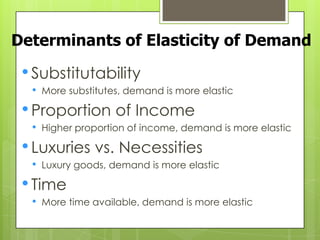
Determinants of Elasticity of Demand

 • Substitutability
  •   More substitutes, demand is more elastic

 • Proportion of Income
  •   Higher proportion of income, demand is more elastic

 • Luxuries vs. Necessities
  •   Luxury goods, demand is more elastic

 • Time
  •   More time available, demand is more elastic
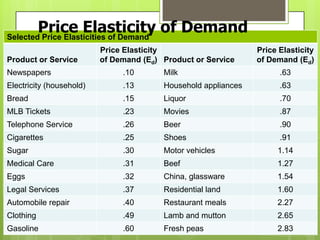
Price Elasticity of Demand
Selected Price Elasticities of Demand
                          Price Elasticity                      Price Elasticity
Product or Service        of Demand (Ed) Product or Service     of Demand (Ed)
Newspapers                     .10       Milk                         .63
Electricity (household)        .13       Household appliances         .63
Bread                          .15       Liquor                       .70
MLB Tickets                    .23       Movies                       .87
Telephone Service              .26       Beer                         .90
Cigarettes                     .25       Shoes                        .91
Sugar                          .30       Motor vehicles              1.14
Medical Care                   .31       Beef                        1.27
Eggs                           .32       China, glassware            1.54
Legal Services                 .37       Residential land            1.60
Automobile repair              .40       Restaurant meals            2.27
Clothing                       .49       Lamb and mutton             2.65
Gasoline                       .60       Fresh peas                  2.83
Applications of Ed
• Large Crop Yields
 • Inelastic demand, lower total revenue
• Excise Taxes
 • Inelastic demand, more total revenue
• Decriminalization of Illegal Drugs
 • Inelastic demand, more total revenue
Price Elasticity of Supply
Measures sellers’ responsiveness
 to price changes
 • Elastic supply, producers are
   responsive to price changes
 • Inelastic supply, producers are
   not responsive to price changes
Price Elasticity of Supply

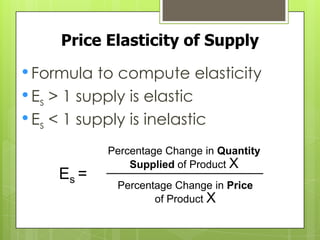
• Formula to compute elasticity
• Es > 1 supply is elastic
• Es < 1 supply is inelastic
           Percentage Change in Quantity
               Supplied of Product X
    Es =
            Percentage Change in Price
                   of Product X
Price Elasticity of Supply
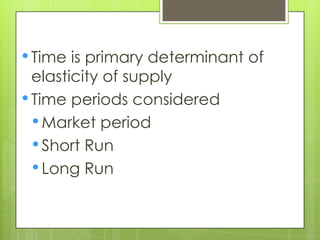
• Time is primary determinant of
  elasticity of supply
• Time periods considered
  • Market period
  • Short Run
  • Long Run
Elasticity of Supply: The Market Period
 • Perfectly inelastic supply
       P
                      Sm


       Pm


       P0
                                D2
                           D1
                 Q0                  Q
Elasticity of Supply: The Short Run
• Supply is more elastic than in market
period
         P
                          Ss


         Ps


         P0
                                D2
                           D1
                  Q0 Qs              Q
Elasticity of Supply: The Long Run
• Supply is even more elastic than in
the short run
      P


                                     Sl


      Pl

      P0
                                D2
                           D1
                 Q0   Ql                  Q
Applications of Elasticity of Supply

  Antiques
   • Inelastic supply
  Reproductions
   • More elastic supply
  Volatile gold prices
   • Inelastic supply
Cross Elasticity of Demand
 • Measures responsiveness of sales
   to change in the price of another
   good
 • Substitutes – positive sign
 • Complements – negative sign
 • Independent goods - zero
          Percentage change in quantity demanded of
                        product X
Ex,y =      Percentage change in price of product Y
Cross Elasticity of Demand

• Application
  • Change the price?
  • Allow a merger?
Income Elasticity of Demand

• Measures responsiveness of buyers
  to changes in income
• Normal goods – positive sign
• Inferior goods – negative sign
              Percentage change
            in quantity demanded
   Ei =
          Percentage change in income
Income Elasticity Insights

• High income elasticities
  • Most affected by a recession
• Low or negative income
  • Least affected by a recession
Ex,y and Ei
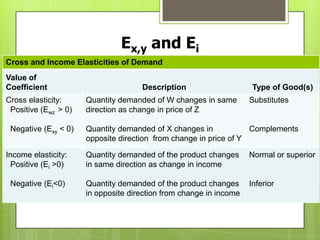
Cross and Income Elasticities of Demand
Value of
Coefficient                          Description                     Type of Good(s)
Cross elasticity:     Quantity demanded of W changes in same        Substitutes
 Positive (Ewz > 0)   direction as change in price of Z

 Negative (Exy < 0)   Quantity demanded of X changes in            Complements
                      opposite direction from change in price of Y

Income elasticity:    Quantity demanded of the product changes      Normal or superior
 Positive (Ei >0)     in same direction as change in income

 Negative (Ei<0)      Quantity demanded of the product changes      Inferior
                      in opposite direction from change in income
Elasticity and Pricing Power
• Charge different prices based on
  price elasticities
• Examples:
  • Business air travelers
  • Adult vs. child
Summary
• Price elasticity of demand
• Income elasticity of demand
• Cross-price elasticity of demand
• Price elasticity of supply

Elasticity

  • 1.
  • 2.
    Price Elasticity ofDemand • Measures buyers’ responsiveness to price changes • Elastic demand • Sensitive to price changes • Large change in quantity when price changes • Inelastic demand • Insensitive to price changes • Small change in quantity when price changes LO1
  • 3.
    Price Elasticity ofDemand Formula Percent change in Quantity Ed = Demanded of Product X Percent change in Price of Product X
  • 4.
    Price Elasticity ofDemand Formula 
  • 5.
    Price Elasticity ofDemand Formula • It is in percentages • Unit free measure • Compares responsiveness across products • Eliminates the minus sign • Easier to compare elasticities LO1 4-5
  • 6.
    Interpretation of Elasticityof Demand • Ed > 1 demand is elastic • Ed = 1 demand is unit elastic • Ed < 1 demand is inelastic • Extreme cases • Perfectly inelastic • Perfectly elastic
  • 7.
    Extreme Cases P D1 Perfectly inelastic demand (Ed = 0) 0 Perfectly inelastic demand
  • 8.
    Extreme Cases P D2 Perfectly elastic demand (Ed = ∞) 0 Perfectly elastic demand
  • 9.
  • 10.
    Total Revenue Test • Increase price with elastic demand: orange gain is less than blue loss •Decrease price with elastic demand: orange loss is less than blue gain •Elastic demand forces sellers to lower prices P $3 a 2 b 1 D1 0 10 20 30 40 Q
  • 11.
    Total Revenue Test • Increase price with inelastic demand: orange gain is more than blue loss • Decrease price with inelastic demand: orange loss exceeds blue gain • With inelastic demand, sellers can increase prices and gain P $4 c 3 2 d 1 D2 0 10 20 Q
  • 12.
    Total Revenue Test • With unit elastic demand: increasing or decreasing price leaves R unchanged P $3 e 2 f 1 D3 0 10 20 30 Q
  • 13.
    Total Revenue Test PriceElasticity of Demand for Movie Tickets as Measured by the Elasticity Coefficient and the Total-Revenue Test (1) (3) (4) (5) Total Quantity of Elasticity Total Total Tickets Demanded per (2) Coefficient Revenue Revenue Week, Thousands Price per Ticket (Ed) (1) X (2) Test 1 $8 $8,000 2 7 5.00 14,000 Elastic 3 6 2.60 18,000 Elastic 4 5 1.57 20,000 Elastic 5 4 1.00 20,000 Unit Elastic 6 3 0.64 18,000 Inelastic 7 2 0.38 14,000 Inelastic 8 1 0.20 8,000 Inelastic
  • 14.
    Elasticity and TotalRevenue $8 Elastic 7 a Ed > 1 6 b 5 c Unit Elastic Price 4 d Ed = 1 3 e Inelastic 2 f Ed < 1 1 g h D 0 1 2 3 4 5 6 7 8 Quantity Demanded (Thousands of Dollars) $20 18 Total Revenue 16 14 12 10 8 6 TR 4 2 0 1 2 3 4Demanded Quantity 5 6 7 8
  • 15.
    Summary of PriceElasticity of Demand Price Elasticity of Demand: A Summary Absolute Value Impact on Total Revenue of a: of Elasticity Coefficient Demand Is: Description Price Increase Price Decrease Greater than 1 Elastic or Qd changes by a Total Revenue Total Revenue (Ed > 1) relatively larger decreases increases elastic percentage than does price Equal to 1 Unit or unitary Qd changes by Total revenue Total revenue (Ed = 1) elastic the same is unchanged is unchanged percentage as does price Less than 1 Inelastic or Qd changes by a Total revenue Total revenue (Ed < 1) relatively smaller increases decreases inelastic percentage than does price
  • 16.
    Determinants of Elasticityof Demand • Substitutability • More substitutes, demand is more elastic • Proportion of Income • Higher proportion of income, demand is more elastic • Luxuries vs. Necessities • Luxury goods, demand is more elastic • Time • More time available, demand is more elastic
  • 17.
    Price Elasticity ofDemand Selected Price Elasticities of Demand Price Elasticity Price Elasticity Product or Service of Demand (Ed) Product or Service of Demand (Ed) Newspapers .10 Milk .63 Electricity (household) .13 Household appliances .63 Bread .15 Liquor .70 MLB Tickets .23 Movies .87 Telephone Service .26 Beer .90 Cigarettes .25 Shoes .91 Sugar .30 Motor vehicles 1.14 Medical Care .31 Beef 1.27 Eggs .32 China, glassware 1.54 Legal Services .37 Residential land 1.60 Automobile repair .40 Restaurant meals 2.27 Clothing .49 Lamb and mutton 2.65 Gasoline .60 Fresh peas 2.83
  • 18.
    Applications of Ed •Large Crop Yields • Inelastic demand, lower total revenue • Excise Taxes • Inelastic demand, more total revenue • Decriminalization of Illegal Drugs • Inelastic demand, more total revenue
  • 19.
    Price Elasticity ofSupply Measures sellers’ responsiveness to price changes • Elastic supply, producers are responsive to price changes • Inelastic supply, producers are not responsive to price changes
  • 20.
    Price Elasticity ofSupply • Formula to compute elasticity • Es > 1 supply is elastic • Es < 1 supply is inelastic Percentage Change in Quantity Supplied of Product X Es = Percentage Change in Price of Product X
  • 21.
    Price Elasticity ofSupply • Time is primary determinant of elasticity of supply • Time periods considered • Market period • Short Run • Long Run
  • 22.
    Elasticity of Supply:The Market Period • Perfectly inelastic supply P Sm Pm P0 D2 D1 Q0 Q
  • 23.
    Elasticity of Supply:The Short Run • Supply is more elastic than in market period P Ss Ps P0 D2 D1 Q0 Qs Q
  • 24.
    Elasticity of Supply:The Long Run • Supply is even more elastic than in the short run P Sl Pl P0 D2 D1 Q0 Ql Q
  • 25.
    Applications of Elasticityof Supply Antiques • Inelastic supply Reproductions • More elastic supply Volatile gold prices • Inelastic supply
  • 26.
    Cross Elasticity ofDemand • Measures responsiveness of sales to change in the price of another good • Substitutes – positive sign • Complements – negative sign • Independent goods - zero Percentage change in quantity demanded of product X Ex,y = Percentage change in price of product Y
  • 27.
    Cross Elasticity ofDemand • Application • Change the price? • Allow a merger?
  • 28.
    Income Elasticity ofDemand • Measures responsiveness of buyers to changes in income • Normal goods – positive sign • Inferior goods – negative sign Percentage change in quantity demanded Ei = Percentage change in income
  • 29.
    Income Elasticity Insights •High income elasticities • Most affected by a recession • Low or negative income • Least affected by a recession
  • 30.
    Ex,y and Ei Crossand Income Elasticities of Demand Value of Coefficient Description Type of Good(s) Cross elasticity: Quantity demanded of W changes in same Substitutes Positive (Ewz > 0) direction as change in price of Z Negative (Exy < 0) Quantity demanded of X changes in Complements opposite direction from change in price of Y Income elasticity: Quantity demanded of the product changes Normal or superior Positive (Ei >0) in same direction as change in income Negative (Ei<0) Quantity demanded of the product changes Inferior in opposite direction from change in income
  • 31.
    Elasticity and PricingPower • Charge different prices based on price elasticities • Examples: • Business air travelers • Adult vs. child
  • 32.
    Summary • Price elasticityof demand • Income elasticity of demand • Cross-price elasticity of demand • Price elasticity of supply