
Risk
juliohuato@gmail.com
Goals: To learn about…
 The   effect of uncertainty in our economic
  life
 Ways in which risk can be estimated
 Our attitudes towards risk
 The different sources of risk
 The ways in which manage our economic
  risk
Uncertainty
   Kenneth J Arrow: “Uncertainty is our relative
    ignorance about the future effects of our current
    choices -- the more so, the further removed the
    effects are from these choices.”
   We are ignorant about how the world and our
    society functions (economics barely makes a
    dent), ultimately because our productive powers
    are finite
   On top of our regular ignorance vis-à-vis the rest of
    nature, uncertainty about our own social life is self-
    referential – it depends on how we deal with our
    own uncertainty (chicken-and-egg).
Risk
 In economics and finance, we usually
  think of risk as:
      The economic effect (benefits/costs) of our
       uncertainty
      One usual way in which risk is quantified in
       economics and finance is as the variability
       in payoffs
Probability & Statistics
 Probability   is a mathematical theory
  about our cognitive behavior in the face
  of uncertainty
 Statistics is a set of techniques that use
  probability theory (and other
  assumptions) to extract knowledge from
  data (observations)
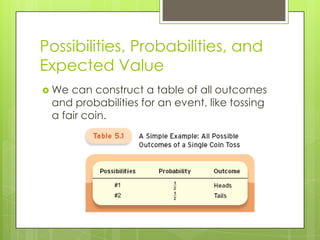
Possibilities, Probabilities, and
Expected Value
 We can construct a table of all outcomes
 and probabilities for an event, like tossing
 a fair coin.
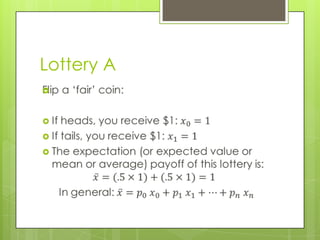
Lottery A

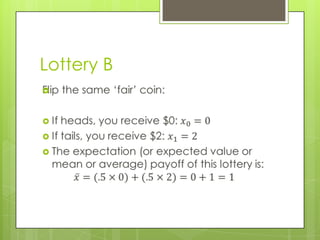
Lottery B

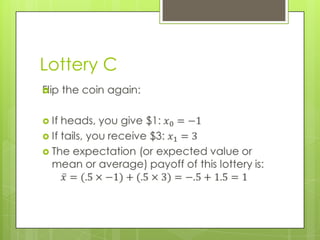
Lottery C

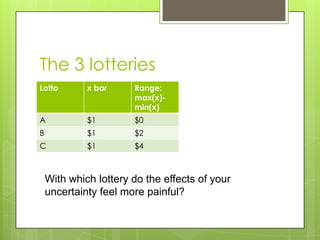
The 3 lotteries
Lotto        x bar     Range:
                       max(x)-
                       min(x)
A            $1        $0
B            $1        $2
C            $1        $4


    With which lottery do the effects of your
    uncertainty feel more painful?
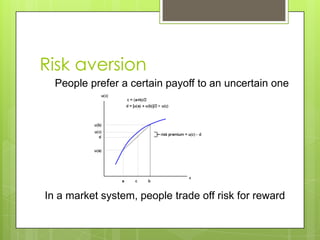
Risk aversion
  People prefer a certain payoff to an uncertain one


In a market system, people trade off risk for reward
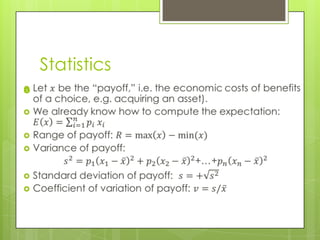
Statistics

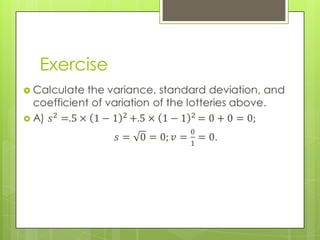
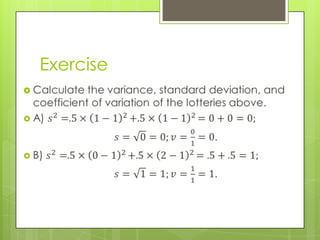
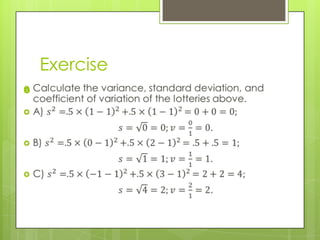
Exercise
 Calculate the variance, standard deviation, and
 coefficient of variation of the lotteries above.
Exercise

Exercise

Exercise

Risk in economics & finance
   Usually, we think of risk as a measure of uncertainty
    about the future payoff to a bond over a time
    period and compared to a benchmark
   The benchmark is usually a hypothetical risk-free
    bond
   Again, in a market system with prevailing risk
    aversion, there is a tradeoff between risk and
    reward
   The use of probability theory requires that we
    envision all possible scenarios (“states of the
    world”) and their likelihood
Sources of Risk
All risks can be classified into two groups:
1. Those affecting a small number of
     people but no one else:
       idiosyncratic or unique risks
2.   Those affecting everyone:
       systemic, systematic, economy-wide, or
           macro risks
Sources of Risk
Idiosyncratic risks can be classified into two
extreme types:
   1.   A risk is bad for one sector of the
        economy but good for another.
   2.   Unique risks specific to one person or
        company and unrelated to others.
Dealing with risk
 Risk can be reduced through:
  Hedging: building a portfolio with assets that
   have offsetting payoffs
  Diversification: randomly adding more assets
   to one’s portfolio, since the additional assets
   are unlikely to have payoffs that move
   exactly like those already in the portfolio
5-21


Hedging Risk
•   Hedging is the strategy of reducing
    idiosyncratic risk by making two
    investments with opposing risks.
    •   If one industry is volatile, the payoffs are
        stable.
•   Let’s compare three strategies for
    investing $100:
    •   Invest $100 in GE.
    •   Invest $100 in Texaco.
    •   Invest half in each company.
5-22


Spreading Risk
 You  can’t always hedge as investments
  don’t always move in a predictable
  fashion.
 The alternative is to spread risk around.
     Find investments whose payoffs are
      unrelated.
 Weneed to look at the
 possibilities, probabilities and associated
 payoffs of different investments.
5-23


Spreading Risk
 The   more independent sources of risk you
  hold in your portfolio, the lower your
  overall risk.
 As we add more and more independent
  sources of risk, the standard deviation
  becomes negligible.
 Diversification through the spreading of
  risk is the basis for the insurance business.
We learned about…
  Uncertainty and its economic effect: risk
 Estimating risk by measuring the variation of payoffs
   to our assets
 Risk aversion and the tradeoff between risk and
   reward in a market system
 Idiosyncratic (unique) risk and systemic (macro) risk
 How hedging (if there are assets with contrarian
   payoffs) and diversification (spreading risk around)
   lowered idiosyncratic risk
In our next session, we will study how the risk premium
on bonds can be estimated (under certain
assumptions)

Risk

  • 1.
  • 2.
    Goals: To learnabout…  The effect of uncertainty in our economic life  Ways in which risk can be estimated  Our attitudes towards risk  The different sources of risk  The ways in which manage our economic risk
  • 3.
    Uncertainty  Kenneth J Arrow: “Uncertainty is our relative ignorance about the future effects of our current choices -- the more so, the further removed the effects are from these choices.”  We are ignorant about how the world and our society functions (economics barely makes a dent), ultimately because our productive powers are finite  On top of our regular ignorance vis-à-vis the rest of nature, uncertainty about our own social life is self- referential – it depends on how we deal with our own uncertainty (chicken-and-egg).
  • 4.
    Risk  In economicsand finance, we usually think of risk as:  The economic effect (benefits/costs) of our uncertainty  One usual way in which risk is quantified in economics and finance is as the variability in payoffs
  • 5.
    Probability & Statistics Probability is a mathematical theory about our cognitive behavior in the face of uncertainty  Statistics is a set of techniques that use probability theory (and other assumptions) to extract knowledge from data (observations)
  • 6.
    Possibilities, Probabilities, and ExpectedValue  We can construct a table of all outcomes and probabilities for an event, like tossing a fair coin.
  • 7.
  • 8.
  • 9.
  • 10.
    The 3 lotteries Lotto x bar Range: max(x)- min(x) A $1 $0 B $1 $2 C $1 $4 With which lottery do the effects of your uncertainty feel more painful?
  • 11.
    Risk aversion People prefer a certain payoff to an uncertain one In a market system, people trade off risk for reward
  • 12.
  • 13.
    Exercise  Calculate thevariance, standard deviation, and coefficient of variation of the lotteries above.
  • 14.
  • 15.
  • 16.
  • 17.
    Risk in economics& finance  Usually, we think of risk as a measure of uncertainty about the future payoff to a bond over a time period and compared to a benchmark  The benchmark is usually a hypothetical risk-free bond  Again, in a market system with prevailing risk aversion, there is a tradeoff between risk and reward  The use of probability theory requires that we envision all possible scenarios (“states of the world”) and their likelihood
  • 18.
    Sources of Risk Allrisks can be classified into two groups: 1. Those affecting a small number of people but no one else: idiosyncratic or unique risks 2. Those affecting everyone: systemic, systematic, economy-wide, or macro risks
  • 19.
    Sources of Risk Idiosyncraticrisks can be classified into two extreme types: 1. A risk is bad for one sector of the economy but good for another. 2. Unique risks specific to one person or company and unrelated to others.
  • 20.
    Dealing with risk Risk can be reduced through:  Hedging: building a portfolio with assets that have offsetting payoffs  Diversification: randomly adding more assets to one’s portfolio, since the additional assets are unlikely to have payoffs that move exactly like those already in the portfolio
  • 21.
    5-21 Hedging Risk • Hedging is the strategy of reducing idiosyncratic risk by making two investments with opposing risks. • If one industry is volatile, the payoffs are stable. • Let’s compare three strategies for investing $100: • Invest $100 in GE. • Invest $100 in Texaco. • Invest half in each company.
  • 22.
    5-22 Spreading Risk  You can’t always hedge as investments don’t always move in a predictable fashion.  The alternative is to spread risk around.  Find investments whose payoffs are unrelated.  Weneed to look at the possibilities, probabilities and associated payoffs of different investments.
  • 23.
    5-23 Spreading Risk  The more independent sources of risk you hold in your portfolio, the lower your overall risk.  As we add more and more independent sources of risk, the standard deviation becomes negligible.  Diversification through the spreading of risk is the basis for the insurance business.
  • 24.
    We learned about…  Uncertainty and its economic effect: risk  Estimating risk by measuring the variation of payoffs to our assets  Risk aversion and the tradeoff between risk and reward in a market system  Idiosyncratic (unique) risk and systemic (macro) risk  How hedging (if there are assets with contrarian payoffs) and diversification (spreading risk around) lowered idiosyncratic risk In our next session, we will study how the risk premium on bonds can be estimated (under certain assumptions)