Fiscal Imbalance and Deficit Financing
Presented By:
Animesh Arya
Harshit Jalan
Budget and Budget Balance (BBB)
A government budget is a financial statement
presenting the government’s proposed revenues and
spending for a financial year.
Budget balance refers to the difference between total
revenues and total expenditure of a government.
Surplus: TR > TE
Deficit : TR < TE
Fiscal Imbalance
Fiscal Imbalance refers to a situation when
the total expenditure of the government
and total receipts (excluding borrowing) are
not equal.
There can be two situations:
Fiscal Deficit
Fiscal Surplus
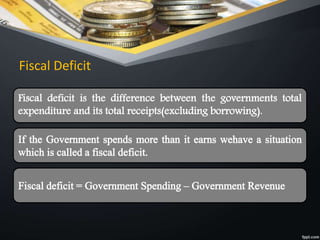
Fiscal Deficit
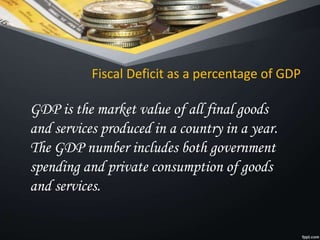
Fiscal Deficit as a percentage of GDP
GDP is the market value of all final goods
and services produced in a country in a year.
The GDP number includes both government
spending and private consumption of goods
and services.
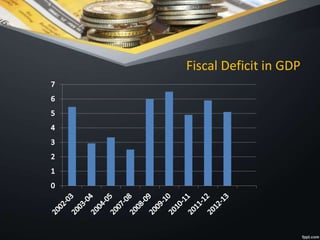
Fiscal Deficit in GDP
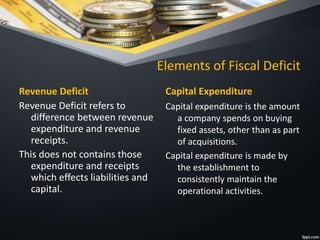
Elements of Fiscal Deficit
Revenue Deficit
Revenue Deficit refers to
difference between revenue
expenditure and revenue
receipts.
This does not contains those
expenditure and receipts
which effects liabilities and
capital.
Capital Expenditure
Capital expenditure is the amount
a company spends on buying
fixed assets, other than as part
of acquisitions.
Capital expenditure is made by
the establishment to
consistently maintain the
operational activities.
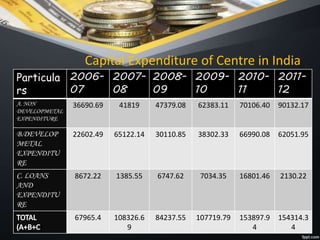
Capital Expenditure of Centre in India
Particula
rs
2006-
07
2007-
08
2008-
09
2009-
10
2010-
11
2011-
12
A. NON
DEVELOPMETAL
EXPENDITURE
36690.69 41819 47379.08 62383.11 70106.40 90132.17
B.DEVELOP
METAL
EXPENDITU
RE
22602.49 65122.14 30110.85 38302.33 66990.08 62051.95
C. LOANS
AND
EXPENDITU
RE
8672.22 1385.55 6747.62 7034.35 16801.46 2130.22
)
67965.4 108326.6
9
84237.55 107719.79 153897.9
4
154314.3
4
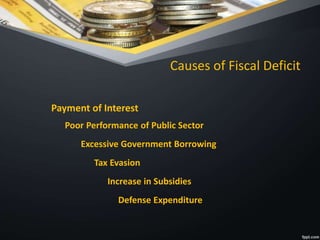
Causes of Fiscal Deficit
Payment of Interest
Poor Performance of Public Sector
Excessive Government Borrowing
Tax Evasion
Increase in Subsidies
Defense Expenditure
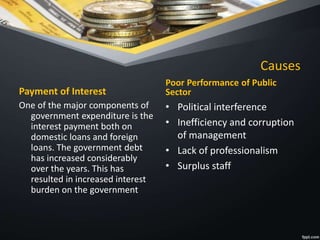
Causes
Payment of Interest
One of the major components of
government expenditure is the
interest payment both on
domestic loans and foreign
loans. The government debt
has increased considerably
over the years. This has
resulted in increased interest
burden on the government
Poor Performance of Public
Sector
• Political interference
• Inefficiency and corruption
of management
• Lack of professionalism
• Surplus staff
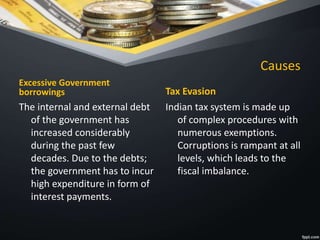
Causes
Excessive Government
borrowings
The internal and external debt
of the government has
increased considerably
during the past few
decades. Due to the debts;
the government has to incur
high expenditure in form of
interest payments.
Tax Evasion
Indian tax system is made up
of complex procedures with
numerous exemptions.
Corruptions is rampant at all
levels, which leads to the
fiscal imbalance.
Causes
Increase in Subsidies
The major subsidies provided
by the Central Government
of India have increased over
the years resulting in fiscal
imbalance period .
Defense Expenditure
The government has limited
scope to reduce defense
budget due to security
problems across the Indian
borders.
Consequences
Debt. Trap
Cut in Capital Expenditure
No increase in expenditure on health and Education
High interest rates
Leads to inflation
Discourages foreign investment
Extra burden of Interest Payment
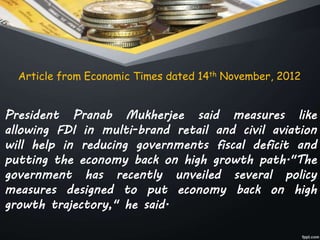
Article from Economic Times dated 14th November, 2012
Fiscal Policy to control deficit
The fiscal policy is concerned with the raising of government revenue
and incurring of government expenditure.
To generate revenue and to incur expenditure, the government frames
a policy called budgetary policy or fiscal policy. So, the fiscal policy is
concerned with government expenditure and government revenue.
Fiscal policy deals with the taxation and expenditure decisions of the
government. Fiscal policy is composed of several parts.
These include, tax policy, expenditure policy, investment or
disinvestment strategies and debt or surplus management.
Fiscal policy is an important constituent of the overall economic
framework of a country.
Deficit Financing
Deficit financing is defined as financing the budgetary
deficit through public loans.
Deficit financing is an approach to money
management that involves spending more money
than is collected during the same period
Objectives of Deficit Financing
• To finance war.
• Economic development.
• Mobilization of resources.
• To granting subsidies.
• To increase in aggregate demand.
• For payment of interest.
Objectives
To Finance War
Deficit financing has generally
being used as a method of
financing war expenditure.
During the war time through
normal methods of raising
resources. It becomes difficult
to mobilize adequate
resources. Therefore
government has to adopt
deficit financing.
Economic Development
The main objective of deficit
financing in an under
developed country like India is
to promote economic
development The use of
deficit financing in fact
becomes essential for
financing the development
plan especially in
underdeveloped countries.
Objectives
Mobilization of resources
Deficit financing is also used
for the mobilization of
surplus, ideal and unutilized
resources in the country
For granting subsidies
In a country like India
government grants subsidies
to the producers to encourage
them to produce a particular
type of commodity, granting
subsidies is a very costly affair
which we cannot meet with
the regular income this deficit
financing becomes must for it.
Objectives
To increase aggregate demand
Deficit financing loads to increase
in aggregate demand through
increased public expenditure.
This increase the income and
purchasing power of the
people as a consequence
there is an increase availability
of goods and services and the
production and employment
level also increase.
Payment of Loans
Loan which are taken by the govt.
are supposed to be repaid
with their interest for that
government needs money
deficit financing is an
important tool to get the
income for the repayment of
loan along with the interest.
Adverse effect of deficit financing
• Leads to inflation.
• Adverse effect on saving.
• Inequality.
• Adverse effect on investment.
• Problem of balance of payment.
• Change in pattern of investment.
Effects
Leads to inflation
Deficit financing may lead to
inflation. Due to deficit
financing money supply
increases & the purchasing
power of the people also
increase which increases
the aggregate demand and
the prices also increase.
Adverse effect on savings
Deficit financing leads to
inflation and inflation
affects the habit of
voluntary saving adversely.
Infect it is not possible for
the people to maintain the
previous rate of saving in
the state of rising prices.
Effects
Inequality
In case of deficit financing income
distribution becomes unequal.
During deficit financing
deflationary pressure can be seen
on the economy which make the
rich richer and the poor, poorer.
The fix wage earners are badly
effected and their standard of
living detoriates thus no gap b/w
rich & poor increases.
Adverse effect on Investment
Deficit financing effects investment
adversely when there is inflation
in the economy trade unions
make demand for higher wages
for that they go for strikes and
lock outs which decreases the
efficiency of Labor and creates
uncertainty in the business which
a decreases the level of
investment of the country.
Effects
Problem in BOP
Deficit financing leads to inflation. A
high price level as compared to
other countries will make the
exports more expensive and thus
they start declining. On the other
hand rise in domestic income and
price may encourage people to
import more commodities from
abroad. This will create a deficit
in balance of payment and the
balance of payment will become
unfavorable.
Change in pattern of investment
Deficit financing leads to
inflation. During inflation
prices rise and reach to a
very high level in that case
people instead of indulging
into productive activities
they start doing speculative
activities.
Limitations of Deficit Financing
• Deficit financing is inevitable
under planned economic
development to activate
unutilized resources or step
up tempo of economic
process.
• It is necessary to the extent
it can promote capital
formation and economic
development.
Lets recall
by a video
Is deficit financing inflationary??????
Deficit financing may not necessarily be inflationary there are certain
conditions under which deficit financing may not lead to inflation. With
increase in money supply due to deficit financing prices do rise but rise
in price will only be temporary for about a period. As flow of goods and
services increase prices will began to fall. deficit financing is an
important device for financing development plans for underdeveloped
countries and accelerate their rate of economic development. But If
deficit financing is not kept with in limits It may give rise to prices,
distorted investment and unequal and unjust distribution of income.
therefore it is essential that deficit financing is kept within limits and its
impact on prices and costs are softened through various controls.

Fiscal Imbalance and Deficit Financing

  • 1.
    Fiscal Imbalance andDeficit Financing Presented By: Animesh Arya Harshit Jalan
  • 2.
    Budget and BudgetBalance (BBB) A government budget is a financial statement presenting the government’s proposed revenues and spending for a financial year. Budget balance refers to the difference between total revenues and total expenditure of a government. Surplus: TR > TE Deficit : TR < TE
  • 3.
    Fiscal Imbalance Fiscal Imbalancerefers to a situation when the total expenditure of the government and total receipts (excluding borrowing) are not equal. There can be two situations: Fiscal Deficit Fiscal Surplus
  • 4.
  • 5.
    Fiscal Deficit asa percentage of GDP GDP is the market value of all final goods and services produced in a country in a year. The GDP number includes both government spending and private consumption of goods and services.
  • 6.
  • 7.
    Elements of FiscalDeficit Revenue Deficit Revenue Deficit refers to difference between revenue expenditure and revenue receipts. This does not contains those expenditure and receipts which effects liabilities and capital. Capital Expenditure Capital expenditure is the amount a company spends on buying fixed assets, other than as part of acquisitions. Capital expenditure is made by the establishment to consistently maintain the operational activities.
  • 9.
    Capital Expenditure ofCentre in India Particula rs 2006- 07 2007- 08 2008- 09 2009- 10 2010- 11 2011- 12 A. NON DEVELOPMETAL EXPENDITURE 36690.69 41819 47379.08 62383.11 70106.40 90132.17 B.DEVELOP METAL EXPENDITU RE 22602.49 65122.14 30110.85 38302.33 66990.08 62051.95 C. LOANS AND EXPENDITU RE 8672.22 1385.55 6747.62 7034.35 16801.46 2130.22 ) 67965.4 108326.6 9 84237.55 107719.79 153897.9 4 154314.3 4
  • 10.
    Causes of FiscalDeficit Payment of Interest Poor Performance of Public Sector Excessive Government Borrowing Tax Evasion Increase in Subsidies Defense Expenditure
  • 11.
    Causes Payment of Interest Oneof the major components of government expenditure is the interest payment both on domestic loans and foreign loans. The government debt has increased considerably over the years. This has resulted in increased interest burden on the government Poor Performance of Public Sector • Political interference • Inefficiency and corruption of management • Lack of professionalism • Surplus staff
  • 12.
    Causes Excessive Government borrowings The internaland external debt of the government has increased considerably during the past few decades. Due to the debts; the government has to incur high expenditure in form of interest payments. Tax Evasion Indian tax system is made up of complex procedures with numerous exemptions. Corruptions is rampant at all levels, which leads to the fiscal imbalance.
  • 13.
    Causes Increase in Subsidies Themajor subsidies provided by the Central Government of India have increased over the years resulting in fiscal imbalance period . Defense Expenditure The government has limited scope to reduce defense budget due to security problems across the Indian borders.
  • 14.
    Consequences Debt. Trap Cut inCapital Expenditure No increase in expenditure on health and Education High interest rates Leads to inflation Discourages foreign investment Extra burden of Interest Payment
  • 15.
    Article from EconomicTimes dated 14th November, 2012
  • 16.
    Fiscal Policy tocontrol deficit The fiscal policy is concerned with the raising of government revenue and incurring of government expenditure. To generate revenue and to incur expenditure, the government frames a policy called budgetary policy or fiscal policy. So, the fiscal policy is concerned with government expenditure and government revenue. Fiscal policy deals with the taxation and expenditure decisions of the government. Fiscal policy is composed of several parts. These include, tax policy, expenditure policy, investment or disinvestment strategies and debt or surplus management. Fiscal policy is an important constituent of the overall economic framework of a country.
  • 17.
    Deficit Financing Deficit financingis defined as financing the budgetary deficit through public loans. Deficit financing is an approach to money management that involves spending more money than is collected during the same period
  • 18.
    Objectives of DeficitFinancing • To finance war. • Economic development. • Mobilization of resources. • To granting subsidies. • To increase in aggregate demand. • For payment of interest.
  • 19.
    Objectives To Finance War Deficitfinancing has generally being used as a method of financing war expenditure. During the war time through normal methods of raising resources. It becomes difficult to mobilize adequate resources. Therefore government has to adopt deficit financing. Economic Development The main objective of deficit financing in an under developed country like India is to promote economic development The use of deficit financing in fact becomes essential for financing the development plan especially in underdeveloped countries.
  • 20.
    Objectives Mobilization of resources Deficitfinancing is also used for the mobilization of surplus, ideal and unutilized resources in the country For granting subsidies In a country like India government grants subsidies to the producers to encourage them to produce a particular type of commodity, granting subsidies is a very costly affair which we cannot meet with the regular income this deficit financing becomes must for it.
  • 21.
    Objectives To increase aggregatedemand Deficit financing loads to increase in aggregate demand through increased public expenditure. This increase the income and purchasing power of the people as a consequence there is an increase availability of goods and services and the production and employment level also increase. Payment of Loans Loan which are taken by the govt. are supposed to be repaid with their interest for that government needs money deficit financing is an important tool to get the income for the repayment of loan along with the interest.
  • 22.
    Adverse effect ofdeficit financing • Leads to inflation. • Adverse effect on saving. • Inequality. • Adverse effect on investment. • Problem of balance of payment. • Change in pattern of investment.
  • 23.
    Effects Leads to inflation Deficitfinancing may lead to inflation. Due to deficit financing money supply increases & the purchasing power of the people also increase which increases the aggregate demand and the prices also increase. Adverse effect on savings Deficit financing leads to inflation and inflation affects the habit of voluntary saving adversely. Infect it is not possible for the people to maintain the previous rate of saving in the state of rising prices.
  • 24.
    Effects Inequality In case ofdeficit financing income distribution becomes unequal. During deficit financing deflationary pressure can be seen on the economy which make the rich richer and the poor, poorer. The fix wage earners are badly effected and their standard of living detoriates thus no gap b/w rich & poor increases. Adverse effect on Investment Deficit financing effects investment adversely when there is inflation in the economy trade unions make demand for higher wages for that they go for strikes and lock outs which decreases the efficiency of Labor and creates uncertainty in the business which a decreases the level of investment of the country.
  • 25.
    Effects Problem in BOP Deficitfinancing leads to inflation. A high price level as compared to other countries will make the exports more expensive and thus they start declining. On the other hand rise in domestic income and price may encourage people to import more commodities from abroad. This will create a deficit in balance of payment and the balance of payment will become unfavorable. Change in pattern of investment Deficit financing leads to inflation. During inflation prices rise and reach to a very high level in that case people instead of indulging into productive activities they start doing speculative activities.
  • 26.
    Limitations of DeficitFinancing • Deficit financing is inevitable under planned economic development to activate unutilized resources or step up tempo of economic process. • It is necessary to the extent it can promote capital formation and economic development.
  • 27.
  • 29.
    Is deficit financinginflationary?????? Deficit financing may not necessarily be inflationary there are certain conditions under which deficit financing may not lead to inflation. With increase in money supply due to deficit financing prices do rise but rise in price will only be temporary for about a period. As flow of goods and services increase prices will began to fall. deficit financing is an important device for financing development plans for underdeveloped countries and accelerate their rate of economic development. But If deficit financing is not kept with in limits It may give rise to prices, distorted investment and unequal and unjust distribution of income. therefore it is essential that deficit financing is kept within limits and its impact on prices and costs are softened through various controls.