STOCK TRANSPORT ORDERS
by -Nagesh
STOCK TRANSFER USING STOCK
TRANSFER ORDER
Advantages of stock transfer with STO w.r.to
transfer posting
• 1. Good receipt can be planned in receiving plant
• 2. Can include an additional vendors (freight, etc) in Stock
Transport Order
• 3. Delivery costs can be entered in STO
• 4. It’s a part of MRP – PR created via MRP can be converted to
STO
• 5. Goods Issue can be done through Shipping delivery
• 7. Total process can be monitored through PO history
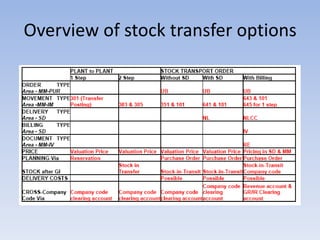
Overview of stock transfer options
STOCK TRANSFER – PLANT to PLANT –
1 Step
• · Carried out ONLY in Inventory Management
• · Entered as a transfer posting – MB1B
• · Can be planned by reservation
• · The quantity of unrestricted stock entering in sending plant posts
IMMEDIATELY
• to unrestricted stock of receiving Plant
• · Postings are valuated at the price of sending plant
• · If it is between 2 company codes, it will create 2 accounting
documents at the time
• of goods issue
STOCK TRANSFER – PLANT to PLANT –
2 Step
• · Carried out ONLY in inventory management
• · Transfer posting CAN NOT be planned through a reservation
• · Goods issue sending plant > Stock-in-transit of receiving Plant >
Goods Receipt of
• receiving Plant.
• · Transfer posting (Goods issue-1step) is valuated at the price of
sending plant
• · If it is between 2 company codes, it will create 2 accounting
documents at the time
• of goods issue. If any offset, will post to Company code clearing
account
• · We can request and monitor stock transfer in purchasing through
a PR, STO
STOCK TRANPORT ORDER WITHOUT
SD DELIVERY
• Goods Issue Sending Plant > Stock-in-transit of receiving plant > Goods receipt of
receiving Plant
• Delivery costs CAN BE entered in ST Order
• Transfer posting (Goods issue-1step) is valuated at the price of sending plant
• If it is between 2 company codes, it will create 2 accounting documents at the
time of goods issue. If any offset, will post to Company code clearing account
Process Flow
• 1. Creation of ST order in receiving Plant for sending plant with a
• document type UB in ME21N
• 2. Posting a goods issue through transfer posting –MB1B at sending plant
• with a movement type –351
• 3. Posting a goods receipt – MIGO at receiving plant with movement type
• –101
• 4. Invoice verification at receiving plant – Normal MIRO
STOCK TRANSPORT ORDER WITH
DELIVERY
• Carried out in Purchasing (entering the STO), Shipping
(delivery
at sending Plant) and Inventory management (GR at
receiving Plant)
• Other characteristics are same as that of STO without
delivery
Process Flow
i. Creation of STO at sending Plant
ii. Post goods issue through delivery (VL 10B or 10F) at
sending plant with movement type 641
iii. Goods receipt (MIGO) at receiving plant with movement
type -101
STOCK TRANSPORT ORDER WITH
DELIVERY & BILLING
• The transfer posting in NOT VALUATED at the valuation price of the
material of sending Plant. But defined in both the sending and
receiving plant using conditions
• Possible ONLY between plants at DIFFERENT COMPANY CODES
• The areas are – Purchasing (STO), Shipping(sending Plant delivery
and goods issue), Billing Plant (Creation of Invoice at sending Plant),
Inventory management (Receiving Plant goods receipt) and Invoice
verification (MIRO at receiving plant)
• Goods Issue through Delivery > Stock-in-transit
• Company code at receiving Plant > Goods receipt at receiving plant
• Prices in purchasing as per the conditions
• maintained in Info record and inter company pricing procedure
• Goods movements are valuated as per the accounting documents
generated.
Accounting documents are generated
• a. Goods Issue at sending Plant
• b. Goods receipt at receiving Plant
• c. Billing at sending Plant
• d. Invoice verification at receiving plant
Process Flow
a. Creation of STO in receiving Plant for sending Plant.
Document type –UB and item category -U
b. Post delivery in sending Plant (Movement type –643)
c. Creation of billing document in sending plant
d. Post GR at receiving Plant
e. Post invoice at receiving Plant
CROSS COMPANY STOCK TRANFER
We can do a cross company stock transfer in 3 ways
• a. Stock transfer between 2 plants by 1 step or 2
step
• b. An STO without delivery via shipping
• c. STO with delivery via shipping (possible for
plants in different company codes)
• In all cases the value of transportation is posted
to a company code clearing account in both the
plants. The stock transfer is valuated at the
valuation price of the material in sending plant
Valuation of stock transport with
billing- INTERCOMAPNY – EXAMPLE
• Plant P1 orders 10Kg of material from Plant P2
• Value of the material at P1 – 10
• Price for inter company billing at P1 – 12
• STO order price – 11
• Plant Transaction Value Account Remarks
P1 Goods Issue 100(-) - Stock Account (at price of P1)
100(+) – Change inventory stocks (at price of P1)
P1 Billing 120(-) – Sales revenue (Price –Inter Co billing)
120(+) – Customer clearing (Price –Inter Co billing)
P2 Goods Receipt 110(-) – GR/IR clearing ( P2 -STO Price)
110(+) –Stock account ( P2 -STO Price)
P2 Invoice verify. 120(-) - Vendor account (Billing Price)
110(+) – GR/IR clearing (STO Price)
10(+) – PDA or Stock A/c (Difference)
• THANK YOU
- Nagesh

STO

  • 1.
  • 2.
    STOCK TRANSFER USINGSTOCK TRANSFER ORDER Advantages of stock transfer with STO w.r.to transfer posting • 1. Good receipt can be planned in receiving plant • 2. Can include an additional vendors (freight, etc) in Stock Transport Order • 3. Delivery costs can be entered in STO • 4. It’s a part of MRP – PR created via MRP can be converted to STO • 5. Goods Issue can be done through Shipping delivery • 7. Total process can be monitored through PO history
  • 3.
    Overview of stocktransfer options
  • 4.
    STOCK TRANSFER –PLANT to PLANT – 1 Step • · Carried out ONLY in Inventory Management • · Entered as a transfer posting – MB1B • · Can be planned by reservation • · The quantity of unrestricted stock entering in sending plant posts IMMEDIATELY • to unrestricted stock of receiving Plant • · Postings are valuated at the price of sending plant • · If it is between 2 company codes, it will create 2 accounting documents at the time • of goods issue
  • 5.
    STOCK TRANSFER –PLANT to PLANT – 2 Step • · Carried out ONLY in inventory management • · Transfer posting CAN NOT be planned through a reservation • · Goods issue sending plant > Stock-in-transit of receiving Plant > Goods Receipt of • receiving Plant. • · Transfer posting (Goods issue-1step) is valuated at the price of sending plant • · If it is between 2 company codes, it will create 2 accounting documents at the time • of goods issue. If any offset, will post to Company code clearing account • · We can request and monitor stock transfer in purchasing through a PR, STO
  • 6.
    STOCK TRANPORT ORDERWITHOUT SD DELIVERY • Goods Issue Sending Plant > Stock-in-transit of receiving plant > Goods receipt of receiving Plant • Delivery costs CAN BE entered in ST Order • Transfer posting (Goods issue-1step) is valuated at the price of sending plant • If it is between 2 company codes, it will create 2 accounting documents at the time of goods issue. If any offset, will post to Company code clearing account Process Flow • 1. Creation of ST order in receiving Plant for sending plant with a • document type UB in ME21N • 2. Posting a goods issue through transfer posting –MB1B at sending plant • with a movement type –351 • 3. Posting a goods receipt – MIGO at receiving plant with movement type • –101 • 4. Invoice verification at receiving plant – Normal MIRO
  • 7.
    STOCK TRANSPORT ORDERWITH DELIVERY • Carried out in Purchasing (entering the STO), Shipping (delivery at sending Plant) and Inventory management (GR at receiving Plant) • Other characteristics are same as that of STO without delivery Process Flow i. Creation of STO at sending Plant ii. Post goods issue through delivery (VL 10B or 10F) at sending plant with movement type 641 iii. Goods receipt (MIGO) at receiving plant with movement type -101
  • 8.
    STOCK TRANSPORT ORDERWITH DELIVERY & BILLING • The transfer posting in NOT VALUATED at the valuation price of the material of sending Plant. But defined in both the sending and receiving plant using conditions • Possible ONLY between plants at DIFFERENT COMPANY CODES • The areas are – Purchasing (STO), Shipping(sending Plant delivery and goods issue), Billing Plant (Creation of Invoice at sending Plant), Inventory management (Receiving Plant goods receipt) and Invoice verification (MIRO at receiving plant) • Goods Issue through Delivery > Stock-in-transit • Company code at receiving Plant > Goods receipt at receiving plant • Prices in purchasing as per the conditions • maintained in Info record and inter company pricing procedure • Goods movements are valuated as per the accounting documents generated.
  • 9.
    Accounting documents aregenerated • a. Goods Issue at sending Plant • b. Goods receipt at receiving Plant • c. Billing at sending Plant • d. Invoice verification at receiving plant Process Flow a. Creation of STO in receiving Plant for sending Plant. Document type –UB and item category -U b. Post delivery in sending Plant (Movement type –643) c. Creation of billing document in sending plant d. Post GR at receiving Plant e. Post invoice at receiving Plant
  • 10.
    CROSS COMPANY STOCKTRANFER We can do a cross company stock transfer in 3 ways • a. Stock transfer between 2 plants by 1 step or 2 step • b. An STO without delivery via shipping • c. STO with delivery via shipping (possible for plants in different company codes) • In all cases the value of transportation is posted to a company code clearing account in both the plants. The stock transfer is valuated at the valuation price of the material in sending plant
  • 11.
    Valuation of stocktransport with billing- INTERCOMAPNY – EXAMPLE • Plant P1 orders 10Kg of material from Plant P2 • Value of the material at P1 – 10 • Price for inter company billing at P1 – 12 • STO order price – 11 • Plant Transaction Value Account Remarks P1 Goods Issue 100(-) - Stock Account (at price of P1) 100(+) – Change inventory stocks (at price of P1) P1 Billing 120(-) – Sales revenue (Price –Inter Co billing) 120(+) – Customer clearing (Price –Inter Co billing) P2 Goods Receipt 110(-) – GR/IR clearing ( P2 -STO Price) 110(+) –Stock account ( P2 -STO Price) P2 Invoice verify. 120(-) - Vendor account (Billing Price) 110(+) – GR/IR clearing (STO Price) 10(+) – PDA or Stock A/c (Difference)
  • 12.