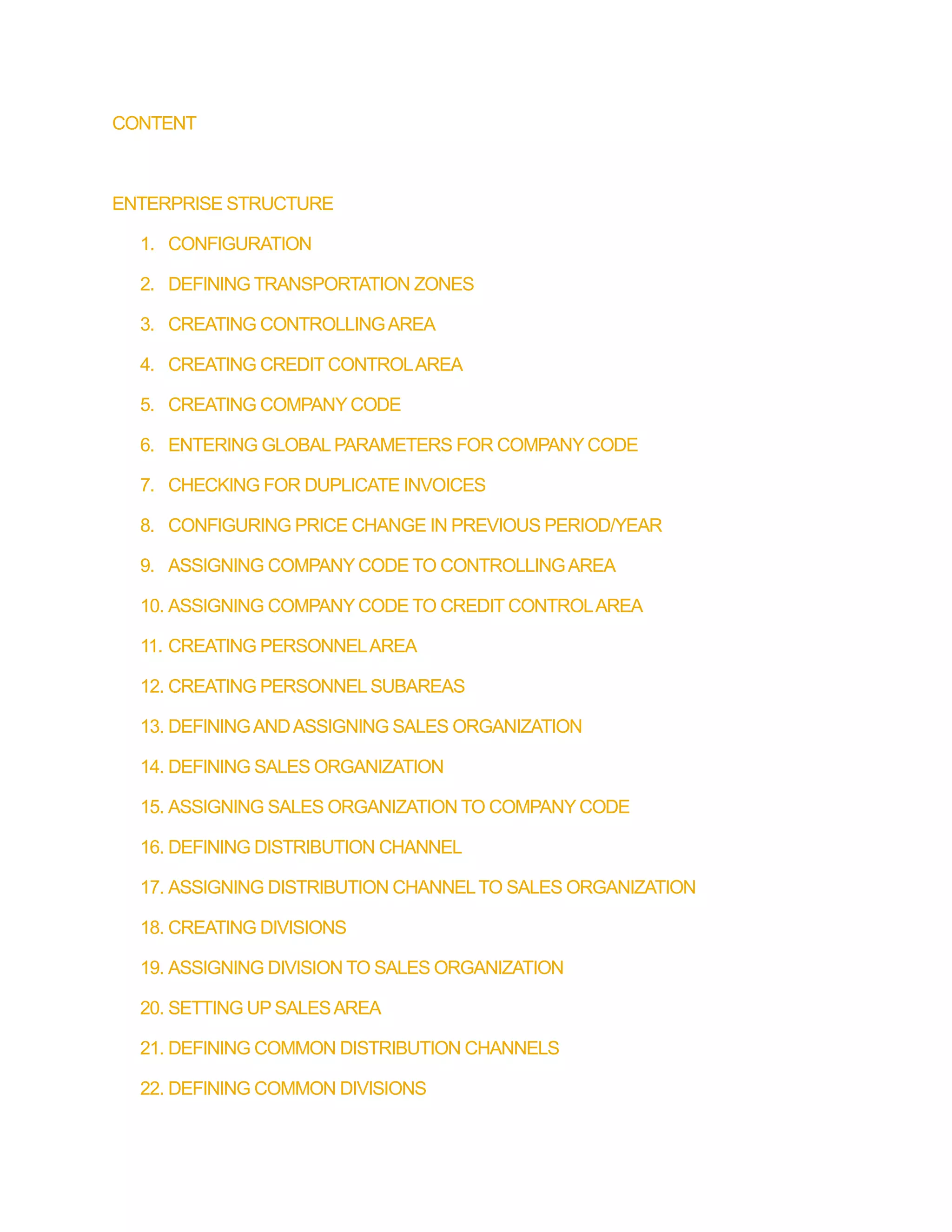
CONTENT
ENTERPRISE STRUCTURE
1. CONFIGURATION
2. DEFINING TRANSPORTATION ZONES
3. CREATING CONTROLLINGAREA
4. CREATING CREDIT CONTROLAREA
5. CREATING COMPANYCODE
6. ENTERING GLOBAL PARAMETERS FOR COMPANY CODE
7. CHECKING FOR DUPLICATE INVOICES
8. CONFIGURING PRICE CHANGE IN PREVIOUS PERIOD/YEAR
9. ASSIGNING COMPANY CODE TO CONTROLLINGAREA
10. ASSIGNING COMPANY CODE TO CREDIT CONTROLAREA
11. CREATING PERSONNELAREA
12. CREATING PERSONNEL SUBAREAS
13. DEFININGANDASSIGNING SALES ORGANIZATION
14. DEFINING SALES ORGANIZATION
15. ASSIGNING SALES ORGANIZATION TO COMPANYCODE
16. DEFINING DISTRIBUTION CHANNEL
17. ASSIGNING DISTRIBUTION CHANNELTO SALES ORGANIZATION
18. CREATING DIVISIONS
19. ASSIGNING DIVISION TO SALES ORGANIZATION
20. SETTING UP SALESAREA
21. DEFINING COMMON DISTRIBUTION CHANNELS
22. DEFINING COMMON DIVISIONS
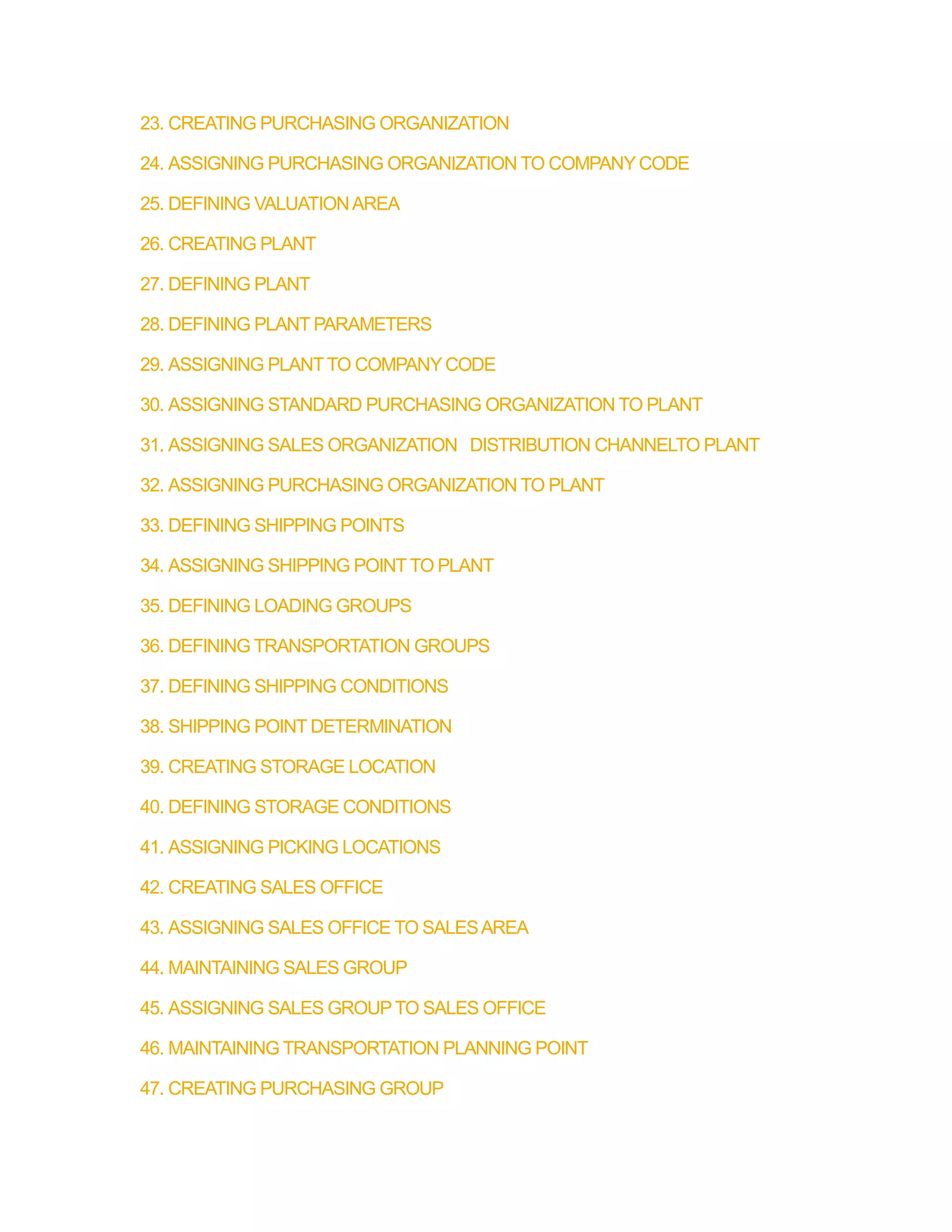
23. CREATING PURCHASING ORGANIZATION
24. ASSIGNING PURCHASING ORGANIZATION TO COMPANYCODE
25. DEFINING VALUATIONAREA
26. CREATING PLANT
27. DEFINING PLANT
28. DEFINING PLANT PARAMETERS
29. ASSIGNING PLANTTO COMPANYCODE
30. ASSIGNING STANDARD PURCHASING ORGANIZATION TO PLANT
31. ASSIGNING SALES ORGANIZATION DISTRIBUTION CHANNELTO PLANT
32. ASSIGNING PURCHASING ORGANIZATION TO PLANT
33. DEFINING SHIPPING POINTS
34. ASSIGNING SHIPPING POINTTO PLANT
35. DEFINING LOADING GROUPS
36. DEFINING TRANSPORTATION GROUPS
37. DEFINING SHIPPING CONDITIONS
38. SHIPPING POINT DETERMINATION
39. CREATING STORAGE LOCATION
40. DEFINING STORAGE CONDITIONS
41. ASSIGNING PICKING LOCATIONS
42. CREATING SALES OFFICE
43. ASSIGNING SALES OFFICE TO SALESAREA
44. MAINTAINING SALES GROUP
45. ASSIGNING SALES GROUPTO SALES OFFICE
46. MAINTAINING TRANSPORTATION PLANNING POINT
47. CREATING PURCHASING GROUP
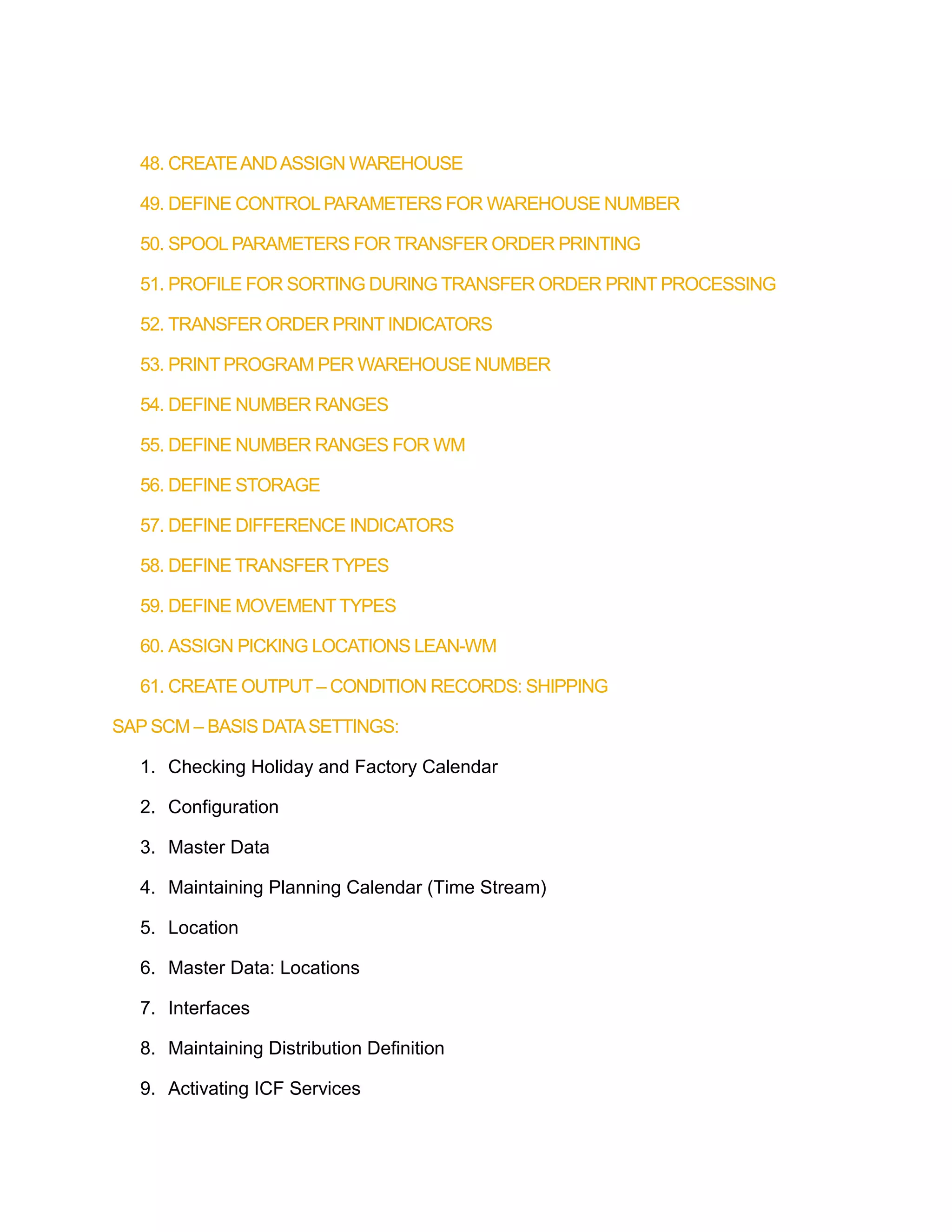
48. CREATEANDASSIGN WAREHOUSE
49. DEFINE CONTROLPARAMETERS FOR WAREHOUSE NUMBER
50. SPOOL PARAMETERS FOR TRANSFER ORDER PRINTING
51. PROFILE FOR SORTING DURING TRANSFER ORDER PRINT PROCESSING
52. TRANSFER ORDER PRINT INDICATORS
53. PRINT PROGRAM PER WAREHOUSE NUMBER
54. DEFINE NUMBER RANGES
55. DEFINE NUMBER RANGES FOR WM
56. DEFINE STORAGE
57. DEFINE DIFFERENCE INDICATORS
58. DEFINE TRANSFER TYPES
59. DEFINE MOVEMENTTYPES
60. ASSIGN PICKING LOCATIONS LEAN-WM
61. CREATE OUTPUT – CONDITION RECORDS: SHIPPING
SAP SCM – BASIS DATASETTINGS:
1. Checking Holiday and Factory Calendar
2. Configuration
3. Master Data
4. Maintaining Planning Calendar (Time Stream)
5. Location
6. Master Data: Locations
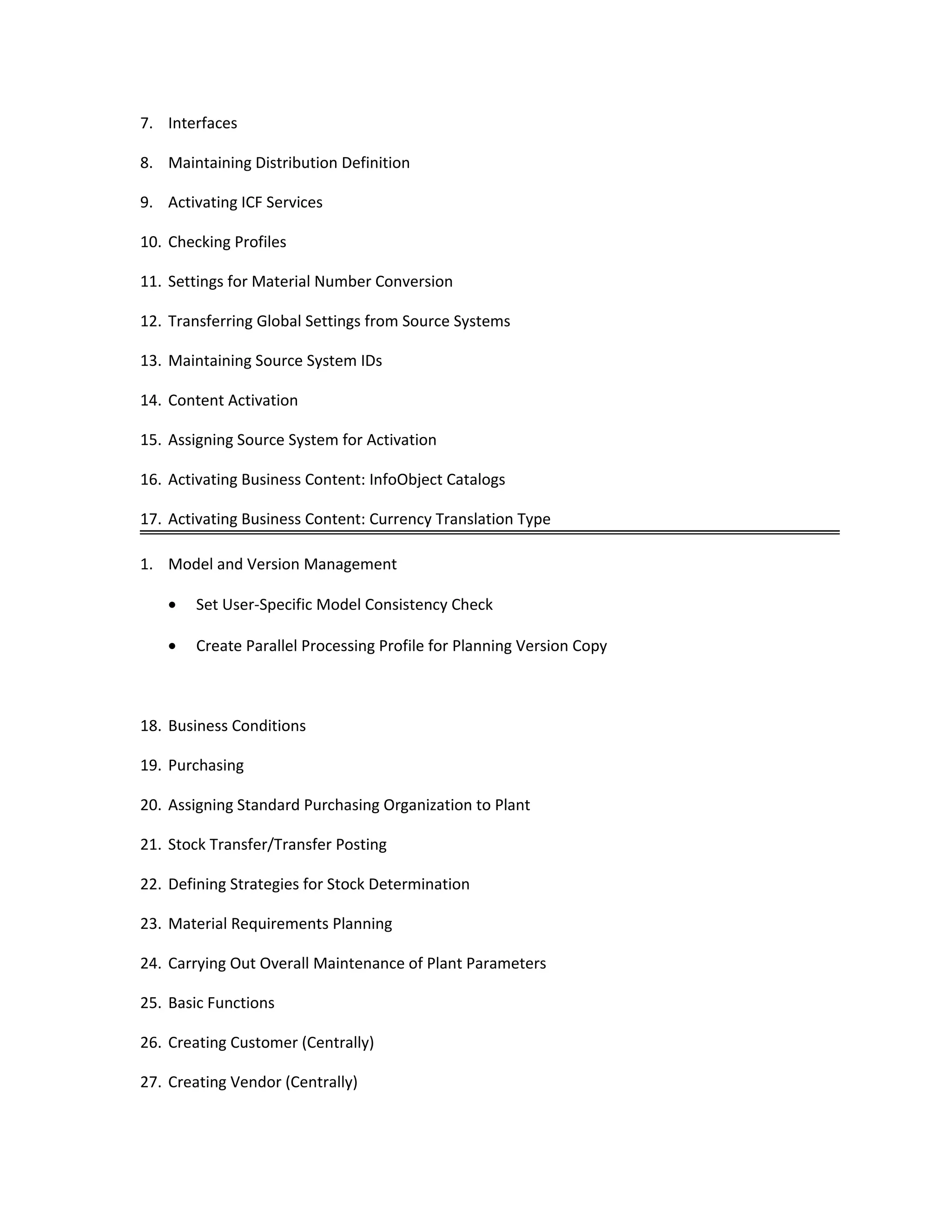
7. Interfaces
8. Maintaining Distribution Definition
9. Activating ICF Services
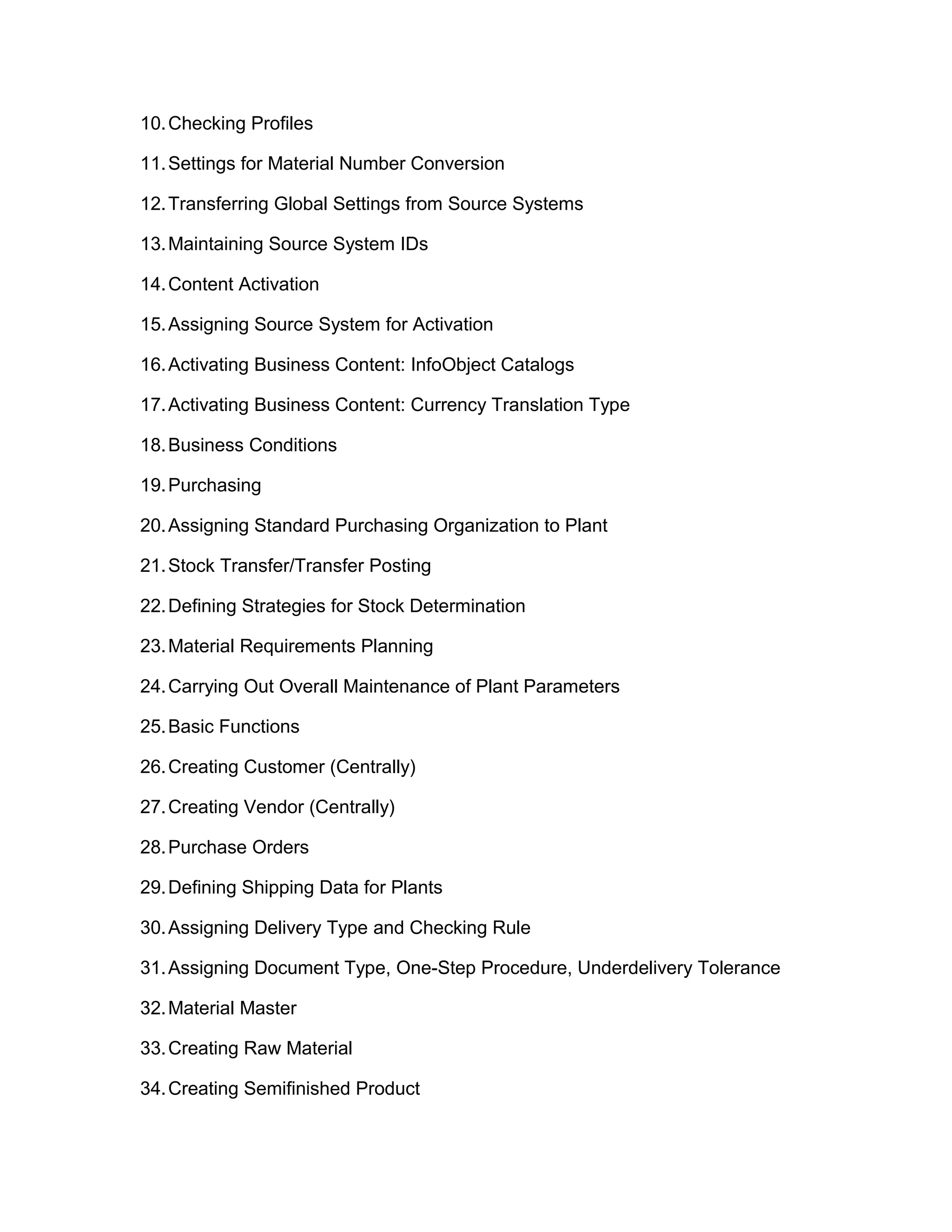
10.Checking Profiles
11.Settings for Material Number Conversion
12.Transferring Global Settings from Source Systems
13.Maintaining Source System IDs
14.Content Activation
15.Assigning Source System for Activation
16.Activating Business Content: InfoObject Catalogs
17.Activating Business Content: Currency Translation Type
18.Business Conditions
19.Purchasing
20.Assigning Standard Purchasing Organization to Plant
21.Stock Transfer/Transfer Posting
22.Defining Strategies for Stock Determination
23.Material Requirements Planning
24.Carrying Out Overall Maintenance of Plant Parameters
25.Basic Functions
26.Creating Customer (Centrally)
27.Creating Vendor (Centrally)
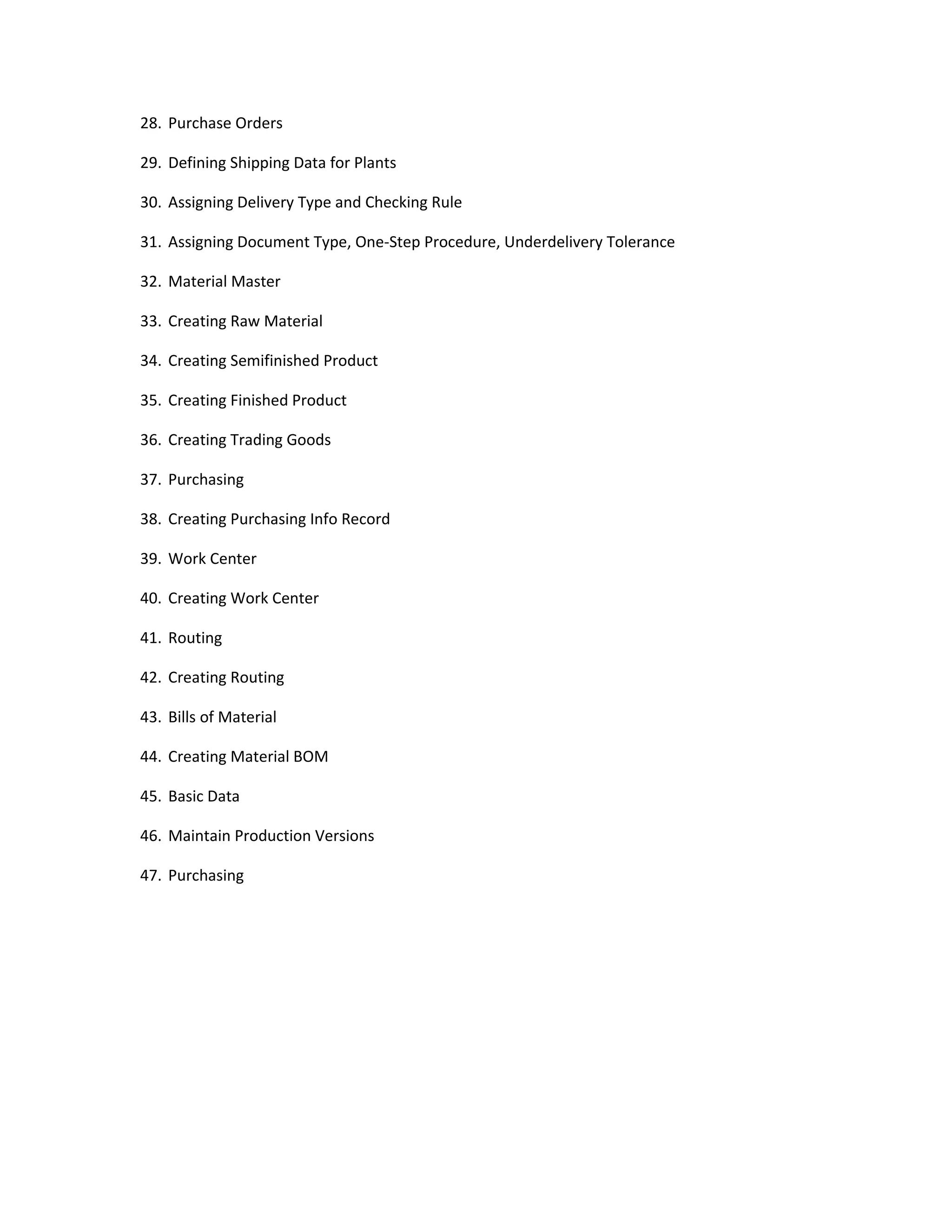
28.Purchase Orders
29.Defining Shipping Data for Plants
30.Assigning Delivery Type and Checking Rule
31.Assigning Document Type, One-Step Procedure, Underdelivery Tolerance
32.Material Master
33.Creating Raw Material
34.Creating Semifinished Product
35.Creating Finished Product
36.Creating Trading Goods
37.Purchasing
38.Creating Purchasing Info Record
39.Work Center
40.Creating Work Center
41.Routing
42.Creating Routing
43.Bills of Material
44.Creating Material BOM
45.Basic Data
46.Maintain Production Versions
47.Purchasing
48.Demand Planning Settings, Macros and Chart Engine:
49.Create Storage Bucket Profile
50.Create Time Bucket Profile
51.Create Planning Object Structure
52.Create Planning Area
53.Create Planning Version 001
54.Maintain Forecast Profile
55.TCreate Diagnosis Group
56.Maintain Characteristic Value Combination
57.Initialize Planning Area
58.Maintain Distribution Definition
59.Create Planning Books and Data Views
60.Setup Macros
61.Setup Chart Engine
62.Create and Assign Demand Planner
63.Key Points
64.Keep data consistency in both detail level and aggregation level.
65.Choose automatic forecasting model to improve forecast quality.
66.Define different contents and layouts for each planning book and data view, to
suit different planners’ requirements.
67.Macros are used to make calculations, generate alerts, change attributes of a
row, column or cell, etc.
68.Obtain a clearer overview of the data with Chart Engine.
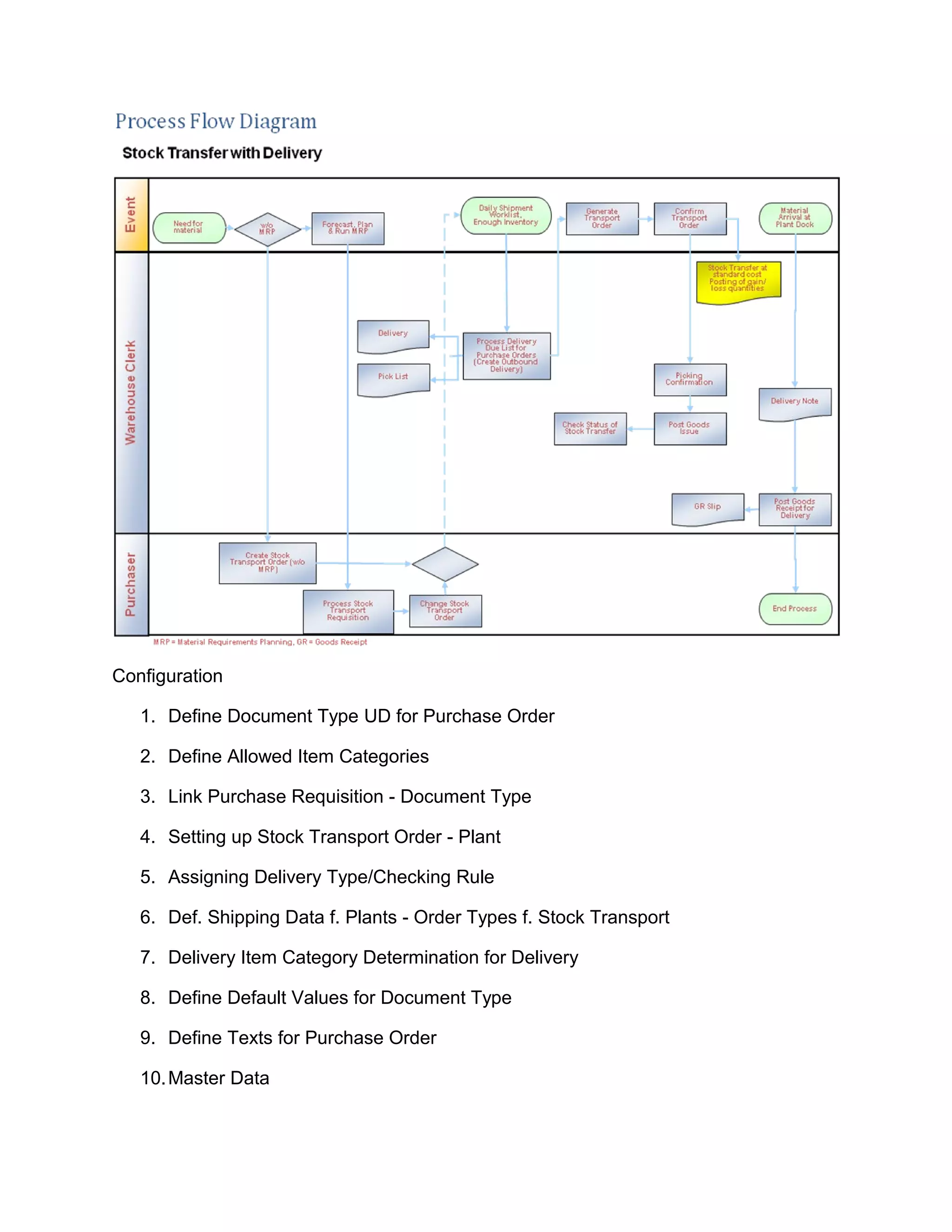
(Spl Pur Sce:)STOCK TRANSFER WITH DELIVERY
The stock transfer process begins with a requirement to transfer material from one plant
to another within the same company code. This request, a stock transfer requisition,
may be created automatically by MRP in the procuring plant, or manually by a buyer.
The process also works without MRP. Here, the buyer creates the stock transport order
directly. The only master data requirement is the material master to support the stock
transfer process. The material master must exist in both the procuring (receiving) plant
and the providing (issuing) plant. Unlike other purchase orders, stock transfer purchase
orders are not subject to approval. A buyer validates the accuracy of the stock transfer
purchase requisition and converts it into a stock transfer purchase order. Without MRP,
the buyer creates the stock transfer purchase order directly. A (Role:User)warehouse
clerk at the issuing plant monitors the materials to be (Trs Mgt)shipped, and creates
necessary deliveries(OutBound Delivery). Once a delivery is created, a (wm
Activity)pick list is generated for the (Material Derimantion)materials. A warehouse clerk
gathers the materials and confirms the picked quantities. Once the delivery is complete,
the delivery quantities are issued, appropriate documentation is generated, and the
shipment is sent, ending the process for the issuing plant.
Goods are received at the receiving plant referencing (Copy Control) the delivery
number on the shipping documents. Inventory is received into a location based on fixed
parameters proposed from the material master which can be changed at time of
purchase order creation or goods receipt (transactional data capture).
Process Flow
This scenario consists of the following steps:
Creating stock transport order
Creating delivery for stock transport order
Key Points
Supports all required documents for stock transfers with delivery
Supports all required master data aspects like batch management and serial numbers
• Monitors stock in transit (2 step)-Intrim Sce(WM+IM)
• Delivery costs can be entered in the stock transport order(FiCO setting)
Configuration
1. Define Document Type UD for Purchase Order
2. Define Allowed Item Categories
3. Link Purchase Requisition - Document Type
4. Setting up Stock Transport Order - Plant
5. Assigning Delivery Type/Checking Rule
6. Def. Shipping Data f. Plants - Order Types f. Stock Transport
7. Delivery Item Category Determination for Delivery
8. Define Default Values for Document Type
9. Define Texts for Purchase Order
10.Master Data
11.Creating Message Condition for PO Type UD
PHYSICAL INVENTORY /
INVENTORY COUNT & ADJUSTMENT
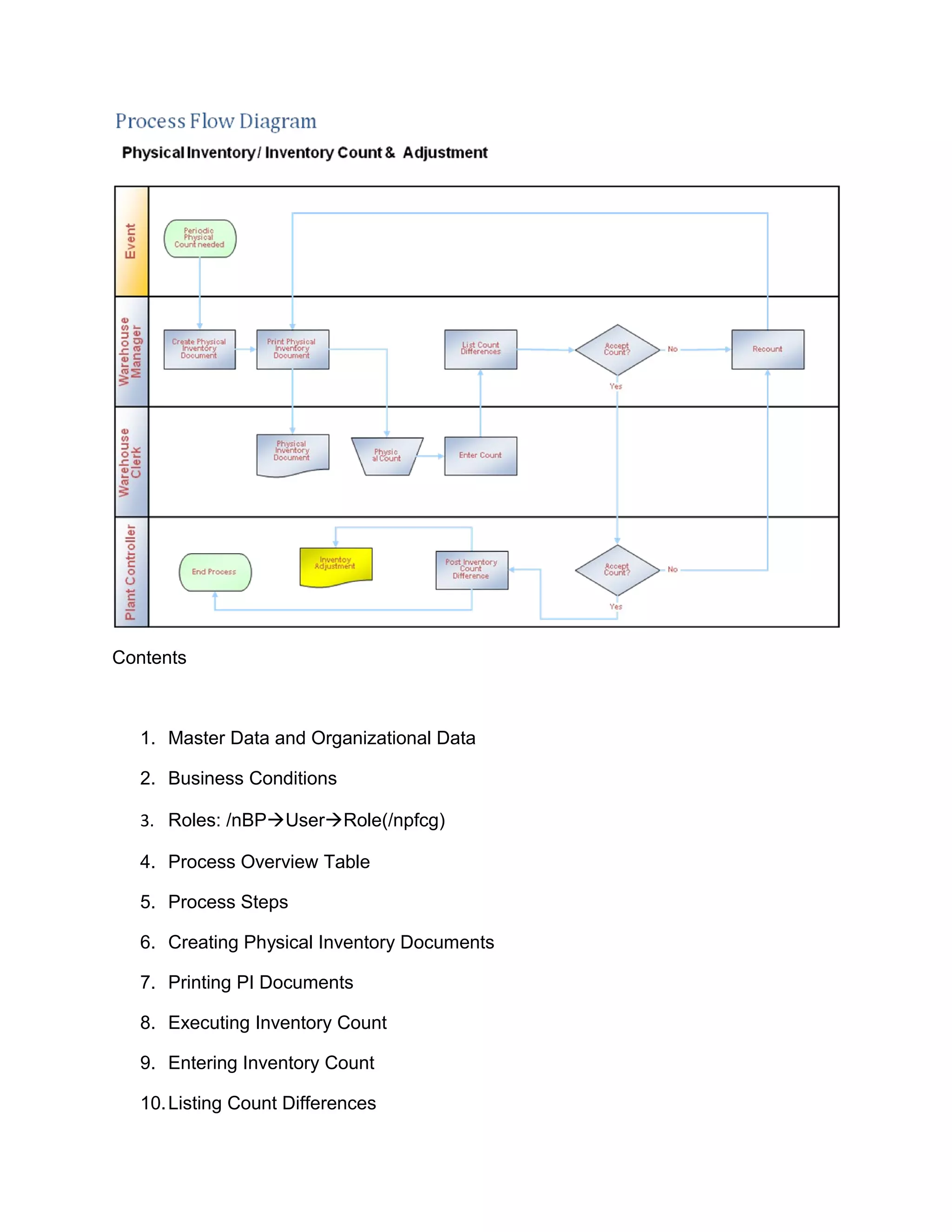
This scenario shows the periodic process of making necessary adjustments to stock on
hand after a physical count.
The process begins with the generation of the required inventory count sheets.
Materials can be blocked here for posting during the physical inventory. Once the
inventory sheets are printed out(Output), the actual physical inventory count is realized
for the given materials. Afterwards, the count result is entered in the system and then
any discrepancies against the system quantities are reviewed. The inventory may be
recounted until final counts are accepted and inventory differences are posted.
Process Flow
This scenario consists of the following steps:
Creating physical inventory documents
Printing PI documents
Executing count and entering the count result in the system
Listing count differences
Posting count differences
Contents
1. Master Data and Organizational Data
2. Business Conditions
3. Roles: /nBPUserRole(/npfcg)
4. Process Overview Table
5. Process Steps
6. Creating Physical Inventory Documents
7. Printing PI Documents
8. Executing Inventory Count
9. Entering Inventory Count
10.Listing Count Differences
11.Recounting
12.Posting Differences
13.Reversal of Process Steps
14.Design Considerations / Assumptions
15.SAP ERP Reports
16.Used Forms
17.Physical Inventory Document
Process Overview Table
Step
Name
External
Process
Reference
Business
Conditio
n
Role Transaction
Code
Expected
Results
Create
Physical
Inventory
Document
s
Warehouse
Manager
MI31 The system
generates
physical
inventory
documents.
Print PI
Document
s
Warehouse
Manager
MI21 The system
generates
a physical
inventory
count
sheet,
documents
are printed.
Execute
Count
Warehouse
Manager
Enter
Count
Warehouse
Manager
MI04 Counts are
entered.
List Count
Difference
s
Warehouse
Manager
MI20 The system
generates
a report
about the
count
differences.
Recount Warehouse
Manager
MI11 New
physical
inventory
document
is created.
Post
Difference
s
Warehouse
Manager
MI20 Differences
are posted.
Warehouse Management – LE SAP ECC SYSTEM.
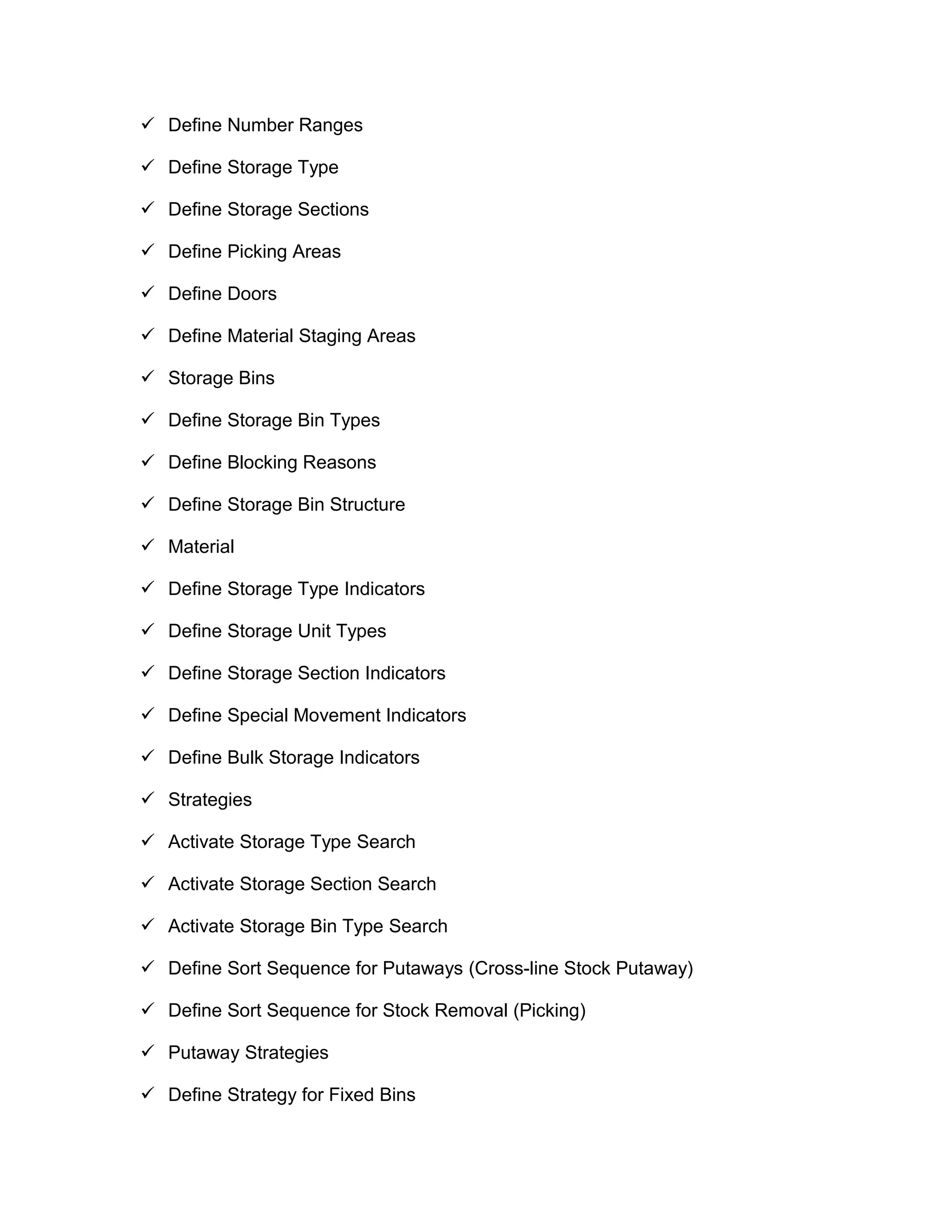
• Master Data
• Define Field Usage
• Define Control Parameters for Warehouse Number
• Define Number Ranges
• Define Storage Type
• Define Storage Sections
• Define Picking Areas
• Define Doors
• Define Material Staging Areas
• Storage Bins
• Material
Warehouse Management
Concept for Warehouse Management
 Master Data
 Define Field Usage
 Define Control Parameters for Warehouse Number
 Define Number Ranges
 Define Storage Type
 Define Storage Sections
 Define Picking Areas
 Define Doors
 Define Material Staging Areas
 Storage Bins
 Define Storage Bin Types
 Define Blocking Reasons
 Define Storage Bin Structure
 Material
 Define Storage Type Indicators
 Define Storage Unit Types
 Define Storage Section Indicators
 Define Special Movement Indicators
 Define Bulk Storage Indicators
 Strategies
 Activate Storage Type Search
 Activate Storage Section Search
 Activate Storage Bin Type Search
 Define Sort Sequence for Putaways (Cross-line Stock Putaway)
 Define Sort Sequence for Stock Removal (Picking)
 Putaway Strategies
 Define Strategy for Fixed Bins
 Define Strategy for Open Storage
 Define Strategy for Addition to Existing Stock
 Define Strategy for Empty Storage Bin
 Define Strategy for Pallets
 Define Strategy for Bulk Storage
 Define Strategy "Near Picking Bin"
 Develop Extensions for Putaway Strategies
 Stock Removal Strategies
 Define FIFO Strategy
 Define Strategy for "Stringent FIFO"
 Define LIFO Strategy
 Define Strategy for Partial Pallet Quantity
 Define Strategy for Large/Small Quantities
 Define Strategy for Expiration Date
 Define "Fixed Bin" Strategy
 Develop Extensions for Picking Strategies
 Return Transfers
SAP SCM – Basis
1. Checking Holiday and Factory Calendar
2. Configuration
3. Master Data
4. Maintaining Planning Calendar (Time Stream)
5. Location
6. Master Data: Locations
7. Interfaces
8. Maintaining Distribution Definition
9. Activating ICF Services
10. Checking Profiles
11. Settings for Material Number Conversion
12. Transferring Global Settings from Source Systems
13. Maintaining Source System IDs
14. Content Activation
15. Assigning Source System for Activation
16. Activating Business Content: InfoObject Catalogs
17. Activating Business Content: Currency Translation Type
1. Model and Version Management
• Set User-Specific Model Consistency Check
• Create Parallel Processing Profile for Planning Version Copy
18. Business Conditions
19. Purchasing
20. Assigning Standard Purchasing Organization to Plant
21. Stock Transfer/Transfer Posting
22. Defining Strategies for Stock Determination
23. Material Requirements Planning
24. Carrying Out Overall Maintenance of Plant Parameters
25. Basic Functions
26. Creating Customer (Centrally)
27. Creating Vendor (Centrally)
28. Purchase Orders
29. Defining Shipping Data for Plants
30. Assigning Delivery Type and Checking Rule
31. Assigning Document Type, One-Step Procedure, Underdelivery Tolerance
32. Material Master
33. Creating Raw Material
34. Creating Semifinished Product
35. Creating Finished Product
36. Creating Trading Goods
37. Purchasing
38. Creating Purchasing Info Record
39. Work Center
40. Creating Work Center
41. Routing
42. Creating Routing
43. Bills of Material
44. Creating Material BOM
45. Basic Data
46. Maintain Production Versions
47. Purchasing

Sap scm ewm na muk 11 02

  • 1.
    CONTENT ENTERPRISE STRUCTURE 1. CONFIGURATION 2.DEFINING TRANSPORTATION ZONES 3. CREATING CONTROLLINGAREA 4. CREATING CREDIT CONTROLAREA 5. CREATING COMPANYCODE 6. ENTERING GLOBAL PARAMETERS FOR COMPANY CODE 7. CHECKING FOR DUPLICATE INVOICES 8. CONFIGURING PRICE CHANGE IN PREVIOUS PERIOD/YEAR 9. ASSIGNING COMPANY CODE TO CONTROLLINGAREA 10. ASSIGNING COMPANY CODE TO CREDIT CONTROLAREA 11. CREATING PERSONNELAREA 12. CREATING PERSONNEL SUBAREAS 13. DEFININGANDASSIGNING SALES ORGANIZATION 14. DEFINING SALES ORGANIZATION 15. ASSIGNING SALES ORGANIZATION TO COMPANYCODE 16. DEFINING DISTRIBUTION CHANNEL 17. ASSIGNING DISTRIBUTION CHANNELTO SALES ORGANIZATION 18. CREATING DIVISIONS 19. ASSIGNING DIVISION TO SALES ORGANIZATION 20. SETTING UP SALESAREA 21. DEFINING COMMON DISTRIBUTION CHANNELS 22. DEFINING COMMON DIVISIONS
  • 2.
    23. CREATING PURCHASINGORGANIZATION 24. ASSIGNING PURCHASING ORGANIZATION TO COMPANYCODE 25. DEFINING VALUATIONAREA 26. CREATING PLANT 27. DEFINING PLANT 28. DEFINING PLANT PARAMETERS 29. ASSIGNING PLANTTO COMPANYCODE 30. ASSIGNING STANDARD PURCHASING ORGANIZATION TO PLANT 31. ASSIGNING SALES ORGANIZATION DISTRIBUTION CHANNELTO PLANT 32. ASSIGNING PURCHASING ORGANIZATION TO PLANT 33. DEFINING SHIPPING POINTS 34. ASSIGNING SHIPPING POINTTO PLANT 35. DEFINING LOADING GROUPS 36. DEFINING TRANSPORTATION GROUPS 37. DEFINING SHIPPING CONDITIONS 38. SHIPPING POINT DETERMINATION 39. CREATING STORAGE LOCATION 40. DEFINING STORAGE CONDITIONS 41. ASSIGNING PICKING LOCATIONS 42. CREATING SALES OFFICE 43. ASSIGNING SALES OFFICE TO SALESAREA 44. MAINTAINING SALES GROUP 45. ASSIGNING SALES GROUPTO SALES OFFICE 46. MAINTAINING TRANSPORTATION PLANNING POINT 47. CREATING PURCHASING GROUP
  • 3.
    48. CREATEANDASSIGN WAREHOUSE 49.DEFINE CONTROLPARAMETERS FOR WAREHOUSE NUMBER 50. SPOOL PARAMETERS FOR TRANSFER ORDER PRINTING 51. PROFILE FOR SORTING DURING TRANSFER ORDER PRINT PROCESSING 52. TRANSFER ORDER PRINT INDICATORS 53. PRINT PROGRAM PER WAREHOUSE NUMBER 54. DEFINE NUMBER RANGES 55. DEFINE NUMBER RANGES FOR WM 56. DEFINE STORAGE 57. DEFINE DIFFERENCE INDICATORS 58. DEFINE TRANSFER TYPES 59. DEFINE MOVEMENTTYPES 60. ASSIGN PICKING LOCATIONS LEAN-WM 61. CREATE OUTPUT – CONDITION RECORDS: SHIPPING SAP SCM – BASIS DATASETTINGS: 1. Checking Holiday and Factory Calendar 2. Configuration 3. Master Data 4. Maintaining Planning Calendar (Time Stream) 5. Location 6. Master Data: Locations 7. Interfaces 8. Maintaining Distribution Definition 9. Activating ICF Services
  • 4.
    10.Checking Profiles 11.Settings forMaterial Number Conversion 12.Transferring Global Settings from Source Systems 13.Maintaining Source System IDs 14.Content Activation 15.Assigning Source System for Activation 16.Activating Business Content: InfoObject Catalogs 17.Activating Business Content: Currency Translation Type 18.Business Conditions 19.Purchasing 20.Assigning Standard Purchasing Organization to Plant 21.Stock Transfer/Transfer Posting 22.Defining Strategies for Stock Determination 23.Material Requirements Planning 24.Carrying Out Overall Maintenance of Plant Parameters 25.Basic Functions 26.Creating Customer (Centrally) 27.Creating Vendor (Centrally) 28.Purchase Orders 29.Defining Shipping Data for Plants 30.Assigning Delivery Type and Checking Rule 31.Assigning Document Type, One-Step Procedure, Underdelivery Tolerance 32.Material Master 33.Creating Raw Material 34.Creating Semifinished Product
  • 5.
    35.Creating Finished Product 36.CreatingTrading Goods 37.Purchasing 38.Creating Purchasing Info Record 39.Work Center 40.Creating Work Center 41.Routing 42.Creating Routing 43.Bills of Material 44.Creating Material BOM 45.Basic Data 46.Maintain Production Versions 47.Purchasing 48.Demand Planning Settings, Macros and Chart Engine: 49.Create Storage Bucket Profile 50.Create Time Bucket Profile 51.Create Planning Object Structure 52.Create Planning Area 53.Create Planning Version 001 54.Maintain Forecast Profile 55.TCreate Diagnosis Group 56.Maintain Characteristic Value Combination 57.Initialize Planning Area 58.Maintain Distribution Definition
  • 6.
    59.Create Planning Booksand Data Views 60.Setup Macros 61.Setup Chart Engine 62.Create and Assign Demand Planner 63.Key Points 64.Keep data consistency in both detail level and aggregation level. 65.Choose automatic forecasting model to improve forecast quality. 66.Define different contents and layouts for each planning book and data view, to suit different planners’ requirements. 67.Macros are used to make calculations, generate alerts, change attributes of a row, column or cell, etc. 68.Obtain a clearer overview of the data with Chart Engine. (Spl Pur Sce:)STOCK TRANSFER WITH DELIVERY The stock transfer process begins with a requirement to transfer material from one plant to another within the same company code. This request, a stock transfer requisition, may be created automatically by MRP in the procuring plant, or manually by a buyer. The process also works without MRP. Here, the buyer creates the stock transport order directly. The only master data requirement is the material master to support the stock transfer process. The material master must exist in both the procuring (receiving) plant and the providing (issuing) plant. Unlike other purchase orders, stock transfer purchase orders are not subject to approval. A buyer validates the accuracy of the stock transfer purchase requisition and converts it into a stock transfer purchase order. Without MRP, the buyer creates the stock transfer purchase order directly. A (Role:User)warehouse clerk at the issuing plant monitors the materials to be (Trs Mgt)shipped, and creates necessary deliveries(OutBound Delivery). Once a delivery is created, a (wm Activity)pick list is generated for the (Material Derimantion)materials. A warehouse clerk gathers the materials and confirms the picked quantities. Once the delivery is complete, the delivery quantities are issued, appropriate documentation is generated, and the shipment is sent, ending the process for the issuing plant.
  • 7.
    Goods are receivedat the receiving plant referencing (Copy Control) the delivery number on the shipping documents. Inventory is received into a location based on fixed parameters proposed from the material master which can be changed at time of purchase order creation or goods receipt (transactional data capture). Process Flow This scenario consists of the following steps: Creating stock transport order Creating delivery for stock transport order Key Points Supports all required documents for stock transfers with delivery Supports all required master data aspects like batch management and serial numbers • Monitors stock in transit (2 step)-Intrim Sce(WM+IM) • Delivery costs can be entered in the stock transport order(FiCO setting)
  • 8.
    Configuration 1. Define DocumentType UD for Purchase Order 2. Define Allowed Item Categories 3. Link Purchase Requisition - Document Type 4. Setting up Stock Transport Order - Plant 5. Assigning Delivery Type/Checking Rule 6. Def. Shipping Data f. Plants - Order Types f. Stock Transport 7. Delivery Item Category Determination for Delivery 8. Define Default Values for Document Type 9. Define Texts for Purchase Order 10.Master Data
  • 9.
    11.Creating Message Conditionfor PO Type UD PHYSICAL INVENTORY / INVENTORY COUNT & ADJUSTMENT This scenario shows the periodic process of making necessary adjustments to stock on hand after a physical count. The process begins with the generation of the required inventory count sheets. Materials can be blocked here for posting during the physical inventory. Once the inventory sheets are printed out(Output), the actual physical inventory count is realized for the given materials. Afterwards, the count result is entered in the system and then any discrepancies against the system quantities are reviewed. The inventory may be recounted until final counts are accepted and inventory differences are posted. Process Flow This scenario consists of the following steps: Creating physical inventory documents Printing PI documents Executing count and entering the count result in the system Listing count differences Posting count differences
  • 10.
    Contents 1. Master Dataand Organizational Data 2. Business Conditions 3. Roles: /nBPUserRole(/npfcg) 4. Process Overview Table 5. Process Steps 6. Creating Physical Inventory Documents 7. Printing PI Documents 8. Executing Inventory Count 9. Entering Inventory Count 10.Listing Count Differences
  • 11.
    11.Recounting 12.Posting Differences 13.Reversal ofProcess Steps 14.Design Considerations / Assumptions 15.SAP ERP Reports 16.Used Forms 17.Physical Inventory Document Process Overview Table Step Name External Process Reference Business Conditio n Role Transaction Code Expected Results Create Physical Inventory Document s Warehouse Manager MI31 The system generates physical inventory documents. Print PI Document s Warehouse Manager MI21 The system generates a physical inventory count sheet, documents are printed. Execute Count Warehouse Manager Enter Count Warehouse Manager MI04 Counts are entered. List Count Difference s Warehouse Manager MI20 The system generates a report about the count differences. Recount Warehouse Manager MI11 New physical
  • 12.
    inventory document is created. Post Difference s Warehouse Manager MI20 Differences areposted. Warehouse Management – LE SAP ECC SYSTEM. • Master Data • Define Field Usage • Define Control Parameters for Warehouse Number • Define Number Ranges • Define Storage Type • Define Storage Sections • Define Picking Areas • Define Doors • Define Material Staging Areas • Storage Bins • Material Warehouse Management Concept for Warehouse Management  Master Data  Define Field Usage  Define Control Parameters for Warehouse Number
  • 13.
     Define NumberRanges  Define Storage Type  Define Storage Sections  Define Picking Areas  Define Doors  Define Material Staging Areas  Storage Bins  Define Storage Bin Types  Define Blocking Reasons  Define Storage Bin Structure  Material  Define Storage Type Indicators  Define Storage Unit Types  Define Storage Section Indicators  Define Special Movement Indicators  Define Bulk Storage Indicators  Strategies  Activate Storage Type Search  Activate Storage Section Search  Activate Storage Bin Type Search  Define Sort Sequence for Putaways (Cross-line Stock Putaway)  Define Sort Sequence for Stock Removal (Picking)  Putaway Strategies  Define Strategy for Fixed Bins
  • 14.
     Define Strategyfor Open Storage  Define Strategy for Addition to Existing Stock  Define Strategy for Empty Storage Bin  Define Strategy for Pallets  Define Strategy for Bulk Storage  Define Strategy "Near Picking Bin"  Develop Extensions for Putaway Strategies  Stock Removal Strategies  Define FIFO Strategy  Define Strategy for "Stringent FIFO"  Define LIFO Strategy  Define Strategy for Partial Pallet Quantity  Define Strategy for Large/Small Quantities  Define Strategy for Expiration Date  Define "Fixed Bin" Strategy  Develop Extensions for Picking Strategies  Return Transfers SAP SCM – Basis 1. Checking Holiday and Factory Calendar 2. Configuration 3. Master Data 4. Maintaining Planning Calendar (Time Stream) 5. Location 6. Master Data: Locations
  • 15.
    7. Interfaces 8. MaintainingDistribution Definition 9. Activating ICF Services 10. Checking Profiles 11. Settings for Material Number Conversion 12. Transferring Global Settings from Source Systems 13. Maintaining Source System IDs 14. Content Activation 15. Assigning Source System for Activation 16. Activating Business Content: InfoObject Catalogs 17. Activating Business Content: Currency Translation Type 1. Model and Version Management • Set User-Specific Model Consistency Check • Create Parallel Processing Profile for Planning Version Copy 18. Business Conditions 19. Purchasing 20. Assigning Standard Purchasing Organization to Plant 21. Stock Transfer/Transfer Posting 22. Defining Strategies for Stock Determination 23. Material Requirements Planning 24. Carrying Out Overall Maintenance of Plant Parameters 25. Basic Functions 26. Creating Customer (Centrally) 27. Creating Vendor (Centrally)
  • 16.
    28. Purchase Orders 29.Defining Shipping Data for Plants 30. Assigning Delivery Type and Checking Rule 31. Assigning Document Type, One-Step Procedure, Underdelivery Tolerance 32. Material Master 33. Creating Raw Material 34. Creating Semifinished Product 35. Creating Finished Product 36. Creating Trading Goods 37. Purchasing 38. Creating Purchasing Info Record 39. Work Center 40. Creating Work Center 41. Routing 42. Creating Routing 43. Bills of Material 44. Creating Material BOM 45. Basic Data 46. Maintain Production Versions 47. Purchasing