

By: Saagar Parikh
Stingrays are a group of rays, which are cartilaginous fish related to sharks
and consist of about seven major families. Most stingrays have one or more
barbed stingers on the tail, which are used exclusively in self-defense. The
flattened bodies of stingrays allow them to effectively conceal themselves in
their environment. Because their eyes are on top of their bodies and their
mouths on the undersides, stingrays cannot see their prey; instead, they use
smell and electroreceptors similar to those of sharks. A stingray's diet
includes small fish, snails, clams, shrimp, and some other small sea
creatures.
The Sixgill Stingray is a species of stingray and the only remaining member of
the family Hexatrygonidae. The Sixgill Stingray has a bulky, flabby body with a
rounded pectoral fin disc that is longer than wide, and a long, triangular snout. The
tiny eyes are placed far apart, and unlike other stingrays, the sixgill has six gills
instead of the usual five. The disc is purplish to pinkish brown above, darkening
slightly at the fin margins.
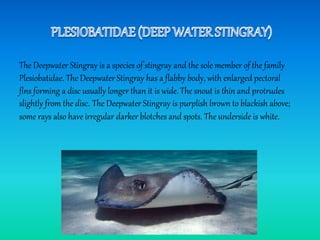
The Deepwater Stingray is a species of stingray and the sole member of the family
Plesiobatidae. The Deepwater Stingray has a flabby body, with enlarged pectoral
fins forming a disc usually longer than it is wide. The snout is thin and protrudes
slightly from the disc. The Deepwater Stingray is purplish brown to blackish above;
some rays also have irregular darker blotches and spots. The underside is white.
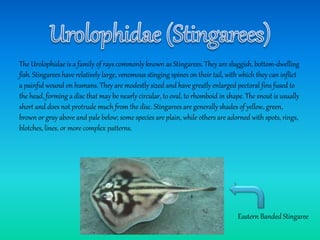
The Urolophidae is a family of rays commonly known as Stingarees. They are sluggish, bottom-dwelling
fish. Stingarees have relatively large, venomous stinging spines on their tail, with which they can inflict
a painful wound on humans. They are modestly sized and have greatly enlarged pectoral fins fused to
the head, forming a disc that may be nearly circular, to oval, to rhomboid in shape. The snout is usually
short and does not protrude much from the disc. Stingarees are generally shades of yellow, green,
brown or gray above and pale below; some species are plain, while others are adorned with spots, rings,
blotches, lines, or more complex patterns.
Eastern Banded Stingaree
• New Ireland stingaree
• Sepia stingray
• Crossback stingaree
• Haller's round ray
• Java stingaree
• Kai stingaree
• Sandyback stingaree
• Spotted round ray
• Wide stingaree
• Greenback stingaree
• Yellowback stingaree
• Spotted stingaree
• Circular stingaree
• Lobed stingaree
• Sparsely-spotted stingaree
• Patchwork stingaree
• Mitotic stingaree
• Coastal stingaree
• Brown stingaree
• Coral sea stingaree
• Kapala stingaree
• Common stingaree
• Western shovelnose stingaree
• Striped stingaree
• Masked stingaree
• Eastern shovelnose stingaree
New Ireland
Stingaree
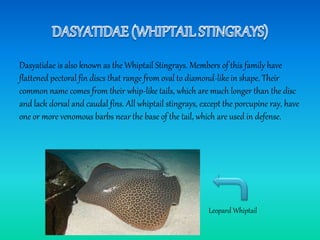
Dasyatidae is also known as the Whiptail Stingrays. Members of this family have
flattened pectoral fin discs that range from oval to diamond-like in shape. Their
common name comes from their whip-like tails, which are much longer than the disc
and lack dorsal and caudal fins. All whiptail stingrays, except the porcupine ray, have
one or more venomous barbs near the base of the tail, which are used in defense.
Leopard Whiptail
• Common stingray
• Longnose stingray
• Roughtail stingray
• Bluntnose stingray
• Atlantic stingray
• Blue stingray
• Whip stingray
• Bennett's stingray
• Pale-edged stingray
• Thorny freshwater stingray
• Daisy stingray
• Smalltooth stingray
• Short-tail stingray
• Whiptail stingray
• Diamond stingray
• Brown stingray
• Longtail stingray
• Leopard whipray
• Bleeker's whipray
• Pink whipray
• Pale-spot whip ray
• Honeycomb whipray
• Tubemouth whipray
• Arabian banded whipray
• Plain maskray
• Round ribbontail ray
• Marbled stingray
• Blackish stingray
• Chinese stingray
• Thorntail stingray
• Estuary stingray
• Smalleye stingray
• Cow stingray
• Southern stingray
• Giant stumptail stingray
• Pitted stingray
• Sharpsnout stingray
• Multispine giant stingray
• Yantai stingray
• Smooth freshwater stingray
• Tortonese's stingray
• Pearl stingray
• Blackedge whipray
• Marbled whipray
• Jenkins whipray
• Marbled freshwater whip ray
• Black-spotted whipray
• Pacific chupare
• Fine-spotted leopard whipray
• Ribbontail stingray
• Painted maskray
• Pelagic stingray
• Mekong stingray
• Izu stingray
• Brazilian large-eyed stingray
• Dwarf black stingray
• Cowtail stingray
• Roughnose stingray
• Narrowtail Stingray
• Starrynose stingray
• Honeycomb stingray
• Scaly whipray
• Ganges stingray
• Dwarf whipray
• Sharpnose stingray
• Round whip ray
• Freshwater whipray
• Whitenose whip ray
• Mangrove whipray
• Chupare stingray
• Smalleye whip ray
• White-rimmed stingray
• Hortle's whipray
• Round stingray
• Porcupine ray
• Blue-spotted stingray
• Peppered maskray
River stingrays are Neotropical freshwater fishes of the Potamotrygonidae family.
They are generally pale brown, variously mottled or speckled, and have venomous
caudal barbs. They are one of the most feared freshwater fishes in the Neotropical
region, sometimes more feared than piranhas and electric eels. However, they are not
dangerous unless stepped on or otherwise threatened. River stingrays are the only
family of stingray completely restricted to fresh water habitats. This famiy also
contains the third largest freshwater fish in the world, the Mekong “giant” river
stingray.
Rosette River Stingray
• Porcupine river stingray
• South American freshwater stingray
• Bigtooth river stingray
• Smooth back river stingray
• Magdalena river stingray
• Short-tailed river stingray
• Thorny river stingray
• Red-blotched river stingray
• Raspy river stingray
• Parnaiba river stingray
• Rosette river stingray
• Largespot river stingray
• White-blotched river stingray
• Maracaibo river stingray
• Discus ray
• Long-tailed river stingray
• Gomes’s round ray
• Rosa’s round ray
• Ocellate River Stingray
• Mekong River Stingray
Ocellate River Stingray
Largespot River Stingray
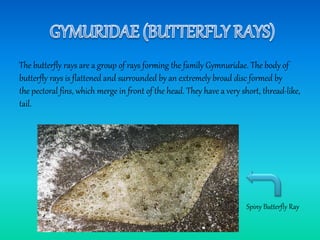
The butterfly rays are a group of rays forming the family Gymnuridae. The body of
butterfly rays is flattened and surrounded by an extremely broad disc formed by
the pectoral fins, which merge in front of the head. They have a very short, thread-like,
tail.
Spiny Butterfly Ray
• Smooth butterfly ray
• Spiny butterfly ray
• Long-tailed butterfly ray
• Tentacled butterfly ray
• Madeira butterfly ray
• Japanese butterfly ray
• Zonetail butterfly ray
• California butterfly ray
• Longsnout butterfly ray
• Australian butterfly ray
• Butterfly ray
• Twin-spot butterfly ray
• Thornback Butterfly Ray
Smooth Butterfly Ray
Thornback Butterfly Ray
The eagle rays are a group of cartilaginous fishes in the family Myliobatidae,
consisting mostly of large species living in the open ocean rather than on the sea
bottom. They are excellent, powerful swimmers and are able to breach the water up to
several meters above the surface. Compared with other rays, they have long tails, and
well-defined rhomboidal bodies. Most are quite large in size and have some of the
most popular stingrays.
Giant Manta (Manta Ray)
• Common eagle ray
• Bullnose eagle ray
• Japanese eagle ray
• Bat eagle ray
• Eagle ray
• Australian bull ray
• Southern eagle ray
• Chilean eagle ray
• Purple eagle ray
• Peruvian eagle ray
• Snouted eagle ray
• Shortnose eagle ray
• Spotted eagle ray
• Longheaded eagle ray
• Ocellated eagle ray
• Naru eagle ray
• Mottled eagle ray
• Banded eagle ray
• Flapnose ray
• Oman cownose ray
• Bull ray
• Ornate eagle ray
• Rough eagle ray
• Devil fish
• Lesser devil ray
• Spinetail mobula
• Shortfin devil ray
• Longhorned mobula
• Lesser Guinean devil ray
• Chilean devil ray
• Smoothtail mobula
• Munk's devil ray
• Giant manta
• Alfred manta
• Lusitanian cownose ray
• Cownose ray
• Brazilian cownose ray
• Rough cownose ray
• Pacific cownose ray
• Australian cownose ray

Stingrays

  • 1.
  • 2.
    Stingrays are agroup of rays, which are cartilaginous fish related to sharks and consist of about seven major families. Most stingrays have one or more barbed stingers on the tail, which are used exclusively in self-defense. The flattened bodies of stingrays allow them to effectively conceal themselves in their environment. Because their eyes are on top of their bodies and their mouths on the undersides, stingrays cannot see their prey; instead, they use smell and electroreceptors similar to those of sharks. A stingray's diet includes small fish, snails, clams, shrimp, and some other small sea creatures.
  • 3.
    The Sixgill Stingrayis a species of stingray and the only remaining member of the family Hexatrygonidae. The Sixgill Stingray has a bulky, flabby body with a rounded pectoral fin disc that is longer than wide, and a long, triangular snout. The tiny eyes are placed far apart, and unlike other stingrays, the sixgill has six gills instead of the usual five. The disc is purplish to pinkish brown above, darkening slightly at the fin margins.
  • 4.
    The Deepwater Stingrayis a species of stingray and the sole member of the family Plesiobatidae. The Deepwater Stingray has a flabby body, with enlarged pectoral fins forming a disc usually longer than it is wide. The snout is thin and protrudes slightly from the disc. The Deepwater Stingray is purplish brown to blackish above; some rays also have irregular darker blotches and spots. The underside is white.
  • 5.
    The Urolophidae isa family of rays commonly known as Stingarees. They are sluggish, bottom-dwelling fish. Stingarees have relatively large, venomous stinging spines on their tail, with which they can inflict a painful wound on humans. They are modestly sized and have greatly enlarged pectoral fins fused to the head, forming a disc that may be nearly circular, to oval, to rhomboid in shape. The snout is usually short and does not protrude much from the disc. Stingarees are generally shades of yellow, green, brown or gray above and pale below; some species are plain, while others are adorned with spots, rings, blotches, lines, or more complex patterns. Eastern Banded Stingaree
  • 6.
    • New Irelandstingaree • Sepia stingray • Crossback stingaree • Haller's round ray • Java stingaree • Kai stingaree • Sandyback stingaree • Spotted round ray • Wide stingaree • Greenback stingaree • Yellowback stingaree • Spotted stingaree • Circular stingaree • Lobed stingaree • Sparsely-spotted stingaree • Patchwork stingaree • Mitotic stingaree • Coastal stingaree • Brown stingaree • Coral sea stingaree • Kapala stingaree • Common stingaree • Western shovelnose stingaree • Striped stingaree • Masked stingaree • Eastern shovelnose stingaree New Ireland Stingaree
  • 7.
    Dasyatidae is alsoknown as the Whiptail Stingrays. Members of this family have flattened pectoral fin discs that range from oval to diamond-like in shape. Their common name comes from their whip-like tails, which are much longer than the disc and lack dorsal and caudal fins. All whiptail stingrays, except the porcupine ray, have one or more venomous barbs near the base of the tail, which are used in defense. Leopard Whiptail
  • 8.
    • Common stingray •Longnose stingray • Roughtail stingray • Bluntnose stingray • Atlantic stingray • Blue stingray • Whip stingray • Bennett's stingray • Pale-edged stingray • Thorny freshwater stingray • Daisy stingray • Smalltooth stingray • Short-tail stingray • Whiptail stingray • Diamond stingray • Brown stingray • Longtail stingray • Leopard whipray • Bleeker's whipray • Pink whipray • Pale-spot whip ray • Honeycomb whipray • Tubemouth whipray • Arabian banded whipray • Plain maskray • Round ribbontail ray • Marbled stingray • Blackish stingray • Chinese stingray • Thorntail stingray • Estuary stingray • Smalleye stingray • Cow stingray • Southern stingray • Giant stumptail stingray • Pitted stingray • Sharpsnout stingray • Multispine giant stingray • Yantai stingray • Smooth freshwater stingray • Tortonese's stingray • Pearl stingray • Blackedge whipray • Marbled whipray • Jenkins whipray • Marbled freshwater whip ray • Black-spotted whipray • Pacific chupare • Fine-spotted leopard whipray • Ribbontail stingray • Painted maskray • Pelagic stingray • Mekong stingray • Izu stingray • Brazilian large-eyed stingray • Dwarf black stingray • Cowtail stingray • Roughnose stingray • Narrowtail Stingray • Starrynose stingray • Honeycomb stingray • Scaly whipray • Ganges stingray • Dwarf whipray • Sharpnose stingray • Round whip ray • Freshwater whipray • Whitenose whip ray • Mangrove whipray • Chupare stingray • Smalleye whip ray • White-rimmed stingray • Hortle's whipray • Round stingray • Porcupine ray • Blue-spotted stingray • Peppered maskray
  • 9.
    River stingrays areNeotropical freshwater fishes of the Potamotrygonidae family. They are generally pale brown, variously mottled or speckled, and have venomous caudal barbs. They are one of the most feared freshwater fishes in the Neotropical region, sometimes more feared than piranhas and electric eels. However, they are not dangerous unless stepped on or otherwise threatened. River stingrays are the only family of stingray completely restricted to fresh water habitats. This famiy also contains the third largest freshwater fish in the world, the Mekong “giant” river stingray. Rosette River Stingray
  • 10.
    • Porcupine riverstingray • South American freshwater stingray • Bigtooth river stingray • Smooth back river stingray • Magdalena river stingray • Short-tailed river stingray • Thorny river stingray • Red-blotched river stingray • Raspy river stingray • Parnaiba river stingray • Rosette river stingray • Largespot river stingray • White-blotched river stingray • Maracaibo river stingray • Discus ray • Long-tailed river stingray • Gomes’s round ray • Rosa’s round ray • Ocellate River Stingray • Mekong River Stingray Ocellate River Stingray Largespot River Stingray
  • 11.
    The butterfly raysare a group of rays forming the family Gymnuridae. The body of butterfly rays is flattened and surrounded by an extremely broad disc formed by the pectoral fins, which merge in front of the head. They have a very short, thread-like, tail. Spiny Butterfly Ray
  • 12.
    • Smooth butterflyray • Spiny butterfly ray • Long-tailed butterfly ray • Tentacled butterfly ray • Madeira butterfly ray • Japanese butterfly ray • Zonetail butterfly ray • California butterfly ray • Longsnout butterfly ray • Australian butterfly ray • Butterfly ray • Twin-spot butterfly ray • Thornback Butterfly Ray Smooth Butterfly Ray Thornback Butterfly Ray
  • 13.
    The eagle raysare a group of cartilaginous fishes in the family Myliobatidae, consisting mostly of large species living in the open ocean rather than on the sea bottom. They are excellent, powerful swimmers and are able to breach the water up to several meters above the surface. Compared with other rays, they have long tails, and well-defined rhomboidal bodies. Most are quite large in size and have some of the most popular stingrays. Giant Manta (Manta Ray)
  • 14.
    • Common eagleray • Bullnose eagle ray • Japanese eagle ray • Bat eagle ray • Eagle ray • Australian bull ray • Southern eagle ray • Chilean eagle ray • Purple eagle ray • Peruvian eagle ray • Snouted eagle ray • Shortnose eagle ray • Spotted eagle ray • Longheaded eagle ray • Ocellated eagle ray • Naru eagle ray • Mottled eagle ray • Banded eagle ray • Flapnose ray • Oman cownose ray • Bull ray • Ornate eagle ray • Rough eagle ray • Devil fish • Lesser devil ray • Spinetail mobula • Shortfin devil ray • Longhorned mobula • Lesser Guinean devil ray • Chilean devil ray • Smoothtail mobula • Munk's devil ray • Giant manta • Alfred manta • Lusitanian cownose ray • Cownose ray • Brazilian cownose ray • Rough cownose ray • Pacific cownose ray • Australian cownose ray