Emerging Spatial Information Systems And Applications Brian N Hilton
Emerging Spatial Information Systems And Applications Brian N Hilton
Emerging Spatial Information Systems And Applications Brian N Hilton
Emerging Spatial Information Systems And Applications Brian N Hilton
Emerging Spatial Information Systems And Applications Brian N Hilton
1.
Emerging Spatial InformationSystems And
Applications Brian N Hilton download
https://ebookbell.com/product/emerging-spatial-information-
systems-and-applications-brian-n-hilton-4117580
Explore and download more ebooks at ebookbell.com
2.
Here are somerecommended products that we believe you will be
interested in. You can click the link to download.
The Emerging Spatial Mind 1st Edition Jodie M Plumert John P Spencer
https://ebookbell.com/product/the-emerging-spatial-mind-1st-edition-
jodie-m-plumert-john-p-spencer-1782136
Corporeality Emergent Consciousness Within Its Spatial Dimensions
Emergent Consciousness Within Its Spatial Dimensions 1st Edition Maya
Nanitchkova Ztrk
https://ebookbell.com/product/corporeality-emergent-consciousness-
within-its-spatial-dimensions-emergent-consciousness-within-its-
spatial-dimensions-1st-edition-maya-nanitchkova-ztrk-51296036
Spatial Augmented Reality Merging Real And Virtual Worlds Oliver
Bimber
https://ebookbell.com/product/spatial-augmented-reality-merging-real-
and-virtual-worlds-oliver-bimber-2207632
Emerging Itict And Ai Technologies Affecting Society Mousmi Ajay
Chaurasia
https://ebookbell.com/product/emerging-itict-and-ai-technologies-
affecting-society-mousmi-ajay-chaurasia-44938960
3.
Emerging Trends InIntelligent Systems Network Security Mohamed Ben
Ahmed
https://ebookbell.com/product/emerging-trends-in-intelligent-systems-
network-security-mohamed-ben-ahmed-45334068
Emerging Pollutants In Sewage Sludge And Soils Avelino Nezdelgado
https://ebookbell.com/product/emerging-pollutants-in-sewage-sludge-
and-soils-avelino-nezdelgado-46084254
Emerging Ecosystemcentric Business Models For Sustainable Value
Creation Xenia Ziouvelou
https://ebookbell.com/product/emerging-ecosystemcentric-business-
models-for-sustainable-value-creation-xenia-ziouvelou-46091468
Emerging Trends In Iot And Integration With Data Science Cloud
Computing And Big Data Analytics Pelin Yildirim Taser
https://ebookbell.com/product/emerging-trends-in-iot-and-integration-
with-data-science-cloud-computing-and-big-data-analytics-pelin-
yildirim-taser-46091472
Emerging Practices In The Age Of Automated Digital Journalism Models
Languages And Storytelling Berta Garcaorosa
https://ebookbell.com/product/emerging-practices-in-the-age-of-
automated-digital-journalism-models-languages-and-storytelling-berta-
garcaorosa-46110028
Family 68.—MORMYRIDÆ. (3Genera, 25 Species.)
"Fresh-water fishes, with scales on the body and tail but not on the
head, and no barbels."
Distribution.—The Ethiopian Region.
Most abundant in the Nile, a few from the Gambia, the Congo, and
Rovuma. The genera are:—
Mormyrus (1 sp.), Nile, Gambia, West Africa, Mozambique, Rovuma;
Hyperopsius (2 sp.), Nile and West Africa; Mormyrops (4 sp.), Nile,
West Africa and Mozambique.
Family 69.—GYMNARCHIDÆ. (1 Genus, 1 Species.)
"Fresh-water fishes, resembling the Mormyridæ, but with tapering
finless tail, and neither anal nor ventral fins."
Distribution.—Ethiopian region.
The only genus, Gymnarchus, inhabits the Nile and the rivers of West
Africa.
Family 70.—ESOCIDÆ. (1 Genus, 7 Species.)
"Fresh-water fishes, with scaly bodies, no barbels, and dorsal fins
situated towards the tail."
Distribution.—The Nearctic and Palæarctic regions.
7.
One species, thePike (Esox lucius) ranges from Lapland to Turkey,
and in America from the Arctic regions to the Albany river; the
remainder are American species extending South as far as New
Orleans.
Family 71.—UMBRIDÆ. (1 Genus, 2 Species.)
"Small fresh-water scaly fishes, without barbels or adipose fin."
Distribution.—Central Europe and Temperate North America.
Family 72.—SCOMBRESOCIDÆ. (5 Genera, 136 Species.)
"Marine or fresh-water fishes, with scaly bodies and a series of
keeled scales along each side of the belly."
Distribution.—Temperate and tropical regions.
All the genera have a wide distribution. A species of Belone and one
of Scombresox are found on the British coast. The Flying-fishes
(Exocetus, 44 sp.), belong to this family. They abound in all tropical
seas and extend as far as the Mediterranean and Australia. None of
the genera are exclusively fresh-water, but a few species of Belone,
and Hemiramphus are found in rivers in various parts of the world.
Family 73.—CYPRINODONTIDÆ. (20 Genera, 106 Species.)
"Fresh-water fishes, covered with scales, the sexes frequently
differing, mostly viviparous."
8.
Distribution.—Southern Europe, Asia,Africa and North America, but
most abundant in Tropical America.
The distribution of the genera is as follows:—
Cyprinodon (11 sp.), Italy, North Africa and Western Asia to Persia,
also North America from Texas to New York; Fitzroya (1 sp.),
Montevideo; Characodon (1 sp.), Central America; Tellia (1 sp.),
Alpine pools of the Atlas: Limnurgus (1 sp.), Mexican plateau;
Lucania (1 sp.), Texas; Haplochilus (18 sp.), India, Java, Japan,
Tropical Africa, Madagascar, and the Seychelle Islands, Carolina to
Brazil, Jamaica; Fundulus (17 sp.), North and Central America and
Ecuador, Spain and East Africa; Rivulus (3 sp.), Tropical America,
Cuba and Trinidad; Orestias (6 sp.), Lake Titacaca, Andes; Jenynsia
(1 sp.), Rio Plata; Pseudoxiphophorus (2 sp.), Central America;
Belonesox (1 sp.), Central America; Gambusia (8 sp.), Antilles,
Central America and Texas; Anableps (3 sp.), Central and Equatorial
America; Pœcilia (16 sp.), Antilles, Central and South America;
Mollienesia (4 sp.), Louisiana to Mexico; Platypœcilus (1 sp.), Mexico;
Girardinus (10 sp.), Antilles and South Carolina to Uruguay; Lepistes
(1 sp.), Barbadoes.
Family 74.—HETEROPYGII. (2 Genera, 2 Species.)
"Fresh-water fishes, with posterior dorsal fin, and very small scales."
Distribution.—Fresh waters of the United States.
Amblyopsis (1 sp.) is a blind fish found in the caverns of Kentucky;
while Chologastes (1 sp.), which only differs from it in having perfect
eyes, is found in ditches in South Carolina.
9.
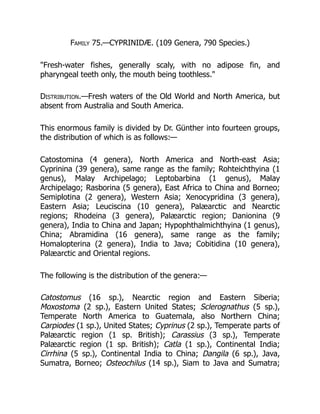
Family 75.—CYPRINIDÆ. (109Genera, 790 Species.)
"Fresh-water fishes, generally scaly, with no adipose fin, and
pharyngeal teeth only, the mouth being toothless."
Distribution.—Fresh waters of the Old World and North America, but
absent from Australia and South America.
This enormous family is divided by Dr. Günther into fourteen groups,
the distribution of which is as follows:—
Catostomina (4 genera), North America and North-east Asia;
Cyprinina (39 genera), same range as the family; Rohteichthyina (1
genus), Malay Archipelago; Leptobarbina (1 genus), Malay
Archipelago; Rasborina (5 genera), East Africa to China and Borneo;
Semiplotina (2 genera), Western Asia; Xenocypridina (3 genera),
Eastern Asia; Leuciscina (10 genera), Palæarctic and Nearctic
regions; Rhodeina (3 genera), Palæarctic region; Danionina (9
genera), India to China and Japan; Hypophthalmichthyina (1 genus),
China; Abramidina (16 genera), same range as the family;
Homalopterina (2 genera), India to Java; Cobitidina (10 genera),
Palæarctic and Oriental regions.
The following is the distribution of the genera:—
Catostomus (16 sp.), Nearctic region and Eastern Siberia;
Moxostoma (2 sp.), Eastern United States; Sclerognathus (5 sp.),
Temperate North America to Guatemala, also Northern China;
Carpiodes (1 sp.), United States; Cyprinus (2 sp.), Temperate parts of
Palæarctic region (1 sp. British); Carassius (3 sp.), Temperate
Palæarctic region (1 sp. British); Catla (1 sp.), Continental India;
Cirrhina (5 sp.), Continental India to China; Dangila (6 sp.), Java,
Sumatra, Borneo; Osteochilus (14 sp.), Siam to Java and Sumatra;
10.
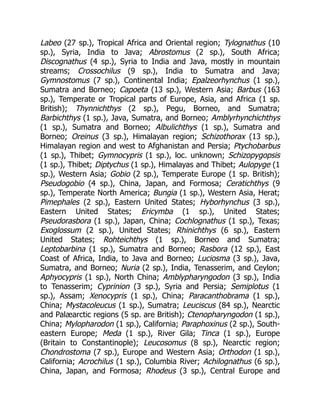
Labeo (27 sp.),Tropical Africa and Oriental region; Tylognathus (10
sp.), Syria, India to Java; Abrostomus (2 sp.), South Africa;
Discognathus (4 sp.), Syria to India and Java, mostly in mountain
streams; Crossochilus (9 sp.), India to Sumatra and Java;
Gymnostomus (7 sp.), Continental India; Epalzeorhynchus (1 sp.),
Sumatra and Borneo; Capoeta (13 sp.), Western Asia; Barbus (163
sp.), Temperate or Tropical parts of Europe, Asia, and Africa (1 sp.
British); Thynnichthys (2 sp.), Pegu, Borneo, and Sumatra;
Barbichthys (1 sp.), Java, Sumatra, and Borneo; Amblyrhynchichthys
(1 sp.), Sumatra and Borneo; Albulichthys (1 sp.), Sumatra and
Borneo; Oreinus (3 sp.), Himalayan region; Schizothorax (13 sp.),
Himalayan region and west to Afghanistan and Persia; Ptychobarbus
(1 sp.), Thibet; Gymnocypris (1 sp.), loc. unknown; Schizopygopsis
(1 sp.), Thibet; Diptychus (1 sp.), Himalayas and Thibet; Aulopyge (1
sp.), Western Asia; Gobio (2 sp.), Temperate Europe (1 sp. British);
Pseudogobio (4 sp.), China, Japan, and Formosa; Ceratichthys (9
sp.), Temperate North America; Bungia (1 sp.), Western Asia, Herat;
Pimephales (2 sp.), Eastern United States; Hyborhynchus (3 sp.),
Eastern United States; Ericymba (1 sp.), United States;
Pseudorasbora (1 sp.), Japan, China; Cochlognathus (1 sp.), Texas;
Exoglossum (2 sp.), United States; Rhinichthys (6 sp.), Eastern
United States; Rohteichthys (1 sp.), Borneo and Sumatra;
Leptobarbina (1 sp.), Sumatra and Borneo; Rasbora (12 sp.), East
Coast of Africa, India, to Java and Borneo; Luciosma (3 sp.), Java,
Sumatra, and Borneo; Nuria (2 sp.), India, Tenasserim, and Ceylon;
Aphyocypris (1 sp.), North China; Amblypharyngodon (3 sp.), India
to Tenasserim; Cyprinion (3 sp.), Syria and Persia; Semiplotus (1
sp.), Assam; Xenocypris (1 sp.), China; Paracanthobrama (1 sp.),
China; Mystacoleucus (1 sp.), Sumatra; Leuciscus (84 sp.), Nearctic
and Palæarctic regions (5 sp. are British); Ctenopharyngodon (1 sp.),
China; Mylopharodon (1 sp.), California; Paraphoxinus (2 sp.), South-
eastern Europe; Meda (1 sp.), River Gila; Tinca (1 sp.), Europe
(Britain to Constantinople); Leucosomus (8 sp.), Nearctic region;
Chondrostoma (7 sp.), Europe and Western Asia; Orthodon (1 sp.),
California; Acrochilus (1 sp.), Columbia River; Achilognathus (6 sp.),
China, Japan, and Formosa; Rhodeus (3 sp.), Central Europe and
11.
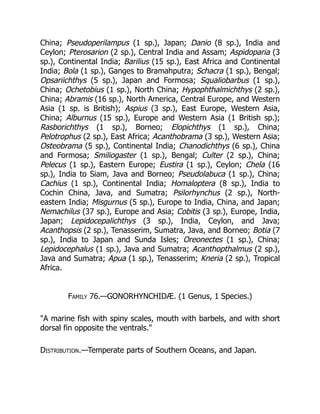
China; Pseudoperilampus (1sp.), Japan; Danio (8 sp.), India and
Ceylon; Pterosarion (2 sp.), Central India and Assam; Aspidoparia (3
sp.), Continental India; Barilius (15 sp.), East Africa and Continental
India; Bola (1 sp.), Ganges to Bramahputra; Schacra (1 sp.), Bengal;
Opsariichthys (5 sp.), Japan and Formosa; Squaliobarbus (1 sp.),
China; Ochetobius (1 sp.), North China; Hypophthalmichthys (2 sp.),
China; Abramis (16 sp.), North America, Central Europe, and Western
Asia (1 sp. is British); Aspius (3 sp.), East Europe, Western Asia,
China; Alburnus (15 sp.), Europe and Western Asia (1 British sp.);
Rasborichthys (1 sp.), Borneo; Elopichthys (1 sp.), China;
Pelotrophus (2 sp.), East Africa; Acanthobrama (3 sp.), Western Asia;
Osteobrama (5 sp.), Continental India; Chanodichthys (6 sp.), China
and Formosa; Smiliogaster (1 sp.), Bengal; Culter (2 sp.), China;
Pelecus (1 sp.), Eastern Europe; Eustira (1 sp.), Ceylon; Chela (16
sp.), India to Siam, Java and Borneo; Pseudolabuca (1 sp.), China;
Cachius (1 sp.), Continental India; Homaloptera (8 sp.), India to
Cochin China, Java, and Sumatra; Psilorhynchus (2 sp.), North-
eastern India; Misgurnus (5 sp.), Europe to India, China, and Japan;
Nemachilus (37 sp.), Europe and Asia; Cobitis (3 sp.), Europe, India,
Japan; Lepidocepalichthys (3 sp.), India, Ceylon, and Java;
Acanthopsis (2 sp.), Tenasserim, Sumatra, Java, and Borneo; Botia (7
sp.), India to Japan and Sunda Isles; Oreonectes (1 sp.), China;
Lepidocephalus (1 sp.), Java and Sumatra; Acanthopthalmus (2 sp.),
Java and Sumatra; Apua (1 sp.), Tenasserim; Kneria (2 sp.), Tropical
Africa.
Family 76.—GONORHYNCHIDÆ. (1 Genus, 1 Species.)
"A marine fish with spiny scales, mouth with barbels, and with short
dorsal fin opposite the ventrals."
Distribution.—Temperate parts of Southern Oceans, and Japan.
12.
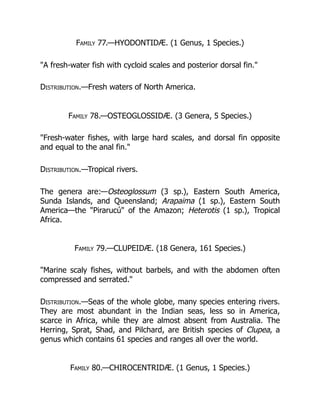
Family 77.—HYODONTIDÆ. (1Genus, 1 Species.)
"A fresh-water fish with cycloid scales and posterior dorsal fin."
Distribution.—Fresh waters of North America.
Family 78.—OSTEOGLOSSIDÆ. (3 Genera, 5 Species.)
"Fresh-water fishes, with large hard scales, and dorsal fin opposite
and equal to the anal fin."
Distribution.—Tropical rivers.
The genera are:—Osteoglossum (3 sp.), Eastern South America,
Sunda Islands, and Queensland; Arapaima (1 sp.), Eastern South
America—the "Pirarucú" of the Amazon; Heterotis (1 sp.), Tropical
Africa.
Family 79.—CLUPEIDÆ. (18 Genera, 161 Species.)
"Marine scaly fishes, without barbels, and with the abdomen often
compressed and serrated."
Distribution.—Seas of the whole globe, many species entering rivers.
They are most abundant in the Indian seas, less so in America,
scarce in Africa, while they are almost absent from Australia. The
Herring, Sprat, Shad, and Pilchard, are British species of Clupea, a
genus which contains 61 species and ranges all over the world.
Family 80.—CHIROCENTRIDÆ. (1 Genus, 1 Species.)
13.
"A marine fish,with thin deciduous scales, no barbels, and posterior
dorsal fin."
Distribution.—The Eastern seas from Africa to China.
Family 81.—ALEPOCEPHALIDÆ. (1 Genus, 1 Species.)
"A marine fish, covered with thin cycloid scales, no barbels, and
posterior dorsal fin."
Distribution.—Deep waters of the Mediterranean.
Family 82.—NOTOPTERIDÆ. (1 Genus, 5 Species.)
"Fresh-water fishes, without barbels, head and body scaly, long
tapering tail, and short posterior dorsal fin."
Distribution.—Rivers of India, Siam, the Sunda Islands, and West
Africa.
Family 83.—HALOSAURIDÆ. (1 Genus, 1 Species.)
"Marine fishes, with cycloid scales, a short median dorsal fin, and no
barbels."
Distribution.—Deep waters of the Atlantic, Madeira.
Family 84.—GYMNOTIDÆ. (5 Genera, 20 Species.)
14.
"Fresh-water fishes, withelongate bodies, pointed tail, and no dorsal
fin."
Distribution.—Tropical America from Trinidad to the River Parana.
The genera are distributed as follows:—
Sternarchus (8 sp.), Guiana and Brazil; Rhamphichthys (6 sp.),
Guiana and Brazil; Sternophygus (4 sp.), Tropical America; Carapus
(1 sp.), Trinidad to Brazil; Gymnotus, (1 sp.—the Electric eel),
Tropical South America.
Family 85.—SYMBRANCHIDÆ. (4 Genera, 6 Species.)
"Marine and fresh-water fishes, having elongate bodies without fins,
and very minute scales or none."
Distribution.—Fresh waters and coasts of Western Australia and
Tasmania.
The genera are:—
Amphipnous (1 sp.), Bengal; Monopterus (1 sp.), Siam to Northern
China and Sunda Islands; Symbranchus (3 sp.), Tropical America,
and India to Australia; Chilobranchus (1 sp.), Australia and Tasmania.
Family 86.—MURÆNIDÆ. (26 Genera, 230 Species.)
"Marine or fresh-water fishes, with cylindrical or band-like bodies and
no ventral fins."
15.
Distribution.—The seas andfresh waters of temperate and tropical
regions. This family is divided by Dr. Günther into two sub-families
and nine sections. The genus Anguilla, comprising our common Eel
and a number of species from all parts of the world, is the only one
which is found in fresh water, though even here most of the species
are marine. Anguilla and Conger are the only British genera.
Family 87.—PEGASIDÆ. (1 Genus, 4 Species.)
"Small marine fishes, covered with bony plates, and short opposite
dorsal and anal fins."
Distribution.—Indian Ocean and seas of China and Australia.
Order V.—LOPHOBRANCHII.
"Fish with a segmented bony covering, long snout, and small
toothless mouth."
Family 88.—SOLENOSTOMIDÆ. (1 Genus, 3 Species.)
"Marine Lophobranchii, with wide gill openings and two dorsal fins."
Distribution.—Indian Ocean, from Zanzibar to China and the
Moluccas.
Family 89.—SYNGNATHIDÆ. (15 Genera, 112 Species.)
16.
"Marine Lophobranchii, withvery small gill opening and one soft
dorsal fin."
Distribution.—All the tropical and temperate seas. Some species of
Syngnathus, Doryichthys, and Cœlonotus enter fresh water, and a
few live in it exclusively. Siphonostoma, Syngnathus, Nerophis, and
Hippocampus are British genera. The Hippocampina (5 genera, 25
sp.), or Sea-horses, are peculiar to the Indian and Pacific Oceans,
except three or four species of Hippocampus in the Atlantic and
Mediterranean.
Order VI.—PLECTOGNATHI.
"Fishes covered with rough scales or shields, having a narrow mouth,
and soft posterior dorsal fin."
Family 90.—SCLERODERMI. (7 Genera, 95 Species.)
"Marine Plectognathi, with toothed jaws."
Distribution.—Temperate and Tropical seas, but much more abundant
in the Tropics.
Family 91.—GYMNODONTES. (10 Genera, 82 Species.)
"Marine or fresh-water Plectognathi, with jaws modified into a beak."
Distribution.—Temperate and tropical regions.
17.
Some species ofTetrodon are found in the rivers of Tropical America,
Africa, and Asia. Species of Tetrodon and Orthagoriscus have been
found on the British coasts.
Sub-class II.—DIPNOI.
Family 92.—Sirenoidei. (3 Genera, 3 Species.)
"Eel-shaped fresh-water fishes, covered with cycloid scales; the
vertical fins forming a continuous border to the compressed tapering
tail."
Distribution.—Rivers of Tropical Africa, South America, and Australia.
The genera are:—Protopterus (1 sp.), Tropical Africa; Lepidosiren (1
sp.), Amazon Valley; Ceratodus (1 sp.), Queensland.
Sub-class III.—GANOIDEI.
Order I.—HOLOSTEI.
"Body covered with scales."
Family 93.—AMIIDÆ. (1 Genus, 1 Species.)
"A fresh-water fish, with cycloid scales and a long soft dorsal fin."
Distribution.—United States.
18.
Family 94.—POLYPTERIDÆ. (2Genera, 2 Species.)
"Fresh-water fishes, with ganoid scales and dorsal spines."
Distribution.—Central and Western Africa.
The genera are:—
Polypterus (1 sp.), the Nile and rivers of West Africa; Calamoichthys
(1 sp.), Old Calabar.
Family 95.—LEPIDOSTEIDÆ. (1 Genus, 3 Species.)
"Fresh-water fishes, with ganoid scales, and dorsal and anal fins
composed of articulated rays."
Distribution.—The genus Lepidosteus, the Garfishes or Bony Pikes,
inhabits North America to Mexico and Cuba.
Order II.—CHONDROSTEI.
"Sub-cartilaginous scaleless fishes with heterocercal tail, the skin
with osseous bucklers or naked."
Family 96.—ACCIPENSERIDÆ. (2 Genera, 20 Species.)
"Marine or fresh-water fishes with osseous bucklers and inferior
mouth."
19.
Distribution.—Temperate and Arcticregions of the northern
hemisphere. Accipenser (19 sp.), comprising the Sturgeons, has the
distribution of the family; most of the species are marine, but some
are confined to the Caspian and Black Seas and the great American
lakes with the rivers flowing into them, while the Danube,
Mississippi, and Columbia River have peculiar species. The other
genus, Scaphirhynchus (1 sp.), is confined to the Mississippi and its
tributaries.
Family 97.—POLYDONTIDÆ. (1 Genus, 2 Species.)
"Fresh-water fishes, with wide lateral mouth and naked skin."
Distribution.—The Mississippi and Yang-tse-kiang rivers.
Sub class IV.—CHONDROPTERYGII. (Sharks and Rays.)
Order I.—HOLOCEPHALA. (Chimæras.)
Family 98.—CHIMÆRIDÆ. (2 Genera, 4 Species.)
"Shark-like marine fishes, snout of the male with a prehensile organ."
Distribution.—Northern and Southern temperate seas. Chimæra is
British.
Order II.—PLAGIOSTOMATA.
Sub-order.—Selachoidea. (Sharks.)
20.
Family 99.—CARCHARIIDÆ. (11Genera, 59 Species.)
"Sharks with two dorsals and a nictitating membrane."
Distribution.—Seas of the Arctic, temperate, and tropical regions.
Species of Galeus and Mustelus have occurred on our coasts.
Family 100.—LAMNIDÆ. (5 Genera, 7 Species.)
"Sharks with two dorsals and no nictitating membrane."
Distribution.—Temperate and tropical seas. Species of Lamna,
Alopecias, and Selache have occurred in British seas.
Family 101.—RHINODONTIDÆ. (1 Genus, 1 Species.)
"Sharks with two dorsal fins, the second small, and no nictitating
membrane."
Distribution.—South and East Africa.
Family 102.—NOTIDANIDÆ. (1 Genus, 4 Species.)
"Sharks with one dorsal fin and no nictitating membrane."
Distribution.—Temperate and tropical seas, from the North Atlantic to
the Cape of Good Hope and California. One species has occurred on
our southern coasts.
21.
Family 103.—SCYLLIIDÆ. (7Genera, 25 Species.)
"Sharks with one dorsal fin and no nictitating membrane."
Distribution.—All temperate and tropical seas. Species of Scyllium
and Pristiurus are British.
Family 104.—CESTRACIONTIDÆ. (1 Genus, 4 Species.)
"Sharks with two dorsal fins and no nictitating membrane."
Distribution.—Pacific Ocean from Japan to New Zealand, Moluccan
Sea.
Family 105.—SPINACIDÆ. (10 Genera, 21 Species.)
"Sharks with two dorsal fins and no nictitating membrane, no anal
fin."
Distribution.—Arctic, temperate, and tropical seas. Species of
Acanthias, Læmargus, and Echinorhinus have occurred on our
coasts.
Family 106.—RHINIDÆ (1 Genus, 1 Species.)
"Sharks with depressed flat body and large expanded pectoral fins."
Distribution.—Temperate and tropical seas, from Britain to California
and Australia.
22.
Family 107.—PRISTIOPHORIDÆ. (1Genus, 4 Species.)
"Sharks with produced flat snout, armed with teeth on each edge."
Distribution.—Seas of Japan and Australia.
Sub-order Batoidei. (Rays.)
Family 108.—PRISTIDÆ. (1 Genus, 5 Species.)
"Rays with produced snout and lateral saw-like teeth."
Distribution.—Seas of tropical and sub-tropical regions.
Family 109.—RHINOBATIDÆ. (3 Genera, 15 Species.)
"Rays with long and strong tail, having a caudal and two dorsal fins."
Distribution.—Tropical and sub-tropical seas.
Family 110.—TORPEDINIDÆ. (6 Genera, 15 Species.)
"Rays with broad smooth disc, and an electric organ."
Distribution.—Tropical and temperate seas, from Britain to Tasmania.
Family 111.—RAIIDÆ. (4 Genera, 29 Species.)
23.
"Rays with broadrhombic disc and no serrated caudal spine."
Distribution.—All temperate and tropical seas. Several species of Raia
are found on our coasts.
Family 112.—TRYGONIDÆ (6 Genera, 43 Species.)
"Rays with the pectoral fins extending to end of snout."
Distribution.—Seas of all temperate and tropical regions, and rivers of
Tropical America. A species of Trygon has occurred on our Southern
coast. Ellipesurus and Tæniura are found in the fresh waters of the
interior of South America, while the latter genus occurs also in the
Indian seas, but not in the Atlantic.
Family 113.—MYLOBATIDÆ. (5 Genera, 22 Species.)
"Rays with very broad pectoral fins not extending to end of snout."
Distribution.—Temperate and tropical seas. A species of Myliobatis is
British, but most of the species and genera are confined to tropical
seas. Dicerobatis and Ceratoptera are very large Rays, commonly
called Sea-devils.
Sub-class V.—CYCLOSTOMATA.
"Cartilaginous fishes, with suctorial mouths and without lateral fins."
Family 114.—PETROMYZONTIDÆ. (4 Genera, 12 Species.)
24.
"Marine or fresh-watereel-like fishes, with suctorial mouths and
without barbels."
Distribution.—Coasts and fresh waters of temperate regions of both
hemispheres. Three species of Petromyzon (Lampreys), are British.
Family 115.—MYXINIDÆ. (2 Genera, 5 Species.)
"Marine eel-like fishes, with four pairs of barbels."
Distribution.—Seas of the temperate regions of both hemispheres.
Sub-class VI.—LEPTOCARDII.
Family 116.—CIRRHOSTOMI. (1 Genus, 1 Species.)
"A small marine fish with no jaws or fins, and with rudimentary
eyes."
Distribution.—The only species, the Lancelet (Amphioxus), is the
lowest form of living vertebrate. It is found in the temperate regions
of both hemispheres, and has occurred on our southern coast.
Remarks on the Distribution of Fishes.
Marine Fish.—There are about 80 families of marine fishes, and of
these no less than 50 are universally, or almost universally,
distributed over the seas and oceans of the globe. Of the remainder
many are widely distributed, some species even ranging from the
25.
North Atlantic toAustralia. Six families are confined to the Northern
Seas, but four of these consist of single species only, the other two
being the Discoboli (2 genera, 11 sp.), and the Accipenseridæ (2
genera and 20 sp.). Only one family (Acanthoclinidæ) is confined to
the Southern oceans, and that consists of but a single species. Four
families (Sternoptychidæ, Stomiatidæ, Alepocephalidæ and
Halosauridæ) are confined to the Atlantic Ocean, while 13 are found
only in the Pacific; and of the remainder several are more abundant
in the Pacific than the Atlantic. Two families (Lycodidæ and Gadidæ)
are found in the Arctic and Antarctic seas only, though the latter
family has a single species in the Indian seas. Among the curiosities
of distribution are,—the extensive genus Diagramma, confined to the
Pacific with the exception of one species in the Mediterranean; the
single species constituting the family Lophotidæ, found only in the
Mediterranean and Japan; the small family of Notacanthi, confined to
Greenland, the Mediterranean, and West Australia; and the four
families, Sternoptychidæ, Stomiatidæ, Alepocephalidæ, and
Halosauridæ, which are believed to inhabit exclusively the depths of
the ocean, and are therefore very rarely obtained.
Fresh-water Fish.—There are 36 families of fishes which inhabit fresh
water exclusively, and 5 others, which are both marine and fresh-
water. These present many interesting peculiarities of distribution.
The Neotropical region is the richest in families, and probably also in
genera and species. No less than 22 families inhabit it, and of these
6 are altogether peculiar. The Ethiopian and Nearctic regions each
have 18 families, the former with 3, and the latter with 5 peculiar.
Several isolated forms, requiring to be placed in distinct families,
inhabit the great American lakes; and, no doubt, when the African
lakes are equally well known, they will be found also to possess
many peculiar forms. The Oriental region comes next, with 17
families, of which 3 are peculiar. The Palæarctic has 12, and the
Australian 11 families, each with only 1 altogether peculiar to it.
26.
Welcome to ourwebsite – the perfect destination for book lovers and
knowledge seekers. We believe that every book holds a new world,
offering opportunities for learning, discovery, and personal growth.
That’s why we are dedicated to bringing you a diverse collection of
books, ranging from classic literature and specialized publications to
self-development guides and children's books.
More than just a book-buying platform, we strive to be a bridge
connecting you with timeless cultural and intellectual values. With an
elegant, user-friendly interface and a smart search system, you can
quickly find the books that best suit your interests. Additionally,
our special promotions and home delivery services help you save time
and fully enjoy the joy of reading.
Join us on a journey of knowledge exploration, passion nurturing, and
personal growth every day!
ebookbell.com