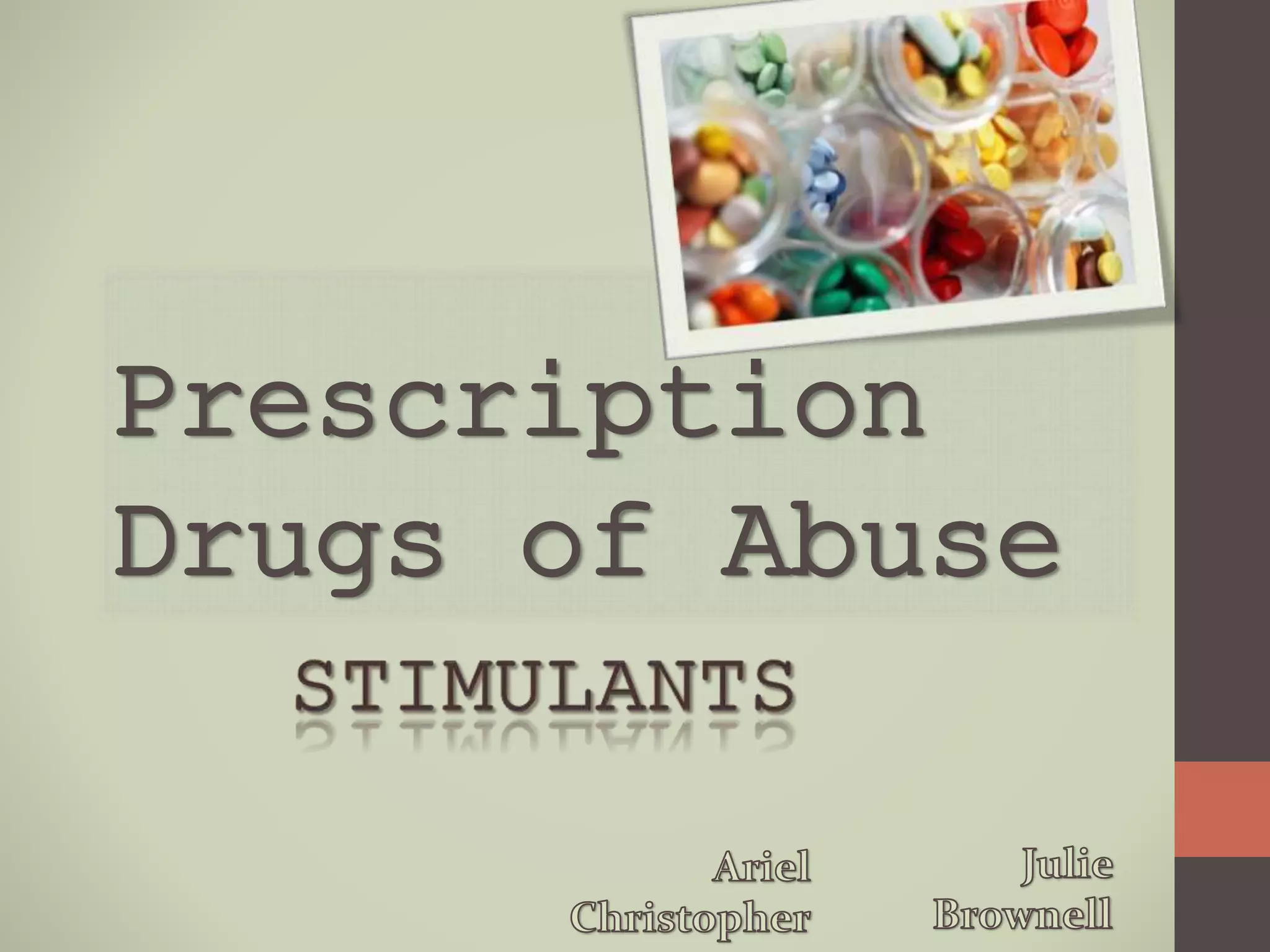
Prescription
Drugs of Abuse
What is Prescription drug Abuse?
Prescription drug abuse1 is the use of a medication without a
prescription, in a way other than as prescribed, or for the
experience or feelings elicited. According to several national
surveys, prescription medications, such as those used to treat
pain, attention deficit disorders, and anxiety, are being
abused at a rate second only to marijuana among illicit drug
users. The consequences of this abuse have been steadily
worsening, reflected in increased treatment admissions,
emergency room visits, and overdose deaths. For the
purpose of this report we are focusing on prescription
stimulants (NIDA).
Stimulants
are a class of psychoactive drug that increase
activity in the brain. These drugs can temporarily elevate
alertness, mood and awareness. While some stimulant
drugs are legal and widely used, all can be addicting. (
nicotine, caffeine) Stimulants share many commonalities,
but each has unique properties and mechanisms of action.
work by speeding up the
messages going between the brain and body through an
increase in the activity of the central nervous system and
enhancing the effects of Dopamine in the brain, the
neurotransmitter responsible for feelings of pleasure and
norepinephrine.
What is Dopamine?
• Dopamine is both a neurotransmitter and a neurohormone
that is produced in several different areas of the brain.
Dopamine has a part in many important functions in the
brain, playing a role in cognition, punishment, motivation,
attention, mood, sleep, voluntary movement, learning and
working memory and also to feelings of reward and
pleasure. This is why stimulant medication is given to
children and adults suffering from ADHD as it helps to
regulate impulsive behavior and improve attention span
and focus by increasing the levels of certain chemicals such
as dopamine and norepinephrine which help transmit
signals between nerves.
• Drugs can interact with systems regulating
these basic drive states through effects on
receptors in the brain and neural circuitry
• Drugs can capture control of brain
mechanisms that control motivations and
emotions (i.e., Basic drives, such as anger,
fear, anxiety, pain, and depression).
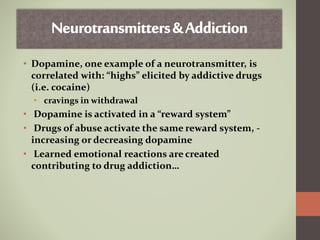
• Dopamine, one example of a neurotransmitter, is
correlated with: “highs” elicited by addictive drugs
(i.e. cocaine)
• cravings in withdrawal
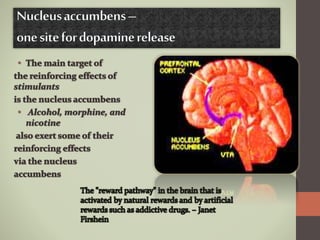
• Dopamine is activated in a “reward system”
• Drugs of abuse activate the same reward system, -
increasing or decreasing dopamine
• Learned emotional reactions are created
contributing to drug addiction…
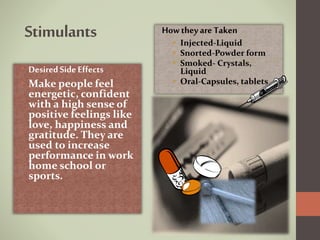
Stimulants Howtheyare Taken
 Injected-Liquid
 Snorted-Powder form
 Smoked- Crystals,
Liquid
 Oral-Capsules, tablets
• DesiredSideEffects
• Make people feel
energetic, confident
with a high sense of
positive feelings like
love, happiness and
gratitude. They are
used to increase
performance in work
home school or
sports.
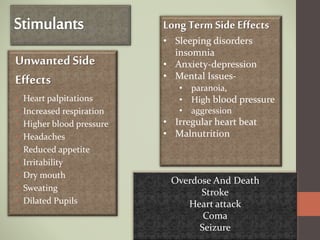
UnwantedSide
Effects
• Heart palpitations
• Increased respiration
• Higher blood pressure
• Headaches
• Reduced appetite
• Irritability
• Dry mouth
• Sweating
• Dilated Pupils
Long Term Side Effects
• Sleeping disorders
insomnia
• Anxiety-depression
• Mental Issues-
• paranoia,
• High blood pressure
• aggression
• Irregular heart beat
• Malnutrition
Overdose And Death
Stroke
Heart attack
Coma
Seizure
StimulantMedications
These psychotropic medications stimulate
the central nervous system (CNS) by
boosting the release of certain chemicals in
the brain and are the most commonly
prescribed for ADHD, Narcolepsy,
depression (when all other antidepressants
fail) and to quell hunger in obese patients.
ADHD is treated with stimulant medication
to increase the neurotransmitter dopamine
in the brain particularly in the prefrontal
cortex along with therapy and education
StimulantMedications
Adderall (dextroamphetamine
and amphetamine)
• Is a racemic mixture of d-and
1-amphetamine that seems to
be effective in treating ADHD.
The different isomers have
different properties and
complementary in
combination. According to
the first empirical studies
performed using Adderall
have suggested that Adderall
has a longer half life than
Ritalin and it may enable the
use of a singe dose to cover
most of a child's school day.
Ritalin (methylphenidate)
• Most commonly
prescribed has several
limitations. After
taking orally drug is
readily absorbed; its
clinical effects appear
within 1 hour and last r
hours and have a half
life of 3 hours thus
multiple doses per day
are required.
How are Stimulant
medications abused?
• Prescription stimulants are normally taken in pill form, but some people who
abuse them crush the tablets and snort or inject them,
• which can cause complications because insoluble fillers in the tablets can block
small blood vessels.
• Stimulants have been abused for both “performance enhancement” (e.g., to stay up
all night cramming for an exam) and to get high.
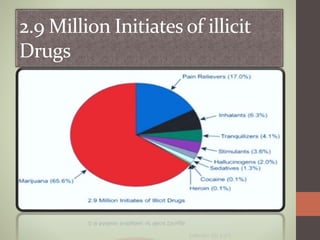
2.9 Million Initiates of illicit
Drugs
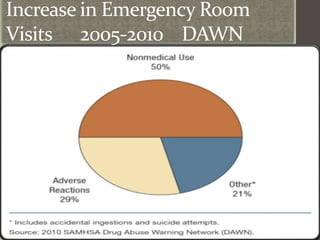
Increase in Emergency Room
Visits 2005-2010 DAWN
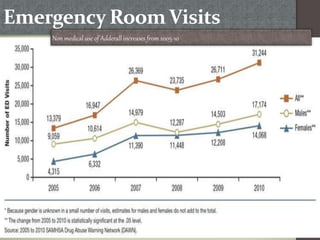
Emergency Room Visits
Non medical use of Adderall increases from 2005-10
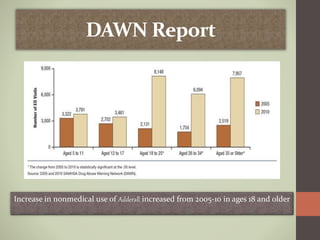
DAWN Report
Increase in nonmedical use of Adderall increased from 2005-10 in ages 18 and older
Drug use is highest in late teens-
twenties

Stimulants of Misuse

  • 1.
  • 2.
    What is Prescriptiondrug Abuse? Prescription drug abuse1 is the use of a medication without a prescription, in a way other than as prescribed, or for the experience or feelings elicited. According to several national surveys, prescription medications, such as those used to treat pain, attention deficit disorders, and anxiety, are being abused at a rate second only to marijuana among illicit drug users. The consequences of this abuse have been steadily worsening, reflected in increased treatment admissions, emergency room visits, and overdose deaths. For the purpose of this report we are focusing on prescription stimulants (NIDA).
  • 3.
    Stimulants are a classof psychoactive drug that increase activity in the brain. These drugs can temporarily elevate alertness, mood and awareness. While some stimulant drugs are legal and widely used, all can be addicting. ( nicotine, caffeine) Stimulants share many commonalities, but each has unique properties and mechanisms of action. work by speeding up the messages going between the brain and body through an increase in the activity of the central nervous system and enhancing the effects of Dopamine in the brain, the neurotransmitter responsible for feelings of pleasure and norepinephrine.
  • 4.
    What is Dopamine? •Dopamine is both a neurotransmitter and a neurohormone that is produced in several different areas of the brain. Dopamine has a part in many important functions in the brain, playing a role in cognition, punishment, motivation, attention, mood, sleep, voluntary movement, learning and working memory and also to feelings of reward and pleasure. This is why stimulant medication is given to children and adults suffering from ADHD as it helps to regulate impulsive behavior and improve attention span and focus by increasing the levels of certain chemicals such as dopamine and norepinephrine which help transmit signals between nerves.
  • 5.
    • Drugs caninteract with systems regulating these basic drive states through effects on receptors in the brain and neural circuitry • Drugs can capture control of brain mechanisms that control motivations and emotions (i.e., Basic drives, such as anger, fear, anxiety, pain, and depression).
  • 6.
    • Dopamine, oneexample of a neurotransmitter, is correlated with: “highs” elicited by addictive drugs (i.e. cocaine) • cravings in withdrawal • Dopamine is activated in a “reward system” • Drugs of abuse activate the same reward system, - increasing or decreasing dopamine • Learned emotional reactions are created contributing to drug addiction…
  • 8.
    Stimulants Howtheyare Taken Injected-Liquid  Snorted-Powder form  Smoked- Crystals, Liquid  Oral-Capsules, tablets • DesiredSideEffects • Make people feel energetic, confident with a high sense of positive feelings like love, happiness and gratitude. They are used to increase performance in work home school or sports.
  • 9.
    UnwantedSide Effects • Heart palpitations •Increased respiration • Higher blood pressure • Headaches • Reduced appetite • Irritability • Dry mouth • Sweating • Dilated Pupils Long Term Side Effects • Sleeping disorders insomnia • Anxiety-depression • Mental Issues- • paranoia, • High blood pressure • aggression • Irregular heart beat • Malnutrition Overdose And Death Stroke Heart attack Coma Seizure
  • 10.
    StimulantMedications These psychotropic medicationsstimulate the central nervous system (CNS) by boosting the release of certain chemicals in the brain and are the most commonly prescribed for ADHD, Narcolepsy, depression (when all other antidepressants fail) and to quell hunger in obese patients. ADHD is treated with stimulant medication to increase the neurotransmitter dopamine in the brain particularly in the prefrontal cortex along with therapy and education
  • 11.
    StimulantMedications Adderall (dextroamphetamine and amphetamine) •Is a racemic mixture of d-and 1-amphetamine that seems to be effective in treating ADHD. The different isomers have different properties and complementary in combination. According to the first empirical studies performed using Adderall have suggested that Adderall has a longer half life than Ritalin and it may enable the use of a singe dose to cover most of a child's school day. Ritalin (methylphenidate) • Most commonly prescribed has several limitations. After taking orally drug is readily absorbed; its clinical effects appear within 1 hour and last r hours and have a half life of 3 hours thus multiple doses per day are required.
  • 12.
    How are Stimulant medicationsabused? • Prescription stimulants are normally taken in pill form, but some people who abuse them crush the tablets and snort or inject them, • which can cause complications because insoluble fillers in the tablets can block small blood vessels. • Stimulants have been abused for both “performance enhancement” (e.g., to stay up all night cramming for an exam) and to get high.
  • 16.
    2.9 Million Initiatesof illicit Drugs
  • 18.
    Increase in EmergencyRoom Visits 2005-2010 DAWN
  • 19.
    Emergency Room Visits Nonmedical use of Adderall increases from 2005-10
  • 20.
    DAWN Report Increase innonmedical use of Adderall increased from 2005-10 in ages 18 and older
  • 21.
    Drug use ishighest in late teens- twenties

Editor's Notes

  • #6 Institute of Medicine. (1997). Dispelling the myths about addiction: Strategies to increase understanding and strengthen research. Washington, D.C.: National Academy Press. Retrieved on April 13, 2002 from http://www.netlibrary.com/urlapi.asp?action=summary&v=1&bookid=964
  • #8 Robbins and Everitt, 1999.