
By: Sourav Goswami
Moderator: Dr Subodh S Gupta
MGIMS, Sevagram
EPIDEMIOLOGY OF STILLBIRTH
Framework
Introduction & definition
Facts and figures
The triad
Causes & Classification
Strategies to  SBR in India - INAP
Surveillance - Audit of stillbirth
Psycho-social impact
Conclusion
References
Introduction
Stillbirth is an important indicator of
- access to and quality of ANC and
delivery services
Perinatal deaths or stillborn ?
“Stillbirth rate” may be used as an
important developmental indicator.
Definition
Definition contd….
Stillbirth rate =
Number of babies born per year with no signs
of life weighing 1000 g and after 28≥
completed weeks of gestation / 1000 total
(live and stillborn) births
Facts and figures
WORLD (WHO)
Stillbirths are invisible in policy and
programs, yet constitute an enormous
burden of deaths, and disproportionately
affect the poor.
 2.6 million stillbirths annually (2015)
 1.3 million intrapartum stillbirths
Worldwide SBR is 18.4/1000 total births
 98% of the world’s stillbirths occur in
low- and middle-income countries
Facts and figures contd..
 In no of stillbirths by 19.4% from
2000 to 2015
ARR (globally) –
Stillbirths (2%)< MMR(3%) &
U5MR(4.5%)
10 nations of the world account for 2/3rd
of the global stillbirths
 India tops in that list !!!
Facts and figures contd..
In India, we have paucity of reliable
data regarding stillbirth.
Still birth rate of India is 22/1000 births
(Lancet stillbirth series,2009)
The epidemiological triad
Stillbirth
Agents
Host Environment
Infections
Pregnancy complications
Fetal complications
Congenital anomalies
 Maternal age
Addictions
Obesity
Preexisting condition-
DM, Epilepsy etc
 Infrastructure
Poverty
 Maternal education
 Surveillance/Reporting
Social stigma
Indoor air pollution
 Awareness
Causes of stillbirth
Developing countries
Obstructed/prolonged labor
and associated asphyxia,
infection and birth injury
(low availability of C-
section)
Congenitally acquired
infections especially syphilis
Hypertensive disease—
especially poor
management of
preeclampsia/eclampsia
Poor nutritional status
Previous stillbirth
Congenital anomalies
Malaria
Developed countries
Congenital/chrom
anomalies
Growth
restriction/placental
thrombosis
Medical diseases: DM,SLE,
kidney &, thyroid disorders,
thrombophilia, cholestasis
of pregnancy, Hypertensive
disease
Congenitally acquired
infections :Group B Strep
and parvovirus 19
Smoking
Classification of stillbirth
Why is classification required?
Different classifications
1. Causes of death and associated
conditions (Codac)
2. Wigglesworth classification
3. ICD-PM classification

CODAC system of classification
The CODAC classification system is
designed to retain information on the
main cause of death as well as up to two
associated conditions. It is a classification
system for perinatal deaths, recently
developed by an international group of
investigators events.
CODAC system of classification
It was developed with a basis of
incorporating:
Compatibility with the ICD.
Expandable main categories, when detailed
information is available, but possible to use
the main groups when information is limited.
Capture of intra-partum events.
Capture of placental conditions.
Ability to differentiate unknown and
unexplained
CODAC system of classification
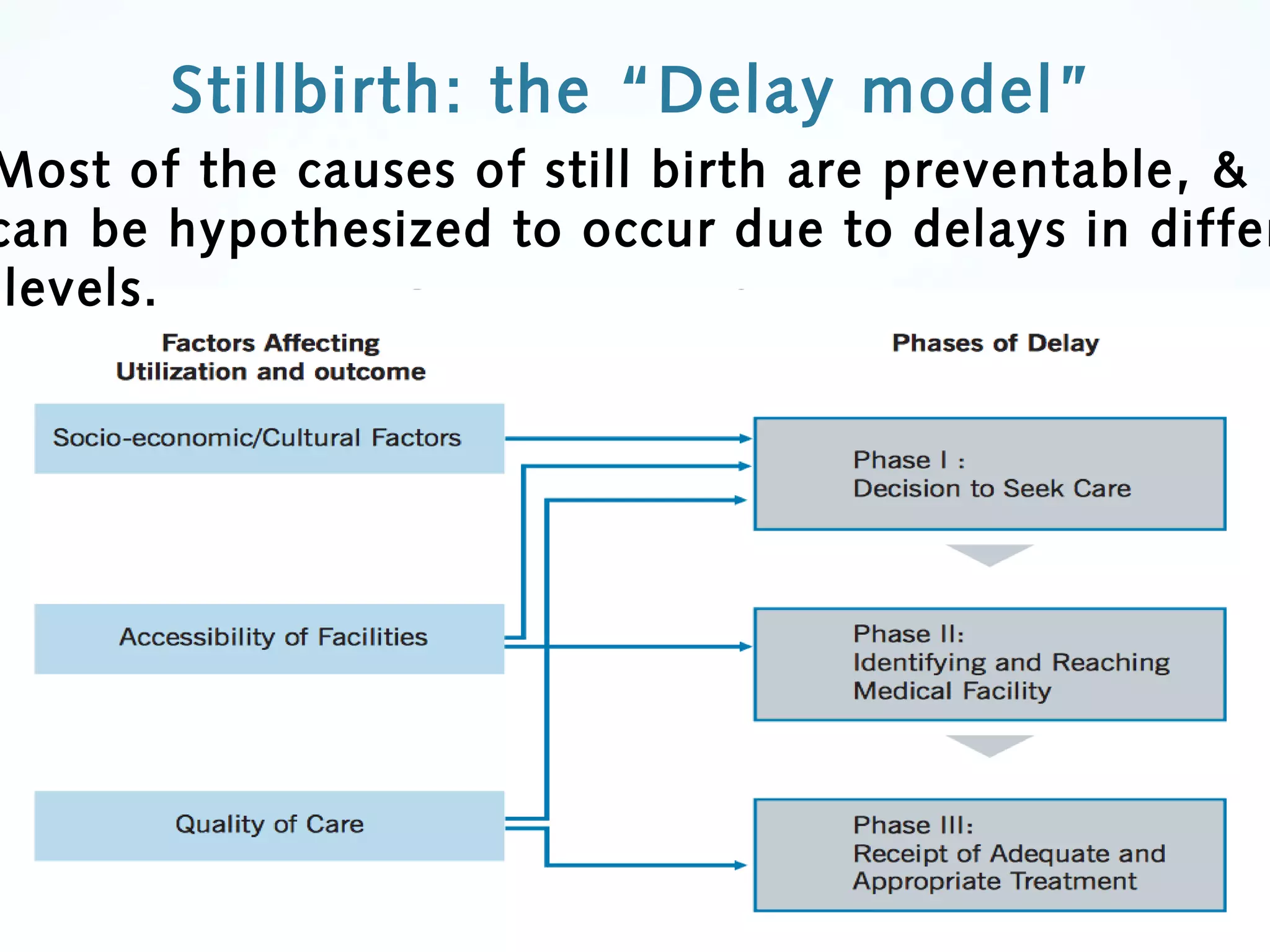
Stillbirth: the “Delay model”
Most of the causes of still birth are preventable, &
can be hypothesized to occur due to delays in differ
levels.
Surveillance & Still birth Audit
Why is surveillance essential?
Types of audit
Status in India
Strategies for  SBR
The Every Newborn Action Plan (ENAP) that
has been recently endorsed by the World
Health Assembly calls for a national SBR ≤
12/1000 births by 2030 & 10/1000 by 2035.≤
India has the potential to achieve the 2035
goals much earlier. But translating such
aspirations into deliverables would require long
term view, executional brilliance, intersectoral
synergy and, above all, political resolve.
The India Newborn Action Plan (INAP) being
launched by the Government of India indeed
incorporates these very principles.
INAP
Strategic goal for India:
Goal 1: Ending Preventable Newborn Deaths to
achieve “Single Digit NMR” by 2030, with all the
states to individually achieve this target by 2035
Goal 2: Ending Preventable Stillbirths to achieve
“Single Digit SBR” by 2030, with all the states to
individually achieve this target by 2035
INAP – National Targets
Target Current 2017 2020 2025 2030
Impact Targets
SBR 22 19 17 13 <10
Coverage targets
Safe
delivery
(%)
76 90 95 95 95
Projected Levels of SBR in India
2012-2030
Intervention packages(INAP)
1. Care during labour and child birth
2. Care of small and sick newborn
3. Care of healthy newborn
4. Immediate newborn care
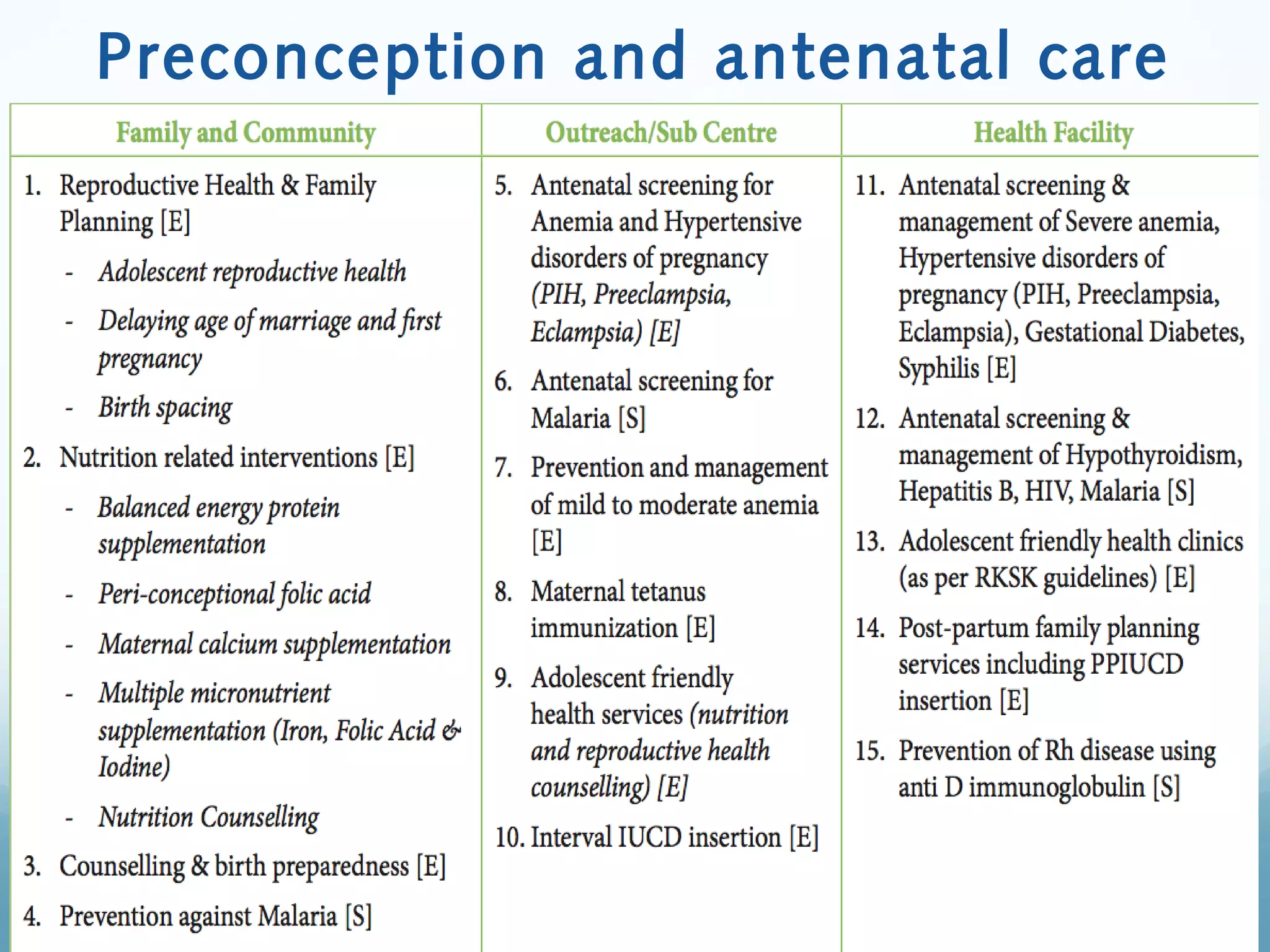
5. Preconception and antenatal care
Preconception and antenatal care
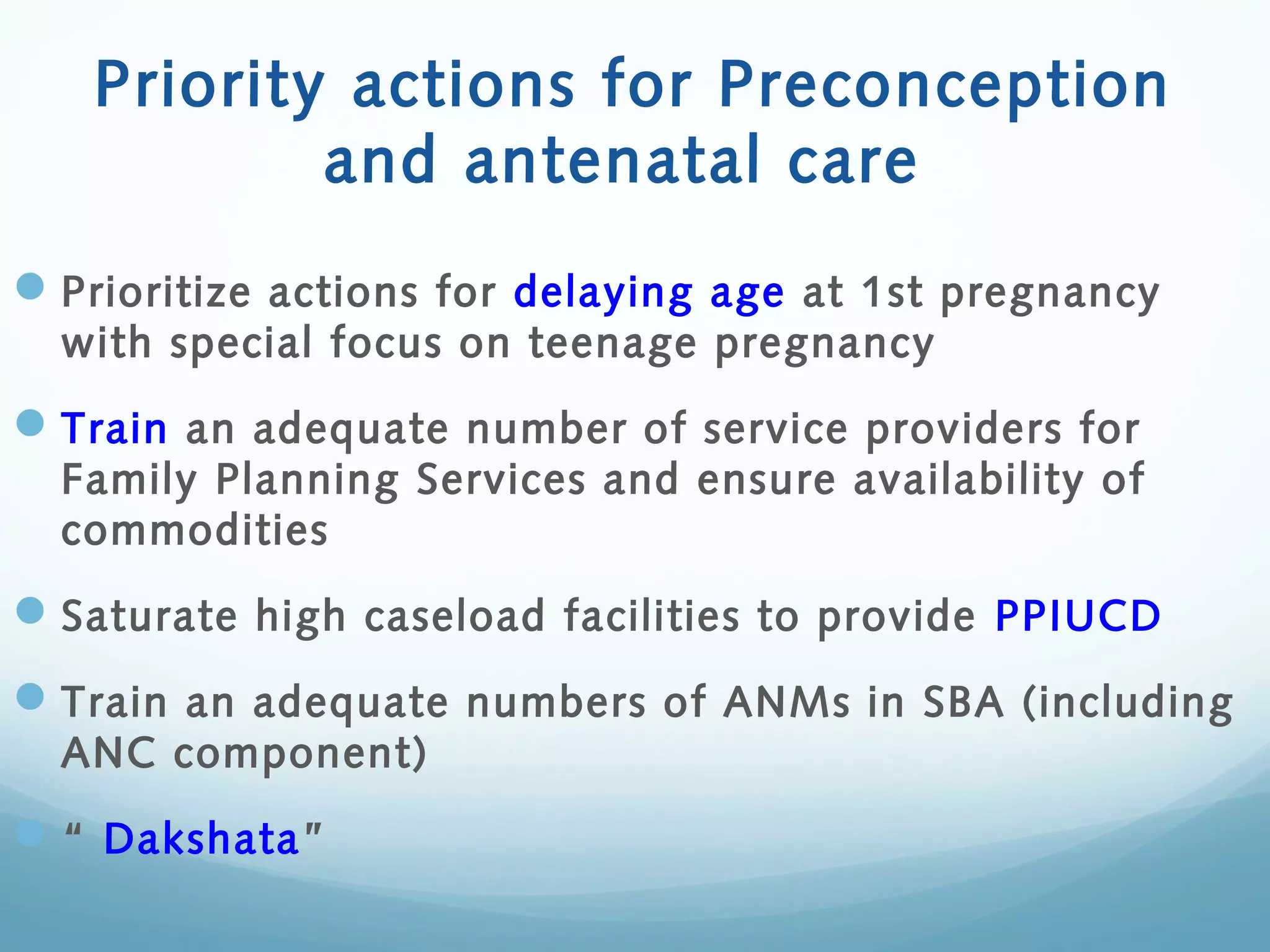
Priority actions for Preconception
and antenatal care
Prioritize actions for delaying age at 1st pregnancy
with special focus on teenage pregnancy
Train an adequate number of service providers for
Family Planning Services and ensure availability of
commodities
Saturate high caseload facilities to provide PPIUCD
Train an adequate numbers of ANMs in SBA (including
ANC component)
“ Dakshata”
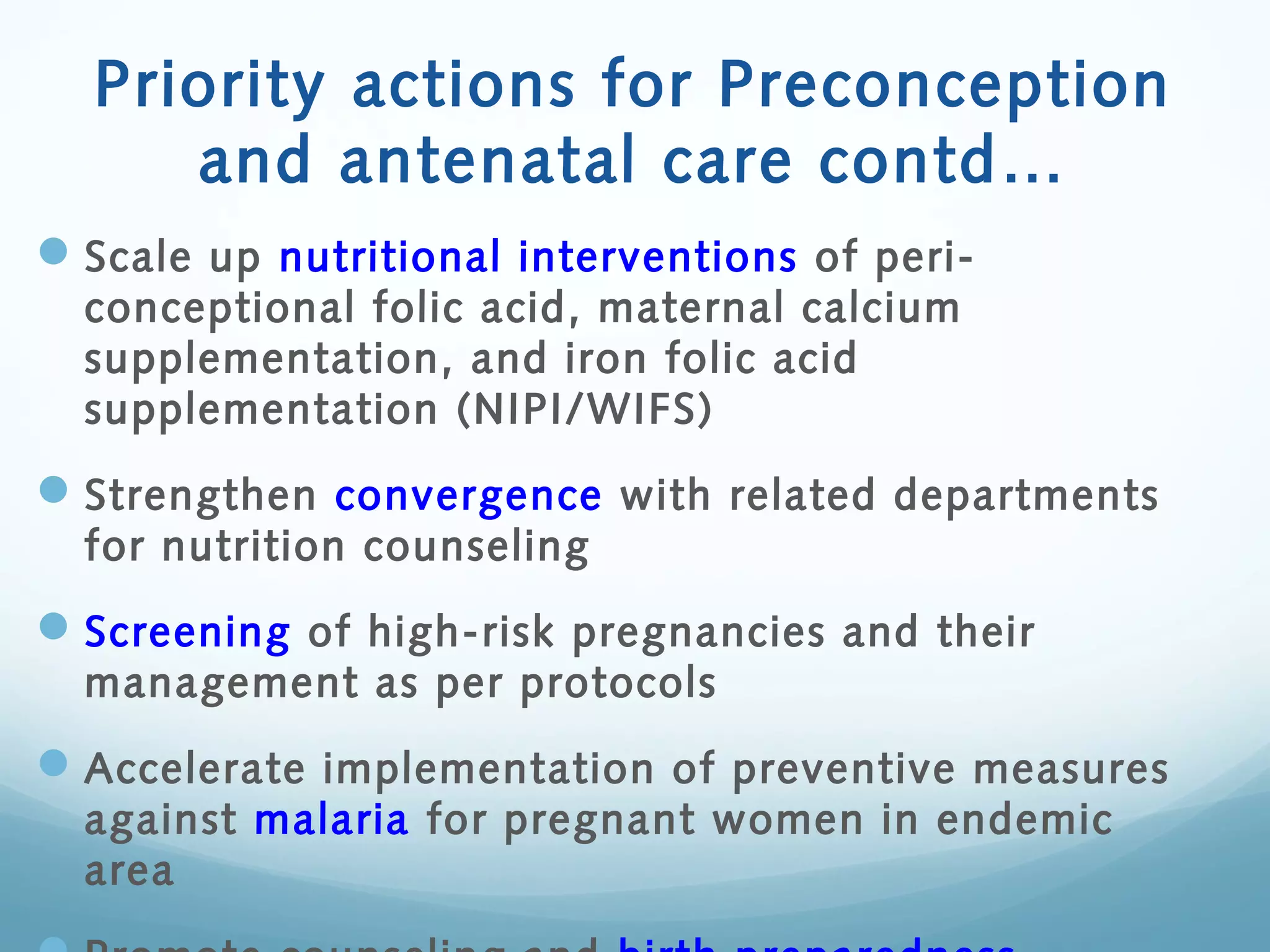
Priority actions for Preconception
and antenatal care contd…
Scale up nutritional interventions of peri-
conceptional folic acid, maternal calcium
supplementation, and iron folic acid
supplementation (NIPI/WIFS)
Strengthen convergence with related departments
for nutrition counseling
Screening of high-risk pregnancies and their
management as per protocols
Accelerate implementation of preventive measures
against malaria for pregnant women in endemic
area
Care during labour &
child birth
Priority action for care during
labour & child birth
Prioritize and strengthen public health facilities at
all levels (L1, L2, L3) for conducting safe delivery,
including provision of emergency obstetric care as
per the norms of MNH Toolkit
Provision of dedicated MCH wings in facilities with
high caseload, including functional WASH facilities
All delivery points to be saturated with adequately
trained health workers: Ensure trained and skilled
staff at all designated delivery points: L1 delivery
point should have SBA trained ANMs/SNs, L2
delivery point to have at least one BEmOC trained
MO, and L3 delivery point must have at least four
obstetrician & gynaecologist /CEmOC trained MOs
and four Anaesthetist/LSAS trained MOs
Priority action for care during
labour & child birth contd..
Expand the availability of SBA-trained birth
attendants. In addition to ANM, SBA training to
be rolled out for AYUSH doctors (as per state-
specific need)
Establish Quality Assurance mechanism at each
level, like- use of safe birth checklist and
regular quality audits including perinatal death
audits
Institutionalize referral mechanism to ensure to-
and-fro referral, including inter-facility referral,
as and where required
Priority action for care during
labour & child birth contd..
Accelerate scale-up of new policy decisions on
management of preterm labour through use of
antenatal corticosteroids and antibiotics for
premature rupture of membranes
Develop a mechanism of supportive supervision
through existing systems or through partnerships
(with professional organizations, medical colleges,
and private hospitals) at the regional and state level
Generate awareness on JSSK entitlements, promote
community participation, and demand for safe
institutional delivery
Establish a sound surveillance system for tracking
stillbirths
Name:
Laxmi Anil Belsare
Age: 25 years
Residence:
Zhingapur,
Tembusunda PHC,
Melghat
Psycho-social & financial impact
of Stillbirth
Stillbirth remains hidden from society, and
has wide-reaching consequences for parents,
care providers, communities, and society that
are frequently overlooked and
underappreciated.
The estimated direct financial cost of a
stillbirth is 10-70% greater than the cost of a
live birth (OOP)
Survey data show parents may only be
working at 26% of normal work productivity
30 days after the stillbirth of their baby,
Psycho-social impact of Stillbirth
Parents' grief after stillbirth is not
legitimized or accepted by health
professionals, family members, or
society.
An estimated 4.2 million women are
living with depression associated with
stillbirth
Care providers are also deeply affected
both personally and professionally,
experiencing guilt, anger, blame, anxiety,
and sadness, as well as fear of litigation
and disciplinary action.
Psycho-social impact of
Stillbirth
Mullan et al. describe consequence of a
stillbirth as: ‘The grief of a stillbirth is
unlike any other form of grief: the months
of excitement and expectation, planning,
eager questions and the drama of labor —
all magnifying the devastating
incomprehension of giving birth to a baby
bearing no signs of life.’
Conclusion
The stillbirth rate is an important indicator
of quality of care in pregnancy and
childbirth, as well as a sensitive marker of
health systems’ strength, measuring not
only progress in achieving SDG targets for
reduction of neonatal, maternal, and under
5 mortality, but also progress on other
targets aimed at reducing poverty and
increasing equity and access to healthcare.
Extra and directed efforts will be necessary
in overcoming barriers at service-
community interfaces in achieving our
Conclusion contd…
Barriers crossing will need awareness,
health education & demand creation in
community; socioeconomic upliftment of
population and physical (roads etc) &
communication infrastructure development
on one hand and manpower development
and their effective deployment in health
sector on the other.
Women's empowerment plays an important
part in reducing stillbirth
Unavailability of reliable data
References
Blencowe, Hannah et al. National, regional, and
worldwide estimates of stillbirth rates in 2015, with
trends from 2000: a systematic analysis. The Lancet
Global Health , Volume 4 , Issue 2 , e98 - e108
Lawn, JE, Blencowe, H, Oza, S et al. Every Newborn:
progress, priorities, and potential beyond survival.
Lancet. 2014; 384: 189–205
WHO and UNICEF. Every Newborn: an action plan to
end preventable deaths. World Health Organization,
Geneva; 2014
http://wwweverynewbornorg/Every%20Newborn%20Actio
. (accessed Dec 03, 2016).
Cunningham F G et al. Williams Obstetrics. 23rd
edition.
New York : McGraw-Hill Medical; 334-335
Horton, Richard et al. Stillbirths: ending an epidemic of
grief. The Lancet , Feb 2016. Volume 387 , Issue
10018 , 515 – 516
References contd..
Lawn, Joy E et al. Stillbirths: rates, risk factors, and
acceleration towards 2030. Feb 2016. The Lancet ,
Volume 387 , Issue 10018 , 587 – 603
WHO. Making every baby count: Audit and review of
stillbirths and neonatal deaths. World Health
Organization, Geneva;2016
Roberts LR, Anderson BA, Lee JW, Montgomery SB. Grief
and Women: Stillbirth in the Social Context of India.
International journal of childbirth. 2012;2(3):187-198.
Bharti DK. Stillbirths: A high magnitude public health
issue in India. South East Asia Journal Of Public Health .
http://www.banglajol.info/index.php/SEAJPH/article/viewFil
(accessed Dec 04,2016)
Census of India. Estimates of mortality indicators 2010.
http://www.censusindia.gov.in/
vital_statistics/srs/Chap_4_2010.pdf (accessed November
2016)
References contd…
Mullan Z, Horton R. Bringing stillbirths out of the
shadows. Lancet 2011; 377: 9774:1291-2.
McClure EM, Dudley DJ, Reddy U, Goldenberg RL.
Infectious Causes of Stillbirth: A Clinical Perspective.
Clinical obstetrics and gynecology. 2010;53(3):635-
645.
Silver RM et al.Stillbirth: A review of the evidence.
American journal of obstetrics and gynecology.
2007;196(5):433-444.
Kochar PS, Dandona R, Kumar GA, Dandona L.
Population-based estimates of still birth, induced
abortion and miscarriage in the Indian state of Bihar.
BMC Pregnancy and Childbirth. 2014;14:413
Thank you

Epidemiology of Still birth

  • 1.
    By: Sourav Goswami Moderator:Dr Subodh S Gupta MGIMS, Sevagram EPIDEMIOLOGY OF STILLBIRTH
  • 2.
    Framework Introduction & definition Factsand figures The triad Causes & Classification Strategies to  SBR in India - INAP Surveillance - Audit of stillbirth Psycho-social impact Conclusion References
  • 3.
    Introduction Stillbirth is animportant indicator of - access to and quality of ANC and delivery services Perinatal deaths or stillborn ? “Stillbirth rate” may be used as an important developmental indicator.
  • 4.
  • 5.
    Definition contd…. Stillbirth rate= Number of babies born per year with no signs of life weighing 1000 g and after 28≥ completed weeks of gestation / 1000 total (live and stillborn) births
  • 6.
    Facts and figures WORLD(WHO) Stillbirths are invisible in policy and programs, yet constitute an enormous burden of deaths, and disproportionately affect the poor.  2.6 million stillbirths annually (2015)  1.3 million intrapartum stillbirths Worldwide SBR is 18.4/1000 total births  98% of the world’s stillbirths occur in low- and middle-income countries
  • 7.
    Facts and figurescontd..  In no of stillbirths by 19.4% from 2000 to 2015 ARR (globally) – Stillbirths (2%)< MMR(3%) & U5MR(4.5%) 10 nations of the world account for 2/3rd of the global stillbirths  India tops in that list !!!
  • 8.
  • 9.
    Facts and figurescontd.. In India, we have paucity of reliable data regarding stillbirth. Still birth rate of India is 22/1000 births (Lancet stillbirth series,2009)
  • 10.
    The epidemiological triad Stillbirth Agents HostEnvironment Infections Pregnancy complications Fetal complications Congenital anomalies  Maternal age Addictions Obesity Preexisting condition- DM, Epilepsy etc  Infrastructure Poverty  Maternal education  Surveillance/Reporting Social stigma Indoor air pollution  Awareness
  • 11.
    Causes of stillbirth Developingcountries Obstructed/prolonged labor and associated asphyxia, infection and birth injury (low availability of C- section) Congenitally acquired infections especially syphilis Hypertensive disease— especially poor management of preeclampsia/eclampsia Poor nutritional status Previous stillbirth Congenital anomalies Malaria Developed countries Congenital/chrom anomalies Growth restriction/placental thrombosis Medical diseases: DM,SLE, kidney &, thyroid disorders, thrombophilia, cholestasis of pregnancy, Hypertensive disease Congenitally acquired infections :Group B Strep and parvovirus 19 Smoking
  • 12.
    Classification of stillbirth Whyis classification required? Different classifications 1. Causes of death and associated conditions (Codac) 2. Wigglesworth classification 3. ICD-PM classification 
  • 13.
    CODAC system ofclassification The CODAC classification system is designed to retain information on the main cause of death as well as up to two associated conditions. It is a classification system for perinatal deaths, recently developed by an international group of investigators events.
  • 14.
    CODAC system ofclassification It was developed with a basis of incorporating: Compatibility with the ICD. Expandable main categories, when detailed information is available, but possible to use the main groups when information is limited. Capture of intra-partum events. Capture of placental conditions. Ability to differentiate unknown and unexplained
  • 15.
    CODAC system ofclassification
  • 17.
    Stillbirth: the “Delaymodel” Most of the causes of still birth are preventable, & can be hypothesized to occur due to delays in differ levels.
  • 18.
    Surveillance & Stillbirth Audit Why is surveillance essential? Types of audit Status in India
  • 19.
    Strategies for SBR The Every Newborn Action Plan (ENAP) that has been recently endorsed by the World Health Assembly calls for a national SBR ≤ 12/1000 births by 2030 & 10/1000 by 2035.≤ India has the potential to achieve the 2035 goals much earlier. But translating such aspirations into deliverables would require long term view, executional brilliance, intersectoral synergy and, above all, political resolve. The India Newborn Action Plan (INAP) being launched by the Government of India indeed incorporates these very principles.
  • 20.
    INAP Strategic goal forIndia: Goal 1: Ending Preventable Newborn Deaths to achieve “Single Digit NMR” by 2030, with all the states to individually achieve this target by 2035 Goal 2: Ending Preventable Stillbirths to achieve “Single Digit SBR” by 2030, with all the states to individually achieve this target by 2035
  • 21.
    INAP – NationalTargets Target Current 2017 2020 2025 2030 Impact Targets SBR 22 19 17 13 <10 Coverage targets Safe delivery (%) 76 90 95 95 95
  • 22.
    Projected Levels ofSBR in India 2012-2030
  • 23.
    Intervention packages(INAP) 1. Careduring labour and child birth 2. Care of small and sick newborn 3. Care of healthy newborn 4. Immediate newborn care 5. Preconception and antenatal care
  • 24.
  • 25.
    Priority actions forPreconception and antenatal care Prioritize actions for delaying age at 1st pregnancy with special focus on teenage pregnancy Train an adequate number of service providers for Family Planning Services and ensure availability of commodities Saturate high caseload facilities to provide PPIUCD Train an adequate numbers of ANMs in SBA (including ANC component) “ Dakshata”
  • 26.
    Priority actions forPreconception and antenatal care contd… Scale up nutritional interventions of peri- conceptional folic acid, maternal calcium supplementation, and iron folic acid supplementation (NIPI/WIFS) Strengthen convergence with related departments for nutrition counseling Screening of high-risk pregnancies and their management as per protocols Accelerate implementation of preventive measures against malaria for pregnant women in endemic area
  • 27.
    Care during labour& child birth
  • 28.
    Priority action forcare during labour & child birth Prioritize and strengthen public health facilities at all levels (L1, L2, L3) for conducting safe delivery, including provision of emergency obstetric care as per the norms of MNH Toolkit Provision of dedicated MCH wings in facilities with high caseload, including functional WASH facilities All delivery points to be saturated with adequately trained health workers: Ensure trained and skilled staff at all designated delivery points: L1 delivery point should have SBA trained ANMs/SNs, L2 delivery point to have at least one BEmOC trained MO, and L3 delivery point must have at least four obstetrician & gynaecologist /CEmOC trained MOs and four Anaesthetist/LSAS trained MOs
  • 29.
    Priority action forcare during labour & child birth contd.. Expand the availability of SBA-trained birth attendants. In addition to ANM, SBA training to be rolled out for AYUSH doctors (as per state- specific need) Establish Quality Assurance mechanism at each level, like- use of safe birth checklist and regular quality audits including perinatal death audits Institutionalize referral mechanism to ensure to- and-fro referral, including inter-facility referral, as and where required
  • 30.
    Priority action forcare during labour & child birth contd.. Accelerate scale-up of new policy decisions on management of preterm labour through use of antenatal corticosteroids and antibiotics for premature rupture of membranes Develop a mechanism of supportive supervision through existing systems or through partnerships (with professional organizations, medical colleges, and private hospitals) at the regional and state level Generate awareness on JSSK entitlements, promote community participation, and demand for safe institutional delivery Establish a sound surveillance system for tracking stillbirths
  • 31.
    Name: Laxmi Anil Belsare Age:25 years Residence: Zhingapur, Tembusunda PHC, Melghat
  • 32.
    Psycho-social & financialimpact of Stillbirth Stillbirth remains hidden from society, and has wide-reaching consequences for parents, care providers, communities, and society that are frequently overlooked and underappreciated. The estimated direct financial cost of a stillbirth is 10-70% greater than the cost of a live birth (OOP) Survey data show parents may only be working at 26% of normal work productivity 30 days after the stillbirth of their baby,
  • 33.
    Psycho-social impact ofStillbirth Parents' grief after stillbirth is not legitimized or accepted by health professionals, family members, or society. An estimated 4.2 million women are living with depression associated with stillbirth Care providers are also deeply affected both personally and professionally, experiencing guilt, anger, blame, anxiety, and sadness, as well as fear of litigation and disciplinary action.
  • 34.
    Psycho-social impact of Stillbirth Mullanet al. describe consequence of a stillbirth as: ‘The grief of a stillbirth is unlike any other form of grief: the months of excitement and expectation, planning, eager questions and the drama of labor — all magnifying the devastating incomprehension of giving birth to a baby bearing no signs of life.’
  • 35.
    Conclusion The stillbirth rateis an important indicator of quality of care in pregnancy and childbirth, as well as a sensitive marker of health systems’ strength, measuring not only progress in achieving SDG targets for reduction of neonatal, maternal, and under 5 mortality, but also progress on other targets aimed at reducing poverty and increasing equity and access to healthcare. Extra and directed efforts will be necessary in overcoming barriers at service- community interfaces in achieving our
  • 36.
    Conclusion contd… Barriers crossingwill need awareness, health education & demand creation in community; socioeconomic upliftment of population and physical (roads etc) & communication infrastructure development on one hand and manpower development and their effective deployment in health sector on the other. Women's empowerment plays an important part in reducing stillbirth Unavailability of reliable data
  • 37.
    References Blencowe, Hannah etal. National, regional, and worldwide estimates of stillbirth rates in 2015, with trends from 2000: a systematic analysis. The Lancet Global Health , Volume 4 , Issue 2 , e98 - e108 Lawn, JE, Blencowe, H, Oza, S et al. Every Newborn: progress, priorities, and potential beyond survival. Lancet. 2014; 384: 189–205 WHO and UNICEF. Every Newborn: an action plan to end preventable deaths. World Health Organization, Geneva; 2014 http://wwweverynewbornorg/Every%20Newborn%20Actio . (accessed Dec 03, 2016). Cunningham F G et al. Williams Obstetrics. 23rd edition. New York : McGraw-Hill Medical; 334-335 Horton, Richard et al. Stillbirths: ending an epidemic of grief. The Lancet , Feb 2016. Volume 387 , Issue 10018 , 515 – 516
  • 38.
    References contd.. Lawn, JoyE et al. Stillbirths: rates, risk factors, and acceleration towards 2030. Feb 2016. The Lancet , Volume 387 , Issue 10018 , 587 – 603 WHO. Making every baby count: Audit and review of stillbirths and neonatal deaths. World Health Organization, Geneva;2016 Roberts LR, Anderson BA, Lee JW, Montgomery SB. Grief and Women: Stillbirth in the Social Context of India. International journal of childbirth. 2012;2(3):187-198. Bharti DK. Stillbirths: A high magnitude public health issue in India. South East Asia Journal Of Public Health . http://www.banglajol.info/index.php/SEAJPH/article/viewFil (accessed Dec 04,2016) Census of India. Estimates of mortality indicators 2010. http://www.censusindia.gov.in/ vital_statistics/srs/Chap_4_2010.pdf (accessed November 2016)
  • 39.
    References contd… Mullan Z,Horton R. Bringing stillbirths out of the shadows. Lancet 2011; 377: 9774:1291-2. McClure EM, Dudley DJ, Reddy U, Goldenberg RL. Infectious Causes of Stillbirth: A Clinical Perspective. Clinical obstetrics and gynecology. 2010;53(3):635- 645. Silver RM et al.Stillbirth: A review of the evidence. American journal of obstetrics and gynecology. 2007;196(5):433-444. Kochar PS, Dandona R, Kumar GA, Dandona L. Population-based estimates of still birth, induced abortion and miscarriage in the Indian state of Bihar. BMC Pregnancy and Childbirth. 2014;14:413
  • 40.

Editor's Notes

  • #5 Talk of still birth rate:
  • #8 ARR- annual rate of reduction of stillbirth (globally)
  • #21 While there is widespread acknowledgment of the need for improved quality and quantity of information on births and deaths, there has been less movement towards systematically capturing and reviewing the causes and avoidable factors linked to deaths, in order to affect change. This is particularly true for stillbirths and neonatal deaths which can fall between different health care providers and departments. Maternal and perinatal mortality audit applies to two of the five objectives in the Every Newborn Action Plan but data on successful approaches to overcome bottlenecks to scaling up audit are lacking
  • #22 So the Millennium Development goals are gone and now we have a new song, perhaps a pleasant one but also a less clear song than that of the MDGs. This new song is that of the Sustainable Development Goals (SDGs). The SDGs are about everything but in health we have only one of 17 goals, Goal 3: Ensure healthy lives and promote well-being for all at all ages. Within this goal, there are targets for neonatal mortality (10 deaths per 1000 live births), stillbirths (10 per 1000 live births) and maternal mortality (70 deaths per 100,000 live births) to be achieved by all countries by 2030.
  • #24 Guided by its two-fold goals, INAP has set out specific outcomes and selected coverage targets . These include: SBA= skilled birth attendant
  • #27 Talk of PMSMA: Pradhan Mantri Surakshit Matriva Aviyan in relation to ANC care
  • #31 Water, Sanitation and Hygiene (WASH)
  • #36 A survey found that bereaved parents felt their community believed that &amp;quot;parents should try to forget their stillborn baby and have another child&amp;quot;