Unit: 4 Kitchen stewarding
Food production Management
instructor
Ashish Raut
ICHM college
1.1 Meaning of stewarding
• Also known as maitre d’, is the person commonly in charge of all dining
operations.
• In French term, maitre d'hôtel, which means master of the hotel.
• Stewarding is the department is mainly responsible for cleaning of all
crockery, cutlery, glassware, halloware etc.
• Perform various work such as:- clean utensils, kitchen & storage area, assist
food rotation.
• Entry-level position.
1.2 Role/important function of kitchen stewarding
 This department play a vital role in functioning of both food production and
food & beverage service.
 The main operations of kitchen stewarding department are mainly in the back
area and are responsible for cleaning.
 This department is headed by the kitchen stewarding manager.
 who reports to the f&b manager.
 it is the shift supervisors and the utility workers who carry out the work in the
department strict eye is necessary on the work of workers.
 Shift supervisor must ensure preventive maintenance of dish washing
machine and also to get the machine repaired on time for smooth show of
work.
Conti.. Role/important function of kitchen stewarding
• All the soiled tableware and glassware is cleaned by the kitchen stewarding
department.
• washing kitchen pot and pan (scullery/pot wash)
• Maintaining kitchen equipment
• cleaning all kitchen equipment and ensuring hygiene
• washing all service equipment including ones used in banquet.
• garbage disposable
• polishing silverware
• Sending damage silverware for plating
• carrying transporting heavy articles
• Pest control
• Replenishment of service ware for various outlet
Conti.. Role/important function of kitchen stewarding
• Cleaning and wiping of crockery, cutlery ,flatware and hollowware
• Polishing EPNS(ELECTRO PLATED NICKEL SERVICE).
• Maintaining cleanliness in kitchen and staff cafeteria
• Washing and cleaning of heavy utensils and cooking ranges Monitoring the
garbage disposals system , collecting and periodical cleaning of wet and dry
garbage.
• Replacing of breakage.
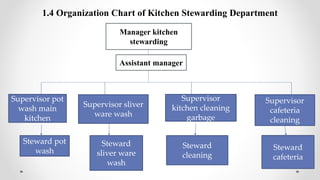
1.4 Organization Chart of Kitchen Stewarding Department
Manager kitchen
stewarding
Assistant manager
Supervisor sliver
ware wash
Supervisor
kitchen cleaning
garbage
Supervisor
cafeteria
cleaning
Supervisor pot
wash main
kitchen
Steward pot
wash
Steward
sliver ware
wash
Steward
cleaning
Steward
cafeteria
1.5 Tools & Equipment used in stewarding
• Manual Method: Dishwashing by hand can be done by the two-sink method or by the
three sink method. Both these systems start with the removal of leftover food, followed
by a preliminary wash under running hot water, which helps to preserve the cleanliness.
The dirt is removed from the utensils by scraping and then rinsing under the forced
water stream
• Two - Sink Method: The simplest way of having germ-free cutlery and utensils is the
two-sink method. Washing and rinsing of service ware is done in the first sink that
contains hot water at 450C. Rinsed service ware is then sanitized in the second sink
containing hot water at 770C and above with sanitizing solution. Three - Sink
Method: After the dishes have been sorted out and the debris has been removed, the
utensils are washed in warm detergent solution in the first compartment, and then rinsed
in second compartment at the temperature of 450C. Service ware is then transferred to
third sink for sanitization at 770C and above.
• The other method of sterilizing service equipment is treating them with a chemical
solution prepared with lukewarm water and chlorine or iodine solution or tablets.
•
Kitchen stewarding operation:
• Gather all dirty dishware from tubs brought to the dishroom,rinses and stacks in dish
racks, always clearing dishes of leftovers and trash in order to prepare for
automated washing.
• Loads full dish racks on belt and ensure correct placement in accordance to the
instruction for the operation of the machine. Operate automatic dish washing
machine by using control as instructed.
• Loads dishwashing solution in to automatic dispenser and regulates the output of
detergent and chemical to the dishwashing machine by monitoring and adjusting
controls.
• Uploads clean dishes from racks after being processed through dish machine,
inspect for cleanliness and carefully stacks in specified carts and shelves for the
easy use by restaurant and kitchen staff.
• manually scrubs pots, pan and other equipment that cant be washed automatically ,
inspect for cleanliness , manually dries with towel and put in correct place.
Dishwashers: there are 3 types of dishwashers on the basis of the use
A. Glass washers: used primarily used in bars for there is a frequent use of the glassware and the same
glass cannot be used to serve cocktails every time the guest asks for a repeat. The process of dish washing
would be the hot water rinse -soap solution-final hot water rinse-wiping if required.
• B. Single rack dishwasher: the racks are used to put in cutlery or line the plates and other crockery.
It is a box type machine and has a cover of sorts which can be pulled up or down to stop or start the
machine respectively.
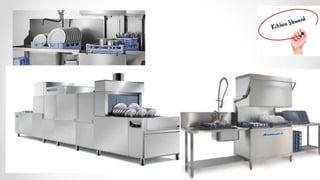
C. Conveyor belt type dishwasher: this is the dishwasher used now days in all 5 star properties
wherein there is a conveyor belt and all the cutlery and crockery is lined in the racks. Dividing curtains
highly resistant to chemical agents and heat are present. It is loaded from one end and the process of
cleaning is carried out.
• Three types on the basis of working:
A. Spray Type: Dishes are neatly stacked in racks which slide into the machines where they are
sprayed with hot water and detergents (48 degree C-60 degree C) from above and
below. The rack then moves to the sterilization section where the dishes are subjected to a hot
water shower (of 82 degree C).Dishes sterilized at this temperature dry quickly when
passed out into the air.
• B. Brush type: dishes are scrubbed in hot detergent water (48-60 degree C)with
revolving brushes. Then they are rinsed and sterilized in another section of the
machine.
C. Agitator water machine: In this method, baskets of dishes are immersed in
deep tanks and cleaned by mechanical agitation in hot detergent water. The baskets
are given a final hot water rinse for sanitization.(82degree C).These machines are
usually operated by two people, one for sorting soiled items and to feed the machine
and the other to collect the clean ware.
• 2. Burnishing machine: There is a large drum which is half filled with ball bearings and
there is a rod in the center used for putting the handles of the cups and jugs. The cutlery is
directly put into the drum. The soap solution is added to avoid friction which could cause
scratches. This machine is either attached to a water supply or else water is poured manually.
The machine takes around 15 min to complete the polishing process.
3. Silver plating machines: there is a separate room that is used as the silver plating room
where machines are used to electroplate the silver articles.
THANK YOU

Steward 4th sem

  • 1.
    Unit: 4 Kitchenstewarding Food production Management instructor Ashish Raut ICHM college
  • 2.
    1.1 Meaning ofstewarding • Also known as maitre d’, is the person commonly in charge of all dining operations. • In French term, maitre d'hôtel, which means master of the hotel. • Stewarding is the department is mainly responsible for cleaning of all crockery, cutlery, glassware, halloware etc. • Perform various work such as:- clean utensils, kitchen & storage area, assist food rotation. • Entry-level position.
  • 3.
    1.2 Role/important functionof kitchen stewarding  This department play a vital role in functioning of both food production and food & beverage service.  The main operations of kitchen stewarding department are mainly in the back area and are responsible for cleaning.  This department is headed by the kitchen stewarding manager.  who reports to the f&b manager.  it is the shift supervisors and the utility workers who carry out the work in the department strict eye is necessary on the work of workers.  Shift supervisor must ensure preventive maintenance of dish washing machine and also to get the machine repaired on time for smooth show of work.
  • 4.
    Conti.. Role/important functionof kitchen stewarding • All the soiled tableware and glassware is cleaned by the kitchen stewarding department. • washing kitchen pot and pan (scullery/pot wash) • Maintaining kitchen equipment • cleaning all kitchen equipment and ensuring hygiene • washing all service equipment including ones used in banquet. • garbage disposable • polishing silverware • Sending damage silverware for plating • carrying transporting heavy articles • Pest control • Replenishment of service ware for various outlet
  • 5.
    Conti.. Role/important functionof kitchen stewarding • Cleaning and wiping of crockery, cutlery ,flatware and hollowware • Polishing EPNS(ELECTRO PLATED NICKEL SERVICE). • Maintaining cleanliness in kitchen and staff cafeteria • Washing and cleaning of heavy utensils and cooking ranges Monitoring the garbage disposals system , collecting and periodical cleaning of wet and dry garbage. • Replacing of breakage.
  • 6.
    1.4 Organization Chartof Kitchen Stewarding Department Manager kitchen stewarding Assistant manager Supervisor sliver ware wash Supervisor kitchen cleaning garbage Supervisor cafeteria cleaning Supervisor pot wash main kitchen Steward pot wash Steward sliver ware wash Steward cleaning Steward cafeteria
  • 7.
    1.5 Tools &Equipment used in stewarding • Manual Method: Dishwashing by hand can be done by the two-sink method or by the three sink method. Both these systems start with the removal of leftover food, followed by a preliminary wash under running hot water, which helps to preserve the cleanliness. The dirt is removed from the utensils by scraping and then rinsing under the forced water stream • Two - Sink Method: The simplest way of having germ-free cutlery and utensils is the two-sink method. Washing and rinsing of service ware is done in the first sink that contains hot water at 450C. Rinsed service ware is then sanitized in the second sink containing hot water at 770C and above with sanitizing solution. Three - Sink Method: After the dishes have been sorted out and the debris has been removed, the utensils are washed in warm detergent solution in the first compartment, and then rinsed in second compartment at the temperature of 450C. Service ware is then transferred to third sink for sanitization at 770C and above. • The other method of sterilizing service equipment is treating them with a chemical solution prepared with lukewarm water and chlorine or iodine solution or tablets. •
  • 8.
    Kitchen stewarding operation: •Gather all dirty dishware from tubs brought to the dishroom,rinses and stacks in dish racks, always clearing dishes of leftovers and trash in order to prepare for automated washing. • Loads full dish racks on belt and ensure correct placement in accordance to the instruction for the operation of the machine. Operate automatic dish washing machine by using control as instructed. • Loads dishwashing solution in to automatic dispenser and regulates the output of detergent and chemical to the dishwashing machine by monitoring and adjusting controls. • Uploads clean dishes from racks after being processed through dish machine, inspect for cleanliness and carefully stacks in specified carts and shelves for the easy use by restaurant and kitchen staff. • manually scrubs pots, pan and other equipment that cant be washed automatically , inspect for cleanliness , manually dries with towel and put in correct place.
  • 9.
    Dishwashers: there are3 types of dishwashers on the basis of the use A. Glass washers: used primarily used in bars for there is a frequent use of the glassware and the same glass cannot be used to serve cocktails every time the guest asks for a repeat. The process of dish washing would be the hot water rinse -soap solution-final hot water rinse-wiping if required. • B. Single rack dishwasher: the racks are used to put in cutlery or line the plates and other crockery. It is a box type machine and has a cover of sorts which can be pulled up or down to stop or start the machine respectively. C. Conveyor belt type dishwasher: this is the dishwasher used now days in all 5 star properties wherein there is a conveyor belt and all the cutlery and crockery is lined in the racks. Dividing curtains highly resistant to chemical agents and heat are present. It is loaded from one end and the process of cleaning is carried out. • Three types on the basis of working: A. Spray Type: Dishes are neatly stacked in racks which slide into the machines where they are sprayed with hot water and detergents (48 degree C-60 degree C) from above and below. The rack then moves to the sterilization section where the dishes are subjected to a hot water shower (of 82 degree C).Dishes sterilized at this temperature dry quickly when passed out into the air.
  • 10.
    • B. Brushtype: dishes are scrubbed in hot detergent water (48-60 degree C)with revolving brushes. Then they are rinsed and sterilized in another section of the machine. C. Agitator water machine: In this method, baskets of dishes are immersed in deep tanks and cleaned by mechanical agitation in hot detergent water. The baskets are given a final hot water rinse for sanitization.(82degree C).These machines are usually operated by two people, one for sorting soiled items and to feed the machine and the other to collect the clean ware. • 2. Burnishing machine: There is a large drum which is half filled with ball bearings and there is a rod in the center used for putting the handles of the cups and jugs. The cutlery is directly put into the drum. The soap solution is added to avoid friction which could cause scratches. This machine is either attached to a water supply or else water is poured manually. The machine takes around 15 min to complete the polishing process. 3. Silver plating machines: there is a separate room that is used as the silver plating room where machines are used to electroplate the silver articles.
  • 12.