T.L.E
COOKERY
LEARNING OBJECTIVE:
• Identify the chemicals to be utilized in cleaning
and sanitizing kitchen tools and equipment
• Prepare cleaning agents in accordance with
manufacturer’s instructions
• Clean and sanitize kitchen tools according with
prescribed standards
• Store cleaned kitchen tools and equipment
safety in the designated space
COOKERY??
COOKERY
is defined as “chemical process”, the mixing
of ingredients; the application and
withdrawal of heat; decision-making,
technical knowledge and manipulative skills,
in the more advanced stages, a further
element occurs-that of creativity. Cookery is
considered both an art and a technology.
Cooking is a transfer of heat
source to a food. This energy
alters the food molecular
structures, changing its flavor,
aroma and appearance.
KITCHEN TOOLS & EQUIPMENT
PICTURE PUZZLE
PICTURE PUZZLE
CLEANING VS. SANITIZING
Cleaning Tools &
Equipment
CLEANING
•Is the process of removing food and
other types of soil from surface, such
as a dish, glass or cutting board.
•Is done with cleaning agent that
removes food, soil, or other
substances.
SANITIZING
•Reduces the number of
pathogens on that clean surface
to safe levels. It destroys the
microbes that are left on the clean
surface.
CLEANING COMPOUND
• Detergents Solvent cleaners
• Acid Cleaners Abrasives
• Ammonia Dishwashing Liquid
• Chlorine Disinfectants
• Soap
DETERGENTS
• These are cleaning agents,
solvents or any substance
used to wash tableware’s,
surfaces, and equipment.
Example: soap, soap
powders, cleaners, acids,
volatile solvents and
abrasives.
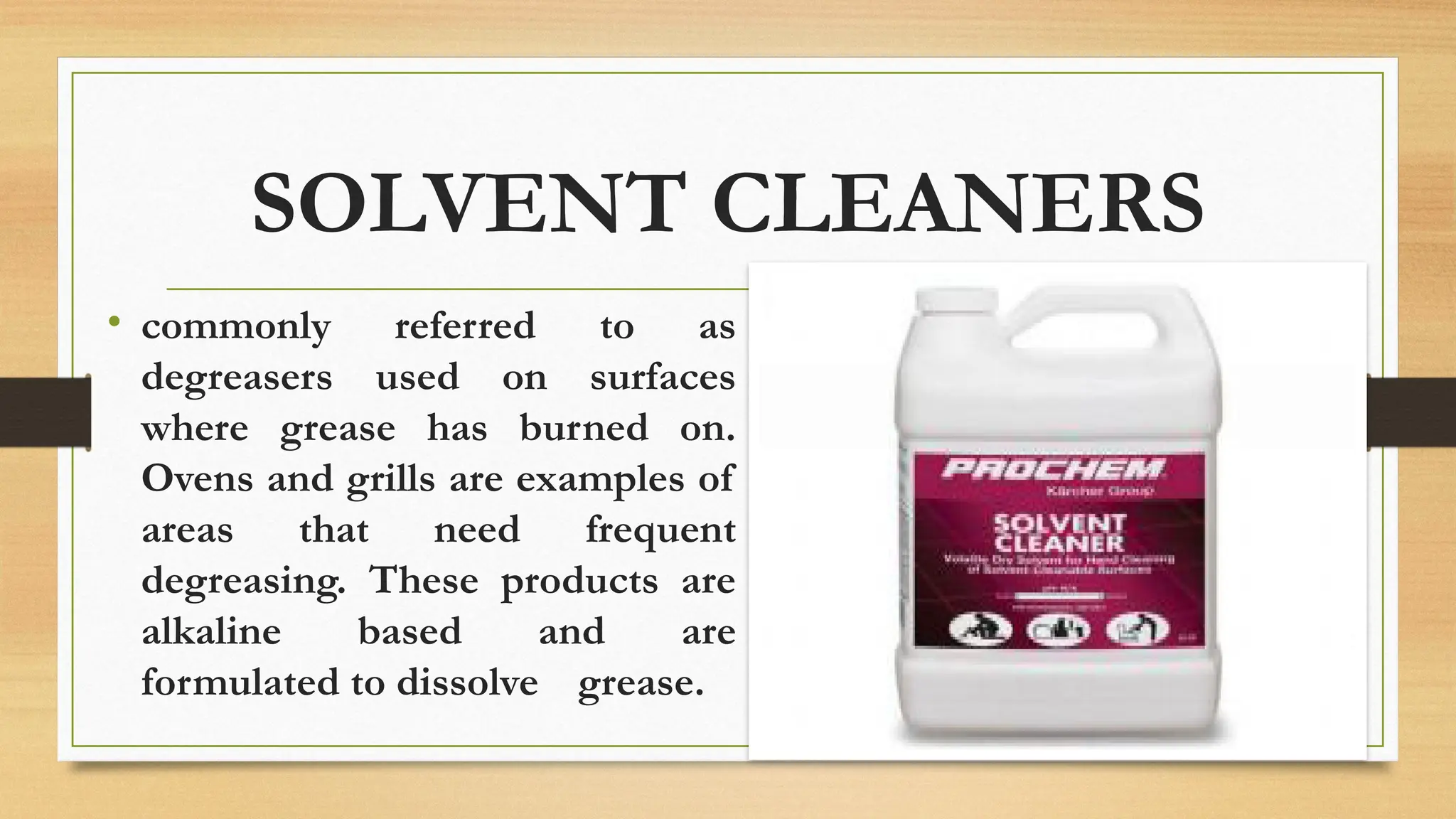
SOLVENT CLEANERS
• commonly referred to as
degreasers used on surfaces
where grease has burned on.
Ovens and grills are examples of
areas that need frequent
degreasing. These products are
alkaline based and are
formulated to dissolve grease.
ACID CLEANERS
• Used periodically in
removing mineral deposits
and other soils that
detergents cannot eliminate
such as scale in washing
machines and steam tables,
lime build up on
dishwashing machines and
rust on shelving.
ABRASIVES
• are generally used to remove
heavy accumulations of soil
that are difficult to remove
with detergents, solvents
and acids. These products
must be carefully used to
avoid damage to the surface
being cleaned.
AMMONIA
• also is effective at
breaking down
household grime or
stains from animal fats
or vegetable oils, such as
cooking grease and wine
stains.
DISWASHING LIQUID
• is a specially
formulated solution
that has been produced
by incorporating
surfactants and other
ingredients.
CHLORINE
• It is used to disinfect water and is
part of the sanitation process for
sewage and industrial waste.
During the production of paper
and cloth, chlorine is used as a
bleaching agent. It is also used in
cleaning products,
including household bleach which
is chlorine dissolved in water.
DISINFECTANTS
• is a chemical substance or
compound used to inactivate or
destroy microorganisms on inert
surfaces. Disinfection does not
necessarily kill all microorganisms,
especially resistant bacterial spores;
it is less effective than sterilization,
which is an extreme physical or
chemical process that kills all types
of life.
SOAP
• are generally made by
reacting an alkali (like
sodium hydroxide) in liquid
form with naturally
occurring fats or fatty acids,
produced from animals and
plants. The process is
known as saponification.
4-40-140 RULE
To minimize the growth of bacteria and
other organisms that can cause food
spoilage or food-borne illness, remember
the basic formula 4-40-140: Perishable
foods should spend no more than 4 hours
at temperature between 40 and 140 degrees
Fahrenheit.
APPLICATION
• The class will be divided into 5 groups. The leader
will make the procedures on cleaning and sanitizing.
All members will perform the following:
• 1. Clean tools and equipment
• 2. Sanitize tools and equipment using cleaning
agents
ASSESSMENT:
•Modified True or False
Direction: Read the statements carefully.
Write TRUE if the statement is correct and
FALSE if it is wrong, give your opinion to
make it correct (For additional points.)
Modified True or False
• 1. Rewashing is necessary if there is remaining grease.
• 2. Do not rinse out brush, sponge after using.
• 3. Disinfection does not necessarily kill all microorganisms,
especially resistant bacterial spores; it is less effective
than sterilization,
• 4. Cleaning reduces the number of pathogens on that clean
surface to safe levels.
• 5. Sanitizing is the process of removing food and other types
of soil from surface, such as a dish, glass or cutting board.
ASSESSMENT:
IDENTIFICATION:
Direction: Identify the following uses of cleaning compounds. Write the correct answer
on the space provided.
• ___________1. used to wash tableware’s, surfaces, and equipment.
• ___________2. used on surfaces where grease has burned on.
• ___________3. used periodically in removing mineral deposits and other soils
that detergents cannot eliminate.
• ___________4. used to remove heavy accumulations of soil that are difficult to
remove with detergents, solvents and acids.
• ___________5. used to disinfect water and is part of the sanitation process for
sewage and industrial waste.
ASSIGNMENT:
• Research about other cleaning compounds
• Procedures in Washing
LEARNING OBJECTIVE:
• Identify the chemicals to be utilized in cleaning and
sanitizing kitchen tools and equipment
• Prepare cleaning agents in accordance with
manufacturer’s instructions
• Clean and sanitize kitchen tools according with
prescribed standards
• Store cleaned kitchen tools and equipment safety in
the designated space
PROCEDURES IN WASHING
TWO WAY IN WASHING DISHES:
1. Manual Dishwashing
2. Mechanical Dishwashing
STEPS IN WASHING DISHES MANUALLY
• PREPARE
Wear rubber gloves if you
have dry hands or other
skin problems. If you are
wearing long sleeves, roll
them up or put them under
the gloves.
STEPS IN WASHING DISHES MANUALLY
SCRAPE
• all the large pieces
of food on the
dishes and place it
in a compost bin or
garbage can
STEPS IN WASHING DISHES MANUALLY
STACK
• the dishes in the proper
order namely: glassware,
silverware, chinaware, and
utensils. Stack them to the
right of the sink so that
work progresses from right
to left.
STEPS IN WASHING DISHES MANUALLY
• Fill the sink with water and add a
considerable amount of detergent.
The hotter the water, the better
it’s sanitizing and grease cutting
properties but use tolerable heat
(66oC (150oF) or above.) so not to
scald yourself. Use rubber gloves.
STEPS IN WASHING DISHES MANUALLY
• Wash the lightest soiled
items first.
Start with glasses, cups,
and flatware. Soap each
piece individually and
rinse in hot water.
STEPS IN WASHING DISHES MANUALLY
• Wash plates, bowls, and
serve dishes.
Remember to scrape these
items before washing. Soap
each piece gently and
individually and rinse in hot
water. Remember to keep an
eye when you should change
the dish washing water.
STEPS IN WASHING DISHES MANUALLY
• Wash pots and pans last.
Soak them first. Wash the pans
thoroughly and don’t forget to
clean the bottoms. If anything was
burnt or overcooked to pots or
casserole dishes, put a little extra
soap and water in it and let it stand
while you wash the other dishes.
Take note that any oil residue left
will lead to burned food during the
next cooking session.
STEPS IN WASHING DISHES MANUALLY
• Lay your dishes out
on a rack to air-dry
or wipe them clean
with a towel.
STEPS IN WASHING DISHES MANUALLY
• There should be no visible
matter and no "greasy" feel.
Run a hand over the dish to
ensure that they are
thoroughly cleaned. If there is
still some grease remaining,
consider rewashing the item.
STEPS IN WASHING DISHES MANUALLY
• Rinse out brush, sponge and
allow drying.
Sterilize your equipment
often using boiling water
with bleach. When a
sponge or brush starts to
smell unpleasant, throw it
away.
STEPS IN WASHING DISHES MANUALLY
• Wipe down the sink and your
tools. Wipe down the sink,
dish drainer, and dishpan.
Any rags, dish cloths, or
sponges need to be left out to
air dry, or thrown into the
washing machine. Remember to
replace sponges and rags
frequently.
Steps in Washing with the Dishwasher
• 1. Load it up 2. Fill your dishwasher logically.
Steps in Washing with the Dishwasher
• 3. Don't crowd the dishes. 4. Add detergent.
Steps in Washing with the Dishwasher
5. Turn it on. 6. Dry the
dishes.
4 Ways in Sanitizing Kitchen Tools & Equipment
• HEAT - is an inefficient sanitizer because it takes so much energy. The
efficiency of heat depends on the humidity, the temperature required, and
the length of time it takes to destroy microbes at that temperature.
• Steam - sanitizing with steam is expensive because of high energy costs,
and it is usually ineffective. Workers often mistake water vapor for steam,
so the temperature usually is not high enough to sterilize the equipment
or surface.
• Hot Water - can sanitize food-contact surfaces, plates, and utensils,
although spores may survive more than an hour of boiling temperatures.
• RADIATION - in the form of ultraviolet light or high-energy cathode or
gamma rays destroys microorganisms.
Methods of Cleaning Equipment
• Foam – You use this to increase the contact time of the chemical solutions
to improve cleaning with less mechanical force.
• High Pressure – used to increase mechanical force, aiding in soil
removal. In high pressure cleaning, chemical detergents are often used
along with an increased temperature to make soil removal more effective.
• Clean In Place (CIP) – is utilized to clean the interior surfaces of tanks
and pipelines of liquid process equipment. A chemical solution is
circulated through a circuit of tanks and or lines then returned to a central
reservoir allowing the chemical solution to be reused. Time, temperature
and mechanical force are manipulated to achieve maximum cleaning.
• Clean Out of Place (COP) – is utilized to clean the parts of
filters and parts of other equipment. This requires
disassembly for proper cleaning. Parts removed for
cleaning are placed in a circulation tank and cleaned
using a heated chemical solution and agitation.
• Mechanical – it normally involves the use of brush either
by hand or a machine such as a floor scrubber.
Mechanical cleaning uses friction for food soil removal.
Methods of Cleaning Equipment
Fundamental Cleaning Procedures
• 1. Scrape and Pre-rinse – soiled equipment surfaces
are scraped and rinsed with warm water to remove
loose food soils.
• 2. Cleaning Cycle – the removal of residual food soils
from equipment surfaces is based on the manipulation
of the four basic cleaning factors and the method of
cleaning. Typically, alkaline chemical solutions are used
for the cleaning cycle.
• 3. Rinse – rinse all surfaces with cold to hot water,
depending on the temperature of the cleaning cycle, to
thoroughly remove all remaining chemical solution and food
soil residues.
• 4. Acid Rinse – a mild acid rinse of the equipment
neutralizes any alkaline residues left and removes any
mineral soil present.
• 5. Sanitize – all equipment surfaces are rinsed or flooded
with a sanitizing agent. Both time and chemical
concentration are critical for optimum results.
Factors that influence the cleaning process
• Soil – varying degrees of food soil will be deposited on the
equipment during production. These food soils will require
complete removal during the cleaning process and will affect the
cleaning compound used, along with the method of cleaning
• Time – the longer a cleaning solution remains in contact with the
equipment surface, the greater the amount of food soil that is
removed. More time in contact with the soil reduces the chemical
concentration requirements.
• Temperature – soils are affected by temperature in varying
degrees. In the presence of a cleaning solution most soils become
more readily soluble as the temperature increases.
• ● Chemical concentrations – it varies depending on the chemical
itself, type of food soil, and the equipment to be cleaned.
Concentration will normally be reduced as time and temperature are
increased.
• ● Mechanical force – is as simple as hand scrubbing with a brush or
as complex as turbulent flow and pressure inside a pipeline. This aids
in soil removal and typically reduces time, temperature and
concentration requirements.
• ● Water – minerals in hard water can reduce the effectiveness of
some detergents or sanitizers. Water pH ranges generally from pH5-
8.5. However, highly acidic water may require additional buffering
agents. Water used for cleaning and sanitizing must be potable and
Equipment Sanitation Procedures
1. Range
a. Remove all burnt sediments and wipe grease from top of range after each use.
b. Scrape grease from curbs and openings hinges.
c. When cool, wash top of range
d. Run oiled cloth over top of range
e. Clean oven by removing grates, scraping off food deposits, washing & drying.
f. Keep burners clean. Gas burners can be soaked & scrubbed with a stiff brush
while electric burners should be cleaned with a brush or with a damp cloth.
g. Before replacing, rub with oil-damped cloth.
2. Dishwashing machine
• a. Remove strainer pans, wash and stock outside machine until next
use.
• b. Scrub inside frequently with stiff brush.
• c. Remove and clean the wash and rinse arms and fits daily to remove
• foreign particles.
• d. Wash tables and top of machine
• e. Clean nozzles.
• f. Do a special periodic cleaning in the hard water area.
3. Slicers
• a. Clean immediately after using, especially after slicing
vegetables and nuts.
• b. Remove all parts to clean
• c. Dry and cover knives after cleaning with oil-damped cloth.
• d. Wash carriage slides thoroughly.
• e. Wipe outside with cloth.
• f. Clean table and pedestal under slicers
• g. Replace guard after cleaning.
4. Refrigerator
• a. Wipe up spilled foods immediately
• b. Wash inside shelves and trays at least twice a
week with baking soda.
• c. Rinse and dry thoroughly
• d. Flush drains weekly
5. Sink and Drains
• a. Keep outlet screened at all times
• b. Flush daily with 1 gal. of solution, made up of strong
solution soda (4oz.to 2 gal. of water)
• c. Clean and replace greased trays regularly.
• d. Use force pump if drain is slow
• e. Replace washers immediately on leaking faucets.
• Proper Storage of Kitchen Tools and Equipment
• Storing is an act of keeping something in a proper and designated
place.
• Proper storage and handling of cleaned and sanitized equipment and
utensils are very important to prevent recontamination prior to use.
• Cleaned and sanitized equipment and utensils must be:
• ● stored in clean storage areas; and
• ● handled properly to minimize contamination of the food contact
surface.
Store cleaned kitchen tools and equipment safely in designated
areas
•10 Steps in Organizing Kitchen Cabinets
• 1. Pretend it has a glass door and that everyone is going to see what’s inside.
• 2. Remove all the equipment and scrub shelves with soapy water.
• 3. Think about what you reach most often and make sure it gets a position
that’s easy to reach.
• 4. Take a cabinet full of glasses and line them up by color. Make sure all of the
entire front is facing out and straight. (Jeff Lewis-Style)
• 5. Take a step back after one shelf is done and make someone else look at
what you’ve done.
• 6. They should be stored in a clean dry place adequately protected against
vermin and other sources of contamination
• 7. Cups, bowls, and glasses must be inverted for storage.
• 8. When not stored in closed cupboards or lockers, utensils and
containers must be covered or inverted whenever possible. Utensils
must be stored on the bottom shelves of open cabinets below the
working top level.
• 9. Racks, trays and shelves must be made of materials that are
imperious, corrosive-resistant, non-toxic, smooth, durable and
resistant to chipping.
• 10. Drawers must be made of the same materials and kept clean.
Full-lined drawers are not acceptable, but the use of clean and
removable towels for lining drawers is acceptable.

sanitizing-9-WEEK-1-2.pptx grade 9 grade 9

  • 1.
  • 2.
    LEARNING OBJECTIVE: • Identifythe chemicals to be utilized in cleaning and sanitizing kitchen tools and equipment • Prepare cleaning agents in accordance with manufacturer’s instructions • Clean and sanitize kitchen tools according with prescribed standards • Store cleaned kitchen tools and equipment safety in the designated space
  • 3.
  • 4.
    COOKERY is defined as“chemical process”, the mixing of ingredients; the application and withdrawal of heat; decision-making, technical knowledge and manipulative skills, in the more advanced stages, a further element occurs-that of creativity. Cookery is considered both an art and a technology.
  • 5.
    Cooking is atransfer of heat source to a food. This energy alters the food molecular structures, changing its flavor, aroma and appearance.
  • 6.
    KITCHEN TOOLS &EQUIPMENT
  • 7.
    KITCHEN TOOLS &EQUIPMENT
  • 8.
    KITCHEN TOOLS &EQUIPMENT
  • 12.
  • 13.
  • 14.
  • 15.
  • 16.
  • 17.
  • 18.
  • 19.
    CLEANING •Is the processof removing food and other types of soil from surface, such as a dish, glass or cutting board. •Is done with cleaning agent that removes food, soil, or other substances.
  • 20.
    SANITIZING •Reduces the numberof pathogens on that clean surface to safe levels. It destroys the microbes that are left on the clean surface.
  • 21.
    CLEANING COMPOUND • DetergentsSolvent cleaners • Acid Cleaners Abrasives • Ammonia Dishwashing Liquid • Chlorine Disinfectants • Soap
  • 22.
    DETERGENTS • These arecleaning agents, solvents or any substance used to wash tableware’s, surfaces, and equipment. Example: soap, soap powders, cleaners, acids, volatile solvents and abrasives.
  • 23.
    SOLVENT CLEANERS • commonlyreferred to as degreasers used on surfaces where grease has burned on. Ovens and grills are examples of areas that need frequent degreasing. These products are alkaline based and are formulated to dissolve grease.
  • 24.
    ACID CLEANERS • Usedperiodically in removing mineral deposits and other soils that detergents cannot eliminate such as scale in washing machines and steam tables, lime build up on dishwashing machines and rust on shelving.
  • 25.
    ABRASIVES • are generallyused to remove heavy accumulations of soil that are difficult to remove with detergents, solvents and acids. These products must be carefully used to avoid damage to the surface being cleaned.
  • 26.
    AMMONIA • also iseffective at breaking down household grime or stains from animal fats or vegetable oils, such as cooking grease and wine stains.
  • 27.
    DISWASHING LIQUID • isa specially formulated solution that has been produced by incorporating surfactants and other ingredients.
  • 28.
    CHLORINE • It isused to disinfect water and is part of the sanitation process for sewage and industrial waste. During the production of paper and cloth, chlorine is used as a bleaching agent. It is also used in cleaning products, including household bleach which is chlorine dissolved in water.
  • 29.
    DISINFECTANTS • is achemical substance or compound used to inactivate or destroy microorganisms on inert surfaces. Disinfection does not necessarily kill all microorganisms, especially resistant bacterial spores; it is less effective than sterilization, which is an extreme physical or chemical process that kills all types of life.
  • 30.
    SOAP • are generallymade by reacting an alkali (like sodium hydroxide) in liquid form with naturally occurring fats or fatty acids, produced from animals and plants. The process is known as saponification.
  • 31.
    4-40-140 RULE To minimizethe growth of bacteria and other organisms that can cause food spoilage or food-borne illness, remember the basic formula 4-40-140: Perishable foods should spend no more than 4 hours at temperature between 40 and 140 degrees Fahrenheit.
  • 32.
    APPLICATION • The classwill be divided into 5 groups. The leader will make the procedures on cleaning and sanitizing. All members will perform the following: • 1. Clean tools and equipment • 2. Sanitize tools and equipment using cleaning agents
  • 33.
    ASSESSMENT: •Modified True orFalse Direction: Read the statements carefully. Write TRUE if the statement is correct and FALSE if it is wrong, give your opinion to make it correct (For additional points.)
  • 34.
    Modified True orFalse • 1. Rewashing is necessary if there is remaining grease. • 2. Do not rinse out brush, sponge after using. • 3. Disinfection does not necessarily kill all microorganisms, especially resistant bacterial spores; it is less effective than sterilization, • 4. Cleaning reduces the number of pathogens on that clean surface to safe levels. • 5. Sanitizing is the process of removing food and other types of soil from surface, such as a dish, glass or cutting board.
  • 35.
    ASSESSMENT: IDENTIFICATION: Direction: Identify thefollowing uses of cleaning compounds. Write the correct answer on the space provided. • ___________1. used to wash tableware’s, surfaces, and equipment. • ___________2. used on surfaces where grease has burned on. • ___________3. used periodically in removing mineral deposits and other soils that detergents cannot eliminate. • ___________4. used to remove heavy accumulations of soil that are difficult to remove with detergents, solvents and acids. • ___________5. used to disinfect water and is part of the sanitation process for sewage and industrial waste.
  • 36.
    ASSIGNMENT: • Research aboutother cleaning compounds • Procedures in Washing
  • 37.
    LEARNING OBJECTIVE: • Identifythe chemicals to be utilized in cleaning and sanitizing kitchen tools and equipment • Prepare cleaning agents in accordance with manufacturer’s instructions • Clean and sanitize kitchen tools according with prescribed standards • Store cleaned kitchen tools and equipment safety in the designated space
  • 38.
    PROCEDURES IN WASHING TWOWAY IN WASHING DISHES: 1. Manual Dishwashing 2. Mechanical Dishwashing
  • 39.
    STEPS IN WASHINGDISHES MANUALLY • PREPARE Wear rubber gloves if you have dry hands or other skin problems. If you are wearing long sleeves, roll them up or put them under the gloves.
  • 40.
    STEPS IN WASHINGDISHES MANUALLY SCRAPE • all the large pieces of food on the dishes and place it in a compost bin or garbage can
  • 41.
    STEPS IN WASHINGDISHES MANUALLY STACK • the dishes in the proper order namely: glassware, silverware, chinaware, and utensils. Stack them to the right of the sink so that work progresses from right to left.
  • 42.
    STEPS IN WASHINGDISHES MANUALLY • Fill the sink with water and add a considerable amount of detergent. The hotter the water, the better it’s sanitizing and grease cutting properties but use tolerable heat (66oC (150oF) or above.) so not to scald yourself. Use rubber gloves.
  • 43.
    STEPS IN WASHINGDISHES MANUALLY • Wash the lightest soiled items first. Start with glasses, cups, and flatware. Soap each piece individually and rinse in hot water.
  • 44.
    STEPS IN WASHINGDISHES MANUALLY • Wash plates, bowls, and serve dishes. Remember to scrape these items before washing. Soap each piece gently and individually and rinse in hot water. Remember to keep an eye when you should change the dish washing water.
  • 45.
    STEPS IN WASHINGDISHES MANUALLY • Wash pots and pans last. Soak them first. Wash the pans thoroughly and don’t forget to clean the bottoms. If anything was burnt or overcooked to pots or casserole dishes, put a little extra soap and water in it and let it stand while you wash the other dishes. Take note that any oil residue left will lead to burned food during the next cooking session.
  • 46.
    STEPS IN WASHINGDISHES MANUALLY • Lay your dishes out on a rack to air-dry or wipe them clean with a towel.
  • 47.
    STEPS IN WASHINGDISHES MANUALLY • There should be no visible matter and no "greasy" feel. Run a hand over the dish to ensure that they are thoroughly cleaned. If there is still some grease remaining, consider rewashing the item.
  • 48.
    STEPS IN WASHINGDISHES MANUALLY • Rinse out brush, sponge and allow drying. Sterilize your equipment often using boiling water with bleach. When a sponge or brush starts to smell unpleasant, throw it away.
  • 49.
    STEPS IN WASHINGDISHES MANUALLY • Wipe down the sink and your tools. Wipe down the sink, dish drainer, and dishpan. Any rags, dish cloths, or sponges need to be left out to air dry, or thrown into the washing machine. Remember to replace sponges and rags frequently.
  • 50.
    Steps in Washingwith the Dishwasher • 1. Load it up 2. Fill your dishwasher logically.
  • 51.
    Steps in Washingwith the Dishwasher • 3. Don't crowd the dishes. 4. Add detergent.
  • 52.
    Steps in Washingwith the Dishwasher 5. Turn it on. 6. Dry the dishes.
  • 53.
    4 Ways inSanitizing Kitchen Tools & Equipment • HEAT - is an inefficient sanitizer because it takes so much energy. The efficiency of heat depends on the humidity, the temperature required, and the length of time it takes to destroy microbes at that temperature. • Steam - sanitizing with steam is expensive because of high energy costs, and it is usually ineffective. Workers often mistake water vapor for steam, so the temperature usually is not high enough to sterilize the equipment or surface. • Hot Water - can sanitize food-contact surfaces, plates, and utensils, although spores may survive more than an hour of boiling temperatures. • RADIATION - in the form of ultraviolet light or high-energy cathode or gamma rays destroys microorganisms.
  • 54.
    Methods of CleaningEquipment • Foam – You use this to increase the contact time of the chemical solutions to improve cleaning with less mechanical force. • High Pressure – used to increase mechanical force, aiding in soil removal. In high pressure cleaning, chemical detergents are often used along with an increased temperature to make soil removal more effective. • Clean In Place (CIP) – is utilized to clean the interior surfaces of tanks and pipelines of liquid process equipment. A chemical solution is circulated through a circuit of tanks and or lines then returned to a central reservoir allowing the chemical solution to be reused. Time, temperature and mechanical force are manipulated to achieve maximum cleaning.
  • 55.
    • Clean Outof Place (COP) – is utilized to clean the parts of filters and parts of other equipment. This requires disassembly for proper cleaning. Parts removed for cleaning are placed in a circulation tank and cleaned using a heated chemical solution and agitation. • Mechanical – it normally involves the use of brush either by hand or a machine such as a floor scrubber. Mechanical cleaning uses friction for food soil removal. Methods of Cleaning Equipment
  • 56.
    Fundamental Cleaning Procedures •1. Scrape and Pre-rinse – soiled equipment surfaces are scraped and rinsed with warm water to remove loose food soils. • 2. Cleaning Cycle – the removal of residual food soils from equipment surfaces is based on the manipulation of the four basic cleaning factors and the method of cleaning. Typically, alkaline chemical solutions are used for the cleaning cycle.
  • 57.
    • 3. Rinse– rinse all surfaces with cold to hot water, depending on the temperature of the cleaning cycle, to thoroughly remove all remaining chemical solution and food soil residues. • 4. Acid Rinse – a mild acid rinse of the equipment neutralizes any alkaline residues left and removes any mineral soil present. • 5. Sanitize – all equipment surfaces are rinsed or flooded with a sanitizing agent. Both time and chemical concentration are critical for optimum results.
  • 58.
    Factors that influencethe cleaning process • Soil – varying degrees of food soil will be deposited on the equipment during production. These food soils will require complete removal during the cleaning process and will affect the cleaning compound used, along with the method of cleaning • Time – the longer a cleaning solution remains in contact with the equipment surface, the greater the amount of food soil that is removed. More time in contact with the soil reduces the chemical concentration requirements. • Temperature – soils are affected by temperature in varying degrees. In the presence of a cleaning solution most soils become more readily soluble as the temperature increases.
  • 59.
    • ● Chemicalconcentrations – it varies depending on the chemical itself, type of food soil, and the equipment to be cleaned. Concentration will normally be reduced as time and temperature are increased. • ● Mechanical force – is as simple as hand scrubbing with a brush or as complex as turbulent flow and pressure inside a pipeline. This aids in soil removal and typically reduces time, temperature and concentration requirements. • ● Water – minerals in hard water can reduce the effectiveness of some detergents or sanitizers. Water pH ranges generally from pH5- 8.5. However, highly acidic water may require additional buffering agents. Water used for cleaning and sanitizing must be potable and
  • 60.
    Equipment Sanitation Procedures 1.Range a. Remove all burnt sediments and wipe grease from top of range after each use. b. Scrape grease from curbs and openings hinges. c. When cool, wash top of range d. Run oiled cloth over top of range e. Clean oven by removing grates, scraping off food deposits, washing & drying. f. Keep burners clean. Gas burners can be soaked & scrubbed with a stiff brush while electric burners should be cleaned with a brush or with a damp cloth. g. Before replacing, rub with oil-damped cloth.
  • 61.
    2. Dishwashing machine •a. Remove strainer pans, wash and stock outside machine until next use. • b. Scrub inside frequently with stiff brush. • c. Remove and clean the wash and rinse arms and fits daily to remove • foreign particles. • d. Wash tables and top of machine • e. Clean nozzles. • f. Do a special periodic cleaning in the hard water area.
  • 62.
    3. Slicers • a.Clean immediately after using, especially after slicing vegetables and nuts. • b. Remove all parts to clean • c. Dry and cover knives after cleaning with oil-damped cloth. • d. Wash carriage slides thoroughly. • e. Wipe outside with cloth. • f. Clean table and pedestal under slicers • g. Replace guard after cleaning.
  • 63.
    4. Refrigerator • a.Wipe up spilled foods immediately • b. Wash inside shelves and trays at least twice a week with baking soda. • c. Rinse and dry thoroughly • d. Flush drains weekly
  • 64.
    5. Sink andDrains • a. Keep outlet screened at all times • b. Flush daily with 1 gal. of solution, made up of strong solution soda (4oz.to 2 gal. of water) • c. Clean and replace greased trays regularly. • d. Use force pump if drain is slow • e. Replace washers immediately on leaking faucets.
  • 65.
    • Proper Storageof Kitchen Tools and Equipment • Storing is an act of keeping something in a proper and designated place. • Proper storage and handling of cleaned and sanitized equipment and utensils are very important to prevent recontamination prior to use. • Cleaned and sanitized equipment and utensils must be: • ● stored in clean storage areas; and • ● handled properly to minimize contamination of the food contact surface. Store cleaned kitchen tools and equipment safely in designated areas
  • 67.
    •10 Steps inOrganizing Kitchen Cabinets • 1. Pretend it has a glass door and that everyone is going to see what’s inside. • 2. Remove all the equipment and scrub shelves with soapy water. • 3. Think about what you reach most often and make sure it gets a position that’s easy to reach. • 4. Take a cabinet full of glasses and line them up by color. Make sure all of the entire front is facing out and straight. (Jeff Lewis-Style) • 5. Take a step back after one shelf is done and make someone else look at what you’ve done. • 6. They should be stored in a clean dry place adequately protected against vermin and other sources of contamination
  • 68.
    • 7. Cups,bowls, and glasses must be inverted for storage. • 8. When not stored in closed cupboards or lockers, utensils and containers must be covered or inverted whenever possible. Utensils must be stored on the bottom shelves of open cabinets below the working top level. • 9. Racks, trays and shelves must be made of materials that are imperious, corrosive-resistant, non-toxic, smooth, durable and resistant to chipping. • 10. Drawers must be made of the same materials and kept clean. Full-lined drawers are not acceptable, but the use of clean and removable towels for lining drawers is acceptable.