U CHARTS By Steven H. Baker
AGENDA Control Charts U Charts Application Exercise Summary
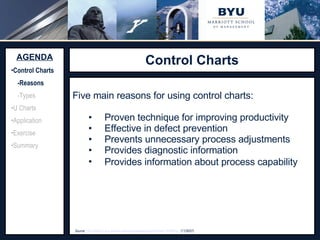
Control Charts Five main reasons for using control charts: Proven technique for improving productivity Effective in defect prevention Prevents unnecessary process adjustments Provides diagnostic information Provides information about process capability   AGENDA Control Charts -Reasons -Types U Charts Application Exercise Summary Source:  http://deming.eng.clemson.edu/pub/tutorials/qctools/ccmain1.htm#Top   (11/26/07)
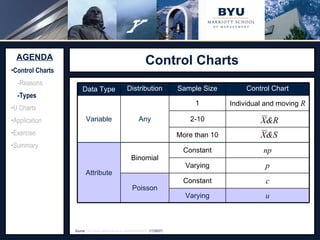
Control Charts Source:  http://www.adeptscience.co.uk/kb/article/642A   (11/26/07) AGENDA Control Charts -Reasons -Types U Charts Application Exercise Summary 2-10 Any More than 10 np Constant Binomial Attribute p Varying u Varying c Constant Poisson Individual and moving  R 1 Variable Control Chart Sample Size Distribution Data Type
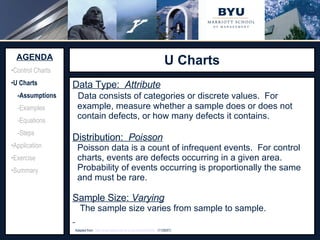
U Charts Data Type:  Attribute Data consists of categories or discrete values.  For example, measure whether a sample does or does not contain defects, or how many defects it contains. Distribution:  Poisson Poisson data is a count of infrequent events.  For control charts, events are defects occurring in a given area. Probability of events occurring is proportionally the same and must be rare. Sample Size:  Varying The sample size varies from sample to sample. Adapted from:  http://www.adeptscience.co.uk/kb/article/642A   (11/26/07) AGENDA Control Charts U Charts -Assumptions -Examples -Equations -Steps Application Exercise Summary
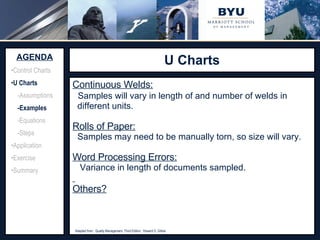
U Charts Source:  http://www.adeptscience.co.uk/kb/article/642A   (11/26/07) Continuous Welds: Samples will vary in length of and number of welds in  different units.  Rolls of Paper: Samples may need to be manually torn, so size will vary.  Word Processing Errors: Variance in length of documents sampled. Others? Adapted from:  Quality Management, Third Edition.  Howard S. Gitlow AGENDA Control Charts U Charts -Assumptions -Examples -Equations -Steps Application Exercise Summary
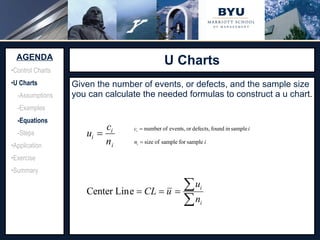
U Charts AGENDA Control Charts U Charts -Assumptions -Examples -Equations -Steps Application Exercise Summary Source:  http://www.adeptscience.co.uk/kb/article/642A   (11/26/07) Given the number of events, or defects, and the sample size you can calculate the needed formulas to construct a u chart.
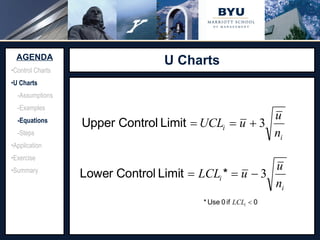
U Charts Source:  http://www.adeptscience.co.uk/kb/article/642A   (11/26/07) AGENDA Control Charts U Charts -Assumptions -Examples -Equations -Steps Application Exercise Summary
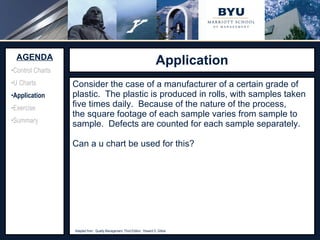
Application Source:  http://www.adeptscience.co.uk/kb/article/642A   (11/26/07) Consider the case of a manufacturer of a certain grade of plastic.  The plastic is produced in rolls, with samples taken five times daily.  Because of the nature of the process, the square footage of each sample varies from sample to sample.  Defects are counted for each sample separately. Can a u chart be used for this? AGENDA Control Charts U Charts Application Exercise Summary Adapted from:  Quality Management, Third Edition.  Howard S. Gitlow
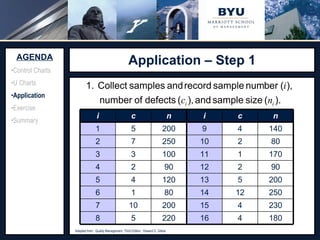
Application – Step 1 Source:  http://www.adeptscience.co.uk/kb/article/642A   (11/26/07) AGENDA Control Charts U Charts Application Exercise Summary Adapted from:  Quality Management, Third Edition.  Howard S. Gitlow 4 4 12 5 2 1 2 4 c 5 10 1 4 2 3 7 5 c 250 14 80 6 180 16 220 8 230 15 200 7 200 13 120 5 90 12 90 4 170 11 100 3 80 10 250 2 140 9 200 1 n i n i
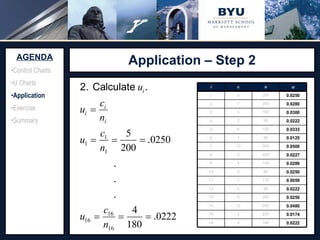
Application – Step 2 Source:  http://www.adeptscience.co.uk/kb/article/642A   (11/26/07) AGENDA Control Charts U Charts Application Exercise Summary 0.0222 180 4 16 0.0174 230 4 15 0.0480 250 12 14 0.0250 200 5 13 0.0222 90 2 12 0.0059 170 1 11 0.0250 80 2 10 0.0286 140 4 9 0.0227 220 5 8 0.0500 200 10 7 0.0125 80 1 6 0.0333 120 4 5 0.0222 90 2 4 0.0300 100 3 3 0.0280 250 7 2 0.0250 200 5 1 u n c i
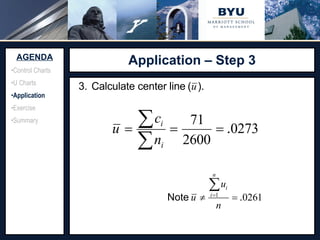
Application – Step 3 Source:  http://www.adeptscience.co.uk/kb/article/642A   (11/26/07) AGENDA Control Charts U Charts Application Exercise Summary
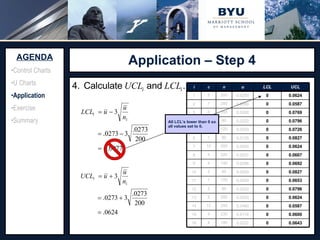
Application – Step 4 Source:  http://www.adeptscience.co.uk/kb/article/642A   (11/26/07) AGENDA Control Charts U Charts Application Exercise Summary All LCL’s lower than 0 so all values set to 0. 0.0222 0.0174 0.0480 0.0250 0.0222 0.0059 0.0250 0.0286 0.0227 0.0500 0.0125 0.0333 0.0222 0.0300 0.0280 0.0250 u 0 0 0 0 0 0 0 0 0 0 0 0 0 0 0 0 LCL 0.0643  180 4 16 0.0600  230 4 15 0.0587  250 12 14 0.0624  200 5 13 0.0796  90 2 12 0.0653  170 1 11 0.0827  80 2 10 0.0692  140 4 9 0.0607  220 5 8 0.0624  200 10 7 0.0827  80 1 6 0.0726  120 4 5 0.0796  90 2 4 0.0769  100 3 3 0.0587  250 7 2 0.0624  200 5 1 UCL n c i
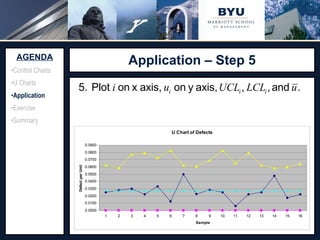
Application – Step 5 Source:  http://www.adeptscience.co.uk/kb/article/642A   (11/26/07) AGENDA Control Charts U Charts Application Exercise Summary
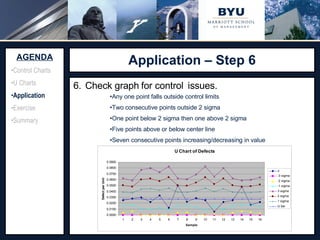
Application – Step 6 Source:  http://www.adeptscience.co.uk/kb/article/642A   (11/26/07) AGENDA Control Charts U Charts Application Exercise Summary Any one point falls outside control limits Two consecutive points outside 2 sigma One point below 2 sigma then one above 2 sigma Five points above or below center line Seven consecutive points increasing/decreasing in value
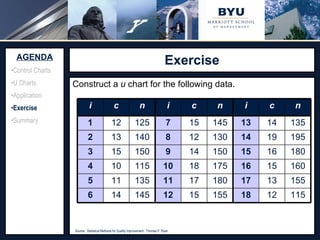
Exercise Source:  http://www.adeptscience.co.uk/kb/article/642A   (11/26/07) Construct a  u  chart for the following data. AGENDA Control Charts U Charts Application Exercise Summary Source:  Statistical Methods for Quality Improvement.  Thomas P. Ryan 18 17 16 15 14 13 i 12 11 10 9 8 7 i 6 5 4 3 2 1 i 115 12 155 15 145 14 155 13 180 17 135 11 160 15 175 18 115 10 180 16 150 14 150 15 195 19 130 12 140 13 135 14 145 15 125 12 n c n c n c
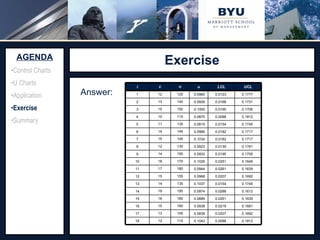
Exercise Source:  http://www.adeptscience.co.uk/kb/article/642A   (11/26/07) AGENDA Control Charts U Charts Application Exercise Summary Answer: 0.1812  0.0088  0.1043 115 12 18 0.1692  0.0207  0.0839 155 13 17 0.1681  0.0219  0.0938 160 15 16 0.1639  0.0261  0.0889 180 16 15 0.1612  0.0288  0.0974 195 19 14 0.1745  0.0154  0.1037 135 14 13 0.1692  0.0207  0.0968 155 15 12 0.1639  0.0261  0.0944 180 17 11 0.1649  0.0251  0.1029 175 18 10 0.1705  0.0195  0.0933 150 14 9 0.1761  0.0139  0.0923 130 12 8 0.1717  0.0182  0.1034 145 15 7 0.1717  0.0182  0.0966 145 14 6 0.1745  0.0154  0.0815 135 11 5 0.1812  0.0088  0.0870 115 10 4 0.1705  0.0195  0.1000 150 15 3 0.1731  0.0168  0.0929 140 13 2 0.1777  0.0123  0.0960 125 12 1 UCL LCL u n c i
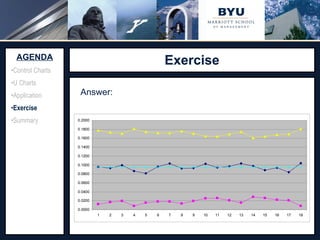
Exercise Source:  http://www.adeptscience.co.uk/kb/article/642A   (11/26/07) AGENDA Control Charts U Charts Application Exercise Summary Answer:
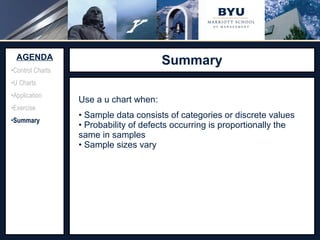
Summary Source:  http://www.adeptscience.co.uk/kb/article/642A   (11/26/07) AGENDA Control Charts U Charts Application Exercise Summary Use a u chart when: Sample data consists of categories or discrete values Probability of defects occurring is proportionally the same in samples Sample sizes vary
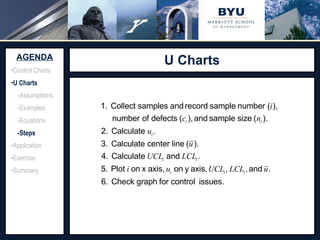
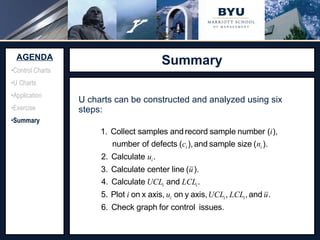
Summary Source:  http://www.adeptscience.co.uk/kb/article/642A   (11/26/07) AGENDA Control Charts U Charts Application Exercise Summary U charts can be constructed and analyzed using six steps:
Readings List Source:  http://www.adeptscience.co.uk/kb/article/642A   (11/26/07) AGENDA Control Charts U Charts Application Exercise Summary Statistical Methods For Quality Improvement - Thomas P. Ryan Quality Management, Third Edition - Howard S. Gitlow

Steven Baker Free Quality U Charts

  • 1.
    U CHARTS BySteven H. Baker
  • 2.
    AGENDA Control ChartsU Charts Application Exercise Summary
  • 3.
    Control Charts Fivemain reasons for using control charts: Proven technique for improving productivity Effective in defect prevention Prevents unnecessary process adjustments Provides diagnostic information Provides information about process capability AGENDA Control Charts -Reasons -Types U Charts Application Exercise Summary Source: http://deming.eng.clemson.edu/pub/tutorials/qctools/ccmain1.htm#Top (11/26/07)
  • 4.
    Control Charts Source: http://www.adeptscience.co.uk/kb/article/642A (11/26/07) AGENDA Control Charts -Reasons -Types U Charts Application Exercise Summary 2-10 Any More than 10 np Constant Binomial Attribute p Varying u Varying c Constant Poisson Individual and moving R 1 Variable Control Chart Sample Size Distribution Data Type
  • 5.
    U Charts DataType: Attribute Data consists of categories or discrete values. For example, measure whether a sample does or does not contain defects, or how many defects it contains. Distribution: Poisson Poisson data is a count of infrequent events. For control charts, events are defects occurring in a given area. Probability of events occurring is proportionally the same and must be rare. Sample Size: Varying The sample size varies from sample to sample. Adapted from: http://www.adeptscience.co.uk/kb/article/642A (11/26/07) AGENDA Control Charts U Charts -Assumptions -Examples -Equations -Steps Application Exercise Summary
  • 6.
    U Charts Source: http://www.adeptscience.co.uk/kb/article/642A (11/26/07) Continuous Welds: Samples will vary in length of and number of welds in different units. Rolls of Paper: Samples may need to be manually torn, so size will vary. Word Processing Errors: Variance in length of documents sampled. Others? Adapted from: Quality Management, Third Edition. Howard S. Gitlow AGENDA Control Charts U Charts -Assumptions -Examples -Equations -Steps Application Exercise Summary
  • 7.
    U Charts AGENDAControl Charts U Charts -Assumptions -Examples -Equations -Steps Application Exercise Summary Source: http://www.adeptscience.co.uk/kb/article/642A (11/26/07) Given the number of events, or defects, and the sample size you can calculate the needed formulas to construct a u chart.
  • 8.
    U Charts Source: http://www.adeptscience.co.uk/kb/article/642A (11/26/07) AGENDA Control Charts U Charts -Assumptions -Examples -Equations -Steps Application Exercise Summary
  • 9.
    U Charts Source: http://www.adeptscience.co.uk/kb/article/642A (11/26/07) AGENDA Control Charts U Charts -Assumptions -Examples -Equations -Steps Application Exercise Summary
  • 10.
    Application Source: http://www.adeptscience.co.uk/kb/article/642A (11/26/07) Consider the case of a manufacturer of a certain grade of plastic. The plastic is produced in rolls, with samples taken five times daily. Because of the nature of the process, the square footage of each sample varies from sample to sample. Defects are counted for each sample separately. Can a u chart be used for this? AGENDA Control Charts U Charts Application Exercise Summary Adapted from: Quality Management, Third Edition. Howard S. Gitlow
  • 11.
    Application – Step1 Source: http://www.adeptscience.co.uk/kb/article/642A (11/26/07) AGENDA Control Charts U Charts Application Exercise Summary Adapted from: Quality Management, Third Edition. Howard S. Gitlow 4 4 12 5 2 1 2 4 c 5 10 1 4 2 3 7 5 c 250 14 80 6 180 16 220 8 230 15 200 7 200 13 120 5 90 12 90 4 170 11 100 3 80 10 250 2 140 9 200 1 n i n i
  • 12.
    Application – Step2 Source: http://www.adeptscience.co.uk/kb/article/642A (11/26/07) AGENDA Control Charts U Charts Application Exercise Summary 0.0222 180 4 16 0.0174 230 4 15 0.0480 250 12 14 0.0250 200 5 13 0.0222 90 2 12 0.0059 170 1 11 0.0250 80 2 10 0.0286 140 4 9 0.0227 220 5 8 0.0500 200 10 7 0.0125 80 1 6 0.0333 120 4 5 0.0222 90 2 4 0.0300 100 3 3 0.0280 250 7 2 0.0250 200 5 1 u n c i
  • 13.
    Application – Step3 Source: http://www.adeptscience.co.uk/kb/article/642A (11/26/07) AGENDA Control Charts U Charts Application Exercise Summary
  • 14.
    Application – Step4 Source: http://www.adeptscience.co.uk/kb/article/642A (11/26/07) AGENDA Control Charts U Charts Application Exercise Summary All LCL’s lower than 0 so all values set to 0. 0.0222 0.0174 0.0480 0.0250 0.0222 0.0059 0.0250 0.0286 0.0227 0.0500 0.0125 0.0333 0.0222 0.0300 0.0280 0.0250 u 0 0 0 0 0 0 0 0 0 0 0 0 0 0 0 0 LCL 0.0643 180 4 16 0.0600 230 4 15 0.0587 250 12 14 0.0624 200 5 13 0.0796 90 2 12 0.0653 170 1 11 0.0827 80 2 10 0.0692 140 4 9 0.0607 220 5 8 0.0624 200 10 7 0.0827 80 1 6 0.0726 120 4 5 0.0796 90 2 4 0.0769 100 3 3 0.0587 250 7 2 0.0624 200 5 1 UCL n c i
  • 15.
    Application – Step5 Source: http://www.adeptscience.co.uk/kb/article/642A (11/26/07) AGENDA Control Charts U Charts Application Exercise Summary
  • 16.
    Application – Step6 Source: http://www.adeptscience.co.uk/kb/article/642A (11/26/07) AGENDA Control Charts U Charts Application Exercise Summary Any one point falls outside control limits Two consecutive points outside 2 sigma One point below 2 sigma then one above 2 sigma Five points above or below center line Seven consecutive points increasing/decreasing in value
  • 17.
    Exercise Source: http://www.adeptscience.co.uk/kb/article/642A (11/26/07) Construct a u chart for the following data. AGENDA Control Charts U Charts Application Exercise Summary Source: Statistical Methods for Quality Improvement. Thomas P. Ryan 18 17 16 15 14 13 i 12 11 10 9 8 7 i 6 5 4 3 2 1 i 115 12 155 15 145 14 155 13 180 17 135 11 160 15 175 18 115 10 180 16 150 14 150 15 195 19 130 12 140 13 135 14 145 15 125 12 n c n c n c
  • 18.
    Exercise Source: http://www.adeptscience.co.uk/kb/article/642A (11/26/07) AGENDA Control Charts U Charts Application Exercise Summary Answer: 0.1812 0.0088 0.1043 115 12 18 0.1692 0.0207 0.0839 155 13 17 0.1681 0.0219 0.0938 160 15 16 0.1639 0.0261 0.0889 180 16 15 0.1612 0.0288 0.0974 195 19 14 0.1745 0.0154 0.1037 135 14 13 0.1692 0.0207 0.0968 155 15 12 0.1639 0.0261 0.0944 180 17 11 0.1649 0.0251 0.1029 175 18 10 0.1705 0.0195 0.0933 150 14 9 0.1761 0.0139 0.0923 130 12 8 0.1717 0.0182 0.1034 145 15 7 0.1717 0.0182 0.0966 145 14 6 0.1745 0.0154 0.0815 135 11 5 0.1812 0.0088 0.0870 115 10 4 0.1705 0.0195 0.1000 150 15 3 0.1731 0.0168 0.0929 140 13 2 0.1777 0.0123 0.0960 125 12 1 UCL LCL u n c i
  • 19.
    Exercise Source: http://www.adeptscience.co.uk/kb/article/642A (11/26/07) AGENDA Control Charts U Charts Application Exercise Summary Answer:
  • 20.
    Summary Source: http://www.adeptscience.co.uk/kb/article/642A (11/26/07) AGENDA Control Charts U Charts Application Exercise Summary Use a u chart when: Sample data consists of categories or discrete values Probability of defects occurring is proportionally the same in samples Sample sizes vary
  • 21.
    Summary Source: http://www.adeptscience.co.uk/kb/article/642A (11/26/07) AGENDA Control Charts U Charts Application Exercise Summary U charts can be constructed and analyzed using six steps:
  • 22.
    Readings List Source: http://www.adeptscience.co.uk/kb/article/642A (11/26/07) AGENDA Control Charts U Charts Application Exercise Summary Statistical Methods For Quality Improvement - Thomas P. Ryan Quality Management, Third Edition - Howard S. Gitlow