Why is maritime health an international issue? Should medical examinations remain a national responsibility? 
Tim Carter 
Norwegian Centre for Maritime Medicine 
Bergen
Maritime health – prevention and care 
1.Fitness to work at sea 
2.Prevention of risks from disease and injury – at sea, in port, on leave 
3.Management of medical incidents at sea 
4.Health care ashore – foreign ports, home country 
5.Special health care needs of former seafarers. 
All have both national and an international components. Their importance depends on trading patterns and structure of the maritime sector. 
NCMM
A paradox! 
The shipping industry has been around the globe for several hundred years. Its health problems have long been international ones. 
Ships are extensions of national territory in terms of legal jurisdiction. This model fitted when ships were owned, mainly crewed and registered in a single country. Historically maritime health has been regulated and practiced within national boundaries. 
National approaches have long been flawed. Infections have been carried across boundaries by ships, ill and injured seamen have been treated in foreign ports, training in the seafarer’s home country and the medical equipment for handling emergencies on board may be incompatible, unfit crewmembers can endanger the safety of other nations’ ships. Fitness standards are not consistently applied. 
NCMM
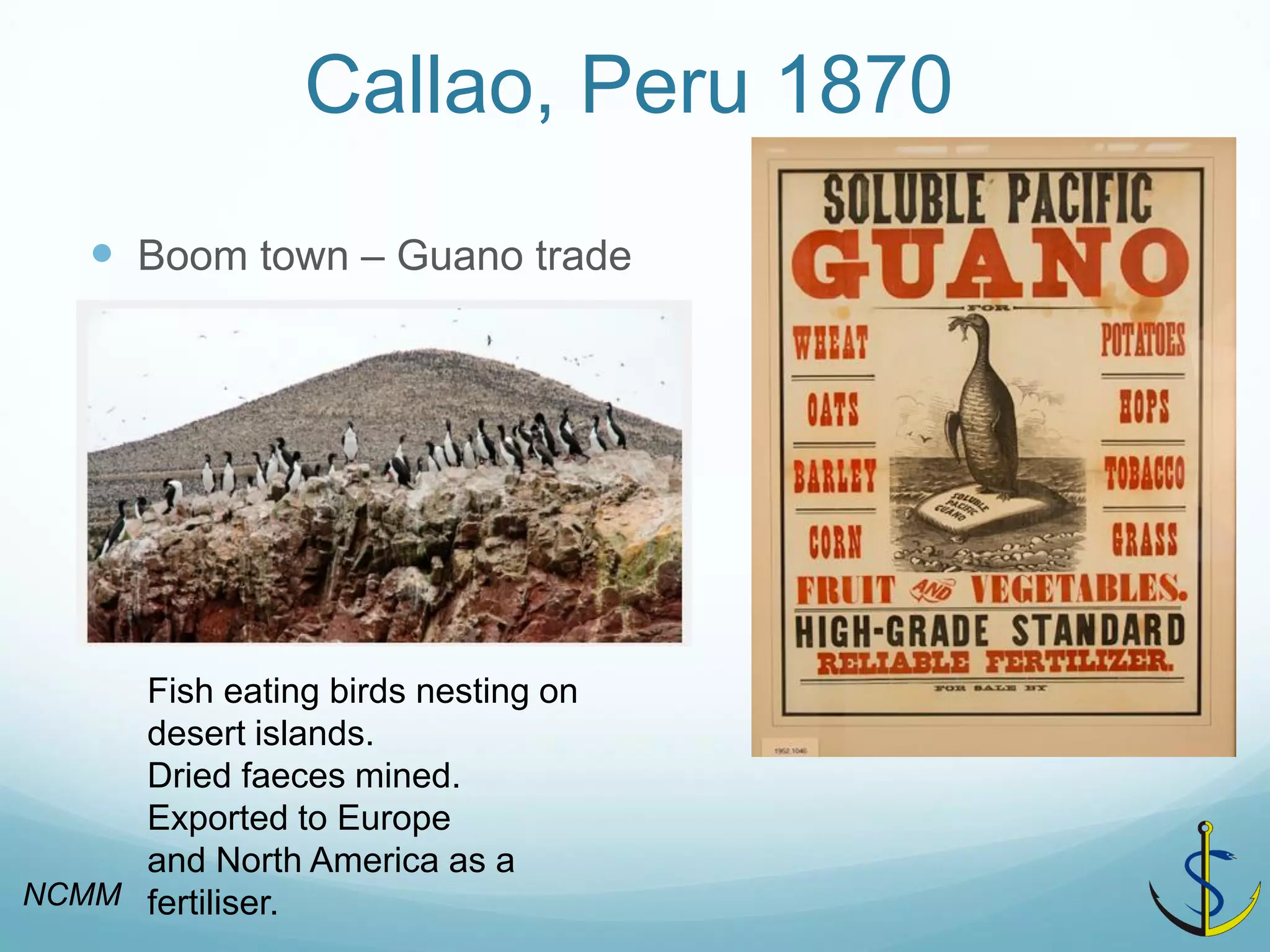
Callao, Peru 1870 
Boom town – Guano trade 
Fish eating birds nesting on 
desert islands. 
Dried faeces mined. 
Exported to Europe and North America as a fertiliser. 
NCMM
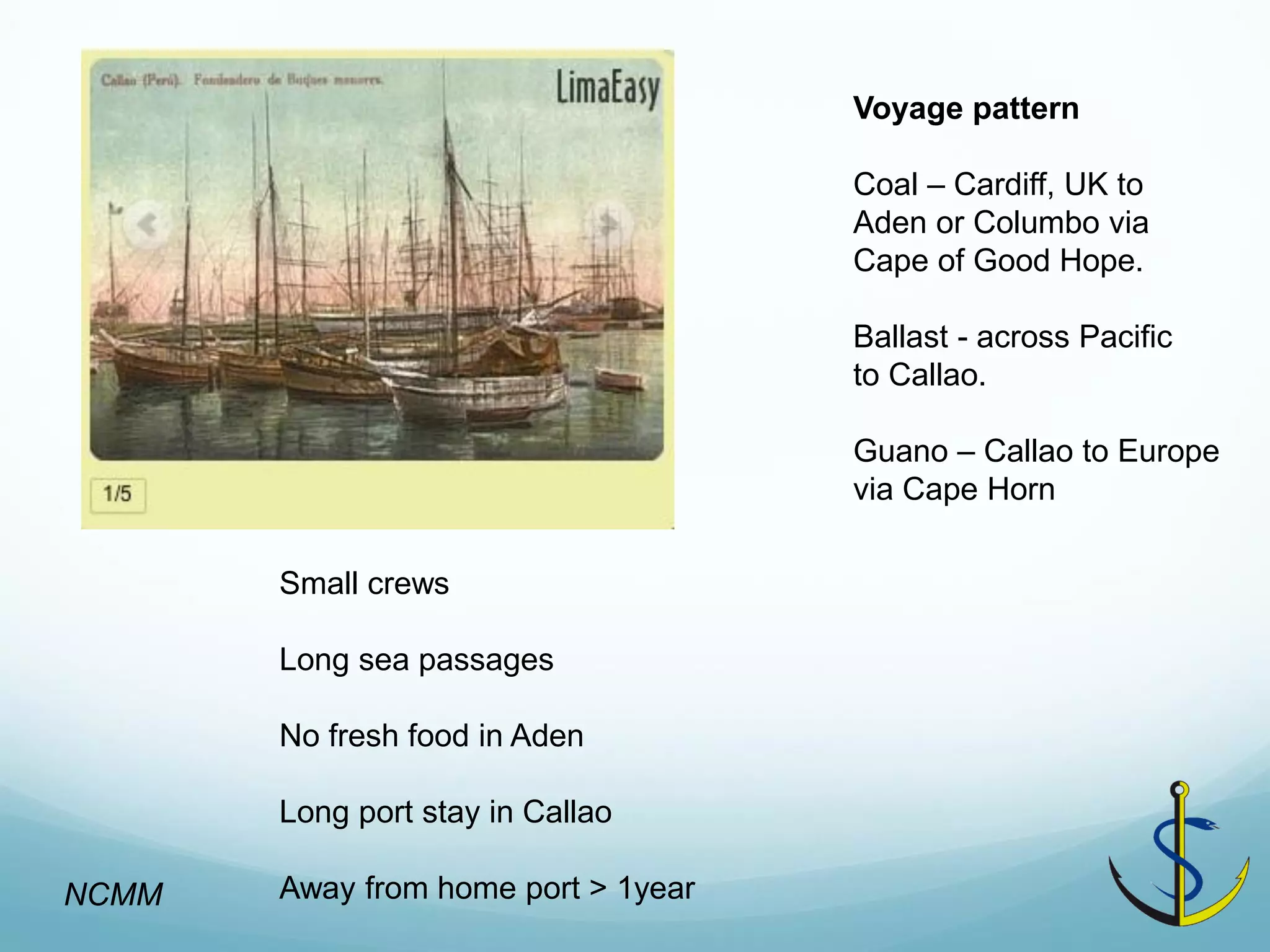
Voyage pattern 
Coal – Cardiff, UK to 
Aden or Columbo via 
Cape of Good Hope. 
Ballast - across Pacific to Callao. 
Guano – Callao to Europe via Cape Horn 
Small crews 
Long sea passages 
No fresh food in Aden 
Long port stay in Callao 
Away from home port > 1year 
NCMM
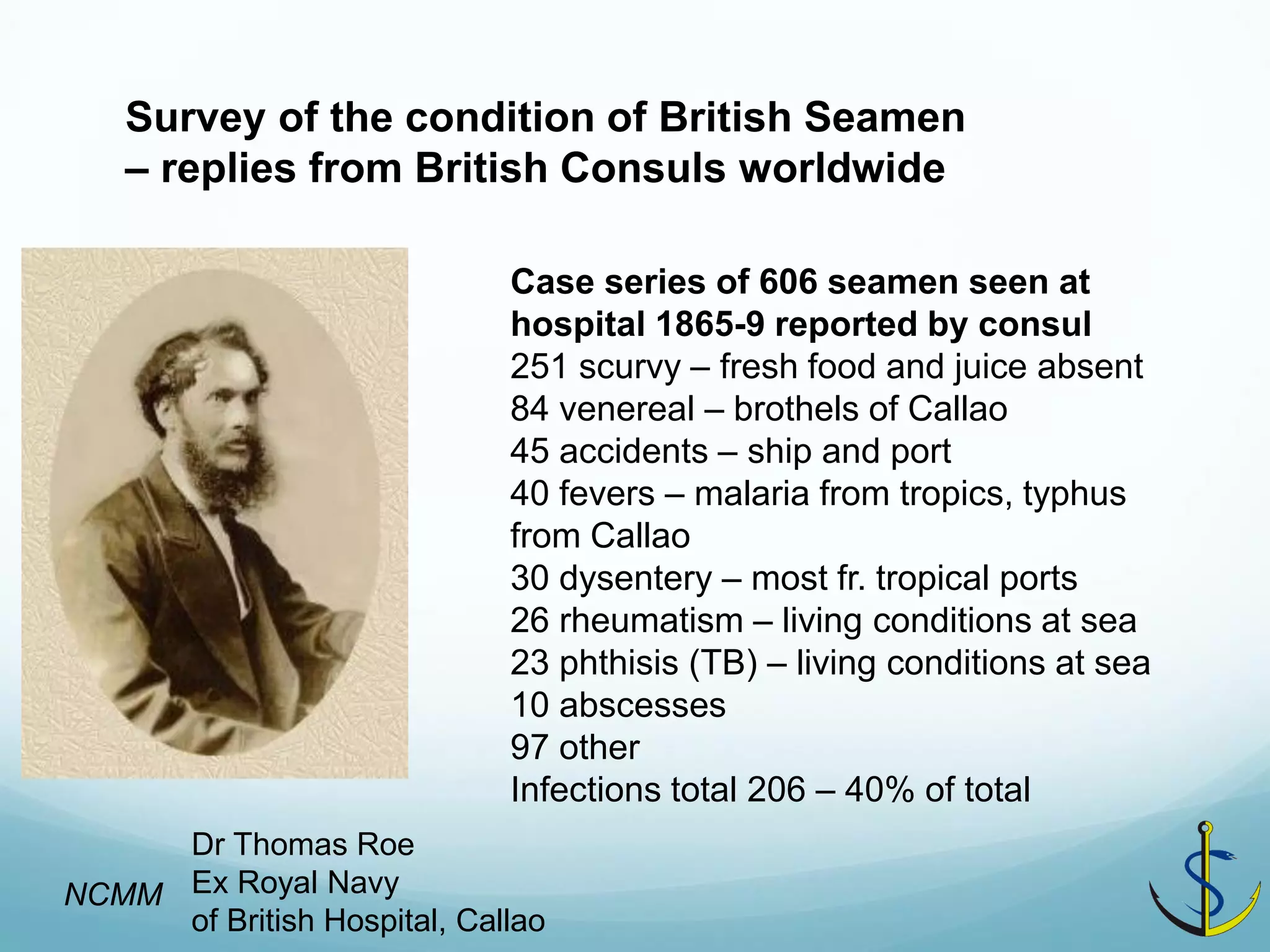
Survey of the condition of British Seamen 
– replies from British Consuls worldwide 
Dr Thomas Roe 
Ex Royal Navy 
of British Hospital, Callao 
Case series of 606 seamen seen at hospital 1865-9 reported by consul 251 scurvy – fresh food and juice absent 84 venereal – brothels of Callao 45 accidents – ship and port 40 fevers – malaria from tropics, typhus from Callao 30 dysentery – most fr. tropical ports 26 rheumatism – living conditions at sea 23 phthisis (TB) – living conditions at sea 10 abscesses 97 other Infections total 206 – 40% of total 
NCMM
Lessons from Callao 
Trades change – guano peaked in late 19C 
Health problems in seafarers may relate to job, to living at sea, to risks in ports. 
The preventable (scurvy) may be unprevented. 
Treatment provided in port, but it needs an ex naval doctor to know that statistics matter. 
Who treated non-British seamen in Callao? 
Risks and remedies transcended national boundaries even when fleets and crews were national 
NCMM
Oslo, Bergen, Trondheim 1926 
Norway had fast growing merchant fleet 
Political concern for seafarers as they were main Norwegian casualties in First World War 
Seeking international facilities to care of seafarers, rather than national ones. 
Had a model for this in port clinics open to all seafarers- visited during conference. 
Conference hosted by Norwegian Red Cross. 
Recent ILO seafarers conferences, Brussels agreement- VD treatment 
 
NCMM
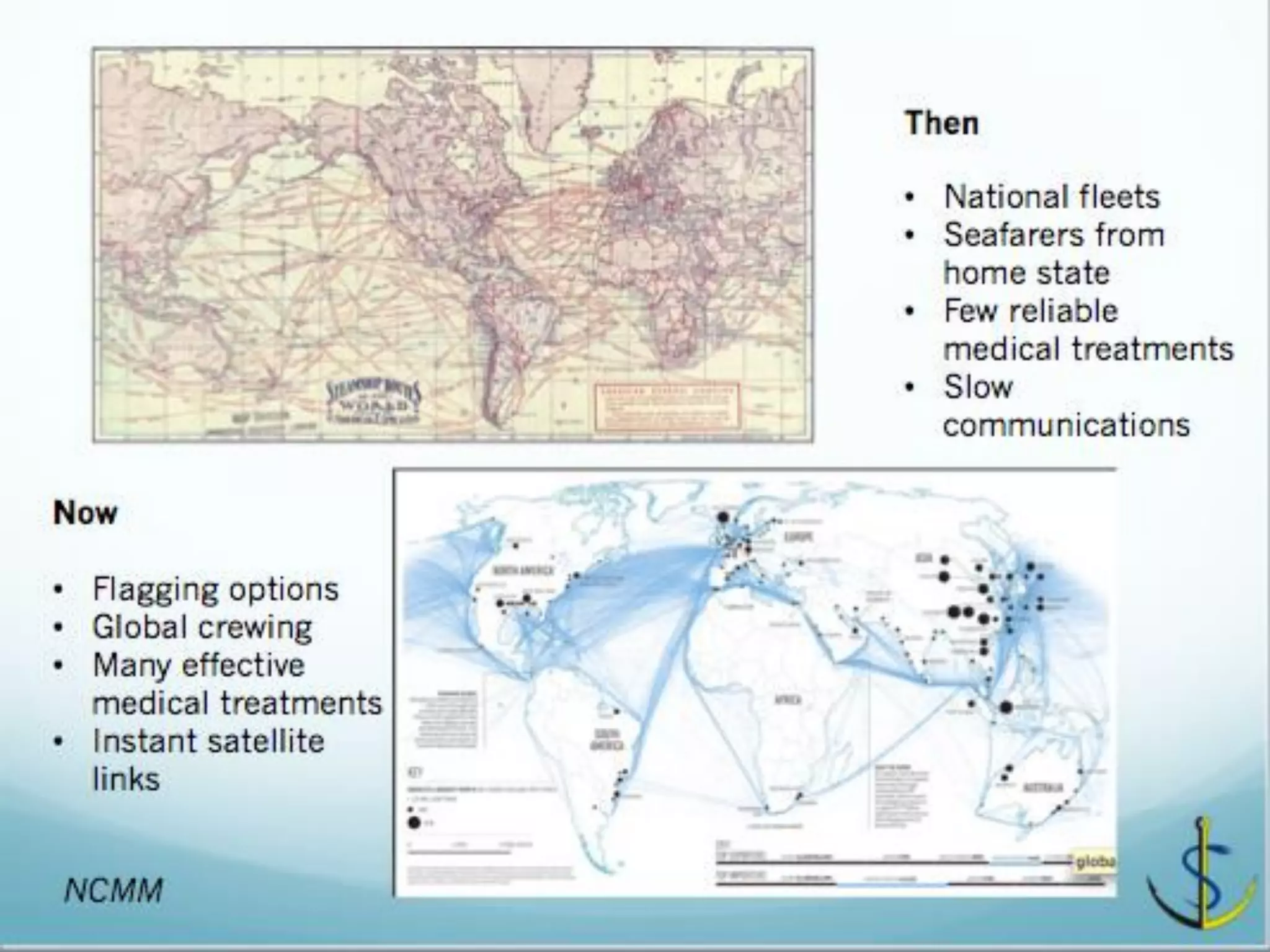
A changing world 1 
[UK Seafarer Mortality 1925- 2005] Infection and respiratory down by 1955. 
-Immunisation 
-Precautions 
-Antibiotics 
Circulatory up and slow fall 
- Lifestyle and age, worse prognosis at sea. - radiomedical not enough 
Sources of risk? 
Place of illness? 
NCMM
A changing world 2 
Air takes over passenger transport 
Containerisation 
Flagging out – politics and performance of different flag states 
Crewing from low cost countries vs. home state supply 
UN Agencies ILO/IMO/WHO increasing leverage on international maritime health 
BUT flag state and port state authorities are regulators. 
NCMM
International Maritime Health 
Ship operators and insurers have economic reasons to maximise performance and minimise ill-health within a contract period. The may not be concerned about discrimination or welfare in doing so. 
Trade unions want fair deals for their members, but not all shipping is unionised and unions are strongest in traditional maritime nations not crewing countries. FoCs may not acknowledge role of unions. 
Authorities want political peace, some want economic benefits, a few want better health – avoid big incidents, avoid harm to citizens. Often more concern for own nationals than others. 
Health professionals have concepts of good practice and use of evidence, these differ by country. They can arouse suspicion in others, but are needed when health problems arise. 
NCMM
Medical certificate SWOT 
Easy transaction seafarer/doctor/employer 
Fit for work – meaning of ‘fit’: capable, reliable. All duties or limited? Limits of prediction. How confidential? 
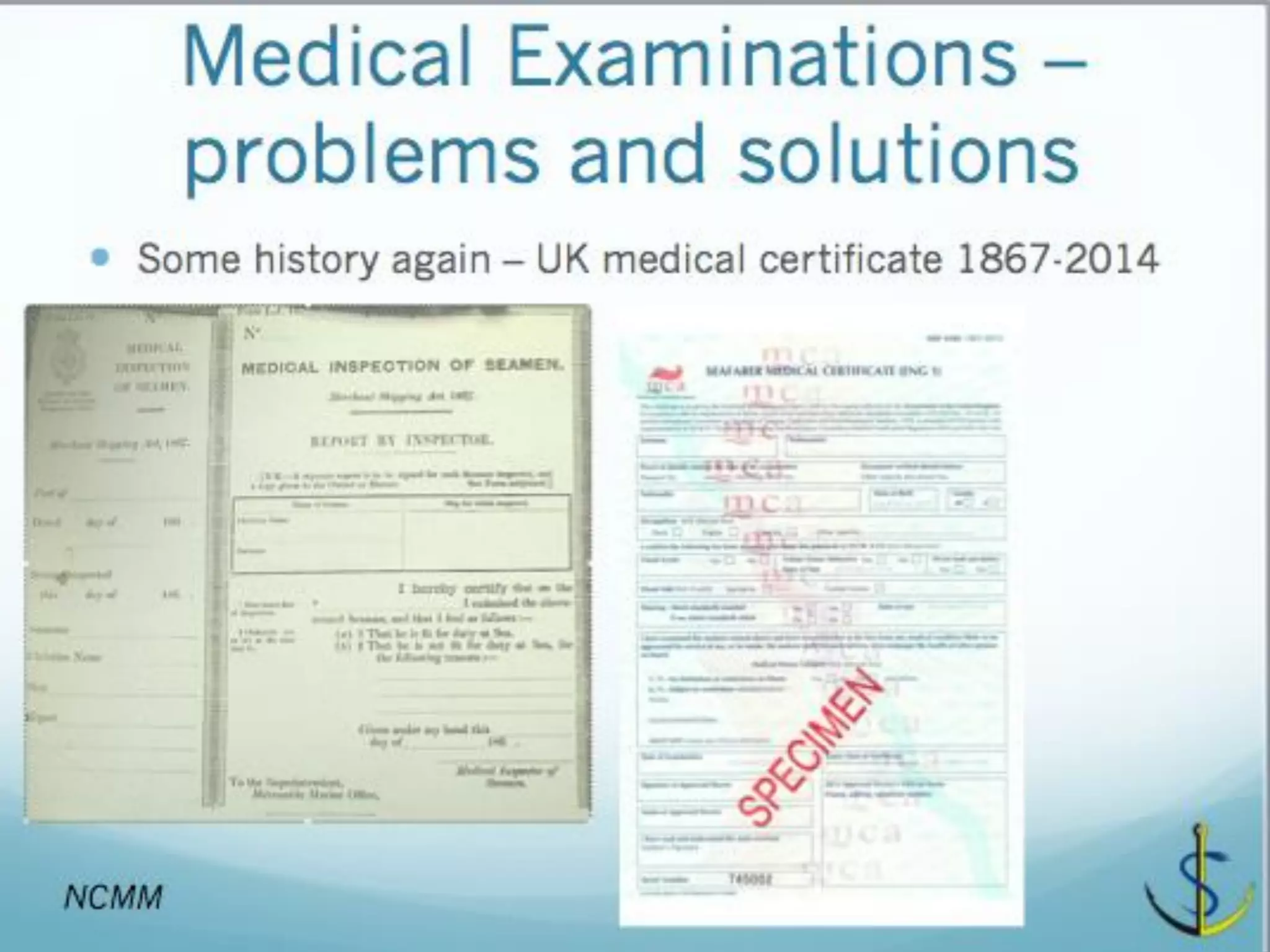
Optional UK 1867 – little used, but employers introduced their own systems. Seafarers hated them! 
State systems 1990s – poor QA, inconsistent. Employers mistrusted certificates, they and P&I Clubs introduced their own systems. Equity? Corruption? 
NCMM
Medical fitness now 
Employer/P&I medicals continue in crewing countries – often incompatible with employment law in Europe/ N America. 
ILO MLC – provisions consolidated in MLC 2006 
IMO STCW Manila amendments. Principles for fitness assessment in more detail. QA requirements 
ILO/IMO Guidelines. Detailed recommendations on procedures and on fitness criteria. 
Aim is internationally consistent medical certificate based on fair and valid assessment. 
NCMM
Colour vision – case study in barriers to consistency. 
1860s – red and green navigation lights introduced 
1880s – multiple international reports of incidents from failure to identify colours correctly 
1880s – early tests for officers introduced. 
1900s – invalidity of test methods recognised 
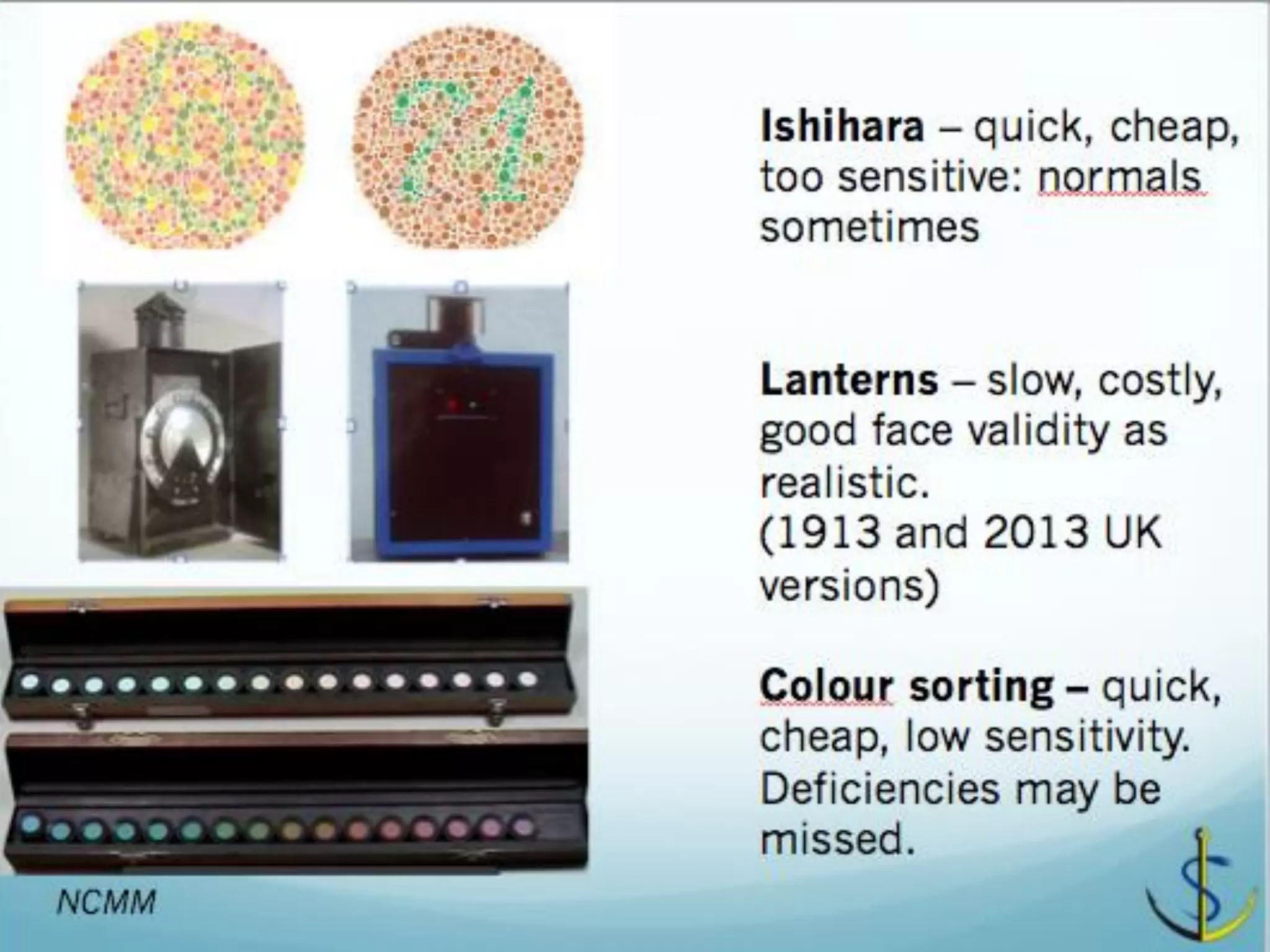
1910 onwards – better tests adopted: lanterns to simulate navigation lights, Ishihara plates. 
Incidents from colour vision defects no longer seen. 
But c 5% of males excluded from deck officer training 
NCMM
Choice of tests 
Big variations internationally 
Cheap option where failures can be discarded – Ishihara. 
Cheap option where failures to be minimised but risk may be increased – colour sorting 
Higher cost option when greater validity needed – lantern or Ishihara +lantern if failed 
Alternatives: opthalmologist opinion, anomaloscopy 
NCMM
Where are we now? 
Each country has its own seafarers tested in the national way. Any change threatens them and adds new costs. 
Employers may discriminate to save costs. 
New screen based tests now available, but not yet fully validated 
NO UP TO DATE ASSESSMENT OF REQUIREMENTS FOR COLOUR VISION IN LOOKOUTS 
NCMM
Where may we go? 
IMO adopted CIE 143:2001 criteria. Protests from countries who don’t want or need to change national practices. 
Delay in implementing colour vision parts of STCW 
Expert workshop in Kobe Jan 2014 to try and resolve. New tests have potential. First the acceptable level of deficiency needs to be found. 
Passed back to CIE – international vision and lighting standards body. Action awaited! 
Industry will need to fund studies on vision requirements to secure progress. 
But the maritime sector is not organised to fund research. 
Problems of national vested interests will remain 
NCMM
Summary 
Maritime health always has been international. 
With national fleets most parts could be based on national jurisdictions. 
Now fleets do not respect national boundaries. Greater need for international consistency. 
Principles are there for all aspects of health management. 
People and interest groups are the barriers to realising the benefits of common international approaches. 
Commerce is ahead of governments in global approaches, but is less concerned for interests of seafarers and more concerned with competitive advantage 
NCMM
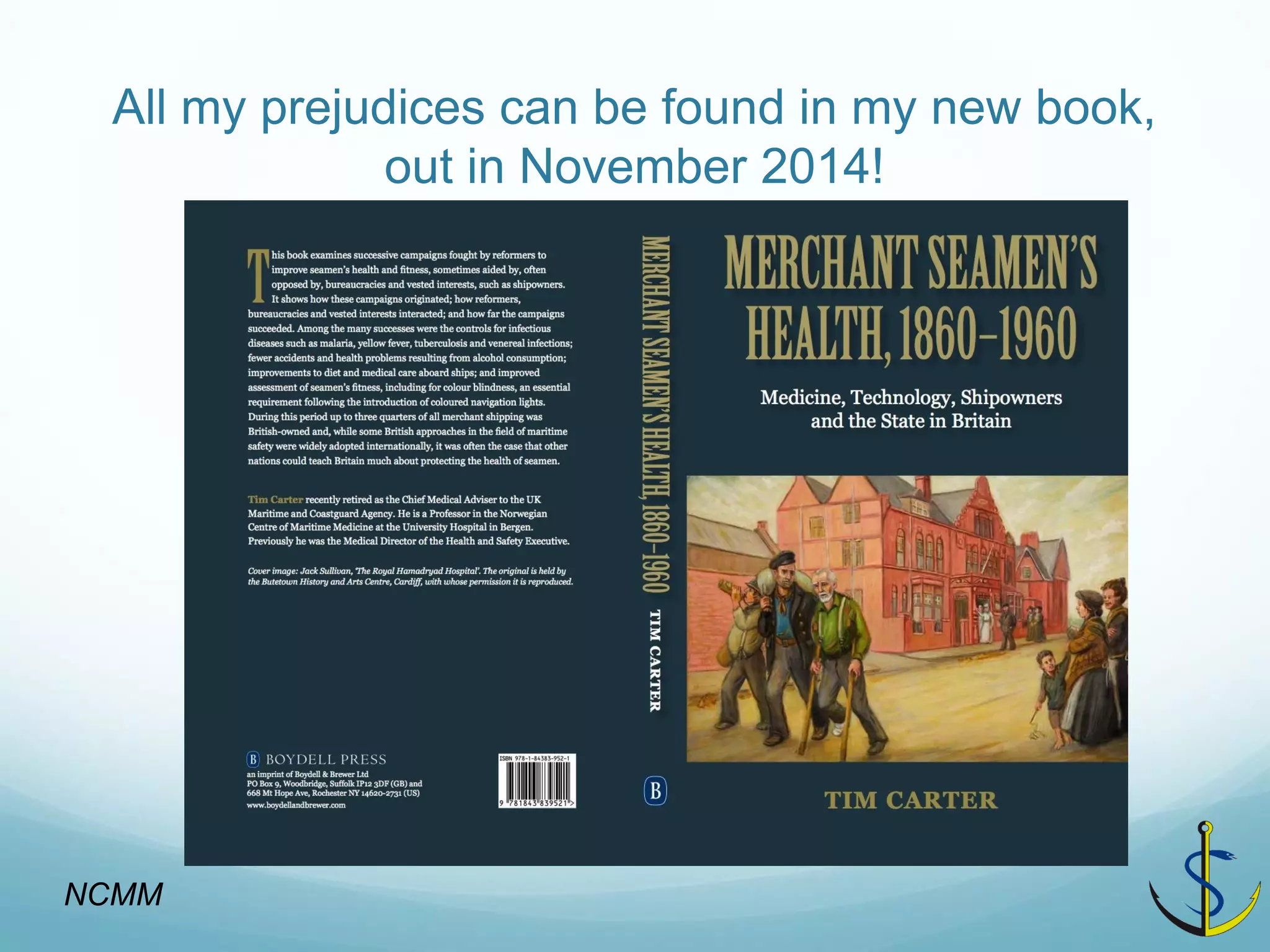
All my prejudices can be found in my new book, out in November 2014! 
NCMM

Session 1 1 - tim carter - nshc 2014 keynote red

  • 1.
    Why is maritimehealth an international issue? Should medical examinations remain a national responsibility? Tim Carter Norwegian Centre for Maritime Medicine Bergen
  • 2.
    Maritime health –prevention and care 1.Fitness to work at sea 2.Prevention of risks from disease and injury – at sea, in port, on leave 3.Management of medical incidents at sea 4.Health care ashore – foreign ports, home country 5.Special health care needs of former seafarers. All have both national and an international components. Their importance depends on trading patterns and structure of the maritime sector. NCMM
  • 3.
    A paradox! Theshipping industry has been around the globe for several hundred years. Its health problems have long been international ones. Ships are extensions of national territory in terms of legal jurisdiction. This model fitted when ships were owned, mainly crewed and registered in a single country. Historically maritime health has been regulated and practiced within national boundaries. National approaches have long been flawed. Infections have been carried across boundaries by ships, ill and injured seamen have been treated in foreign ports, training in the seafarer’s home country and the medical equipment for handling emergencies on board may be incompatible, unfit crewmembers can endanger the safety of other nations’ ships. Fitness standards are not consistently applied. NCMM
  • 5.
    Callao, Peru 1870 Boom town – Guano trade Fish eating birds nesting on desert islands. Dried faeces mined. Exported to Europe and North America as a fertiliser. NCMM
  • 6.
    Voyage pattern Coal– Cardiff, UK to Aden or Columbo via Cape of Good Hope. Ballast - across Pacific to Callao. Guano – Callao to Europe via Cape Horn Small crews Long sea passages No fresh food in Aden Long port stay in Callao Away from home port > 1year NCMM
  • 7.
    Survey of thecondition of British Seamen – replies from British Consuls worldwide Dr Thomas Roe Ex Royal Navy of British Hospital, Callao Case series of 606 seamen seen at hospital 1865-9 reported by consul 251 scurvy – fresh food and juice absent 84 venereal – brothels of Callao 45 accidents – ship and port 40 fevers – malaria from tropics, typhus from Callao 30 dysentery – most fr. tropical ports 26 rheumatism – living conditions at sea 23 phthisis (TB) – living conditions at sea 10 abscesses 97 other Infections total 206 – 40% of total NCMM
  • 8.
    Lessons from Callao Trades change – guano peaked in late 19C Health problems in seafarers may relate to job, to living at sea, to risks in ports. The preventable (scurvy) may be unprevented. Treatment provided in port, but it needs an ex naval doctor to know that statistics matter. Who treated non-British seamen in Callao? Risks and remedies transcended national boundaries even when fleets and crews were national NCMM
  • 9.
    Oslo, Bergen, Trondheim1926 Norway had fast growing merchant fleet Political concern for seafarers as they were main Norwegian casualties in First World War Seeking international facilities to care of seafarers, rather than national ones. Had a model for this in port clinics open to all seafarers- visited during conference. Conference hosted by Norwegian Red Cross. Recent ILO seafarers conferences, Brussels agreement- VD treatment  NCMM
  • 12.
    A changing world1 [UK Seafarer Mortality 1925- 2005] Infection and respiratory down by 1955. -Immunisation -Precautions -Antibiotics Circulatory up and slow fall - Lifestyle and age, worse prognosis at sea. - radiomedical not enough Sources of risk? Place of illness? NCMM
  • 13.
    A changing world2 Air takes over passenger transport Containerisation Flagging out – politics and performance of different flag states Crewing from low cost countries vs. home state supply UN Agencies ILO/IMO/WHO increasing leverage on international maritime health BUT flag state and port state authorities are regulators. NCMM
  • 14.
    International Maritime Health Ship operators and insurers have economic reasons to maximise performance and minimise ill-health within a contract period. The may not be concerned about discrimination or welfare in doing so. Trade unions want fair deals for their members, but not all shipping is unionised and unions are strongest in traditional maritime nations not crewing countries. FoCs may not acknowledge role of unions. Authorities want political peace, some want economic benefits, a few want better health – avoid big incidents, avoid harm to citizens. Often more concern for own nationals than others. Health professionals have concepts of good practice and use of evidence, these differ by country. They can arouse suspicion in others, but are needed when health problems arise. NCMM
  • 16.
    Medical certificate SWOT Easy transaction seafarer/doctor/employer Fit for work – meaning of ‘fit’: capable, reliable. All duties or limited? Limits of prediction. How confidential? Optional UK 1867 – little used, but employers introduced their own systems. Seafarers hated them! State systems 1990s – poor QA, inconsistent. Employers mistrusted certificates, they and P&I Clubs introduced their own systems. Equity? Corruption? NCMM
  • 17.
    Medical fitness now Employer/P&I medicals continue in crewing countries – often incompatible with employment law in Europe/ N America. ILO MLC – provisions consolidated in MLC 2006 IMO STCW Manila amendments. Principles for fitness assessment in more detail. QA requirements ILO/IMO Guidelines. Detailed recommendations on procedures and on fitness criteria. Aim is internationally consistent medical certificate based on fair and valid assessment. NCMM
  • 18.
    Colour vision –case study in barriers to consistency. 1860s – red and green navigation lights introduced 1880s – multiple international reports of incidents from failure to identify colours correctly 1880s – early tests for officers introduced. 1900s – invalidity of test methods recognised 1910 onwards – better tests adopted: lanterns to simulate navigation lights, Ishihara plates. Incidents from colour vision defects no longer seen. But c 5% of males excluded from deck officer training NCMM
  • 20.
    Choice of tests Big variations internationally Cheap option where failures can be discarded – Ishihara. Cheap option where failures to be minimised but risk may be increased – colour sorting Higher cost option when greater validity needed – lantern or Ishihara +lantern if failed Alternatives: opthalmologist opinion, anomaloscopy NCMM
  • 21.
    Where are wenow? Each country has its own seafarers tested in the national way. Any change threatens them and adds new costs. Employers may discriminate to save costs. New screen based tests now available, but not yet fully validated NO UP TO DATE ASSESSMENT OF REQUIREMENTS FOR COLOUR VISION IN LOOKOUTS NCMM
  • 22.
    Where may wego? IMO adopted CIE 143:2001 criteria. Protests from countries who don’t want or need to change national practices. Delay in implementing colour vision parts of STCW Expert workshop in Kobe Jan 2014 to try and resolve. New tests have potential. First the acceptable level of deficiency needs to be found. Passed back to CIE – international vision and lighting standards body. Action awaited! Industry will need to fund studies on vision requirements to secure progress. But the maritime sector is not organised to fund research. Problems of national vested interests will remain NCMM
  • 23.
    Summary Maritime healthalways has been international. With national fleets most parts could be based on national jurisdictions. Now fleets do not respect national boundaries. Greater need for international consistency. Principles are there for all aspects of health management. People and interest groups are the barriers to realising the benefits of common international approaches. Commerce is ahead of governments in global approaches, but is less concerned for interests of seafarers and more concerned with competitive advantage NCMM
  • 24.
    All my prejudicescan be found in my new book, out in November 2014! NCMM