Dr. Anita S.Goswami-Giri
Professor and Head
Department of Chemistry
B N BANDODKAR COLLEGE OF SCIENCE AUTUNOMOUS THANE
goswamigiria@gmail.com
Definition
“A careful investigation or inquiry specially through search
for new facts in any branch of knowledge.”1
Systematized effort to gain new knowledge.”2
“The manipulation of things, concepts or symbols for the
purpose of generalising to extend, correct or verify
knowledge, whether that knowledge aids in construction of
theory or in the practice of an art.”3
1 The Advanced Learner’s Dictionary of Current English, Oxford, 1952, p. 1069.
2 L.V. Redman and A.V.H. Mory, The Romance of Research, 1923, p.10.
3 The Encyclopaedia of Social Sciences, Vol. IX, MacMillan, 1930.
Simple definition
• The process or the way you intend to execute your study.
• The methodology section of a research paper outlines
• how you plan to conduct your study. It covers various steps
such as
- collecting data,
- statistical analysis,
- observing participants, and
- other procedures involved in the research process
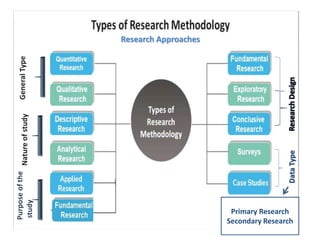
Data
Type
Primary Research
Secondary Research
Research Approaches
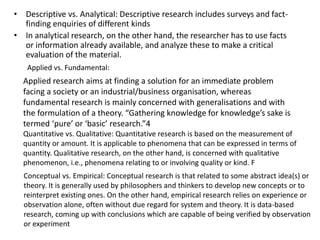
• Descriptive vs. Analytical: Descriptive research includes surveys and fact-
finding enquiries of different kinds
• In analytical research, on the other hand, the researcher has to use facts
or information already available, and analyze these to make a critical
evaluation of the material.
Applied vs. Fundamental:
Applied research aims at finding a solution for an immediate problem
facing a society or an industrial/business organisation, whereas
fundamental research is mainly concerned with generalisations and with
the formulation of a theory. “Gathering knowledge for knowledge’s sake is
termed ‘pure’ or ‘basic’ research.”4
Quantitative vs. Qualitative: Quantitative research is based on the measurement of
quantity or amount. It is applicable to phenomena that can be expressed in terms of
quantity. Qualitative research, on the other hand, is concerned with qualitative
phenomenon, i.e., phenomena relating to or involving quality or kind. F
Conceptual vs. Empirical: Conceptual research is that related to some abstract idea(s) or
theory. It is generally used by philosophers and thinkers to develop new concepts or to
reinterpret existing ones. On the other hand, empirical research relies on experience or
observation alone, often without due regard for system and theory. It is data-based
research, coming up with conclusions which are capable of being verified by observation
or experiment
A good research
methodology
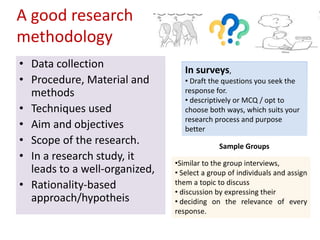
• Data collection
• Procedure, Material and
methods
• Techniques used
• Aim and objectives
• Scope of the research.
• In a research study, it
leads to a well-organized,
• Rationality-based
approach/hypotheis
In surveys,
• Draft the questions you seek the
response for.
• descriptively or MCQ / opt to
choose both ways, which suits your
research process and purpose
better
Sample Groups
•Similar to the group interviews,
• Select a group of individuals and assign
them a topic to discuss
• discussion by expressing their
• deciding on the relevance of every
response.
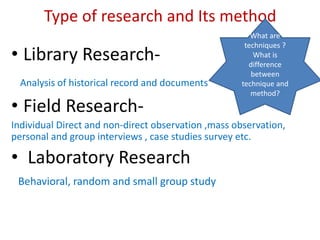
Type of research and Its method
• Library Research-
Analysis of historical record and documents
• Field Research-
Individual Direct and non-direct observation ,mass observation,
personal and group interviews , case studies survey etc.
• Laboratory Research
Behavioral, random and small group study
What are
techniques ?
What is
difference
between
technique and
method?
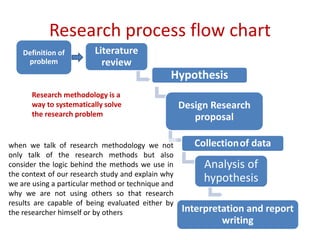
Research process flow chart
Definition of
problem
Literature
review
Hypothesis
Design Research
proposal
Collectionof data
Analysis of
hypothesis
Interpretation and report
writing
Research methodology is a
way to systematically solve
the research problem
when we talk of research methodology we not
only talk of the research methods but also
consider the logic behind the methods we use in
the context of our research study and explain why
we are using a particular method or technique and
why we are not using others so that research
results are capable of being evaluated either by
the researcher himself or by others
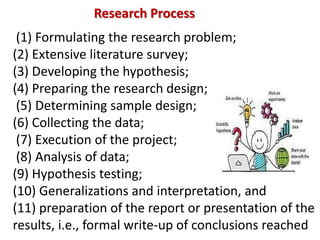
(1) Formulating the research problem;
(2) Extensive literature survey;
(3) Developing the hypothesis;
(4) Preparing the research design;
(5) Determining sample design;
(6) Collecting the data;
(7) Execution of the project;
(8) Analysis of data;
(9) Hypothesis testing;
(10) Generalizations and interpretation, and
(11) preparation of the report or presentation of the
results, i.e., formal write-up of conclusions reached
Research Process
1. It relies on empirical evidence;
2. It utilizes relevant concepts;
3. It is committed to only objective considerations;
4. It presupposes ethical neutrality, i.e., it aims at nothing but
making only adequate and correct statements about
population objects;
5. It results into probabilistic predictions;
6. Its methodology is made known to all concerned for critical
scrutiny are for use in testing the conclusions through
replication;
7. It aims at formulating most general axioms or what can be
termed as scientific theories
Research and Scientific Method
Significance of Research
• Research inculcates scientific and inductive
thinking and it promotes the development of
logical habits of thinking and organisation
• All progress is born of inquiry. Doubt is often
better than overconfidence, for it leads to
inquiry, and inquiry leads to invention
• Special significance in solving various operational and
planning problems of business and industry.
Operations research and market research, along with
motivational research, are considered crucial and
their results assist, in more than one way, in taking
business decisions.
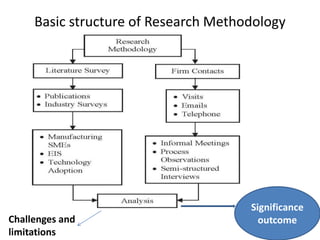
Basic structure of Research Methodology
Significance
outcome
Challenges and
limitations
1. The layout of the report :
(i) the preliminary pages;
(ii) the main text, and
(iii) the end matter.
2. The main text of the report :
(a) Introduction: -statement , objective ,scope , limitations
(b) Summary of findings: statement of findings and recommendations in non-technical
language.
(c) Main report: presented in logical sequence and broken-down into readily identifiable
sections.
(d) Conclusion: Towards the end of the main text, researcher should again put down the
results of his research clearly and precisely. In fact, it is the final summing up.
Preparation of the report or the thesis:
Ref .Research Methodology: Methods and Techniques
Book by C. R. Kothari
Research Methodology Introduction-slide share.pptx

Research Methodology Introduction-slide share.pptx

  • 1.
    Dr. Anita S.Goswami-Giri Professorand Head Department of Chemistry B N BANDODKAR COLLEGE OF SCIENCE AUTUNOMOUS THANE goswamigiria@gmail.com
  • 2.
    Definition “A careful investigationor inquiry specially through search for new facts in any branch of knowledge.”1 Systematized effort to gain new knowledge.”2 “The manipulation of things, concepts or symbols for the purpose of generalising to extend, correct or verify knowledge, whether that knowledge aids in construction of theory or in the practice of an art.”3 1 The Advanced Learner’s Dictionary of Current English, Oxford, 1952, p. 1069. 2 L.V. Redman and A.V.H. Mory, The Romance of Research, 1923, p.10. 3 The Encyclopaedia of Social Sciences, Vol. IX, MacMillan, 1930.
  • 3.
    Simple definition • Theprocess or the way you intend to execute your study. • The methodology section of a research paper outlines • how you plan to conduct your study. It covers various steps such as - collecting data, - statistical analysis, - observing participants, and - other procedures involved in the research process
  • 4.
  • 5.
    • Descriptive vs.Analytical: Descriptive research includes surveys and fact- finding enquiries of different kinds • In analytical research, on the other hand, the researcher has to use facts or information already available, and analyze these to make a critical evaluation of the material. Applied vs. Fundamental: Applied research aims at finding a solution for an immediate problem facing a society or an industrial/business organisation, whereas fundamental research is mainly concerned with generalisations and with the formulation of a theory. “Gathering knowledge for knowledge’s sake is termed ‘pure’ or ‘basic’ research.”4 Quantitative vs. Qualitative: Quantitative research is based on the measurement of quantity or amount. It is applicable to phenomena that can be expressed in terms of quantity. Qualitative research, on the other hand, is concerned with qualitative phenomenon, i.e., phenomena relating to or involving quality or kind. F Conceptual vs. Empirical: Conceptual research is that related to some abstract idea(s) or theory. It is generally used by philosophers and thinkers to develop new concepts or to reinterpret existing ones. On the other hand, empirical research relies on experience or observation alone, often without due regard for system and theory. It is data-based research, coming up with conclusions which are capable of being verified by observation or experiment
  • 6.
    A good research methodology •Data collection • Procedure, Material and methods • Techniques used • Aim and objectives • Scope of the research. • In a research study, it leads to a well-organized, • Rationality-based approach/hypotheis In surveys, • Draft the questions you seek the response for. • descriptively or MCQ / opt to choose both ways, which suits your research process and purpose better Sample Groups •Similar to the group interviews, • Select a group of individuals and assign them a topic to discuss • discussion by expressing their • deciding on the relevance of every response.
  • 7.
    Type of researchand Its method • Library Research- Analysis of historical record and documents • Field Research- Individual Direct and non-direct observation ,mass observation, personal and group interviews , case studies survey etc. • Laboratory Research Behavioral, random and small group study What are techniques ? What is difference between technique and method?
  • 8.
    Research process flowchart Definition of problem Literature review Hypothesis Design Research proposal Collectionof data Analysis of hypothesis Interpretation and report writing Research methodology is a way to systematically solve the research problem when we talk of research methodology we not only talk of the research methods but also consider the logic behind the methods we use in the context of our research study and explain why we are using a particular method or technique and why we are not using others so that research results are capable of being evaluated either by the researcher himself or by others
  • 9.
    (1) Formulating theresearch problem; (2) Extensive literature survey; (3) Developing the hypothesis; (4) Preparing the research design; (5) Determining sample design; (6) Collecting the data; (7) Execution of the project; (8) Analysis of data; (9) Hypothesis testing; (10) Generalizations and interpretation, and (11) preparation of the report or presentation of the results, i.e., formal write-up of conclusions reached Research Process
  • 10.
    1. It relieson empirical evidence; 2. It utilizes relevant concepts; 3. It is committed to only objective considerations; 4. It presupposes ethical neutrality, i.e., it aims at nothing but making only adequate and correct statements about population objects; 5. It results into probabilistic predictions; 6. Its methodology is made known to all concerned for critical scrutiny are for use in testing the conclusions through replication; 7. It aims at formulating most general axioms or what can be termed as scientific theories Research and Scientific Method
  • 11.
    Significance of Research •Research inculcates scientific and inductive thinking and it promotes the development of logical habits of thinking and organisation • All progress is born of inquiry. Doubt is often better than overconfidence, for it leads to inquiry, and inquiry leads to invention • Special significance in solving various operational and planning problems of business and industry. Operations research and market research, along with motivational research, are considered crucial and their results assist, in more than one way, in taking business decisions.
  • 12.
    Basic structure ofResearch Methodology Significance outcome Challenges and limitations
  • 13.
    1. The layoutof the report : (i) the preliminary pages; (ii) the main text, and (iii) the end matter. 2. The main text of the report : (a) Introduction: -statement , objective ,scope , limitations (b) Summary of findings: statement of findings and recommendations in non-technical language. (c) Main report: presented in logical sequence and broken-down into readily identifiable sections. (d) Conclusion: Towards the end of the main text, researcher should again put down the results of his research clearly and precisely. In fact, it is the final summing up. Preparation of the report or the thesis: Ref .Research Methodology: Methods and Techniques Book by C. R. Kothari