Actuators
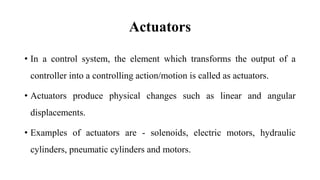
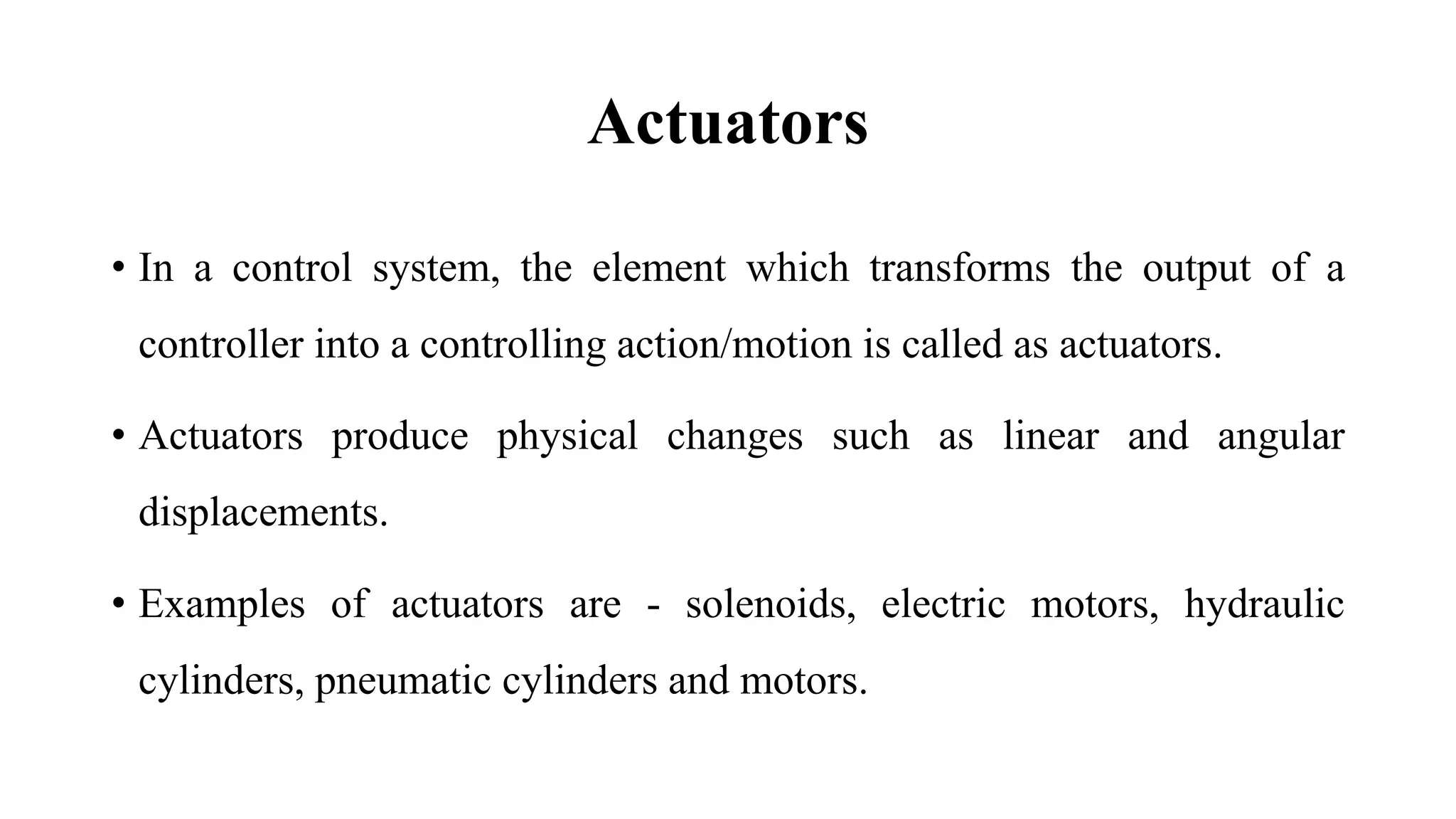
• In a control system, the element which transforms the output of a
controller into a controlling action/motion is called as actuators.
• Actuators produce physical changes such as linear and angular
displacements.
• Examples of actuators are - solenoids, electric motors, hydraulic
cylinders, pneumatic cylinders and motors.
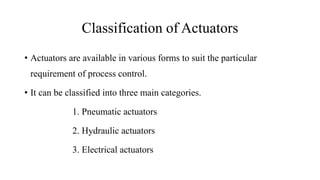
Classification of Actuators
• Actuators are available in various forms to suit the particular
requirement of process control.
• It can be classified into three main categories.
1. Pneumatic actuators
2. Hydraulic actuators
3. Electrical actuators
Stepper Motor
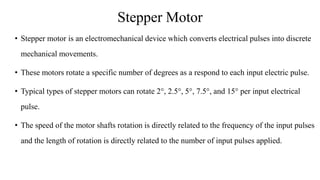
• Stepper motor is an electromechanical device which converts electrical pulses into discrete
mechanical movements.
• These motors rotate a specific number of degrees as a respond to each input electric pulse.
• Typical types of stepper motors can rotate 2°, 2.5°, 5°, 7.5°, and 15° per input electrical
pulse.
• The speed of the motor shafts rotation is directly related to the frequency of the input pulses
and the length of rotation is directly related to the number of input pulses applied.
Variable- Reluctance (VR) Stepper Motor
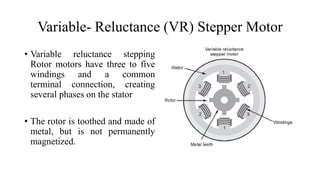
• Variable reluctance stepping
Rotor motors have three to five
windings and a common
terminal connection, creating
several phases on the stator
• The rotor is toothed and made of
metal, but is not permanently
magnetized.
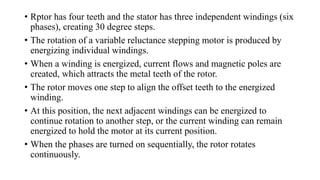
• Rptor has four teeth and the stator has three independent windings (six
phases), creating 30 degree steps.
• The rotation of a variable reluctance stepping motor is produced by
energizing individual windings.
• When a winding is energized, current flows and magnetic poles are
created, which attracts the metal teeth of the rotor.
• The rotor moves one step to align the offset teeth to the energized
winding.
• At this position, the next adjacent windings can be energized to
continue rotation to another step, or the current winding can remain
energized to hold the motor at its current position.
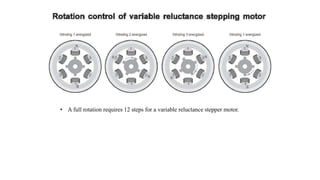
• When the phases are turned on sequentially, the rotor rotates
continuously.
• A full rotation requires 12 steps for a variable reluctance stepper motor.

Stepper Motor.pptx

  • 1.
    Actuators • In acontrol system, the element which transforms the output of a controller into a controlling action/motion is called as actuators. • Actuators produce physical changes such as linear and angular displacements. • Examples of actuators are - solenoids, electric motors, hydraulic cylinders, pneumatic cylinders and motors.
  • 2.
    Classification of Actuators •Actuators are available in various forms to suit the particular requirement of process control. • It can be classified into three main categories. 1. Pneumatic actuators 2. Hydraulic actuators 3. Electrical actuators
  • 3.
    Stepper Motor • Steppermotor is an electromechanical device which converts electrical pulses into discrete mechanical movements. • These motors rotate a specific number of degrees as a respond to each input electric pulse. • Typical types of stepper motors can rotate 2°, 2.5°, 5°, 7.5°, and 15° per input electrical pulse. • The speed of the motor shafts rotation is directly related to the frequency of the input pulses and the length of rotation is directly related to the number of input pulses applied.
  • 4.
    Variable- Reluctance (VR)Stepper Motor • Variable reluctance stepping Rotor motors have three to five windings and a common terminal connection, creating several phases on the stator • The rotor is toothed and made of metal, but is not permanently magnetized.
  • 5.
    • Rptor hasfour teeth and the stator has three independent windings (six phases), creating 30 degree steps. • The rotation of a variable reluctance stepping motor is produced by energizing individual windings. • When a winding is energized, current flows and magnetic poles are created, which attracts the metal teeth of the rotor. • The rotor moves one step to align the offset teeth to the energized winding. • At this position, the next adjacent windings can be energized to continue rotation to another step, or the current winding can remain energized to hold the motor at its current position. • When the phases are turned on sequentially, the rotor rotates continuously.
  • 6.
    • A fullrotation requires 12 steps for a variable reluctance stepper motor.