Структура «Реперфузионной
Сети» Чешской Республики:
первичное стентирование для
всех STEMI пациентов страны.
Петр Видимский
(г. Прага, Чешская республика)
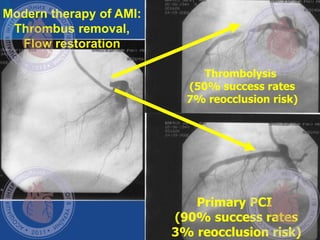
Thrombolysis
(50% success rates
7% reocclusion risk)
Primary PCI
(90% success rates
3% reocclusion risk)
Modern therapy of AMI:
Thrombus removal,
Flow restoration
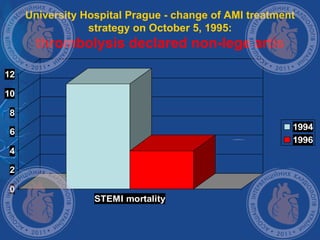
University Hospital Prague - change of AMI treatment
strategy on October 5, 1995:
thrombolysis declared non-lege artis
0
2
4
6
8
10
12
STEMI mortality
1994
1996
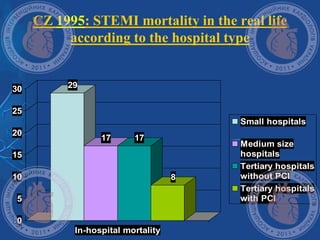
CZ 1995: STEMI mortality in the real life
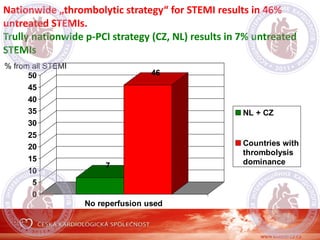
according to the hospital type
29
17 17
8
0
5
10
15
20
25
30
In-hospital mortality
Small hospitals
Medium size
hospitals
Tertiary hospitals
without PCI
Tertiary hospitals
with PCI
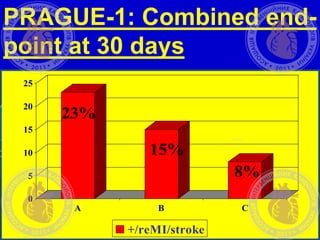
PRAGUE-1: Combined end-
point at 30 days
23%
15%
8%
0
5
10
15
20
25
A B C
+/reMI/stroke
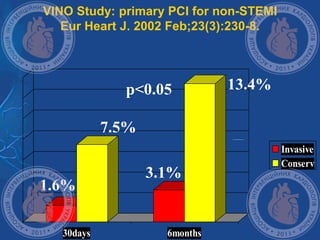
VINO Study: primary PCI for non-STEMI
Eur Heart J. 2002 Feb;23(3):230-8.
30days 6months
Invasive
Conserv
7.5%
13.4%
1.6%
3.1%
p<0.05
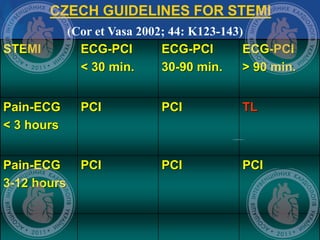
CZECH GUIDELINES FOR STEMI
PCIPCIPCIPain-ECG
3-12 hours
TLPCIPCIPain-ECG
< 3 hours
ECG-PCI
> 90 min.
ECG-PCI
30-90 min.
ECG-PCI
< 30 min.
STEMI
(Cor et Vasa 2002; 44: K123-143)
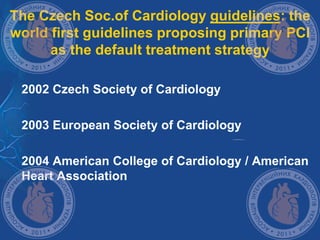
The Czech Soc.of Cardiology guidelines: the
world first guidelines proposing primary PCI
as the default treatment strategy
 2002 Czech Society of Cardiology
 2003 European Society of Cardiology
 2004 American College of Cardiology / American
Heart Association
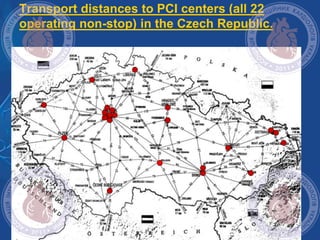
Transport distances to PCI centers (all 22
operating non-stop) in the Czech Republic.
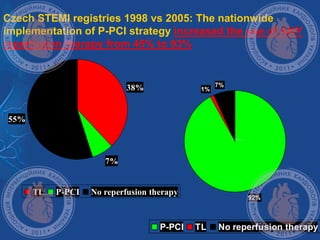
Czech STEMI registries 1998 vs 2005: The nationwide
implementation of P-PCI strategy increased the use of ANY
reperfusion therapy from 45% to 93%
7%
55%
38%
TL P-PCI No reperfusion therapy
1%
7%
92%
P-PCI TL No reperfusion therapy
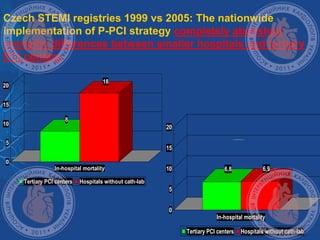
Czech STEMI registries 1999 vs 2005: The nationwide
implementation of P-PCI strategy completely abolished
mortality differences between smaller hospitals and tertiary
PCI centers
8
18
0
5
10
15
20
In-hospital mortality
Tertiary PCI centers Hospitals without cath-lab
6,8 6,9
0
5
10
15
20
In-hospital mortality
Tertiary PCI centers Hospitals without cath-lab
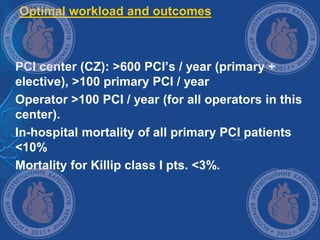
Optimal workload and outcomes
 PCI center (CZ): >600 PCI’s / year (primary +
elective), >100 primary PCI / year
 Operator >100 PCI / year (for all operators in this
center).
 In-hospital mortality of all primary PCI patients
<10%
 Mortality for Killip class I pts. <3%.
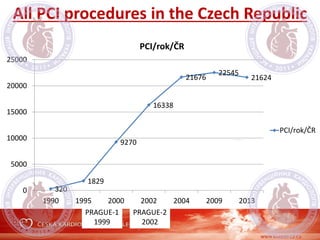
All PCI procedures in the Czech Republic
320
1829
9270
16338
21676
22545
21624
0
5000
10000
15000
20000
25000
1990 1995 2000 2002 2004 2009 2013
PCI/rok/ČR
PCI/rok/ČR
PRAGUE-1
1999
PRAGUE-2
2002
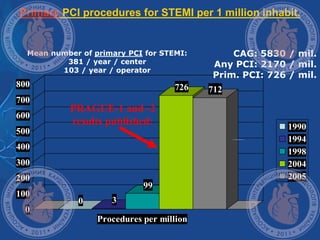
Primary PCI procedures for STEMI per 1 million inhabit.
0 3
99
726 712
0
100
200
300
400
500
600
700
800
Procedures per million
1990
1994
1998
2004
2005
PRAGUE-1 and -2
results published:
Mean number of primary PCI for STEMI:
381 / year / center
103 / year / operator
CAG: 5830 / mil.
Any PCI: 2170 / mil.
Prim. PCI: 726 / mil.
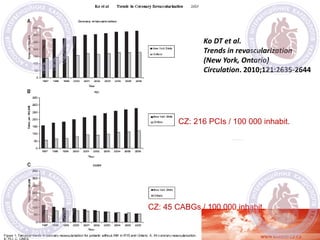
Ko DT et al.
Trends in revascularization
(New York, Ontario)
Circulation. 2010;121:2635-2644
CZ: 216 PCIs / 100 000 inhabit.
CZ: 45 CABGs / 100 000 inhabit.
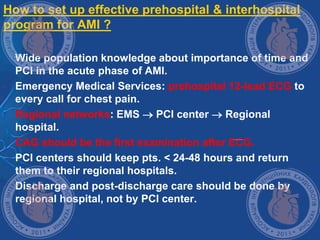
How to set up effective prehospital & interhospital
program for AMI ?
 Wide population knowledge about importance of time and
PCI in the acute phase of AMI.
 Emergency Medical Services: prehospital 12-lead ECG to
every call for chest pain.
 Regional networks: EMS  PCI center  Regional
hospital.
 CAG should be the first examination after ECG.
 PCI centers should keep pts. < 24-48 hours and return
them to their regional hospitals.
 Discharge and post-discharge care should be done by
regional hospital, not by PCI center.
How to minimize time delays ?
 Direct transfer first contact - cath-lab ! (Passing nearest hospital,
passing ER or CCU in the PCI center !). This can keep ECG – PCI
time almost always below 90 min.
 Cath-lab has to be prepared during the transport – patient thus
arrives to an empty room with waiting personnel.
Primary PCI organization:
 GOLDEN „30 MINUTES RULE“:
 First call – diagnosis < 30 min.
 (Diagnosis in non-PCI hospital - departure < 30
min.)
 Transport duration < 30 min.
 Arrival to cathlab – first balloon inflation < 30 min.
 Interventional cardiologist: call-needle <30min.
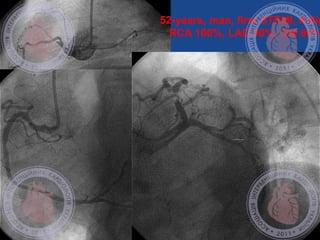
52-years, man, first STEMI, Killip
RCA 100%, LAD 90%, OM 80%
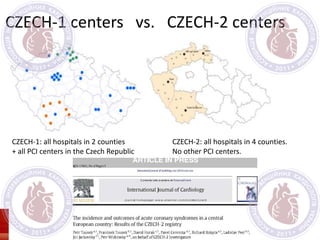
CZECH-1 centers vs. CZECH-2 centers
CZECH-1: all hospitals in 2 counties
+ all PCI centers in the Czech Republic
CZECH-2: all hospitals in 4 counties.
No other PCI centers.
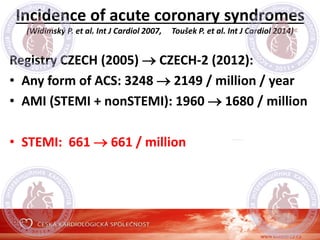
Incidence of acute coronary syndromes
(Widimský P. et al. Int J Cardiol 2007, Toušek P. et al. Int J Cardiol 2014)
Registry CZECH (2005)  CZECH-2 (2012):
• Any form of ACS: 3248  2149 / million / year
• AMI (STEMI + nonSTEMI): 1960  1680 / million
• STEMI: 661  661 / million
Stent for Life
Petr Widimský
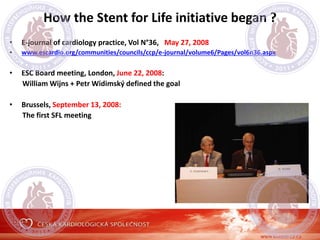
How the Stent for Life initiative began ?
• E-journal of cardiology practice, Vol N°36, May 27, 2008
• www.escardio.org/communities/councils/ccp/e-journal/volume6/Pages/vol6n36.aspx
• ESC Board meeting, London, June 22, 2008:
William Wijns + Petr Widimský defined the goal
• Brussels, September 13, 2008:
The first SFL meeting
92 92
86
81 81
75 75 72 70
66 64
59
49
45 45
35 33 30 30 28 24 23 19 19
9 8 5
0 1
0 7
2 12
5
3
15
8 10
31
15
15
40
35
28
26
35
30
55
25
44
33
41
29
45
8 7
14 12
17 13
20
25
15
26 26
10
36
40
15
30
39
44
35
42
21
52
37
48 50
63
50
0%
10%
20%
30%
40%
50%
60%
70%
80%
90%
100%
NL CZ SLO DE CH NO DK PL HR SE HU BE IL IT FIN AT FR SK ES LAT UK BG PO SRB GR TR RO
P-PCI Thrombolysis No reperfusion
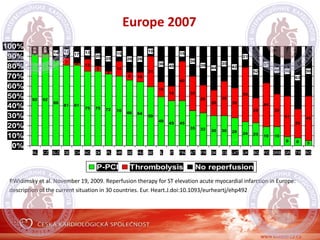
Europe 2007
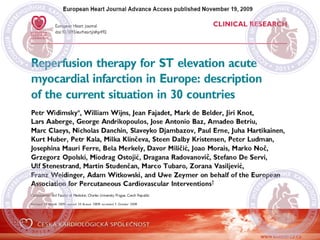
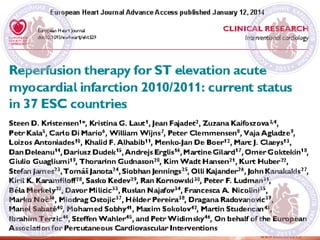
P.Widimsky et al. November 19, 2009. Reperfusion therapy for ST elevation acute myocardial infarction in Europe:
description of the current situation in 30 countries. Eur. Heart.J.doi:10.1093/eurheartj/ehp492
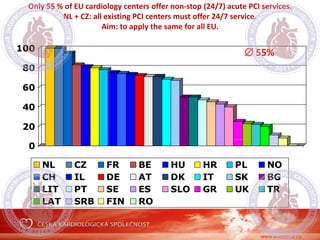
Only 55 % of EU cardiology centers offer non-stop (24/7) acute PCI services.
NL + CZ: all existing PCI centers must offer 24/7 service.
Aim: to apply the same for all EU.
0
20
40
60
80
100
NL CZ FR BE HU HR PL NO
CH IL DE AT DK IT SK BG
LIT PT SE ES SLO GR UK TR
LAT SRB FIN RO
 55%
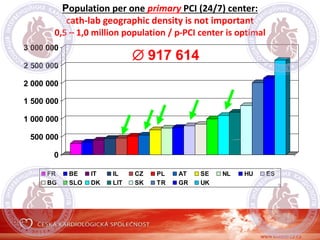
Population per one primary PCI (24/7) center:
cath-lab geographic density is not important
0,5 – 1,0 million population / p-PCI center is optimal
0
500 000
1 000 000
1 500 000
2 000 000
2 500 000
3 000 000
FR BE IT IL CZ PL AT SE NL HU ES
BG SLO DK LIT SK TR GR UK
 917 614
Nationwide „thrombolytic strategy“ for STEMI results in 46%
untreated STEMIs.
Trully nationwide p-PCI strategy (CZ, NL) results in 7% untreated
STEMIs
7
46
0
5
10
15
20
25
30
35
40
45
50
No reperfusion used
NL + CZ
Countries with
thrombolysis
dominance
% from all STEMI
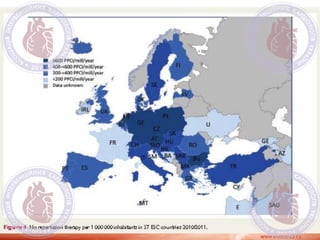
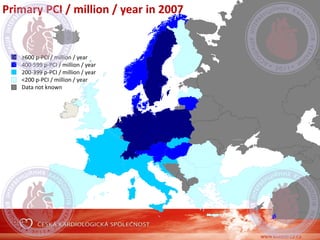
≥600 p-PCI / million / year
400-599 p-PCI / million / year
200-399 p-PCI / million / year
<200 p-PCI / million / year
Data not known
Primary PCI / million / year in 2007
How Can We Improve
Networks and Infrastructure
• Regional network (EMS, non-PCI hospitals and PCI centers) should cover an
area with population around 0,5 million (cca 0,3 – 1 million).
• Respect the right of local hospitals to take care for the patients after primary
PCI is completed and the patient is stabilized (tertiary transport to the local
hospital nearest to patient’s home).
• All PCI centers should provide non-stop (24/7) services for primary PCI. PCI
hospitals, which are not able to provide non-stop (24/7) primary PCI services,
should not be part of the network.
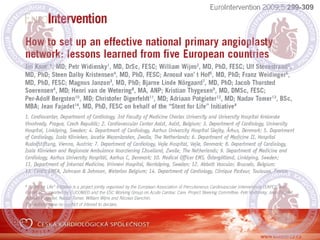
J.Knot:How to set up an effective national primary angioplasty network: lessons learned
from five European countries (EuroIntervention, August 2009).
How Can We Improve
Emergency Medical Services (EMS)
• EMS staff training is more important that the EMS staff structure (trained
nurses suitable for the triage and transport of AMI patients)
• EMS ambulances: equipped by resuscitation facilities and by a portable
12-leads ECG.
• ECG teletransmission (to the PCI center) can be left on the local decision,
is not mandatory.
• Road transport is prefferred (air transport takes usually more time).
• Helicopter transport is generally faster in mountainous, islandic or very
scarsely populated regions.
J.Knot:How to set up an effective national primary angioplasty network: lessons learned
from five European countries (EuroIntervention, August 2009).
How Can We Improve
Transport & Time Delays
Primary transport should bypass the nearest non-PCI hospital and the
Emergency Room or Intensive Care Unit of the PCI center.
• Immediately diagnostic ECG call to cathlab and start transfer. The ECG –
cathlab time <90 minutes can be achieved in vast majority of patients.
• Admission to Emergency Room (or ICU) in the PCI center delays
reperfusion by at least 20-40 minutes.
• Admission to non-PCI hospital followed by the „secondary transport“ to
PCI center delays reperfusion by at least 30-60 minutes.
J.Knot:How to set up an effective national primary angioplasty network: lessons learned
from five European countries(EuroIntervention, August 2009).
Интервенционная кардиология:
ключевая субспециальность в
кардиологии.
Требования к подготовке
специалистов в Чешской республике и
в ЕС
Петр Видимский
(г. Прага, Чешская республика)
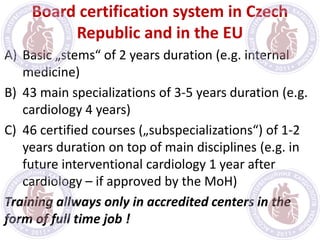
Board certification system in Czech
Republic and in the EU
A) Basic „stems“ of 2 years duration (e.g. internal
medicine)
B) 43 main specializations of 3-5 years duration (e.g.
cardiology 4 years)
C) 46 certified courses („subspecializations“) of 1-2
years duration on top of main disciplines (e.g. in
future interventional cardiology 1 year after
cardiology – if approved by the MoH)
Training allways only in accredited centers in the
form of full time job !
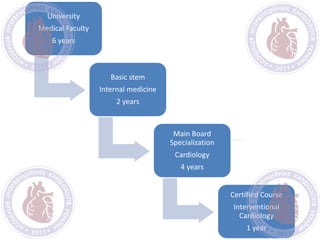
University
Medical Faculty
6 years
Basic stem
Internal medicine
2 years
Main Board
Specialization
Cardiology
4 years
Certified Course
Interventional
Cardiology
1 year
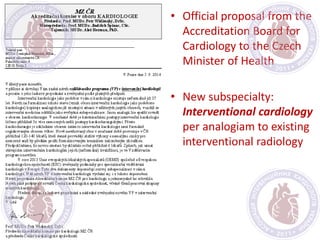
• Official proposal from the
Accreditation Board for
Cardiology to the Czech
Minister of Health
• New subspecialty:
Interventional cardiology
per analogiam to existing
interventional radiology
Joint proposal of the Accreditation Board for Cardiology &
the Czech Society of Cardiology & Kardio-35 (young
cardiologists organization)
• Cardiac surgery (independent specialty) is currently treating only
25% patients compared to interventional cardiology treating
75% CAD patients
• Interventional radiology is specialty on top of radiology. The
same should exists for interventional cardiology and cardiology.
• Interventional cardiology is practiced by 130 physicians in the
Czech Republic. New specialty will produce approx. 6-8 new
interventional cardiologists per year.
• They perform complex procedures with definite risks without
properly formalized training requirements and board
examinations
• UEMS & ESC 2013 published conditions for cardiology training
and board specialization / certification in Europe and both
documents recommend interventional cardiology as a key
subspecialty on top of cardiology (being baseline specialty).
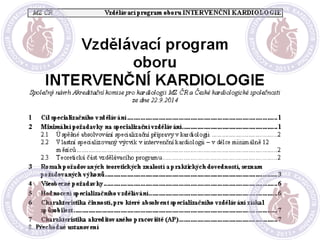
Requirements for interventional
cardiologist – Czech proposal
• Completed board certification CARDIOLOGY
• At least 1-year FULL TIME training in a center
accredited for INTERVENTIONAL cardiology
• Courses on radial protection, hemodynamics and
diagnostic catheterization and interventional
cardiology
• 1 publication (as first author) in peer-reviewed
journal and 1 lecture at annual congress of CSC
• Final board examination from I.C.
Practical skills
• Level I.: Selecting the appropriate diagnostic and
therapeutic approach, ability to interpret results. During the
training must see such procedures and may assist these
interventions.
• Level II.: Must assist, but cannot work as first operator.
Must be able to interpret.
• Level III.: Must be able to perform independently as first
operator (incl. indications, interpret results and treat
complications).
• Trainee must have list of all patients and procedures, where
he participated actively with clear definition of his role (first
operator vs. assistance vs. observer). This role must be also
recorded in hospital documentation.
Final board examination
• Practical part – analysis of 5 patients: 2 CAGs,
2 hemodynamic exams (L+R cath) and 1
complex or complicated PCI.
• Theoretical part – 1 question from diagnostic
invasive cardiology or from interventional
cardiology.
Requirements for accredited center
• At least 2 trainers (interventional cardiologists
with >5 years experience)
• Head of department must be cardiologist
• ICU with unselected full case mix (incl. STEMI,
acute heart failure, resuscitated patients etc.)
• At least 2 cath-labs
• Non-invasive cardiac imaging (echo, CT)
• Cardiac surgery (may be subcontracted in
another hospital)
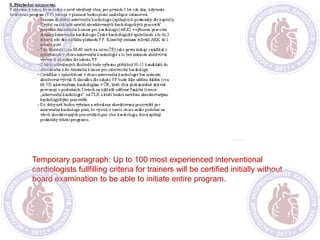
Temporary paragraph: Up to 100 most experienced interventional
cardiologists fullfilling criteria for trainers will be certified initially without
board examination to be able to initiate entire program.
This is a proposal, not yet a working program
Not yet approved by the Ministry of Health
(undergoing administrative and inter-
disciplinary discussions)
Структура «Реперфузионной Сети» Чешской Республики. Первичное стентирование для всех STEMI пациентов страны. Петр Видимский

Структура «Реперфузионной Сети» Чешской Республики. Первичное стентирование для всех STEMI пациентов страны. Петр Видимский

  • 1.
    Структура «Реперфузионной Сети» ЧешскойРеспублики: первичное стентирование для всех STEMI пациентов страны. Петр Видимский (г. Прага, Чешская республика)
  • 2.
    Thrombolysis (50% success rates 7%reocclusion risk) Primary PCI (90% success rates 3% reocclusion risk) Modern therapy of AMI: Thrombus removal, Flow restoration
  • 3.
    University Hospital Prague- change of AMI treatment strategy on October 5, 1995: thrombolysis declared non-lege artis 0 2 4 6 8 10 12 STEMI mortality 1994 1996
  • 4.
    CZ 1995: STEMImortality in the real life according to the hospital type 29 17 17 8 0 5 10 15 20 25 30 In-hospital mortality Small hospitals Medium size hospitals Tertiary hospitals without PCI Tertiary hospitals with PCI
  • 5.
    PRAGUE-1: Combined end- pointat 30 days 23% 15% 8% 0 5 10 15 20 25 A B C +/reMI/stroke
  • 7.
    VINO Study: primaryPCI for non-STEMI Eur Heart J. 2002 Feb;23(3):230-8. 30days 6months Invasive Conserv 7.5% 13.4% 1.6% 3.1% p<0.05
  • 8.
    CZECH GUIDELINES FORSTEMI PCIPCIPCIPain-ECG 3-12 hours TLPCIPCIPain-ECG < 3 hours ECG-PCI > 90 min. ECG-PCI 30-90 min. ECG-PCI < 30 min. STEMI (Cor et Vasa 2002; 44: K123-143)
  • 9.
    The Czech Soc.ofCardiology guidelines: the world first guidelines proposing primary PCI as the default treatment strategy  2002 Czech Society of Cardiology  2003 European Society of Cardiology  2004 American College of Cardiology / American Heart Association
  • 10.
    Transport distances toPCI centers (all 22 operating non-stop) in the Czech Republic.
  • 11.
    Czech STEMI registries1998 vs 2005: The nationwide implementation of P-PCI strategy increased the use of ANY reperfusion therapy from 45% to 93% 7% 55% 38% TL P-PCI No reperfusion therapy 1% 7% 92% P-PCI TL No reperfusion therapy
  • 12.
    Czech STEMI registries1999 vs 2005: The nationwide implementation of P-PCI strategy completely abolished mortality differences between smaller hospitals and tertiary PCI centers 8 18 0 5 10 15 20 In-hospital mortality Tertiary PCI centers Hospitals without cath-lab 6,8 6,9 0 5 10 15 20 In-hospital mortality Tertiary PCI centers Hospitals without cath-lab
  • 13.
    Optimal workload andoutcomes  PCI center (CZ): >600 PCI’s / year (primary + elective), >100 primary PCI / year  Operator >100 PCI / year (for all operators in this center).  In-hospital mortality of all primary PCI patients <10%  Mortality for Killip class I pts. <3%.
  • 14.
    All PCI proceduresin the Czech Republic 320 1829 9270 16338 21676 22545 21624 0 5000 10000 15000 20000 25000 1990 1995 2000 2002 2004 2009 2013 PCI/rok/ČR PCI/rok/ČR PRAGUE-1 1999 PRAGUE-2 2002
  • 15.
    Primary PCI proceduresfor STEMI per 1 million inhabit. 0 3 99 726 712 0 100 200 300 400 500 600 700 800 Procedures per million 1990 1994 1998 2004 2005 PRAGUE-1 and -2 results published: Mean number of primary PCI for STEMI: 381 / year / center 103 / year / operator CAG: 5830 / mil. Any PCI: 2170 / mil. Prim. PCI: 726 / mil.
  • 16.
    Ko DT etal. Trends in revascularization (New York, Ontario) Circulation. 2010;121:2635-2644 CZ: 216 PCIs / 100 000 inhabit. CZ: 45 CABGs / 100 000 inhabit.
  • 17.
    How to setup effective prehospital & interhospital program for AMI ?  Wide population knowledge about importance of time and PCI in the acute phase of AMI.  Emergency Medical Services: prehospital 12-lead ECG to every call for chest pain.  Regional networks: EMS  PCI center  Regional hospital.  CAG should be the first examination after ECG.  PCI centers should keep pts. < 24-48 hours and return them to their regional hospitals.  Discharge and post-discharge care should be done by regional hospital, not by PCI center.
  • 18.
    How to minimizetime delays ?  Direct transfer first contact - cath-lab ! (Passing nearest hospital, passing ER or CCU in the PCI center !). This can keep ECG – PCI time almost always below 90 min.  Cath-lab has to be prepared during the transport – patient thus arrives to an empty room with waiting personnel.
  • 19.
    Primary PCI organization: GOLDEN „30 MINUTES RULE“:  First call – diagnosis < 30 min.  (Diagnosis in non-PCI hospital - departure < 30 min.)  Transport duration < 30 min.  Arrival to cathlab – first balloon inflation < 30 min.  Interventional cardiologist: call-needle <30min.
  • 20.
    52-years, man, firstSTEMI, Killip RCA 100%, LAD 90%, OM 80%
  • 21.
    CZECH-1 centers vs.CZECH-2 centers CZECH-1: all hospitals in 2 counties + all PCI centers in the Czech Republic CZECH-2: all hospitals in 4 counties. No other PCI centers.
  • 22.
    Incidence of acutecoronary syndromes (Widimský P. et al. Int J Cardiol 2007, Toušek P. et al. Int J Cardiol 2014) Registry CZECH (2005)  CZECH-2 (2012): • Any form of ACS: 3248  2149 / million / year • AMI (STEMI + nonSTEMI): 1960  1680 / million • STEMI: 661  661 / million
  • 23.
  • 24.
    How the Stentfor Life initiative began ? • E-journal of cardiology practice, Vol N°36, May 27, 2008 • www.escardio.org/communities/councils/ccp/e-journal/volume6/Pages/vol6n36.aspx • ESC Board meeting, London, June 22, 2008: William Wijns + Petr Widimský defined the goal • Brussels, September 13, 2008: The first SFL meeting
  • 26.
    92 92 86 81 81 7575 72 70 66 64 59 49 45 45 35 33 30 30 28 24 23 19 19 9 8 5 0 1 0 7 2 12 5 3 15 8 10 31 15 15 40 35 28 26 35 30 55 25 44 33 41 29 45 8 7 14 12 17 13 20 25 15 26 26 10 36 40 15 30 39 44 35 42 21 52 37 48 50 63 50 0% 10% 20% 30% 40% 50% 60% 70% 80% 90% 100% NL CZ SLO DE CH NO DK PL HR SE HU BE IL IT FIN AT FR SK ES LAT UK BG PO SRB GR TR RO P-PCI Thrombolysis No reperfusion Europe 2007 P.Widimsky et al. November 19, 2009. Reperfusion therapy for ST elevation acute myocardial infarction in Europe: description of the current situation in 30 countries. Eur. Heart.J.doi:10.1093/eurheartj/ehp492
  • 27.
    Only 55 %of EU cardiology centers offer non-stop (24/7) acute PCI services. NL + CZ: all existing PCI centers must offer 24/7 service. Aim: to apply the same for all EU. 0 20 40 60 80 100 NL CZ FR BE HU HR PL NO CH IL DE AT DK IT SK BG LIT PT SE ES SLO GR UK TR LAT SRB FIN RO  55%
  • 28.
    Population per oneprimary PCI (24/7) center: cath-lab geographic density is not important 0,5 – 1,0 million population / p-PCI center is optimal 0 500 000 1 000 000 1 500 000 2 000 000 2 500 000 3 000 000 FR BE IT IL CZ PL AT SE NL HU ES BG SLO DK LIT SK TR GR UK  917 614
  • 29.
    Nationwide „thrombolytic strategy“for STEMI results in 46% untreated STEMIs. Trully nationwide p-PCI strategy (CZ, NL) results in 7% untreated STEMIs 7 46 0 5 10 15 20 25 30 35 40 45 50 No reperfusion used NL + CZ Countries with thrombolysis dominance % from all STEMI
  • 30.
    ≥600 p-PCI /million / year 400-599 p-PCI / million / year 200-399 p-PCI / million / year <200 p-PCI / million / year Data not known Primary PCI / million / year in 2007
  • 34.
    How Can WeImprove Networks and Infrastructure • Regional network (EMS, non-PCI hospitals and PCI centers) should cover an area with population around 0,5 million (cca 0,3 – 1 million). • Respect the right of local hospitals to take care for the patients after primary PCI is completed and the patient is stabilized (tertiary transport to the local hospital nearest to patient’s home). • All PCI centers should provide non-stop (24/7) services for primary PCI. PCI hospitals, which are not able to provide non-stop (24/7) primary PCI services, should not be part of the network. J.Knot:How to set up an effective national primary angioplasty network: lessons learned from five European countries (EuroIntervention, August 2009).
  • 35.
    How Can WeImprove Emergency Medical Services (EMS) • EMS staff training is more important that the EMS staff structure (trained nurses suitable for the triage and transport of AMI patients) • EMS ambulances: equipped by resuscitation facilities and by a portable 12-leads ECG. • ECG teletransmission (to the PCI center) can be left on the local decision, is not mandatory. • Road transport is prefferred (air transport takes usually more time). • Helicopter transport is generally faster in mountainous, islandic or very scarsely populated regions. J.Knot:How to set up an effective national primary angioplasty network: lessons learned from five European countries (EuroIntervention, August 2009).
  • 36.
    How Can WeImprove Transport & Time Delays Primary transport should bypass the nearest non-PCI hospital and the Emergency Room or Intensive Care Unit of the PCI center. • Immediately diagnostic ECG call to cathlab and start transfer. The ECG – cathlab time <90 minutes can be achieved in vast majority of patients. • Admission to Emergency Room (or ICU) in the PCI center delays reperfusion by at least 20-40 minutes. • Admission to non-PCI hospital followed by the „secondary transport“ to PCI center delays reperfusion by at least 30-60 minutes. J.Knot:How to set up an effective national primary angioplasty network: lessons learned from five European countries(EuroIntervention, August 2009).
  • 38.
    Интервенционная кардиология: ключевая субспециальностьв кардиологии. Требования к подготовке специалистов в Чешской республике и в ЕС Петр Видимский (г. Прага, Чешская республика)
  • 39.
    Board certification systemin Czech Republic and in the EU A) Basic „stems“ of 2 years duration (e.g. internal medicine) B) 43 main specializations of 3-5 years duration (e.g. cardiology 4 years) C) 46 certified courses („subspecializations“) of 1-2 years duration on top of main disciplines (e.g. in future interventional cardiology 1 year after cardiology – if approved by the MoH) Training allways only in accredited centers in the form of full time job !
  • 40.
    University Medical Faculty 6 years Basicstem Internal medicine 2 years Main Board Specialization Cardiology 4 years Certified Course Interventional Cardiology 1 year
  • 41.
    • Official proposalfrom the Accreditation Board for Cardiology to the Czech Minister of Health • New subspecialty: Interventional cardiology per analogiam to existing interventional radiology
  • 43.
    Joint proposal ofthe Accreditation Board for Cardiology & the Czech Society of Cardiology & Kardio-35 (young cardiologists organization) • Cardiac surgery (independent specialty) is currently treating only 25% patients compared to interventional cardiology treating 75% CAD patients • Interventional radiology is specialty on top of radiology. The same should exists for interventional cardiology and cardiology. • Interventional cardiology is practiced by 130 physicians in the Czech Republic. New specialty will produce approx. 6-8 new interventional cardiologists per year. • They perform complex procedures with definite risks without properly formalized training requirements and board examinations • UEMS & ESC 2013 published conditions for cardiology training and board specialization / certification in Europe and both documents recommend interventional cardiology as a key subspecialty on top of cardiology (being baseline specialty).
  • 44.
    Requirements for interventional cardiologist– Czech proposal • Completed board certification CARDIOLOGY • At least 1-year FULL TIME training in a center accredited for INTERVENTIONAL cardiology • Courses on radial protection, hemodynamics and diagnostic catheterization and interventional cardiology • 1 publication (as first author) in peer-reviewed journal and 1 lecture at annual congress of CSC • Final board examination from I.C.
  • 45.
    Practical skills • LevelI.: Selecting the appropriate diagnostic and therapeutic approach, ability to interpret results. During the training must see such procedures and may assist these interventions. • Level II.: Must assist, but cannot work as first operator. Must be able to interpret. • Level III.: Must be able to perform independently as first operator (incl. indications, interpret results and treat complications). • Trainee must have list of all patients and procedures, where he participated actively with clear definition of his role (first operator vs. assistance vs. observer). This role must be also recorded in hospital documentation.
  • 47.
    Final board examination •Practical part – analysis of 5 patients: 2 CAGs, 2 hemodynamic exams (L+R cath) and 1 complex or complicated PCI. • Theoretical part – 1 question from diagnostic invasive cardiology or from interventional cardiology.
  • 48.
    Requirements for accreditedcenter • At least 2 trainers (interventional cardiologists with >5 years experience) • Head of department must be cardiologist • ICU with unselected full case mix (incl. STEMI, acute heart failure, resuscitated patients etc.) • At least 2 cath-labs • Non-invasive cardiac imaging (echo, CT) • Cardiac surgery (may be subcontracted in another hospital)
  • 49.
    Temporary paragraph: Upto 100 most experienced interventional cardiologists fullfilling criteria for trainers will be certified initially without board examination to be able to initiate entire program.
  • 50.
    This is aproposal, not yet a working program Not yet approved by the Ministry of Health (undergoing administrative and inter- disciplinary discussions)