SHED: Stem cells in 
human exfoliated 
deciduous teeth 
Hope or Hype!!!!! 
DR. UPAMA SISHAN
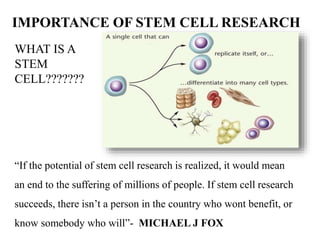
IMPORTANCE OF STEM CELL RESEARCH 
WHAT IS A 
STEM 
CELL??????? 
“If the potential of stem cell research is realized, it would mean 
an end to the suffering of millions of people. If stem cell research 
succeeds, there isn’t a person in the country who wont benefit, or 
know somebody who will”- MICHAEL J FOX
COMMON SOURCES OF STEM CELLS 
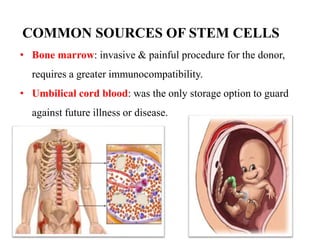
• Bone marrow: invasive & painful procedure for the donor, 
requires a greater immunocompatibility. 
• Umbilical cord blood: was the only storage option to guard 
against future illness or disease.
SHED 
(STEM CELLS IN HUMAN EXFOLIATED 
DECIDUOUS TEETH) 
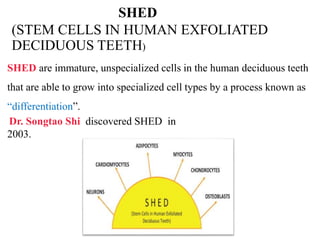
SHED are immature, unspecialized cells in the human deciduous teeth 
that are able to grow into specialized cell types by a process known as 
“differentiation”. 
Dr. Songtao Shi discovered SHED in 
2003.
HISTORY 
In 2003 
Miura & co workers discovered a multipotent 
stem cell population in human exfoliated deciduous 
teeth. 
In 2009 
(1) Sayaka & co workers - SHED have highest proliferative 
ability than the dental pulp stem cell of permanent teeth & 
human bone marrow stem cells. 
(2)Wang’s study on the therapeutic efficacy of SHED in 
Parkinsons disease in rat model concluded that SHED may 
be an optimal source of post natal stem cells for parkinsons 
disease treatment.
In 2010 
(1) Yudai Nishino - SHED have similar effects of wound healing 
properties as human fibroblasts. 
(2)Takayoshi Yamaza - SHED have same 
immunomodulatory properties as that of human bone marrow 
stem cells . 
In 2012 
Vakhrushev & co workers pulp of the deciduous teeth is a promising 
source of cell material for scaffold population in tissue bone 
engineering.
SALIENT FEATURES OF SHED 
• a multipotent stem-cell population. 
• can be isolated and expanded ex vivo. 
• have higher proliferation rate 
• increased cell-population doublings 
• sphere-like cell-cluster formation 
• osteoinductive capacity in vivo
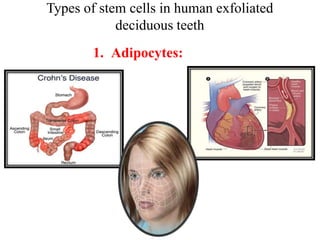
Types of stem cells in human exfoliated 
deciduous teeth 
1. Adipocytes:
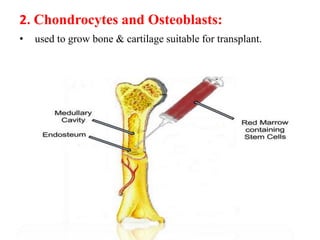
2. Chondrocytes and Osteoblasts: 
• used to grow bone & cartilage suitable for transplant.
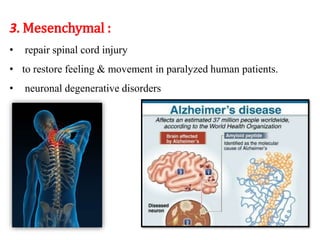
3. Mesenchymal : 
• repair spinal cord injury 
• to restore feeling & movement in paralyzed human patients. 
• neuronal degenerative disorders
ADVANTAGES OF BANKING SHED 
• It Provides a guaranteed matching donor (autologous 
transplant) for life. 
• Saves cells before natural damage occurs. 
• Simple and painless for both child and parent. 
• Less than one third of the cost of cord blood storage. 
• SHED are adult stem cells and are not the subject of the 
same ethical concerns as embryonic stem cells.
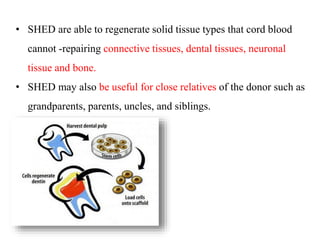
• SHED are able to regenerate solid tissue types that cord blood 
cannot -repairing connective tissues, dental tissues, neuronal 
tissue and bone. 
• SHED may also be useful for close relatives of the donor such as 
grandparents, parents, uncles, and siblings.
Tooth Eligibility Criteria for SHED Banking 
INCLUSION CRITERIA: 
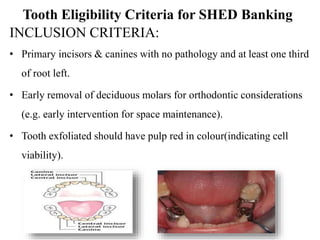
• Primary incisors & canines with no pathology and at least one third 
of root left. 
• Early removal of deciduous molars for orthodontic considerations 
(e.g. early intervention for space maintenance). 
• Tooth exfoliated should have pulp red in colour(indicating cell 
viability).
EXCLUSION CRITERIA: 
• Primary teeth distal to the canine. 
• Primary molars. 
• The pulp which is grey in colour (compromised blood 
supply- necrotic pulp). 
• Teeth that become very mobile, either through trauma 
or disease (e.g. Class III or IV mobility).
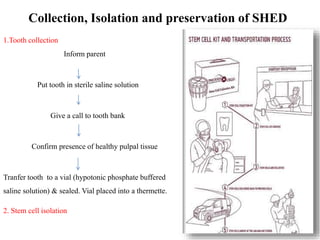
Collection, Isolation and preservation of SHED 
1.Tooth collection 
Inform parent 
Put tooth in sterile saline solution 
Give a call to tooth bank 
Confirm presence of healthy pulpal tissue 
Tranfer tooth to a vial (hypotonic phosphate buffered 
saline solution) & sealed. Vial placed into a thermette. 
2. Stem cell isolation
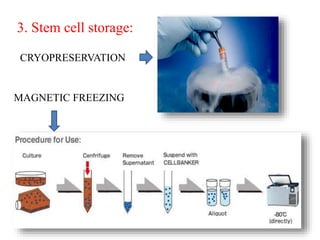
3. Stem cell storage: 
CRYOPRESERVATION 
MAGNETIC FREEZING
SUMMARY 
• Recent studies - SHED can develop into more types of body tissue 
than other types of stem cells. 
• There is much research left to be conducted. 
• The immense scope & magnitude of stem cell therapies will only be 
fully realized in the future. 
• Dental Professionals have realized that the critical time to act is now. 
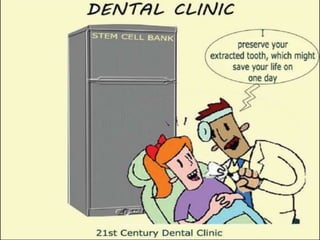
• So its better that the dentist bank their patients dental stem cells while 
patients are young and healthy –simple & convenient 
-Primary teeth are better source of stem cells.
References: 
1. SHED: stem cells from human exfoliated deciduous teeth. 
Miura M, Gronthos S, Zhao M, Lu B, Fisher L W, Robey PG, Shi S. 
2. Stem cells from human exfoliated deciduous teeth (SHED) 
enhance wound healing and the possibility of novel cell therapy. 
Nishino Y , Yamada Y , Ebisawa K, Nakamura S . 
3. Immunomodulatory properties of stem cells from human 
exfoliated deciduous teeth .Yamaza T, Kentaro A, Chen C, Liu Y, 
Shi Y, Gronthos S, Wang S, Shi S.
4. Banking Stem Cells from Human Exfoliated Deciduous Teeth 
(SHED): Saving for the Future . Vipin Arora , Pooja Arora& AK 
Munshi. 
5. Stem cells from human exfoliated deciduous teeth (SHED) 
enhance wound healing and the possibility of novel cell therapy. 
Yudai Nishino , Yoichi Yamada , Katsumi Ebisawa , Sayaka 
Nakamura ,Kazuto Okabe , Eri Umemura , Hara k & Ueda M. 
6. Stem Cells from Human-Exfoliated Deciduous Teeth Can 
Differentiate into Dopaminergic Neuron-Like Cells. 
Wang J, Wang X , Sun Z ,Wang Z , Yang H, Shi S & Wang S.
STEM CELLS IN HUMAN EXFOLIATED DECIDUOUS TEETH(SHED)

STEM CELLS IN HUMAN EXFOLIATED DECIDUOUS TEETH(SHED)

  • 1.
    SHED: Stem cellsin human exfoliated deciduous teeth Hope or Hype!!!!! DR. UPAMA SISHAN
  • 2.
    IMPORTANCE OF STEMCELL RESEARCH WHAT IS A STEM CELL??????? “If the potential of stem cell research is realized, it would mean an end to the suffering of millions of people. If stem cell research succeeds, there isn’t a person in the country who wont benefit, or know somebody who will”- MICHAEL J FOX
  • 4.
    COMMON SOURCES OFSTEM CELLS • Bone marrow: invasive & painful procedure for the donor, requires a greater immunocompatibility. • Umbilical cord blood: was the only storage option to guard against future illness or disease.
  • 6.
    SHED (STEM CELLSIN HUMAN EXFOLIATED DECIDUOUS TEETH) SHED are immature, unspecialized cells in the human deciduous teeth that are able to grow into specialized cell types by a process known as “differentiation”. Dr. Songtao Shi discovered SHED in 2003.
  • 7.
    HISTORY In 2003 Miura & co workers discovered a multipotent stem cell population in human exfoliated deciduous teeth. In 2009 (1) Sayaka & co workers - SHED have highest proliferative ability than the dental pulp stem cell of permanent teeth & human bone marrow stem cells. (2)Wang’s study on the therapeutic efficacy of SHED in Parkinsons disease in rat model concluded that SHED may be an optimal source of post natal stem cells for parkinsons disease treatment.
  • 8.
    In 2010 (1)Yudai Nishino - SHED have similar effects of wound healing properties as human fibroblasts. (2)Takayoshi Yamaza - SHED have same immunomodulatory properties as that of human bone marrow stem cells . In 2012 Vakhrushev & co workers pulp of the deciduous teeth is a promising source of cell material for scaffold population in tissue bone engineering.
  • 9.
    SALIENT FEATURES OFSHED • a multipotent stem-cell population. • can be isolated and expanded ex vivo. • have higher proliferation rate • increased cell-population doublings • sphere-like cell-cluster formation • osteoinductive capacity in vivo
  • 10.
    Types of stemcells in human exfoliated deciduous teeth 1. Adipocytes:
  • 11.
    2. Chondrocytes andOsteoblasts: • used to grow bone & cartilage suitable for transplant.
  • 12.
    3. Mesenchymal : • repair spinal cord injury • to restore feeling & movement in paralyzed human patients. • neuronal degenerative disorders
  • 13.
    ADVANTAGES OF BANKINGSHED • It Provides a guaranteed matching donor (autologous transplant) for life. • Saves cells before natural damage occurs. • Simple and painless for both child and parent. • Less than one third of the cost of cord blood storage. • SHED are adult stem cells and are not the subject of the same ethical concerns as embryonic stem cells.
  • 14.
    • SHED areable to regenerate solid tissue types that cord blood cannot -repairing connective tissues, dental tissues, neuronal tissue and bone. • SHED may also be useful for close relatives of the donor such as grandparents, parents, uncles, and siblings.
  • 15.
    Tooth Eligibility Criteriafor SHED Banking INCLUSION CRITERIA: • Primary incisors & canines with no pathology and at least one third of root left. • Early removal of deciduous molars for orthodontic considerations (e.g. early intervention for space maintenance). • Tooth exfoliated should have pulp red in colour(indicating cell viability).
  • 16.
    EXCLUSION CRITERIA: •Primary teeth distal to the canine. • Primary molars. • The pulp which is grey in colour (compromised blood supply- necrotic pulp). • Teeth that become very mobile, either through trauma or disease (e.g. Class III or IV mobility).
  • 17.
    Collection, Isolation andpreservation of SHED 1.Tooth collection Inform parent Put tooth in sterile saline solution Give a call to tooth bank Confirm presence of healthy pulpal tissue Tranfer tooth to a vial (hypotonic phosphate buffered saline solution) & sealed. Vial placed into a thermette. 2. Stem cell isolation
  • 18.
    3. Stem cellstorage: CRYOPRESERVATION MAGNETIC FREEZING
  • 19.
    SUMMARY • Recentstudies - SHED can develop into more types of body tissue than other types of stem cells. • There is much research left to be conducted. • The immense scope & magnitude of stem cell therapies will only be fully realized in the future. • Dental Professionals have realized that the critical time to act is now. • So its better that the dentist bank their patients dental stem cells while patients are young and healthy –simple & convenient -Primary teeth are better source of stem cells.
  • 20.
    References: 1. SHED:stem cells from human exfoliated deciduous teeth. Miura M, Gronthos S, Zhao M, Lu B, Fisher L W, Robey PG, Shi S. 2. Stem cells from human exfoliated deciduous teeth (SHED) enhance wound healing and the possibility of novel cell therapy. Nishino Y , Yamada Y , Ebisawa K, Nakamura S . 3. Immunomodulatory properties of stem cells from human exfoliated deciduous teeth .Yamaza T, Kentaro A, Chen C, Liu Y, Shi Y, Gronthos S, Wang S, Shi S.
  • 21.
    4. Banking StemCells from Human Exfoliated Deciduous Teeth (SHED): Saving for the Future . Vipin Arora , Pooja Arora& AK Munshi. 5. Stem cells from human exfoliated deciduous teeth (SHED) enhance wound healing and the possibility of novel cell therapy. Yudai Nishino , Yoichi Yamada , Katsumi Ebisawa , Sayaka Nakamura ,Kazuto Okabe , Eri Umemura , Hara k & Ueda M. 6. Stem Cells from Human-Exfoliated Deciduous Teeth Can Differentiate into Dopaminergic Neuron-Like Cells. Wang J, Wang X , Sun Z ,Wang Z , Yang H, Shi S & Wang S.

Editor's Notes

  • #5  To date, the most common source of stem cells has been bone marrow. However, the bone marrow aspirate is an invasive and painful procedure for the donor. Though stem cells can be found in most tissues of the body, they are usually buried deep, are few in number and are similar in appearance to surrounding cells. Until recently, stem cells harvested from umbilical cord blood was the only storage option to guard against future illness or disease.
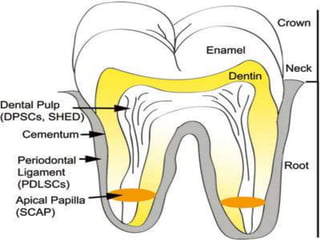
  • #6 Dental Pulp Stem Cells (DPSCs) Stem cells from human exfoliated deciduous teeth (SHEDs) Periodontal Ligament (PDLSCs) Dental follicle stem cells (DFSCs) Apical papilla (SCAPs)
  • #7 SHED appear at the 6th week during the embryonic stage of human development. Scientists believe that these stem cells behave differently than post-natal (adult) stem cells. SHED cells multiply rapidly and grow much faster than adult stem cells, suggesting that they are less mature, so they have the potential to develop into a wider variety of tissue types.
  • #9 In 2010 Yudai Nishino found out that the SHED have similar effects of wound healing properties as human fibroblasts. Indicating possibilities of novel stem cell therapies for wound healing in the future In 2010 Takayoshi Yamaza found out that SHED have same immunomodulatory properties as that of human bone marrow stem cells . In 2012 Vakhrushev & co workers found out that pulp of the deciduous teeth is a promising source of cell material for scaffold population in tissue bone engineering
  • #10 Deciduous teeth are significantly different from permanent teeth with regards to their developmental processes, tissue structure, and function. So the SHED have higher proliferation rate, increased cell-population doublings, sphere-like cell-cluster formation, osteoinductive capacity in vivo, and failure to reconstitute a dentin–pulp-like complex.
  • #11 used to repair damage to the heart muscle. cardiovascular disease orthopedic conditions congestive heart failure, Crohn’s disease plastic surgery.
  • #14  It Provides a guaranteed matching donor (autologous transplant) for life. -no immune reaction -no tissue rejection of cells - immunosupressive therapy not needed -significantly reduced risk of communicable diseases. • SHED cells are complementary to stem cells from cord blood. While cord blood stem cells have proven valuable in the regeneration of blood cell types, SHED are able to regenerate solid tissue types that cord blood cannot - such as potentially repairing connective tissues, dental tissues, neuronal tissue and bone.7,11,13,14 • SHED may also be useful for close relatives of the donor such as grandparents, parents, uncles, and siblings. 9
  • #16  Primary molars have a broader root base, & therefore, are retained in the mouth for a longer period of time than anterior teeth. Eruption of posterior permanent teeth generally takes a longer amount of time to resorb the primary molar roots, which may result in an obliterated pulp chamber that contains no pulp, and thus, no stem cells. In some instances, early removal of deciduous molars for orthodontic considerations (e.g. early intervention for space maintenance) will present an opportunity to recover these teeth for stem cell banking. 1.tooth exfoliated should have pulp red in color, indicating that the pulp received blood flow up until the time of removal, which is indicative of cell viability. 2.If the pulp is gray in color, it is likely that blood flow to the pulp has been compromised, and thus, the stem cells are likely necrotic and are no longer viable for recovery. ) 3.Teeth that become very mobile, either through trauma or disease (e.g. Class III or IV mobility, often have a severed blood supply, and are not candidates for stem cell recovery. Pulpal stem cells should not be harvested from teeth with apical abscesses, tumors or cysts.
  • #18  1.tooth exfoliated should have pulp red in color, indicating that the pulp received blood flow up until the time of removal, which is indicative of cell viability. 2.If the pulp is gray in color, it is likely that blood flow to the pulp has been compromised, and thus, the stem cells are likely necrotic and are no longer viable for recovery. 3.Teeth that become very mobile, either through trauma or disease (e.g. Class III or IV mobility), often have a severed blood supply, and are not candidates for stem cell recovery. Pulpal stem cells should not be harvested from teeth with apical abscesses, tumors or cysts. the tooth or teeth is transferred into the vial containing a hypotonic phosphate buffered saline solution, which provides nutrients and helps to prevent the tissue from drying out during transport (up to four teeth in the one vial). Placing a tooth into this vial at room temperature induces hypothermia. The vial is then carefully sealed and placed into the thermette a temperature phase change carrier, after which the carrier is then placed into an insulated metal transport vessel. The thermette along with the insulated transport vessel maintains the sample in a hypothermic state during transportation. This procedure is described as Sustentation.
  • #19 Cryopreservation: It is the process of preserving cells or whole tissues by cooling them to sub-zero temperatures. At these freezing temperatures, biological activity is stopped, as are any cellular processes that lead to cell death These cells can be cryopreserved for an extended period of time, and when needed, carefully taken The cells are preserved in liquid nitrogen vapor at a temperature of less than -150ºC. This preserves the cells and maintains their latency and potency. . Magnetic freezingg tech : uses little known phenomena that applying even a weak magnetic field to water or cell tissue will lower the freezing point of that body by up to 6-7 degrees Celsius. The idea of dis tech is to completely chill an object below freezing point without freezing occuring, thus Ensures , distributed low temperature without the cell wall damage nutrient drainage, as normally caused by conventional freezing methods. Then, once the object is uniformly chilled, the magnetic field is turned off and the object snap freezes. The Hiroshima University company is the first expression of this new technology.
  • #20 Stem cell therapy is emerging as a revolutionary treatment modality to treat diseases and injury, with wide-ranging medical benefits. SHED are stem cells found in the exfoliated deciduous/ primary teeth of children. Recent studies show that SHED appear to have the ability to develop into more types of body tissue than other types of stem cells. This difference opens the door to more therapeutic applications .There is much research left to be conducted, but the existing research has clearly shown that primary teeth are a better source for stem cells. While the promise of the immense scope and magnitude that stem cell therapies will have upon the population will only be fully realized in the future, Dental Professionals have realized that the critical time to act is now. The available opportunities to bank their patients’ dental stem cells will have the greatest future impact if seized while patients are young and healthy