STATISTICAL
INTERFERENCE
ESTIMATION
INTRODUCTION
• Estimation is a statistical method used to estimate unknown parameters of
a population based on a sample of data.
• i.e, The objective of estimation is to determine the approximate value of
population parameter on the basis of a sample statistic.
• There are two types of estimation:-
• Point estimation and
• Interval estimation.
POINT ESTIMATION
• Point estimation involves using a single value, called a point estimator, to
estimate the unknown population parameter. For example, the sample mean
can be used as a point estimator of the population mean, and the sample
proportion can be used as a point estimator of the population proportion.
• The formula for the sample mean is : x
̄ = Σx i / n
• x
̄ is the mean of the n
• xi is individual values.
Cont….
• Example:- Let's say you're interested in estimating the average height
(population parameter) of a certain species of trees in a forest. You collect a
sample of 50 trees and record their heights along with other relevant data.
• Your point estimate for the average height based on your sample data is, for
instance, 120 centimeters. This point estimate represents your best guess for
the population parameter.
INTERVAL ESTIMATION
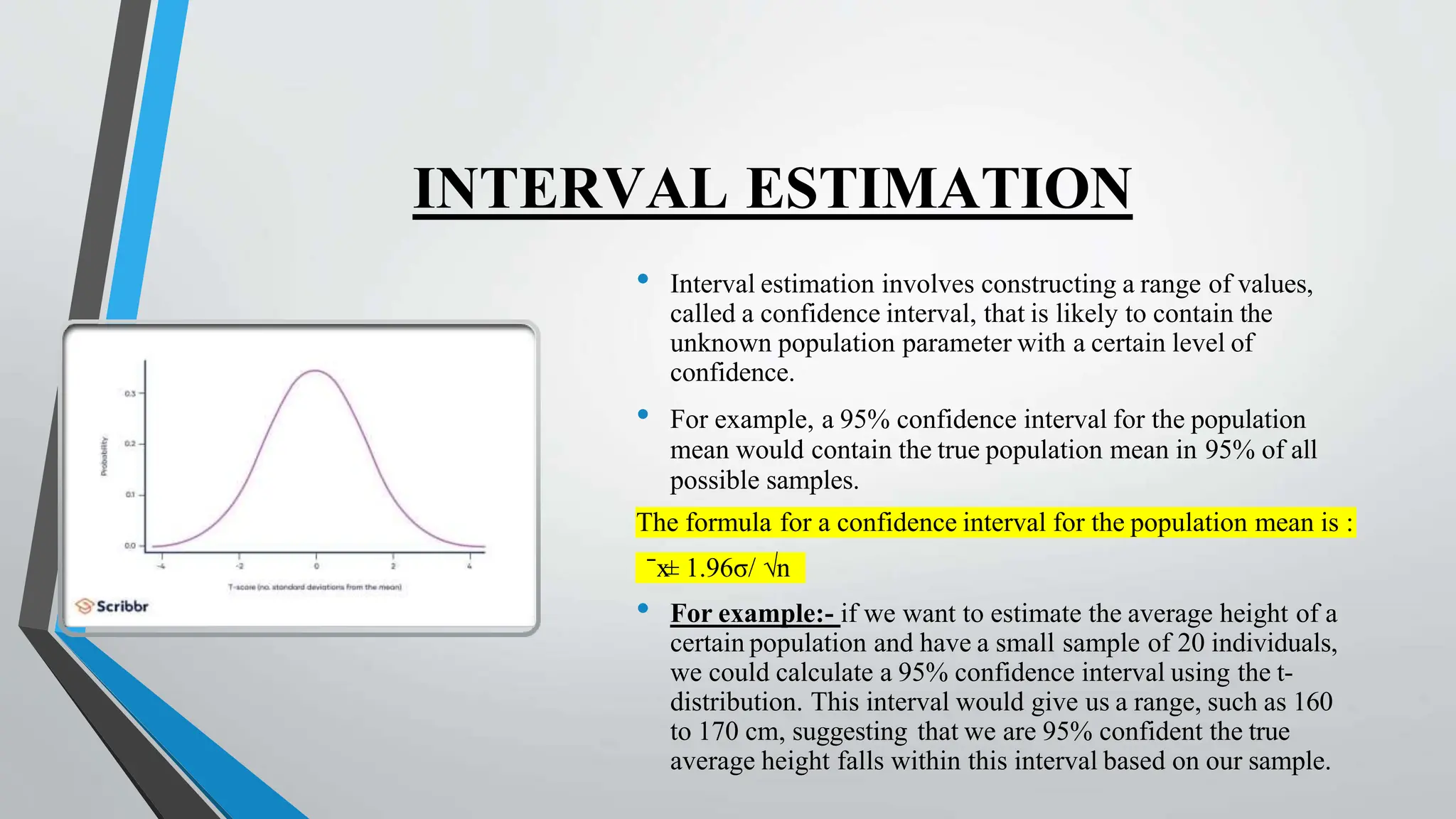
• Interval estimation involves constructing a range of values,
called a confidence interval, that is likely to contain the
unknown population parameter with a certain level of
confidence.
• For example, a 95% confidence interval for the population
mean would contain the true population mean in 95% of all
possible samples.
The formula for a confidence interval for the population mean is :
x
̄ ± 1.96σ/ √n
• For example:- if we want to estimate the average height of a
certain population and have a small sample of 20 individuals,
we could calculate a 95% confidence interval using the t-
distribution. This interval would give us a range, such as 160
to 170 cm, suggesting that we are 95% confident the true
average height falls within this interval based on our sample.
THANK YOU

stats for 1st sem MBA atudents hypothesis testing notes

  • 1.
  • 2.
    INTRODUCTION • Estimation isa statistical method used to estimate unknown parameters of a population based on a sample of data. • i.e, The objective of estimation is to determine the approximate value of population parameter on the basis of a sample statistic. • There are two types of estimation:- • Point estimation and • Interval estimation.
  • 3.
    POINT ESTIMATION • Pointestimation involves using a single value, called a point estimator, to estimate the unknown population parameter. For example, the sample mean can be used as a point estimator of the population mean, and the sample proportion can be used as a point estimator of the population proportion. • The formula for the sample mean is : x ̄ = Σx i / n • x ̄ is the mean of the n • xi is individual values.
  • 4.
    Cont…. • Example:- Let'ssay you're interested in estimating the average height (population parameter) of a certain species of trees in a forest. You collect a sample of 50 trees and record their heights along with other relevant data. • Your point estimate for the average height based on your sample data is, for instance, 120 centimeters. This point estimate represents your best guess for the population parameter.
  • 5.
    INTERVAL ESTIMATION • Intervalestimation involves constructing a range of values, called a confidence interval, that is likely to contain the unknown population parameter with a certain level of confidence. • For example, a 95% confidence interval for the population mean would contain the true population mean in 95% of all possible samples. The formula for a confidence interval for the population mean is : x ̄ ± 1.96σ/ √n • For example:- if we want to estimate the average height of a certain population and have a small sample of 20 individuals, we could calculate a 95% confidence interval using the t- distribution. This interval would give us a range, such as 160 to 170 cm, suggesting that we are 95% confident the true average height falls within this interval based on our sample.
  • 6.