Fixing
Scholarly Publishing
Leonid Schneider,
Independent science journalist
leonid.schneider@gmail.com
Twitter: @schneiderleonid
www.forbetterscience.com
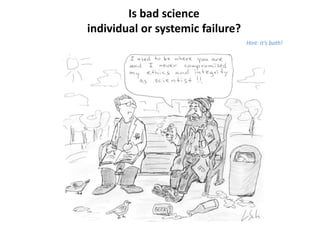
Is bad science
individual or systemic failure?
Hint: it’s both!
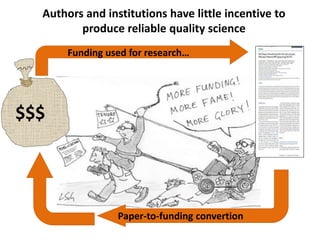
$$$
Authors and institutions have little incentive to
produce reliable quality science
Paper-to-funding convertion
Funding used for research…
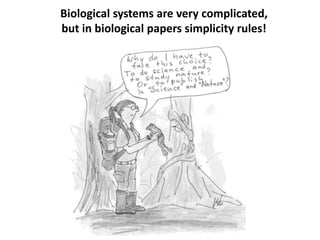
Biological systems are very complicated,
but in biological papers simplicity rules!
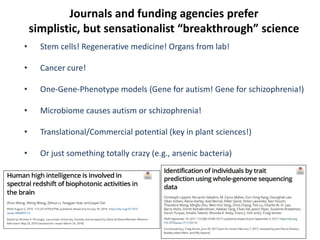
Journals and funding agencies prefer
simplistic, but sensationalist “breakthrough” science
• Stem cells! Regenerative medicine! Organs from lab!
• Cancer cure!
• One-Gene-Phenotype models (Gene for autism! Gene for schizophrenia!)
• Microbiome causes autism or schizophrenia!
• Translational/Commercial potential (key in plant sciences!)
• Or just something totally crazy (e.g., arsenic bacteria)
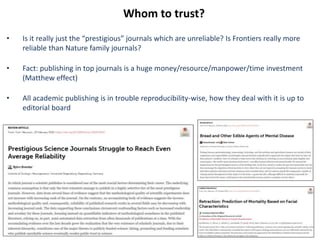
Whom to trust?
• Is it really just the “prestigious” journals which are unreliable? Is Frontiers really more
reliable than Nature family journals?
• Fact: publishing in top journals is a huge money/resource/manpower/time investment
(Matthew effect)
• All academic publishing is in trouble reproducibility-wise, how they deal with it is up to
editorial board
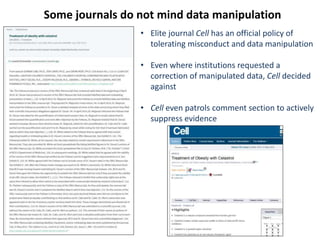
Some journals do not mind data manipulation
• Elite journal Cell has an official policy of
tolerating misconduct and data manipulation
• Even where institutions requested a
correction of manipulated data, Cell decided
against
• Cell even patrols comment section to actively
suppress evidence
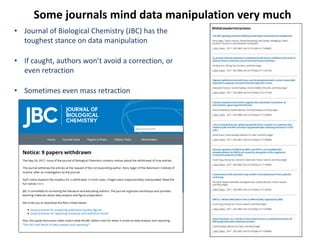
Some journals mind data manipulation very much
• Journal of Biological Chemistry (JBC) has the
toughest stance on data manipulation
• If caught, authors won’t avoid a correction, or
even retraction
• Sometimes even mass retraction
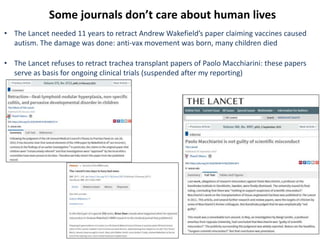
Some journals don’t care about human lives
• The Lancet needed 11 years to retract Andrew Wakefield’s paper claiming vaccines caused
autism. The damage was done: anti-vax movement was born, many children died
• The Lancet refuses to retract trachea transplant papers of Paolo Macchiarini: these papers
serve as basis for ongoing clinical trials (suspended after my reporting)
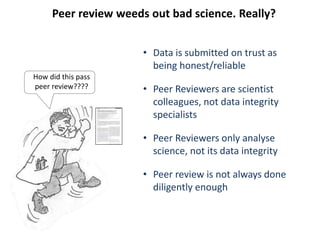
Peer review weeds out bad science. Really?
• Data is submitted on trust as
being honest/reliable
• Peer Reviewers are scientist
colleagues, not data integrity
specialists
• Peer Reviewers only analyse
science, not its data integrity
• Peer review is not always done
diligently enough
How did this pass
peer review????
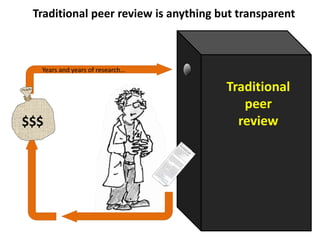
$$$
Traditional
peer
review
Traditional peer review is anything but transparent
Years and years of research…
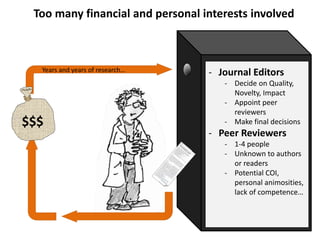
- Journal Editors
- Decide on Quality,
Novelty, Impact
- Appoint peer
reviewers
- Make final decisions
- Peer Reviewers
- 1-4 people
- Unknown to authors
or readers
- Potential COI,
personal animosities,
lack of competence…
$$$
Too many financial and personal interests involved
Years and years of research…
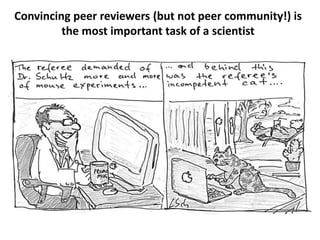
Convincing peer reviewers (but not peer community!) is
the most important task of a scientist
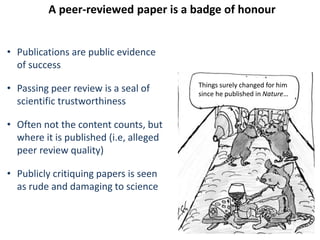
A peer-reviewed paper is a badge of honour
• Publications are public evidence
of success
• Passing peer review is a seal of
scientific trustworthiness
• Often not the content counts, but
where it is published (i.e, alleged
peer review quality)
• Publicly critiquing papers is seen
as rude and damaging to science
Things surely changed for him
since he published in Nature…
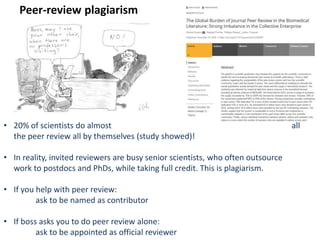
Peer-review plagiarism
• 20% of scientists do almost all
the peer review all by themselves (study showed)!
• In reality, invited reviewers are busy senior scientists, who often outsource
work to postdocs and PhDs, while taking full credit. This is plagiarism.
• If you help with peer review:
ask to be named as contributor
• If boss asks you to do peer review alone:
ask to be appointed as official reviewer
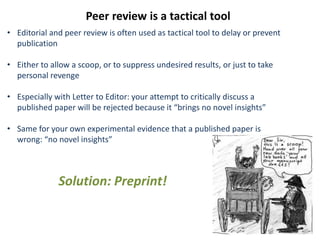
Peer review is a tactical tool
• Editorial and peer review is often used as tactical tool to delay or prevent
publication
• Either to allow a scoop, or to suppress undesired results, or just to take
personal revenge
• Especially with Letter to Editor: your attempt to critically discuss a
published paper will be rejected because it “brings no novel insights”
• Same for your own experimental evidence that a published paper is
wrong: “no novel insights”
Solution: Preprint!
Publishing negative or contradictory results
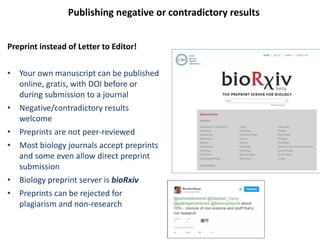
Preprint instead of Letter to Editor!
• Your own manuscript can be published
online, gratis, with DOI before or
during submission to a journal
• Negative/contradictory results
welcome
• Preprints are not peer-reviewed
• Most biology journals accept preprints
and some even allow direct preprint
submission
• Biology preprint server is bioRxiv
• Preprints can be rejected for
plagiarism and non-research
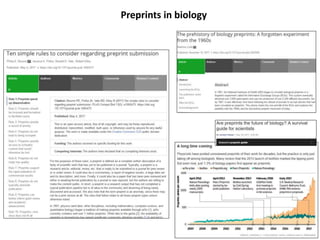
Preprints in biology
Advantages of preprinting
• Your research is immediately available to the community and not months and
years after a publishing battle
• Scoop protection and publishing independence (for junior scientists)
• Preprinting can speed up publication process and prevent unjustified rejections
• You can add your “unpublished” work to your CV if you made preprints!
• Many preprints have already featured in science news, long before they were
published in a journal
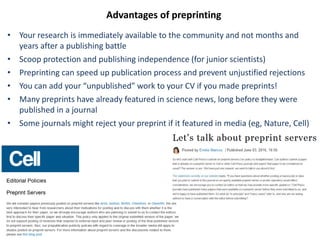
• Some journals might reject your preprint if it featured in media (eg, Nature, Cell)
Vicki Vance
Professor of Botany, University of South Carolina
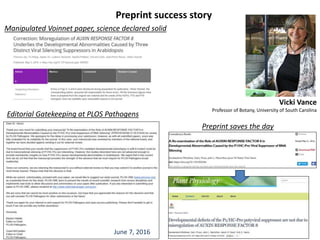
Preprint success story
June 7, 2016
Editorial Gatekeeping at PLOS Pathogens
Manipulated Voinnet paper, science declared solid
Preprint saves the day
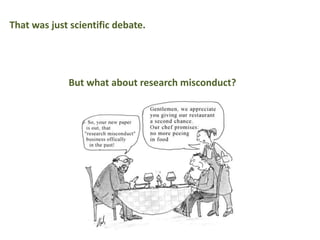
That was just scientific debate.
But what about research misconduct?
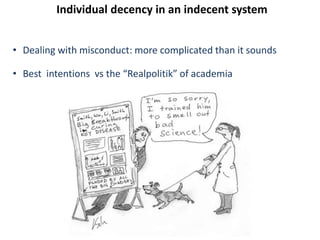
Individual decency in an indecent system
• Dealing with misconduct: more complicated than it sounds
• Best intentions vs the “Realpolitik” of academia
Climate of fear and coalition of silence
• Science is simultaneously cooperative and competitive
• Scientists’ top concern is funding, which requires collaboration
even with worst fraudsters
• Because of this, scientists rarely dispute each other publicly
• Instead, dark channels are used to punish cheaters
• Sometimes, false misconduct allegations secretly used to
damage competitors, critics and rogue ex-employees
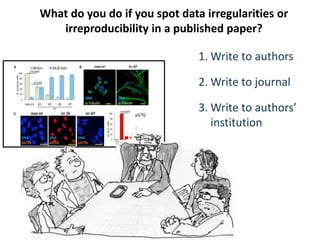
What do you do if you spot data irregularities or
irreproducibility in a published paper?
1. Write to authors
2. Write to journal
3. Write to authors’
institution
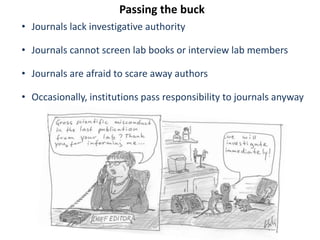
Passing the buck
• Journals lack investigative authority
• Journals cannot screen lab books or interview lab members
• Journals are afraid to scare away authors
• Occasionally, institutions pass responsibility to journals anyway
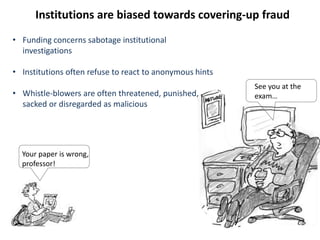
Your paper is wrong,
professor!
See you at the
exam…
Institutions are biased towards covering-up fraud
• Funding concerns sabotage institutional
investigations
• Institutions often refuse to react to anonymous hints
• Whistle-blowers are often threatened, punished,
sacked or disregarded as malicious
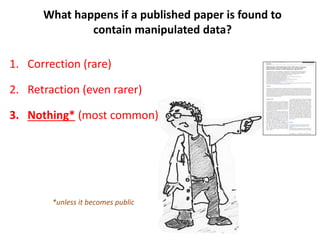
What happens if a published paper is found to
contain manipulated data?
1. Correction (rare)
2. Retraction (even rarer)
3. Nothing* (most common)
*unless it becomes public
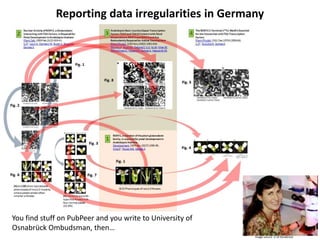
Reporting data irregularities in Germany
Image source: U of Osnabrück
You find stuff on PubPeer and you write to University of
Osnabrück Ombudsman, then…
Reporting data irregularities in Germany
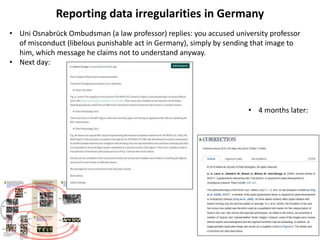
• Uni Osnabrück Ombudsman (a law professor) replies: you accused university professor
of misconduct (libelous punishable act in Germany), simply by sending that image to
him, which message he claims not to understand anyway.
• Next day:
• 4 months later:
You have the power to make science better!
• Never compromise your own research integrity
• Do not work with bad scientists
• Blog about science!
• Engage in post-publication peer review
• Expose irreproducible and bad science
• Report suspected research misconduct
• They are more afraid of you than you of them!
Post-Publication Peer Review
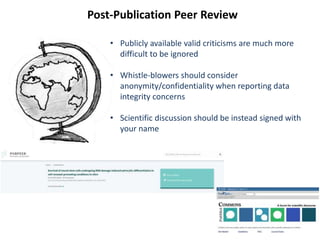
• Publicly available valid criticisms are much more
difficult to be ignored
• Whistle-blowers should consider
anonymity/confidentiality when reporting data
integrity concerns
• Scientific discussion should be instead signed with
your name
Post-Publication Peer Review
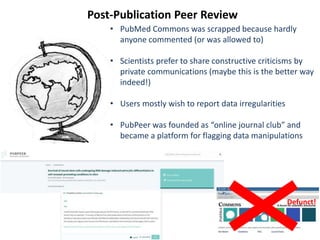
Defunct!
• PubMed Commons was scrapped because hardly
anyone commented (or was allowed to)
• Scientists prefer to share constructive criticisms by
private communications (maybe this is the better way
indeed!)
• Users mostly wish to report data irregularities
• PubPeer was founded as “online journal club” and
became a platform for flagging data manipulations
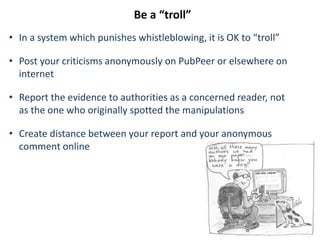
Be a “troll”
• In a system which punishes whistleblowing, it is OK to “troll”
• Post your criticisms anonymously on PubPeer or elsewhere on
internet
• Report the evidence to authorities as a concerned reader, not
as the one who originally spotted the manipulations
• Create distance between your report and your anonymous
comment online
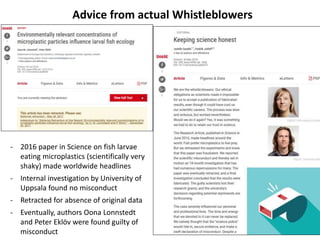
Advice from actual Whistleblowers
- 2016 paper in Science on fish larvae
eating microplastics (scientifically very
shaky) made worldwide headlines
- Internal investigation by University of
Uppsala found no misconduct
- Retracted for absence of original data
- Eventually, authors Oona Lonnstedt
and Peter Eklöv were found guilty of
misconduct
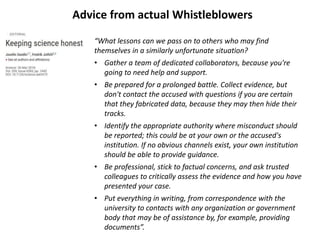
Advice from actual Whistleblowers
“What lessons can we pass on to others who may find
themselves in a similarly unfortunate situation?
• Gather a team of dedicated collaborators, because you're
going to need help and support.
• Be prepared for a prolonged battle. Collect evidence, but
don't contact the accused with questions if you are certain
that they fabricated data, because they may then hide their
tracks.
• Identify the appropriate authority where misconduct should
be reported; this could be at your own or the accused's
institution. If no obvious channels exist, your own institution
should be able to provide guidance.
• Be professional, stick to factual concerns, and ask trusted
colleagues to critically assess the evidence and how you have
presented your case.
• Put everything in writing, from correspondence with the
university to contacts with any organization or government
body that may be of assistance by, for example, providing
documents”.
Thank you!
Website: forbetterscience.com
Email: leonid.schneider@gmail.com
Twitter: @schneiderleonid

Fixing Scholarly Publishing (Cologne 6.4.2018)

  • 1.
    Fixing Scholarly Publishing Leonid Schneider, Independentscience journalist leonid.schneider@gmail.com Twitter: @schneiderleonid www.forbetterscience.com
  • 2.
    Is bad science individualor systemic failure? Hint: it’s both!
  • 3.
    $$$ Authors and institutionshave little incentive to produce reliable quality science Paper-to-funding convertion Funding used for research…
  • 4.
    Biological systems arevery complicated, but in biological papers simplicity rules!
  • 5.
    Journals and fundingagencies prefer simplistic, but sensationalist “breakthrough” science • Stem cells! Regenerative medicine! Organs from lab! • Cancer cure! • One-Gene-Phenotype models (Gene for autism! Gene for schizophrenia!) • Microbiome causes autism or schizophrenia! • Translational/Commercial potential (key in plant sciences!) • Or just something totally crazy (e.g., arsenic bacteria)
  • 6.
    Whom to trust? •Is it really just the “prestigious” journals which are unreliable? Is Frontiers really more reliable than Nature family journals? • Fact: publishing in top journals is a huge money/resource/manpower/time investment (Matthew effect) • All academic publishing is in trouble reproducibility-wise, how they deal with it is up to editorial board
  • 7.
    Some journals donot mind data manipulation • Elite journal Cell has an official policy of tolerating misconduct and data manipulation • Even where institutions requested a correction of manipulated data, Cell decided against • Cell even patrols comment section to actively suppress evidence
  • 8.
    Some journals minddata manipulation very much • Journal of Biological Chemistry (JBC) has the toughest stance on data manipulation • If caught, authors won’t avoid a correction, or even retraction • Sometimes even mass retraction
  • 9.
    Some journals don’tcare about human lives • The Lancet needed 11 years to retract Andrew Wakefield’s paper claiming vaccines caused autism. The damage was done: anti-vax movement was born, many children died • The Lancet refuses to retract trachea transplant papers of Paolo Macchiarini: these papers serve as basis for ongoing clinical trials (suspended after my reporting)
  • 10.
    Peer review weedsout bad science. Really? • Data is submitted on trust as being honest/reliable • Peer Reviewers are scientist colleagues, not data integrity specialists • Peer Reviewers only analyse science, not its data integrity • Peer review is not always done diligently enough How did this pass peer review????
  • 11.
    $$$ Traditional peer review Traditional peer reviewis anything but transparent Years and years of research…
  • 12.
    - Journal Editors -Decide on Quality, Novelty, Impact - Appoint peer reviewers - Make final decisions - Peer Reviewers - 1-4 people - Unknown to authors or readers - Potential COI, personal animosities, lack of competence… $$$ Too many financial and personal interests involved Years and years of research…
  • 13.
    Convincing peer reviewers(but not peer community!) is the most important task of a scientist
  • 14.
    A peer-reviewed paperis a badge of honour • Publications are public evidence of success • Passing peer review is a seal of scientific trustworthiness • Often not the content counts, but where it is published (i.e, alleged peer review quality) • Publicly critiquing papers is seen as rude and damaging to science Things surely changed for him since he published in Nature…
  • 15.
    Peer-review plagiarism • 20%of scientists do almost all the peer review all by themselves (study showed)! • In reality, invited reviewers are busy senior scientists, who often outsource work to postdocs and PhDs, while taking full credit. This is plagiarism. • If you help with peer review: ask to be named as contributor • If boss asks you to do peer review alone: ask to be appointed as official reviewer
  • 16.
    Peer review isa tactical tool • Editorial and peer review is often used as tactical tool to delay or prevent publication • Either to allow a scoop, or to suppress undesired results, or just to take personal revenge • Especially with Letter to Editor: your attempt to critically discuss a published paper will be rejected because it “brings no novel insights” • Same for your own experimental evidence that a published paper is wrong: “no novel insights” Solution: Preprint!
  • 17.
    Publishing negative orcontradictory results Preprint instead of Letter to Editor! • Your own manuscript can be published online, gratis, with DOI before or during submission to a journal • Negative/contradictory results welcome • Preprints are not peer-reviewed • Most biology journals accept preprints and some even allow direct preprint submission • Biology preprint server is bioRxiv • Preprints can be rejected for plagiarism and non-research
  • 18.
  • 19.
    Advantages of preprinting •Your research is immediately available to the community and not months and years after a publishing battle • Scoop protection and publishing independence (for junior scientists) • Preprinting can speed up publication process and prevent unjustified rejections • You can add your “unpublished” work to your CV if you made preprints! • Many preprints have already featured in science news, long before they were published in a journal • Some journals might reject your preprint if it featured in media (eg, Nature, Cell)
  • 20.
    Vicki Vance Professor ofBotany, University of South Carolina Preprint success story June 7, 2016 Editorial Gatekeeping at PLOS Pathogens Manipulated Voinnet paper, science declared solid Preprint saves the day
  • 21.
    That was justscientific debate. But what about research misconduct?
  • 22.
    Individual decency inan indecent system • Dealing with misconduct: more complicated than it sounds • Best intentions vs the “Realpolitik” of academia
  • 23.
    Climate of fearand coalition of silence • Science is simultaneously cooperative and competitive • Scientists’ top concern is funding, which requires collaboration even with worst fraudsters • Because of this, scientists rarely dispute each other publicly • Instead, dark channels are used to punish cheaters • Sometimes, false misconduct allegations secretly used to damage competitors, critics and rogue ex-employees
  • 24.
    What do youdo if you spot data irregularities or irreproducibility in a published paper? 1. Write to authors 2. Write to journal 3. Write to authors’ institution
  • 25.
    Passing the buck •Journals lack investigative authority • Journals cannot screen lab books or interview lab members • Journals are afraid to scare away authors • Occasionally, institutions pass responsibility to journals anyway
  • 26.
    Your paper iswrong, professor! See you at the exam… Institutions are biased towards covering-up fraud • Funding concerns sabotage institutional investigations • Institutions often refuse to react to anonymous hints • Whistle-blowers are often threatened, punished, sacked or disregarded as malicious
  • 27.
    What happens ifa published paper is found to contain manipulated data? 1. Correction (rare) 2. Retraction (even rarer) 3. Nothing* (most common) *unless it becomes public
  • 28.
    Reporting data irregularitiesin Germany Image source: U of Osnabrück You find stuff on PubPeer and you write to University of Osnabrück Ombudsman, then…
  • 29.
    Reporting data irregularitiesin Germany • Uni Osnabrück Ombudsman (a law professor) replies: you accused university professor of misconduct (libelous punishable act in Germany), simply by sending that image to him, which message he claims not to understand anyway. • Next day: • 4 months later:
  • 30.
    You have thepower to make science better! • Never compromise your own research integrity • Do not work with bad scientists • Blog about science! • Engage in post-publication peer review • Expose irreproducible and bad science • Report suspected research misconduct • They are more afraid of you than you of them!
  • 31.
    Post-Publication Peer Review •Publicly available valid criticisms are much more difficult to be ignored • Whistle-blowers should consider anonymity/confidentiality when reporting data integrity concerns • Scientific discussion should be instead signed with your name
  • 32.
    Post-Publication Peer Review Defunct! •PubMed Commons was scrapped because hardly anyone commented (or was allowed to) • Scientists prefer to share constructive criticisms by private communications (maybe this is the better way indeed!) • Users mostly wish to report data irregularities • PubPeer was founded as “online journal club” and became a platform for flagging data manipulations
  • 33.
    Be a “troll” •In a system which punishes whistleblowing, it is OK to “troll” • Post your criticisms anonymously on PubPeer or elsewhere on internet • Report the evidence to authorities as a concerned reader, not as the one who originally spotted the manipulations • Create distance between your report and your anonymous comment online
  • 34.
    Advice from actualWhistleblowers - 2016 paper in Science on fish larvae eating microplastics (scientifically very shaky) made worldwide headlines - Internal investigation by University of Uppsala found no misconduct - Retracted for absence of original data - Eventually, authors Oona Lonnstedt and Peter Eklöv were found guilty of misconduct
  • 35.
    Advice from actualWhistleblowers “What lessons can we pass on to others who may find themselves in a similarly unfortunate situation? • Gather a team of dedicated collaborators, because you're going to need help and support. • Be prepared for a prolonged battle. Collect evidence, but don't contact the accused with questions if you are certain that they fabricated data, because they may then hide their tracks. • Identify the appropriate authority where misconduct should be reported; this could be at your own or the accused's institution. If no obvious channels exist, your own institution should be able to provide guidance. • Be professional, stick to factual concerns, and ask trusted colleagues to critically assess the evidence and how you have presented your case. • Put everything in writing, from correspondence with the university to contacts with any organization or government body that may be of assistance by, for example, providing documents”.
  • 36.
    Thank you! Website: forbetterscience.com Email:leonid.schneider@gmail.com Twitter: @schneiderleonid