BERKELEY INITIATIVE FOR TRANSPARENCY
IN THE SOCIAL SCIENCESBITSS
@UCBITSS
Temina Madon, Center for Effective Global Action (CEGA)
Open Con Webinar – August 14, 2015
Why transparency?
Public policy and private decisions are based on
evaluation of past events (i.e. research)
So research can affect millions of lives
But what is a “good” evaluation?
 Credibility
 Legitimacy
Scientific values
1. Universalism
Anyone can make a claim
2. Communality
Open sharing of knowledge
3. Disinterestedness
“Truth” as motivation (≠COI)
4. Organized skepticism
Peer review, replication
Merton, 1942
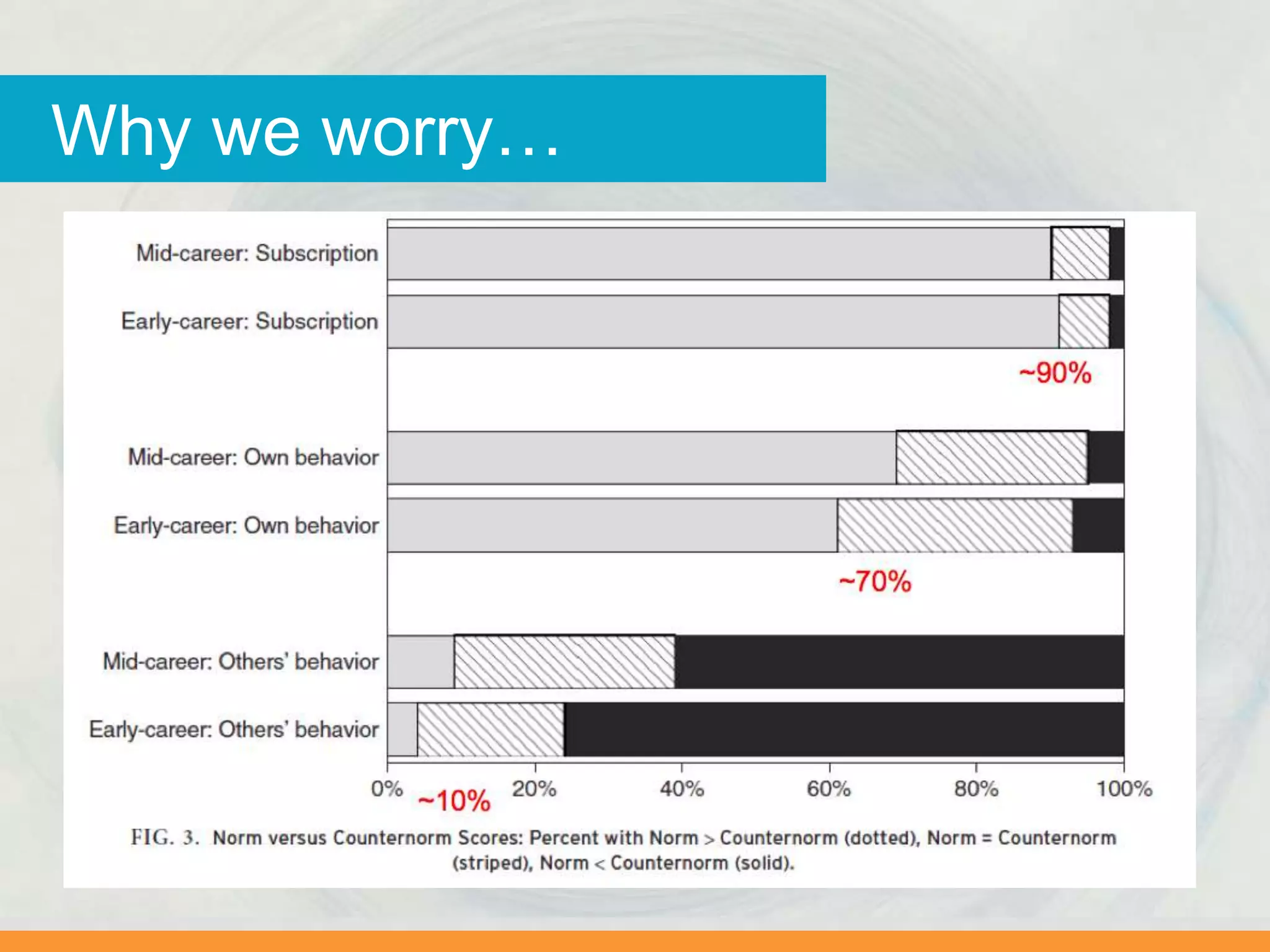
Why we worry…
A response:
Ecosystem for Open Science
Why we worry…What we’re finding:
Weak academic norms can distort the body of evidence.
 Publication bias (“file drawer” problem)
 p-hacking
 Non-disclosure
 Selective reporting
 Failure to replicate
We need more “meta-research” –
evaluating the practice of science
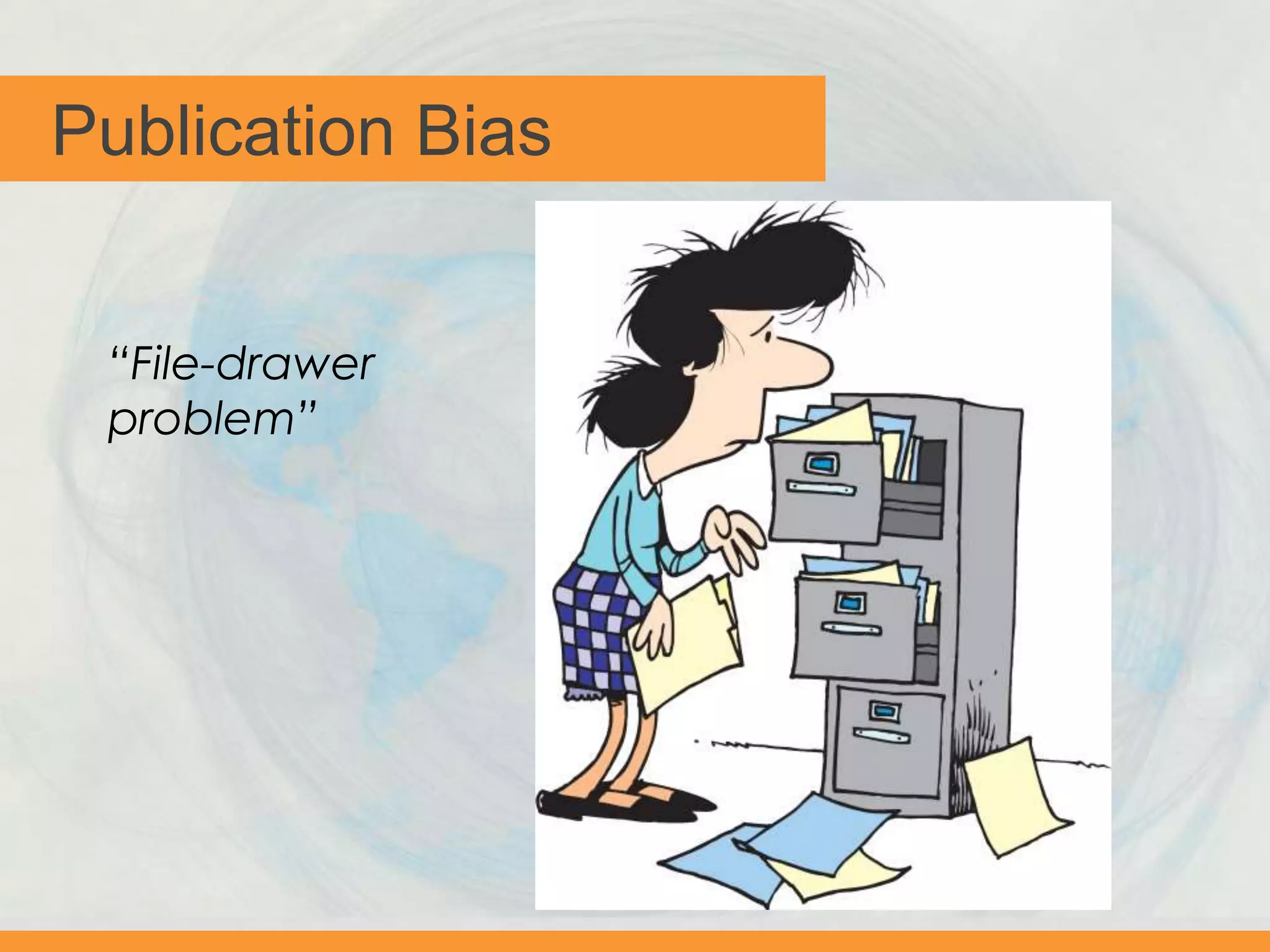
Publication Bias
“File-drawer
problem”
Publication Bias
 Status quo: Null results are not as “interesting”
 What if you find no relationship between a school intervention and
test scores? (in a well-designed study…)
 It’s less likely to get published, so null results are hidden.
 How do we know? Rosenthal 1979:
 Published: 3 published studies, all showing a positive effect…
 Hidden: A few unpublished studies showing null effect
 The significance of positive findings is now in question!
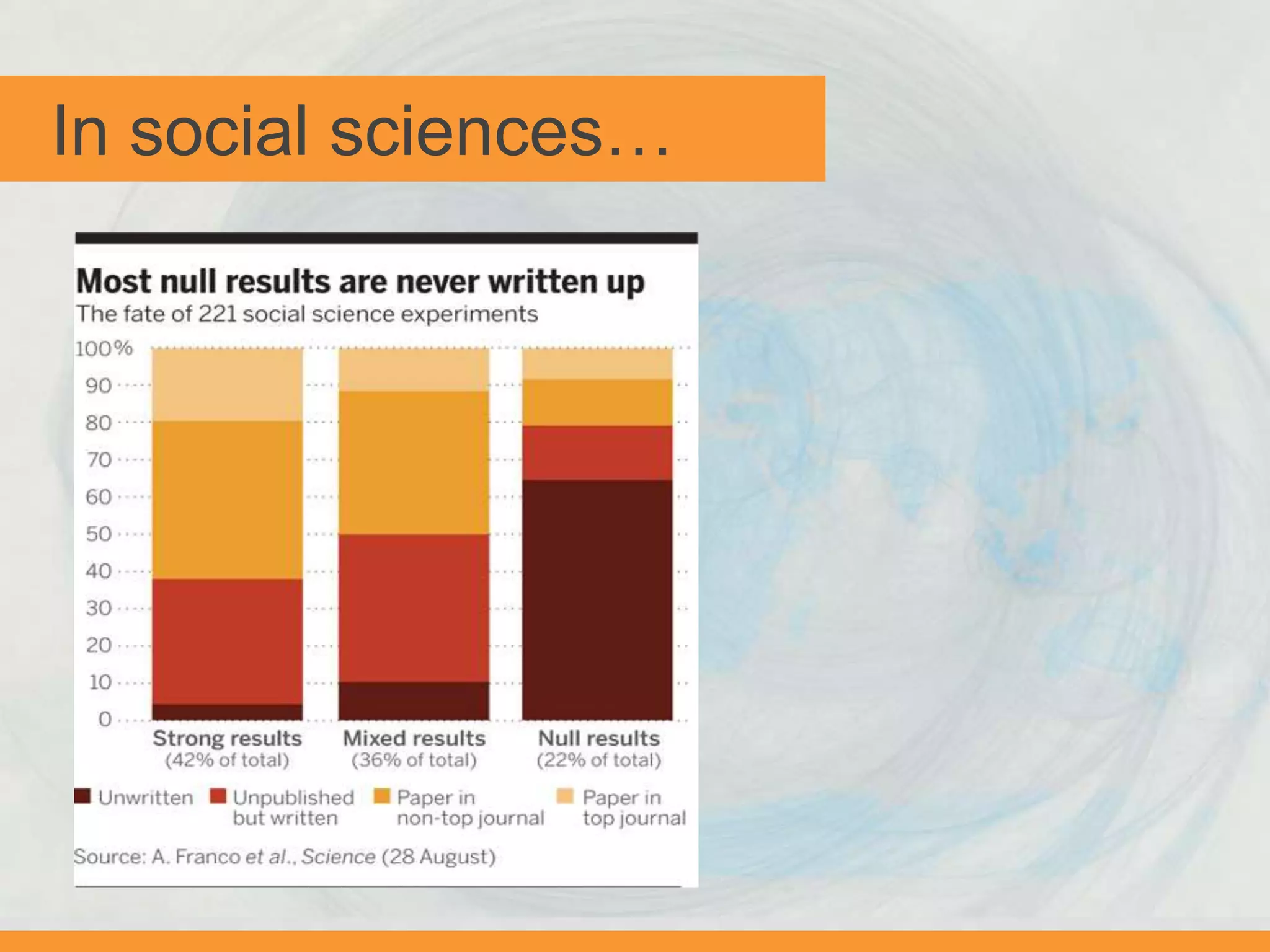
In social sciences…
Turner et al. [2008]
ClinicalTrials.gov
In medicine…
p-curves
 Scientists want to test hypotheses
 i.e. look for relationships among variables (schooling, test scores)
 Observed relationships should be statistically significant
 Minimize the likelihood that an observed relationship is actually a false
discovery
 Common norm: probability < 0.05
But null results not “interesting” ...
So incentive is to look for (or report) the positive effects,
even if they’re false discoveries
Turner et al. [2008]
In economics…
Brodeur et al 2012. Data 50,000 tests published in AER, JPE, QJE (2005-2011)
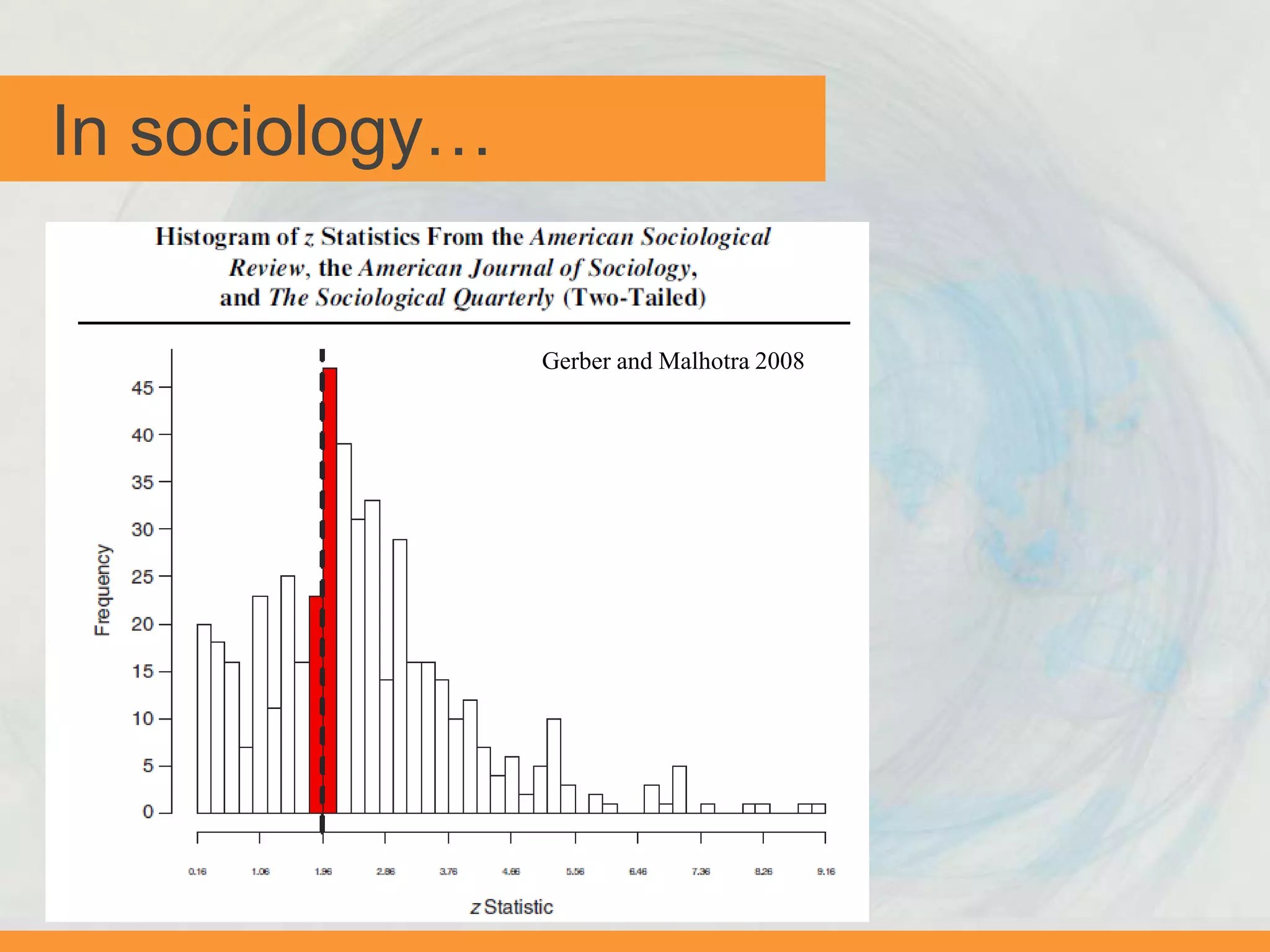
In sociology…
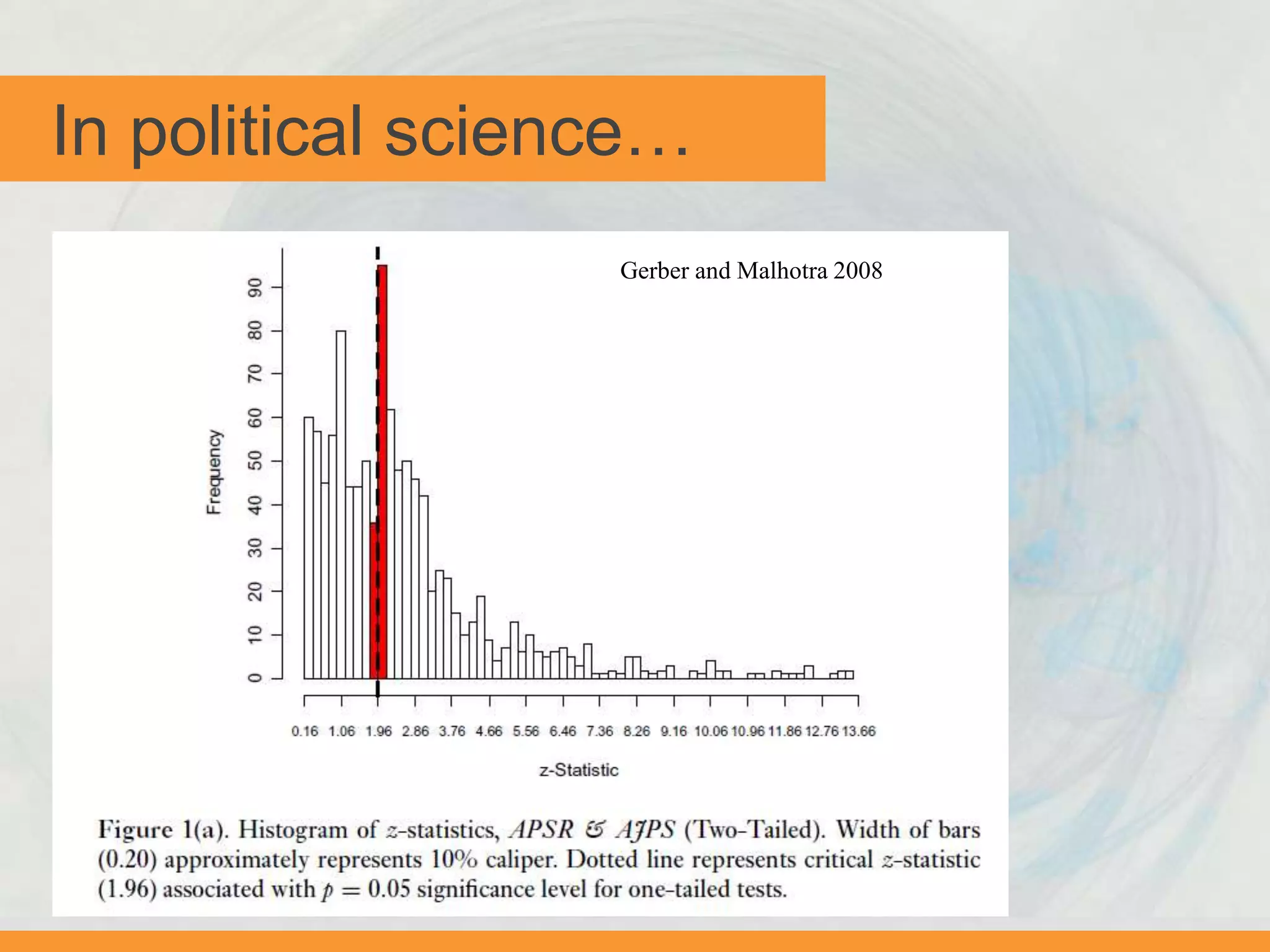
Gerber and Malhotra 2008
In political science…
Gerber and Malhotra 2008
Solution: Registries
Prospectively register hypotheses in a public database
“Paper trail” to solve the “File Drawer” problem
Differentiate HYPOTHESIS-TESTING from EXPLORATORY
 Medicine & Public Health: clinicaltrials.gov
 Economics: 2013 AEA registry: socialscienceregistry.org
 Political Science: EGAP Registry: egap.org/design-registration/
 Development: 3IE Registry: ridie.3ieimpact.org/
 Open Science Framework: http://osf.io
Open Questions:
 How best to promote registration? Nudges, incentives (Registered
Reports, Badges), requirements (journal standards), penalties?
 What about observational (non-experimental) work?
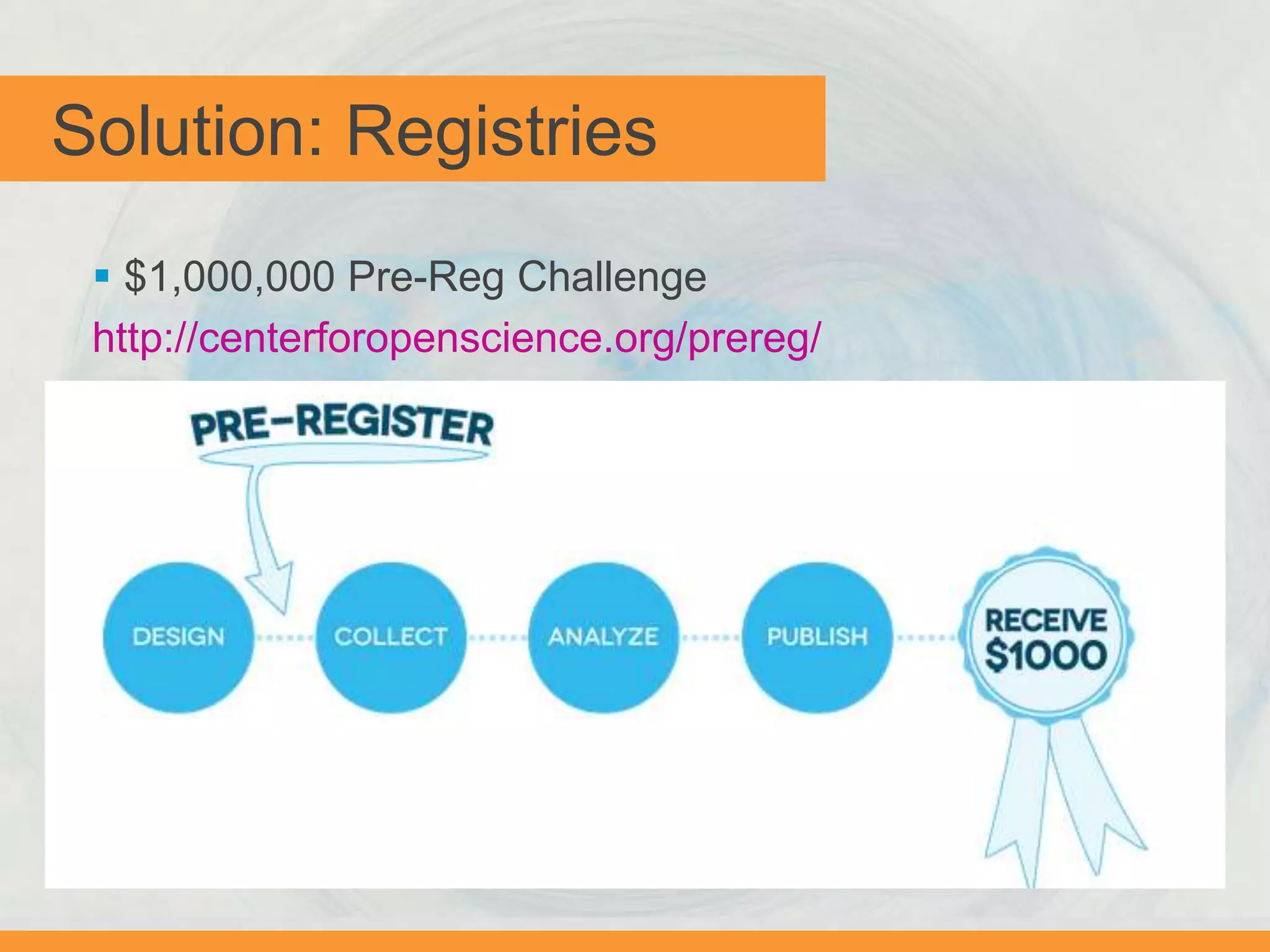
Solution: Registries
 $1,000,000 Pre-Reg Challenge
http://centerforopenscience.org/prereg/
Non-disclosure
 To evaluate the evidentiary quality of research, we need
full universe of methods and results….
 Challenge: shrinking real estate in journals
 Challenge: heterogeneous reporting
 Challenge: perverse incentives
 It’s impossible to replicate or validate findings, if methods
are not disclosed.
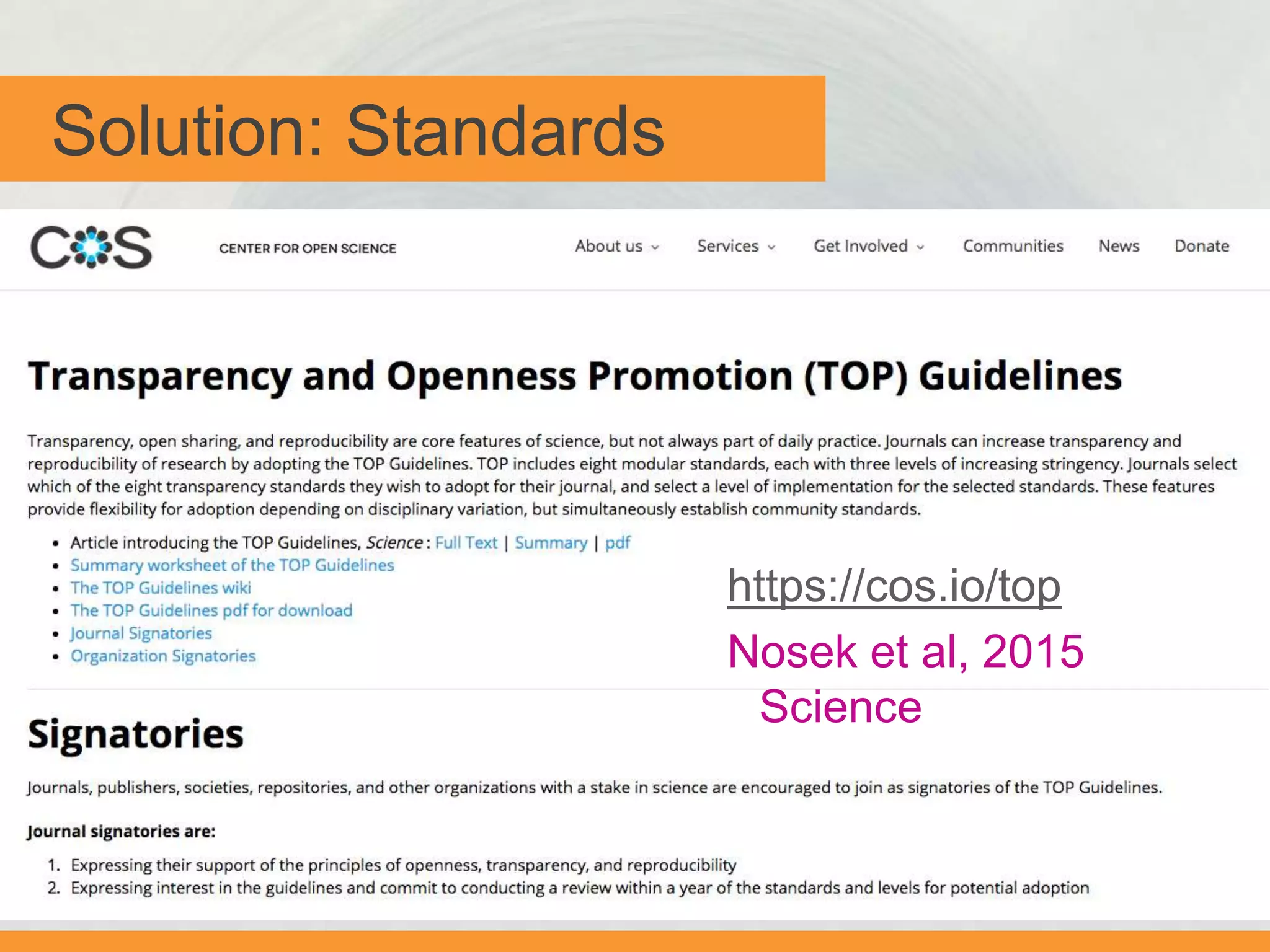
Solution: Standards
https://cos.io/top
Nosek et al, 2015
Science
Grass Roots Efforts
 DA-RT Guidelines: http://dartstatement.org
 Psych Science Guidelines: Checklists for reporting excluded
data, manipulations, outcome measures, sample size.
Inspired by grass-roots “psychdisclosure.org”
http://pss.sagepub.com/content/early/2013/11/25/095679761
3512465.full
 21 word solution in Nelson, Simmons and Simonsohn
(2012): “We report how we determined our sample size, all
data exclusions (if any), all manipulations, and all measures in
the study.”
Selective reporting
 Problem: Cherry-picking & fishing for results
 Can result from vested interests, perverse incentives…
You can tell many stories with any data set…
Example: Casey, Glennerster and Miguel (2012, QJE)
Solution: Pre-specify
1. Define hypotheses
2. Identify all outcomes to be measured
3. Specify statistical models, techniques, tests (# obs, sub-
group analyses, control variables, inclusion/exclusion rules,
corrections, etc)
 Pre-Analysis Plans: Written up just like a publication. Stored
in registries, can be embargoed.
 Open Questions: will it stifle creativity? Could “thinking
ahead” improve the quality of research?
 Unanticipated benefit: Protect your work from political
interests!
Failure to replicate
“Reproducibility is just collaboration with people
you don’t know, including yourself next week”—
Philip Stark, UC Berkeley
“Economists treat replication the way teenagers
treat chastity - as an ideal to be professed but not
to be practised.”—Daniel Hamermesh, UT Austin
http://www.psychologicalscience.org/index.php/replication
Why we care
 Identifies fraud, human error
 Confirms earlier findings (bolsters evidence base)
Replication Resources
Replication Wiki:
replication.uni-goettingen.de/wiki/index.php/Main_Page
Replication Project on OSF
Data/Code Repositories:
 Dataverse (IQSS)
 ICPSR
 Open Science Framework
 GitHub
Replication Standards
• Replications need to be subject to rigorous peer review
(no “second-tier” standards)
Reproducibility
The Reproducibility Project: Psychology is a
crowdsourced empirical effort to estimate
the reproducibility of a sample of studies
from scientific literature. The project is a
large-scale, open collaboration currently
involving more than 150 scientists from
around the world.
https://osf.io/ezcuj/
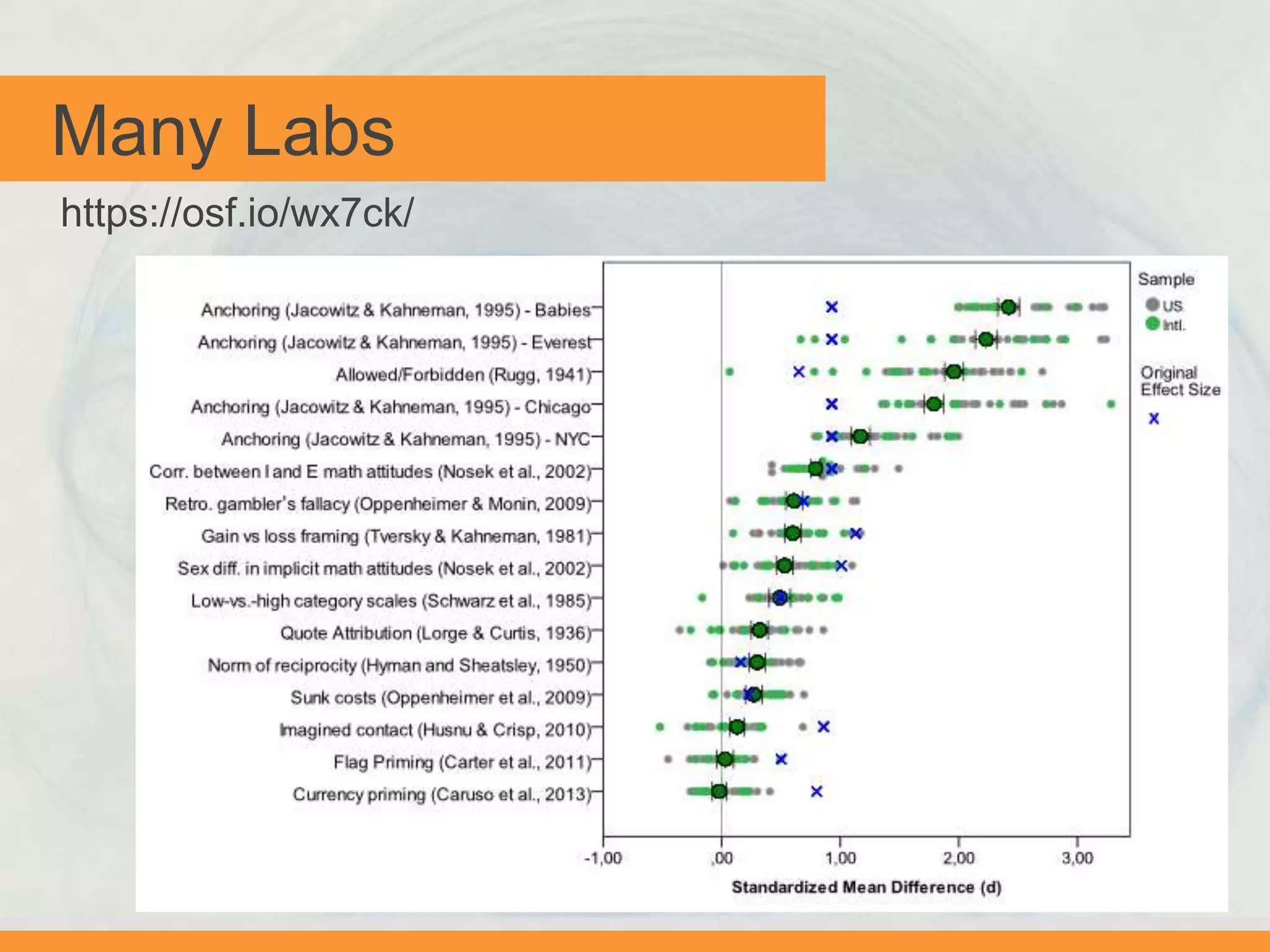
Many Labs
https://osf.io/wx7ck/
Why we worry…Some Solutions…
 Publication bias  Pre-registration
 p-hacking  Transparent reporting, Specification curves
 Non-disclosure  Reporting standards
 Selective reporting  Pre-specification
 Failure to replicate  Open data/materials, Many Labs
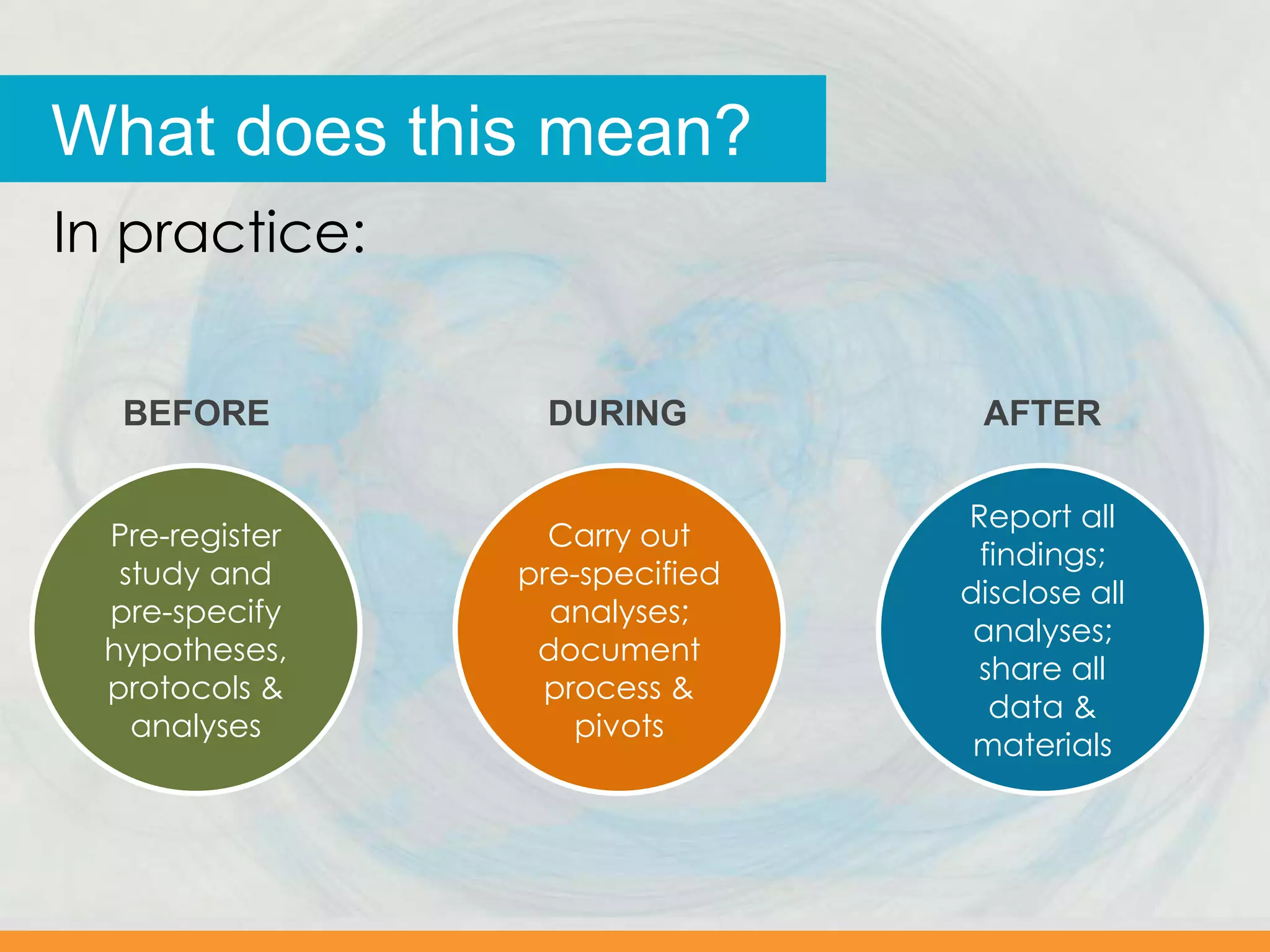
What does this mean?
Pre-register
study and
pre-specify
hypotheses,
protocols &
analyses
Carry out
pre-specified
analyses;
document
process &
pivots
Report all
findings;
disclose all
analyses;
share all
data &
materials
BEFORE DURING AFTER
In practice:
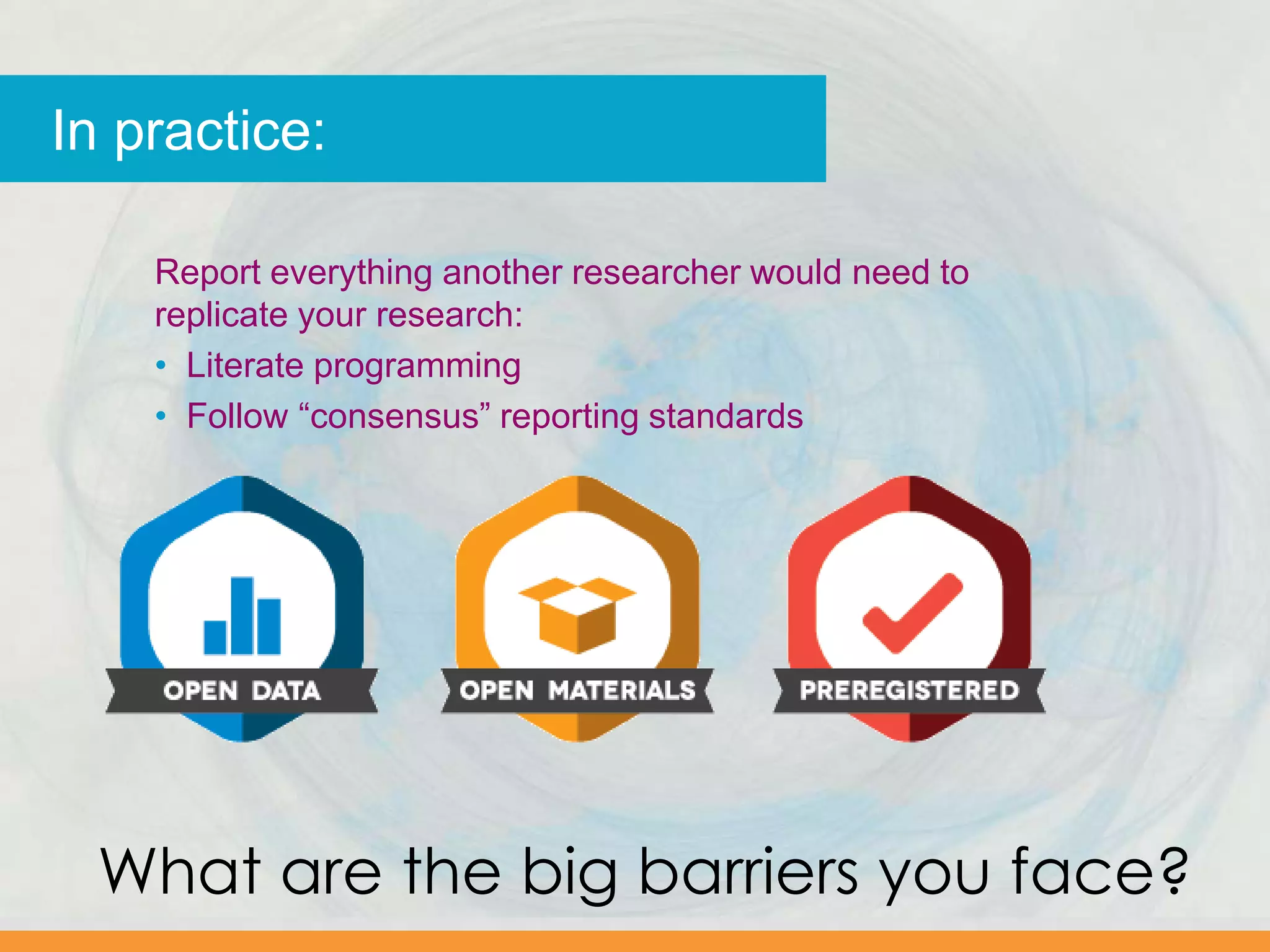
In practice:
Report everything another researcher would need to
replicate your research:
• Literate programming
• Follow “consensus” reporting standards
What are the big barriers you face?
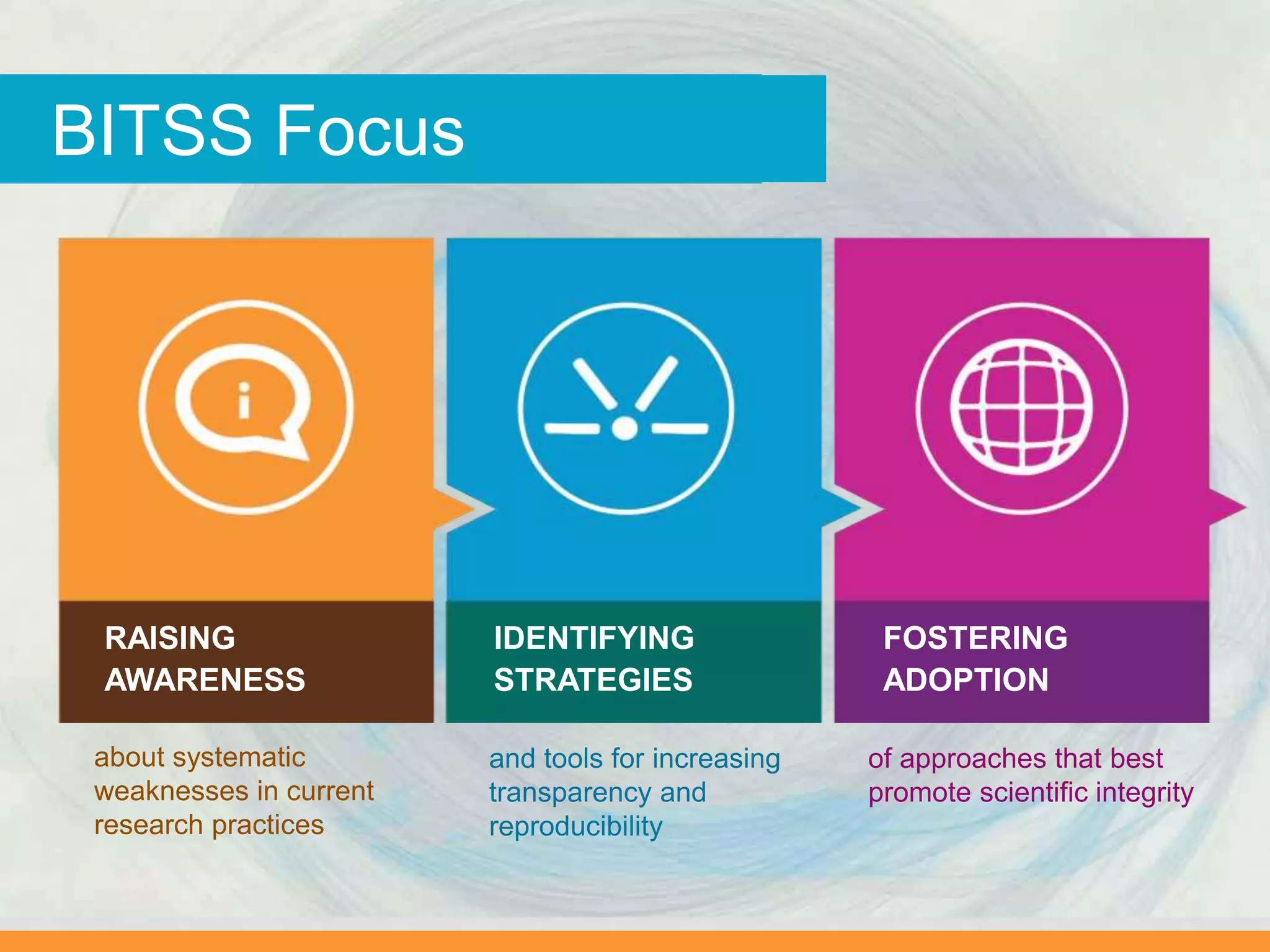
RAISING
AWARENESS
about systematic
weaknesses in current
research practices
FOSTERING
ADOPTION
of approaches that best
promote scientific integrity
IDENTIFYING
STRATEGIES
and tools for increasing
transparency and
reproducibility
BITSS Focus
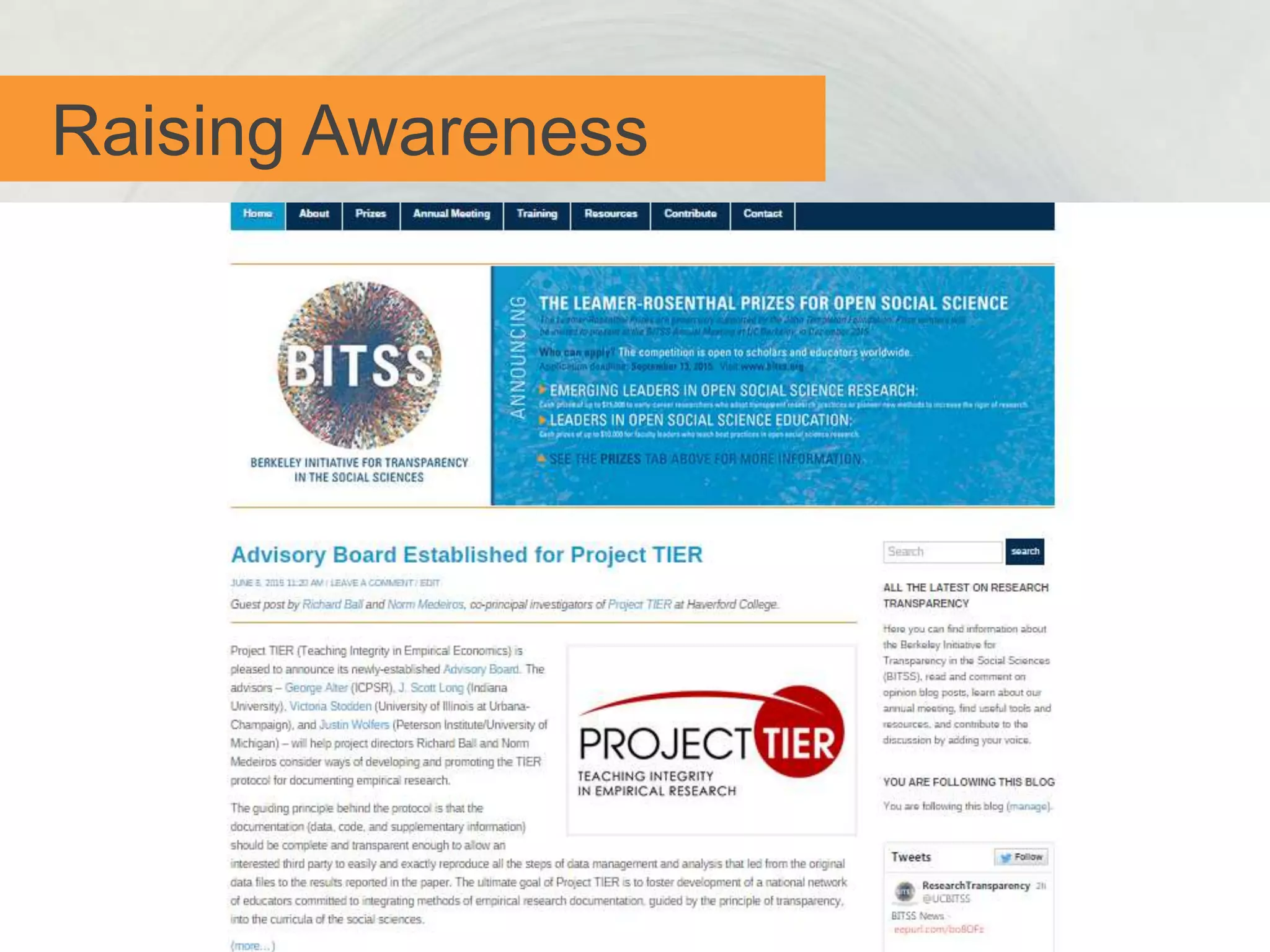
Raising Awareness
 Social Media: bitss.org @UCBITSS
 Publications (best practices guide)
https://github.com/garretchristensen/BestPracticesManual
 Sessions at conferences: AEA/ASA, APSA, OpenCon
 BITSS Annual Meeting (December 2015)
Raising Awareness
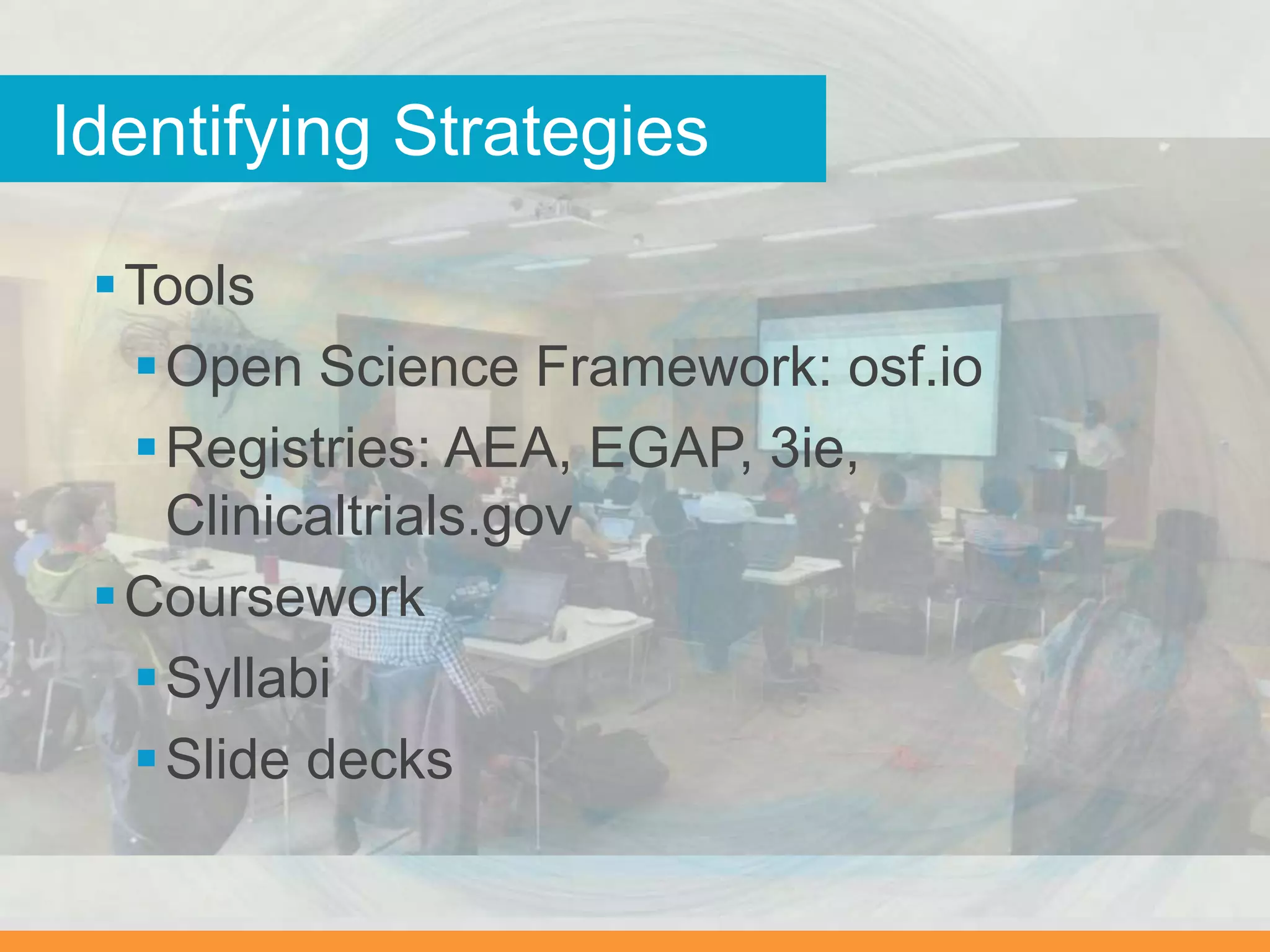
Tools
Open Science Framework: osf.io
Registries: AEA, EGAP, 3ie,
Clinicaltrials.gov
Coursework
Syllabi
Slide decks
Identifying Strategies
 Annual Summer Institute in Research Transparency
(bitss.org/training/)
 Consulting with COS
(centerforopenscience.org/stats_consulting/)
 Meta-research grants
(bitss.org/ssmart)
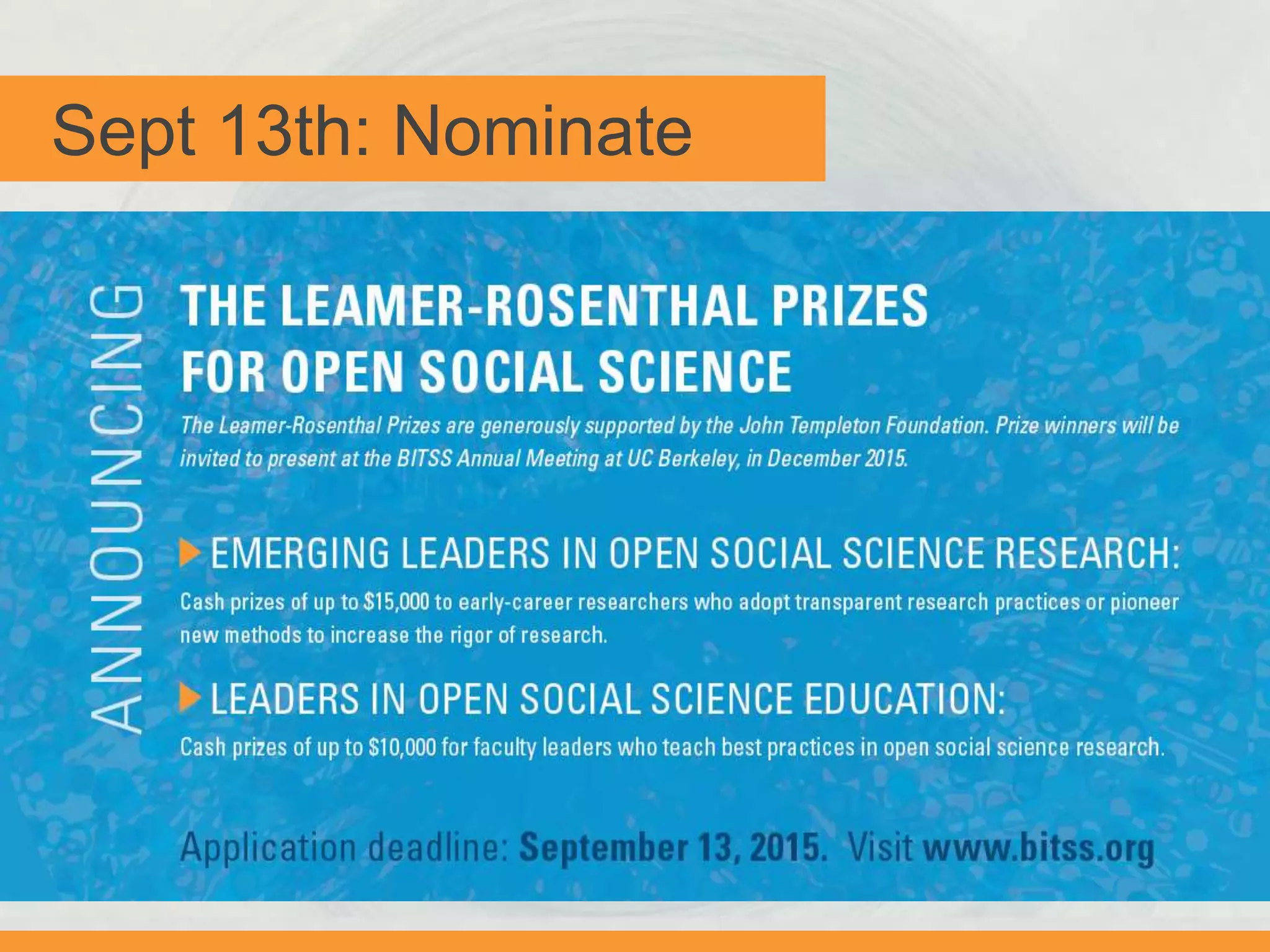
 Leamer-Rosenthal Prizes for Open Social Science
(bitss.org/prizes/leamer-rosenthal-prizes/)
Fostering Adoption
Sept 13th: Nominate
Sept 6th: Apply
New methods to improve the transparency and credibility of
research?
Systematic uses of existing data (innovation in meta-analysis) to
produce credible knowledge?
Understanding research culture and adoption of new norms?
SSMART Grants
Questions?
@UCBITSS
bitss.org
cega.org

Open Data and the Social Sciences - OpenCon Community Webcast

  • 1.
    BERKELEY INITIATIVE FORTRANSPARENCY IN THE SOCIAL SCIENCESBITSS @UCBITSS Temina Madon, Center for Effective Global Action (CEGA) Open Con Webinar – August 14, 2015
  • 2.
    Why transparency? Public policyand private decisions are based on evaluation of past events (i.e. research) So research can affect millions of lives But what is a “good” evaluation?  Credibility  Legitimacy
  • 3.
    Scientific values 1. Universalism Anyonecan make a claim 2. Communality Open sharing of knowledge 3. Disinterestedness “Truth” as motivation (≠COI) 4. Organized skepticism Peer review, replication Merton, 1942
  • 4.
  • 5.
  • 6.
  • 7.
    Why we worry…Whatwe’re finding: Weak academic norms can distort the body of evidence.  Publication bias (“file drawer” problem)  p-hacking  Non-disclosure  Selective reporting  Failure to replicate We need more “meta-research” – evaluating the practice of science
  • 8.
  • 9.
    Publication Bias  Statusquo: Null results are not as “interesting”  What if you find no relationship between a school intervention and test scores? (in a well-designed study…)  It’s less likely to get published, so null results are hidden.  How do we know? Rosenthal 1979:  Published: 3 published studies, all showing a positive effect…  Hidden: A few unpublished studies showing null effect  The significance of positive findings is now in question!
  • 10.
  • 11.
    Turner et al.[2008] ClinicalTrials.gov In medicine…
  • 12.
    p-curves  Scientists wantto test hypotheses  i.e. look for relationships among variables (schooling, test scores)  Observed relationships should be statistically significant  Minimize the likelihood that an observed relationship is actually a false discovery  Common norm: probability < 0.05 But null results not “interesting” ... So incentive is to look for (or report) the positive effects, even if they’re false discoveries
  • 13.
    Turner et al.[2008] In economics… Brodeur et al 2012. Data 50,000 tests published in AER, JPE, QJE (2005-2011)
  • 14.
  • 15.
  • 17.
    Solution: Registries Prospectively registerhypotheses in a public database “Paper trail” to solve the “File Drawer” problem Differentiate HYPOTHESIS-TESTING from EXPLORATORY  Medicine & Public Health: clinicaltrials.gov  Economics: 2013 AEA registry: socialscienceregistry.org  Political Science: EGAP Registry: egap.org/design-registration/  Development: 3IE Registry: ridie.3ieimpact.org/  Open Science Framework: http://osf.io Open Questions:  How best to promote registration? Nudges, incentives (Registered Reports, Badges), requirements (journal standards), penalties?  What about observational (non-experimental) work?
  • 18.
    Solution: Registries  $1,000,000Pre-Reg Challenge http://centerforopenscience.org/prereg/
  • 19.
    Non-disclosure  To evaluatethe evidentiary quality of research, we need full universe of methods and results….  Challenge: shrinking real estate in journals  Challenge: heterogeneous reporting  Challenge: perverse incentives  It’s impossible to replicate or validate findings, if methods are not disclosed.
  • 20.
  • 21.
    Grass Roots Efforts DA-RT Guidelines: http://dartstatement.org  Psych Science Guidelines: Checklists for reporting excluded data, manipulations, outcome measures, sample size. Inspired by grass-roots “psychdisclosure.org” http://pss.sagepub.com/content/early/2013/11/25/095679761 3512465.full  21 word solution in Nelson, Simmons and Simonsohn (2012): “We report how we determined our sample size, all data exclusions (if any), all manipulations, and all measures in the study.”
  • 22.
    Selective reporting  Problem:Cherry-picking & fishing for results  Can result from vested interests, perverse incentives… You can tell many stories with any data set… Example: Casey, Glennerster and Miguel (2012, QJE)
  • 23.
    Solution: Pre-specify 1. Definehypotheses 2. Identify all outcomes to be measured 3. Specify statistical models, techniques, tests (# obs, sub- group analyses, control variables, inclusion/exclusion rules, corrections, etc)  Pre-Analysis Plans: Written up just like a publication. Stored in registries, can be embargoed.  Open Questions: will it stifle creativity? Could “thinking ahead” improve the quality of research?  Unanticipated benefit: Protect your work from political interests!
  • 24.
    Failure to replicate “Reproducibilityis just collaboration with people you don’t know, including yourself next week”— Philip Stark, UC Berkeley “Economists treat replication the way teenagers treat chastity - as an ideal to be professed but not to be practised.”—Daniel Hamermesh, UT Austin http://www.psychologicalscience.org/index.php/replication
  • 25.
    Why we care Identifies fraud, human error  Confirms earlier findings (bolsters evidence base)
  • 26.
    Replication Resources Replication Wiki: replication.uni-goettingen.de/wiki/index.php/Main_Page ReplicationProject on OSF Data/Code Repositories:  Dataverse (IQSS)  ICPSR  Open Science Framework  GitHub
  • 27.
    Replication Standards • Replicationsneed to be subject to rigorous peer review (no “second-tier” standards)
  • 28.
    Reproducibility The Reproducibility Project:Psychology is a crowdsourced empirical effort to estimate the reproducibility of a sample of studies from scientific literature. The project is a large-scale, open collaboration currently involving more than 150 scientists from around the world. https://osf.io/ezcuj/
  • 29.
  • 30.
    Why we worry…SomeSolutions…  Publication bias  Pre-registration  p-hacking  Transparent reporting, Specification curves  Non-disclosure  Reporting standards  Selective reporting  Pre-specification  Failure to replicate  Open data/materials, Many Labs
  • 31.
    What does thismean? Pre-register study and pre-specify hypotheses, protocols & analyses Carry out pre-specified analyses; document process & pivots Report all findings; disclose all analyses; share all data & materials BEFORE DURING AFTER In practice:
  • 32.
    In practice: Report everythinganother researcher would need to replicate your research: • Literate programming • Follow “consensus” reporting standards What are the big barriers you face?
  • 33.
    RAISING AWARENESS about systematic weaknesses incurrent research practices FOSTERING ADOPTION of approaches that best promote scientific integrity IDENTIFYING STRATEGIES and tools for increasing transparency and reproducibility BITSS Focus
  • 34.
  • 35.
     Social Media:bitss.org @UCBITSS  Publications (best practices guide) https://github.com/garretchristensen/BestPracticesManual  Sessions at conferences: AEA/ASA, APSA, OpenCon  BITSS Annual Meeting (December 2015) Raising Awareness
  • 36.
    Tools Open Science Framework:osf.io Registries: AEA, EGAP, 3ie, Clinicaltrials.gov Coursework Syllabi Slide decks Identifying Strategies
  • 37.
     Annual SummerInstitute in Research Transparency (bitss.org/training/)  Consulting with COS (centerforopenscience.org/stats_consulting/)  Meta-research grants (bitss.org/ssmart)  Leamer-Rosenthal Prizes for Open Social Science (bitss.org/prizes/leamer-rosenthal-prizes/) Fostering Adoption
  • 38.
  • 39.
    Sept 6th: Apply Newmethods to improve the transparency and credibility of research? Systematic uses of existing data (innovation in meta-analysis) to produce credible knowledge? Understanding research culture and adoption of new norms? SSMART Grants
  • 40.

Editor's Notes

  • #11 This is a study of researchers who received grants to work with a large, nationally representative data set. Here, the paper authors went back and surveyed all grantees. “Strong” results were 40pp more likely to be published, and 60pp more likely to be written up. The file drawer problem is large. (Franco, Malhotra, Simonovits 2014)
  • #12 Publication rates of studies related to FDA-approved antidepressants. (See also Ioannidis [2008].) Nearly all trials with positive outcomes are published, a majority of negative-outcome studies were unpublished – all at four years after the study was completed. Solution: clinicaltrials.gov *Publicly state all research you will do, what hypotheses you will test, prospectively. *Near universal adoption in medical RCTs. Numerous journals won’t publish if it’s not registered. *Even better if registry requires outcomes from after study. Currently limited, but NIH is moving on this.
  • #13 *Also called fishing, researcher degrees of freedom, or data-mining.
  • #14 *Figure 1 shows a skewed distribution of p-values (which are used to determine the statistical significance of results) across various publications. There is a non-random increase in reported p-values just below 0.05 (a value commonly used as a threshold in the social sciences), suggesting researchers are tweaking data to verify hypotheses and increase the likelihood of publication (or else journal editors are discriminating against “barely not significant” estimates.) This figure alone does not tell us if it is data mining that leads to the skewed results, or if researchers are honest but journal editor discriminate against “barely not significant” estimates. In fact this curve should bend in the opposite direction: there should be more outcomes with p-values above 0.05 – or, for a null effect, we should see a uniform distribution (flat line). Using 50,000 tests published between 2005 and 2011 in the AER, JPE and QJE, we identify a residual in the distribution of tests that cannot be explained by selection. The distribution of p-values exhibits a camel shape with abundant p-values above :25, a valley between :25 and :10 and a bump slightly under :05. Missing tests are those which would have been accepted but close to being rejected (p-values between :25 and :10). We show that this pattern corresponds to a shift in the distribution of p-values: between 10% and 20% of marginally rejected tests are misallocated. Our interpretation is that researchers might be tempted to inflate the value of their tests by choosing the specification that provides the highest statistics.
  • #16 ** Explain the x and y axes. Publication bias in political science. A 3-fold jump right at p=0.05.
  • #23 ** Explain the x and y axes. Publication bias in three of the leading general interest journals in economics This figure alone does not tell us if it is data mining that leads to the skewed results, or if researchers are honest but journal editor discriminate against “barely not significant” estimates. -- Also mention that these findings of publication bias may only be the tip of the iceberg, once you think about all of the studies / results that are never published at all, never see the light of day. There is increasing evidence from the medical trial literature, where registration has been around for a while, that lots of registered studies never get published, or get published slower, and these delayed or vanishing studies are much more likely to have null results. -- STAR WARS: THE EMPIRICS STRIKE BACK Abel Brodeury Mathias Léz Marc Sangnierx Yanos Zylberberg{ June 2012 Abstract: Journals favor rejections of the null hypothesis. This selection upon results may distort the behavior of researchers. Using 50,000 tests published between 2005 and 2011 in the AER, JPE and QJE, we identify a residual in the distribution of tests that cannot be explained by selection. The distribution of p-values exhibits a camel shape with abundant p-values above :25, a valley between :25 and :10 and a bump slightly under :05. Missing tests are those which would have been accepted but close to being rejected (p-values between :25 and :10). We show that this pattern corresponds to a shift in the distribution of p-values: between 10% and 20% of marginally rejected tests are misallocated. Our interpretation is that researchers might be tempted to inflate the value of their tests by choosing the specification that provides the highest statistics. Note that Inflation is larger in articles where stars are used in order to highlight statistical significance and lower in articles with theoretical models.
  • #24 ** Explain the x and y axes. Publication bias in three of the leading general interest journals in economics This figure alone does not tell us if it is data mining that leads to the skewed results, or if researchers are honest but journal editor discriminate against “barely not significant” estimates. -- Also mention that these findings of publication bias may only be the tip of the iceberg, once you think about all of the studies / results that are never published at all, never see the light of day. There is increasing evidence from the medical trial literature, where registration has been around for a while, that lots of registered studies never get published, or get published slower, and these delayed or vanishing studies are much more likely to have null results. -- STAR WARS: THE EMPIRICS STRIKE BACK Abel Brodeury Mathias Léz Marc Sangnierx Yanos Zylberberg{ June 2012 Abstract: Journals favor rejections of the null hypothesis. This selection upon results may distort the behavior of researchers. Using 50,000 tests published between 2005 and 2011 in the AER, JPE and QJE, we identify a residual in the distribution of tests that cannot be explained by selection. The distribution of p-values exhibits a camel shape with abundant p-values above :25, a valley between :25 and :10 and a bump slightly under :05. Missing tests are those which would have been accepted but close to being rejected (p-values between :25 and :10). We show that this pattern corresponds to a shift in the distribution of p-values: between 10% and 20% of marginally rejected tests are misallocated. Our interpretation is that researchers might be tempted to inflate the value of their tests by choosing the specification that provides the highest statistics. Note that Inflation is larger in articles where stars are used in order to highlight statistical significance and lower in articles with theoretical models.
  • #33 (1) Post your code and your data in a trusted public repository. *Find the appropriate repository: http://www.re3data.org/ *Repositories will last longer than your own website. *Repositories are more easily searchable by other researchers. *Repositories will store your data in a non-proprietary format that won’t become obsolete. (2) Literate programming: write and command your code in a way that can be understood by humans, not only machines (3) CONSORT for medical trials, not really in social science – but some good resources are being developed.
  • #36 Social Media *blog *twitter Publications *Science article *manual of best practices Sessions at conferences *AEA, APSA (booth this september in SF), CGD
  • #37 Tools development *Work closely with data scientists (including in Silicon Valley) Coursework development *Workshops on transparency: 1h, half-day, full-day, one week, one semester (Ted’s class) *MOOC *Eventually, we think these topics should become full part of the actual teaching of social science
  • #38 *SumInst 2014: A total of 32 participants were selected from 57 applications, representing a total of 13 academic institutions in the US, six overseas, and four research non-profits. *This year: over 80 applications *COS: Help-desk