RVDist-1
Distributions of Random Variables
(§4.6 - 4.10)
In this Lecture we discuss the different types of
random variables and illustrate the properties of
typical probability distributions for these random
variables.
RVDist-2
For a defined population, every random variable has an associated
distribution that defines the probability of occurrence of each
possible value of that variable (if there are a finitely countable
number of unique values) or all possible sets of possible values (if
the variable is defined on the real line).
A variable is any characteristic, observed or measured. A variable
can be either random or constant in the population of interest.
Note this differs from common English usage where the word
variable implies something that varies from individual to individual.
What is a Random Variable?
RVDist-3
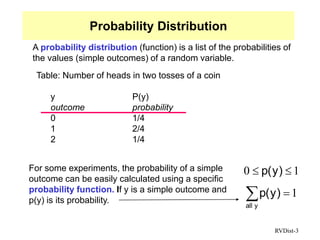
A probability distribution (function) is a list of the probabilities of
the values (simple outcomes) of a random variable.
Table: Number of heads in two tosses of a coin
y P(y)
outcome probability
0 1/4
1 2/4
2 1/4
For some experiments, the probability of a simple
outcome can be easily calculated using a specific
probability function. If y is a simple outcome and
p(y) is its probability.  


y
all
)
y
(
p
)
y
(
p
1
1
0
Probability Distribution
RVDist-4
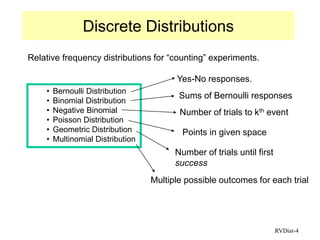
• Bernoulli Distribution
• Binomial Distribution
• Negative Binomial
• Poisson Distribution
• Geometric Distribution
• Multinomial Distribution
Relative frequency distributions for “counting” experiments.
Yes-No responses.
Sums of Bernoulli responses
Number of trials to kth event
Points in given space
Number of trials until first
success
Multiple possible outcomes for each trial
Discrete Distributions
RVDist-5
• The experiment consists of n identical trials (simple experiments).
• Each trial results in one of two outcomes (success or failure)
• The probability of success on a single trial is equal to  and 
remains the same from trial to trial.
• The trials are independent, that is, the outcome of one trial does not
influence the outcome of any other trial.
• The random variable y is the number of successes observed during
n trials.
y
n
y
y
n
y
n
y
P 


 )
1
(
)!
(
!
!
)
( 

)
1
( 







n
n Mean
Standard deviation
n!=1x2x3x…x n
Binomial Distribution
RVDist-6
Example n=5
y
n
y
y
n
y
n
y
P 


 )
1
(
)!
(
!
!
)
( 

n    
5 0.5 0.25 0.1 0.05
y y! n!/(y!)(n-y)! P(y) P(y) P(y) P(y)
0 1 1 0.03125 0.2373 0.59049 0.7737809
1 1 5 0.15625 0.3955 0.32805 0.2036266
2 2 10 0.31250 0.2637 0.07290 0.0214344
3 6 10 0.31250 0.0879 0.00810 0.0011281
4 24 5 0.15625 0.0146 0.00045 0.0000297
5 120 1 0.03125 0.0010 0.00001 0.0000003
sum = 1 1 1 1
RVDist-7
As the n goes up, the distribution looks more symmetric and bell shaped.
Binomial probability density function forms
RVDist-8
Basic Experiment: 5 fair coins are tossed.
Event of interest: total number of heads.
Each coin is a trial with probability of a head coming up (a
success) equal to 0.5. So the number of heads in the five coins
is a binomial random variable with n=5 and =.5.
# of heads Observed Theoretical
0 1 1.56
1 11 7.81
2 11 15.63
3 19 15.63
4 6 7.81
5 2 1.56
The Experiment is repeated 50 times.
0 1 2 3 4 5
20
18
16
14
12
10
8
6
4
2
0
Binomial Distribution Example
RVDist-9
Outcome Frequency Relative Freq
2 2 0.04
3 4 0.08
4 4 0.08
5 3 0.06
6 4 0.08
7 7 0.14
8 9 0.18
9 3 0.06
10 5 0.10
11 7 0.14
12 2 0.04
total 50 1.00
Two dice are thrown and the number of “pips” showing are counted
(random variable X). The simple experiment is repeated 50 times.
P(X8)=
P(X6)=
P(4X10)=
33/50 =.66
37/50 = .74
34/50 = .68
Two Dice Experiment
Approximate probabilities
for the random variable X:
RVDist-10
A typical method for determining the density of vegetation is to use
“quadrats”, rectangular or circular frames in which the number of plant
stems are counted. Suppose 50 “throws” of the frame are used and the
distribution of counts reported.
Count Frequency
(stems) (quadrats)
0 12
1 15
2 9
3 6
4 4
5 3
6 0
7 1
total 50
20
18
16
14
12
10
8
6
4
2
0
0 1 2 3 4 5 6 7
If stems are
randomly dispersed,
the counts could be
modeled as a
Poisson distribution.
Vegetation Sampling Data
# of stems per quadrat
RVDist-11
A random variable is said to have a Poisson Distribution with rate
parameter , if its probability function is given by:
e=2.718…
Poisson Distribution
Mean and variance for a Poisson
,...
2
,
1
,
0
for
,
!
)
( 
 
y
e
y
y
P
y





 
 2
,
Ex: A certain type of tree has seedlings randomly dispersed in a large area,
with a mean density of approx 5 per sq meter. If a 10 sq meter area is
randomly sampled, what is the probability that no such seedlings are found?
P(0) = 500(e-50)/0! = approx 10-22
(Since this probability is so small, if no seedlings were actually found, we
might question the validity of our model…)
RVDist-12
Environmental Example
Van Beneden (1994,Env. Health. Persp., 102, Suppl. 12, p.81-83)
describes an experiment where DNA is taken from softshell and
hardshell clams and transfected into murine cells in culture in order to
study the ability of the murine host cells to indicate selected damage to
the clam DNA. (Mouse cells are much easier to culture than clam cells.
This process could facilitate laboratory study of in vivo aquatic toxicity
in clams).
The response is the number of focal lesions seen on the plates after
a fixed period of incubation. The goal is to assess whether there are
differences in response between DNA transfected from two clam
species.
The response could be modeled as if it followed a Poisson Distribution.
Ref: Piegorsch and Bailer, Stat for Environmental Biol and Tox, p400
RVDist-13
• Primarily related to “counting” experiments.
• Probability only defined for “integer” values.
• Symmetric and non-symmetric distribution shapes.
• Best description is a frequency table.
Examples where discrete distributions are seen.
Wildlife - animal sampling, birds in a 2 km x 2 km area.
Botany - vegetation sampling, quadrats, flowers on stem.
Entomology - bugs on a leaf
Medicine - disease incidence, clinical trials
Engineering - quality control, number of failures in fixed time
Discrete Distributions
Take Home Messages
RVDist-14
• Normal Distribution
• Log Normal Distribution
• Gamma Distribution
• Chi Square Distribution
• F Distribution
• t Distribution
• Weibull Distribution
• Extreme Value Distribution
(Type I and II)
Basis for statistical tests.
Foundations for much of
statistical inference
Environmental variables
Time to failure, radioactivity
Lifetime distributions
Continuous Distributions
Continuous random variables are defined for continuous
numbers on the real line. Probabilities have to be computed
for all possible sets of numbers.
RVDist-15
A function which integrates to 1 over its range and from which
event probabilities can be determined.
f(x)
Area under curve
sums to one.
Random variable range
A theoretical shape - if we were able to sample the
whole (infinite) population of possible values, this is
what the associated histogram would look like.
A mathematical abstraction
Probability Density Function
RVDist-16
y
x
2
0 5 10
15
20
25
30
0
.
0
0
.
1
0
.
2
0
.
3
0
.
4
0
.
5
The pdf does not
have to be
symmetric, nor
be defined for all
real numbers.
Chi Square density functions
The shape of the
curve is
determined by
one or more
distribution
parameters.
fX(x|b)
Probability Density Function
RVDist-17





o
x
X dx
)
x
(
f
)
x
X
(
P
)
x
(
F 0
0
 


0
0
0
0
x
x
X dx
)
x
(
f
)
x
X
(
P
Probability can be computed by integrating the density function.
Any one point has zero probability of occurrence.
Continuous random variables only have positive probability for events
which define intervals on the real line.
Continuous Distribution Properties
RVDist-18
Cumulative Distribution Function
P(X<x)
x
RVDist-19
Using the Cumulative Distribution
P(X< x1)
xo
P(xo < X < x1) = P(X< x1 ) - P(X < xo) = .8-.2 = .6
P(X< xo)
x1
RVDist-20
Chi Square Cumulative Distribution
Cumulative distribution does not have to be S shaped. In fact, only the
normal and t-distributions have S shaped distributions.
RVDist-21
Normal Distribution
68% of total area
is between - and +.
68
.
)
( 



 


 X
P
A symmetric distribution defined on the range - to +  whose shape is
defined by two parameters, the mean, denoted , that centers the
distribution, and the standard deviation, , that determines the spread
of the distribution.
 

Area=.68
RVDist-22
All normal random
variables can be related
back to the standard
normal random
variable.
A Standard Normal
random variable has
mean 0 and
standard deviation 1.
Standard Normal Distribution
3 3
2



2
0 +1 +2 +3
-1
-2
-3
RVDist-23
Illustration


Density of X
Density of X-
0
Density of (X-)/
1
RVDist-24
Notation
Suppose X has a normal distribution with mean  and standard deviation
, denoted X ~ N(, ).
Then a new random variable defined as Z=(X- )/ , has the standard
normal distribution, denoted Z ~ N(0,1).
Why is this important? Because in this way, the probability of
any event on a normal random variable with any given mean and
standard deviation can be computed from tables of the standard
normal distribution.
Z=(X- )/  To standardize we subtract the mean
and divide by the standard deviation.
 Z+  = X
To create a random variable with specific mean and
standard deviation, we start with a standard normal
deviate, multiply it by the target standard deviation, and
then add the target mean.
RVDist-25
)
,
(
N
~
X 
 )
,
(
N
~
Z 1
0



 Z
X
)
x
Z
(
P
)
x
Z
(
P
)
x
Z
(
P
)
x
X
(
P














0
0
0
0 This probability can be found
in a table of standard normal
probabilities (Table 1 in Ott
and Longnecker)
This value is just a number,
usually between 4
)
z
Z
(
P
)
z
Z
(
P
)
z
Z
(
P
)
z
Z
(
P
0
0
0
0 1









Other Useful Relationships
Probability of complementary events.
Symmetry of the normal distribution.
Relating Any Normal RV
to a Standard Normal RV
RVDist-26
Normal Table
Z
0.0 1.0
Ott & Longnecker, Table 1
page 676, gives areas left of
z. This table from a previous
edition gives areas right of z.
RVDist-27
Find P(2 < X < 4) when X ~ N(5,2).
The standarization equation for X is:
Z = (X-)/ = (X-5)/2
when X=2, Z= -3/2 = -1.5
when X=4, Z= -1/2 = -0.5
P(2<X<4) = P(X<4) - P(X<2)
P(X<2) = P( Z< -1.5 )
= P( Z > 1.5 ) (by symmetry)
P(X<4) = P(Z < -0.5)
= P(Z > 0.5) (by symmetry)
P(2 < x < 4) = P(X<4)-P(X<2)
= P(Z>0.5) - P( Z > 1.5)
= 0.3085 - 0.0668 = 0.2417
x
y
-
4
-
3
-
2
-
1
0
1
2
3
4
Using a Normal Table
RVDist-28
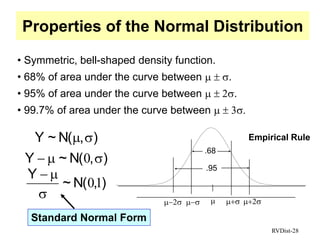
• Symmetric, bell-shaped density function.
• 68% of area under the curve between   .
• 95% of area under the curve between   2.
• 99.7% of area under the curve between   3.
)
,
(
N
~
Y
)
,
(
N
~
Y
)
,
(
N
~
Y
1
0
0








Standard Normal Form
.68
.95

  2
2
Properties of the Normal Distribution
Empirical Rule
RVDist-29
Pr(Z > 1.83) =
Pr(Z < 1.83)=
1.83
0.0336
1-Pr( Z> 1.83)
=1-0.0336 = 0.9664
Pr(Z < -1.83) = Pr( Z> 1.83)
=0.0336
-1.83
By Symmetry
Using symmetry and the fact that the
area under the density curve is 1.
Probability Problems
RVDist-30
Pr( -0.6 < Z < 1.83 )=
Cutting out the tails.
Pr( Z < 1.83 ) - Pr( Z < -0.6 )
Or
Pr( Z > -0.6 ) - Pr( Z > 1.83 )
Pr ( Z > -0.6) =
Pr ( Z < +0.6 ) =
1 - Pr (Z > 0.6 ) =
1 - 0.2743 =
0.7257
Pr( Z > 1.83 ) =
0.0336
= 0.7257 - 0.0336
= 0.6921
1.83
-0.6
Probability Problems
RVDist-31
z0
Working backwards.
Pr (Z > z0 ) = .1314
= 1.12
z0
Pr (Z < z0 ) = .1314
Pr ( Z < z0 ) = 0.1314
1. - Pr (Z > z0 ) = 0.1314
Pr ( Z > z0 ) = 1 - 0.1314
= 0.8686
z0 must be negative,
since Pr ( Z > 0.0 ) = 0.5
= -1.12
Given the Probability - What is Z0 ?
RVDist-32
Suppose we have a random variable (say weight), denoted by W, that
has a normal distribution with mean 100 and standard deviation 10.
W ~ N( 100, 10)
Pr ( W < 90 ) = Pr( Z < (90 - 100) / 10 ) = Pr ( Z < -1.0 )




X
Z
= Pr ( Z > 1.0 ) = 0.1587
Pr ( W > 80 ) = Pr( Z > (80 - 100) / 10 ) = Pr ( Z > -2.0 )
= 1.0 - Pr ( Z < -2.0 )
= 1.0 - Pr ( Z > 2.0 )
= 1.0 - 0.0228 = 0.9772
100
80
Converting to Standard Normal Form
RVDist-33
W ~ N( 100, 10)
Pr ( 93 < W < 106 ) = Pr( W > 93 ) - Pr ( W > 106 )
= Pr [ Z > (93 - 100) / 10 ] - Pr [ Z > (106 - 100 ) / 10 ]
100
93 106
= Pr [ Z > - 0.7 ] - Pr [ Z > + 0.6 ]
= 1.0 - Pr [ Z > + 0.7 ] - Pr [ Z > + 0.6 ]
= 1.0 - 0.2420 - .2743 = 0.4837
Decomposing Events
RVDist-34
Pr ( wL < W < wU ) = 0.8
W ~ N( 100, 10)
What are the two endpoints for a symmetric area centered on the
mean that contains probability of 0.8 ?
100
wL wU
|100 - wL| = | 100 - wU |
Symmetry requirement
Pr ( 100 < W < wU ) = Pr (wL < W < 100 ) = 0.4
Pr ( 100 < W < wU ) = Pr ( W > 100 ) - Pr ( W > wU ) =
Pr ( Z > 0 ) - Pr ( Z > (wU – 100)/10 ) = .5 - Pr ( Z > (wU – 100)/10 ) = 0.4
Pr ( Z > (wU - 100)/10 ) = 0.1 => (wU - 100)/10 = z0.1  1.28
wU = 1.28 * 10 + 100 = 112.8 wL = -1.28 * 10 + 100 = 87.2
0.4 0.4
Finding Interval Endpoints
RVDist-35
Pr(Z > .47) =
Pr( Z < .47) =
Pr ( Z < -.47 ) =
Pr ( Z > -.47 ) =
1-.6808=.3192
.6808
1.0 - Pr ( Z < -.47)
Using Table 1 in Ott &Longnecker
Pr( .21 < Z < 1.56 ) = Pr ( Z <1.56) - Pr ( Z < .21 )
.9406 - 0.5832 = .3574
= 1.0 - .3192 = .6808
.3192
Pr( -.21 < Z < 1.23 ) = Pr ( Z < 1.23) - Pr ( Z < -.21 )
.8907 - .4168 = .4739
Read probability in table using
row (. 4) + column (.07)
indicators.
Probability Practice
1-P(Z<.47)=
RVDist-36
Pr ( Z > z.2912 ) = 0.2912 z.2912 = 0.55
Pr ( Z > z.05 ) = 0.05 z.05 = 1.645
Pr ( Z > z.01 ) = 0.01 z.01 = 2.326
Pr ( Z > z.025 ) = 0.025 z.025 = 1.96
Find probability in the Table, then read off row and column values.
Finding Critical Values from the Table

Statistical Distributions normal binary.ppt

  • 1.
    RVDist-1 Distributions of RandomVariables (§4.6 - 4.10) In this Lecture we discuss the different types of random variables and illustrate the properties of typical probability distributions for these random variables.
  • 2.
    RVDist-2 For a definedpopulation, every random variable has an associated distribution that defines the probability of occurrence of each possible value of that variable (if there are a finitely countable number of unique values) or all possible sets of possible values (if the variable is defined on the real line). A variable is any characteristic, observed or measured. A variable can be either random or constant in the population of interest. Note this differs from common English usage where the word variable implies something that varies from individual to individual. What is a Random Variable?
  • 3.
    RVDist-3 A probability distribution(function) is a list of the probabilities of the values (simple outcomes) of a random variable. Table: Number of heads in two tosses of a coin y P(y) outcome probability 0 1/4 1 2/4 2 1/4 For some experiments, the probability of a simple outcome can be easily calculated using a specific probability function. If y is a simple outcome and p(y) is its probability.     y all ) y ( p ) y ( p 1 1 0 Probability Distribution
  • 4.
    RVDist-4 • Bernoulli Distribution •Binomial Distribution • Negative Binomial • Poisson Distribution • Geometric Distribution • Multinomial Distribution Relative frequency distributions for “counting” experiments. Yes-No responses. Sums of Bernoulli responses Number of trials to kth event Points in given space Number of trials until first success Multiple possible outcomes for each trial Discrete Distributions
  • 5.
    RVDist-5 • The experimentconsists of n identical trials (simple experiments). • Each trial results in one of two outcomes (success or failure) • The probability of success on a single trial is equal to  and  remains the same from trial to trial. • The trials are independent, that is, the outcome of one trial does not influence the outcome of any other trial. • The random variable y is the number of successes observed during n trials. y n y y n y n y P     ) 1 ( )! ( ! ! ) (   ) 1 (         n n Mean Standard deviation n!=1x2x3x…x n Binomial Distribution
  • 6.
    RVDist-6 Example n=5 y n y y n y n y P    ) 1 ( )! ( ! ! ) (   n     5 0.5 0.25 0.1 0.05 y y! n!/(y!)(n-y)! P(y) P(y) P(y) P(y) 0 1 1 0.03125 0.2373 0.59049 0.7737809 1 1 5 0.15625 0.3955 0.32805 0.2036266 2 2 10 0.31250 0.2637 0.07290 0.0214344 3 6 10 0.31250 0.0879 0.00810 0.0011281 4 24 5 0.15625 0.0146 0.00045 0.0000297 5 120 1 0.03125 0.0010 0.00001 0.0000003 sum = 1 1 1 1
  • 7.
    RVDist-7 As the ngoes up, the distribution looks more symmetric and bell shaped. Binomial probability density function forms
  • 8.
    RVDist-8 Basic Experiment: 5fair coins are tossed. Event of interest: total number of heads. Each coin is a trial with probability of a head coming up (a success) equal to 0.5. So the number of heads in the five coins is a binomial random variable with n=5 and =.5. # of heads Observed Theoretical 0 1 1.56 1 11 7.81 2 11 15.63 3 19 15.63 4 6 7.81 5 2 1.56 The Experiment is repeated 50 times. 0 1 2 3 4 5 20 18 16 14 12 10 8 6 4 2 0 Binomial Distribution Example
  • 9.
    RVDist-9 Outcome Frequency RelativeFreq 2 2 0.04 3 4 0.08 4 4 0.08 5 3 0.06 6 4 0.08 7 7 0.14 8 9 0.18 9 3 0.06 10 5 0.10 11 7 0.14 12 2 0.04 total 50 1.00 Two dice are thrown and the number of “pips” showing are counted (random variable X). The simple experiment is repeated 50 times. P(X8)= P(X6)= P(4X10)= 33/50 =.66 37/50 = .74 34/50 = .68 Two Dice Experiment Approximate probabilities for the random variable X:
  • 10.
    RVDist-10 A typical methodfor determining the density of vegetation is to use “quadrats”, rectangular or circular frames in which the number of plant stems are counted. Suppose 50 “throws” of the frame are used and the distribution of counts reported. Count Frequency (stems) (quadrats) 0 12 1 15 2 9 3 6 4 4 5 3 6 0 7 1 total 50 20 18 16 14 12 10 8 6 4 2 0 0 1 2 3 4 5 6 7 If stems are randomly dispersed, the counts could be modeled as a Poisson distribution. Vegetation Sampling Data # of stems per quadrat
  • 11.
    RVDist-11 A random variableis said to have a Poisson Distribution with rate parameter , if its probability function is given by: e=2.718… Poisson Distribution Mean and variance for a Poisson ,... 2 , 1 , 0 for , ! ) (    y e y y P y         2 , Ex: A certain type of tree has seedlings randomly dispersed in a large area, with a mean density of approx 5 per sq meter. If a 10 sq meter area is randomly sampled, what is the probability that no such seedlings are found? P(0) = 500(e-50)/0! = approx 10-22 (Since this probability is so small, if no seedlings were actually found, we might question the validity of our model…)
  • 12.
    RVDist-12 Environmental Example Van Beneden(1994,Env. Health. Persp., 102, Suppl. 12, p.81-83) describes an experiment where DNA is taken from softshell and hardshell clams and transfected into murine cells in culture in order to study the ability of the murine host cells to indicate selected damage to the clam DNA. (Mouse cells are much easier to culture than clam cells. This process could facilitate laboratory study of in vivo aquatic toxicity in clams). The response is the number of focal lesions seen on the plates after a fixed period of incubation. The goal is to assess whether there are differences in response between DNA transfected from two clam species. The response could be modeled as if it followed a Poisson Distribution. Ref: Piegorsch and Bailer, Stat for Environmental Biol and Tox, p400
  • 13.
    RVDist-13 • Primarily relatedto “counting” experiments. • Probability only defined for “integer” values. • Symmetric and non-symmetric distribution shapes. • Best description is a frequency table. Examples where discrete distributions are seen. Wildlife - animal sampling, birds in a 2 km x 2 km area. Botany - vegetation sampling, quadrats, flowers on stem. Entomology - bugs on a leaf Medicine - disease incidence, clinical trials Engineering - quality control, number of failures in fixed time Discrete Distributions Take Home Messages
  • 14.
    RVDist-14 • Normal Distribution •Log Normal Distribution • Gamma Distribution • Chi Square Distribution • F Distribution • t Distribution • Weibull Distribution • Extreme Value Distribution (Type I and II) Basis for statistical tests. Foundations for much of statistical inference Environmental variables Time to failure, radioactivity Lifetime distributions Continuous Distributions Continuous random variables are defined for continuous numbers on the real line. Probabilities have to be computed for all possible sets of numbers.
  • 15.
    RVDist-15 A function whichintegrates to 1 over its range and from which event probabilities can be determined. f(x) Area under curve sums to one. Random variable range A theoretical shape - if we were able to sample the whole (infinite) population of possible values, this is what the associated histogram would look like. A mathematical abstraction Probability Density Function
  • 16.
    RVDist-16 y x 2 0 5 10 15 20 25 30 0 . 0 0 . 1 0 . 2 0 . 3 0 . 4 0 . 5 Thepdf does not have to be symmetric, nor be defined for all real numbers. Chi Square density functions The shape of the curve is determined by one or more distribution parameters. fX(x|b) Probability Density Function
  • 17.
    RVDist-17      o x X dx ) x ( f ) x X ( P ) x ( F 0 0    0 0 0 0 x x X dx ) x ( f ) x X ( P Probability can be computed by integrating the density function. Any one point has zero probability of occurrence. Continuous random variables only have positive probability for events which define intervals on the real line. Continuous Distribution Properties
  • 18.
  • 19.
    RVDist-19 Using the CumulativeDistribution P(X< x1) xo P(xo < X < x1) = P(X< x1 ) - P(X < xo) = .8-.2 = .6 P(X< xo) x1
  • 20.
    RVDist-20 Chi Square CumulativeDistribution Cumulative distribution does not have to be S shaped. In fact, only the normal and t-distributions have S shaped distributions.
  • 21.
    RVDist-21 Normal Distribution 68% oftotal area is between - and +. 68 . ) (          X P A symmetric distribution defined on the range - to +  whose shape is defined by two parameters, the mean, denoted , that centers the distribution, and the standard deviation, , that determines the spread of the distribution.    Area=.68
  • 22.
    RVDist-22 All normal random variablescan be related back to the standard normal random variable. A Standard Normal random variable has mean 0 and standard deviation 1. Standard Normal Distribution 3 3 2    2 0 +1 +2 +3 -1 -2 -3
  • 23.
    RVDist-23 Illustration   Density of X Densityof X- 0 Density of (X-)/ 1
  • 24.
    RVDist-24 Notation Suppose X hasa normal distribution with mean  and standard deviation , denoted X ~ N(, ). Then a new random variable defined as Z=(X- )/ , has the standard normal distribution, denoted Z ~ N(0,1). Why is this important? Because in this way, the probability of any event on a normal random variable with any given mean and standard deviation can be computed from tables of the standard normal distribution. Z=(X- )/  To standardize we subtract the mean and divide by the standard deviation.  Z+  = X To create a random variable with specific mean and standard deviation, we start with a standard normal deviate, multiply it by the target standard deviation, and then add the target mean.
  • 25.
    RVDist-25 ) , ( N ~ X   ) , ( N ~ Z1 0     Z X ) x Z ( P ) x Z ( P ) x Z ( P ) x X ( P               0 0 0 0 This probability can be found in a table of standard normal probabilities (Table 1 in Ott and Longnecker) This value is just a number, usually between 4 ) z Z ( P ) z Z ( P ) z Z ( P ) z Z ( P 0 0 0 0 1          Other Useful Relationships Probability of complementary events. Symmetry of the normal distribution. Relating Any Normal RV to a Standard Normal RV
  • 26.
    RVDist-26 Normal Table Z 0.0 1.0 Ott& Longnecker, Table 1 page 676, gives areas left of z. This table from a previous edition gives areas right of z.
  • 27.
    RVDist-27 Find P(2 <X < 4) when X ~ N(5,2). The standarization equation for X is: Z = (X-)/ = (X-5)/2 when X=2, Z= -3/2 = -1.5 when X=4, Z= -1/2 = -0.5 P(2<X<4) = P(X<4) - P(X<2) P(X<2) = P( Z< -1.5 ) = P( Z > 1.5 ) (by symmetry) P(X<4) = P(Z < -0.5) = P(Z > 0.5) (by symmetry) P(2 < x < 4) = P(X<4)-P(X<2) = P(Z>0.5) - P( Z > 1.5) = 0.3085 - 0.0668 = 0.2417 x y - 4 - 3 - 2 - 1 0 1 2 3 4 Using a Normal Table
  • 28.
    RVDist-28 • Symmetric, bell-shapeddensity function. • 68% of area under the curve between   . • 95% of area under the curve between   2. • 99.7% of area under the curve between   3. ) , ( N ~ Y ) , ( N ~ Y ) , ( N ~ Y 1 0 0         Standard Normal Form .68 .95    2 2 Properties of the Normal Distribution Empirical Rule
  • 29.
    RVDist-29 Pr(Z > 1.83)= Pr(Z < 1.83)= 1.83 0.0336 1-Pr( Z> 1.83) =1-0.0336 = 0.9664 Pr(Z < -1.83) = Pr( Z> 1.83) =0.0336 -1.83 By Symmetry Using symmetry and the fact that the area under the density curve is 1. Probability Problems
  • 30.
    RVDist-30 Pr( -0.6 <Z < 1.83 )= Cutting out the tails. Pr( Z < 1.83 ) - Pr( Z < -0.6 ) Or Pr( Z > -0.6 ) - Pr( Z > 1.83 ) Pr ( Z > -0.6) = Pr ( Z < +0.6 ) = 1 - Pr (Z > 0.6 ) = 1 - 0.2743 = 0.7257 Pr( Z > 1.83 ) = 0.0336 = 0.7257 - 0.0336 = 0.6921 1.83 -0.6 Probability Problems
  • 31.
    RVDist-31 z0 Working backwards. Pr (Z> z0 ) = .1314 = 1.12 z0 Pr (Z < z0 ) = .1314 Pr ( Z < z0 ) = 0.1314 1. - Pr (Z > z0 ) = 0.1314 Pr ( Z > z0 ) = 1 - 0.1314 = 0.8686 z0 must be negative, since Pr ( Z > 0.0 ) = 0.5 = -1.12 Given the Probability - What is Z0 ?
  • 32.
    RVDist-32 Suppose we havea random variable (say weight), denoted by W, that has a normal distribution with mean 100 and standard deviation 10. W ~ N( 100, 10) Pr ( W < 90 ) = Pr( Z < (90 - 100) / 10 ) = Pr ( Z < -1.0 )     X Z = Pr ( Z > 1.0 ) = 0.1587 Pr ( W > 80 ) = Pr( Z > (80 - 100) / 10 ) = Pr ( Z > -2.0 ) = 1.0 - Pr ( Z < -2.0 ) = 1.0 - Pr ( Z > 2.0 ) = 1.0 - 0.0228 = 0.9772 100 80 Converting to Standard Normal Form
  • 33.
    RVDist-33 W ~ N(100, 10) Pr ( 93 < W < 106 ) = Pr( W > 93 ) - Pr ( W > 106 ) = Pr [ Z > (93 - 100) / 10 ] - Pr [ Z > (106 - 100 ) / 10 ] 100 93 106 = Pr [ Z > - 0.7 ] - Pr [ Z > + 0.6 ] = 1.0 - Pr [ Z > + 0.7 ] - Pr [ Z > + 0.6 ] = 1.0 - 0.2420 - .2743 = 0.4837 Decomposing Events
  • 34.
    RVDist-34 Pr ( wL< W < wU ) = 0.8 W ~ N( 100, 10) What are the two endpoints for a symmetric area centered on the mean that contains probability of 0.8 ? 100 wL wU |100 - wL| = | 100 - wU | Symmetry requirement Pr ( 100 < W < wU ) = Pr (wL < W < 100 ) = 0.4 Pr ( 100 < W < wU ) = Pr ( W > 100 ) - Pr ( W > wU ) = Pr ( Z > 0 ) - Pr ( Z > (wU – 100)/10 ) = .5 - Pr ( Z > (wU – 100)/10 ) = 0.4 Pr ( Z > (wU - 100)/10 ) = 0.1 => (wU - 100)/10 = z0.1  1.28 wU = 1.28 * 10 + 100 = 112.8 wL = -1.28 * 10 + 100 = 87.2 0.4 0.4 Finding Interval Endpoints
  • 35.
    RVDist-35 Pr(Z > .47)= Pr( Z < .47) = Pr ( Z < -.47 ) = Pr ( Z > -.47 ) = 1-.6808=.3192 .6808 1.0 - Pr ( Z < -.47) Using Table 1 in Ott &Longnecker Pr( .21 < Z < 1.56 ) = Pr ( Z <1.56) - Pr ( Z < .21 ) .9406 - 0.5832 = .3574 = 1.0 - .3192 = .6808 .3192 Pr( -.21 < Z < 1.23 ) = Pr ( Z < 1.23) - Pr ( Z < -.21 ) .8907 - .4168 = .4739 Read probability in table using row (. 4) + column (.07) indicators. Probability Practice 1-P(Z<.47)=
  • 36.
    RVDist-36 Pr ( Z> z.2912 ) = 0.2912 z.2912 = 0.55 Pr ( Z > z.05 ) = 0.05 z.05 = 1.645 Pr ( Z > z.01 ) = 0.01 z.01 = 2.326 Pr ( Z > z.025 ) = 0.025 z.025 = 1.96 Find probability in the Table, then read off row and column values. Finding Critical Values from the Table