Statistical discrimination at young age:
evidence from young workers across four decades and 56 countries
Joanna Tyrowicz [FAME|GRAPE, University of Warsaw & IZA ]
Lucas van der Velde [FAME|GRAPE & Warsaw School of Economics]
Royal Economic Society
April 2022
Statistical discrimination at young age:
Motivation
Motivation – textbook case for statistical discrimination
Fertility (-related absences) as premise for gender inequality
fertility plans → hiring decisions
(Becker et al., 2019)
child bearing → wage loss among mothers (not fathers)
(Landais & Kleven, 2019; Cukrowska-Torzewska & Matysiak, 2017; Pertold-Gebicka, 2014)
Statistical discrimination at young age:
Motivation
Motivation – textbook case for statistical discrimination
Fertility (-related absences) as premise for gender inequality
fertility plans → hiring decisions
(Becker et al., 2019)
child bearing → wage loss among mothers (not fathers)
(Landais & Kleven, 2019; Cukrowska-Torzewska & Matysiak, 2017; Pertold-Gebicka, 2014)
Demographic trends: ↑ age at first birth and ↓ # of births
⇒ less reasons for statistical discrimination
Statistical discrimination at young age:
Motivation
Motivation – textbook case for statistical discrimination
Fertility (-related absences) as premise for gender inequality
fertility plans → hiring decisions
(Becker et al., 2019)
child bearing → wage loss among mothers (not fathers)
(Landais & Kleven, 2019; Cukrowska-Torzewska & Matysiak, 2017; Pertold-Gebicka, 2014)
Demographic trends: ↑ age at first birth and ↓ # of births
⇒ less reasons for statistical discrimination
What we do
study gender wage gaps among labor market entrants
explore the role of delayed fertility
Statistical discrimination at young age:
Motivation
Motivation – textbook case for statistical discrimination
Fertility (-related absences) as premise for gender inequality
fertility plans → hiring decisions
(Becker et al., 2019)
child bearing → wage loss among mothers (not fathers)
(Landais & Kleven, 2019; Cukrowska-Torzewska & Matysiak, 2017; Pertold-Gebicka, 2014)
Demographic trends: ↑ age at first birth and ↓ # of births
⇒ less reasons for statistical discrimination
What we do
study gender wage gaps among labor market entrants
explore the role of delayed fertility → implicit test of statistical discrimination
Statistical discrimination at young age:
Motivation
Our contribution
We uncover a link from timing of fertility to (adjusted) gender wage gaps
Statistical discrimination at young age:
Motivation
Our contribution
We uncover a link from timing of fertility to (adjusted) gender wage gaps
Comparable measures of AGWG (across c & t) for entrants
Statistical discrimination at young age:
Motivation
Our contribution
We uncover a link from timing of fertility to (adjusted) gender wage gaps
Comparable measures of AGWG (across c & t) for entrants
Causal evidence: several instruments
Duration of compulsory education (multiple reforms)
Statistical discrimination at young age:
Motivation
Our contribution
We uncover a link from timing of fertility to (adjusted) gender wage gaps
Comparable measures of AGWG (across c & t) for entrants
Causal evidence: several instruments
Duration of compulsory education (multiple reforms)
Military conscription (many changes)
Statistical discrimination at young age:
Motivation
Our contribution
We uncover a link from timing of fertility to (adjusted) gender wage gaps
Comparable measures of AGWG (across c & t) for entrants
Causal evidence: several instruments
Duration of compulsory education (multiple reforms)
Military conscription (many changes)
New IV: international variation in “pill” admission
(in the US: Goldin & Katz, 2002; Bailey, 2006; Oltmans-Ananat & Hungerman, 2012)
Statistical discrimination at young age:
Motivation
Our contribution
We uncover a link from timing of fertility to (adjusted) gender wage gaps
Comparable measures of AGWG (across c & t) for entrants
Causal evidence: several instruments
Duration of compulsory education (multiple reforms)
Military conscription (many changes)
New IV: international variation in “pill” admission
(in the US: Goldin & Katz, 2002; Bailey, 2006; Oltmans-Ananat & Hungerman, 2012)
Fertility observed in the generation of the mothers
Statistical discrimination at young age:
Data & method
What we would like to do
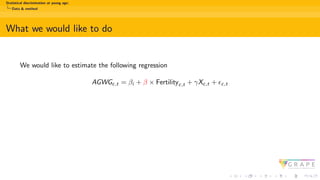
We would like to estimate the following regression
AGWGc,t = βi + β × Fertilityc,t + γXc,t + ϵc,t
Statistical discrimination at young age:
Data & method
What we would like to do
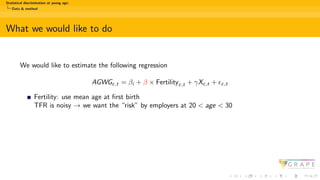
We would like to estimate the following regression
AGWGc,t = βi + β × Fertilityc,t + γXc,t + ϵc,t
Fertility: use mean age at first birth
TFR is noisy → we want the “risk” by employers at 20 < age < 30
Statistical discrimination at young age:
Data & method
What we would like to do
We would like to estimate the following regression
AGWGc,t = βi + β × Fertilityc,t + γXc,t + ϵc,t
Fertility: use mean age at first birth
TFR is noisy → we want the “risk” by employers at 20 < age < 30
AGWG: obtain own estimates
→ adjust raw GWG for 20 < age < 30
But: fertility decisions endogenous to labor force participation & AGWG
Statistical discrimination at young age:
Data & method
What we would like to do
We would like to estimate the following regression
AGWGc,t = βi + β × Fertilityc,t + γXc,t + ϵc,t
Fertility: use mean age at first birth
TFR is noisy → we want the “risk” by employers at 20 < age < 30
AGWG: obtain own estimates
→ adjust raw GWG for 20 < age < 30
But: fertility decisions endogenous to labor force participation & AGWG → need to instrument
Statistical discrimination at young age:
Data & method
(I) Fertility data
We use mean age at first birth (MAB) as a measure of fertility
Direct link to probability of becoming a parent
Less noisy than alternatives
Total fertility rate, age specific fertility, childlessness
Data collected from a variety of sources
Eurostat, UNECE, OECD, Human Fertility Database + bureaus of statistics + papers
Statistical discrimination at young age:
Data & method
(II) Measuring the adjusted gender wage gap
Nopo decomposition
A flexible non-parametric approach based on exact matching
Reliable even when when small set of covariates
Reliable even when cannot correct for selection bias
AGWG within common support
Statistical discrimination at young age:
Data & method
(II) Measuring the adjusted gender wage gap
Nopo decomposition
A flexible non-parametric approach based on exact matching
Reliable even when when small set of covariates
Reliable even when cannot correct for selection bias
AGWG within common support
We need individual level data
Statistical discrimination at young age:
Data & method
(II) Measuring the adjusted gender wage gap
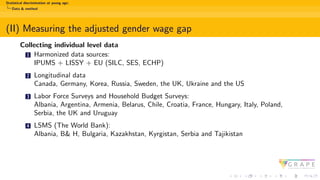
Collecting individual level data
1 Harmonized data sources:
IPUMS + LISSY + EU (SILC, SES, ECHP)
2 Longitudinal data
Canada, Germany, Korea, Russia, Sweden, the UK, Ukraine and the US
3 Labor Force Surveys and Household Budget Surveys:
Albania, Argentina, Armenia, Belarus, Chile, Croatia, France, Hungary, Italy, Poland,
Serbia, the UK and Uruguay
4 LSMS (The World Bank):
Albania, B& H, Bulgaria, Kazakhstan, Kyrgistan, Serbia and Tajikistan
Statistical discrimination at young age:
Data & method
(II) Measuring the adjusted gender wage gap
Collecting individual level data
1 Harmonized data sources:
2 Longitudinal data
3 Labor Force Surveys and Household Budget Surveys:
4 LSMS (The World Bank):
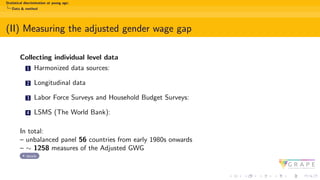
In total:
– unbalanced panel 56 countries from early 1980s onwards
– ∼ 1258 measures of the Adjusted GWG
details
Statistical discrimination at young age:
Data & method
(III) Instruments
Compulsory schooling ⇒ fertility (Black et al. 2008, Cygan-Rehm and Maeder 2013)
Source: Compulsory schooling: UNESCO + papers for earlier years
Statistical discrimination at young age:
Data & method
(III) Instruments
Compulsory schooling ⇒ fertility (Black et al. 2008, Cygan-Rehm and Maeder 2013)
Source: Compulsory schooling: UNESCO + papers for earlier years
Military conscription ⇒ the timing of family formation
Source: Mulligan and Shleifer (2005) + Military Balance
Statistical discrimination at young age:
Data & method
(III) Instruments
Compulsory schooling ⇒ fertility (Black et al. 2008, Cygan-Rehm and Maeder 2013)
Source: Compulsory schooling: UNESCO + papers for earlier years
Military conscription ⇒ the timing of family formation
Source: Mulligan and Shleifer (2005) + Military Balance
Mothers’ fertility (intergenerational transmission of norms)
Source: The World Bank
Statistical discrimination at young age:
Data & method
(III) Instruments
Compulsory schooling ⇒ fertility (Black et al. 2008, Cygan-Rehm and Maeder 2013)
Source: Compulsory schooling: UNESCO + papers for earlier years
Military conscription ⇒ the timing of family formation
Source: Mulligan and Shleifer (2005) + Military Balance
Mothers’ fertility (intergenerational transmission of norms)
Source: The World Bank
Authorization of contraceptive pills ⇒ female education, family and labor supply
(US: Goldin and Katz 2002, Bailey 2006, Ananat and Hungerman 2012)
Source: Finlay, Canning and Po (2012)
Statistical discrimination at young age:
Data & method
(III) Instruments - a small bit of history
The pill first invented in 1940s in the UK, the first approved patent in the US in 1960
Statistical discrimination at young age:
Data & method
(III) Instruments - a small bit of history
The pill first invented in 1940s in the UK, the first approved patent in the US in 1960
Adoption timing varied a lot, even in Europe
Statistical discrimination at young age:
Data & method
(III) Instruments - a small bit of history
The pill first invented in 1940s in the UK, the first approved patent in the US in 1960
Adoption timing varied a lot, even in Europe
Eastern European countries were forerunners
Portugal and Spain lagged behind (late 60’s and 70’s)
The latest: Norway
Statistical discrimination at young age:
Data & method
(III) Instruments - a small bit of history
The pill first invented in 1940s in the UK, the first approved patent in the US in 1960
Adoption timing varied a lot, even in Europe
Admission ̸= access (→ timing)
Statistical discrimination at young age:
Data & method
(III) Instruments - a small bit of history
The pill first invented in 1940s in the UK, the first approved patent in the US in 1960
Adoption timing varied a lot, even in Europe
Admission ̸= access (→ timing)
E.g. former socialist countries: admitted but unavailable
Prescriptions vs otc
The UK originally admitted it only for married women
Statistical discrimination at young age:
Data & method
(III) Instruments - a small bit of history
The pill first invented in 1940s in the UK, the first approved patent in the US in 1960
Adoption timing varied a lot, even in Europe
Admission ̸= access (→ timing)
Until today persistent differences in use as contraceptive
∼ 38% in W. Europe; ∼ 14% E. Europe but 48% (!) in Czech Republic
Statistical discrimination at young age:
Data & method
Estimation procedure
AGWGi,s,t = α + β × time + γ [
MABi,t + ξs + ϵi,s,t
MABi,t = ϕ + θPILLi,t + ϱEDUi,t + µCONSCRi,t + ςM FERTi,t + εi,t
Variation in pill authorizaton: one data-point for each country
We use 2SLS for panel data as in Baltagi and coauthors (1981, 1992, 2000)
It is a random effects model (FGLS)
but... instrumentation is different
Additional instruments are redundant in White sense
→ standard errors adjusted to unbalanced panels
Statistical discrimination at young age:
Results
Raw correlation between MAB and AGWG
AGWGc,t = 0.88 − 0.028 MABc,t + ϵc,t
(0.046) (0.001)
More descriptives
Statistical discrimination at young age:
Results
The effect of delayed fertility on AGWG - IVs
Gender wage Youth, MAB, AGWG Youth All
gap IV OLS TFR, AGWG, OLS
(1) (2) (3) (4) (5) (6) (7)
Fertility -0.026*** -0.042*** -0.031*** -0.023*** -0.020* -0.055* 0.020
(0.007) (0.011) (0.013) (0.009) (0.012) (0.030) (0.018)
R-squared 0.275 0.280 0.277 0.271 0.617 0.559 0.836
F − statistic 12,162 6,891 263.6 289.4 - - -
Observations 1,067 1,081 1,120 1,100 1,128 1,186 1,226
Cluster SE Yes Yes Yes Yes Yes Yes Yes
Time trends Yes Yes Yes Yes Yes Yes Yes
IVs All CS, MS Pill MF - - -
More demanding AGWG
Statistical discrimination at young age:
Results
The effect of delayed fertility on AGWG - Robustness checks
HDFE Quantile Regression Heterogeneous fertility
(1) (2) (3) (4) (5) (6)
Q25 Q50 Q75 Intercepts Slopes
MAB -0.012 *** -0.023 *** -0.022 *** -0.032 ***
[-0.02,-0.00] [-0.03,-0.01] [-0.03,-0.01] [-0.04,-0.02]
MAB< Q25 0.133 *** -0.018
[0.07,0.20] [-0.05,0.02]
MAB ∈ [Q25, Q75] 0.027 -0.019
[-0.03,0.08] [-0.05,0.01]
MAB> Q75 -0.019
[-0.05,0.01]
Statistical discrimination at young age:
Results
Finding a benchmark
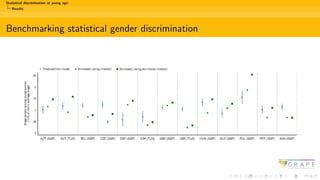
How do our estimates compare to differences in costs faced by employers?
Statistical discrimination at young age:
Results
Finding a benchmark
How do our estimates compare to differences in costs faced by employers?
We need information on
Probability of becoming a parent
→ Age-specific fertility rates
Differences in cost of childbearing / rearing
→ Time-use surveys / ISSP
→ Diff-in-Diff : men vs women, parents vs childless
Statistical discrimination at young age:
Results
Benchmarking statistical gender discrimination
Statistical discrimination at young age:
Summary
Summary
Do employers discriminate statistically? Tentatively yes
Delayed fertility among youth → GWG ↓
Statistical discrimination at young age:
Summary
Summary
Do employers discriminate statistically? Tentatively yes
Delayed fertility among youth → GWG ↓
IV estimates ∼ −0.03 (out of AGWG ∼ 0.12 on average)
Estimates stable and robust across model specifications
Statistical discrimination at young age:
Summary
Summary
Do employers discriminate statistically? Tentatively yes
Delayed fertility among youth → GWG ↓
IV estimates ∼ −0.03 (out of AGWG ∼ 0.12 on average)
Estimates stable and robust across model specifications
IV and OLS similar, but F-statistics strong
Statistical discrimination at young age:
Summary
Summary
Do employers discriminate statistically? Tentatively yes
Delayed fertility among youth → GWG ↓
IV estimates ∼ −0.03 (out of AGWG ∼ 0.12 on average)
Estimates stable and robust across model specifications
IV and OLS similar, but F-statistics strong
Benchmarking: ∆c × π “explains away” AGWG sometimes
→ employers may receive signals correctly, but rarely do
Statistical discrimination at young age:
Summary
Questions or suggestions?
Thank you!
w: grape.org.pl
t: grape org
f: grape.org
e: lvandervelde[at]grape.org.pl
Statistical discrimination at young age:
Summary
Availability of individual level database
back
Statistical discrimination at young age:
Summary
Adjusted vs raw gender wage gap
back
Statistical discrimination at young age:
Summary
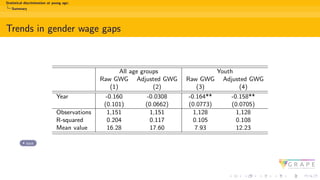
Trends in gender wage gaps
All age groups Youth
Raw GWG Adjusted GWG Raw GWG Adjusted GWG
(1) (2) (3) (4)
Year -0.160 -0.0308 -0.164** -0.158**
(0.101) (0.0662) (0.0773) (0.0705)
Observations 1,151 1,151 1,128 1,128
R-squared 0.204 0.117 0.105 0.108
Mean value 16.28 17.60 7.93 12.23
back
Statistical discrimination at young age:
Summary
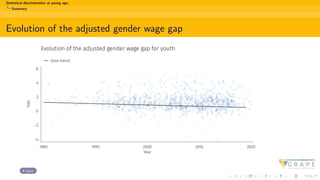
Evolution of the adjusted gender wage gap
back
Statistical discrimination at young age:
Summary
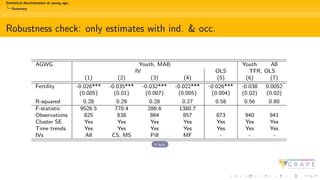
Robustness check: only estimates with ind. & occ.
AGWG Youth, MAB Youth All
IV OLS TFR, OLS
(1) (2) (3) (4) (5) (6) (7)
Fertility -0.026*** -0.035*** -0.032*** -0.022*** -0.026*** -0.038 0.0052
(0.005) (0.01) (0.007) (0.005) (0.004) (0.02) (0.02)
R-squared 0.28 0.29 0.28 0.27 0.58 0.56 0.80
F-statistic 9526.5 770.4 286.6 1380.7
Observations 825 838 864 857 873 940 941
Cluster SE Yes Yes Yes Yes Yes Yes Yes
Time trends Yes Yes Yes Yes Yes Yes Yes
IVs All CS, MS Pill MF - - -
back

Statistical discrimination at young age

  • 1.
    Statistical discrimination atyoung age: Statistical discrimination at young age: evidence from young workers across four decades and 56 countries Joanna Tyrowicz [FAME|GRAPE, University of Warsaw & IZA ] Lucas van der Velde [FAME|GRAPE & Warsaw School of Economics] Royal Economic Society April 2022
  • 2.
    Statistical discrimination atyoung age: Motivation Motivation – textbook case for statistical discrimination Fertility (-related absences) as premise for gender inequality fertility plans → hiring decisions (Becker et al., 2019) child bearing → wage loss among mothers (not fathers) (Landais & Kleven, 2019; Cukrowska-Torzewska & Matysiak, 2017; Pertold-Gebicka, 2014)
  • 3.
    Statistical discrimination atyoung age: Motivation Motivation – textbook case for statistical discrimination Fertility (-related absences) as premise for gender inequality fertility plans → hiring decisions (Becker et al., 2019) child bearing → wage loss among mothers (not fathers) (Landais & Kleven, 2019; Cukrowska-Torzewska & Matysiak, 2017; Pertold-Gebicka, 2014) Demographic trends: ↑ age at first birth and ↓ # of births ⇒ less reasons for statistical discrimination
  • 4.
    Statistical discrimination atyoung age: Motivation Motivation – textbook case for statistical discrimination Fertility (-related absences) as premise for gender inequality fertility plans → hiring decisions (Becker et al., 2019) child bearing → wage loss among mothers (not fathers) (Landais & Kleven, 2019; Cukrowska-Torzewska & Matysiak, 2017; Pertold-Gebicka, 2014) Demographic trends: ↑ age at first birth and ↓ # of births ⇒ less reasons for statistical discrimination What we do study gender wage gaps among labor market entrants explore the role of delayed fertility
  • 5.
    Statistical discrimination atyoung age: Motivation Motivation – textbook case for statistical discrimination Fertility (-related absences) as premise for gender inequality fertility plans → hiring decisions (Becker et al., 2019) child bearing → wage loss among mothers (not fathers) (Landais & Kleven, 2019; Cukrowska-Torzewska & Matysiak, 2017; Pertold-Gebicka, 2014) Demographic trends: ↑ age at first birth and ↓ # of births ⇒ less reasons for statistical discrimination What we do study gender wage gaps among labor market entrants explore the role of delayed fertility → implicit test of statistical discrimination
  • 6.
    Statistical discrimination atyoung age: Motivation Our contribution We uncover a link from timing of fertility to (adjusted) gender wage gaps
  • 7.
    Statistical discrimination atyoung age: Motivation Our contribution We uncover a link from timing of fertility to (adjusted) gender wage gaps Comparable measures of AGWG (across c & t) for entrants
  • 8.
    Statistical discrimination atyoung age: Motivation Our contribution We uncover a link from timing of fertility to (adjusted) gender wage gaps Comparable measures of AGWG (across c & t) for entrants Causal evidence: several instruments Duration of compulsory education (multiple reforms)
  • 9.
    Statistical discrimination atyoung age: Motivation Our contribution We uncover a link from timing of fertility to (adjusted) gender wage gaps Comparable measures of AGWG (across c & t) for entrants Causal evidence: several instruments Duration of compulsory education (multiple reforms) Military conscription (many changes)
  • 10.
    Statistical discrimination atyoung age: Motivation Our contribution We uncover a link from timing of fertility to (adjusted) gender wage gaps Comparable measures of AGWG (across c & t) for entrants Causal evidence: several instruments Duration of compulsory education (multiple reforms) Military conscription (many changes) New IV: international variation in “pill” admission (in the US: Goldin & Katz, 2002; Bailey, 2006; Oltmans-Ananat & Hungerman, 2012)
  • 11.
    Statistical discrimination atyoung age: Motivation Our contribution We uncover a link from timing of fertility to (adjusted) gender wage gaps Comparable measures of AGWG (across c & t) for entrants Causal evidence: several instruments Duration of compulsory education (multiple reforms) Military conscription (many changes) New IV: international variation in “pill” admission (in the US: Goldin & Katz, 2002; Bailey, 2006; Oltmans-Ananat & Hungerman, 2012) Fertility observed in the generation of the mothers
  • 12.
    Statistical discrimination atyoung age: Data & method What we would like to do We would like to estimate the following regression AGWGc,t = βi + β × Fertilityc,t + γXc,t + ϵc,t
  • 13.
    Statistical discrimination atyoung age: Data & method What we would like to do We would like to estimate the following regression AGWGc,t = βi + β × Fertilityc,t + γXc,t + ϵc,t Fertility: use mean age at first birth TFR is noisy → we want the “risk” by employers at 20 < age < 30
  • 14.
    Statistical discrimination atyoung age: Data & method What we would like to do We would like to estimate the following regression AGWGc,t = βi + β × Fertilityc,t + γXc,t + ϵc,t Fertility: use mean age at first birth TFR is noisy → we want the “risk” by employers at 20 < age < 30 AGWG: obtain own estimates → adjust raw GWG for 20 < age < 30 But: fertility decisions endogenous to labor force participation & AGWG
  • 15.
    Statistical discrimination atyoung age: Data & method What we would like to do We would like to estimate the following regression AGWGc,t = βi + β × Fertilityc,t + γXc,t + ϵc,t Fertility: use mean age at first birth TFR is noisy → we want the “risk” by employers at 20 < age < 30 AGWG: obtain own estimates → adjust raw GWG for 20 < age < 30 But: fertility decisions endogenous to labor force participation & AGWG → need to instrument
  • 16.
    Statistical discrimination atyoung age: Data & method (I) Fertility data We use mean age at first birth (MAB) as a measure of fertility Direct link to probability of becoming a parent Less noisy than alternatives Total fertility rate, age specific fertility, childlessness Data collected from a variety of sources Eurostat, UNECE, OECD, Human Fertility Database + bureaus of statistics + papers
  • 17.
    Statistical discrimination atyoung age: Data & method (II) Measuring the adjusted gender wage gap Nopo decomposition A flexible non-parametric approach based on exact matching Reliable even when when small set of covariates Reliable even when cannot correct for selection bias AGWG within common support
  • 18.
    Statistical discrimination atyoung age: Data & method (II) Measuring the adjusted gender wage gap Nopo decomposition A flexible non-parametric approach based on exact matching Reliable even when when small set of covariates Reliable even when cannot correct for selection bias AGWG within common support We need individual level data
  • 19.
    Statistical discrimination atyoung age: Data & method (II) Measuring the adjusted gender wage gap Collecting individual level data 1 Harmonized data sources: IPUMS + LISSY + EU (SILC, SES, ECHP) 2 Longitudinal data Canada, Germany, Korea, Russia, Sweden, the UK, Ukraine and the US 3 Labor Force Surveys and Household Budget Surveys: Albania, Argentina, Armenia, Belarus, Chile, Croatia, France, Hungary, Italy, Poland, Serbia, the UK and Uruguay 4 LSMS (The World Bank): Albania, B& H, Bulgaria, Kazakhstan, Kyrgistan, Serbia and Tajikistan
  • 20.
    Statistical discrimination atyoung age: Data & method (II) Measuring the adjusted gender wage gap Collecting individual level data 1 Harmonized data sources: 2 Longitudinal data 3 Labor Force Surveys and Household Budget Surveys: 4 LSMS (The World Bank): In total: – unbalanced panel 56 countries from early 1980s onwards – ∼ 1258 measures of the Adjusted GWG details
  • 21.
    Statistical discrimination atyoung age: Data & method (III) Instruments Compulsory schooling ⇒ fertility (Black et al. 2008, Cygan-Rehm and Maeder 2013) Source: Compulsory schooling: UNESCO + papers for earlier years
  • 22.
    Statistical discrimination atyoung age: Data & method (III) Instruments Compulsory schooling ⇒ fertility (Black et al. 2008, Cygan-Rehm and Maeder 2013) Source: Compulsory schooling: UNESCO + papers for earlier years Military conscription ⇒ the timing of family formation Source: Mulligan and Shleifer (2005) + Military Balance
  • 23.
    Statistical discrimination atyoung age: Data & method (III) Instruments Compulsory schooling ⇒ fertility (Black et al. 2008, Cygan-Rehm and Maeder 2013) Source: Compulsory schooling: UNESCO + papers for earlier years Military conscription ⇒ the timing of family formation Source: Mulligan and Shleifer (2005) + Military Balance Mothers’ fertility (intergenerational transmission of norms) Source: The World Bank
  • 24.
    Statistical discrimination atyoung age: Data & method (III) Instruments Compulsory schooling ⇒ fertility (Black et al. 2008, Cygan-Rehm and Maeder 2013) Source: Compulsory schooling: UNESCO + papers for earlier years Military conscription ⇒ the timing of family formation Source: Mulligan and Shleifer (2005) + Military Balance Mothers’ fertility (intergenerational transmission of norms) Source: The World Bank Authorization of contraceptive pills ⇒ female education, family and labor supply (US: Goldin and Katz 2002, Bailey 2006, Ananat and Hungerman 2012) Source: Finlay, Canning and Po (2012)
  • 25.
    Statistical discrimination atyoung age: Data & method (III) Instruments - a small bit of history The pill first invented in 1940s in the UK, the first approved patent in the US in 1960
  • 26.
    Statistical discrimination atyoung age: Data & method (III) Instruments - a small bit of history The pill first invented in 1940s in the UK, the first approved patent in the US in 1960 Adoption timing varied a lot, even in Europe
  • 27.
    Statistical discrimination atyoung age: Data & method (III) Instruments - a small bit of history The pill first invented in 1940s in the UK, the first approved patent in the US in 1960 Adoption timing varied a lot, even in Europe Eastern European countries were forerunners Portugal and Spain lagged behind (late 60’s and 70’s) The latest: Norway
  • 28.
    Statistical discrimination atyoung age: Data & method (III) Instruments - a small bit of history The pill first invented in 1940s in the UK, the first approved patent in the US in 1960 Adoption timing varied a lot, even in Europe Admission ̸= access (→ timing)
  • 29.
    Statistical discrimination atyoung age: Data & method (III) Instruments - a small bit of history The pill first invented in 1940s in the UK, the first approved patent in the US in 1960 Adoption timing varied a lot, even in Europe Admission ̸= access (→ timing) E.g. former socialist countries: admitted but unavailable Prescriptions vs otc The UK originally admitted it only for married women
  • 30.
    Statistical discrimination atyoung age: Data & method (III) Instruments - a small bit of history The pill first invented in 1940s in the UK, the first approved patent in the US in 1960 Adoption timing varied a lot, even in Europe Admission ̸= access (→ timing) Until today persistent differences in use as contraceptive ∼ 38% in W. Europe; ∼ 14% E. Europe but 48% (!) in Czech Republic
  • 31.
    Statistical discrimination atyoung age: Data & method Estimation procedure AGWGi,s,t = α + β × time + γ [ MABi,t + ξs + ϵi,s,t MABi,t = ϕ + θPILLi,t + ϱEDUi,t + µCONSCRi,t + ςM FERTi,t + εi,t Variation in pill authorizaton: one data-point for each country We use 2SLS for panel data as in Baltagi and coauthors (1981, 1992, 2000) It is a random effects model (FGLS) but... instrumentation is different Additional instruments are redundant in White sense → standard errors adjusted to unbalanced panels
  • 32.
    Statistical discrimination atyoung age: Results Raw correlation between MAB and AGWG AGWGc,t = 0.88 − 0.028 MABc,t + ϵc,t (0.046) (0.001) More descriptives
  • 33.
    Statistical discrimination atyoung age: Results The effect of delayed fertility on AGWG - IVs Gender wage Youth, MAB, AGWG Youth All gap IV OLS TFR, AGWG, OLS (1) (2) (3) (4) (5) (6) (7) Fertility -0.026*** -0.042*** -0.031*** -0.023*** -0.020* -0.055* 0.020 (0.007) (0.011) (0.013) (0.009) (0.012) (0.030) (0.018) R-squared 0.275 0.280 0.277 0.271 0.617 0.559 0.836 F − statistic 12,162 6,891 263.6 289.4 - - - Observations 1,067 1,081 1,120 1,100 1,128 1,186 1,226 Cluster SE Yes Yes Yes Yes Yes Yes Yes Time trends Yes Yes Yes Yes Yes Yes Yes IVs All CS, MS Pill MF - - - More demanding AGWG
  • 34.
    Statistical discrimination atyoung age: Results The effect of delayed fertility on AGWG - Robustness checks HDFE Quantile Regression Heterogeneous fertility (1) (2) (3) (4) (5) (6) Q25 Q50 Q75 Intercepts Slopes MAB -0.012 *** -0.023 *** -0.022 *** -0.032 *** [-0.02,-0.00] [-0.03,-0.01] [-0.03,-0.01] [-0.04,-0.02] MAB< Q25 0.133 *** -0.018 [0.07,0.20] [-0.05,0.02] MAB ∈ [Q25, Q75] 0.027 -0.019 [-0.03,0.08] [-0.05,0.01] MAB> Q75 -0.019 [-0.05,0.01]
  • 35.
    Statistical discrimination atyoung age: Results Finding a benchmark How do our estimates compare to differences in costs faced by employers?
  • 36.
    Statistical discrimination atyoung age: Results Finding a benchmark How do our estimates compare to differences in costs faced by employers? We need information on Probability of becoming a parent → Age-specific fertility rates Differences in cost of childbearing / rearing → Time-use surveys / ISSP → Diff-in-Diff : men vs women, parents vs childless
  • 37.
    Statistical discrimination atyoung age: Results Benchmarking statistical gender discrimination
  • 38.
    Statistical discrimination atyoung age: Summary Summary Do employers discriminate statistically? Tentatively yes Delayed fertility among youth → GWG ↓
  • 39.
    Statistical discrimination atyoung age: Summary Summary Do employers discriminate statistically? Tentatively yes Delayed fertility among youth → GWG ↓ IV estimates ∼ −0.03 (out of AGWG ∼ 0.12 on average) Estimates stable and robust across model specifications
  • 40.
    Statistical discrimination atyoung age: Summary Summary Do employers discriminate statistically? Tentatively yes Delayed fertility among youth → GWG ↓ IV estimates ∼ −0.03 (out of AGWG ∼ 0.12 on average) Estimates stable and robust across model specifications IV and OLS similar, but F-statistics strong
  • 41.
    Statistical discrimination atyoung age: Summary Summary Do employers discriminate statistically? Tentatively yes Delayed fertility among youth → GWG ↓ IV estimates ∼ −0.03 (out of AGWG ∼ 0.12 on average) Estimates stable and robust across model specifications IV and OLS similar, but F-statistics strong Benchmarking: ∆c × π “explains away” AGWG sometimes → employers may receive signals correctly, but rarely do
  • 42.
    Statistical discrimination atyoung age: Summary Questions or suggestions? Thank you! w: grape.org.pl t: grape org f: grape.org e: lvandervelde[at]grape.org.pl
  • 43.
    Statistical discrimination atyoung age: Summary Availability of individual level database back
  • 44.
    Statistical discrimination atyoung age: Summary Adjusted vs raw gender wage gap back
  • 45.
    Statistical discrimination atyoung age: Summary Trends in gender wage gaps All age groups Youth Raw GWG Adjusted GWG Raw GWG Adjusted GWG (1) (2) (3) (4) Year -0.160 -0.0308 -0.164** -0.158** (0.101) (0.0662) (0.0773) (0.0705) Observations 1,151 1,151 1,128 1,128 R-squared 0.204 0.117 0.105 0.108 Mean value 16.28 17.60 7.93 12.23 back
  • 46.
    Statistical discrimination atyoung age: Summary Evolution of the adjusted gender wage gap back
  • 47.
    Statistical discrimination atyoung age: Summary Robustness check: only estimates with ind. & occ. AGWG Youth, MAB Youth All IV OLS TFR, OLS (1) (2) (3) (4) (5) (6) (7) Fertility -0.026*** -0.035*** -0.032*** -0.022*** -0.026*** -0.038 0.0052 (0.005) (0.01) (0.007) (0.005) (0.004) (0.02) (0.02) R-squared 0.28 0.29 0.28 0.27 0.58 0.56 0.80 F-statistic 9526.5 770.4 286.6 1380.7 Observations 825 838 864 857 873 940 941 Cluster SE Yes Yes Yes Yes Yes Yes Yes Time trends Yes Yes Yes Yes Yes Yes Yes IVs All CS, MS Pill MF - - - back