Function
Abhineet Anand
Center For Information Technology
College of Engineering Studies
UPES Dehradun, India

November 18, 2013

Abhineet Anand

Function
Function

Abhineet Anand

Function
Function
Definition
A Function is a self-contained block of statement that perform a coherent
task of some kind.

Abhineet Anand

Function
Function
Definition
A Function is a self-contained block of statement that perform a coherent
task of some kind.
1

Every C Program can be thought of as a collection of these functions.

2

Function is a set of instruction to carryout a particular task.

3

Function after its execution returns a single value.

4

Generally, the function are classified into standard function and
user-defined functions.

5

The Standard function are also called library function or built-in
function.

6

All standard function, such as sqrt(), abs(), log(), sin() etc. are
provided in the library of function.

7

But, most of the application need other functions than those available
in the software, those are known as user-defined functions.
Abhineet Anand

Function
Need of Function

Abhineet Anand

Function
Need of Function
Several advantages of modularizing a program into function includes:
Reduction in code redundancy
Enabling code reuse
Better readability
Information Hiding
Improved debugging and testing
Improved maintainability

Abhineet Anand

Function
Need of Function
Several advantages of modularizing a program into function includes:
Reduction in code redundancy
Enabling code reuse
Better readability
Information Hiding
Improved debugging and testing
Improved maintainability
Function interact with each other to accomplish a particular task. They
are classified according to the following criteria:
Based upon who develop the function
Based upon the number of arguments a function accepts.

Abhineet Anand

Function
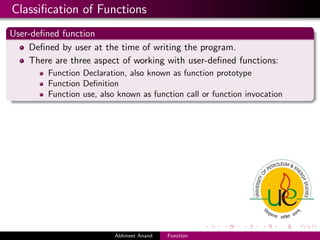
Classification of Functions
User-defined function
Defined by user at the time of writing the program.
There are three aspect of working with user-defined functions:
Function Declaration, also known as function prototype
Function Definition
Function use, also known as function call or function invocation

Abhineet Anand

Function
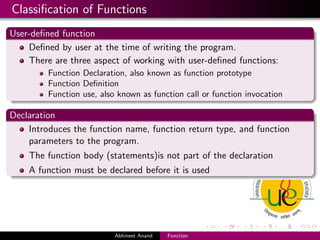
Classification of Functions
User-defined function
Defined by user at the time of writing the program.
There are three aspect of working with user-defined functions:
Function Declaration, also known as function prototype
Function Definition
Function use, also known as function call or function invocation

Declaration
Introduces the function name, function return type, and function
parameters to the program.
The function body (statements)is not part of the declaration
A function must be declared before it is used

Abhineet Anand

Function
Classification of Functions
User-defined function
Defined by user at the time of writing the program.
There are three aspect of working with user-defined functions:
Function Declaration, also known as function prototype
Function Definition
Function use, also known as function call or function invocation

Declaration
Introduces the function name, function return type, and function
parameters to the program.
The function body (statements)is not part of the declaration
A function must be declared before it is used
return_type function_name(parameter_list);
parameter_list: type param1,type param2,type param3, etc
double sqrt(double);
int func1();
Abhineet Anand

Function
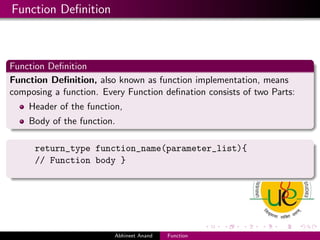
Function Definition

Function Definition
Function Definition, also known as function implementation, means
composing a function. Every Function defination consists of two Parts:
Header of the function,
Body of the function.

Abhineet Anand

Function
Function Definition

Function Definition
Function Definition, also known as function implementation, means
composing a function. Every Function defination consists of two Parts:
Header of the function,
Body of the function.
return_type function_name(parameter_list){
// Function body }

Abhineet Anand

Function
Function Definition
Function Definition
The general form of header of a function is:
[return_type] function_name([parameter_list])
The header of function is not terminated with a semicolon.
The body of a function consist of a set of statements enclosed
within braces.
The return statement is used to return the result of the computations
done in the called function and/or to return the program control back
to the calling function.
A function can be defined in any part of the program text or within a
library.
void print_func(){cout << hello world << endl;}

Abhineet Anand

Function
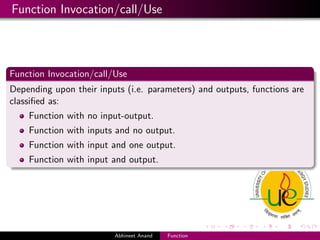
Function Invocation/call/Use

Function Invocation/call/Use
Depending upon their inputs (i.e. parameters) and outputs, functions are
classified as:
Function with no input-output.
Function with inputs and no output.
Function with input and one output.
Function with input and output.

Abhineet Anand

Function
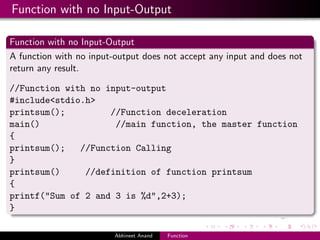
Function with no Input-Output
A function with no input-output does not accept any input and does not
return any result.
//Function with no input-output
#include<stdio.h>
printsum();
//Function deceleration
main()
//main function, the master function
{
printsum();
//Function Calling
}
printsum()
//definition of function printsum
{
printf("Sum of 2 and 3 is %d",2+3);
}
Abhineet Anand

Function
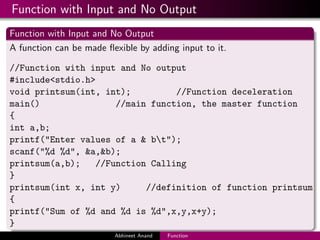
Function with Input and No Output
A function can be made flexible by adding input to it.
//Function with input and No output
#include<stdio.h>
void printsum(int, int);
//Function deceleration
main()
//main function, the master function
{
int a,b;
printf("Enter values of a & bt");
scanf("%d %d", &a,&b);
printsum(a,b);
//Function Calling
}
printsum(int x, int y)
//definition of function printsum
{
printf("Sum of %d and %d is %d",x,y,x+y);
}
Abhineet Anand

Function
Function with Input and No Output

Function with Input and No Output
The expression that appear within parenthesis of function call are
known as actual arguments.
The variable declared in the parameter list in the function header are
known as formal parameters.
The below-mentioned steps are followed when a function with input is
invoked:
1
2

3

The Actual arguments expression are evaluated.
The program control is transfered to the called function and the result
of the evaluation of the actual argument expression are assigned to the
formal parameters on one-to-one basis.
The execution of the calling function is suspended and the called
function starts execution.

Abhineet Anand

Function
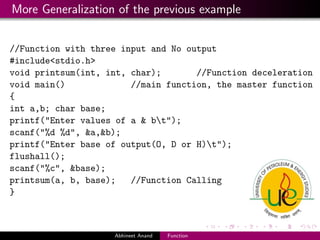
More Generalization of the previous example
//Function with three input and No output
#include<stdio.h>
void printsum(int, int, char);
//Function deceleration
void main()
//main function, the master function
{
int a,b; char base;
printf("Enter values of a & bt");
scanf("%d %d", &a,&b);
printf("Enter base of output(O, D or H)t");
flushall();
scanf("%c", &base);
printsum(a, b, base);
//Function Calling
}

Abhineet Anand

Function
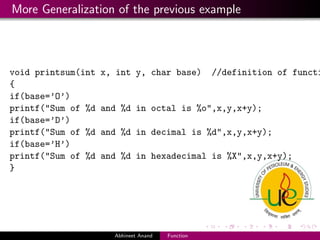
More Generalization of the previous example

void printsum(int
{
if(base=’O’)
printf("Sum of %d
if(base=’D’)
printf("Sum of %d
if(base=’H’)
printf("Sum of %d
}

x, int y, char base)

//definition of functi

and %d in octal is %o",x,y,x+y);
and %d in decimal is %d",x,y,x+y);
and %d in hexadecimal is %X",x,y,x+y);

Abhineet Anand

Function
Function with Input and One Output
The Result of the computation may be required in the calling function
for further processing. The best software engineering practices
suggest the following:
1

2

The developed functions should be kept as general as possible so that
they can be used in different situations.
A function should receive inputs in the form of arguments and return
the result of computation instead of directly printing it. A function
should behave like a ’black box’ that receive inputs, and outputs the
desired value.

Abhineet Anand

Function
Function with Input and One Output
The Result of the computation may be required in the calling function
for further processing. The best software engineering practices
suggest the following:
1

2

The developed functions should be kept as general as possible so that
they can be used in different situations.
A function should receive inputs in the form of arguments and return
the result of computation instead of directly printing it. A function
should behave like a ’black box’ that receive inputs, and outputs the
desired value.

return statement
The return statement is used to return the result of the computations
performed in the called function and/or transfer the program control
back to the calling function.
There are two forms of the return statement:
1
2

return,
return expression.
Abhineet Anand

Function
Function with Input and One Output

Abhineet Anand

Function
Function with Input and Output

Function with Input and Output
More than one value can be indirectly returned to the calling function
by making the use of Pointer.
Pointers can also be used to pass arguments to a function.
Depending upon whether the values or addresses(i.e. pointer) are
passed as arguments to a function, the argument passing methods in
C language are classified as:
1
2

Pass by value,
Pass by address

Abhineet Anand

Function
Function with Input and Output

Passing Arguments by Value
The method of passing arguments by value is also known as call by
value.
The value of actual argument are copied to the formal parameters of
the function.
If the argument are passed by value, the change made in the values of
formal parameters inside the called function are not reflected back to
the calling function.

Abhineet Anand

Function
Function with Input and Output

Abhineet Anand

Function
Function with Input and Output

Passing Arguments by Address/Reference
The method of passing arguments by address or reference is also
known as call by Address or Call by reference.
The address of the actual arguments are passed to the formal
parameters of the function.
If, the arguments are passed by reference, the change made in the
values pointed to by the formal parameter in the called function are
reflected back to the calling function.

Abhineet Anand

Function
Function with Input and Output

Abhineet Anand

Function
Function with Input and Output

Abhineet Anand

Function
Passing Arrays to function
Like simple variable, arrays can also be passed to functions.
There are two ways to pass array to function:
Passing individual elements of an array one by one.
Passing an Entire array at a time.

Abhineet Anand

Function
Passing Arrays to function
Like simple variable, arrays can also be passed to functions.
There are two ways to pass array to function:
Passing individual elements of an array one by one.
Passing an Entire array at a time.

Passing individual element
Passing individual element of an array one by one is similar to passing
basic variables.
The individual elements of an array can be passed either by value or
by reference.

Abhineet Anand

Function
Passing Arrays to function
Like simple variable, arrays can also be passed to functions.
There are two ways to pass array to function:
Passing individual elements of an array one by one.
Passing an Entire array at a time.

Passing individual element
Passing individual element of an array one by one is similar to passing
basic variables.
The individual elements of an array can be passed either by value or
by reference.
Passing entire array at a time
Passing entire array at a time is preferred way of passing arrays to
functions. The entire array is always passed by reference.
Abhineet Anand

Function

Function in C

  • 1.
    Function Abhineet Anand Center ForInformation Technology College of Engineering Studies UPES Dehradun, India November 18, 2013 Abhineet Anand Function
  • 2.
  • 3.
    Function Definition A Function isa self-contained block of statement that perform a coherent task of some kind. Abhineet Anand Function
  • 4.
    Function Definition A Function isa self-contained block of statement that perform a coherent task of some kind. 1 Every C Program can be thought of as a collection of these functions. 2 Function is a set of instruction to carryout a particular task. 3 Function after its execution returns a single value. 4 Generally, the function are classified into standard function and user-defined functions. 5 The Standard function are also called library function or built-in function. 6 All standard function, such as sqrt(), abs(), log(), sin() etc. are provided in the library of function. 7 But, most of the application need other functions than those available in the software, those are known as user-defined functions. Abhineet Anand Function
  • 5.
  • 6.
    Need of Function Severaladvantages of modularizing a program into function includes: Reduction in code redundancy Enabling code reuse Better readability Information Hiding Improved debugging and testing Improved maintainability Abhineet Anand Function
  • 7.
    Need of Function Severaladvantages of modularizing a program into function includes: Reduction in code redundancy Enabling code reuse Better readability Information Hiding Improved debugging and testing Improved maintainability Function interact with each other to accomplish a particular task. They are classified according to the following criteria: Based upon who develop the function Based upon the number of arguments a function accepts. Abhineet Anand Function
  • 8.
    Classification of Functions User-definedfunction Defined by user at the time of writing the program. There are three aspect of working with user-defined functions: Function Declaration, also known as function prototype Function Definition Function use, also known as function call or function invocation Abhineet Anand Function
  • 9.
    Classification of Functions User-definedfunction Defined by user at the time of writing the program. There are three aspect of working with user-defined functions: Function Declaration, also known as function prototype Function Definition Function use, also known as function call or function invocation Declaration Introduces the function name, function return type, and function parameters to the program. The function body (statements)is not part of the declaration A function must be declared before it is used Abhineet Anand Function
  • 10.
    Classification of Functions User-definedfunction Defined by user at the time of writing the program. There are three aspect of working with user-defined functions: Function Declaration, also known as function prototype Function Definition Function use, also known as function call or function invocation Declaration Introduces the function name, function return type, and function parameters to the program. The function body (statements)is not part of the declaration A function must be declared before it is used return_type function_name(parameter_list); parameter_list: type param1,type param2,type param3, etc double sqrt(double); int func1(); Abhineet Anand Function
  • 11.
    Function Definition Function Definition FunctionDefinition, also known as function implementation, means composing a function. Every Function defination consists of two Parts: Header of the function, Body of the function. Abhineet Anand Function
  • 12.
    Function Definition Function Definition FunctionDefinition, also known as function implementation, means composing a function. Every Function defination consists of two Parts: Header of the function, Body of the function. return_type function_name(parameter_list){ // Function body } Abhineet Anand Function
  • 13.
    Function Definition Function Definition Thegeneral form of header of a function is: [return_type] function_name([parameter_list]) The header of function is not terminated with a semicolon. The body of a function consist of a set of statements enclosed within braces. The return statement is used to return the result of the computations done in the called function and/or to return the program control back to the calling function. A function can be defined in any part of the program text or within a library. void print_func(){cout << hello world << endl;} Abhineet Anand Function
  • 14.
    Function Invocation/call/Use Function Invocation/call/Use Dependingupon their inputs (i.e. parameters) and outputs, functions are classified as: Function with no input-output. Function with inputs and no output. Function with input and one output. Function with input and output. Abhineet Anand Function
  • 15.
    Function with noInput-Output Function with no Input-Output A function with no input-output does not accept any input and does not return any result. //Function with no input-output #include<stdio.h> printsum(); //Function deceleration main() //main function, the master function { printsum(); //Function Calling } printsum() //definition of function printsum { printf("Sum of 2 and 3 is %d",2+3); } Abhineet Anand Function
  • 16.
    Function with Inputand No Output Function with Input and No Output A function can be made flexible by adding input to it. //Function with input and No output #include<stdio.h> void printsum(int, int); //Function deceleration main() //main function, the master function { int a,b; printf("Enter values of a & bt"); scanf("%d %d", &a,&b); printsum(a,b); //Function Calling } printsum(int x, int y) //definition of function printsum { printf("Sum of %d and %d is %d",x,y,x+y); } Abhineet Anand Function
  • 17.
    Function with Inputand No Output Function with Input and No Output The expression that appear within parenthesis of function call are known as actual arguments. The variable declared in the parameter list in the function header are known as formal parameters. The below-mentioned steps are followed when a function with input is invoked: 1 2 3 The Actual arguments expression are evaluated. The program control is transfered to the called function and the result of the evaluation of the actual argument expression are assigned to the formal parameters on one-to-one basis. The execution of the calling function is suspended and the called function starts execution. Abhineet Anand Function
  • 18.
    More Generalization ofthe previous example //Function with three input and No output #include<stdio.h> void printsum(int, int, char); //Function deceleration void main() //main function, the master function { int a,b; char base; printf("Enter values of a & bt"); scanf("%d %d", &a,&b); printf("Enter base of output(O, D or H)t"); flushall(); scanf("%c", &base); printsum(a, b, base); //Function Calling } Abhineet Anand Function
  • 19.
    More Generalization ofthe previous example void printsum(int { if(base=’O’) printf("Sum of %d if(base=’D’) printf("Sum of %d if(base=’H’) printf("Sum of %d } x, int y, char base) //definition of functi and %d in octal is %o",x,y,x+y); and %d in decimal is %d",x,y,x+y); and %d in hexadecimal is %X",x,y,x+y); Abhineet Anand Function
  • 20.
    Function with Inputand One Output Function with Input and One Output The Result of the computation may be required in the calling function for further processing. The best software engineering practices suggest the following: 1 2 The developed functions should be kept as general as possible so that they can be used in different situations. A function should receive inputs in the form of arguments and return the result of computation instead of directly printing it. A function should behave like a ’black box’ that receive inputs, and outputs the desired value. Abhineet Anand Function
  • 21.
    Function with Inputand One Output Function with Input and One Output The Result of the computation may be required in the calling function for further processing. The best software engineering practices suggest the following: 1 2 The developed functions should be kept as general as possible so that they can be used in different situations. A function should receive inputs in the form of arguments and return the result of computation instead of directly printing it. A function should behave like a ’black box’ that receive inputs, and outputs the desired value. return statement The return statement is used to return the result of the computations performed in the called function and/or transfer the program control back to the calling function. There are two forms of the return statement: 1 2 return, return expression. Abhineet Anand Function
  • 22.
    Function with Inputand One Output Abhineet Anand Function
  • 23.
    Function with Inputand Output Function with Input and Output More than one value can be indirectly returned to the calling function by making the use of Pointer. Pointers can also be used to pass arguments to a function. Depending upon whether the values or addresses(i.e. pointer) are passed as arguments to a function, the argument passing methods in C language are classified as: 1 2 Pass by value, Pass by address Abhineet Anand Function
  • 24.
    Function with Inputand Output Passing Arguments by Value The method of passing arguments by value is also known as call by value. The value of actual argument are copied to the formal parameters of the function. If the argument are passed by value, the change made in the values of formal parameters inside the called function are not reflected back to the calling function. Abhineet Anand Function
  • 25.
    Function with Inputand Output Abhineet Anand Function
  • 26.
    Function with Inputand Output Passing Arguments by Address/Reference The method of passing arguments by address or reference is also known as call by Address or Call by reference. The address of the actual arguments are passed to the formal parameters of the function. If, the arguments are passed by reference, the change made in the values pointed to by the formal parameter in the called function are reflected back to the calling function. Abhineet Anand Function
  • 27.
    Function with Inputand Output Abhineet Anand Function
  • 28.
    Function with Inputand Output Abhineet Anand Function
  • 29.
    Passing Arrays tofunction Passing Arrays to function Like simple variable, arrays can also be passed to functions. There are two ways to pass array to function: Passing individual elements of an array one by one. Passing an Entire array at a time. Abhineet Anand Function
  • 30.
    Passing Arrays tofunction Passing Arrays to function Like simple variable, arrays can also be passed to functions. There are two ways to pass array to function: Passing individual elements of an array one by one. Passing an Entire array at a time. Passing individual element Passing individual element of an array one by one is similar to passing basic variables. The individual elements of an array can be passed either by value or by reference. Abhineet Anand Function
  • 31.
    Passing Arrays tofunction Passing Arrays to function Like simple variable, arrays can also be passed to functions. There are two ways to pass array to function: Passing individual elements of an array one by one. Passing an Entire array at a time. Passing individual element Passing individual element of an array one by one is similar to passing basic variables. The individual elements of an array can be passed either by value or by reference. Passing entire array at a time Passing entire array at a time is preferred way of passing arrays to functions. The entire array is always passed by reference. Abhineet Anand Function