1 
Inheritance and Polymorphism 
Andrew Davison 
Noppadon Kamolvilassatian 
Department of Computer Engineering 
Prince of Songkla University
2 
Contents 
1. Key OOP Features 
2. Inheritance Concepts 
3. Inheritance Examples 
4. Implementing Inheritance in C++ 
5. Polymorphism 
6. Inclusion (Dynamic Binding) 
7. Virtual Function Examples 
8. C++ Pros and Cons
3 
1. Key OOP Features 
ADTs (done in the last section) 
Inheritance 
Polymorphism
4 
2. Inheritance Concepts 
Derive a new class (subclass) from an existing class (base class or superclass). 
Inheritance creates a hierarchy of related classes (types) which share code and interface.
5 
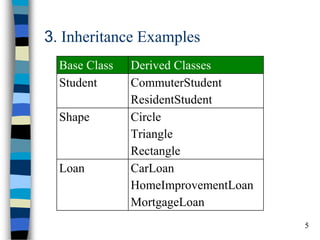
3. Inheritance Examples 
Base ClassDerived ClassesStudentCommuterStudentResidentStudentShapeCircleTriangleRectangleLoanCarLoanHomeImprovementLoanMortgageLoan
6 
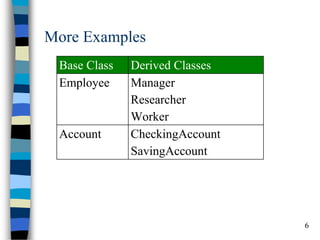
More Examples 
Base ClassDerived ClassesEmployeeManagerResearcherWorkerAccountCheckingAccountSavingAccount
7 
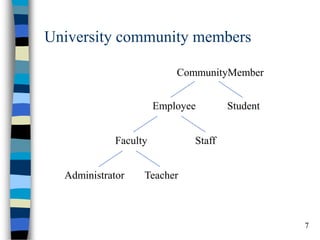
University community members 
Employee 
CommunityMember 
Student 
Faculty 
Staff 
Administrator 
Teacher
8 
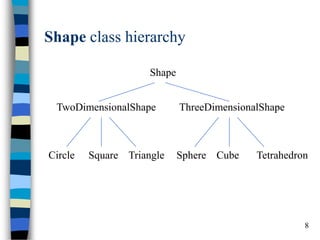
Shape class hierarchy 
TwoDimensionalShape 
Shape 
ThreeDimensionalShape 
Circle 
Square 
Triangle 
Sphere 
Cube 
Tetrahedron
9 
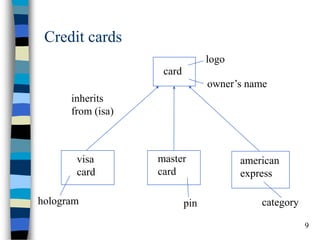
Credit cards 
logo 
american express 
hologram 
card 
owner’s name 
inherits from (isa) 
visa card 
master card 
pin 
category
10 
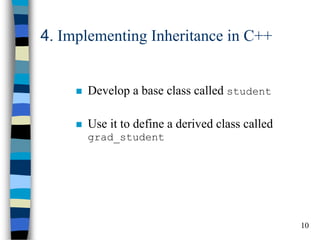
4. Implementing Inheritance in C++ 
Develop a base class called student 
Use it to define a derived class called grad_student
11 
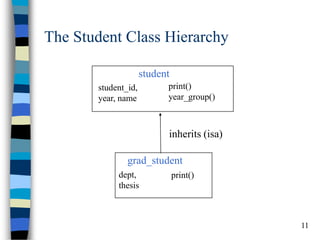
The Student Class Hierarchy 
student 
print() year_group() 
grad_student 
print() 
inherits (isa) 
student_id, year, name 
dept, thesis
12 
Student Class 
class student { public: student(char* nm, int id, int y); void print(); int year_group() { return year; } private: int student_id; int year; char name[30]; };
13 
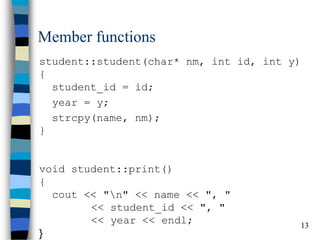
Member functions 
student::student(char* nm, int id, int y) { student_id = id; 
year = y; 
strcpy(name, nm); } void student::print() { cout << "n" << name << ", " << student_id << ", " << year << endl; }
14 
Graduate Student Class 
class grad_student: public student { public: grad_student(char* nm, int id, int y, char* d, char* th); void print(); private: char dept[10]; char thesis[80]; };
15 
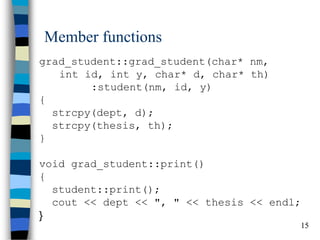
Member functions 
grad_student::grad_student(char* nm, int id, int y, char* d, char* th) :student(nm, id, y) { strcpy(dept, d); strcpy(thesis, th); } void grad_student::print() { student::print(); cout << dept << ", " << thesis << endl; }
16 
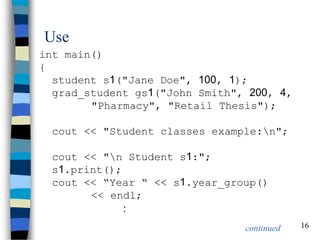
Use 
int main() { student s1("Jane Doe", 100, 1); grad_student gs1("John Smith", 200, 4, "Pharmacy", "Retail Thesis"); cout << "Student classes example:n"; cout << "n Student s1:"; s1.print(); cout << “Year “ << s1.year_group() << endl; : 
continued
17 
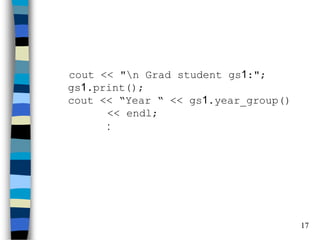
cout << "n Grad student gs1:"; gs1.print(); cout << “Year “ << gs1.year_group() << endl; :
18 
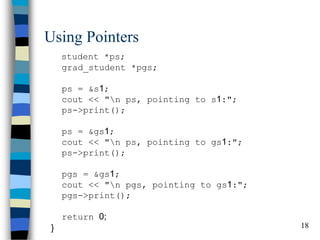
Using Pointers 
student *ps; grad_student *pgs; ps = &s1; cout << "n ps, pointing to s1:"; ps->print(); ps = &gs1; cout << "n ps, pointing to gs1:"; ps->print(); pgs = &gs1; cout << "n pgs, pointing to gs1:"; pgs->print(); return 0; }
19 
Output 
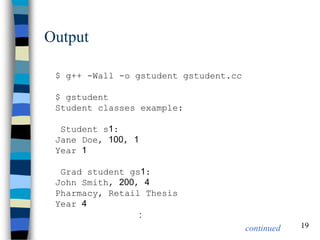
$ g++ -Wall -o gstudent gstudent.cc $ gstudent Student classes example: Student s1: Jane Doe, 100, 1 Year 1 Grad student gs1: John Smith, 200, 4 Pharmacy, Retail Thesis Year 4 : 
continued
20 
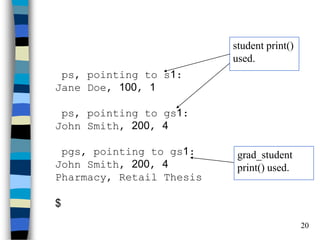
ps, pointing to s1: Jane Doe, 100, 1 ps, pointing to gs1: John Smith, 200, 4 pgs, pointing to gs1: John Smith, 200, 4 Pharmacy, Retail Thesis $ 
student print() used. 
grad_student print() used.
21 
Notes 
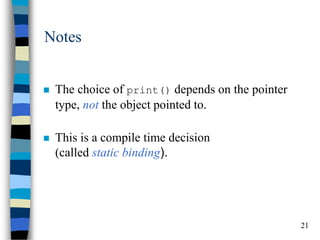
The choice of print() depends on the pointer type, not the object pointed to. 
This is a compile time decision (called static binding).
22 
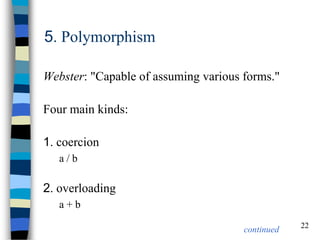
5. Polymorphism 
Webster: "Capable of assuming various forms." 
Four main kinds: 
1. coercion 
a / b 
2. overloading 
a + b 
continued
23 
3. inclusion (dynamic binding) 
–Dynamic binding of a function call to a function. 
4. parametric 
–The type argument is left unspecified and is later instantiated 
e.g generics, templates
24 
6. Inclusion (dynamic binding) 
5.1. Dynamic Binding in OOP 
5.2. Virtual Function Example 
5.3. Representing Shapes 
5.4. Dynamic Binding Reviewed
25 
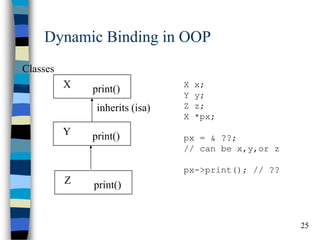
Dynamic Binding in OOP 
X 
print() 
Classes 
Y 
print() 
Z 
print() 
inherits (isa) 
X x; Y y; Z z; X *px; px = & ??; // can be x,y,or z px->print(); // ??
26 
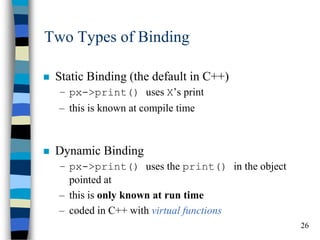
Two Types of Binding 
Static Binding (the default in C++) 
–px->print() uses X’s print 
–this is known at compile time 
Dynamic Binding 
–px->print() uses the print() in the object pointed at 
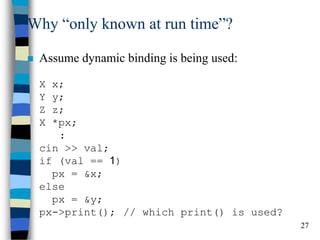
–this is only known at run time 
–coded in C++ with virtual functions
27 
Why “only known at run time”? 
Assume dynamic binding is being used: X x; Y y; Z z; X *px; : cin >> val; if (val == 1) px = &x; else px = &y; px->print(); // which print() is used?
28 
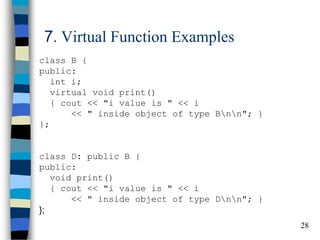
7. Virtual Function Examples 
class B { public: int i; virtual void print() { cout << "i value is " << i << " inside object of type Bnn"; } }; class D: public B { public: void print() { cout << "i value is " << i << " inside object of type Dnn"; } };
29 
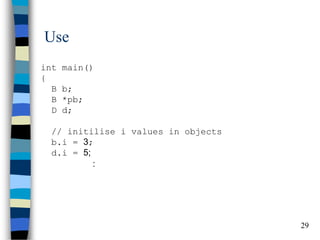
Use 
int main() { B b; B *pb; D d; // initilise i values in objects b.i = 3; d.i = 5; :
30 
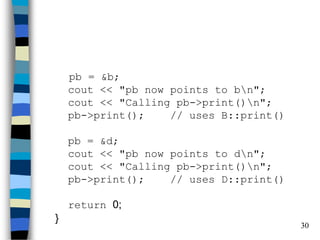
pb = &b; cout << "pb now points to bn"; cout << "Calling pb->print()n"; pb->print(); // uses B::print() pb = &d; cout << "pb now points to dn"; cout << "Calling pb->print()n"; pb->print(); // uses D::print() return 0; }
31 
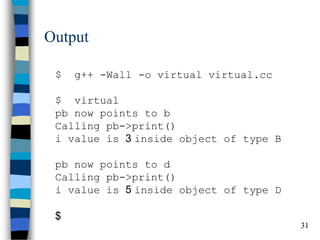
Output 
$ g++ -Wall -o virtual virtual.cc $ virtual pb now points to b Calling pb->print() i value is 3 inside object of type B pb now points to d Calling pb->print() i value is 5 inside object of type D $
32 
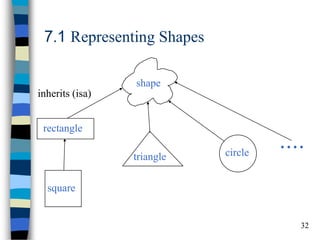
7.1 Representing Shapes 
shape 
rectangle 
square 
triangle 
circle 
• • • • 
inherits (isa)
33 
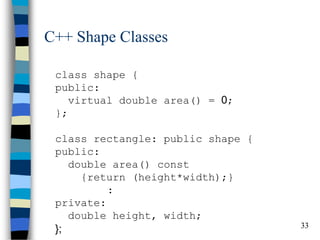
C++ Shape Classes 
class shape { public: virtual double area() = 0; }; class rectangle: public shape { public: double area() const {return (height*width);} : private: double height, width; };
34 
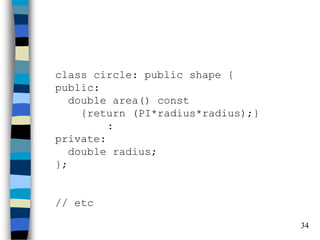
class circle: public shape { public: double area() const {return (PI*radius*radius);} : private: double radius; }; // etc
35 
Use: 
shape* p[N]; circle c1,...; rectangle r1,...; : // fill in p with pointers to // circles, squares, etc p[0] = &c1; p[1] = &r1; ... : : // calculate total area for (i = 0; i < N; ++i) tot_area = tot_area + p[i]->area();
36 
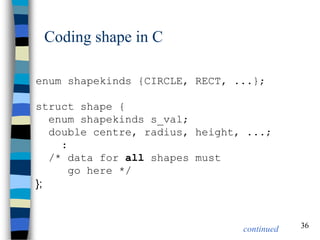
Coding shape in C 
enum shapekinds {CIRCLE, RECT, ...}; struct shape { enum shapekinds s_val; double centre, radius, height, ...; : /* data for all shapes must go here */ }; 
continued
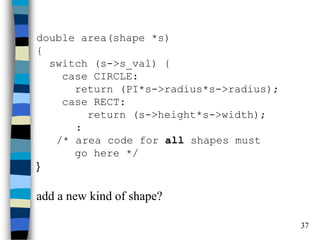
37 
double area(shape *s) { switch (s->s_val) { case CIRCLE: return (PI*s->radius*s->radius); case RECT: return (s->height*s->width); : /* area code for all shapes must go here */ } 
add a new kind of shape?
38 
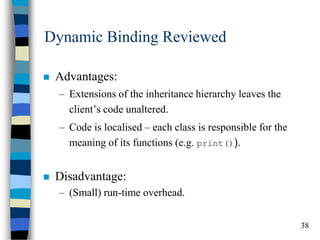
Dynamic Binding Reviewed 
Advantages: 
–Extensions of the inheritance hierarchy leaves the client’s code unaltered. 
–Code is localised – each class is responsible for the meaning of its functions (e.g. print()). 
Disadvantage: 
–(Small) run-time overhead.
39 
8. C++ Pros and Cons 
6.1. Reasons for using C++ 
6.2. Reasons for not using C++
40 
8.1 Reasons for using C++ 
bandwagon effect 
C++ is a superset of C 
–familiarity 
–installed base can be kept 
–can ‘pretend’ to code in C++ 
efficient implementation 
continued
41 
low-level and high-level features 
portable 
a better C 
no need for fancy OOP resources
42 
8.2 Reasons for not using C++ 
a hybrid 
size 
confusing syntax and semantics 
programmers must decide between efficiency and elegance 
no automatic garbage collection

L10

  • 1.
    1 Inheritance andPolymorphism Andrew Davison Noppadon Kamolvilassatian Department of Computer Engineering Prince of Songkla University
  • 2.
    2 Contents 1.Key OOP Features 2. Inheritance Concepts 3. Inheritance Examples 4. Implementing Inheritance in C++ 5. Polymorphism 6. Inclusion (Dynamic Binding) 7. Virtual Function Examples 8. C++ Pros and Cons
  • 3.
    3 1. KeyOOP Features ADTs (done in the last section) Inheritance Polymorphism
  • 4.
    4 2. InheritanceConcepts Derive a new class (subclass) from an existing class (base class or superclass). Inheritance creates a hierarchy of related classes (types) which share code and interface.
  • 5.
    5 3. InheritanceExamples Base ClassDerived ClassesStudentCommuterStudentResidentStudentShapeCircleTriangleRectangleLoanCarLoanHomeImprovementLoanMortgageLoan
  • 6.
    6 More Examples Base ClassDerived ClassesEmployeeManagerResearcherWorkerAccountCheckingAccountSavingAccount
  • 7.
    7 University communitymembers Employee CommunityMember Student Faculty Staff Administrator Teacher
  • 8.
    8 Shape classhierarchy TwoDimensionalShape Shape ThreeDimensionalShape Circle Square Triangle Sphere Cube Tetrahedron
  • 9.
    9 Credit cards logo american express hologram card owner’s name inherits from (isa) visa card master card pin category
  • 10.
    10 4. ImplementingInheritance in C++ Develop a base class called student Use it to define a derived class called grad_student
  • 11.
    11 The StudentClass Hierarchy student print() year_group() grad_student print() inherits (isa) student_id, year, name dept, thesis
  • 12.
    12 Student Class class student { public: student(char* nm, int id, int y); void print(); int year_group() { return year; } private: int student_id; int year; char name[30]; };
  • 13.
    13 Member functions student::student(char* nm, int id, int y) { student_id = id; year = y; strcpy(name, nm); } void student::print() { cout << "n" << name << ", " << student_id << ", " << year << endl; }
  • 14.
    14 Graduate StudentClass class grad_student: public student { public: grad_student(char* nm, int id, int y, char* d, char* th); void print(); private: char dept[10]; char thesis[80]; };
  • 15.
    15 Member functions grad_student::grad_student(char* nm, int id, int y, char* d, char* th) :student(nm, id, y) { strcpy(dept, d); strcpy(thesis, th); } void grad_student::print() { student::print(); cout << dept << ", " << thesis << endl; }
  • 16.
    16 Use intmain() { student s1("Jane Doe", 100, 1); grad_student gs1("John Smith", 200, 4, "Pharmacy", "Retail Thesis"); cout << "Student classes example:n"; cout << "n Student s1:"; s1.print(); cout << “Year “ << s1.year_group() << endl; : continued
  • 17.
    17 cout <<"n Grad student gs1:"; gs1.print(); cout << “Year “ << gs1.year_group() << endl; :
  • 18.
    18 Using Pointers student *ps; grad_student *pgs; ps = &s1; cout << "n ps, pointing to s1:"; ps->print(); ps = &gs1; cout << "n ps, pointing to gs1:"; ps->print(); pgs = &gs1; cout << "n pgs, pointing to gs1:"; pgs->print(); return 0; }
  • 19.
    19 Output $g++ -Wall -o gstudent gstudent.cc $ gstudent Student classes example: Student s1: Jane Doe, 100, 1 Year 1 Grad student gs1: John Smith, 200, 4 Pharmacy, Retail Thesis Year 4 : continued
  • 20.
    20 ps, pointingto s1: Jane Doe, 100, 1 ps, pointing to gs1: John Smith, 200, 4 pgs, pointing to gs1: John Smith, 200, 4 Pharmacy, Retail Thesis $ student print() used. grad_student print() used.
  • 21.
    21 Notes Thechoice of print() depends on the pointer type, not the object pointed to. This is a compile time decision (called static binding).
  • 22.
    22 5. Polymorphism Webster: "Capable of assuming various forms." Four main kinds: 1. coercion a / b 2. overloading a + b continued
  • 23.
    23 3. inclusion(dynamic binding) –Dynamic binding of a function call to a function. 4. parametric –The type argument is left unspecified and is later instantiated e.g generics, templates
  • 24.
    24 6. Inclusion(dynamic binding) 5.1. Dynamic Binding in OOP 5.2. Virtual Function Example 5.3. Representing Shapes 5.4. Dynamic Binding Reviewed
  • 25.
    25 Dynamic Bindingin OOP X print() Classes Y print() Z print() inherits (isa) X x; Y y; Z z; X *px; px = & ??; // can be x,y,or z px->print(); // ??
  • 26.
    26 Two Typesof Binding Static Binding (the default in C++) –px->print() uses X’s print –this is known at compile time Dynamic Binding –px->print() uses the print() in the object pointed at –this is only known at run time –coded in C++ with virtual functions
  • 27.
    27 Why “onlyknown at run time”? Assume dynamic binding is being used: X x; Y y; Z z; X *px; : cin >> val; if (val == 1) px = &x; else px = &y; px->print(); // which print() is used?
  • 28.
    28 7. VirtualFunction Examples class B { public: int i; virtual void print() { cout << "i value is " << i << " inside object of type Bnn"; } }; class D: public B { public: void print() { cout << "i value is " << i << " inside object of type Dnn"; } };
  • 29.
    29 Use intmain() { B b; B *pb; D d; // initilise i values in objects b.i = 3; d.i = 5; :
  • 30.
    30 pb =&b; cout << "pb now points to bn"; cout << "Calling pb->print()n"; pb->print(); // uses B::print() pb = &d; cout << "pb now points to dn"; cout << "Calling pb->print()n"; pb->print(); // uses D::print() return 0; }
  • 31.
    31 Output $g++ -Wall -o virtual virtual.cc $ virtual pb now points to b Calling pb->print() i value is 3 inside object of type B pb now points to d Calling pb->print() i value is 5 inside object of type D $
  • 32.
    32 7.1 RepresentingShapes shape rectangle square triangle circle • • • • inherits (isa)
  • 33.
    33 C++ ShapeClasses class shape { public: virtual double area() = 0; }; class rectangle: public shape { public: double area() const {return (height*width);} : private: double height, width; };
  • 34.
    34 class circle:public shape { public: double area() const {return (PI*radius*radius);} : private: double radius; }; // etc
  • 35.
    35 Use: shape*p[N]; circle c1,...; rectangle r1,...; : // fill in p with pointers to // circles, squares, etc p[0] = &c1; p[1] = &r1; ... : : // calculate total area for (i = 0; i < N; ++i) tot_area = tot_area + p[i]->area();
  • 36.
    36 Coding shapein C enum shapekinds {CIRCLE, RECT, ...}; struct shape { enum shapekinds s_val; double centre, radius, height, ...; : /* data for all shapes must go here */ }; continued
  • 37.
    37 double area(shape*s) { switch (s->s_val) { case CIRCLE: return (PI*s->radius*s->radius); case RECT: return (s->height*s->width); : /* area code for all shapes must go here */ } add a new kind of shape?
  • 38.
    38 Dynamic BindingReviewed Advantages: –Extensions of the inheritance hierarchy leaves the client’s code unaltered. –Code is localised – each class is responsible for the meaning of its functions (e.g. print()). Disadvantage: –(Small) run-time overhead.
  • 39.
    39 8. C++Pros and Cons 6.1. Reasons for using C++ 6.2. Reasons for not using C++
  • 40.
    40 8.1 Reasonsfor using C++ bandwagon effect C++ is a superset of C –familiarity –installed base can be kept –can ‘pretend’ to code in C++ efficient implementation continued
  • 41.
    41 low-level andhigh-level features portable a better C no need for fancy OOP resources
  • 42.
    42 8.2 Reasonsfor not using C++ a hybrid size confusing syntax and semantics programmers must decide between efficiency and elegance no automatic garbage collection