1
CSC241: Object Oriented Programming
Lecture No 04
2
Previous Lecture
• Constructor – example program
• Placing class in separate file
• Destructor – example program
• Constructor with arguments – example
program
3
Today’s Lecture
• Overloaded function
– Constructor
• const (constant)
– object
– member function
– data member
– object as function argument
• friend function
• this pointer
4
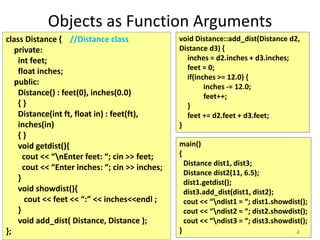
Objects as Function Arguments
class Distance { //Distance class
private:
int feet;
float inches;
public:
Distance() : feet(0), inches(0.0)
{ }
Distance(int ft, float in) : feet(ft),
inches(in)
{ }
void getdist(){
cout << “nEnter feet: “; cin >> feet;
cout << “Enter inches: “; cin >> inches;
}
void showdist(){
cout << feet << “:” << inches<<endl ;
}
void add_dist( Distance, Distance );
};
void Distance::add_dist(Distance d2,
Distance d3) {
inches = d2.inches + d3.inches;
feet = 0;
if(inches >= 12.0) {
inches -= 12.0;
feet++;
}
feet += d2.feet + d3.feet;
}
main()
{
Distance dist1, dist3;
Distance dist2(11, 6.5);
dist1.getdist();
dist3.add_dist(dist1, dist2);
cout << “ndist1 = “; dist1.showdist();
cout << “ndist2 = “; dist2.showdist();
cout << “ndist3 = “; dist3.showdist();
}
5
Overloaded Constructors
• It’s convenient to be able to give variables of type
Distance a value when they are first created
Distance dist2(11, 6.25);
• which defines an object, and initializes it to a value of
11 for feet and 6.25 for inches.
• Distance dist1, dist2; then No-argument constructor
is called/invoked (the default constructor)
• Since there are now two constructors with the
same name, Distance(), we say the constructor is
overloaded
6
Member Functions Defined Outside the
Class
• Such functions, needs to have a
prototype/declaration within the class
• The function name, add_dist(), is preceded by the
class name, Distance, and a new symbol—the
double colon (::). This symbol is called the scope
resolution operator.
• It is a way of specifying what class something is
associated with
• In this situation, Distance::add_dist() means “the
add_dist() member function of the Distance
class”
void Distance::add_dist(Distance d2, Distance d3)
7
Structures and Classes
• We used structures as a way to group data
and classes as a way to group both data and
functions
• In fact, you can use structures in almost
exactly the same way that you use classes
• The only formal difference between class and
struct is that in a class the members are
private by default, while in a structure they
are public by default.
8
Classes, Objects, and Memory
9
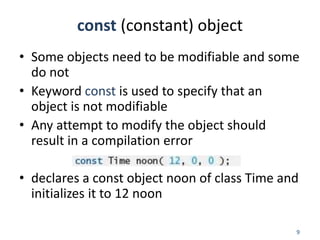
const (constant) object
• Some objects need to be modifiable and some
do not
• Keyword const is used to specify that an
object is not modifiable
• Any attempt to modify the object should
result in a compilation error
• declares a const object noon of class Time and
initializes it to 12 noon
10
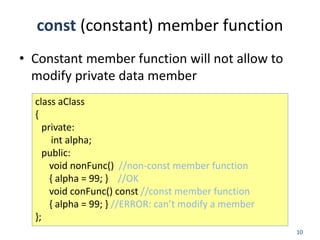
const (constant) member function
• Constant member function will not allow to
modify private data member
class aClass
{
private:
int alpha;
public:
void nonFunc() //non-const member function
{ alpha = 99; } //OK
void conFunc() const //const member function
{ alpha = 99; } //ERROR: can’t modify a member
};
11
Example – Time class
• Data members
• Member functions
program
12
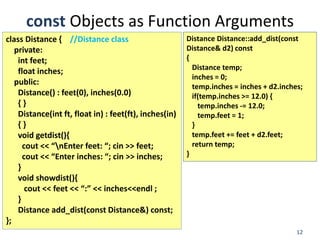
const Objects as Function Arguments
class Distance { //Distance class
private:
int feet;
float inches;
public:
Distance() : feet(0), inches(0.0)
{ }
Distance(int ft, float in) : feet(ft), inches(in)
{ }
void getdist(){
cout << “nEnter feet: “; cin >> feet;
cout << “Enter inches: “; cin >> inches;
}
void showdist(){
cout << feet << “:” << inches<<endl ;
}
Distance add_dist(const Distance&) const;
};
Distance Distance::add_dist(const
Distance& d2) const
{
Distance temp;
inches = 0;
temp.inches = inches + d2.inches;
if(temp.inches >= 12.0) {
temp.inches -= 12.0;
temp.feet = 1;
}
temp.feet += feet + d2.feet;
return temp;
}
13
Cont.
main()
{
Distance dist1, dist3;
Distance dist2(11, 6.25);
dist1.getdist();
dist3 = dist1.add_dist(dist2);
cout << "ndist1 = "; dist1.showdist();
cout << "ndist2 = "; dist2.showdist();
cout << "ndist3 = "; dist3.showdist();
}
feet
inches
dist1
0
0.0
feet
inches
dist3
0
0.0
feet
inches
dist2
11
6.5
void getdist(){
cout << “nEnter feet: “; cin >> feet;
cout << “Enter inches: “; cin >> inches;
}
5
7.0
Distance Distance::add_dist(const Distance& d2) const {
Distance temp;
temp.inches = inches + d2.inches;
if(temp.inches >= 12.0) {
temp.inches -= 12.0;
temp.feet = 1;
}
temp.feet += feet + d2.feet;
return temp;
}
feet
inches
temp
d2
13.5
1.5
1
17
void showdist(){
cout << feet << “:” << inches<<endl ;
}
dist1 = 5 : 7.0
dist2 = 11 : 6.5
dist3 = 17 : 1.5
Go to program
17
1.5
14
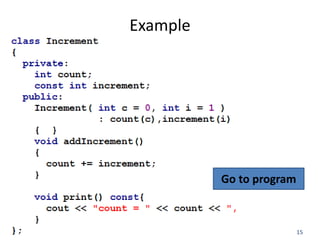
Initializing a const Data Member
• Constant data member must be initialized
using member initializer list
private:
int count;
const int increment;
• const data member must be initialized as soon
as the object is created
15
Example
Go to program
16
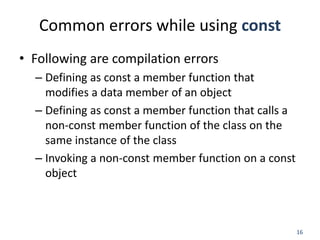
Common errors while using const
• Following are compilation errors
– Defining as const a member function that
modifies a data member of an object
– Defining as const a member function that calls a
non-const member function of the class on the
same instance of the class
– Invoking a non-const member function on a const
object
17
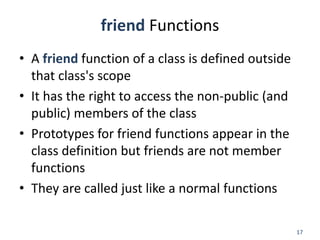
friend Functions
• A friend function of a class is defined outside
that class's scope
• It has the right to access the non-public (and
public) members of the class
• Prototypes for friend functions appear in the
class definition but friends are not member
functions
• They are called just like a normal functions
18
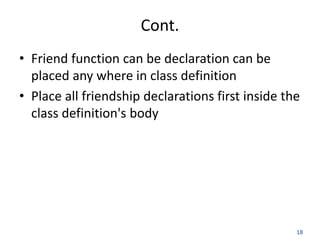
Cont.
• Friend function can be declaration can be
placed any where in class definition
• Place all friendship declarations first inside the
class definition's body
19
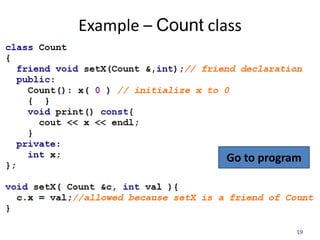
Example – Count class
Go to program
20
Using this pointer
• Object's member functions can manipulate
the object's data
• How do member functions know which
object's data members to manipulate?
• Every object has access to its own address
through a pointer called this
• this pointer is passed (by the compiler) as an
implicit argument to each of the object's non-
static member functions
21
Cont.
• An object's this pointer is not part of the
object itself
• The size of the memory occupied by the this
pointer is not reflected in the result of a sizeof
operation on the object
• Objects use this pointer implicitly or explicitly
to reference their data members and member
functions
22
Type of this pointer
• The type of the this pointer depends on the
type of the object
– non constant member function of class Employee,
the this pointer has type Employee * const
– constant member function of the class Employee,
the this pointer has the data type const Employee
* const
23
Implicitly and Explicitly Use this Pointer
Go to program
24
Cascading function calls using this pointer
• Multiple member functions are invoked in the same
statement
25
Cont.
• Why does the technique of returning *this as a
reference work?
• The dot operator (.) associates from left to right
• so line 14 first evaluates t.setHour( 18 ) then returns
a reference to object t
• The remaining expression is then interpreted as
– t.setMinute( 30 ).setSecond( 22 );
• t.setMinute( 30 ) call executes and returns a
reference to the object t.
– t.setSecond( 22 ); Go to program
26
static Data Members
• Each object of a class has its own copy of all
the data members of the class
• In certain cases, only one copy of a variable
should be shared by all objects of a class
• A static data member is used
• If a data item in a class is declared as static,
only one such item is created for the entire
class, no matter how many objects there are
27
Cont.
• A member static variable is visible only within
the class, but its lifetime is the entire program
• It continues to exist even if there are no
objects of the class
• A static data item is useful when all objects of
the same class must share a common item of
information
28
Uses of static data member
• Suppose an object needed to know how many
other objects of its class were in the program
• In a road-racing game, for example, a race car
might want to know how many other cars are
still in the race
• In this case a static variable count could be
included as a member of the class
• All the objects would have access to this
variable
29
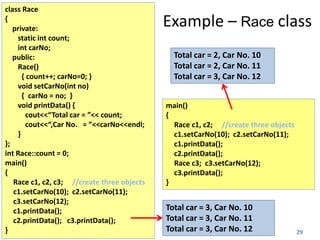
Example – Race class
class Race
{
private:
static int count;
int carNo;
public:
Race()
{ count++; carNo=0; }
void setCarNo(int no)
{ carNo = no; }
void printData() {
cout<<“Total car = ”<< count;
cout<<“,Car No. = ”<<carNo<<endl;
}
};
int Race::count = 0;
main()
{
Race c1, c2, c3; //create three objects
c1.setCarNo(10); c2.setCarNo(11);
c3.setCarNo(12);
c1.printData();
c2.printData(); c3.printData();
}
main()
{
Race c1, c2; //create three objects
c1.setCarNo(10); c2.setCarNo(11);
c1.printData();
c2.printData();
Race c3; c3.setCarNo(12);
c3.printData();
}
Total car = 3, Car No. 10
Total car = 3, Car No. 11
Total car = 3, Car No. 12
Total car = 2, Car No. 10
Total car = 2, Car No. 11
Total car = 3, Car No. 12
30
Composition – Objects as Members of Classes
• An AlarmClock object needs to know when it
is supposed to sound its alarm
• So why not include a Time object as a
member of the AlarmClock class
• It is refer as has-a relationship
• We will see how an object's constructor can
pass arguments to member-object
constructors
31
Example program
Date.h
Date class
Employee.h
Employee class
Date birthday
Date hiredate
Source_emp.cpp
Employee manager
Go to program
firstname
lastname
manager
birthday
day
month
year
hireday
day
month
year
32
33
Dynamic Memory Management
• C++ enables programmers to control the
allocation and deallocation of memory in a
program for any built-in or user-defined type
• Performed with operators new and delete

OOP.pptx

  • 1.
    1 CSC241: Object OrientedProgramming Lecture No 04
  • 2.
    2 Previous Lecture • Constructor– example program • Placing class in separate file • Destructor – example program • Constructor with arguments – example program
  • 3.
    3 Today’s Lecture • Overloadedfunction – Constructor • const (constant) – object – member function – data member – object as function argument • friend function • this pointer
  • 4.
    4 Objects as FunctionArguments class Distance { //Distance class private: int feet; float inches; public: Distance() : feet(0), inches(0.0) { } Distance(int ft, float in) : feet(ft), inches(in) { } void getdist(){ cout << “nEnter feet: “; cin >> feet; cout << “Enter inches: “; cin >> inches; } void showdist(){ cout << feet << “:” << inches<<endl ; } void add_dist( Distance, Distance ); }; void Distance::add_dist(Distance d2, Distance d3) { inches = d2.inches + d3.inches; feet = 0; if(inches >= 12.0) { inches -= 12.0; feet++; } feet += d2.feet + d3.feet; } main() { Distance dist1, dist3; Distance dist2(11, 6.5); dist1.getdist(); dist3.add_dist(dist1, dist2); cout << “ndist1 = “; dist1.showdist(); cout << “ndist2 = “; dist2.showdist(); cout << “ndist3 = “; dist3.showdist(); }
  • 5.
    5 Overloaded Constructors • It’sconvenient to be able to give variables of type Distance a value when they are first created Distance dist2(11, 6.25); • which defines an object, and initializes it to a value of 11 for feet and 6.25 for inches. • Distance dist1, dist2; then No-argument constructor is called/invoked (the default constructor) • Since there are now two constructors with the same name, Distance(), we say the constructor is overloaded
  • 6.
    6 Member Functions DefinedOutside the Class • Such functions, needs to have a prototype/declaration within the class • The function name, add_dist(), is preceded by the class name, Distance, and a new symbol—the double colon (::). This symbol is called the scope resolution operator. • It is a way of specifying what class something is associated with • In this situation, Distance::add_dist() means “the add_dist() member function of the Distance class” void Distance::add_dist(Distance d2, Distance d3)
  • 7.
    7 Structures and Classes •We used structures as a way to group data and classes as a way to group both data and functions • In fact, you can use structures in almost exactly the same way that you use classes • The only formal difference between class and struct is that in a class the members are private by default, while in a structure they are public by default.
  • 8.
  • 9.
    9 const (constant) object •Some objects need to be modifiable and some do not • Keyword const is used to specify that an object is not modifiable • Any attempt to modify the object should result in a compilation error • declares a const object noon of class Time and initializes it to 12 noon
  • 10.
    10 const (constant) memberfunction • Constant member function will not allow to modify private data member class aClass { private: int alpha; public: void nonFunc() //non-const member function { alpha = 99; } //OK void conFunc() const //const member function { alpha = 99; } //ERROR: can’t modify a member };
  • 11.
    11 Example – Timeclass • Data members • Member functions program
  • 12.
    12 const Objects asFunction Arguments class Distance { //Distance class private: int feet; float inches; public: Distance() : feet(0), inches(0.0) { } Distance(int ft, float in) : feet(ft), inches(in) { } void getdist(){ cout << “nEnter feet: “; cin >> feet; cout << “Enter inches: “; cin >> inches; } void showdist(){ cout << feet << “:” << inches<<endl ; } Distance add_dist(const Distance&) const; }; Distance Distance::add_dist(const Distance& d2) const { Distance temp; inches = 0; temp.inches = inches + d2.inches; if(temp.inches >= 12.0) { temp.inches -= 12.0; temp.feet = 1; } temp.feet += feet + d2.feet; return temp; }
  • 13.
    13 Cont. main() { Distance dist1, dist3; Distancedist2(11, 6.25); dist1.getdist(); dist3 = dist1.add_dist(dist2); cout << "ndist1 = "; dist1.showdist(); cout << "ndist2 = "; dist2.showdist(); cout << "ndist3 = "; dist3.showdist(); } feet inches dist1 0 0.0 feet inches dist3 0 0.0 feet inches dist2 11 6.5 void getdist(){ cout << “nEnter feet: “; cin >> feet; cout << “Enter inches: “; cin >> inches; } 5 7.0 Distance Distance::add_dist(const Distance& d2) const { Distance temp; temp.inches = inches + d2.inches; if(temp.inches >= 12.0) { temp.inches -= 12.0; temp.feet = 1; } temp.feet += feet + d2.feet; return temp; } feet inches temp d2 13.5 1.5 1 17 void showdist(){ cout << feet << “:” << inches<<endl ; } dist1 = 5 : 7.0 dist2 = 11 : 6.5 dist3 = 17 : 1.5 Go to program 17 1.5
  • 14.
    14 Initializing a constData Member • Constant data member must be initialized using member initializer list private: int count; const int increment; • const data member must be initialized as soon as the object is created
  • 15.
  • 16.
    16 Common errors whileusing const • Following are compilation errors – Defining as const a member function that modifies a data member of an object – Defining as const a member function that calls a non-const member function of the class on the same instance of the class – Invoking a non-const member function on a const object
  • 17.
    17 friend Functions • Afriend function of a class is defined outside that class's scope • It has the right to access the non-public (and public) members of the class • Prototypes for friend functions appear in the class definition but friends are not member functions • They are called just like a normal functions
  • 18.
    18 Cont. • Friend functioncan be declaration can be placed any where in class definition • Place all friendship declarations first inside the class definition's body
  • 19.
    19 Example – Countclass Go to program
  • 20.
    20 Using this pointer •Object's member functions can manipulate the object's data • How do member functions know which object's data members to manipulate? • Every object has access to its own address through a pointer called this • this pointer is passed (by the compiler) as an implicit argument to each of the object's non- static member functions
  • 21.
    21 Cont. • An object'sthis pointer is not part of the object itself • The size of the memory occupied by the this pointer is not reflected in the result of a sizeof operation on the object • Objects use this pointer implicitly or explicitly to reference their data members and member functions
  • 22.
    22 Type of thispointer • The type of the this pointer depends on the type of the object – non constant member function of class Employee, the this pointer has type Employee * const – constant member function of the class Employee, the this pointer has the data type const Employee * const
  • 23.
    23 Implicitly and ExplicitlyUse this Pointer Go to program
  • 24.
    24 Cascading function callsusing this pointer • Multiple member functions are invoked in the same statement
  • 25.
    25 Cont. • Why doesthe technique of returning *this as a reference work? • The dot operator (.) associates from left to right • so line 14 first evaluates t.setHour( 18 ) then returns a reference to object t • The remaining expression is then interpreted as – t.setMinute( 30 ).setSecond( 22 ); • t.setMinute( 30 ) call executes and returns a reference to the object t. – t.setSecond( 22 ); Go to program
  • 26.
    26 static Data Members •Each object of a class has its own copy of all the data members of the class • In certain cases, only one copy of a variable should be shared by all objects of a class • A static data member is used • If a data item in a class is declared as static, only one such item is created for the entire class, no matter how many objects there are
  • 27.
    27 Cont. • A memberstatic variable is visible only within the class, but its lifetime is the entire program • It continues to exist even if there are no objects of the class • A static data item is useful when all objects of the same class must share a common item of information
  • 28.
    28 Uses of staticdata member • Suppose an object needed to know how many other objects of its class were in the program • In a road-racing game, for example, a race car might want to know how many other cars are still in the race • In this case a static variable count could be included as a member of the class • All the objects would have access to this variable
  • 29.
    29 Example – Raceclass class Race { private: static int count; int carNo; public: Race() { count++; carNo=0; } void setCarNo(int no) { carNo = no; } void printData() { cout<<“Total car = ”<< count; cout<<“,Car No. = ”<<carNo<<endl; } }; int Race::count = 0; main() { Race c1, c2, c3; //create three objects c1.setCarNo(10); c2.setCarNo(11); c3.setCarNo(12); c1.printData(); c2.printData(); c3.printData(); } main() { Race c1, c2; //create three objects c1.setCarNo(10); c2.setCarNo(11); c1.printData(); c2.printData(); Race c3; c3.setCarNo(12); c3.printData(); } Total car = 3, Car No. 10 Total car = 3, Car No. 11 Total car = 3, Car No. 12 Total car = 2, Car No. 10 Total car = 2, Car No. 11 Total car = 3, Car No. 12
  • 30.
    30 Composition – Objectsas Members of Classes • An AlarmClock object needs to know when it is supposed to sound its alarm • So why not include a Time object as a member of the AlarmClock class • It is refer as has-a relationship • We will see how an object's constructor can pass arguments to member-object constructors
  • 31.
    31 Example program Date.h Date class Employee.h Employeeclass Date birthday Date hiredate Source_emp.cpp Employee manager Go to program firstname lastname manager birthday day month year hireday day month year
  • 32.
  • 33.
    33 Dynamic Memory Management •C++ enables programmers to control the allocation and deallocation of memory in a program for any built-in or user-defined type • Performed with operators new and delete