By: Gloria Hernández
Course: 2017/ 2018
Grade: 5th
1. WHAT’S MATTER?
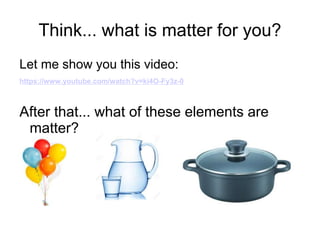
Think... what is matter for you?
Let me show you this video:
https://www.youtube.com/watch?v=ki4O-Fy3z-0
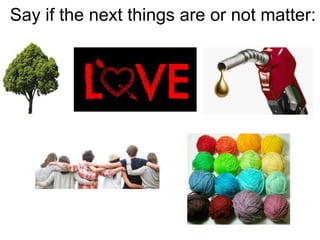
After that... what of these elements are
matter?
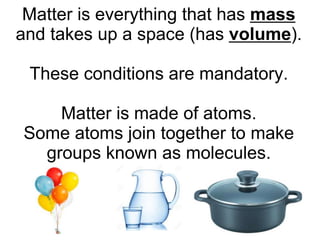
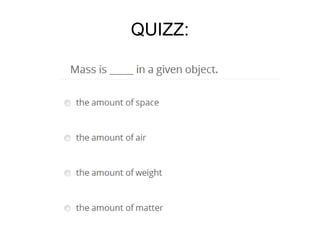
Matter is everything that has mass
and takes up a space (has volume).
These conditions are mandatory.
Matter is made of atoms.
Some atoms join together to make
groups known as molecules.
MASS:
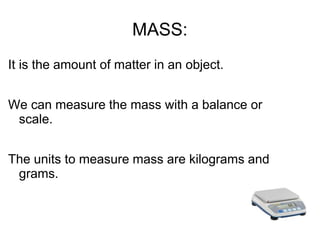
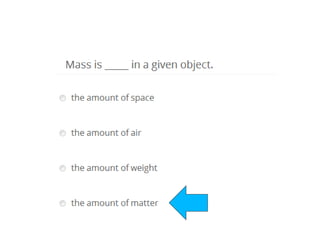
It is the amount of matter in an object.
We can measure the mass with a balance or
scale.
The units to measure mass are kilograms and
grams.
VOLUME:
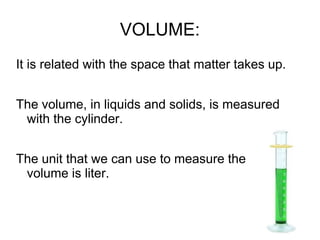
It is related with the space that matter takes up.
The volume, in liquids and solids, is measured
with the cylinder.
The unit that we can use to measure the
volume is liter.
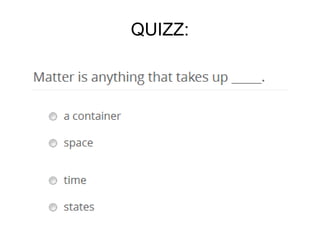
QUIZZ:
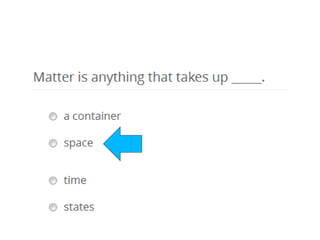
QUIZZ:
Say if the next things are or not matter:
2. PROPERTIES OF MATTER
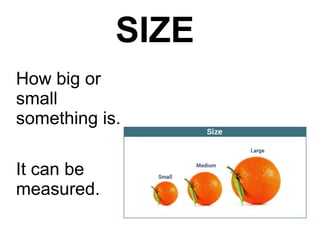
SIZE
How big or
small
something is.
It can be
measured.
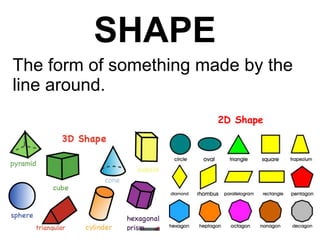
SHAPE
The form of something made by the
line around.
2D Shape
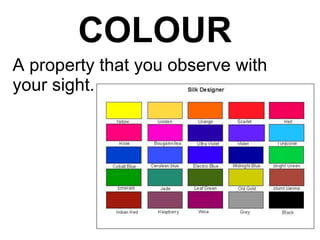
COLOUR
A property that you observe with
your sight.
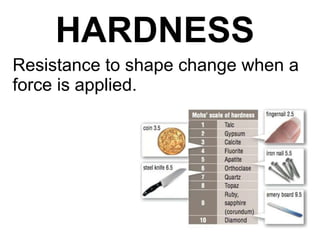
HARDNESS
Resistance to shape change when a
force is applied.
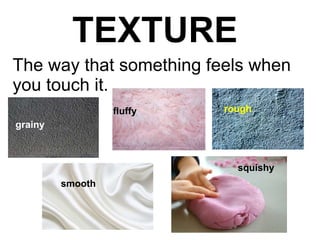
TEXTURE
The way that something feels when
you touch it.
grainy
fluffy rough
smooth
squishy
3. STATES OF MATTER
+#%#I6G+#%#I6G
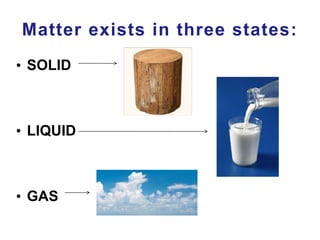
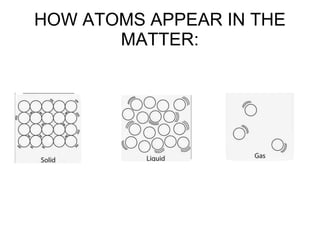
Matter exists in three states:
• SOLID
• LIQUID
• GAS
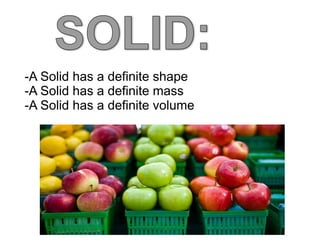
-A Solid has a definite shape
-A Solid has a definite mass
-A Solid has a definite volume
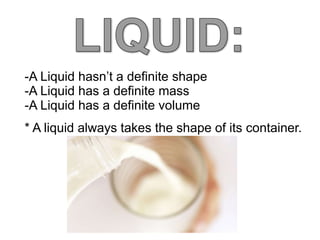
-A Liquid hasn’t a definite shape
-A Liquid has a definite mass
-A Liquid has a definite volume
* A liquid always takes the shape of its container.
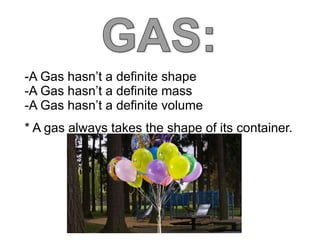
-A Gas hasn’t a definite shape
-A Gas hasn’t a definite mass
-A Gas hasn’t a definite volume
* A gas always takes the shape of its container.
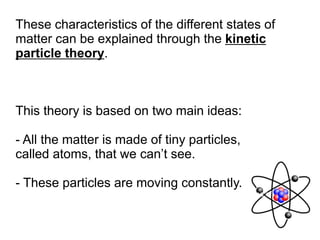
These characteristics of the different states of
matter can be explained through the kinetic
particle theory.
This theory is based on two main ideas:
- All the matter is made of tiny particles,
called atoms, that we can’t see.
- These particles are moving constantly.
Now we are going explain how this theory explains the behaviour of each one of
the states of matter.
Pay attention to this video:
https://www.youtube.com/watch?v=jmm1J2yI9tk
HOW ATOMS APPEAR IN THE
MATTER:
Have you thought what is happening
when we apply heat in a solid?
States of matter can change.
Pay attention to this video:
https://www.youtube.com/watch?v=_pxd56nzPl0
4. PHYSICAL CHANGES
Pay attention to this video:
https://www.youtube.com/watch?v=cjvGQmZFM24
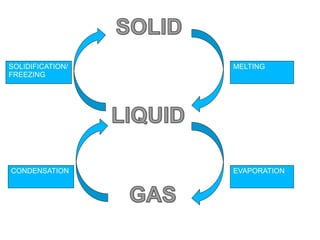
MELTING
EVAPORATIONCONDENSATION
SOLIDIFICATION/
FREEZING
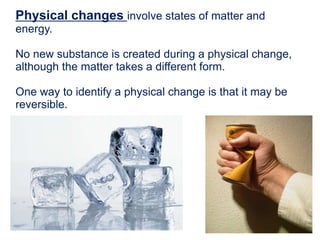
Physical changes involve states of matter and
energy.
No new substance is created during a physical change,
although the matter takes a different form.
One way to identify a physical change is that it may be
reversible.
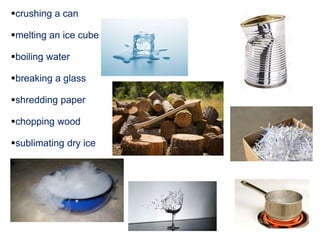
crushing a can
melting an ice cube
boiling water
breaking a glass
shredding paper
chopping wood
sublimating dry ice
Pay attention to this video:
https://www.youtube.com/watch?v=BgM3e8YZxuc
5. CHEMICAL CHANGES
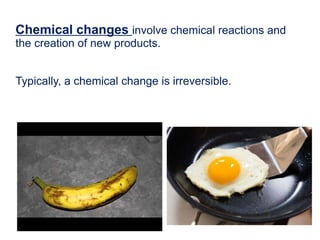
Chemical changes involve chemical reactions and
the creation of new products.
Typically, a chemical change is irreversible.
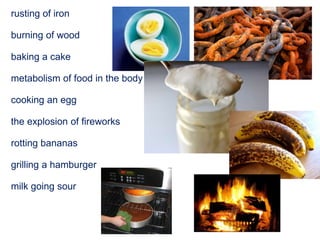
rusting of iron
burning of wood
baking a cake
metabolism of food in the body
cooking an egg
the explosion of fireworks
rotting bananas
grilling a hamburger
milk going sour

Matter