Assessing landscape impacts of potential 
bioenergy production scenarios 
using spatially explicit STSMs 
Jennifer Costanza 
Robert C. Abt, Alexa McKerrow, Jaime Collazo 
September 17, 2014
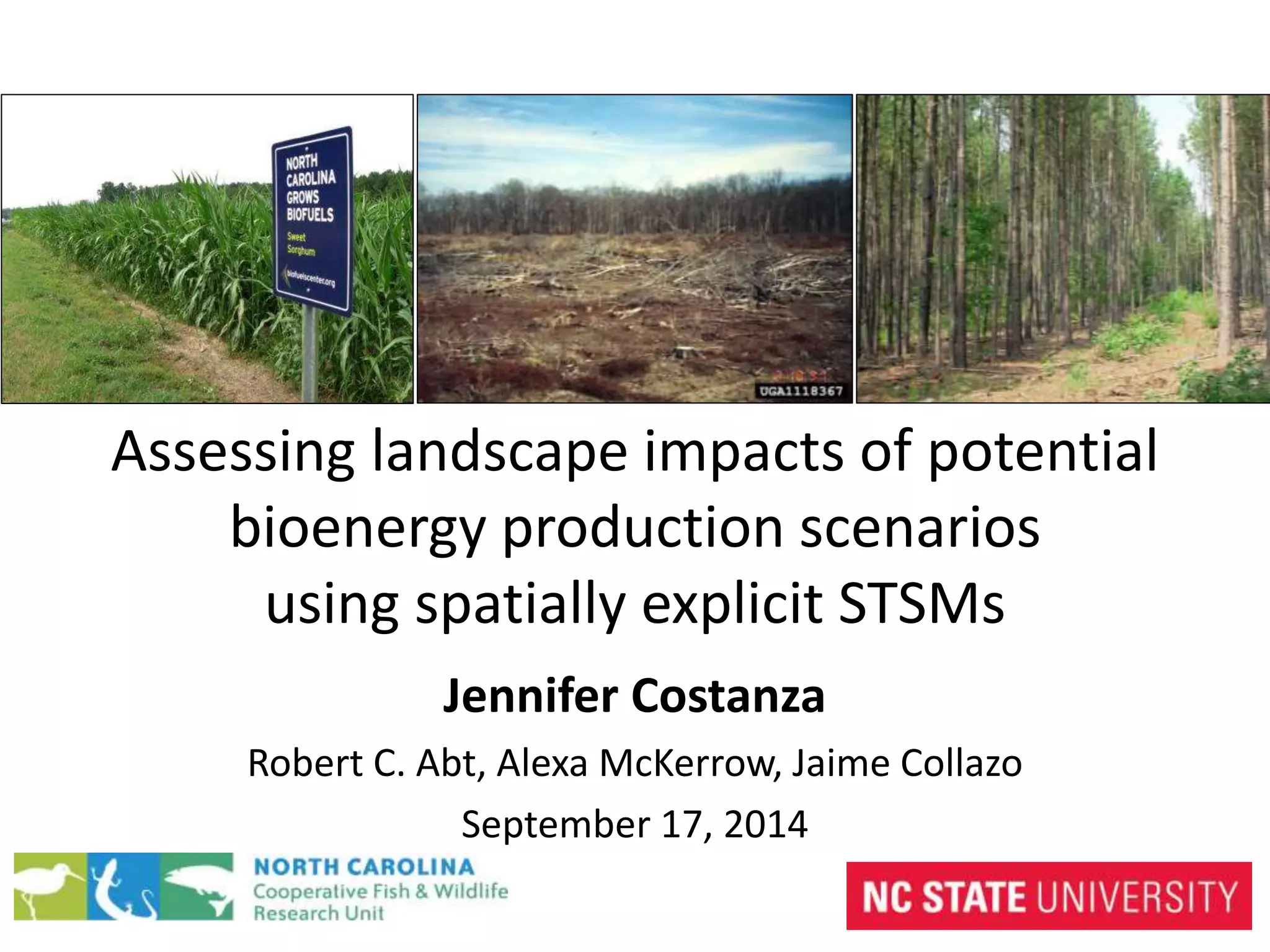
Biomass for energy 
Best alternative for society and 
the environment? 
Landscape and species impacts 
have not been fully addressed 
Recent studies 
Assume impacts 
will be negative 
(Evans et al. 2013 NWF Report) 
2nd generation biofuel feedstocks 
Wood pellets
How will biofuels affect the NC landscape? 
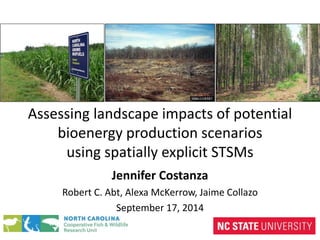
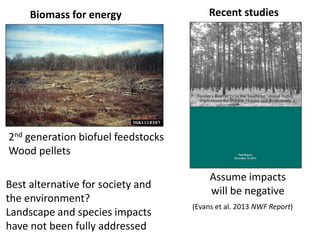
1. Increased “conventional” forest management 
• Sweet sorghum 
• Switchgrass 
• Short-rotation loblolly pine 
based on supply chain (Gonzalez et al. 2011, 2012) 
2. “Purpose-grown crops” on 
marginal ag and forest lands
Overview 
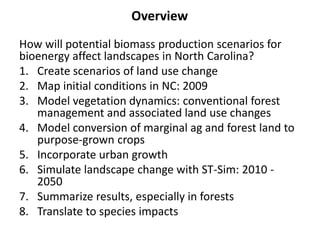
How will potential biomass production scenarios for 
biofuels affect landscapes in North Carolina? 
1. Create scenarios of land use change 
2. Map initial conditions in NC: 2009 
3. Model vegetation dynamics: conventional forest 
management and associated land use changes 
4. Model conversion of marginal ag and forest land to 
purpose-grown crops 
5. Incorporate urban growth 
6. Simulate landscape change with ST-Sim: 2010 - 
2050 
7. Summarize results, especially in forests 
8. Translate to species impacts
Why STSMs (ST-Sim)? 
1. Our past experience and model infrastructure 
2. Existing LANDFIRE VDDT models 
3. Ability to simulate major types of change 
expected from biofuels production 
4. Ability to incorporate output from timber supply 
model 
5. Spatial simulation capability so we can model 
resulting species impacts
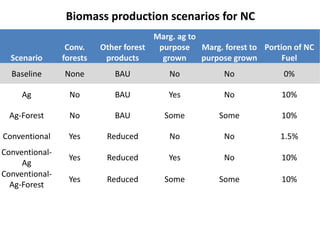
Biomass production scenarios for NC 
Scenario 
Conv. 
forests 
Other forest 
products 
Marg. ag to 
purpose 
grown 
Marg. forest to 
purpose grown 
Portion of NC 
Fuel 
Baseline None BAU No No 0% 
Ag No BAU Yes No 10% 
Ag-Forest No BAU Some Some 10% 
Conventional Yes Reduced No No 1.5% 
Conventional- 
Ag 
Yes Reduced Yes No 10% 
Conventional- 
Ag-Forest 
Yes Reduced Some Some 10%
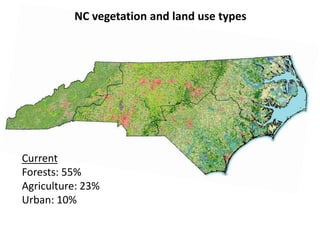
NC vegetation and land use types 
Current 
Forests: 55% 
Agriculture: 23% 
Urban: 10%
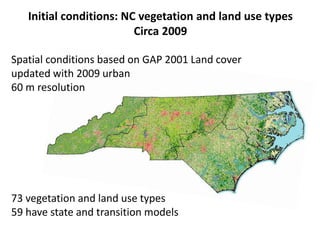
Initial conditions: NC vegetation and land use types 
Circa 2009 
Spatial conditions based on GAP 2001 Land cover 
updated with 2009 urban 
60 m resolution 
73 vegetation and land use types 
59 have state and transition models
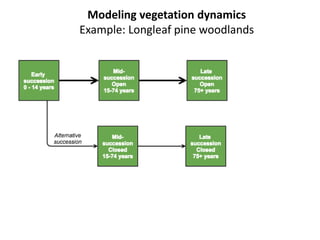
Modeling vegetation dynamics 
Example: Longleaf pine woodlands
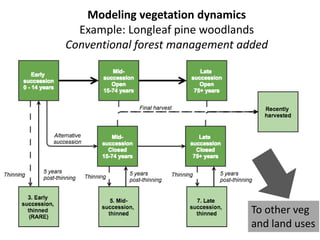
Modeling vegetation dynamics 
Example: Longleaf pine woodlands 
Conventional forest management added 
To other veg 
and land uses
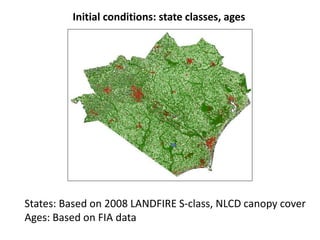
Initial conditions: state classes, ages 
States: Based on 2008 LANDFIRE S-class, NLCD canopy cover 
Ages: Based on FIA data
Modeling conventional forest management: 
Thinning, harvest, land use change 
SRTS timber supply model (Abt et al. 2009 For. Prod. J.) 
Not all demand is met by increased harvest 
Estimates timber supply based on 
• Inventory: how much timber exists? (FIA data; 
economic land use change model) 
• Demand: 
1. Empirical harvests (FIA data) 
2. Annual demand in NC increases to 4 million 
green tons biomass by 2018 
• Forest residues harvested 
• Other products displaced
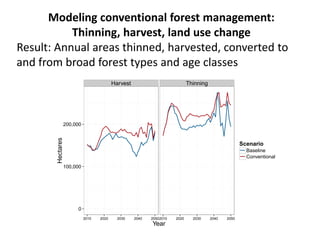
Modeling conventional forest management: 
Thinning, harvest, land use change 
Result: Annual areas thinned, harvested, converted to 
and from broad forest types and age classes 
Harvest Thinning 
200,000 
100,000 
0 
2010 2020 2030 2040 20502010 2020 2030 2040 2050 
Year 
Hectares 
Scenario 
Baseline 
Conventional
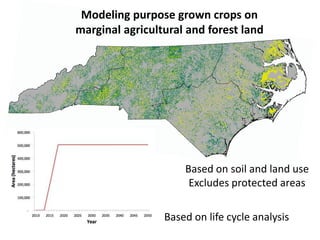
Modeling purpose grown crops on 
marginal agricultural and forest land 
Based on soil and land use 
Excludes protected areas 
Based on life cycle analysis
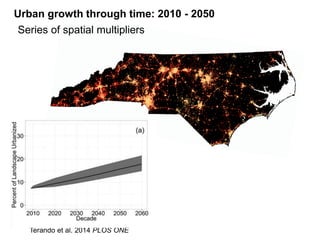
Urban growth through time: 2010 - 2050 
Series of spatial multipliers 
Terando et al. 2014 PLOS ONE
Overview 
How will potential biomass production scenarios for 
bioenergy affect landscapes in North Carolina? 
1. Create scenarios of land use change 
2. Map initial conditions in NC: 2009 
3. Model vegetation dynamics: conventional forest 
management and associated land use changes 
4. Model conversion of marginal ag and forest land to 
purpose-grown crops 
5. Incorporate urban growth 
6. Simulate landscape change with ST-Sim: 2010 - 
2050 
7. Summarize results, especially in forests 
8. Translate to species impacts
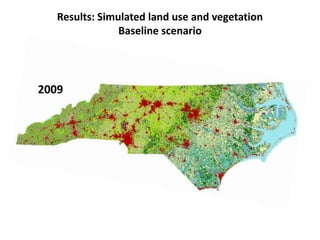
Results: Simulated land use and vegetation 
Baseline scenario 
2009
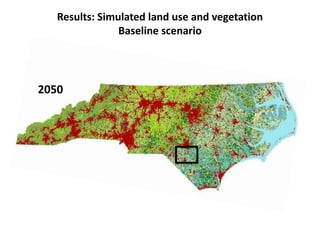
Results: Simulated land use and vegetation 
2050 
Baseline scenario
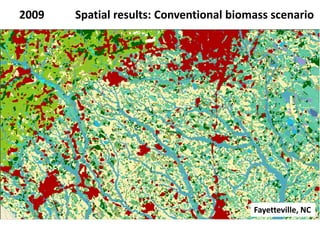
2009 
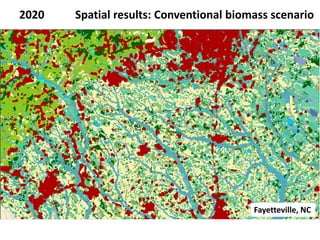
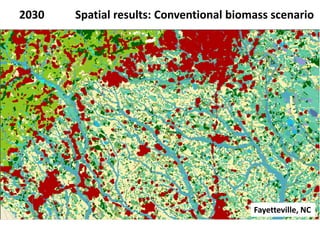
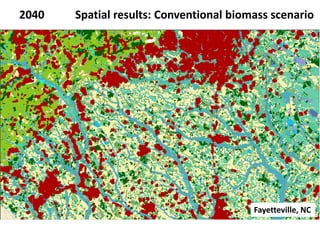
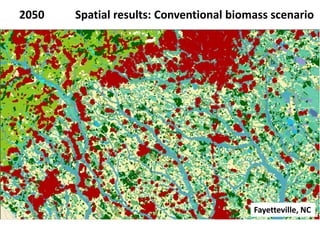
Spatial results: Conventional biomass scenario 
Fayetteville, NC
2020 
Spatial results: Conventional biomass scenario 
Fayetteville, NC
2030 
Spatial results: Conventional biomass scenario 
Fayetteville, NC
2040 Spatial results: Conventional biomass scenario 
Fayetteville, NC
2050 
Spatial results: Conventional biomass scenario 
Fayetteville, NC
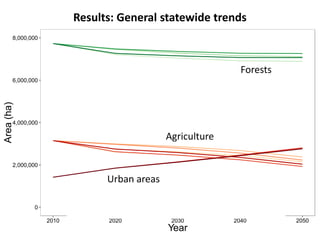
8,000,000 
6,000,000 
4,000,000 
2,000,000 
0 
2010 2020 2030 2040 2050 
Year 
Area (ha) 
Results: General statewide trends 
Forests 
Agriculture 
Urban areas
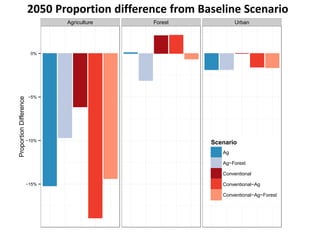
Agriculture Forest Urban 
0% 
−5% 
−10% 
−15% 
Scenario 
Proportion Difference 
Scenario 
Ag 
Ag−Forest 
Conventional 
Conventional−Conventional−2050 Proportion difference from Baseline Scenario 
Mixed pine hardwood Natural pine 
Upland hardwood 
Scenario 
Ag 
Ag−Forest 
Conventional 
Conventional−Ag 
Conventional−Ag−Forest
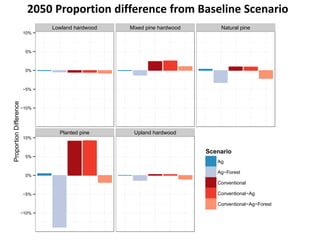
2050 Proportion difference from Baseline Scenario 
Lowland hardwood Mixed pine hardwood Natural pine 
Planted pine Upland hardwood 
10% 
5% 
0% 
−5% 
−10% 
10% 
5% 
0% 
−5% 
−10% 
Scenario 
Proportion Difference 
Scenario 
Ag 
Ag−Forest 
Conventional 
Conventional−Conventional−Mixed pine hardwood Natural pine 
Upland hardwood 
Scenario 
Ag 
Ag−Forest 
Conventional 
Conventional−Ag 
Conventional−Ag−Forest
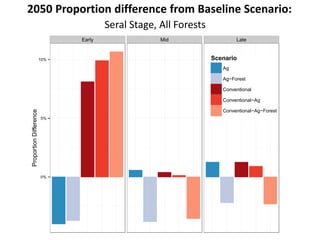
Early Mid Late 
10% 
5% 
0% 
Scenario 
Proportion Difference 
Scenario 
Ag 
Ag−Forest 
Conventional 
Conventional−Conventional−2050 Proportion difference from Baseline Scenario: 
Seral Stage, All Forests 
Upland hardwood 
Scenario 
Scenario 
Ag 
Ag−Forest 
Conventional 
Conventional−Ag 
Conventional−Ag−Forest
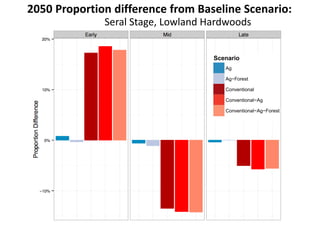
2050 Proportion difference from Baseline Scenario: 
Seral Stage, Lowland Hardwoods 
Upland hardwood 
Scenario 
Scenario 
Ag 
Ag−Forest 
Conventional 
Conventional−Ag 
Conventional−Ag−Forest
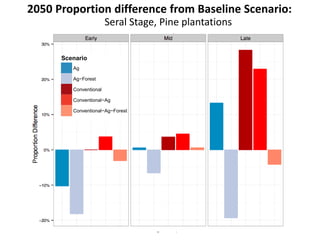
2050 Proportion difference from Baseline Scenario: 
Seral Stage, Pine plantations 
Scenario 
Ag 
Ag−Forest 
Conventional 
Conventional−Ag 
Conventional−Ag−Forest
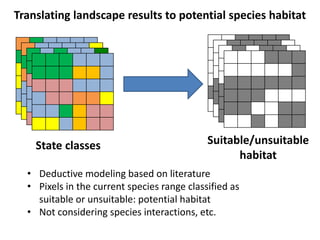
Translating landscape results to potential species habitat 
State classes Suitable/unsuitable 
habitat 
• Deductive modeling based on literature 
• Pixels in the current species range classified as 
suitable or unsuitable: potential habitat 
• Not considering species interactions, etc.
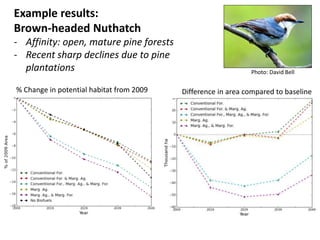
Example results: 
Brown-headed Nuthatch 
- Affinity: open, mature pine forests 
- Recent sharp declines due to pine 
plantations Photo: David Bell 
% Change in potential habitat from 2009 Difference in area compared to baseline
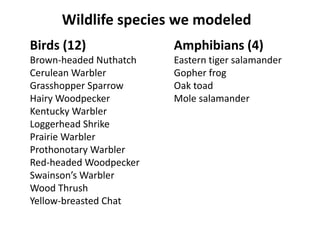
Wildlife species we modeled 
Birds (12) 
Brown-headed Nuthatch 
Cerulean Warbler 
Grasshopper Sparrow 
Hairy Woodpecker 
Kentucky Warbler 
Loggerhead Shrike 
Prairie Warbler 
Prothonotary Warbler 
Red-headed Woodpecker 
Swainson’s Warbler 
Wood Thrush 
Yellow-breasted Chat 
Amphibians (4) 
Eastern tiger salamander 
Gopher frog 
Oak toad 
Mole salamander
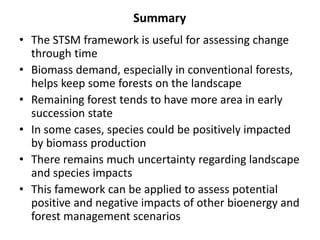
Summary 
• The STSM framework is useful for assessing change 
through time 
• Biomass demand, especially in conventional forests, 
helps keep some forests on the landscape 
• Remaining forest tends to have more area in early 
succession state 
• In some cases, species could be positively impacted 
by biomass production 
• There remains much uncertainty regarding landscape 
and species impacts 
• This famework can be applied to assess potential 
positive and negative impacts of other bioenergy and 
forest management scenarios
Acknowledgements 
People: 
Todd Earnhardt 
Matt Rubino 
Nathan Tarr 
Ashton Drew 
Steve Williams 
Ronalds Gonzalez 
Dennis Hazel 
Funding:

Landscape impacts of bioenergy production using state-and-transition modeling

  • 1.
    Assessing landscape impactsof potential bioenergy production scenarios using spatially explicit STSMs Jennifer Costanza Robert C. Abt, Alexa McKerrow, Jaime Collazo September 17, 2014
  • 2.
    Biomass for energy Best alternative for society and the environment? Landscape and species impacts have not been fully addressed Recent studies Assume impacts will be negative (Evans et al. 2013 NWF Report) 2nd generation biofuel feedstocks Wood pellets
  • 3.
    How will biofuelsaffect the NC landscape? 1. Increased “conventional” forest management • Sweet sorghum • Switchgrass • Short-rotation loblolly pine based on supply chain (Gonzalez et al. 2011, 2012) 2. “Purpose-grown crops” on marginal ag and forest lands
  • 4.
    Overview How willpotential biomass production scenarios for biofuels affect landscapes in North Carolina? 1. Create scenarios of land use change 2. Map initial conditions in NC: 2009 3. Model vegetation dynamics: conventional forest management and associated land use changes 4. Model conversion of marginal ag and forest land to purpose-grown crops 5. Incorporate urban growth 6. Simulate landscape change with ST-Sim: 2010 - 2050 7. Summarize results, especially in forests 8. Translate to species impacts
  • 5.
    Why STSMs (ST-Sim)? 1. Our past experience and model infrastructure 2. Existing LANDFIRE VDDT models 3. Ability to simulate major types of change expected from biofuels production 4. Ability to incorporate output from timber supply model 5. Spatial simulation capability so we can model resulting species impacts
  • 6.
    Biomass production scenariosfor NC Scenario Conv. forests Other forest products Marg. ag to purpose grown Marg. forest to purpose grown Portion of NC Fuel Baseline None BAU No No 0% Ag No BAU Yes No 10% Ag-Forest No BAU Some Some 10% Conventional Yes Reduced No No 1.5% Conventional- Ag Yes Reduced Yes No 10% Conventional- Ag-Forest Yes Reduced Some Some 10%
  • 7.
    NC vegetation andland use types Current Forests: 55% Agriculture: 23% Urban: 10%
  • 8.
    Initial conditions: NCvegetation and land use types Circa 2009 Spatial conditions based on GAP 2001 Land cover updated with 2009 urban 60 m resolution 73 vegetation and land use types 59 have state and transition models
  • 9.
    Modeling vegetation dynamics Example: Longleaf pine woodlands
  • 10.
    Modeling vegetation dynamics Example: Longleaf pine woodlands Conventional forest management added To other veg and land uses
  • 11.
    Initial conditions: stateclasses, ages States: Based on 2008 LANDFIRE S-class, NLCD canopy cover Ages: Based on FIA data
  • 12.
    Modeling conventional forestmanagement: Thinning, harvest, land use change SRTS timber supply model (Abt et al. 2009 For. Prod. J.) Not all demand is met by increased harvest Estimates timber supply based on • Inventory: how much timber exists? (FIA data; economic land use change model) • Demand: 1. Empirical harvests (FIA data) 2. Annual demand in NC increases to 4 million green tons biomass by 2018 • Forest residues harvested • Other products displaced
  • 13.
    Modeling conventional forestmanagement: Thinning, harvest, land use change Result: Annual areas thinned, harvested, converted to and from broad forest types and age classes Harvest Thinning 200,000 100,000 0 2010 2020 2030 2040 20502010 2020 2030 2040 2050 Year Hectares Scenario Baseline Conventional
  • 14.
    Modeling purpose growncrops on marginal agricultural and forest land Based on soil and land use Excludes protected areas Based on life cycle analysis
  • 15.
    Urban growth throughtime: 2010 - 2050 Series of spatial multipliers Terando et al. 2014 PLOS ONE
  • 16.
    Overview How willpotential biomass production scenarios for bioenergy affect landscapes in North Carolina? 1. Create scenarios of land use change 2. Map initial conditions in NC: 2009 3. Model vegetation dynamics: conventional forest management and associated land use changes 4. Model conversion of marginal ag and forest land to purpose-grown crops 5. Incorporate urban growth 6. Simulate landscape change with ST-Sim: 2010 - 2050 7. Summarize results, especially in forests 8. Translate to species impacts
  • 17.
    Results: Simulated landuse and vegetation Baseline scenario 2009
  • 18.
    Results: Simulated landuse and vegetation 2050 Baseline scenario
  • 19.
    2009 Spatial results:Conventional biomass scenario Fayetteville, NC
  • 20.
    2020 Spatial results:Conventional biomass scenario Fayetteville, NC
  • 21.
    2030 Spatial results:Conventional biomass scenario Fayetteville, NC
  • 22.
    2040 Spatial results:Conventional biomass scenario Fayetteville, NC
  • 23.
    2050 Spatial results:Conventional biomass scenario Fayetteville, NC
  • 24.
    8,000,000 6,000,000 4,000,000 2,000,000 0 2010 2020 2030 2040 2050 Year Area (ha) Results: General statewide trends Forests Agriculture Urban areas
  • 25.
    Agriculture Forest Urban 0% −5% −10% −15% Scenario Proportion Difference Scenario Ag Ag−Forest Conventional Conventional−Conventional−2050 Proportion difference from Baseline Scenario Mixed pine hardwood Natural pine Upland hardwood Scenario Ag Ag−Forest Conventional Conventional−Ag Conventional−Ag−Forest
  • 26.
    2050 Proportion differencefrom Baseline Scenario Lowland hardwood Mixed pine hardwood Natural pine Planted pine Upland hardwood 10% 5% 0% −5% −10% 10% 5% 0% −5% −10% Scenario Proportion Difference Scenario Ag Ag−Forest Conventional Conventional−Conventional−Mixed pine hardwood Natural pine Upland hardwood Scenario Ag Ag−Forest Conventional Conventional−Ag Conventional−Ag−Forest
  • 27.
    Early Mid Late 10% 5% 0% Scenario Proportion Difference Scenario Ag Ag−Forest Conventional Conventional−Conventional−2050 Proportion difference from Baseline Scenario: Seral Stage, All Forests Upland hardwood Scenario Scenario Ag Ag−Forest Conventional Conventional−Ag Conventional−Ag−Forest
  • 28.
    2050 Proportion differencefrom Baseline Scenario: Seral Stage, Lowland Hardwoods Upland hardwood Scenario Scenario Ag Ag−Forest Conventional Conventional−Ag Conventional−Ag−Forest
  • 29.
    2050 Proportion differencefrom Baseline Scenario: Seral Stage, Pine plantations Scenario Ag Ag−Forest Conventional Conventional−Ag Conventional−Ag−Forest
  • 30.
    Translating landscape resultsto potential species habitat State classes Suitable/unsuitable habitat • Deductive modeling based on literature • Pixels in the current species range classified as suitable or unsuitable: potential habitat • Not considering species interactions, etc.
  • 31.
    Example results: Brown-headedNuthatch - Affinity: open, mature pine forests - Recent sharp declines due to pine plantations Photo: David Bell % Change in potential habitat from 2009 Difference in area compared to baseline
  • 32.
    Wildlife species wemodeled Birds (12) Brown-headed Nuthatch Cerulean Warbler Grasshopper Sparrow Hairy Woodpecker Kentucky Warbler Loggerhead Shrike Prairie Warbler Prothonotary Warbler Red-headed Woodpecker Swainson’s Warbler Wood Thrush Yellow-breasted Chat Amphibians (4) Eastern tiger salamander Gopher frog Oak toad Mole salamander
  • 33.
    Summary • TheSTSM framework is useful for assessing change through time • Biomass demand, especially in conventional forests, helps keep some forests on the landscape • Remaining forest tends to have more area in early succession state • In some cases, species could be positively impacted by biomass production • There remains much uncertainty regarding landscape and species impacts • This famework can be applied to assess potential positive and negative impacts of other bioenergy and forest management scenarios
  • 34.
    Acknowledgements People: ToddEarnhardt Matt Rubino Nathan Tarr Ashton Drew Steve Williams Ronalds Gonzalez Dennis Hazel Funding: