Landscape Restoration for Improving Ecosystem
Services and Building Climate Resilience
Landscape Restoration for Climate and Communities
Understanding the Opportunities and Challenges in Madhya Pradesh
23 July 2016, Bhopal
ITC’s Agri-Business - Snapshot
Business Relevance - High Stakes in Indian Agriculture
• Direct engagement with nearly 2 hundred thousand farmers thru crop
development on more than 3 hundred thousand hectares
• Farmer connect thru eChoupals – 4 million
• These farmers operate in moisture stressed areas:
 Agriculture mainly rain-fed - crop production unstable
 Depletion of bio-mass - aggravating top-soil losses & surface run-off
 High soil erosion - implications for fertility & productivity of land
 Climate change
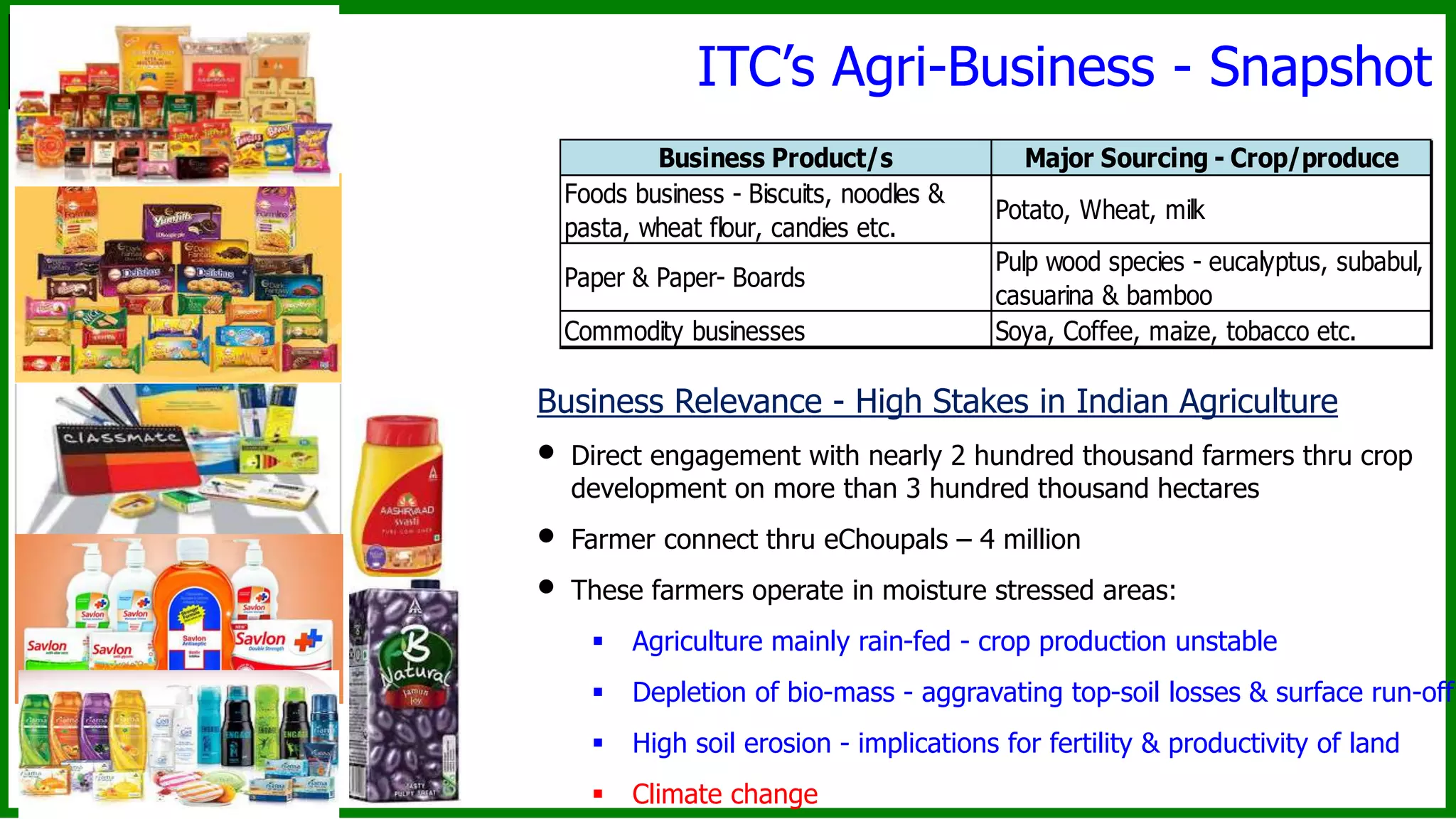
Business Product/s Major Sourcing - Crop/produce
Foods business - Biscuits, noodles &
pasta, wheat flour, candies etc.
Potato, Wheat, milk
Paper & Paper- Boards
Pulp wood species - eucalyptus, subabul,
casuarina & bamboo
Commodity businesses Soya, Coffee, maize, tobacco etc.
ITC’s Social Investments Programme
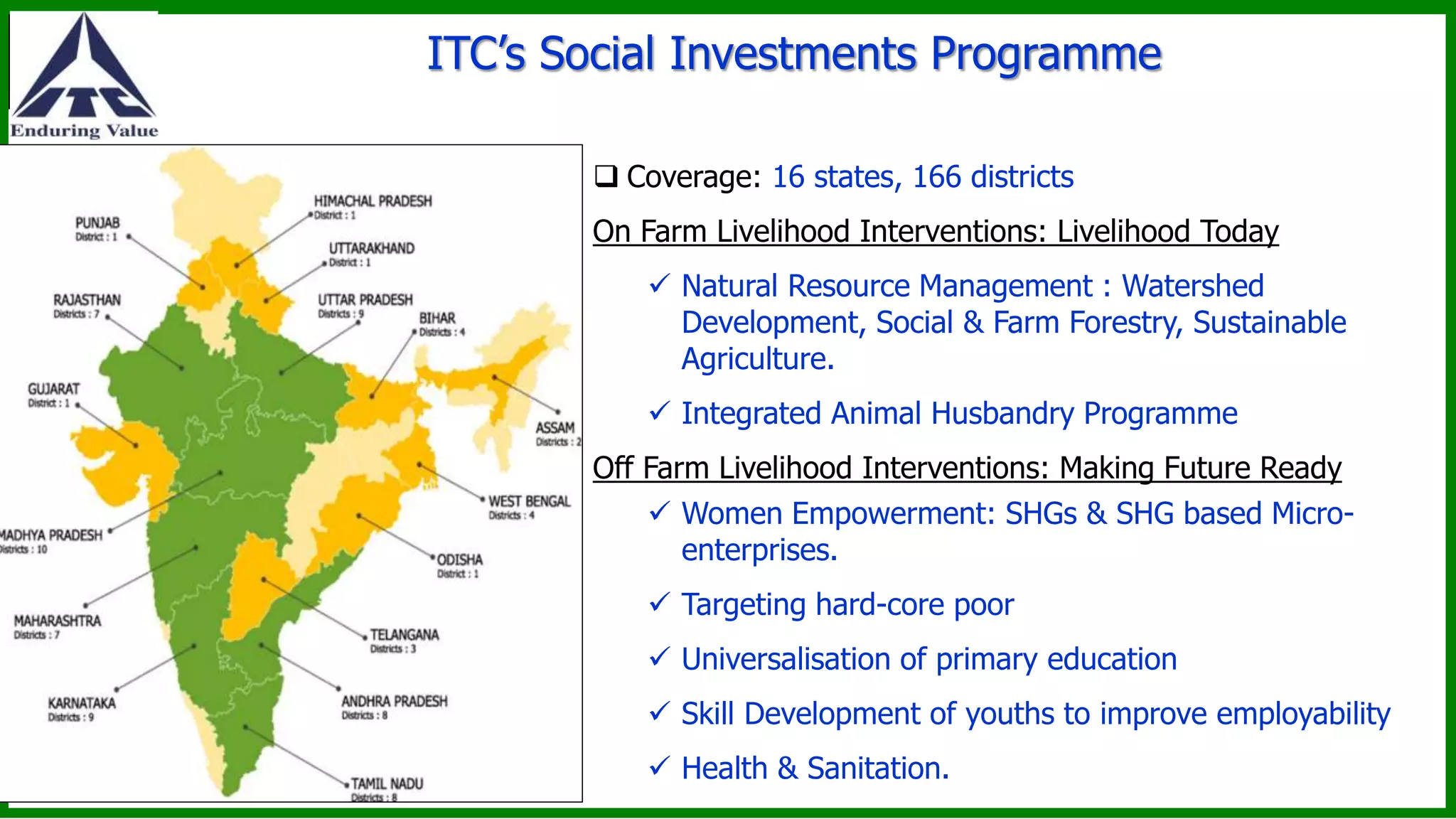
 Coverage: 16 states, 166 districts
On Farm Livelihood Interventions: Livelihood Today
 Natural Resource Management : Watershed
Development, Social & Farm Forestry, Sustainable
Agriculture.
 Integrated Animal Husbandry Programme
Off Farm Livelihood Interventions: Making Future Ready
 Women Empowerment: SHGs & SHG based Micro-
enterprises.
 Targeting hard-core poor
 Universalisation of primary education
 Skill Development of youths to improve employability
 Health & Sanitation.
Approach: Multi Stakeholder Alliance
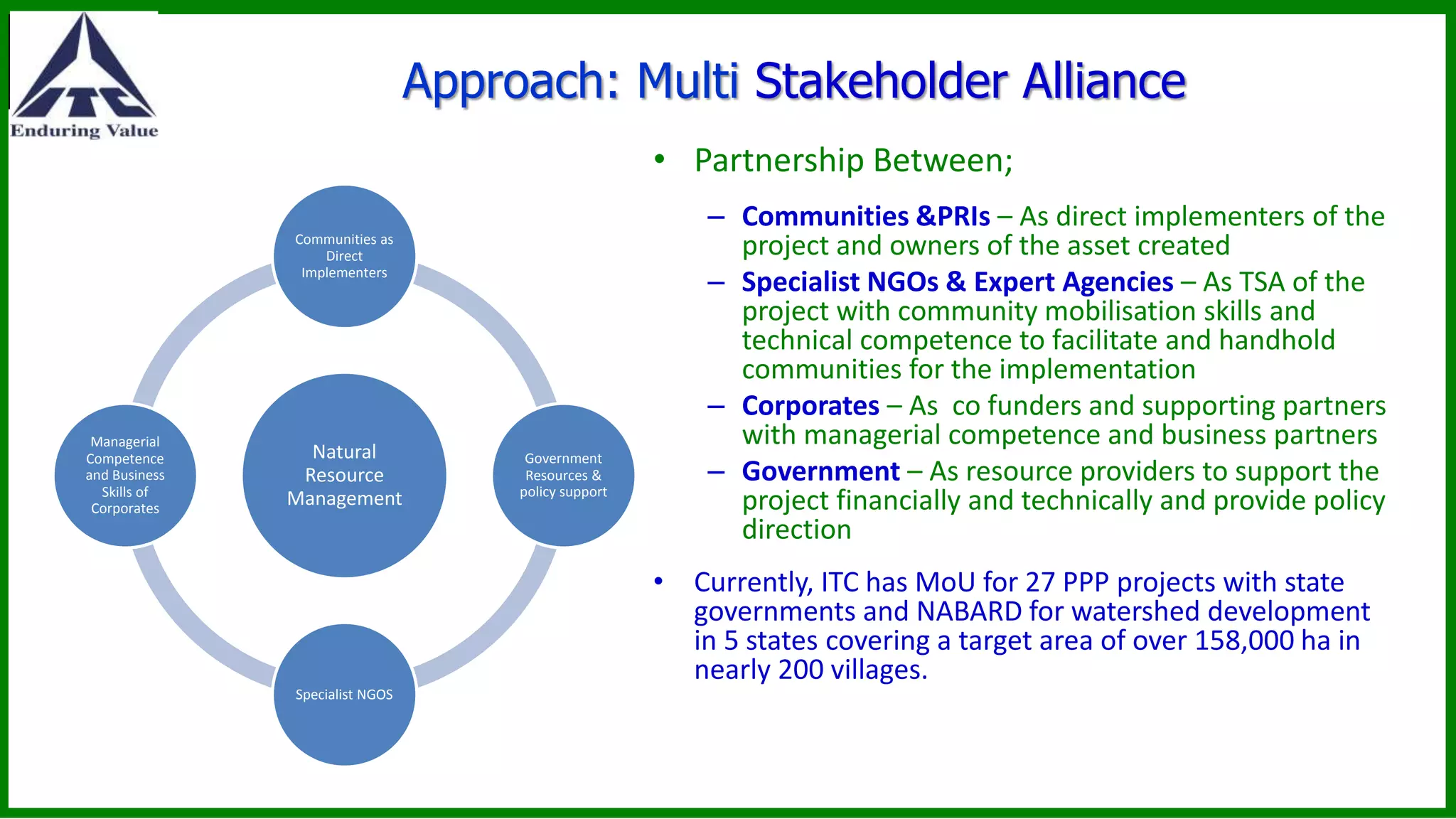
• Partnership Between;
– Communities &PRIs – As direct implementers of the
project and owners of the asset created
– Specialist NGOs & Expert Agencies – As TSA of the
project with community mobilisation skills and
technical competence to facilitate and handhold
communities for the implementation
– Corporates – As co funders and supporting partners
with managerial competence and business partners
– Government – As resource providers to support the
project financially and technically and provide policy
direction
• Currently, ITC has MoU for 27 PPP projects with state
governments and NABARD for watershed development
in 5 states covering a target area of over 158,000 ha in
nearly 200 villages.
Natural
Resource
Management
Communities as
Direct
Implementers
Government
Resources &
policy support
Specialist NGOS
Managerial
Competence
and Business
Skills of
Corporates
Landscape Restoration : Components
 Soil and Moisture Conservation
 Ground Water Management and Water Security
 Sustainable Agriculture Development
 Promotion of Biodiversity
 Building Climate Resilient Livelihood
 Institution Building
Land Degradation
 16.4 tonnes of fertile top soil is lost per hectare per
year of which:
- 29% is lost permanently to the seas and another
- 10% flows into reservoirs thus reducing their storage
capacity by around 2% per year.
 Water is given preference over soil
 Soil Moisture is a neglected area
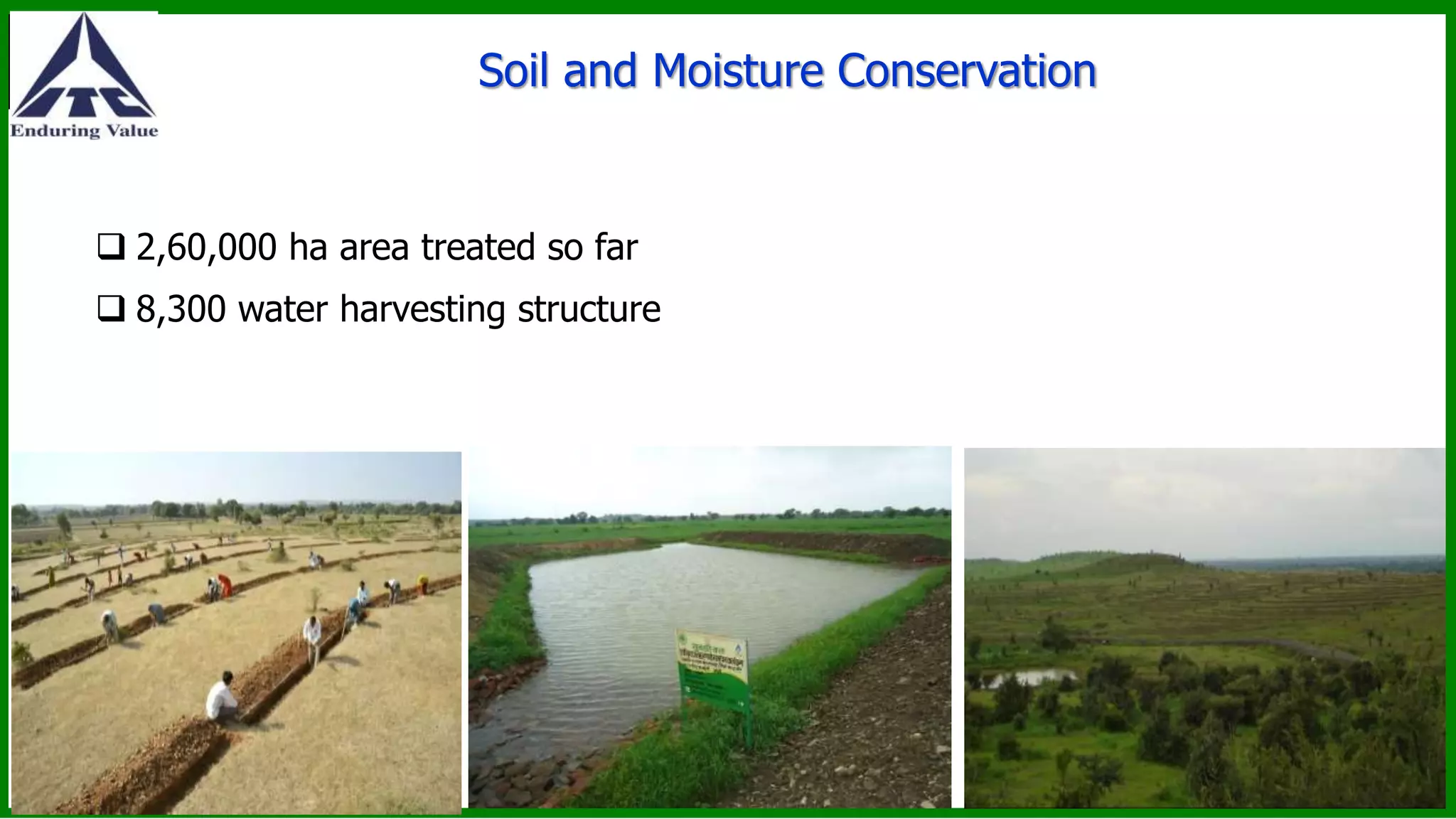
Soil and Moisture Conservation
 2,60,000 ha area treated so far
 8,300 water harvesting structure
Measuring Soil Erosion: Sediment Monitoring Units
Catchment area = 1230 Ha
Raingague distance = 5.7 Kms
SMU location - Khajuriya
Raingauge location – Ratanpur (Sehore)
S.
No
District
Project /
PIA
Location
village
Sediment quantity
(Tons/year)
Estimated
value
Actual
calculated
value
1 Sehore
ITC SMC /
VIBHAVARI Khajuriya 3,215 4,282
2
Chhind
wara
ITC SMC /
IDYWC Khadwadi 4,268 11,328
3 Sehore
ITC-IWMP /
Samarthan
Ramakhe
di 2,045 -
Unsustainable Ground Water Use
• India is the “global champion” in groundwater irrigation:
 40% of irrigated area from tube-wells
 15% of groundwater tables over-exploited
• Sustainable use & groundwater development a major challenge
Watershed plans should be aligned to the science of hydro-geology
Source: Minor Irrigation Census, http://micensus.gov.in/
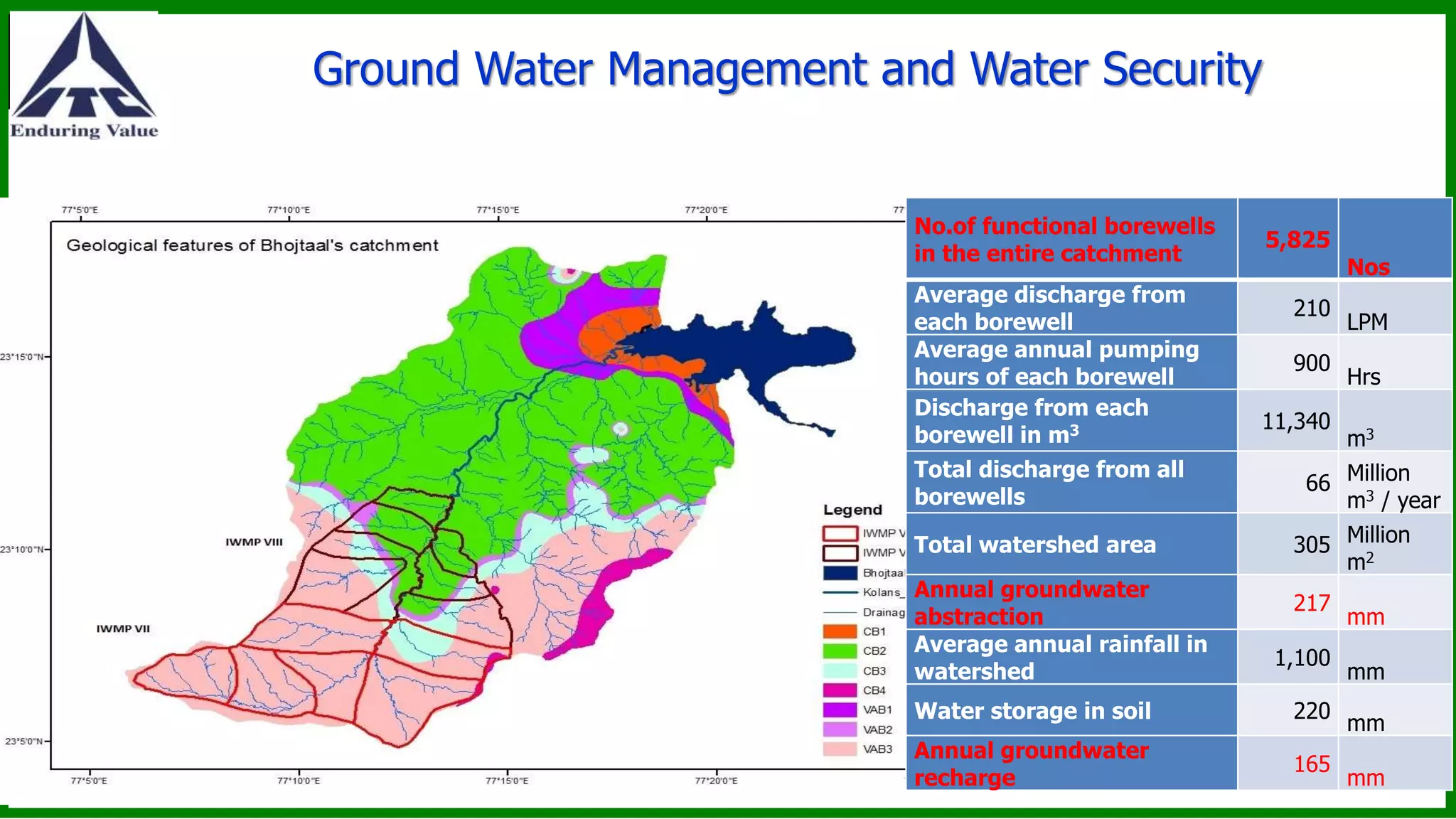
Ground Water Management and Water Security
No.of functional borewells
in the entire catchment
5,825
Nos
Average discharge from
each borewell
210
LPM
Average annual pumping
hours of each borewell
900
Hrs
Discharge from each
borewell in m3 11,340
m3
Total discharge from all
borewells
66 Million
m3 / year
Total watershed area 305 Million
m2
Annual groundwater
abstraction
217
mm
Average annual rainfall in
watershed
1,100
mm
Water storage in soil 220
mm
Annual groundwater
recharge
165
mm
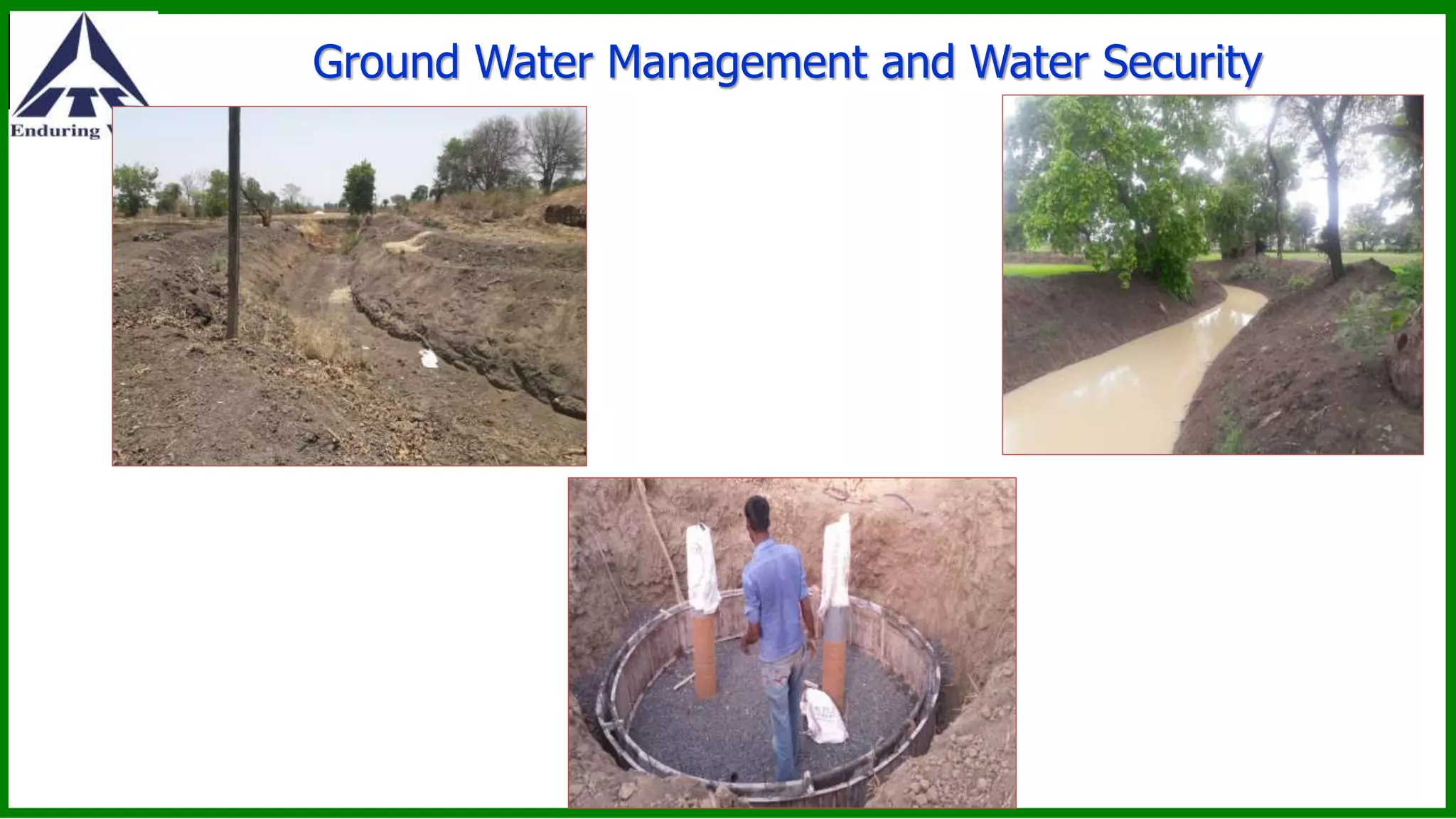
Ground Water Management and Water Security
 Ghod river
 Catchment: 3.58 lakh
ha
 No of villages: 440
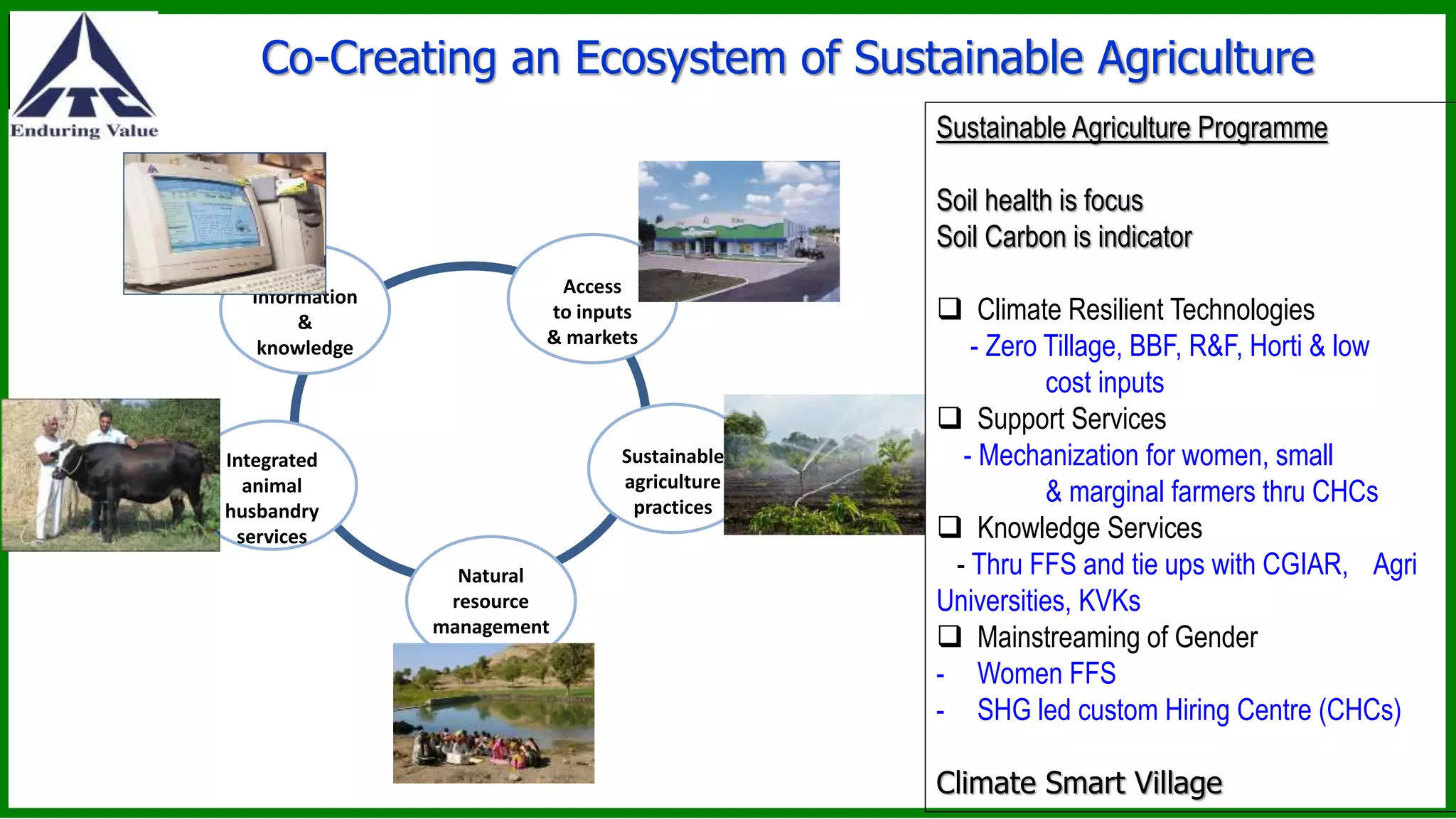
Co-Creating an Ecosystem of Sustainable Agriculture
Information
&
knowledge
Access
to inputs
& markets
Sustainable
agriculture
practices
Natural
resource
management
Integrated
animal
husbandry
services
Sustainable Agriculture Programme
Soil health is focus
Soil Carbon is indicator
 Climate Resilient Technologies
- Zero Tillage, BBF, R&F, Horti & low
cost inputs
 Support Services
- Mechanization for women, small
& marginal farmers thru CHCs
 Knowledge Services
- Thru FFS and tie ups with CGIAR, Agri
Universities, KVKs
 Mainstreaming of Gender
- Women FFS
- SHG led custom Hiring Centre (CHCs)
Climate Smart Village
Promotion of Biodiversity in Agri Landscape
Commons are shrinking at the
rate of 1.9 per cent every five
years due to encroachment
Since independence, more than
834,000 hectares of village
commons have been encroached.
Traditional species are
disappearing from agri fields.
Challenges
•Restoration of pasture lands
•Regeneration of native sps. –
In commons, pastures, tank
catchments
•Promotion of allied livelihoods
– fodder/apiary/pisciculture
/NTFP etc
Approx 5,000 ha commons
have been rejuvenated.
Solution
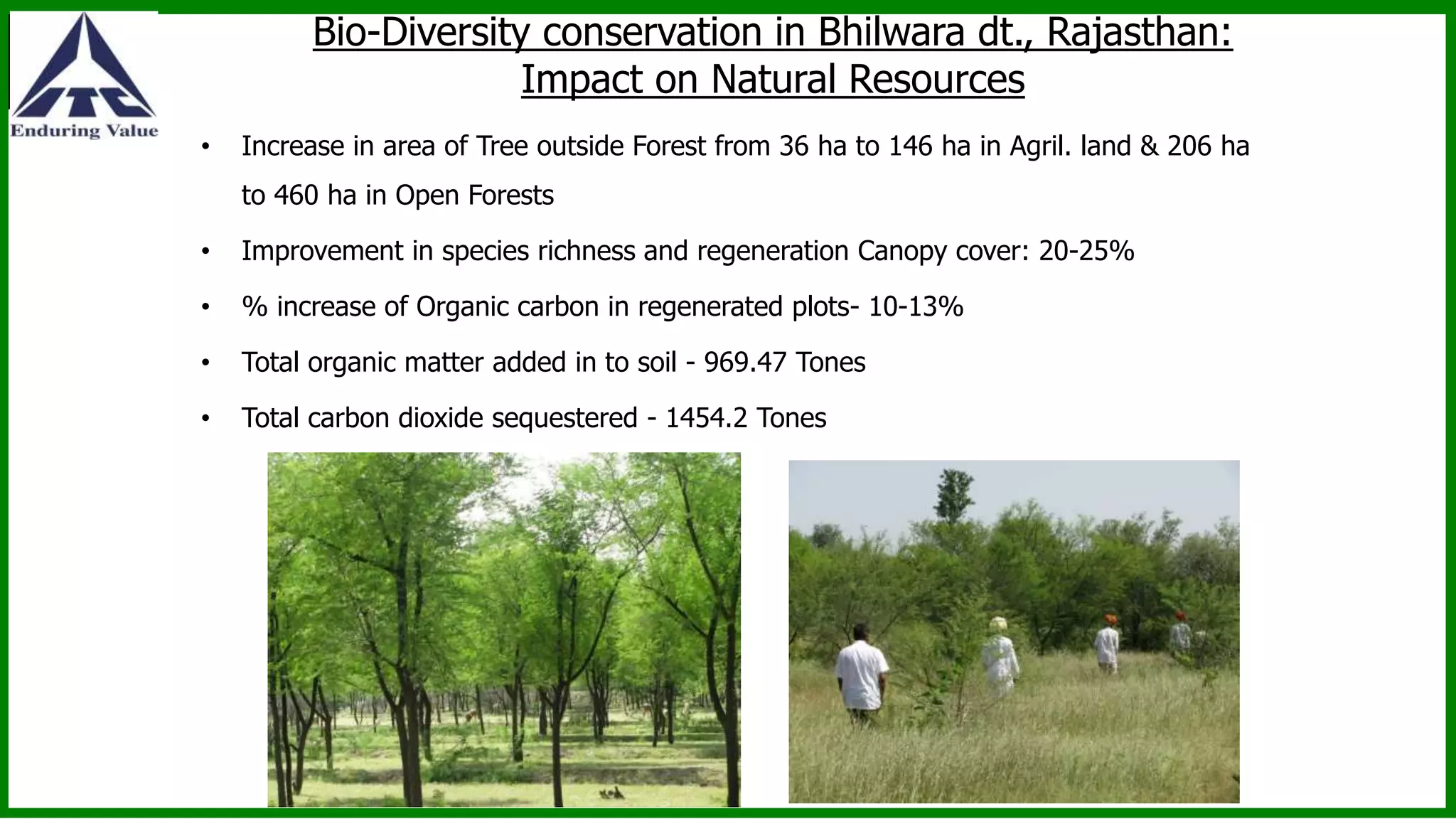
Bio-Diversity conservation in Bhilwara dt., Rajasthan:
Impact on Natural Resources
• Increase in area of Tree outside Forest from 36 ha to 146 ha in Agril. land & 206 ha
to 460 ha in Open Forests
• Improvement in species richness and regeneration Canopy cover: 20-25%
• % increase of Organic carbon in regenerated plots- 10-13%
• Total organic matter added in to soil - 969.47 Tones
• Total carbon dioxide sequestered - 1454.2 Tones
• Initiated towards understanding
relation between eco-system services
and agriculture in partnership with
IUCN. Aimed at mainstreaming
biodiversity into rural and agrarian
communities based on study findings
• Implement biodiversity conservation
at a water basin level and going
forward at river basin level by
incorporating all factors such as, in-
situ conservation, native species
planting, protection of existing flora
and faun
Bio-Diversity Conservation – Way forward
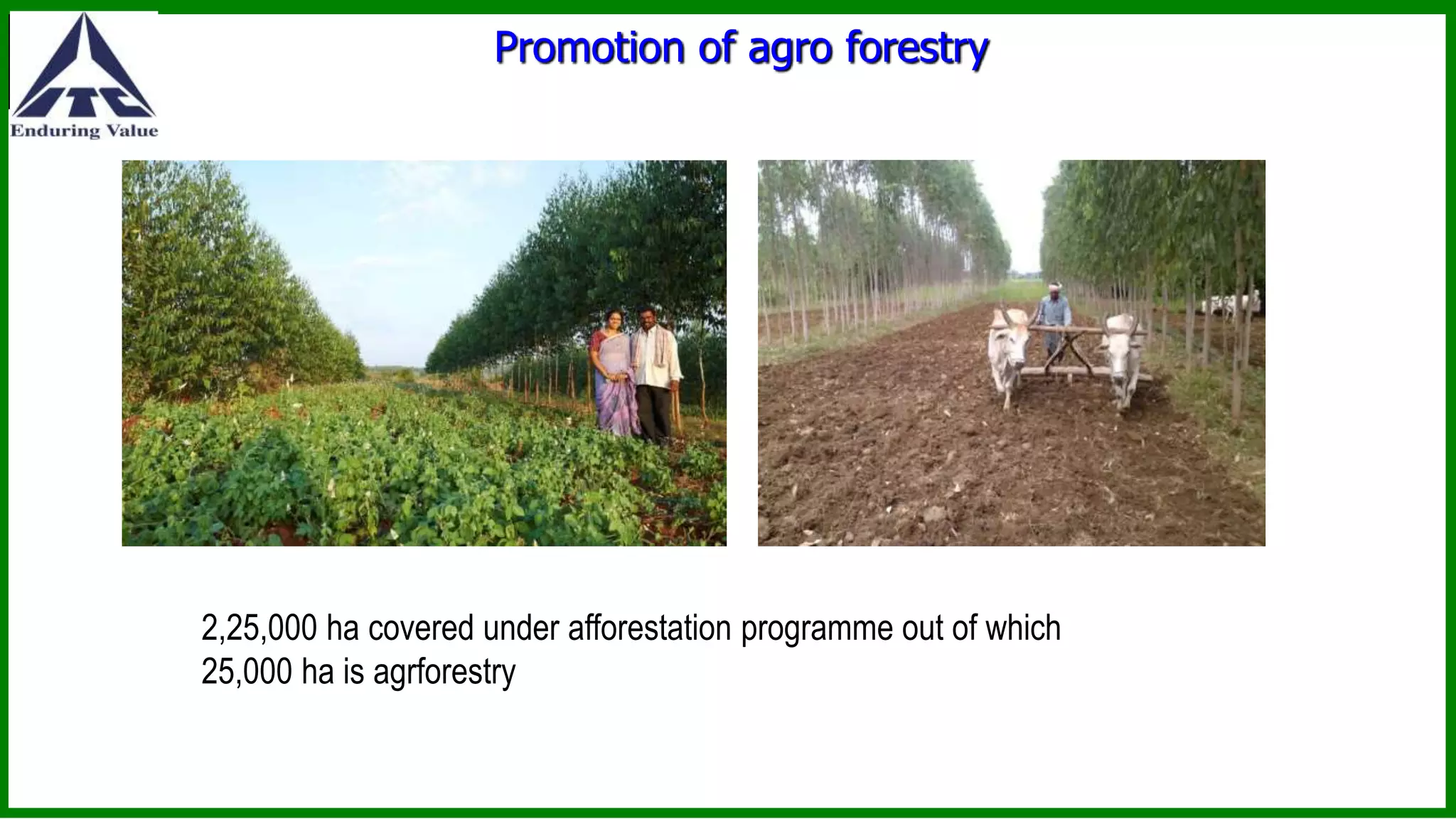
Promotion of agro forestry
2,25,000 ha covered under afforestation programme out of which
25,000 ha is agrforestry
Building Climate Resilience to Rural Livelihoods
• Integrated Animal Husbandry Programme. Covered 13,00,000 milch
animals.
• 50,000 women covered through SHG programme
• Targeting Hardcore Poor:10,000 ultra poor women mainstreamed and
liked with livelihoods.
• Skill development: 31,000 underprivileged youths trained and placed in
different jobs.
• Health and Sanitation : 15,000 households
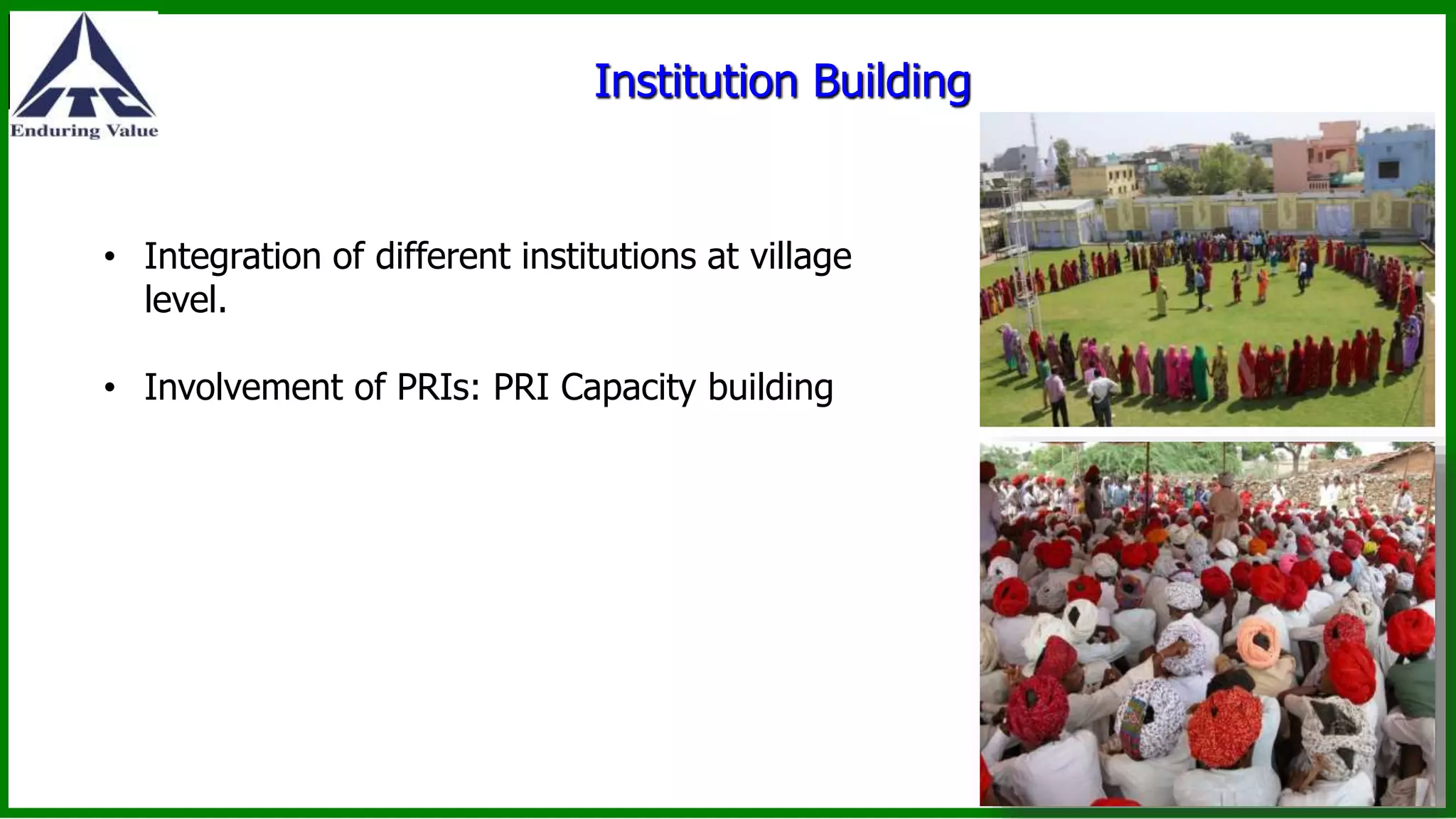
Institution Building
• Integration of different institutions at village
level.
• Involvement of PRIs: PRI Capacity building
Challenges & Learnings
 Diverse Interests of different stakeholders
- Meeting expectations of different stakeholders
- Conflicting interests
 Multiple institutions : PRI is a solution
 Lack of policy support
 Multiple schemes & programmes
 Payment for ecosystem services
Thank you

Landscape Restoration for Improving Ecosystem Services and Building Climate Resilience

  • 1.
    Landscape Restoration forImproving Ecosystem Services and Building Climate Resilience Landscape Restoration for Climate and Communities Understanding the Opportunities and Challenges in Madhya Pradesh 23 July 2016, Bhopal
  • 2.
    ITC’s Agri-Business -Snapshot Business Relevance - High Stakes in Indian Agriculture • Direct engagement with nearly 2 hundred thousand farmers thru crop development on more than 3 hundred thousand hectares • Farmer connect thru eChoupals – 4 million • These farmers operate in moisture stressed areas:  Agriculture mainly rain-fed - crop production unstable  Depletion of bio-mass - aggravating top-soil losses & surface run-off  High soil erosion - implications for fertility & productivity of land  Climate change Business Product/s Major Sourcing - Crop/produce Foods business - Biscuits, noodles & pasta, wheat flour, candies etc. Potato, Wheat, milk Paper & Paper- Boards Pulp wood species - eucalyptus, subabul, casuarina & bamboo Commodity businesses Soya, Coffee, maize, tobacco etc.
  • 3.
    ITC’s Social InvestmentsProgramme  Coverage: 16 states, 166 districts On Farm Livelihood Interventions: Livelihood Today  Natural Resource Management : Watershed Development, Social & Farm Forestry, Sustainable Agriculture.  Integrated Animal Husbandry Programme Off Farm Livelihood Interventions: Making Future Ready  Women Empowerment: SHGs & SHG based Micro- enterprises.  Targeting hard-core poor  Universalisation of primary education  Skill Development of youths to improve employability  Health & Sanitation.
  • 4.
    Approach: Multi StakeholderAlliance • Partnership Between; – Communities &PRIs – As direct implementers of the project and owners of the asset created – Specialist NGOs & Expert Agencies – As TSA of the project with community mobilisation skills and technical competence to facilitate and handhold communities for the implementation – Corporates – As co funders and supporting partners with managerial competence and business partners – Government – As resource providers to support the project financially and technically and provide policy direction • Currently, ITC has MoU for 27 PPP projects with state governments and NABARD for watershed development in 5 states covering a target area of over 158,000 ha in nearly 200 villages. Natural Resource Management Communities as Direct Implementers Government Resources & policy support Specialist NGOS Managerial Competence and Business Skills of Corporates
  • 5.
    Landscape Restoration :Components  Soil and Moisture Conservation  Ground Water Management and Water Security  Sustainable Agriculture Development  Promotion of Biodiversity  Building Climate Resilient Livelihood  Institution Building
  • 6.
    Land Degradation  16.4tonnes of fertile top soil is lost per hectare per year of which: - 29% is lost permanently to the seas and another - 10% flows into reservoirs thus reducing their storage capacity by around 2% per year.  Water is given preference over soil  Soil Moisture is a neglected area
  • 7.
    Soil and MoistureConservation  2,60,000 ha area treated so far  8,300 water harvesting structure
  • 8.
    Measuring Soil Erosion:Sediment Monitoring Units Catchment area = 1230 Ha Raingague distance = 5.7 Kms SMU location - Khajuriya Raingauge location – Ratanpur (Sehore) S. No District Project / PIA Location village Sediment quantity (Tons/year) Estimated value Actual calculated value 1 Sehore ITC SMC / VIBHAVARI Khajuriya 3,215 4,282 2 Chhind wara ITC SMC / IDYWC Khadwadi 4,268 11,328 3 Sehore ITC-IWMP / Samarthan Ramakhe di 2,045 -
  • 9.
    Unsustainable Ground WaterUse • India is the “global champion” in groundwater irrigation:  40% of irrigated area from tube-wells  15% of groundwater tables over-exploited • Sustainable use & groundwater development a major challenge Watershed plans should be aligned to the science of hydro-geology Source: Minor Irrigation Census, http://micensus.gov.in/
  • 10.
    Ground Water Managementand Water Security No.of functional borewells in the entire catchment 5,825 Nos Average discharge from each borewell 210 LPM Average annual pumping hours of each borewell 900 Hrs Discharge from each borewell in m3 11,340 m3 Total discharge from all borewells 66 Million m3 / year Total watershed area 305 Million m2 Annual groundwater abstraction 217 mm Average annual rainfall in watershed 1,100 mm Water storage in soil 220 mm Annual groundwater recharge 165 mm
  • 11.
    Ground Water Managementand Water Security
  • 12.
    Ground Water Managementand Water Security  Ghod river  Catchment: 3.58 lakh ha  No of villages: 440
  • 13.
    Co-Creating an Ecosystemof Sustainable Agriculture Information & knowledge Access to inputs & markets Sustainable agriculture practices Natural resource management Integrated animal husbandry services Sustainable Agriculture Programme Soil health is focus Soil Carbon is indicator  Climate Resilient Technologies - Zero Tillage, BBF, R&F, Horti & low cost inputs  Support Services - Mechanization for women, small & marginal farmers thru CHCs  Knowledge Services - Thru FFS and tie ups with CGIAR, Agri Universities, KVKs  Mainstreaming of Gender - Women FFS - SHG led custom Hiring Centre (CHCs) Climate Smart Village
  • 14.
    Promotion of Biodiversityin Agri Landscape Commons are shrinking at the rate of 1.9 per cent every five years due to encroachment Since independence, more than 834,000 hectares of village commons have been encroached. Traditional species are disappearing from agri fields. Challenges •Restoration of pasture lands •Regeneration of native sps. – In commons, pastures, tank catchments •Promotion of allied livelihoods – fodder/apiary/pisciculture /NTFP etc Approx 5,000 ha commons have been rejuvenated. Solution
  • 15.
    Bio-Diversity conservation inBhilwara dt., Rajasthan: Impact on Natural Resources • Increase in area of Tree outside Forest from 36 ha to 146 ha in Agril. land & 206 ha to 460 ha in Open Forests • Improvement in species richness and regeneration Canopy cover: 20-25% • % increase of Organic carbon in regenerated plots- 10-13% • Total organic matter added in to soil - 969.47 Tones • Total carbon dioxide sequestered - 1454.2 Tones
  • 16.
    • Initiated towardsunderstanding relation between eco-system services and agriculture in partnership with IUCN. Aimed at mainstreaming biodiversity into rural and agrarian communities based on study findings • Implement biodiversity conservation at a water basin level and going forward at river basin level by incorporating all factors such as, in- situ conservation, native species planting, protection of existing flora and faun Bio-Diversity Conservation – Way forward
  • 17.
    Promotion of agroforestry 2,25,000 ha covered under afforestation programme out of which 25,000 ha is agrforestry
  • 18.
    Building Climate Resilienceto Rural Livelihoods • Integrated Animal Husbandry Programme. Covered 13,00,000 milch animals. • 50,000 women covered through SHG programme • Targeting Hardcore Poor:10,000 ultra poor women mainstreamed and liked with livelihoods. • Skill development: 31,000 underprivileged youths trained and placed in different jobs. • Health and Sanitation : 15,000 households
  • 19.
    Institution Building • Integrationof different institutions at village level. • Involvement of PRIs: PRI Capacity building
  • 20.
    Challenges & Learnings Diverse Interests of different stakeholders - Meeting expectations of different stakeholders - Conflicting interests  Multiple institutions : PRI is a solution  Lack of policy support  Multiple schemes & programmes  Payment for ecosystem services
  • 21.