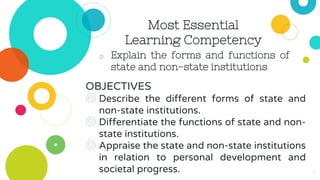
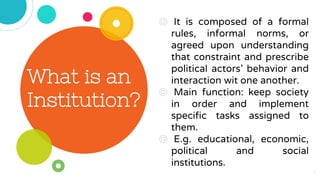
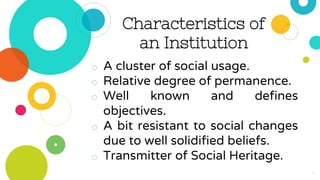
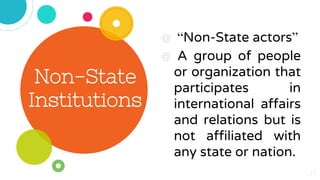
This document discusses state and non-state institutions. It defines institutions as formal or informal rules that constrain behavior. It differentiates between state institutions, which govern the state, and non-state institutions, which participate in international affairs without being part of a state. Examples of state institutions include government branches, agencies, and local governments. Non-state institutions include banks, corporations, trade unions, cooperatives, development agencies, civil organizations, and transnational advocacy groups. The document provides examples and definitions of these different types of institutions and their functions.


















![ANALYZING THE SIGNIFICANCE OF CULTURAL, SOCIAL, [Autosaved] [Autosaved].pptx](https://cdn.slidesharecdn.com/ss_thumbnails/analyzingthesignificanceofculturalsocialautosavedautosaved-220923152702-9c7eb7f1-thumbnail.jpg?width=640&height=640&fit=bounds)


![UCSP- 2ND QUARTER LESSON FOR THE CO1 [Autosaved].pptx](https://cdn.slidesharecdn.com/ss_thumbnails/ucsp-2ndquarterlessonfortheco1autosaved-240108222729-da208d8b-thumbnail.jpg?width=640&height=640&fit=bounds)


