WORKSHOP
Building an Innovative
Value Proposition
What is a business?
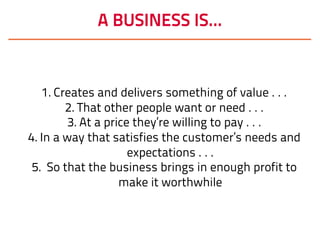
A BUSINESS IS…
1. Creates and delivers something of value . . .
2. That other people want or need . . .
3. At a price they’re willing to pay . . .
4. In a way that satisfies the customer’s needs and
expectations . . .
5. So that the business brings in enough profit to
make it worthwhile
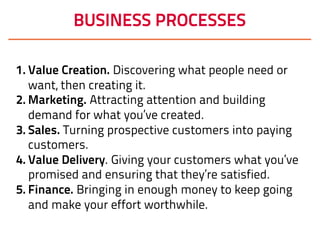
BUSINESS PROCESSES
1. Value Creation. Discovering what people need or
want, then creating it.
2. Marketing. Attracting attention and building
demand for what you’ve created.
3. Sales. Turning prospective customers into paying
customers.
4. Value Delivery. Giving your customers what you’ve
promised and ensuring that they’re satisfied.
5. Finance. Bringing in enough money to keep going
and make your effort worthwhile.
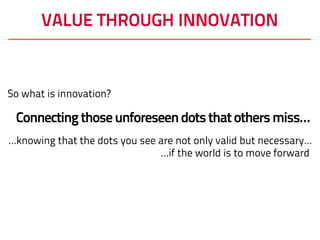
VALUE THROUGH INNOVATION
So what is innovation?
Connectingthoseunforeseendotsthatothersmiss…
…knowing that the dots you see are not only valid but necessary…
…if the world is to move forward
The reason why people
want to
buy your
product/service
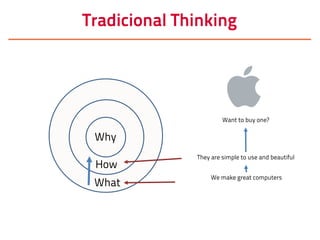
Tradicional Thinking
Why
How
What
We make great computers
They are simple to use and beautiful
Want to buy one?
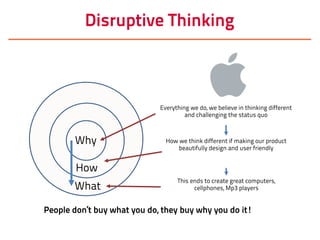
Disruptive Thinking
People don’t buy what you do, they buy why you do it!
Why
How
What
This ends to create great computers,
cellphones, Mp3 players
How we think different if making our product
beautifully design and user friendly
Everything we do, we believe in thinking different
and challenging the status quo
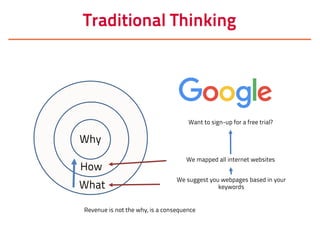
Traditional Thinking
Why
How
What
We suggest you webpages based in your
keywords
We mapped all internet websites
Want to sign-up for a free trial?
Revenue is not the why, is a consequence
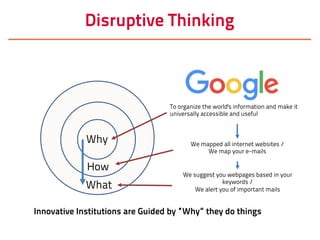
Disruptive Thinking
Innovative Institutions are Guided by “Why” they do things
Why
How
What
We suggest you webpages based in your
keywords /
We alert you of important mails
We mapped all internet websites /
We map your e-mails
To organize the world's information and make it
universally accessible and useful
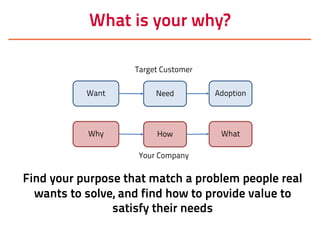
What is your why?
Want Need Adoption
Target Customer
Your Company
Why How What
Find your purpose that match a problem people real
wants to solve, and find how to provide value to
satisfy their needs
What is your why?
Start by discovering your purpose, your “Why”
Make sure your “Why” fits a significant group
of people “Wants” – it is your market
People will buy to you because you allow them
to achieve what they “Want” not what they
“Need”
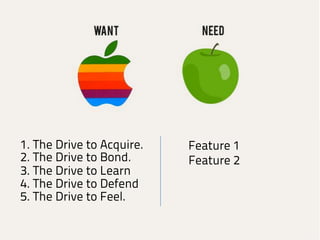
1. The Drive to Acquire.
2. The Drive to Bond.
3. The Drive to Learn
4. The Drive to Defend
5. The Drive to Feel.
Feature 1
Feature 2
How to find what people
want?
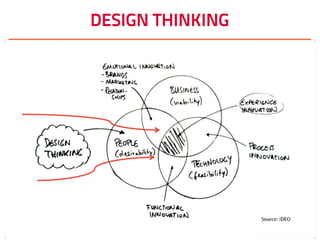
DESIGN THINKING
DESIGN THINKING
How to explore design
thinking?
DESIGN THINKING PROCESS
Building your
Value Proposition
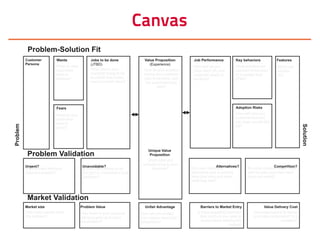
Canvas
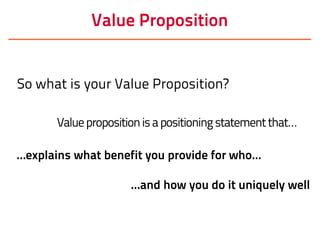
Value Proposition
So what is your Value Proposition?
Valuepropositionisapositioningstatementthat…
…explains what benefit you provide for who…
…and how you do it uniquely well
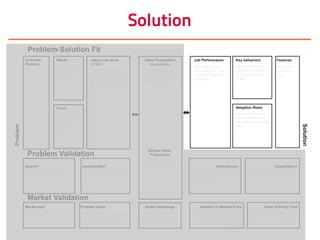
Problem
Solution
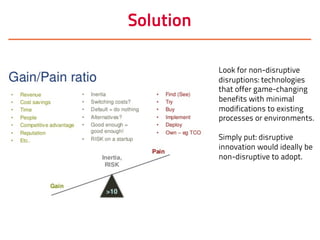
Solution
Look for non-disruptive
disruptions: technologies
that offer game-changing
benefits with minimal
modifications to existing
processes or environments.
Simply put: disruptive
innovation would ideally be
non-disruptive to adopt.
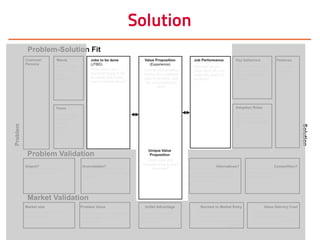
Solution
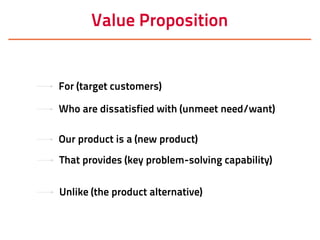
Value Proposition
For (target customers)
Who are dissatisfied with (unmeet need/want)
Our product is a (new product)
That provides (key problem-solving capability)
Unlike (the product alternative)
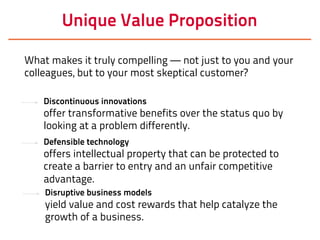
Unique Value Proposition
Discontinuous innovations
offer transformative benefits over the status quo by
looking at a problem differently.
What makes it truly compelling — not just to you and your
colleagues, but to your most skeptical customer?
Defensible technology
offers intellectual property that can be protected to
create a barrier to entry and an unfair competitive
advantage.
Disruptive business models
yield value and cost rewards that help catalyze the
growth of a business.
Is the problem
worth to be solved?
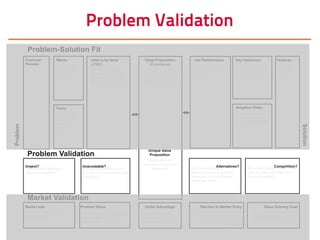
Problem Validation
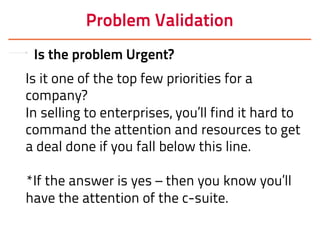
Problem Validation
Is the problem Urgent?
Is it one of the top few priorities for a
company?
In selling to enterprises, you’ll find it hard to
command the attention and resources to get
a deal done if you fall below this line.
*If the answer is yes – then you know you’ll
have the attention of the c-suite.
Problem Validation
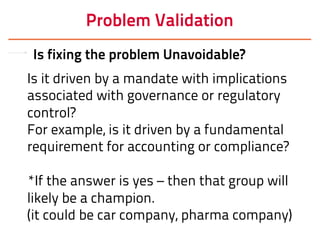
Is fixing the problem Unavoidable?
Is it driven by a mandate with implications
associated with governance or regulatory
control?
For example, is it driven by a fundamental
requirement for accounting or compliance?
*If the answer is yes – then that group will
likely be a champion.
(it could be car company, pharma company)
Problem Validation
Is the problem Unworkable?
Does your solution fix a broken business
process where there are real, measureable
consequences to inaction?
Will someone get fired if the issue is not
addressed?
*If the answer is yes – then that person will
likely be your internal champion.
(it could be the wife, the CFO, the doctor)
Problem Validation
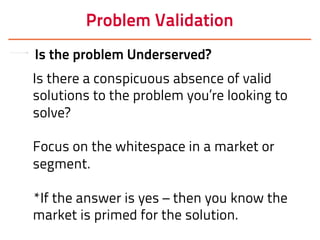
Is the problem Underserved?
Is there a conspicuous absence of valid
solutions to the problem you’re looking to
solve?
Focus on the whitespace in a market or
segment.
*If the answer is yes – then you know the
market is primed for the solution.
Is the problem a good
market opportunity?
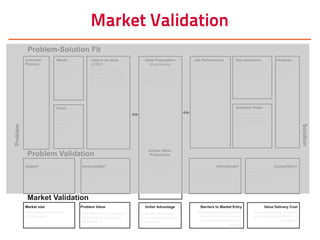
Market Validation
Startup Braga is an initiative from InvestBraga - Agency for Economic Development.

Startup Braga - value proposition workshop

  • 1.
  • 2.
    What is abusiness?
  • 3.
    A BUSINESS IS… 1.Creates and delivers something of value . . . 2. That other people want or need . . . 3. At a price they’re willing to pay . . . 4. In a way that satisfies the customer’s needs and expectations . . . 5. So that the business brings in enough profit to make it worthwhile
  • 4.
    BUSINESS PROCESSES 1. ValueCreation. Discovering what people need or want, then creating it. 2. Marketing. Attracting attention and building demand for what you’ve created. 3. Sales. Turning prospective customers into paying customers. 4. Value Delivery. Giving your customers what you’ve promised and ensuring that they’re satisfied. 5. Finance. Bringing in enough money to keep going and make your effort worthwhile.
  • 5.
    VALUE THROUGH INNOVATION Sowhat is innovation? Connectingthoseunforeseendotsthatothersmiss… …knowing that the dots you see are not only valid but necessary… …if the world is to move forward
  • 6.
    The reason whypeople want to buy your product/service
  • 7.
    Tradicional Thinking Why How What We makegreat computers They are simple to use and beautiful Want to buy one?
  • 8.
    Disruptive Thinking People don’tbuy what you do, they buy why you do it! Why How What This ends to create great computers, cellphones, Mp3 players How we think different if making our product beautifully design and user friendly Everything we do, we believe in thinking different and challenging the status quo
  • 9.
    Traditional Thinking Why How What We suggestyou webpages based in your keywords We mapped all internet websites Want to sign-up for a free trial? Revenue is not the why, is a consequence
  • 10.
    Disruptive Thinking Innovative Institutionsare Guided by “Why” they do things Why How What We suggest you webpages based in your keywords / We alert you of important mails We mapped all internet websites / We map your e-mails To organize the world's information and make it universally accessible and useful
  • 11.
    What is yourwhy? Want Need Adoption Target Customer Your Company Why How What Find your purpose that match a problem people real wants to solve, and find how to provide value to satisfy their needs
  • 12.
    What is yourwhy? Start by discovering your purpose, your “Why” Make sure your “Why” fits a significant group of people “Wants” – it is your market People will buy to you because you allow them to achieve what they “Want” not what they “Need”
  • 13.
    1. The Driveto Acquire. 2. The Drive to Bond. 3. The Drive to Learn 4. The Drive to Defend 5. The Drive to Feel. Feature 1 Feature 2
  • 14.
    How to findwhat people want?
  • 15.
  • 16.
  • 17.
    How to exploredesign thinking?
  • 18.
  • 19.
  • 20.
  • 21.
    Value Proposition So whatis your Value Proposition? Valuepropositionisapositioningstatementthat… …explains what benefit you provide for who… …and how you do it uniquely well
  • 22.
  • 23.
  • 24.
    Solution Look for non-disruptive disruptions:technologies that offer game-changing benefits with minimal modifications to existing processes or environments. Simply put: disruptive innovation would ideally be non-disruptive to adopt.
  • 25.
  • 26.
    Value Proposition For (targetcustomers) Who are dissatisfied with (unmeet need/want) Our product is a (new product) That provides (key problem-solving capability) Unlike (the product alternative)
  • 27.
    Unique Value Proposition Discontinuousinnovations offer transformative benefits over the status quo by looking at a problem differently. What makes it truly compelling — not just to you and your colleagues, but to your most skeptical customer? Defensible technology offers intellectual property that can be protected to create a barrier to entry and an unfair competitive advantage. Disruptive business models yield value and cost rewards that help catalyze the growth of a business.
  • 28.
    Is the problem worthto be solved?
  • 29.
  • 30.
    Problem Validation Is theproblem Urgent? Is it one of the top few priorities for a company? In selling to enterprises, you’ll find it hard to command the attention and resources to get a deal done if you fall below this line. *If the answer is yes – then you know you’ll have the attention of the c-suite.
  • 31.
    Problem Validation Is fixingthe problem Unavoidable? Is it driven by a mandate with implications associated with governance or regulatory control? For example, is it driven by a fundamental requirement for accounting or compliance? *If the answer is yes – then that group will likely be a champion. (it could be car company, pharma company)
  • 32.
    Problem Validation Is theproblem Unworkable? Does your solution fix a broken business process where there are real, measureable consequences to inaction? Will someone get fired if the issue is not addressed? *If the answer is yes – then that person will likely be your internal champion. (it could be the wife, the CFO, the doctor)
  • 33.
    Problem Validation Is theproblem Underserved? Is there a conspicuous absence of valid solutions to the problem you’re looking to solve? Focus on the whitespace in a market or segment. *If the answer is yes – then you know the market is primed for the solution.
  • 34.
    Is the problema good market opportunity?
  • 35.
  • 36.
    Startup Braga isan initiative from InvestBraga - Agency for Economic Development.