STARTER UNIT 
REVIEW
QUESTION WORDS (QW) 
• WHAT / WHICH = 
• WHO = 
• WHEN = 
• WHERE = 
• WHY = 
• HOW =
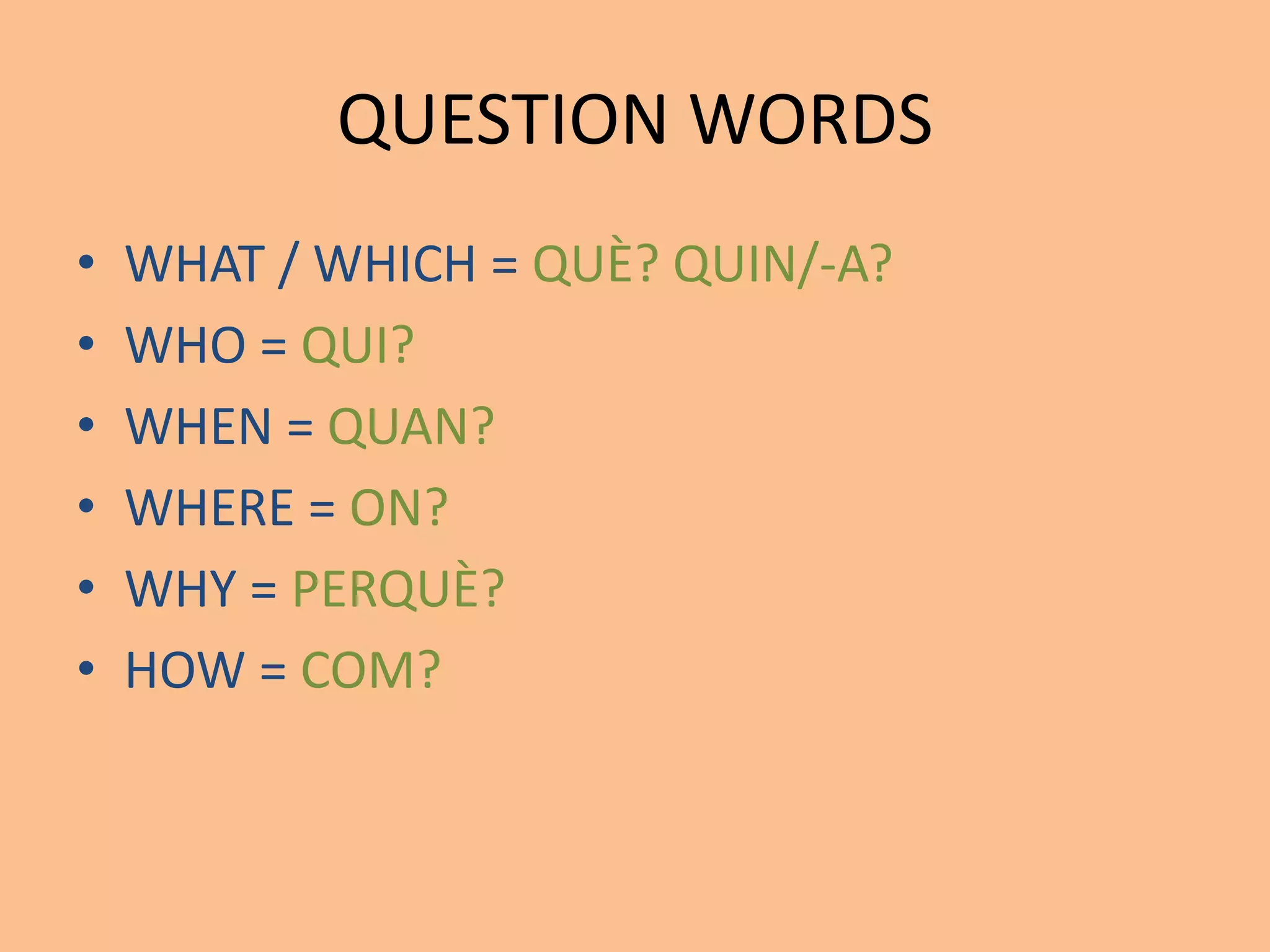
QUESTION WORDS 
• WHAT / WHICH = QUÈ? QUIN/-A? 
• WHO = QUI? 
• WHEN = QUAN? 
• WHERE = ON? 
• WHY = PERQUÈ? 
• HOW = COM?
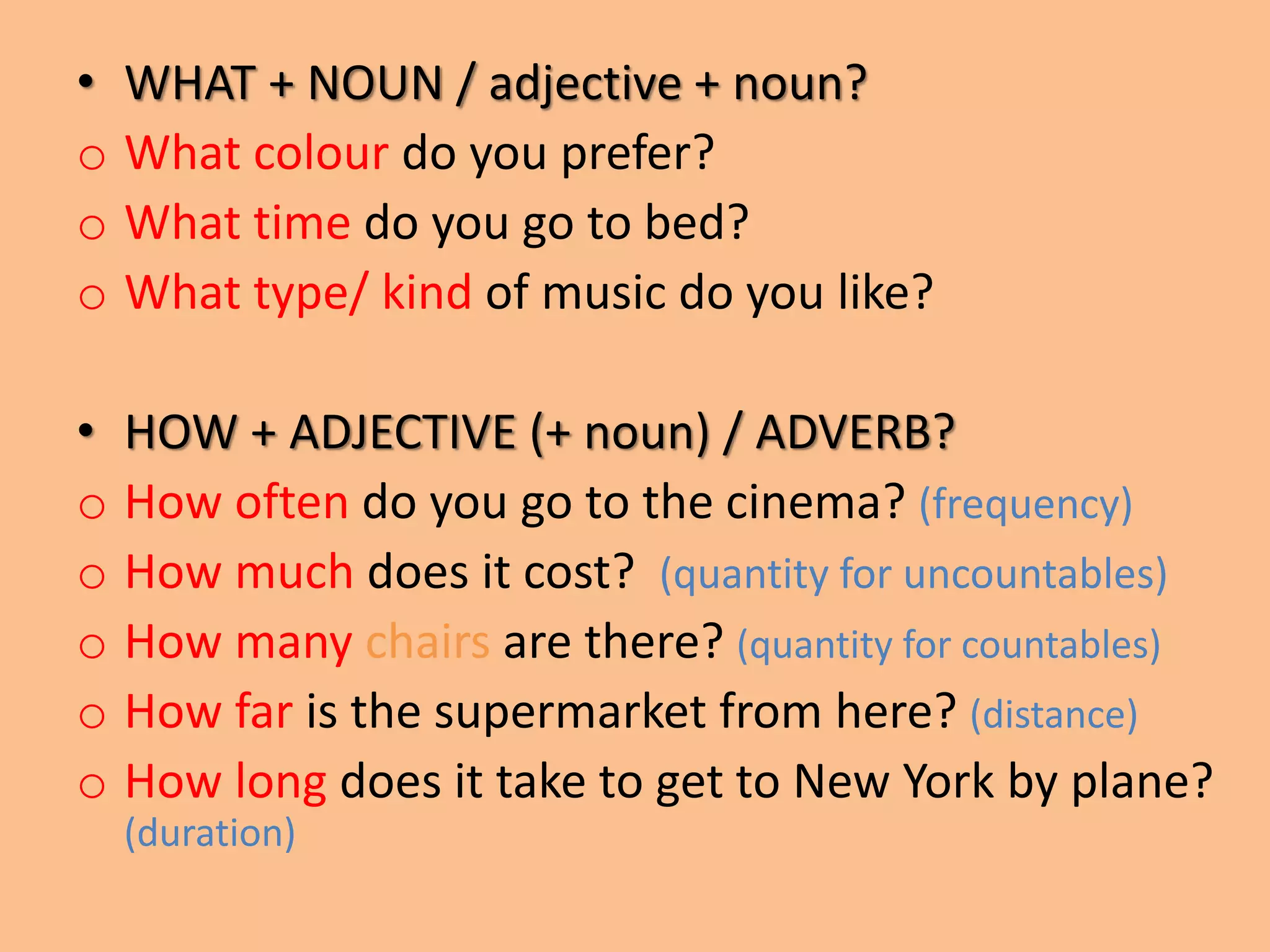
• WHAT + NOUN / adjective + noun? 
o What colour do you prefer? 
o What time do you go to bed? 
o What type/ kind of music do you like? 
• HOW + ADJECTIVE (+ noun) / ADVERB? 
o How often do you go to the cinema? (frequency) 
o How much does it cost? (quantity for uncountables) 
o How many chairs are there? (quantity for countables) 
o How far is the supermarket from here? (distance) 
o How long does it take to get to New York by plane? 
(duration)
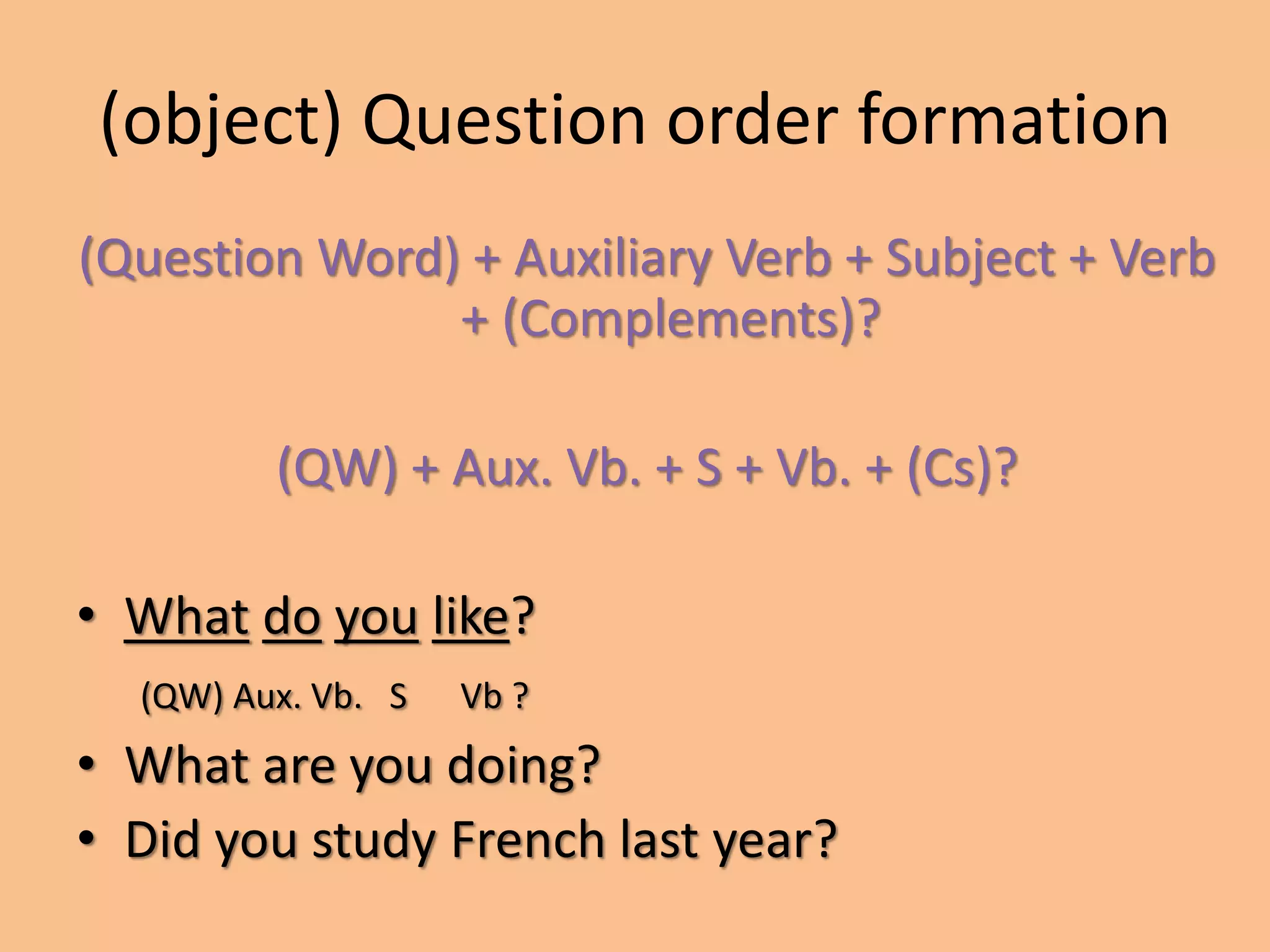
(object) Question order formation 
(Question Word) + Auxiliary Verb + Subject + Verb 
+ (Complements)? 
(QW) + Aux. Vb. + S + Vb. + (Cs)? 
• What do you like? 
(QW) Aux. Vb. S Vb ? 
• What are you doing? 
• Did you study French last year?
Now practice questions on SB p. 5 
ex. 8 and 10 with your partner
Classroom language 
• Do ex. 13 on SB p. 5 
• Then write these questions and answers on 
some cardboards and stick these expressions 
on your classroom’s wall.
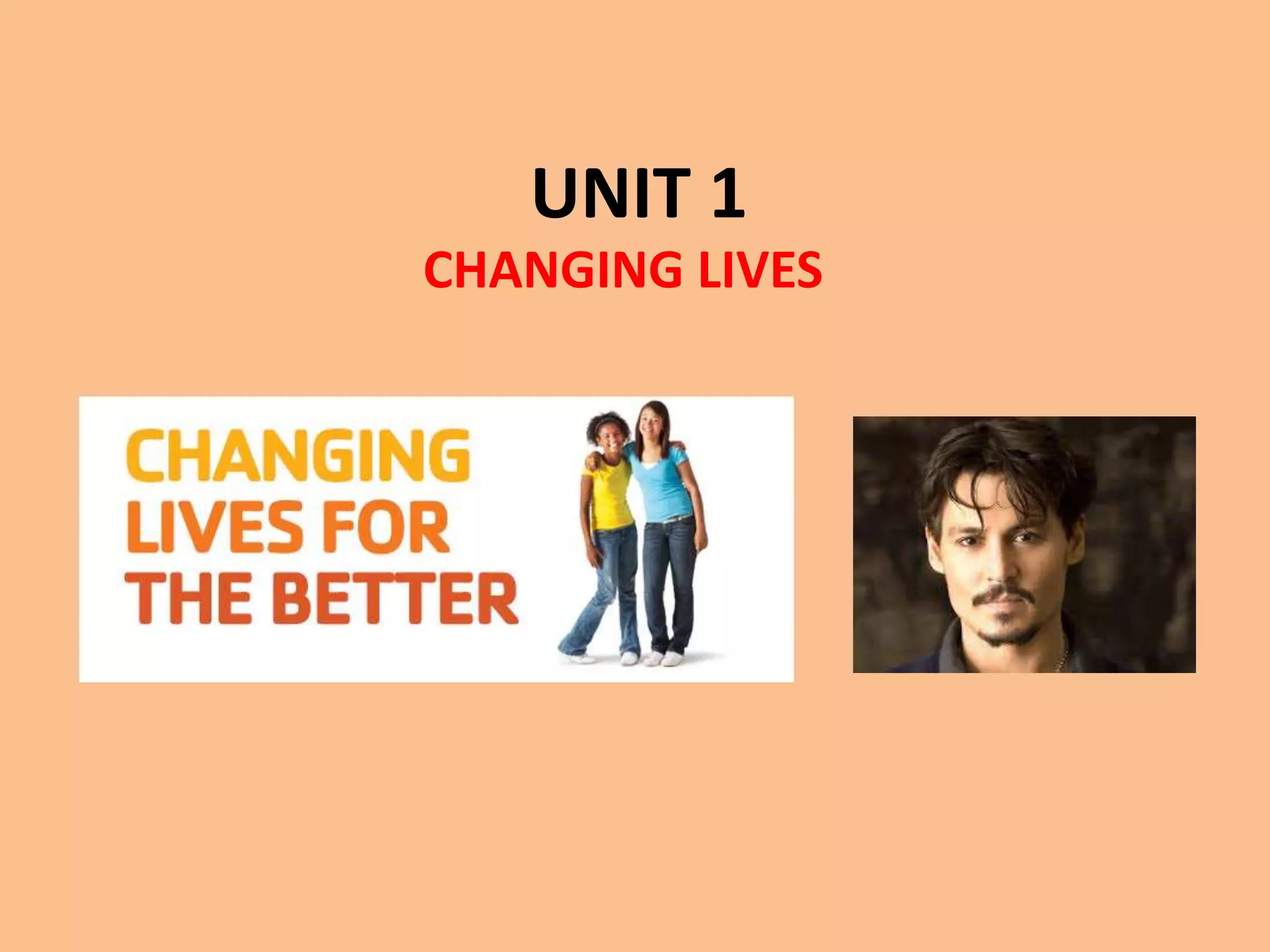
UNIT 1 
CHANGING LIVES
In this unit, we will work on… 
• Vocabulary: Life-changing events 
Verb+ preposition 
• Grammar: Present Simple and Continuous 
Past Simple 
Used to 
Subject and Object questions 
• Reading: ‘Then and now: Johnny Deep’ 
‘My new life’
• Listening: Lifestyle changes 
• Speaking: Talking about photos 
Describing a photo 
• Writing: An informal email 
Informal expressions 
• Our project: Poster describing our class 
English classroom’s language
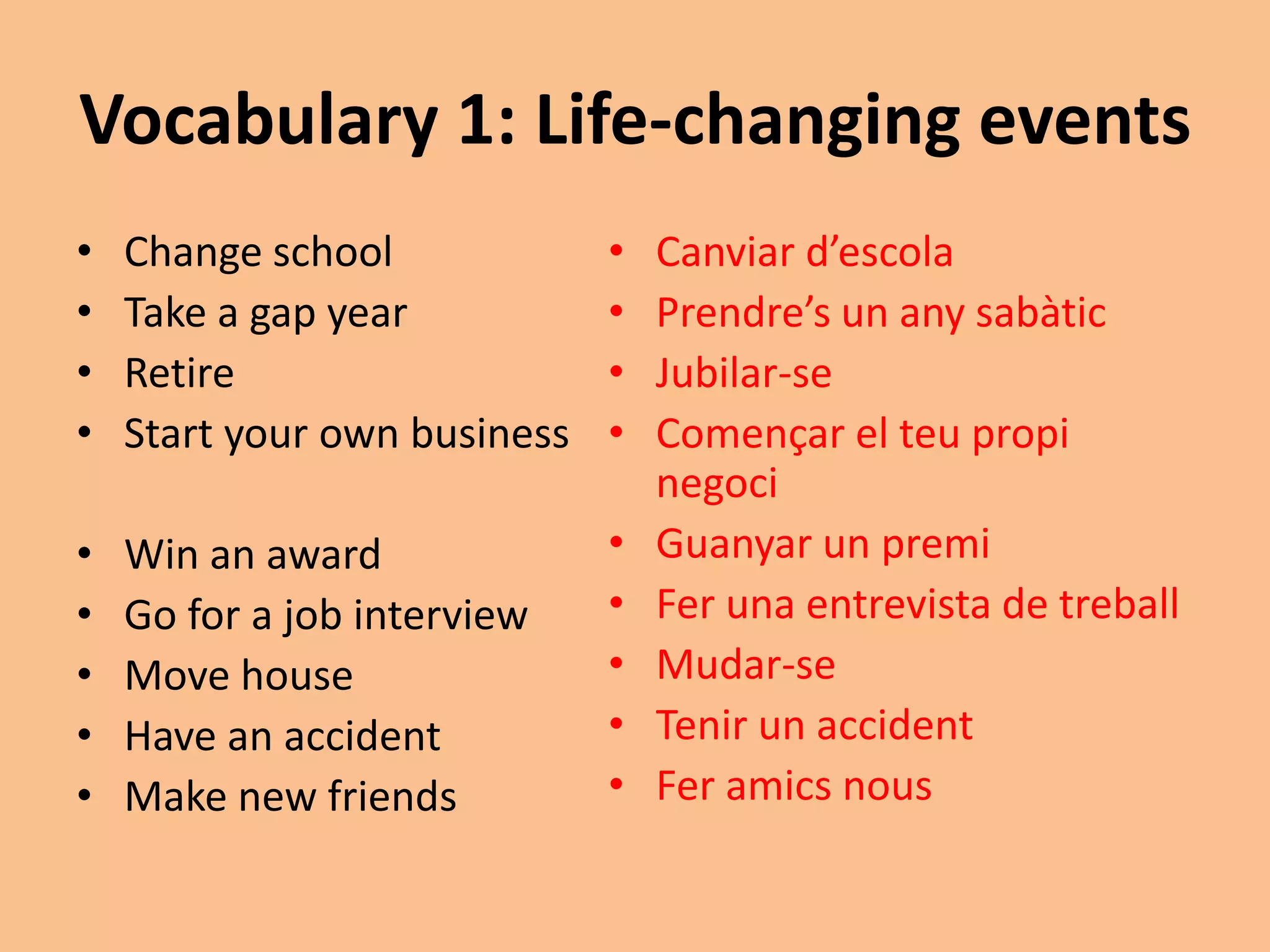
Vocabulary 1: Life-changing events 
• Change school 
• Take a gap year 
• Retire 
• Start your own business 
• Win an award 
• Go for a job interview 
• Move house 
• Have an accident 
• Make new friends
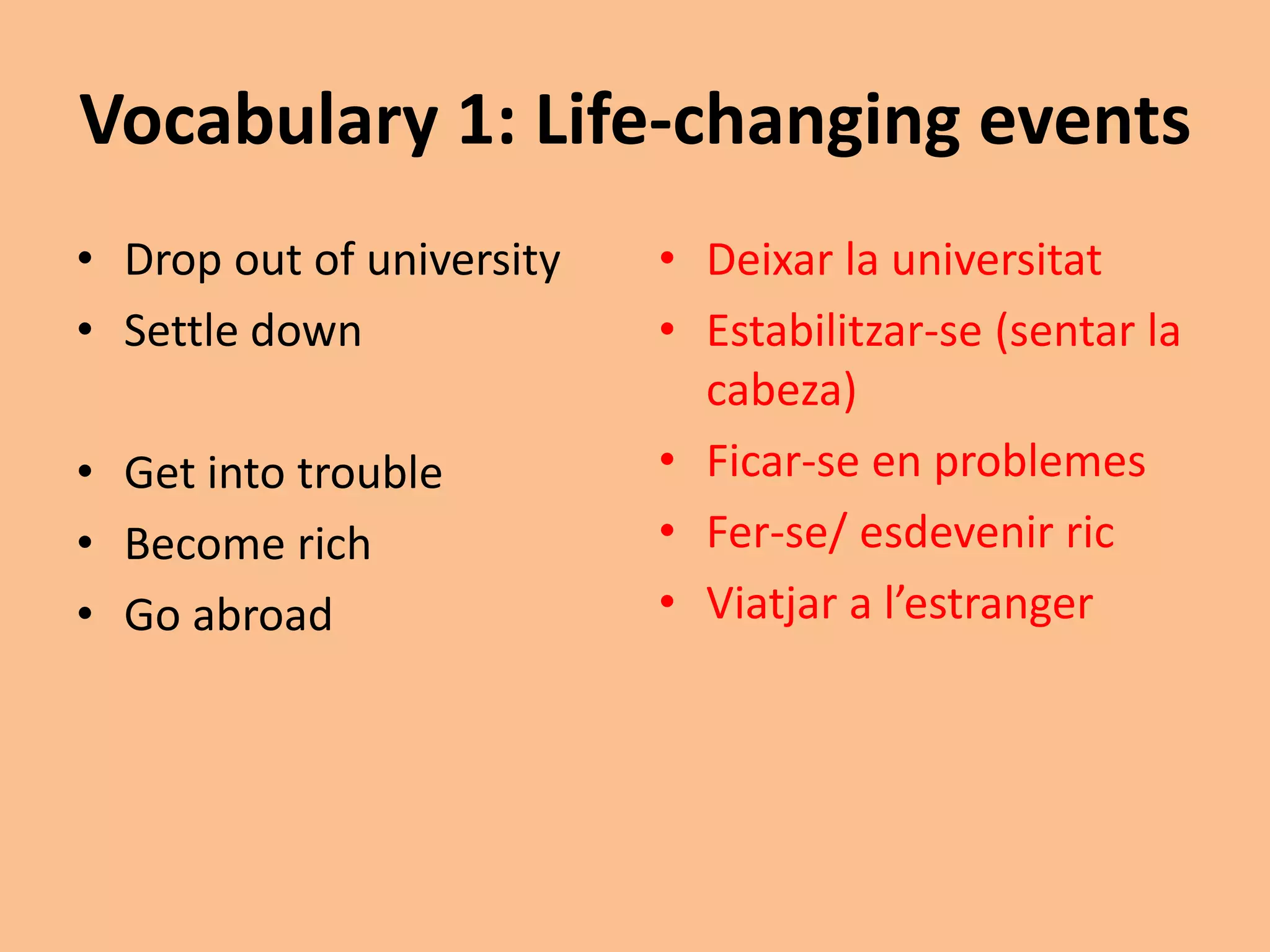
Vocabulary 1: Life-changing events 
• Drop out of university 
• Settle down 
• Get into trouble 
• Become rich 
• Go abroad
Vocabulary 1: Life-changing events 
• Change school 
• Take a gap year 
• Retire 
• Start your own business 
• Win an award 
• Go for a job interview 
• Move house 
• Have an accident 
• Make new friends 
• Canviar d’escola 
• Prendre’s un any sabàtic 
• Jubilar-se 
• Començar el teu propi 
negoci 
• Guanyar un premi 
• Fer una entrevista de treball 
• Mudar-se 
• Tenir un accident 
• Fer amics nous
Vocabulary 1: Life-changing events 
• Drop out of university 
• Settle down 
• Get into trouble 
• Become rich 
• Go abroad 
• Deixar la universitat 
• Estabilitzar-se (sentar la 
cabeza) 
• Ficar-se en problemes 
• Fer-se/ esdevenir ric 
• Viatjar a l’estranger
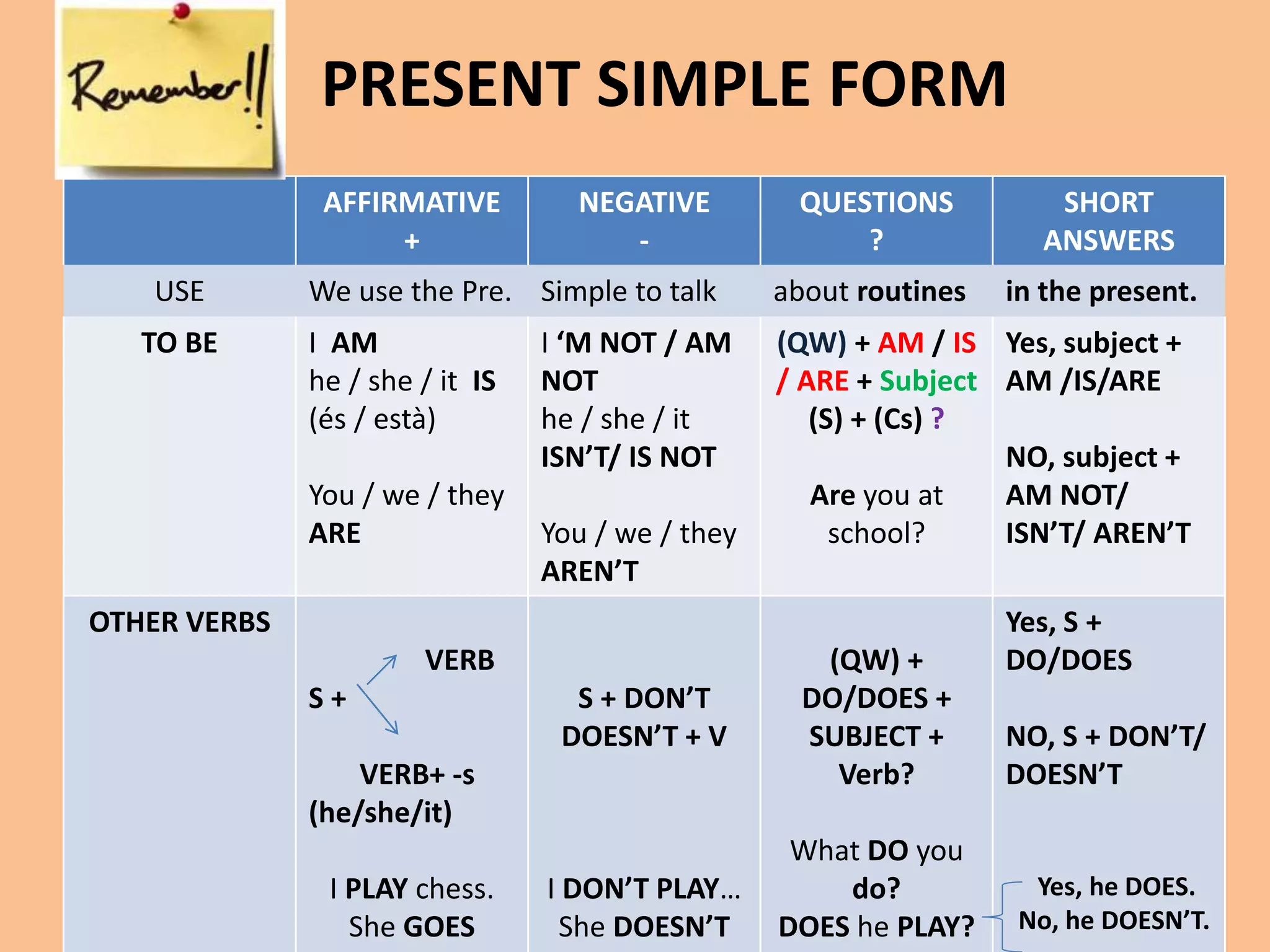
PRESENT SIMPLE FORM 
AFFIRMATIVE 
+ 
NEGATIVE 
- 
QUESTIONS 
? 
SHORT 
ANSWERS 
USE We use the Pre. Simple to talk about routines in the present. 
TO BE I AM 
he / she / it IS 
(és / està) 
You / we / they 
ARE 
I ‘M NOT / AM 
NOT 
he / she / it 
ISN’T/ IS NOT 
You / we / they 
AREN’T 
(QW) + AM / IS 
/ ARE + Subject 
(S) + (Cs) ? 
Are you at 
school? 
Yes, subject + 
AM /IS/ARE 
NO, subject + 
AM NOT/ 
ISN’T/ AREN’T 
OTHER VERBS 
VERB 
S + 
VERB+ -s 
(he/she/it) 
I PLAY chess. 
She GOES 
home. 
S + DON’T 
DOESN’T + V 
I DON’T PLAY… 
She DOESN’T 
GO… 
(QW) + 
DO/DOES + 
SUBJECT + 
Verb? 
What DO you 
do? 
DOES he PLAY? 
Yes, S + 
DO/DOES 
NO, S + DON’T/ 
DOESN’T 
Yes, he DOES. 
No, he DOESN’T.
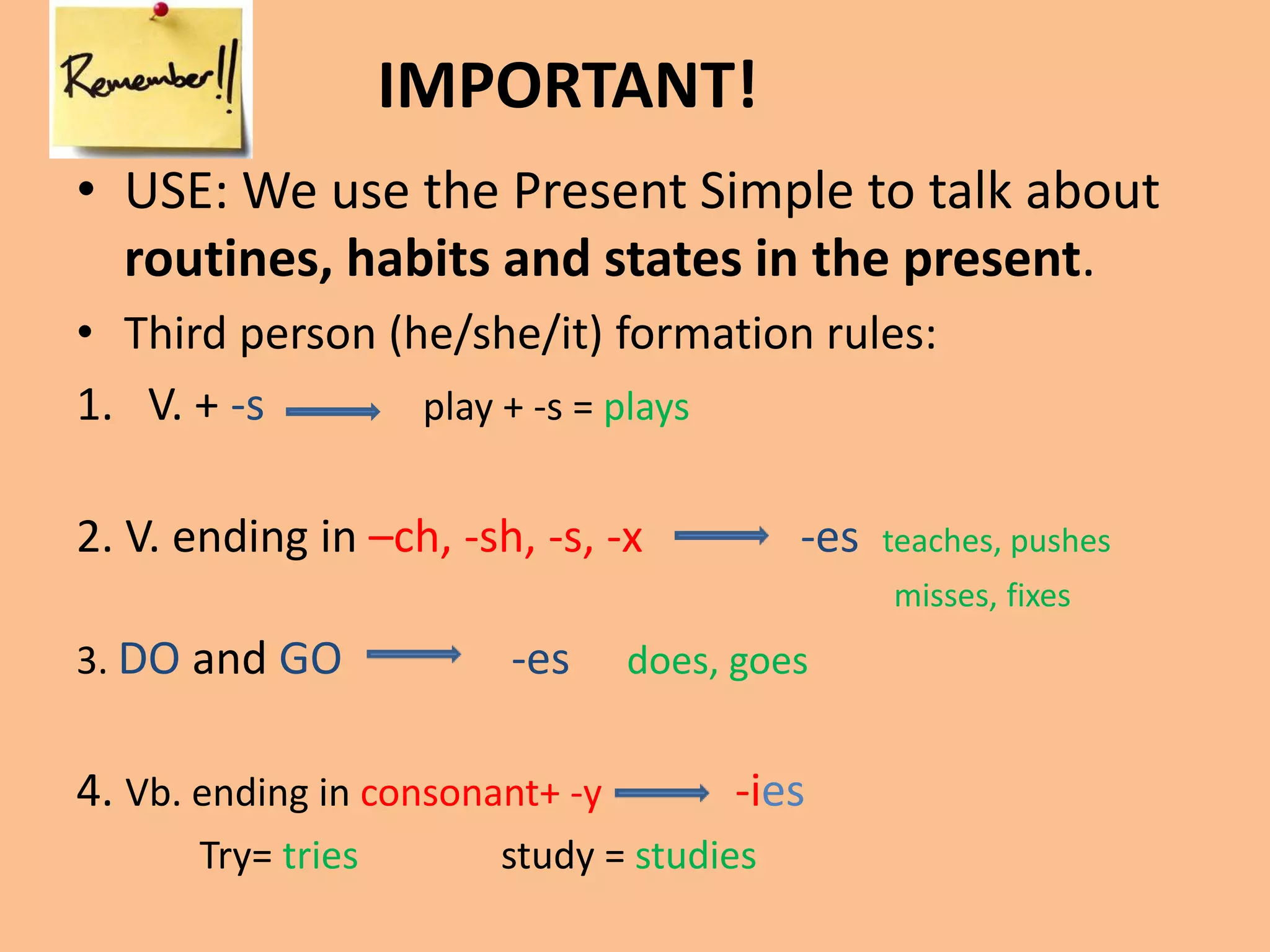
IMPORTANT! 
• USE: We use the Present Simple to talk about 
routines, habits and states in the present. 
• Third person (he/she/it) formation rules: 
1. V. + -s play + -s = plays 
2. V. ending in –ch, -sh, -s, -x -es teaches, pushes 
misses, fixes 
3. DO and GO -es does, goes 
4. Vb. ending in consonant+ -y -ies 
Try= tries study = studies
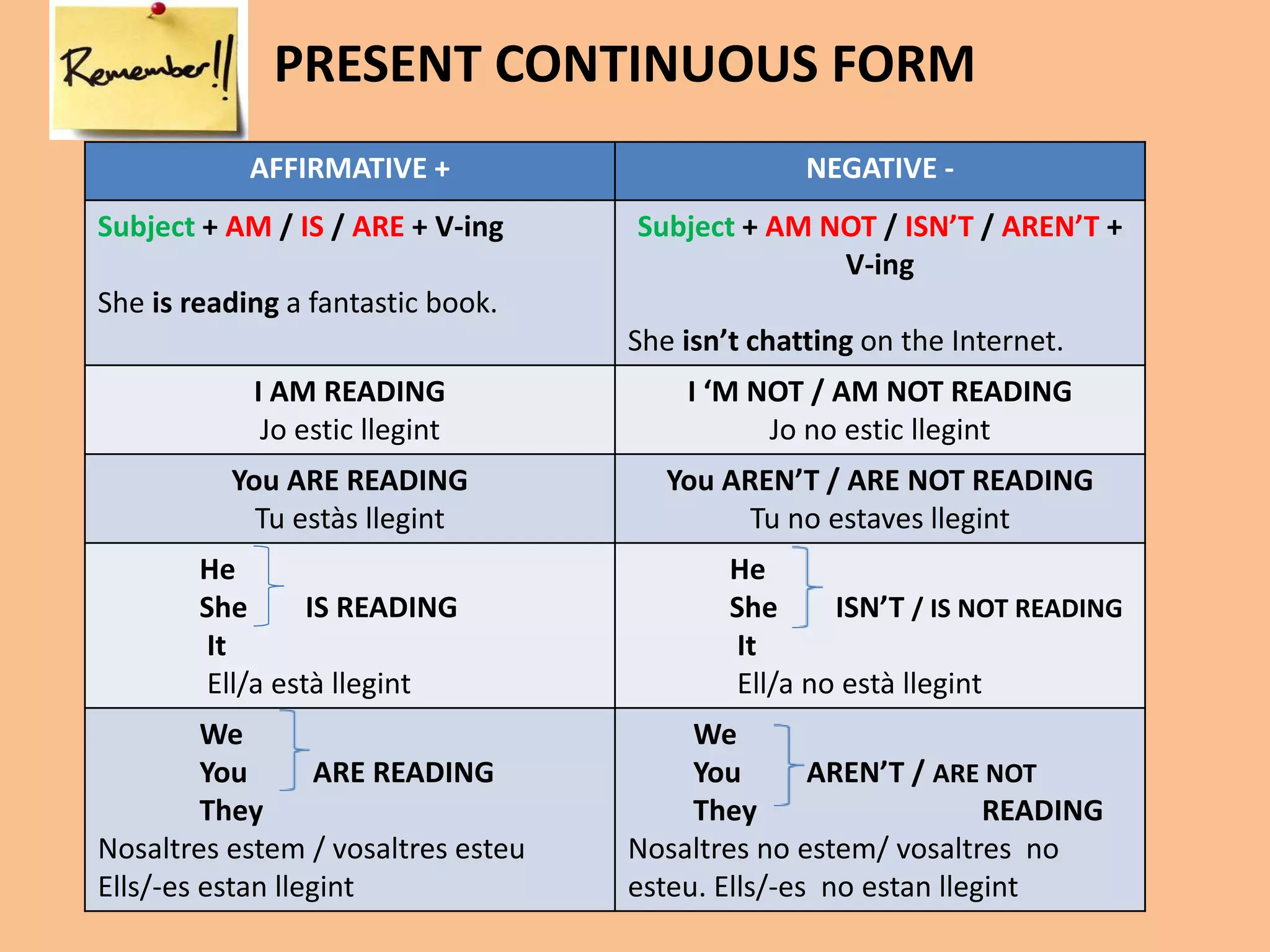
PRESENT CONTINUOUS FORM 
AFFIRMATIVE + NEGATIVE - 
Subject + AM / IS / ARE + V-ing 
She is reading a fantastic book. 
Subject + AM NOT / ISN’T / AREN’T + 
V-ing 
She isn’t chatting on the Internet. 
I AM READING 
Jo estic llegint 
I ‘M NOT / AM NOT READING 
Jo no estic llegint 
You ARE READING 
Tu estàs llegint 
You AREN’T / ARE NOT READING 
Tu no estaves llegint 
He 
She IS READING 
It 
Ell/a està llegint 
He 
She ISN’T / IS NOT READING 
It 
Ell/a no està llegint 
We 
You ARE READING 
They 
Nosaltres estem / vosaltres esteu 
Ells/-es estan llegint 
We 
You AREN’T / ARE NOT 
They READING 
Nosaltres no estem/ vosaltres no 
esteu. Ells/-es no estan llegint
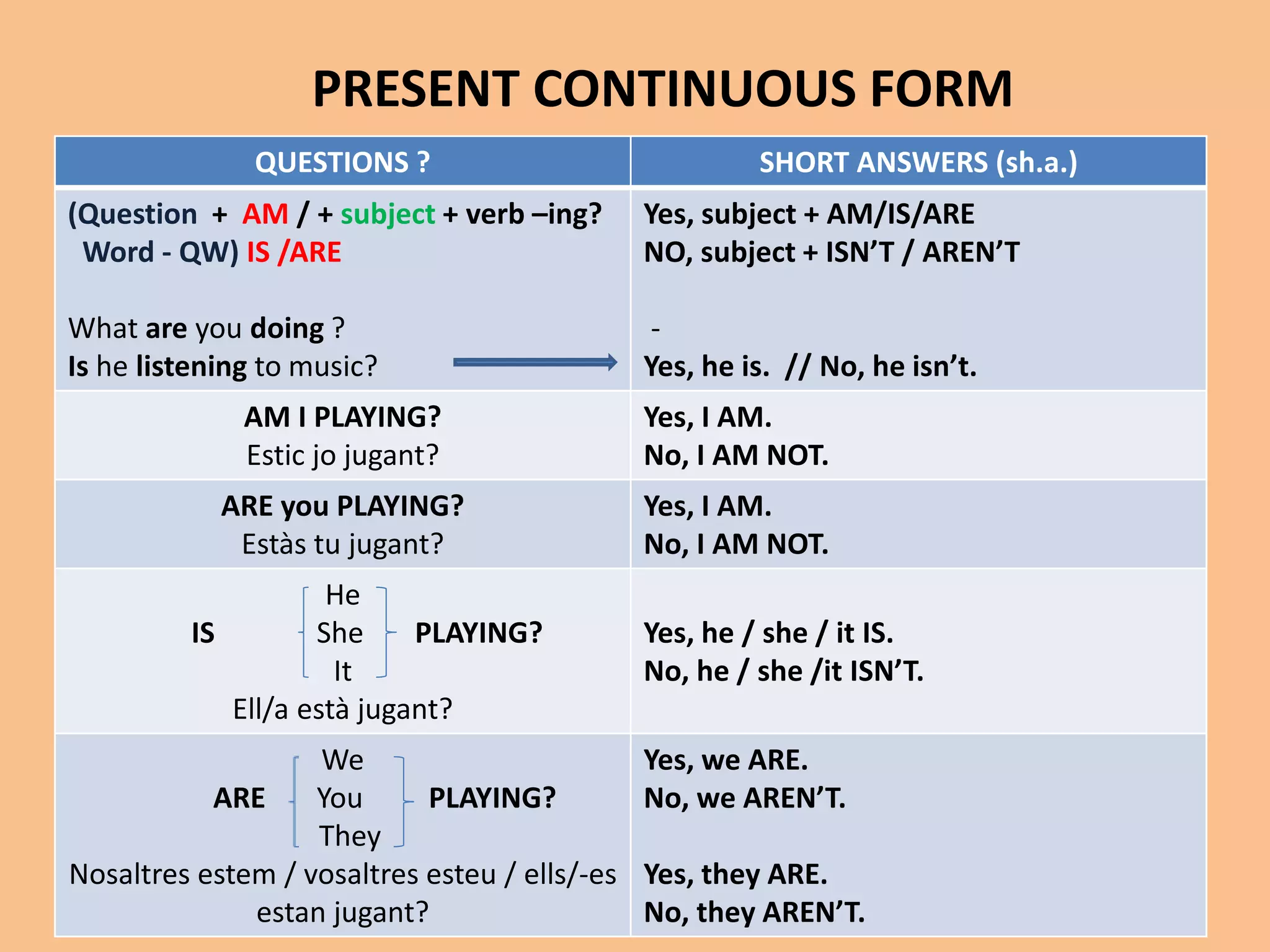
PRESENT CONTINUOUS FORM 
QUESTIONS ? SHORT ANSWERS (sh.a.) 
(Question + AM / + subject + verb –ing? 
Word - QW) IS /ARE 
What are you doing ? 
Is he listening to music? 
Yes, subject + AM/IS/ARE 
NO, subject + ISN’T / AREN’T 
- 
Yes, he is. // No, he isn’t. 
AM I PLAYING? 
Estic jo jugant? 
Yes, I AM. 
No, I AM NOT. 
ARE you PLAYING? 
Estàs tu jugant? 
Yes, I AM. 
No, I AM NOT. 
He 
IS She PLAYING? 
It 
Ell/a està jugant? 
Yes, he / she / it IS. 
No, he / she /it ISN’T. 
We 
ARE You PLAYING? 
They 
Nosaltres estem / vosaltres esteu / ells/-es 
estan jugant? 
Yes, we ARE. 
No, we AREN’T. 
Yes, they ARE. 
No, they AREN’T.
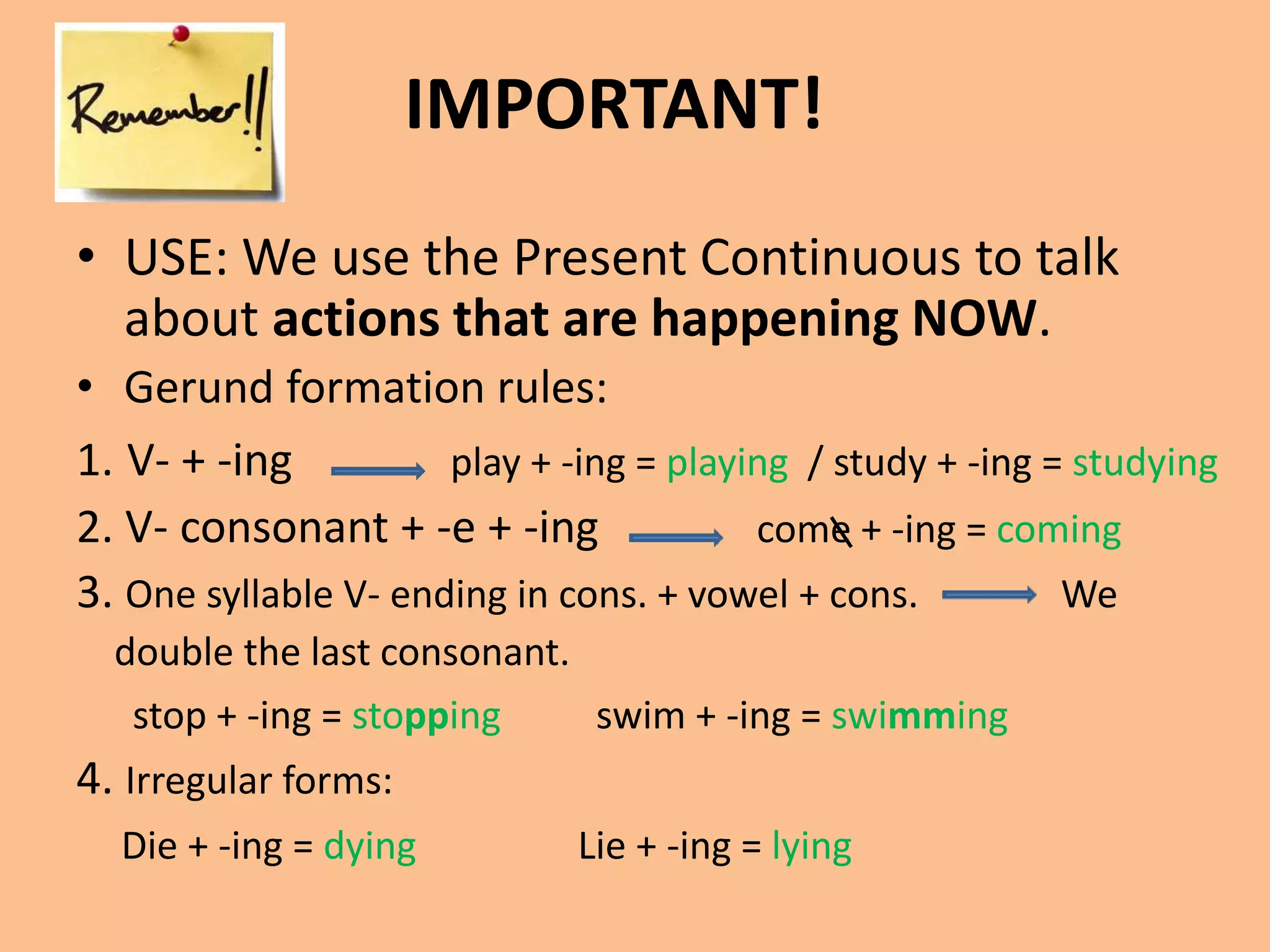
IMPORTANT! 
• USE: We use the Present Continuous to talk 
about actions that are happening NOW. 
• Gerund formation rules: 
1. V- + -ing play + -ing = playing / study + -ing = studying 
2. V- consonant + -e + -ing come + -ing = coming 
3. One syllable V- ending in cons. + vowel + cons. We 
double the last consonant. 
stop + -ing = stopping swim + -ing = swimming 
4. Irregular forms: 
Die + -ing = dying Lie + -ing = lying
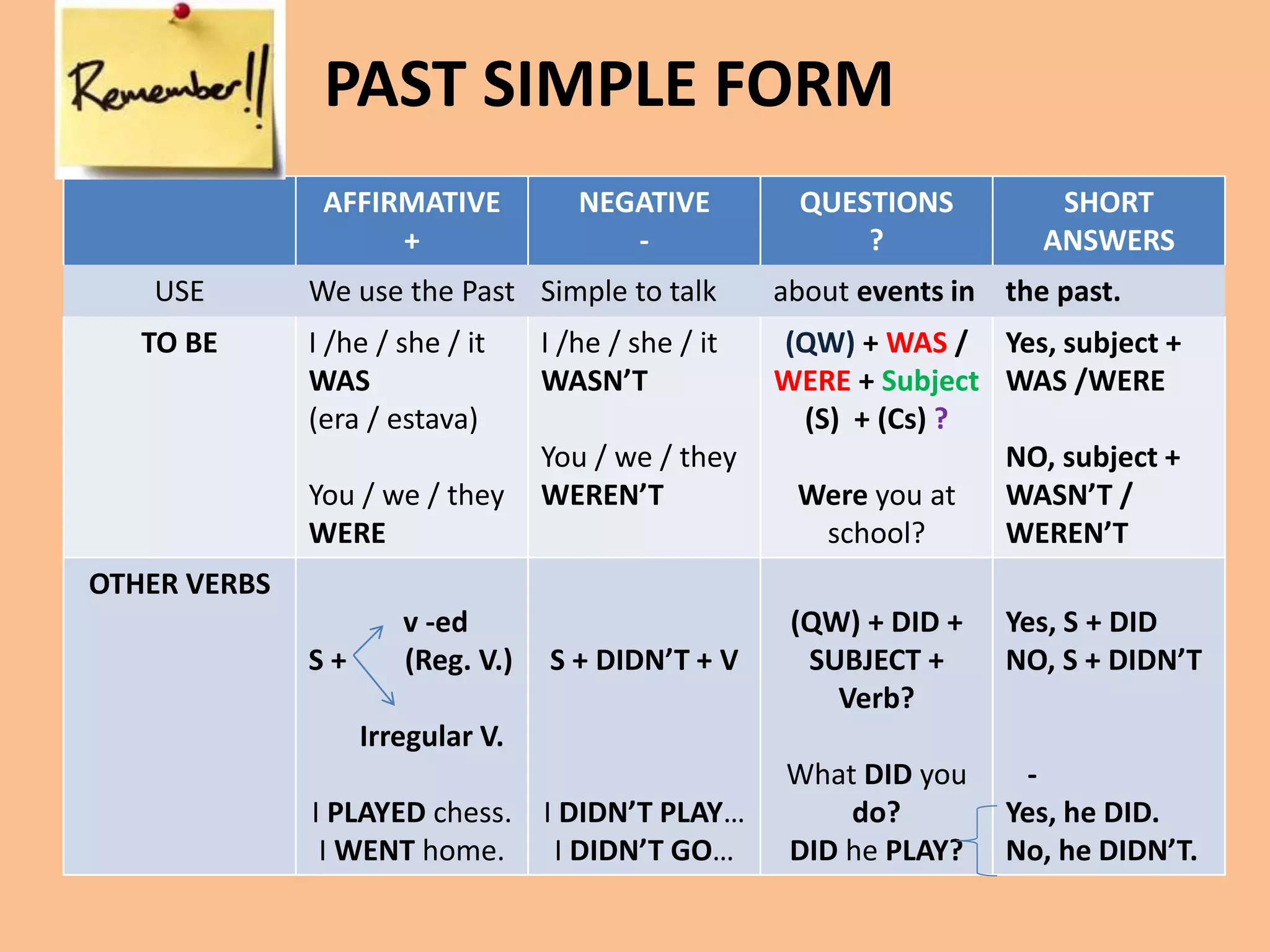
PAST SIMPLE FORM 
AFFIRMATIVE 
+ 
NEGATIVE 
- 
QUESTIONS 
? 
SHORT 
ANSWERS 
USE We use the Past Simple to talk about events in the past. 
TO BE I /he / she / it 
WAS 
(era / estava) 
You / we / they 
WERE 
I /he / she / it 
WASN’T 
You / we / they 
WEREN’T 
(QW) + WAS / 
WERE + Subject 
(S) + (Cs) ? 
Were you at 
school? 
Yes, subject + 
WAS /WERE 
NO, subject + 
WASN’T / 
WEREN’T 
OTHER VERBS 
v -ed 
S + (Reg. V.) 
Irregular V. 
I PLAYED chess. 
I WENT home. 
S + DIDN’T + V 
I DIDN’T PLAY… 
I DIDN’T GO… 
(QW) + DID + 
SUBJECT + 
Verb? 
What DID you 
do? 
DID he PLAY? 
Yes, S + DID 
NO, S + DIDN’T 
- 
Yes, he DID. 
No, he DIDN’T.
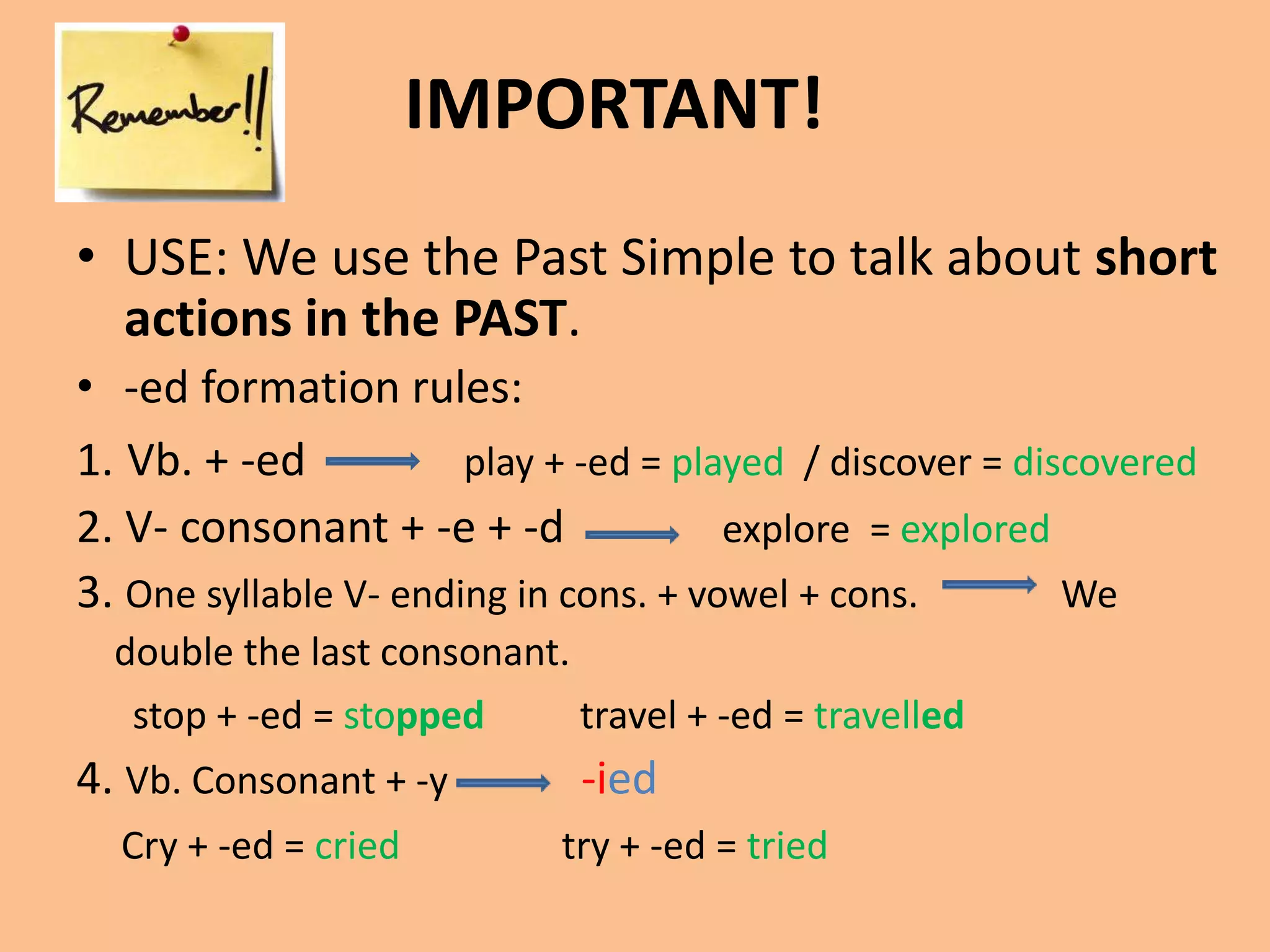
IMPORTANT! 
• USE: We use the Past Simple to talk about short 
actions in the PAST. 
• -ed formation rules: 
1. Vb. + -ed play + -ed = played / discover = discovered 
2. V- consonant + -e + -d explore = explored 
3. One syllable V- ending in cons. + vowel + cons. We 
double the last consonant. 
stop + -ed = stopped travel + -ed = travelled 
4. Vb. Consonant + -y -ied 
Cry + -ed = cried try + -ed = tried
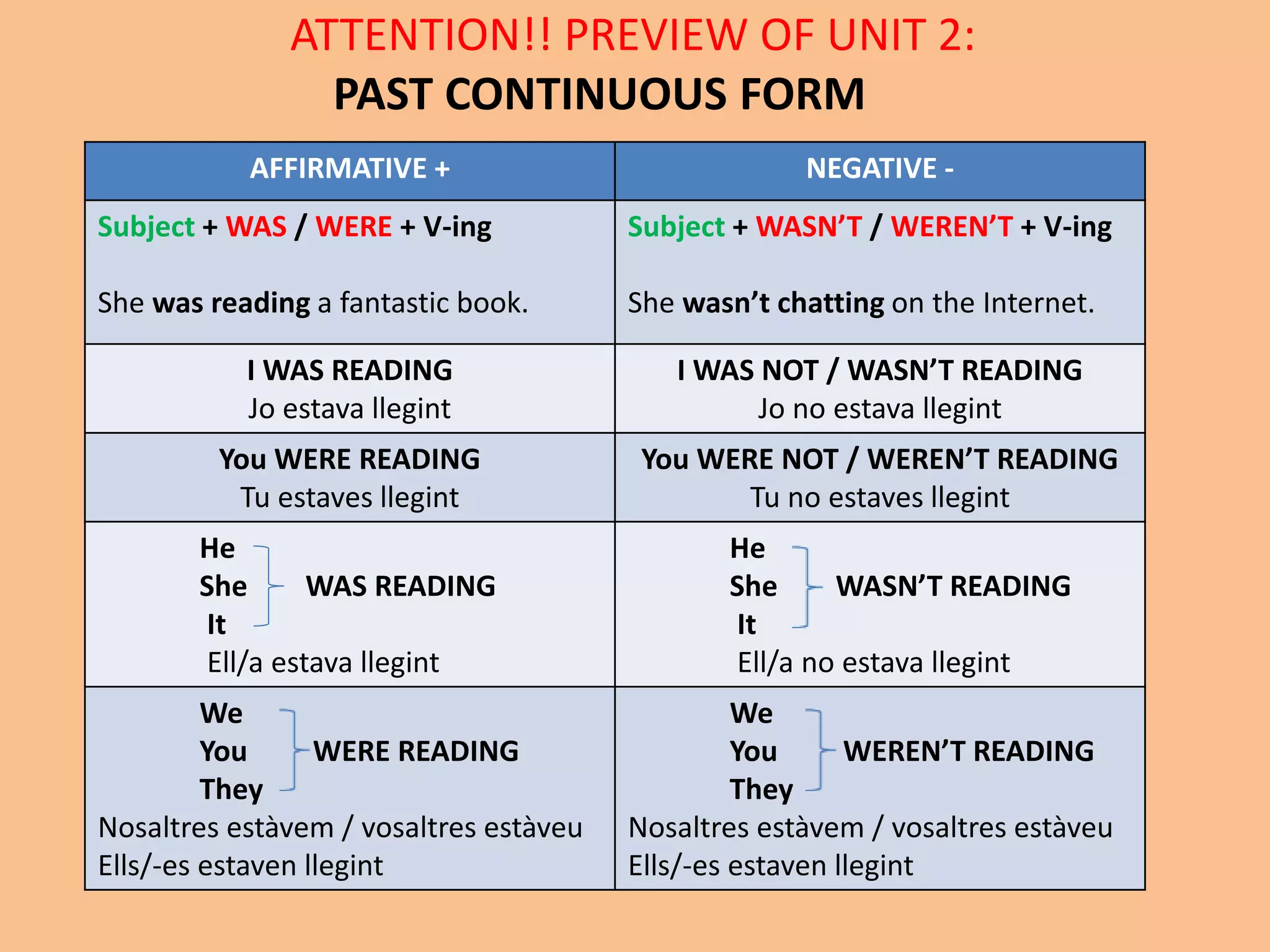
ATTENTION!! PREVIEW OF UNIT 2: 
PAST CONTINUOUS FORM 
AFFIRMATIVE + NEGATIVE - 
Subject + WAS / WERE + V-ing 
She was reading a fantastic book. 
Subject + WASN’T / WEREN’T + V-ing 
She wasn’t chatting on the Internet. 
I WAS READING 
Jo estava llegint 
I WAS NOT / WASN’T READING 
Jo no estava llegint 
You WERE READING 
Tu estaves llegint 
You WERE NOT / WEREN’T READING 
Tu no estaves llegint 
He 
She WAS READING 
It 
Ell/a estava llegint 
He 
She WASN’T READING 
It 
Ell/a no estava llegint 
We 
You WERE READING 
They 
Nosaltres estàvem / vosaltres estàveu 
Ells/-es estaven llegint 
We 
You WEREN’T READING 
They 
Nosaltres estàvem / vosaltres estàveu 
Ells/-es estaven llegint
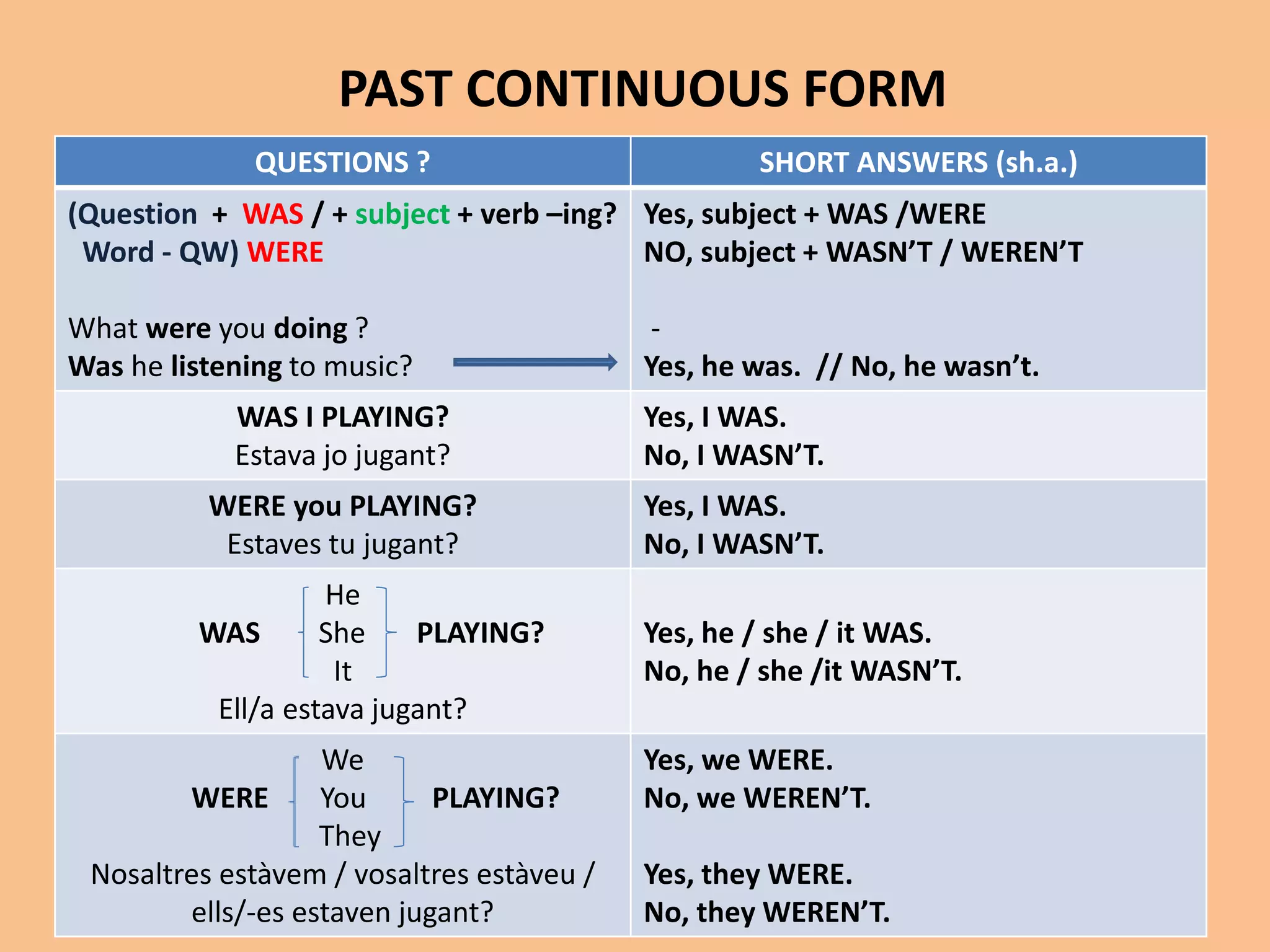
PAST CONTINUOUS FORM 
QUESTIONS ? SHORT ANSWERS (sh.a.) 
(Question + WAS / + subject + verb –ing? 
Word - QW) WERE 
What were you doing ? 
Was he listening to music? 
Yes, subject + WAS /WERE 
NO, subject + WASN’T / WEREN’T 
- 
Yes, he was. // No, he wasn’t. 
WAS I PLAYING? 
Estava jo jugant? 
Yes, I WAS. 
No, I WASN’T. 
WERE you PLAYING? 
Estaves tu jugant? 
Yes, I WAS. 
No, I WASN’T. 
He 
WAS She PLAYING? 
It 
Ell/a estava jugant? 
Yes, he / she / it WAS. 
No, he / she /it WASN’T. 
We 
WERE You PLAYING? 
They 
Nosaltres estàvem / vosaltres estàveu / 
ells/-es estaven jugant? 
Yes, we WERE. 
No, we WEREN’T. 
Yes, they WERE. 
No, they WEREN’T.
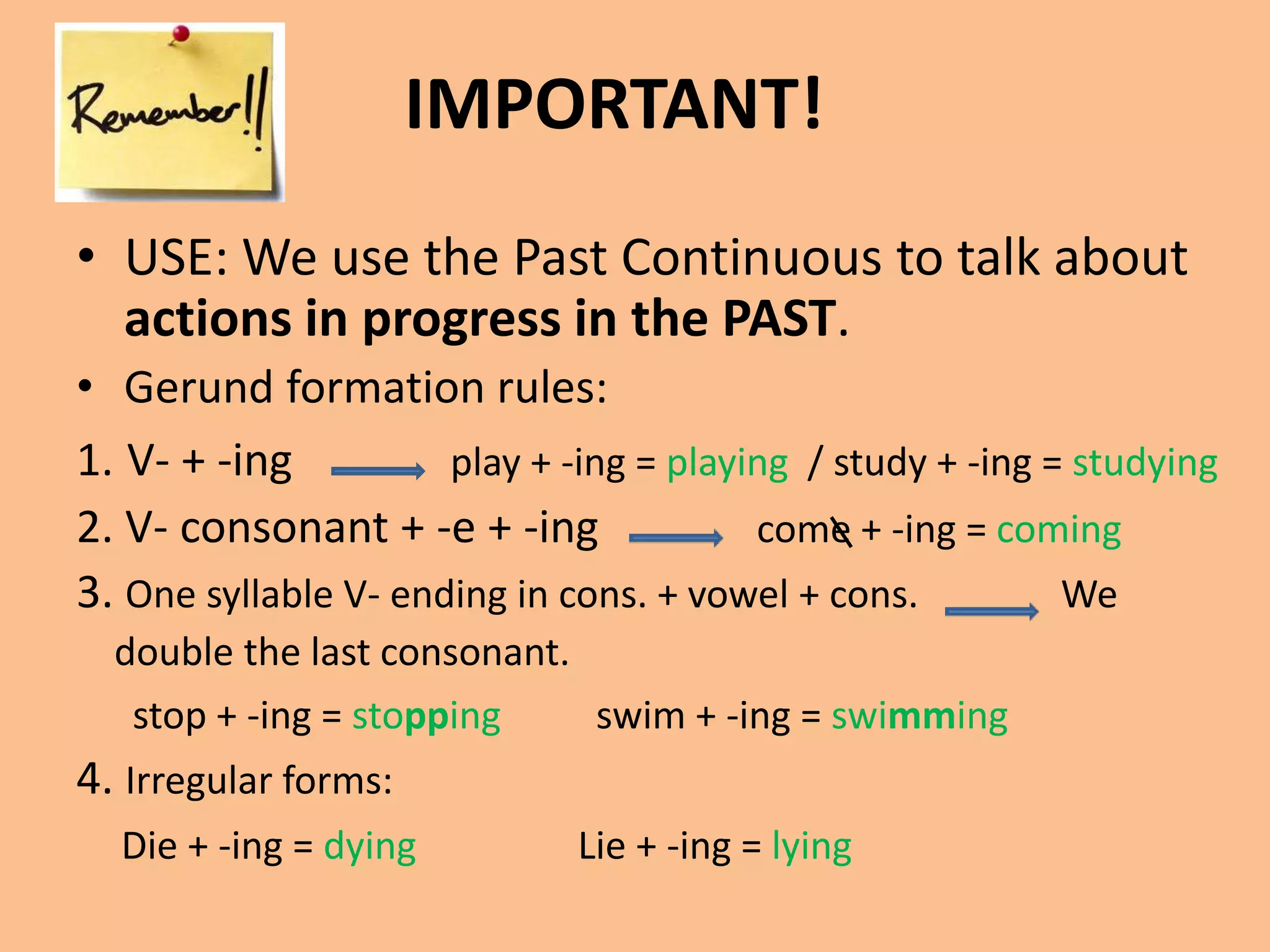
IMPORTANT! 
• USE: We use the Past Continuous to talk about 
actions in progress in the PAST. 
• Gerund formation rules: 
1. V- + -ing play + -ing = playing / study + -ing = studying 
2. V- consonant + -e + -ing come + -ing = coming 
3. One syllable V- ending in cons. + vowel + cons. We 
double the last consonant. 
stop + -ing = stopping swim + -ing = swimming 
4. Irregular forms: 
Die + -ing = dying Lie + -ing = lying
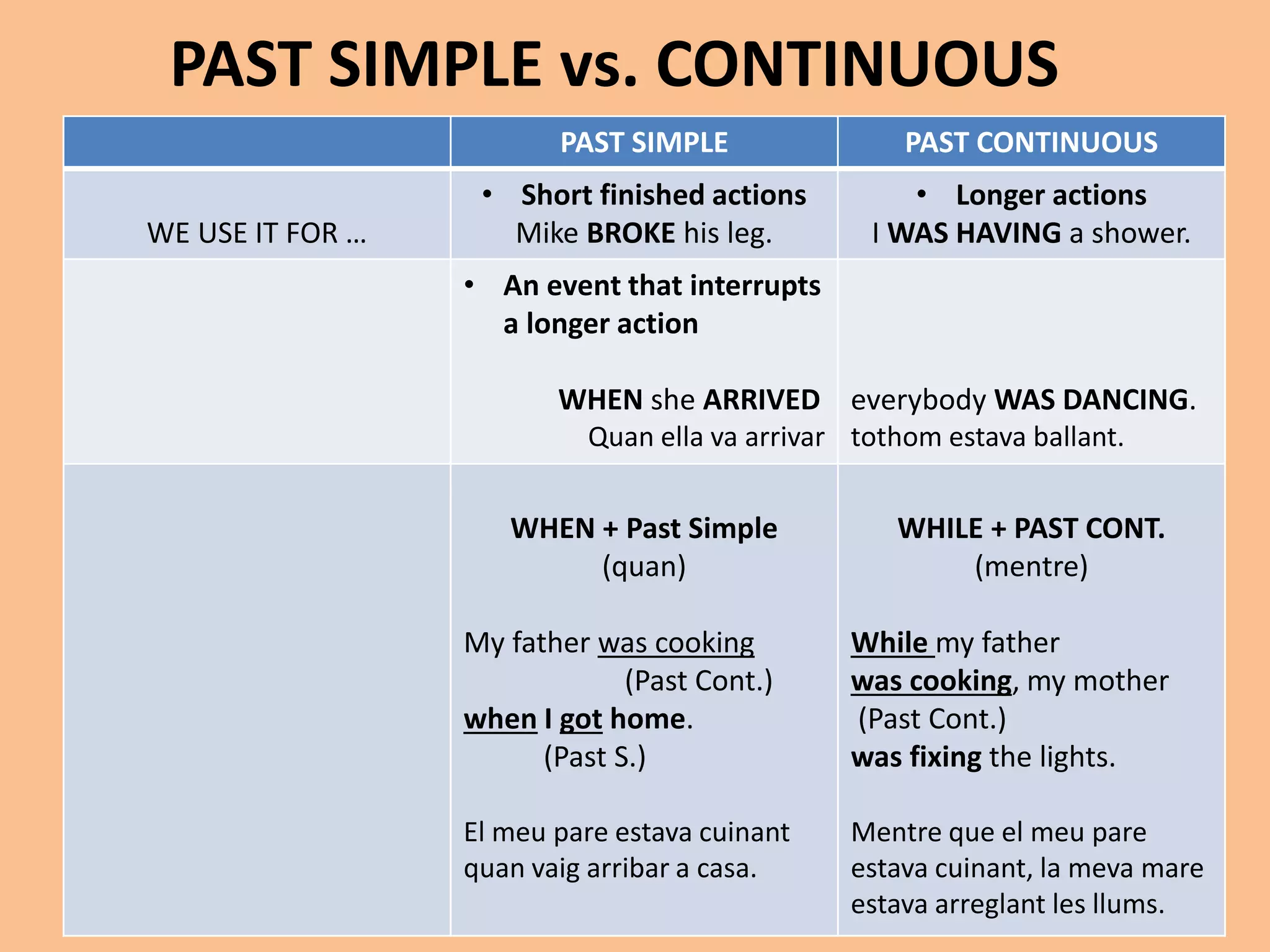
PAST SIMPLE vs. CONTINUOUS 
PAST SIMPLE PAST CONTINUOUS 
WE USE IT FOR … 
• Short finished actions 
Mike BROKE his leg. 
• Longer actions 
I WAS HAVING a shower. 
• An event that interrupts 
a longer action 
WHEN she ARRIVED 
Quan ella va arrivar 
everybody WAS DANCING. 
tothom estava ballant. 
WHEN + Past Simple 
(quan) 
My father was cooking 
(Past Cont.) 
when I got home. 
(Past S.) 
El meu pare estava cuinant 
quan vaig arribar a casa. 
WHILE + PAST CONT. 
(mentre) 
While my father 
was cooking, my mother 
(Past Cont.) 
was fixing the lights. 
Mentre que el meu pare 
estava cuinant, la meva mare 
estava arreglant les llums.
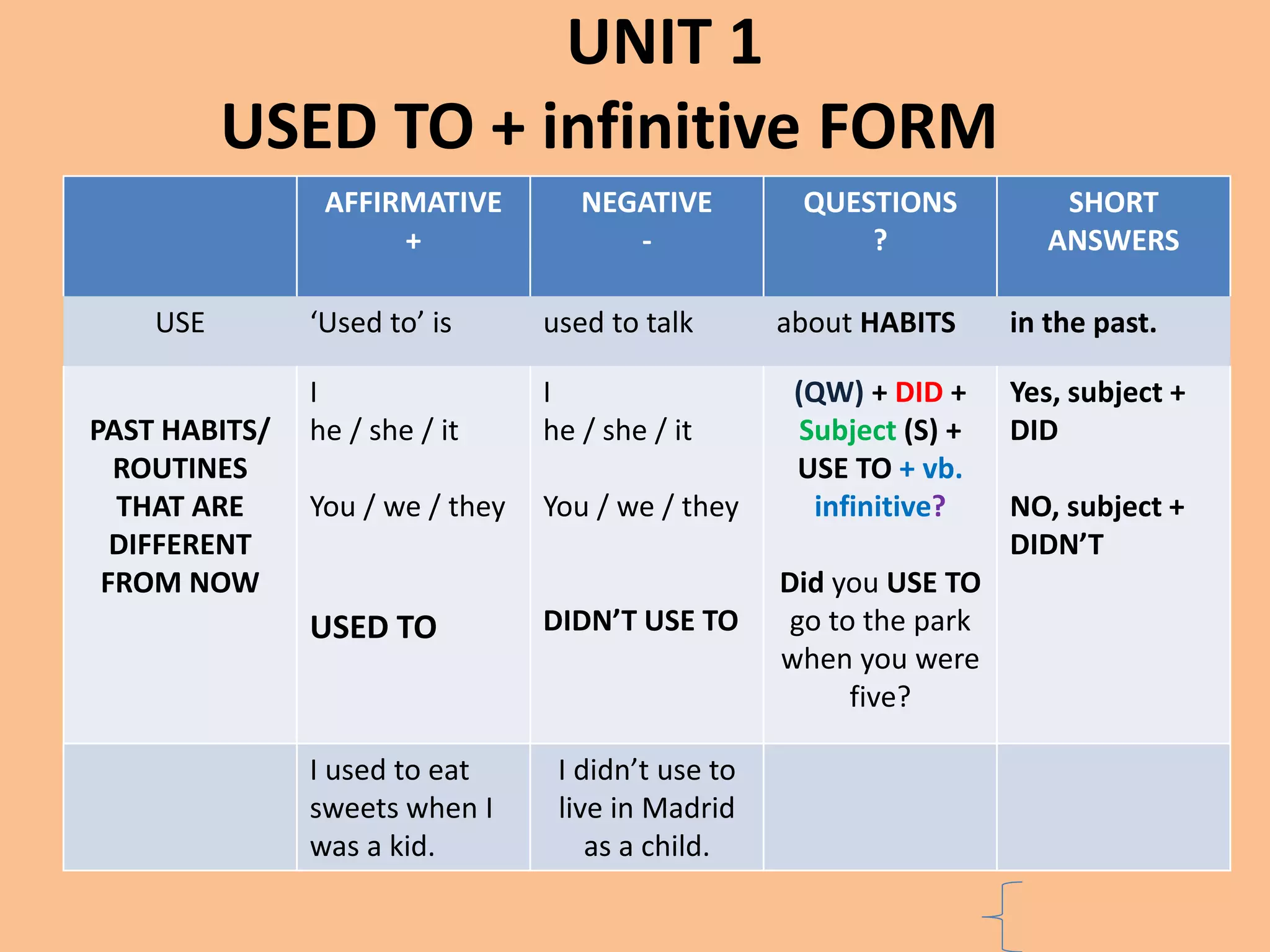
UNIT 1 
USED TO + infinitive FORM 
AFFIRMATIVE 
+ 
NEGATIVE 
- 
QUESTIONS 
? 
SHORT 
ANSWERS 
USE ‘Used to’ is used to talk about HABITS in the past. 
PAST HABITS/ 
ROUTINES 
THAT ARE 
DIFFERENT 
FROM NOW 
I 
he / she / it 
You / we / they 
USED TO 
I 
he / she / it 
You / we / they 
DIDN’T USE TO 
(QW) + DID + 
Subject (S) + 
USE TO + vb. 
infinitive? 
Did you USE TO 
go to the park 
when you were 
five? 
Yes, subject + 
DID 
NO, subject + 
DIDN’T 
I used to eat 
sweets when I 
was a kid. 
I didn’t use to 
live in Madrid 
as a child.
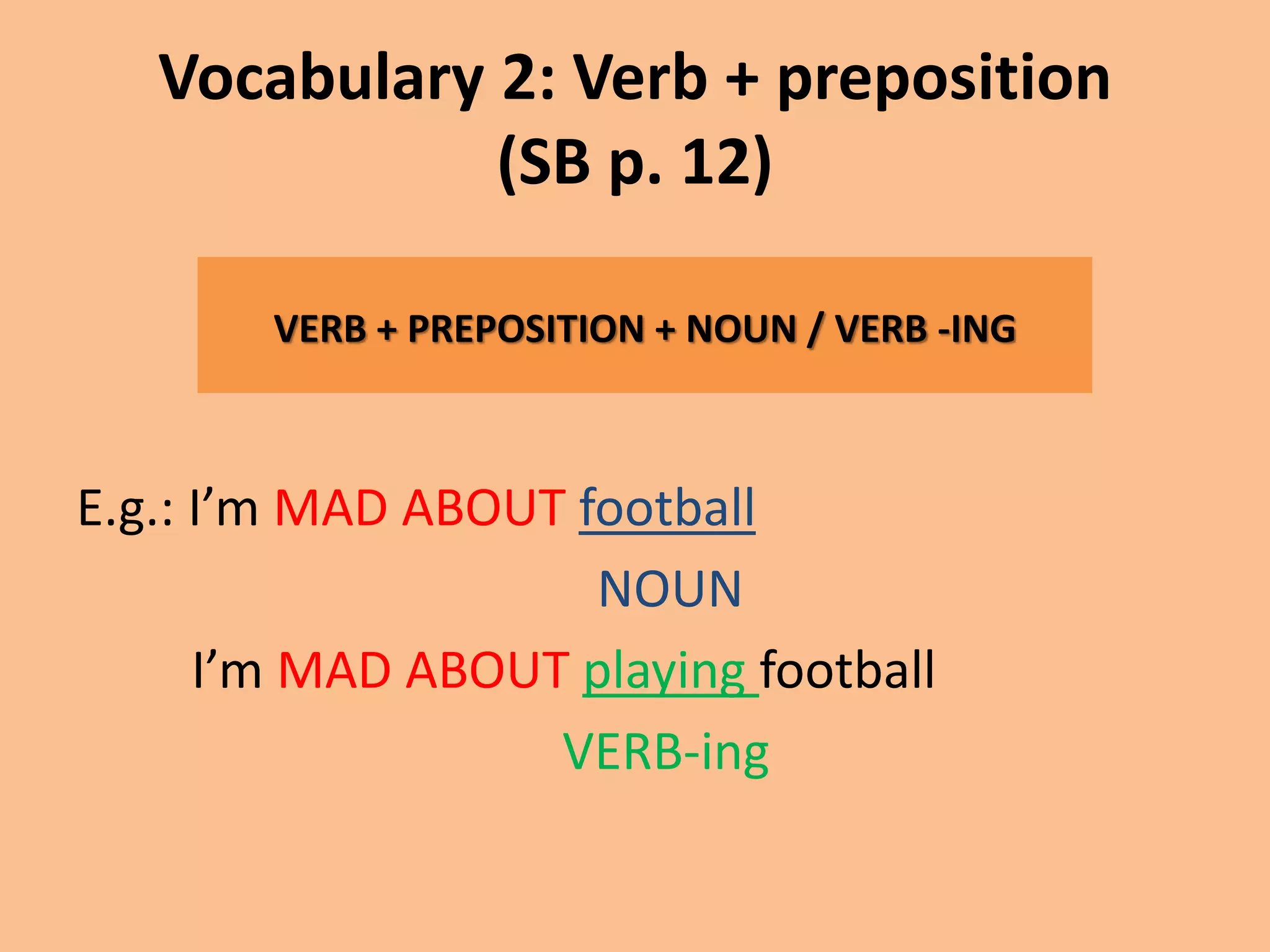
Vocabulary 2: Verb + preposition 
(SB p. 12) 
VERB + PREPOSITION + NOUN / VERB -ING 
E.g.: I’m MAD ABOUT football 
NOUN 
I’m MAD ABOUT playing football 
VERB-ing
Vocabulary 2: Verb + preposition 
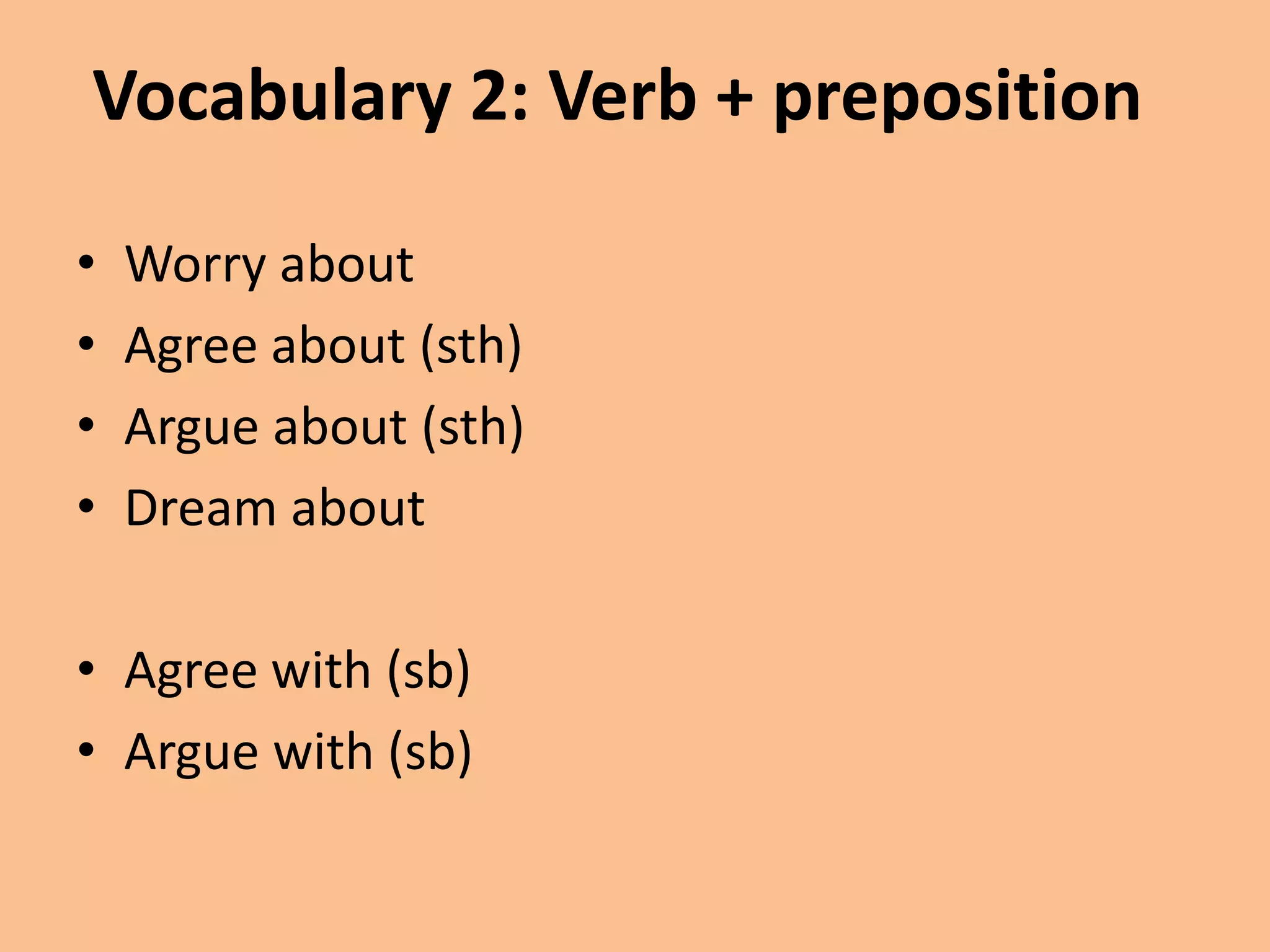
• Worry about 
• Agree about (sth) 
• Argue about (sth) 
• Dream about 
• Agree with (sb) 
• Argue with (sb)
Vocabulary 2: Verb + preposition 
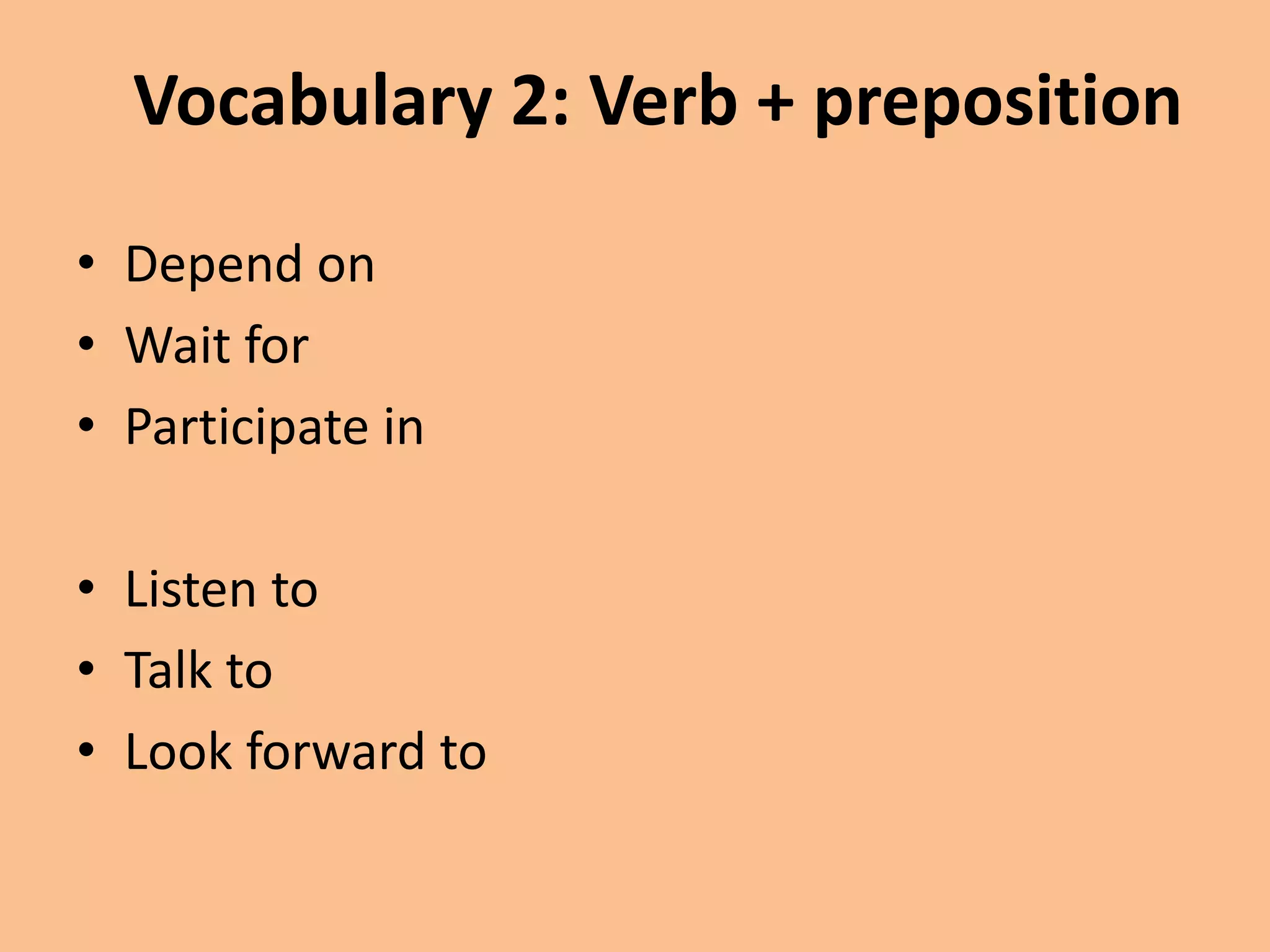
• Depend on 
• Wait for 
• Participate in 
• Listen to 
• Talk to 
• Look forward to
Vocabulary 2: Verb + preposition 
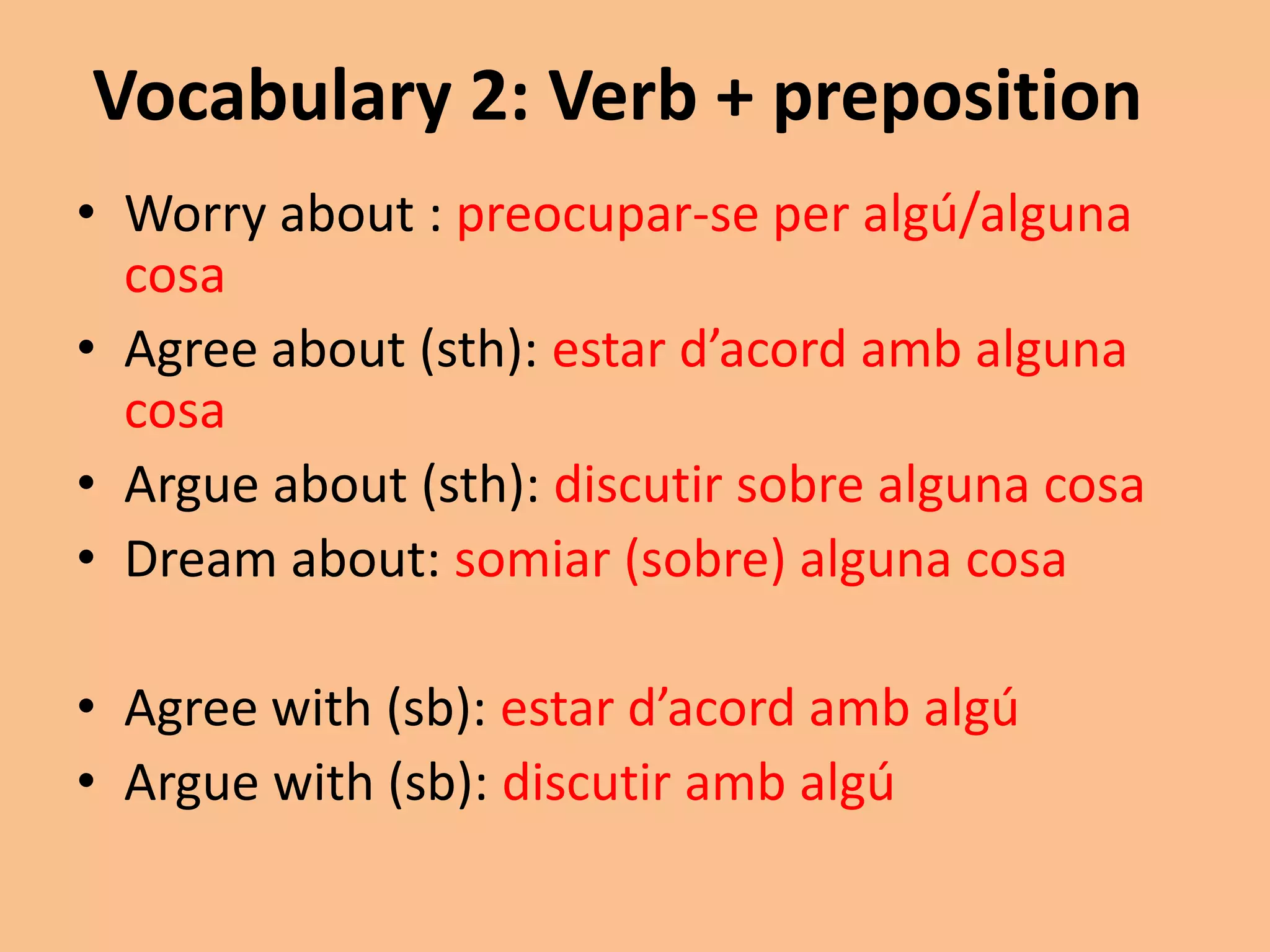
• Worry about : preocupar-se per algú/alguna 
cosa 
• Agree about (sth): estar d’acord amb alguna 
cosa 
• Argue about (sth): discutir sobre alguna cosa 
• Dream about: somiar (sobre) alguna cosa 
• Agree with (sb): estar d’acord amb algú 
• Argue with (sb): discutir amb algú
Vocabulary 2: Verb + preposition 
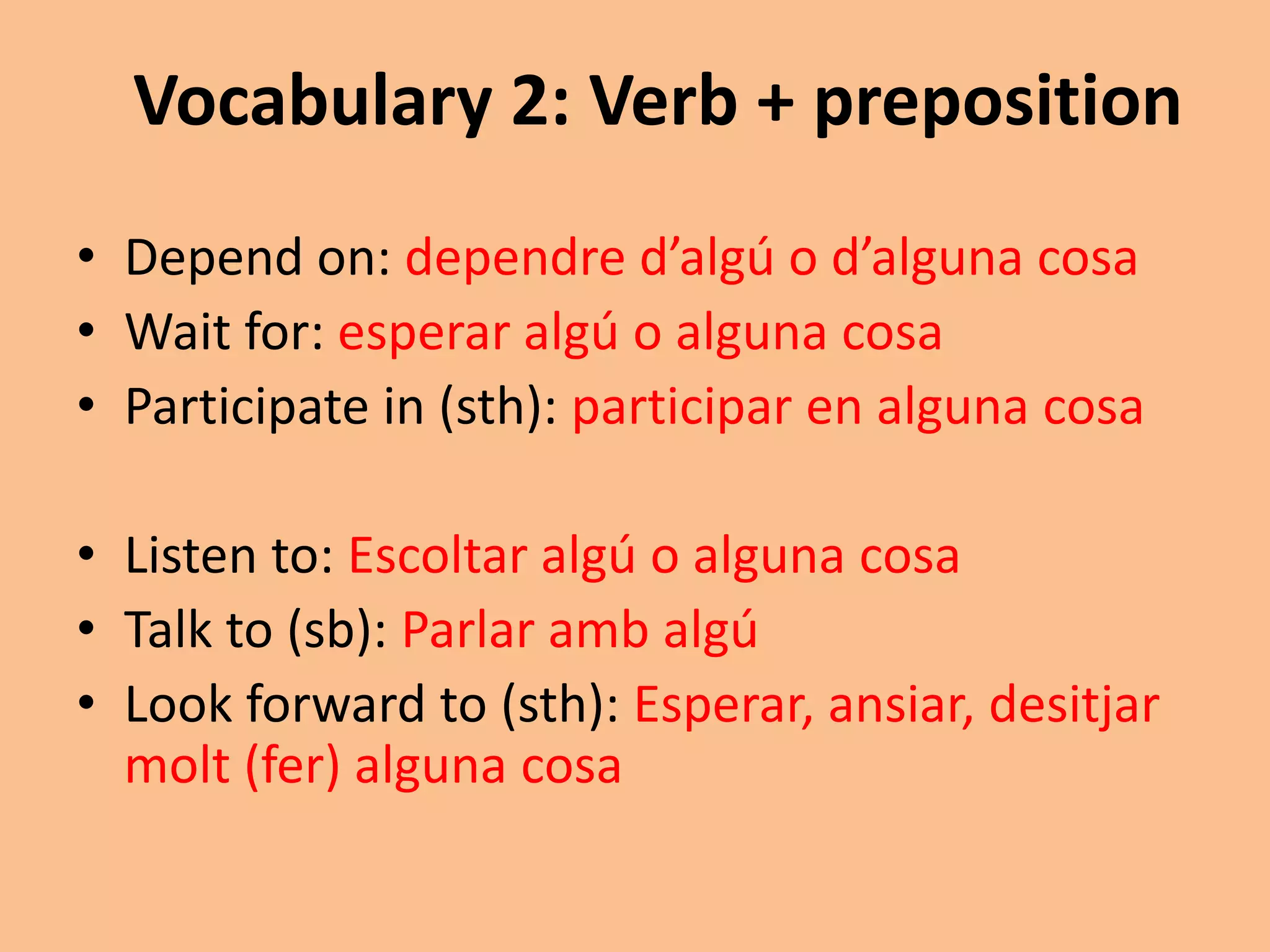
• Depend on: dependre d’algú o d’alguna cosa 
• Wait for: esperar algú o alguna cosa 
• Participate in (sth): participar en alguna cosa 
• Listen to: Escoltar algú o alguna cosa 
• Talk to (sb): Parlar amb algú 
• Look forward to (sth): Esperar, ansiar, desitjar 
molt (fer) alguna cosa
SUBJECT AND OBJECT QUESTIONS
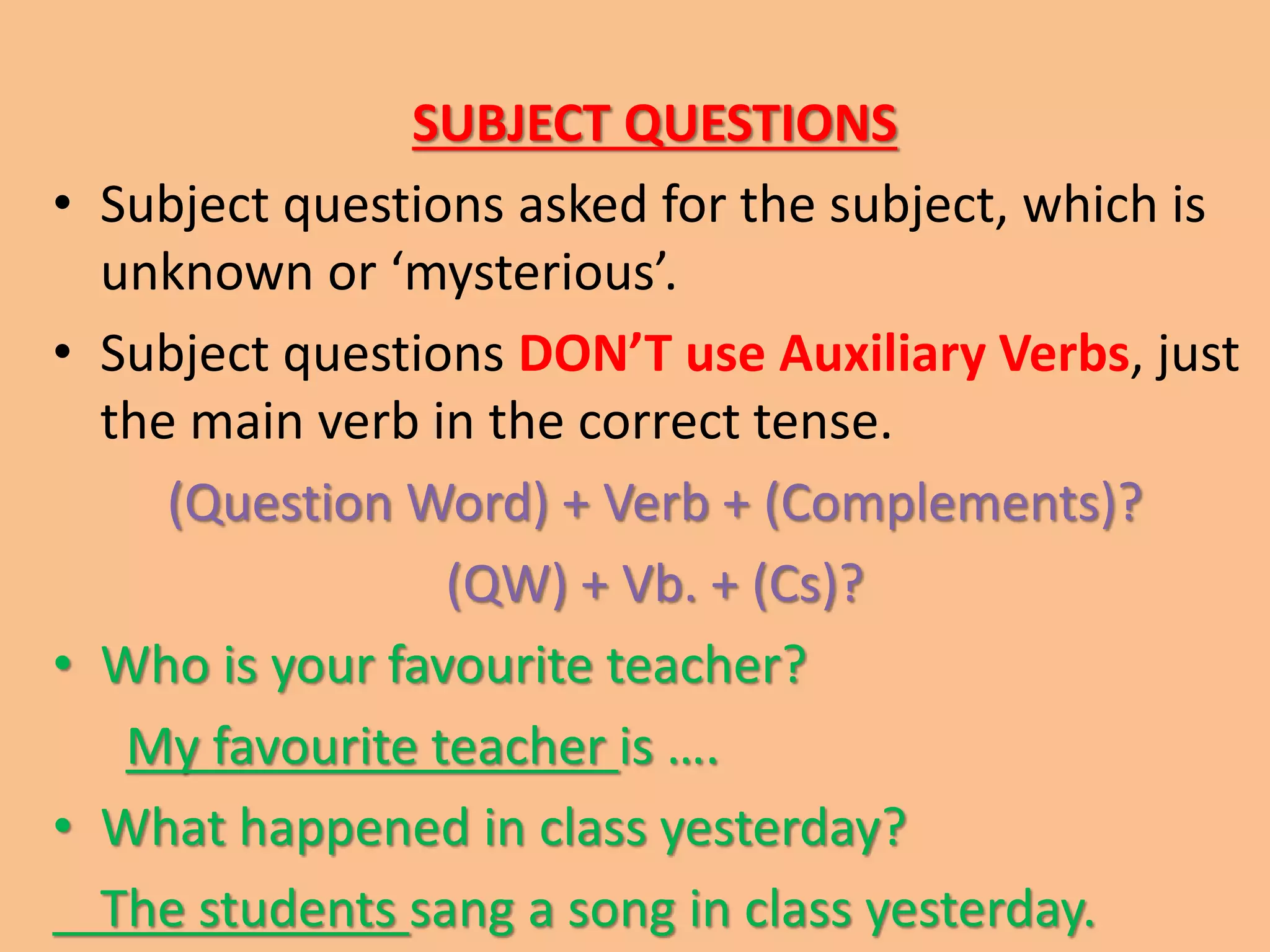
SUBJECT QUESTIONS 
• Subject questions asked for the subject, which is 
unknown or ‘mysterious’. 
• Subject questions DON’T use Auxiliary Verbs, just 
the main verb in the correct tense. 
(Question Word) + Verb + (Complements)? 
(QW) + Vb. + (Cs)? 
• Who is your favourite teacher? 
My favourite teacher is …. 
• What happened in class yesterday? 
The students sang a song in class yesterday.
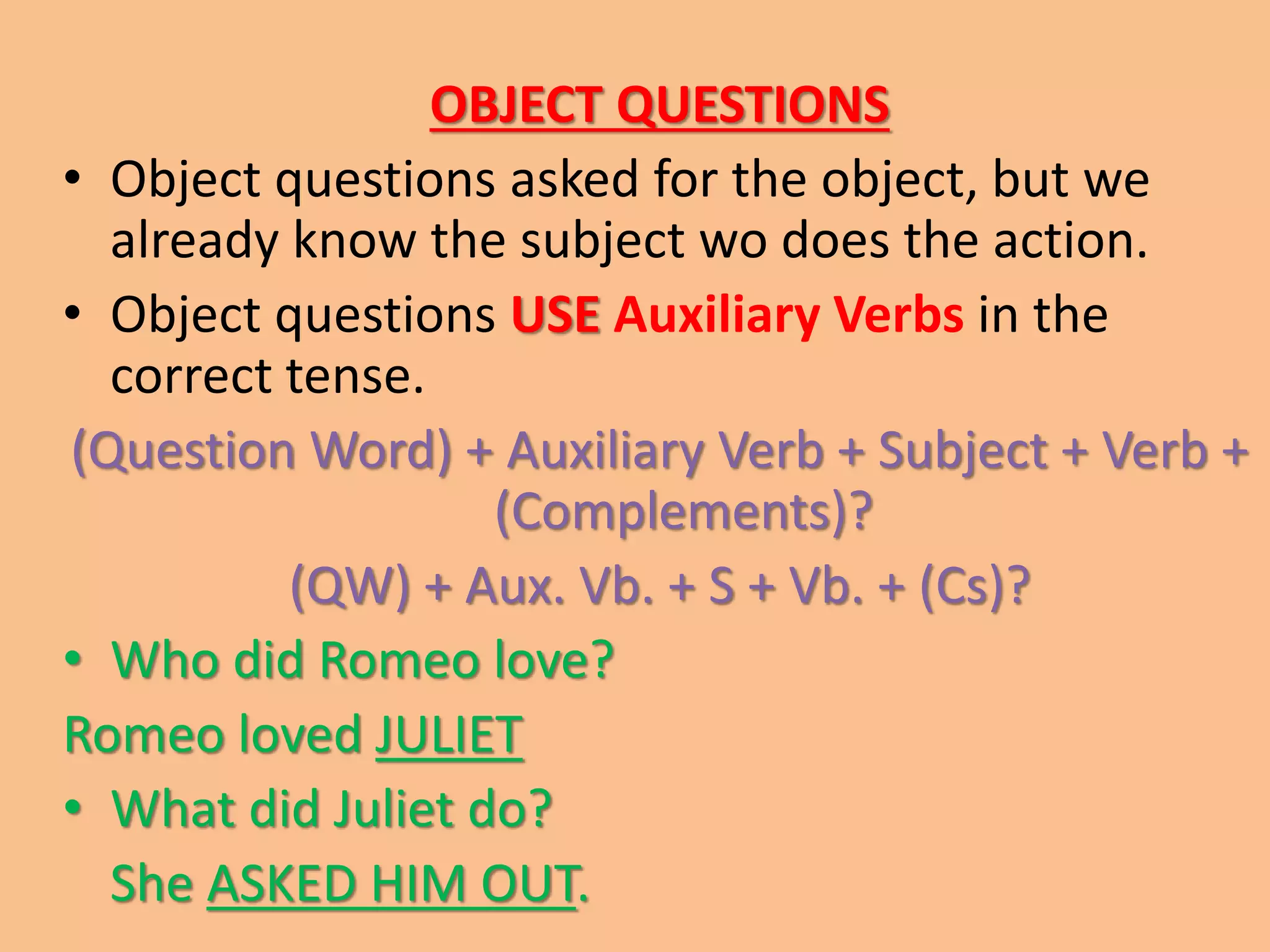
OBJECT QUESTIONS 
• Object questions asked for the object, but we 
already know the subject wo does the action. 
• Object questions USE Auxiliary Verbs in the 
correct tense. 
(Question Word) + Auxiliary Verb + Subject + Verb + 
(Complements)? 
(QW) + Aux. Vb. + S + Vb. + (Cs)? 
• Who did Romeo love? 
Romeo loved JULIET 
• What did Juliet do? 
She ASKED HIM OUT.
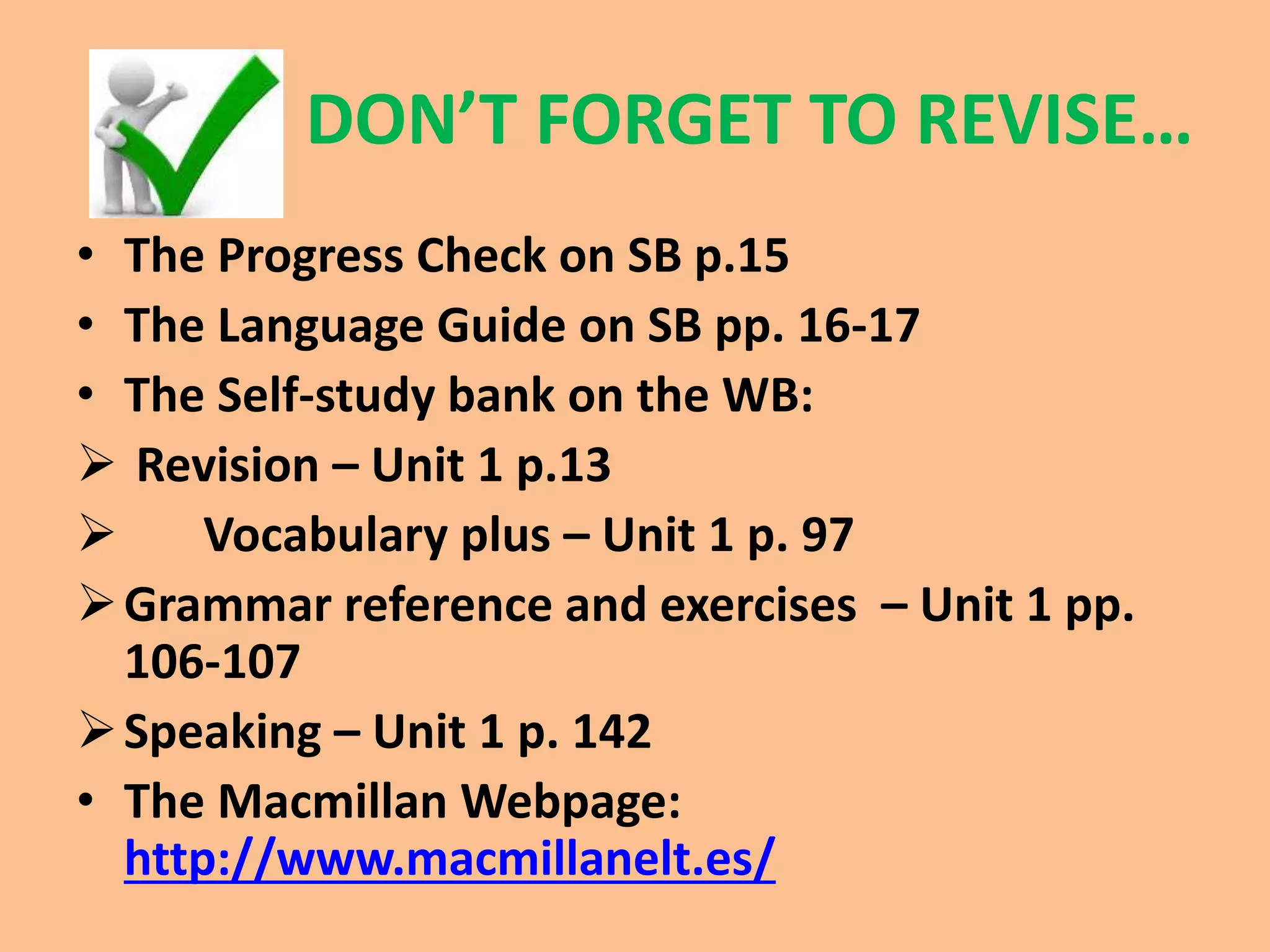
DON’T FORGET TO REVISE… 
• The Progress Check on SB p.15 
• The Language Guide on SB pp. 16-17 
• The Self-study bank on the WB: 
 Revision – Unit 1 p.13 
 Vocabulary plus – Unit 1 p. 97 
Grammar reference and exercises – Unit 1 pp. 
106-107 
Speaking – Unit 1 p. 142 
• The Macmillan Webpage: 
http://www.macmillanelt.es/

Starter Unit and Unit 1 - Interface 4 (Macmillan) - 4th ESO A

  • 1.
  • 2.
    QUESTION WORDS (QW) • WHAT / WHICH = • WHO = • WHEN = • WHERE = • WHY = • HOW =
  • 3.
    QUESTION WORDS •WHAT / WHICH = QUÈ? QUIN/-A? • WHO = QUI? • WHEN = QUAN? • WHERE = ON? • WHY = PERQUÈ? • HOW = COM?
  • 4.
    • WHAT +NOUN / adjective + noun? o What colour do you prefer? o What time do you go to bed? o What type/ kind of music do you like? • HOW + ADJECTIVE (+ noun) / ADVERB? o How often do you go to the cinema? (frequency) o How much does it cost? (quantity for uncountables) o How many chairs are there? (quantity for countables) o How far is the supermarket from here? (distance) o How long does it take to get to New York by plane? (duration)
  • 5.
    (object) Question orderformation (Question Word) + Auxiliary Verb + Subject + Verb + (Complements)? (QW) + Aux. Vb. + S + Vb. + (Cs)? • What do you like? (QW) Aux. Vb. S Vb ? • What are you doing? • Did you study French last year?
  • 6.
    Now practice questionson SB p. 5 ex. 8 and 10 with your partner
  • 7.
    Classroom language •Do ex. 13 on SB p. 5 • Then write these questions and answers on some cardboards and stick these expressions on your classroom’s wall.
  • 8.
  • 9.
    In this unit,we will work on… • Vocabulary: Life-changing events Verb+ preposition • Grammar: Present Simple and Continuous Past Simple Used to Subject and Object questions • Reading: ‘Then and now: Johnny Deep’ ‘My new life’
  • 10.
    • Listening: Lifestylechanges • Speaking: Talking about photos Describing a photo • Writing: An informal email Informal expressions • Our project: Poster describing our class English classroom’s language
  • 11.
    Vocabulary 1: Life-changingevents • Change school • Take a gap year • Retire • Start your own business • Win an award • Go for a job interview • Move house • Have an accident • Make new friends
  • 12.
    Vocabulary 1: Life-changingevents • Drop out of university • Settle down • Get into trouble • Become rich • Go abroad
  • 13.
    Vocabulary 1: Life-changingevents • Change school • Take a gap year • Retire • Start your own business • Win an award • Go for a job interview • Move house • Have an accident • Make new friends • Canviar d’escola • Prendre’s un any sabàtic • Jubilar-se • Començar el teu propi negoci • Guanyar un premi • Fer una entrevista de treball • Mudar-se • Tenir un accident • Fer amics nous
  • 14.
    Vocabulary 1: Life-changingevents • Drop out of university • Settle down • Get into trouble • Become rich • Go abroad • Deixar la universitat • Estabilitzar-se (sentar la cabeza) • Ficar-se en problemes • Fer-se/ esdevenir ric • Viatjar a l’estranger
  • 15.
    PRESENT SIMPLE FORM AFFIRMATIVE + NEGATIVE - QUESTIONS ? SHORT ANSWERS USE We use the Pre. Simple to talk about routines in the present. TO BE I AM he / she / it IS (és / està) You / we / they ARE I ‘M NOT / AM NOT he / she / it ISN’T/ IS NOT You / we / they AREN’T (QW) + AM / IS / ARE + Subject (S) + (Cs) ? Are you at school? Yes, subject + AM /IS/ARE NO, subject + AM NOT/ ISN’T/ AREN’T OTHER VERBS VERB S + VERB+ -s (he/she/it) I PLAY chess. She GOES home. S + DON’T DOESN’T + V I DON’T PLAY… She DOESN’T GO… (QW) + DO/DOES + SUBJECT + Verb? What DO you do? DOES he PLAY? Yes, S + DO/DOES NO, S + DON’T/ DOESN’T Yes, he DOES. No, he DOESN’T.
  • 17.
    IMPORTANT! • USE:We use the Present Simple to talk about routines, habits and states in the present. • Third person (he/she/it) formation rules: 1. V. + -s play + -s = plays 2. V. ending in –ch, -sh, -s, -x -es teaches, pushes misses, fixes 3. DO and GO -es does, goes 4. Vb. ending in consonant+ -y -ies Try= tries study = studies
  • 18.
    PRESENT CONTINUOUS FORM AFFIRMATIVE + NEGATIVE - Subject + AM / IS / ARE + V-ing She is reading a fantastic book. Subject + AM NOT / ISN’T / AREN’T + V-ing She isn’t chatting on the Internet. I AM READING Jo estic llegint I ‘M NOT / AM NOT READING Jo no estic llegint You ARE READING Tu estàs llegint You AREN’T / ARE NOT READING Tu no estaves llegint He She IS READING It Ell/a està llegint He She ISN’T / IS NOT READING It Ell/a no està llegint We You ARE READING They Nosaltres estem / vosaltres esteu Ells/-es estan llegint We You AREN’T / ARE NOT They READING Nosaltres no estem/ vosaltres no esteu. Ells/-es no estan llegint
  • 19.
    PRESENT CONTINUOUS FORM QUESTIONS ? SHORT ANSWERS (sh.a.) (Question + AM / + subject + verb –ing? Word - QW) IS /ARE What are you doing ? Is he listening to music? Yes, subject + AM/IS/ARE NO, subject + ISN’T / AREN’T - Yes, he is. // No, he isn’t. AM I PLAYING? Estic jo jugant? Yes, I AM. No, I AM NOT. ARE you PLAYING? Estàs tu jugant? Yes, I AM. No, I AM NOT. He IS She PLAYING? It Ell/a està jugant? Yes, he / she / it IS. No, he / she /it ISN’T. We ARE You PLAYING? They Nosaltres estem / vosaltres esteu / ells/-es estan jugant? Yes, we ARE. No, we AREN’T. Yes, they ARE. No, they AREN’T.
  • 20.
    IMPORTANT! • USE:We use the Present Continuous to talk about actions that are happening NOW. • Gerund formation rules: 1. V- + -ing play + -ing = playing / study + -ing = studying 2. V- consonant + -e + -ing come + -ing = coming 3. One syllable V- ending in cons. + vowel + cons. We double the last consonant. stop + -ing = stopping swim + -ing = swimming 4. Irregular forms: Die + -ing = dying Lie + -ing = lying
  • 21.
    PAST SIMPLE FORM AFFIRMATIVE + NEGATIVE - QUESTIONS ? SHORT ANSWERS USE We use the Past Simple to talk about events in the past. TO BE I /he / she / it WAS (era / estava) You / we / they WERE I /he / she / it WASN’T You / we / they WEREN’T (QW) + WAS / WERE + Subject (S) + (Cs) ? Were you at school? Yes, subject + WAS /WERE NO, subject + WASN’T / WEREN’T OTHER VERBS v -ed S + (Reg. V.) Irregular V. I PLAYED chess. I WENT home. S + DIDN’T + V I DIDN’T PLAY… I DIDN’T GO… (QW) + DID + SUBJECT + Verb? What DID you do? DID he PLAY? Yes, S + DID NO, S + DIDN’T - Yes, he DID. No, he DIDN’T.
  • 22.
    IMPORTANT! • USE:We use the Past Simple to talk about short actions in the PAST. • -ed formation rules: 1. Vb. + -ed play + -ed = played / discover = discovered 2. V- consonant + -e + -d explore = explored 3. One syllable V- ending in cons. + vowel + cons. We double the last consonant. stop + -ed = stopped travel + -ed = travelled 4. Vb. Consonant + -y -ied Cry + -ed = cried try + -ed = tried
  • 23.
    ATTENTION!! PREVIEW OFUNIT 2: PAST CONTINUOUS FORM AFFIRMATIVE + NEGATIVE - Subject + WAS / WERE + V-ing She was reading a fantastic book. Subject + WASN’T / WEREN’T + V-ing She wasn’t chatting on the Internet. I WAS READING Jo estava llegint I WAS NOT / WASN’T READING Jo no estava llegint You WERE READING Tu estaves llegint You WERE NOT / WEREN’T READING Tu no estaves llegint He She WAS READING It Ell/a estava llegint He She WASN’T READING It Ell/a no estava llegint We You WERE READING They Nosaltres estàvem / vosaltres estàveu Ells/-es estaven llegint We You WEREN’T READING They Nosaltres estàvem / vosaltres estàveu Ells/-es estaven llegint
  • 24.
    PAST CONTINUOUS FORM QUESTIONS ? SHORT ANSWERS (sh.a.) (Question + WAS / + subject + verb –ing? Word - QW) WERE What were you doing ? Was he listening to music? Yes, subject + WAS /WERE NO, subject + WASN’T / WEREN’T - Yes, he was. // No, he wasn’t. WAS I PLAYING? Estava jo jugant? Yes, I WAS. No, I WASN’T. WERE you PLAYING? Estaves tu jugant? Yes, I WAS. No, I WASN’T. He WAS She PLAYING? It Ell/a estava jugant? Yes, he / she / it WAS. No, he / she /it WASN’T. We WERE You PLAYING? They Nosaltres estàvem / vosaltres estàveu / ells/-es estaven jugant? Yes, we WERE. No, we WEREN’T. Yes, they WERE. No, they WEREN’T.
  • 25.
    IMPORTANT! • USE:We use the Past Continuous to talk about actions in progress in the PAST. • Gerund formation rules: 1. V- + -ing play + -ing = playing / study + -ing = studying 2. V- consonant + -e + -ing come + -ing = coming 3. One syllable V- ending in cons. + vowel + cons. We double the last consonant. stop + -ing = stopping swim + -ing = swimming 4. Irregular forms: Die + -ing = dying Lie + -ing = lying
  • 26.
    PAST SIMPLE vs.CONTINUOUS PAST SIMPLE PAST CONTINUOUS WE USE IT FOR … • Short finished actions Mike BROKE his leg. • Longer actions I WAS HAVING a shower. • An event that interrupts a longer action WHEN she ARRIVED Quan ella va arrivar everybody WAS DANCING. tothom estava ballant. WHEN + Past Simple (quan) My father was cooking (Past Cont.) when I got home. (Past S.) El meu pare estava cuinant quan vaig arribar a casa. WHILE + PAST CONT. (mentre) While my father was cooking, my mother (Past Cont.) was fixing the lights. Mentre que el meu pare estava cuinant, la meva mare estava arreglant les llums.
  • 27.
    UNIT 1 USEDTO + infinitive FORM AFFIRMATIVE + NEGATIVE - QUESTIONS ? SHORT ANSWERS USE ‘Used to’ is used to talk about HABITS in the past. PAST HABITS/ ROUTINES THAT ARE DIFFERENT FROM NOW I he / she / it You / we / they USED TO I he / she / it You / we / they DIDN’T USE TO (QW) + DID + Subject (S) + USE TO + vb. infinitive? Did you USE TO go to the park when you were five? Yes, subject + DID NO, subject + DIDN’T I used to eat sweets when I was a kid. I didn’t use to live in Madrid as a child.
  • 28.
    Vocabulary 2: Verb+ preposition (SB p. 12) VERB + PREPOSITION + NOUN / VERB -ING E.g.: I’m MAD ABOUT football NOUN I’m MAD ABOUT playing football VERB-ing
  • 29.
    Vocabulary 2: Verb+ preposition • Worry about • Agree about (sth) • Argue about (sth) • Dream about • Agree with (sb) • Argue with (sb)
  • 30.
    Vocabulary 2: Verb+ preposition • Depend on • Wait for • Participate in • Listen to • Talk to • Look forward to
  • 31.
    Vocabulary 2: Verb+ preposition • Worry about : preocupar-se per algú/alguna cosa • Agree about (sth): estar d’acord amb alguna cosa • Argue about (sth): discutir sobre alguna cosa • Dream about: somiar (sobre) alguna cosa • Agree with (sb): estar d’acord amb algú • Argue with (sb): discutir amb algú
  • 32.
    Vocabulary 2: Verb+ preposition • Depend on: dependre d’algú o d’alguna cosa • Wait for: esperar algú o alguna cosa • Participate in (sth): participar en alguna cosa • Listen to: Escoltar algú o alguna cosa • Talk to (sb): Parlar amb algú • Look forward to (sth): Esperar, ansiar, desitjar molt (fer) alguna cosa
  • 33.
  • 34.
    SUBJECT QUESTIONS •Subject questions asked for the subject, which is unknown or ‘mysterious’. • Subject questions DON’T use Auxiliary Verbs, just the main verb in the correct tense. (Question Word) + Verb + (Complements)? (QW) + Vb. + (Cs)? • Who is your favourite teacher? My favourite teacher is …. • What happened in class yesterday? The students sang a song in class yesterday.
  • 35.
    OBJECT QUESTIONS •Object questions asked for the object, but we already know the subject wo does the action. • Object questions USE Auxiliary Verbs in the correct tense. (Question Word) + Auxiliary Verb + Subject + Verb + (Complements)? (QW) + Aux. Vb. + S + Vb. + (Cs)? • Who did Romeo love? Romeo loved JULIET • What did Juliet do? She ASKED HIM OUT.
  • 36.
    DON’T FORGET TOREVISE… • The Progress Check on SB p.15 • The Language Guide on SB pp. 16-17 • The Self-study bank on the WB:  Revision – Unit 1 p.13  Vocabulary plus – Unit 1 p. 97 Grammar reference and exercises – Unit 1 pp. 106-107 Speaking – Unit 1 p. 142 • The Macmillan Webpage: http://www.macmillanelt.es/

Editor's Notes

  • #18 WB: pg 47 ex. 1-2
  • #21 3. Except for verbs ending in –w, –x, -y, that we don’t double the last consonant. For example, fix= fixing / Draw= drawing
  • #23 WB: pg 47 ex. 1-2
  • #26 WB: pg 47 ex. 1-2