PREPARE CEREALS,
STARCH, AND
ALIMENTARY PASTE
CEREALS
• Cereals are usually starchy
pods or grains.
• Cereal grains are the most
important group of food crops
in the world named after the
Roman goddess of harvest,
Ceres.
• Rice, wheat and corn are the
three most cultivated cereals in
the world.
STARCH
Is the most abundant organic
substance on earth.
Commonly found in all forms
of leafy green plants, located
in the roots, fruit and grains.
Source of up to 80% calorie.
Rice, corn, cassava, potato
etc. are some source of
starch.
ALIMENTARY
PASTE
These are shaped and dried
dough prepared from semolina,
farina, wheat flour, or a mixture
of these with water or milk and
with or without egg or egg yolk.
TOOLS AND
EQUIPMENT NEEDED
Mixing Bowl
Used when preparing
cake mixture, salads,
creams, and sauces.
Sifter
Used for separating
coarse particles of flour,
sugar, baking powder,
and powdered ingredients
to retain finer textures.
Wire Whip
Used for beating egg
whites, egg yolk,
creams and
mayonnaise.
Wooden Spoon
Used for mixing
creams, butter, and for
tossing salads.
Blending Fork
Used for testing the
tenderness of meat,
combining big cuts and
particles of meat and
vegetables, and for
blending other
ingredients with flour.
Rubber Scraper
Used for scraping off
mixtures of butter, sugar,
and egg from the sides
of the mixing bowl.
Strainer
Used for separating
liquids from fine or solid
food particles, such as
coco cream from
coconut and tamarind
extract.
Tongs
Used for handling
hot foods.
Measuring Cups
Used for
measuring dry
and liquid
ingredients.
Measuring
Spoons
Used for measuring
dry and liquid
ingredients which
require a little amount
Sauce Pan and
Pots
Used for cooking meat
and fish dishes with
gravy and sauce.
Kettle and Rice
Cooker
Used for cooking
rice and other
foods.
Pressure
Cooker
Used for tenderizing or
cooking meat, chicken, and
other grains or legumes,
such as mongo and white
beans in lesser time.
Double Boiler
Used for preparing
sauces which easily
get scorched when
cooked directly on the
stove.
Steamer
Used for cooking
food by
steaming.
Colander
A perforated bowl of
varying sizes made of
stainless steel, aluminum or
plastic, used to drain, wash,
or cook ingredients from
liquid.
Canister
A plastic or metal
container with a lid that
is used for keeping dry
products
Channel Knife
A small hand tool used
generally in decorative
works such as making
garnishes.
Sources of
Starch
Sources of Starch
 cereal grains, including corn, wheat,
rice, grain, sorghum, and oats;
 legumes; and
 roots or tubers, including potato, sweet
potato, arrowroot, and the tropical
cassava plant (marketed as tapioca)
Common Source of Manufactured
Food Starch
 corn starch from corn
 rice starch from rice
 tapioca from cassava
Classification
of Starch
Native or
Natural Starch
Refers to the starches
as originally derived
from its plant source.
Modified Starch
Are starches that have
been altered physically
or chemically, to modify
one or more of its key
chemicals and/or
physical property.
Purified Starch
May be separated from
grains and tubers by a
process called wet
milling.
Starch
Composition
and Structure
The Starch Molecule
Starch is
polysaccharide made
up of hundreds or
even thousands of
glucose molecules
joined together.
Amylose
Is a long chain-like
molecule, sometimes
called the linear fraction,
and is produced by
linking together 500 to 2,
000 glucose molecules.
Amylopectin
Has a highly branched, bushy
type of structure, very different
from the long, string-like
molecules of amylose. Cohesion
or thickening properties are
contributed by amylopectin
when a starch mixture is cooked
in the presence of water, but this
fractiondoesnotproduceagel.
The Starch Granule
In the storage areas of
plants, notably the
seeds and roots,
molecules of starch
are deposited in tiny,
organized units.
Hilum
Amylose and
amylopectin molecules
are placed together in
tightly packed stratified
layers formed around a
central spot in the
granule.
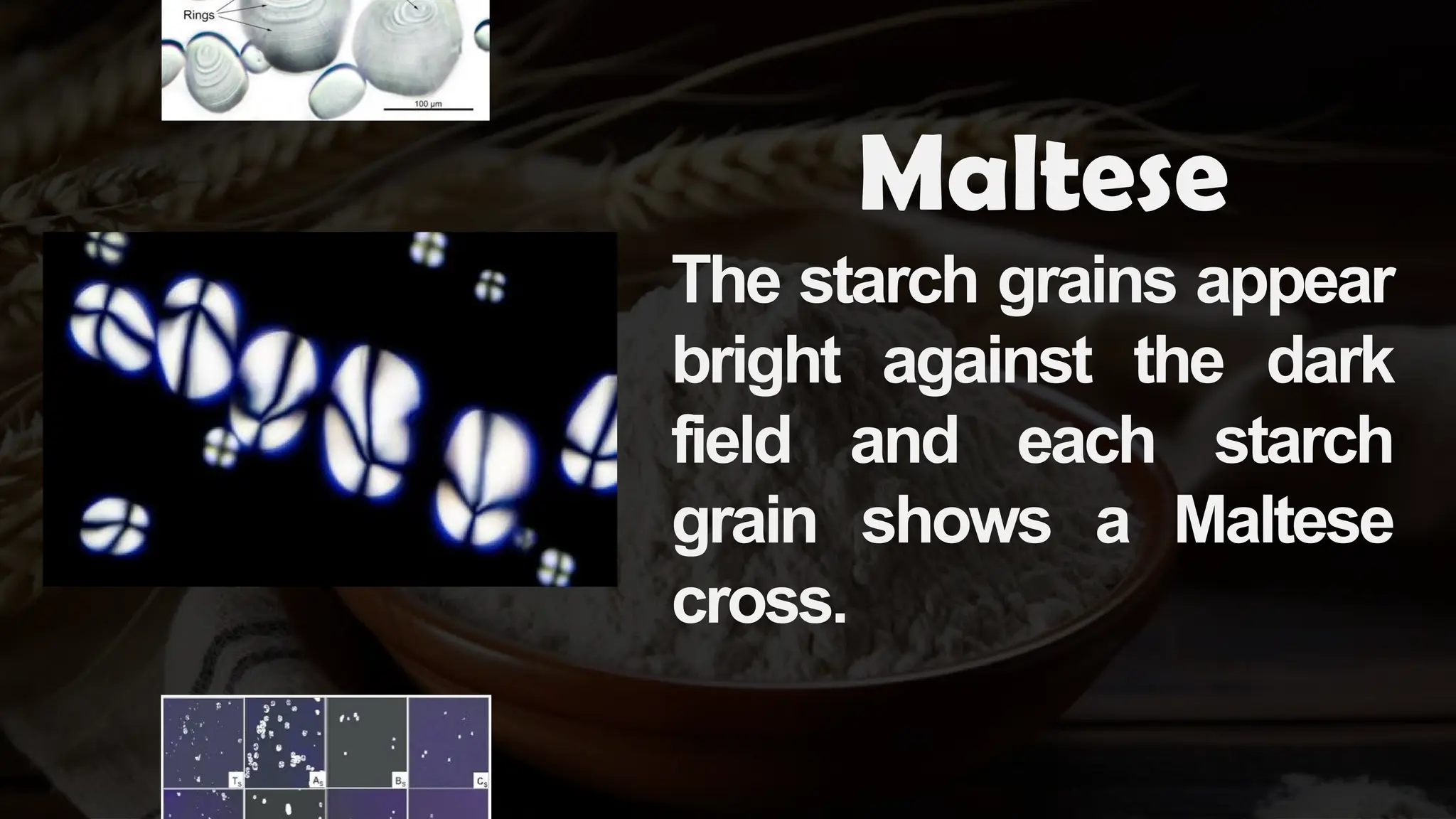
Maltese
The starch grains appear
bright against the dark
field and each starch
grain shows a Maltese
cross.
Birefringence
Birefringence is the ability to
doubly refract polarized
light. All starch granules in
their native form exhibit
birefringence that is
proportional to their
crystalline structure.
Composition
of Starch
Potato Cassava Wheat Cornstarch
Moisture % 19 13 13
Ash % 0.4 0.2 0.2
Protein % 0.06 0.1 0.4
Lipid % 0.05 0.1 0.8
Phosphorus
% 0.08 0.01 0.06
Amylose % 21 17 28
Starch
Properties
and Reaction
Gelatinization
The sum of changes that
occur in the first stages of
heating starch granules in a
moist environment which
includes swelling of granules
as water is absorbed and
disruption of the organized
granule structure.
Viscosity
The resistance to flow; increase
in thickness or consistency.
When the newly gelatinized
starch is stirred, more swollen
granules break and more starch
molecules spill causing
increase in viscosity or
thickness.
Retrogadation
The process in which starch
molecules, particularly the
amylose fraction, re-associate
or bond together in an ordered
structure after disruption by
gelatinization; ultimately a
crystallineorderappears.
Syneresis
Oozing of liquid from gel
when cut and allowed to
stand (e.g. jelly or baked
custard). The oozing of
liquid from a rigid gel;
sometimes called weeping.
Dextrinization
It is the process of
forming dextrin. Dextrins
– are partially hydrolyzed
starches that are
prepared by dry roasting.
Hydrolysis
A chemical reaction in
which a molecular
linkage is broken and a
molecule of water is
utilized.
Hydrolysis
a. Prolonged heating of
starches with acid will
promote hydrolysis. This
can happen when
cooking an acidic food,
Functional
Properties of
Starches
Functional Properties of Starches Starch plays
various roles in food, a typical multi-tasker
1. Thickeners in gravies, sauces, and pudding. It
absorbs water and becomes a gel when cooked.
2. Colloidal stabilizers
3. Moisture retainer
4. Gel forming agents
5. Binders
6. Package
7. Flavor carriers - its ability to trap oils and
fats, which absorb flavoring substances more
efficiently.
Starches
Are added to processed
meats (luncheon meats,
hot dogs, sausages, etc.)
as a filler, binder, moisture,
retainer, and fat substitute.
Cereal
Cereal is any grain that is
used for food. Grains
especially whole grain
are not just empty
calories.
Cereal-
processed food
Whole Grain
Is a grain product that has
retained the specific
nutrients of the whole,
unprocessed grain and
contains natural
proportions of bran, germ
and endosperm.
Enriched Cereal
Enriched cereals are
excellent sources of
thiamine, niacin,
riboflavin, and iron.
Restored Cereal
Made from either the entire
grain or portions of one or more
grains to which there have been
added sufficient amounts of
thiamine, niacin, and iron to
attain the accepted whole grain
levels of these three nutrients
found in the original grain from
whichthecerealisprepared.
Cereals provide the body with:
 Carbohydrates
 Protein
 Fat
 Vitamins
 Minerals
 Water
 Cellulose or roughage
Nutritional Significance of Noodles and
Pasta orAlimentary Paste
 Water
 Protein
 Fat
 Carbon
 Calcium
 Phosphorous
 Iron
 Thiamin
 Riboflavin
 Niacin
Dried Noodles
and Pasta
Macaroni
Spaghetti
Pancit
Canton
Bihon
Sotanghon
Miswa
Miki
Chicken
Mami
Linguini
Lasagna
Prepare and Cook
Starch and Cereal
Dishes
Factors Affecting Starch
Paste Viscosity and
Starch Gel Strength
Stress or other
factor
This is a gelatinized
cornstarch dispersion that is
likely to break; the granules
broke apart due to stirring.
Kind and Amount of
Starch
Certain types of starch will influence
the characteristics of the starch paste
viscosity and gel strength. Generally
speaking, with "native starches" the
greater the amount of amylopectin the
more viscous the starch paste, whereas,
the greater the amount of amylose, the
firmer the gel is
(greater the gel strength).
Heating rate
The faster starch-water
dispersion is heated; the
thicker it will be at the
identical endpoint
temperature. ‘
Endpoint Temperature
Each type of starch has a
specific endpoint temperature
at which it will undergo
optimum gelatinization.
Incompletely gelatinized starch
will not attain optimum starch
paste viscosity or gel strength.
Ingredients added
(acid, enzyme, sugar, fat,
and emulsifiers). The
addition of acid or enzyme
can also cause
dextrinization (the process
of forming dextrin).
Dextrin
a pale powder obtained
from starch used mainly
as an adhesive.
Sugar
will delay or inhibit the
gelatinization of starch.
Starch pudding with
excess sugar will be less
viscous or form a less firm
gel
In cooking all cereal products, the following points should be
observed:
1.Use a double boiler.
2.Observe carefully the correct proportions of cereal,
water and salt.
3.Cook at boiling temperature (212° F.).
4.Watch the time by the clock, and always cook the full
time prescribed, preferably longer.
5.Serve attractively.
6.Improper cooking and poor serving are largely
responsible for the unpopularity of cereal foods. ,
• Pasta should be cooked al dente, or ―to the tooth.
This means the cooking should be stopped when the
pasta still feels firm to the bite, not soft and
mushy. The pleasure of cooking pasta is its texture,
and this is lost if it is overcooked. To test for doneness,
break the pasta into small pieces and taste it. As
soon as pasta is al dente, cooking must be stopped
at once. Half a minute extra is enough to overcook it.
•Cooking times differ for every shape and size of pasta.
Timing also depends on the kind of flour used, and the
moisture content.
• Fresh egg pasta, if it has not been allowed to dry,
takes only 1 to 1 ½ minutes to cook after the water
has returned to a boil.
•Italian practice is to toss the pasta with the sauce the
minute it is drained, the sauce immediately coats all
surfaces of the pasta, and the cheese melts in the heat
of the boiling hot noodles.
• The general rule for cooking pasta in boiling
water is for 1 pound of pasta, use 1 gallon
of water, 1 teaspoon of salt, and 1 teaspoon
of oil.
• For 100 servings of spaghetti, 6 gallons
of water, 2 tablespoons of salt, and 2
tablespoons of oil are needed to cook 6
pounds of dried spaghetti.
• When pasta is to be used as an ingredient in a recipe
that will be cooked more, like macaroni and cheese, it
should be slightly undercooked. This means reducing
the cooking time by about 2 minutes. Pasta that is
not cooked enough is tough and chewy.
• Pasta that is overcooked is soft and pasty. When
overcooked pasta is combined with a sauce, it often
breaks apart. Handle pasta the right way after it is
cooked. Like most foods, pasta is best when it is
cooked and served right away. However, it is
sometimes necessary to cook it ahead and hold it
until time for service.
Pasta Shapes
There are hundreds of shapes and sizes of pasta with
each shape used for different preparations based on
how the sauce will cling, the texture desired, or how the
product will be used. For example:
• Pasta shapes with holes or ridges, such as
wagon wheels or rotini, are perfect for chunkier
sauces.
• Thin, delicate pasta, such as angel hair or vermicelli, are
better served with light, thin sauces.
•Thicker pasta shapes, such as fettuccine, work well
with heavier sauces.
•Very small pasta shapes, like alphabet shapes and
acini di pepe, are good for soups.
THANK
YOU!
REFERENCES:
Cookery cereal.Studylib.Retrieved from the URL:
https://studylib.net/doc/25605784/cookery-cereals

prepare cereals starches and alimentary paste

  • 1.
  • 2.
    CEREALS • Cereals areusually starchy pods or grains. • Cereal grains are the most important group of food crops in the world named after the Roman goddess of harvest, Ceres. • Rice, wheat and corn are the three most cultivated cereals in the world.
  • 3.
    STARCH Is the mostabundant organic substance on earth. Commonly found in all forms of leafy green plants, located in the roots, fruit and grains. Source of up to 80% calorie. Rice, corn, cassava, potato etc. are some source of starch.
  • 4.
    ALIMENTARY PASTE These are shapedand dried dough prepared from semolina, farina, wheat flour, or a mixture of these with water or milk and with or without egg or egg yolk.
  • 5.
  • 6.
    Mixing Bowl Used whenpreparing cake mixture, salads, creams, and sauces.
  • 7.
    Sifter Used for separating coarseparticles of flour, sugar, baking powder, and powdered ingredients to retain finer textures.
  • 8.
    Wire Whip Used forbeating egg whites, egg yolk, creams and mayonnaise.
  • 9.
    Wooden Spoon Used formixing creams, butter, and for tossing salads.
  • 10.
    Blending Fork Used fortesting the tenderness of meat, combining big cuts and particles of meat and vegetables, and for blending other ingredients with flour.
  • 11.
    Rubber Scraper Used forscraping off mixtures of butter, sugar, and egg from the sides of the mixing bowl.
  • 12.
    Strainer Used for separating liquidsfrom fine or solid food particles, such as coco cream from coconut and tamarind extract.
  • 13.
  • 14.
    Measuring Cups Used for measuringdry and liquid ingredients.
  • 15.
    Measuring Spoons Used for measuring dryand liquid ingredients which require a little amount
  • 16.
    Sauce Pan and Pots Usedfor cooking meat and fish dishes with gravy and sauce.
  • 17.
    Kettle and Rice Cooker Usedfor cooking rice and other foods.
  • 18.
    Pressure Cooker Used for tenderizingor cooking meat, chicken, and other grains or legumes, such as mongo and white beans in lesser time.
  • 19.
    Double Boiler Used forpreparing sauces which easily get scorched when cooked directly on the stove.
  • 20.
  • 21.
    Colander A perforated bowlof varying sizes made of stainless steel, aluminum or plastic, used to drain, wash, or cook ingredients from liquid.
  • 22.
    Canister A plastic ormetal container with a lid that is used for keeping dry products
  • 23.
    Channel Knife A smallhand tool used generally in decorative works such as making garnishes.
  • 24.
  • 25.
    Sources of Starch cereal grains, including corn, wheat, rice, grain, sorghum, and oats;  legumes; and  roots or tubers, including potato, sweet potato, arrowroot, and the tropical cassava plant (marketed as tapioca)
  • 26.
    Common Source ofManufactured Food Starch  corn starch from corn  rice starch from rice  tapioca from cassava
  • 27.
  • 28.
    Native or Natural Starch Refersto the starches as originally derived from its plant source.
  • 29.
    Modified Starch Are starchesthat have been altered physically or chemically, to modify one or more of its key chemicals and/or physical property.
  • 30.
    Purified Starch May beseparated from grains and tubers by a process called wet milling.
  • 31.
  • 32.
    The Starch Molecule Starchis polysaccharide made up of hundreds or even thousands of glucose molecules joined together.
  • 33.
    Amylose Is a longchain-like molecule, sometimes called the linear fraction, and is produced by linking together 500 to 2, 000 glucose molecules.
  • 34.
    Amylopectin Has a highlybranched, bushy type of structure, very different from the long, string-like molecules of amylose. Cohesion or thickening properties are contributed by amylopectin when a starch mixture is cooked in the presence of water, but this fractiondoesnotproduceagel.
  • 35.
    The Starch Granule Inthe storage areas of plants, notably the seeds and roots, molecules of starch are deposited in tiny, organized units.
  • 36.
    Hilum Amylose and amylopectin molecules areplaced together in tightly packed stratified layers formed around a central spot in the granule.
  • 37.
    Maltese The starch grainsappear bright against the dark field and each starch grain shows a Maltese cross.
  • 38.
    Birefringence Birefringence is theability to doubly refract polarized light. All starch granules in their native form exhibit birefringence that is proportional to their crystalline structure.
  • 39.
  • 40.
    Potato Cassava WheatCornstarch Moisture % 19 13 13 Ash % 0.4 0.2 0.2 Protein % 0.06 0.1 0.4 Lipid % 0.05 0.1 0.8 Phosphorus % 0.08 0.01 0.06 Amylose % 21 17 28
  • 41.
  • 42.
    Gelatinization The sum ofchanges that occur in the first stages of heating starch granules in a moist environment which includes swelling of granules as water is absorbed and disruption of the organized granule structure.
  • 43.
    Viscosity The resistance toflow; increase in thickness or consistency. When the newly gelatinized starch is stirred, more swollen granules break and more starch molecules spill causing increase in viscosity or thickness.
  • 44.
    Retrogadation The process inwhich starch molecules, particularly the amylose fraction, re-associate or bond together in an ordered structure after disruption by gelatinization; ultimately a crystallineorderappears.
  • 45.
    Syneresis Oozing of liquidfrom gel when cut and allowed to stand (e.g. jelly or baked custard). The oozing of liquid from a rigid gel; sometimes called weeping.
  • 46.
    Dextrinization It is theprocess of forming dextrin. Dextrins – are partially hydrolyzed starches that are prepared by dry roasting.
  • 47.
    Hydrolysis A chemical reactionin which a molecular linkage is broken and a molecule of water is utilized.
  • 48.
    Hydrolysis a. Prolonged heatingof starches with acid will promote hydrolysis. This can happen when cooking an acidic food,
  • 49.
  • 50.
    Functional Properties ofStarches Starch plays various roles in food, a typical multi-tasker 1. Thickeners in gravies, sauces, and pudding. It absorbs water and becomes a gel when cooked. 2. Colloidal stabilizers 3. Moisture retainer 4. Gel forming agents 5. Binders 6. Package 7. Flavor carriers - its ability to trap oils and fats, which absorb flavoring substances more efficiently.
  • 51.
    Starches Are added toprocessed meats (luncheon meats, hot dogs, sausages, etc.) as a filler, binder, moisture, retainer, and fat substitute.
  • 52.
    Cereal Cereal is anygrain that is used for food. Grains especially whole grain are not just empty calories.
  • 53.
  • 54.
    Whole Grain Is agrain product that has retained the specific nutrients of the whole, unprocessed grain and contains natural proportions of bran, germ and endosperm.
  • 55.
    Enriched Cereal Enriched cerealsare excellent sources of thiamine, niacin, riboflavin, and iron.
  • 56.
    Restored Cereal Made fromeither the entire grain or portions of one or more grains to which there have been added sufficient amounts of thiamine, niacin, and iron to attain the accepted whole grain levels of these three nutrients found in the original grain from whichthecerealisprepared.
  • 57.
    Cereals provide thebody with:  Carbohydrates  Protein  Fat  Vitamins  Minerals  Water  Cellulose or roughage
  • 58.
    Nutritional Significance ofNoodles and Pasta orAlimentary Paste  Water  Protein  Fat  Carbon  Calcium  Phosphorous  Iron  Thiamin  Riboflavin  Niacin
  • 59.
  • 60.
  • 61.
  • 62.
  • 63.
  • 64.
  • 65.
  • 66.
  • 67.
  • 68.
  • 69.
  • 70.
    Prepare and Cook Starchand Cereal Dishes
  • 71.
    Factors Affecting Starch PasteViscosity and Starch Gel Strength
  • 72.
    Stress or other factor Thisis a gelatinized cornstarch dispersion that is likely to break; the granules broke apart due to stirring.
  • 73.
    Kind and Amountof Starch Certain types of starch will influence the characteristics of the starch paste viscosity and gel strength. Generally speaking, with "native starches" the greater the amount of amylopectin the more viscous the starch paste, whereas, the greater the amount of amylose, the firmer the gel is (greater the gel strength).
  • 74.
    Heating rate The fasterstarch-water dispersion is heated; the thicker it will be at the identical endpoint temperature. ‘
  • 75.
    Endpoint Temperature Each typeof starch has a specific endpoint temperature at which it will undergo optimum gelatinization. Incompletely gelatinized starch will not attain optimum starch paste viscosity or gel strength.
  • 76.
    Ingredients added (acid, enzyme,sugar, fat, and emulsifiers). The addition of acid or enzyme can also cause dextrinization (the process of forming dextrin).
  • 77.
    Dextrin a pale powderobtained from starch used mainly as an adhesive.
  • 78.
    Sugar will delay orinhibit the gelatinization of starch. Starch pudding with excess sugar will be less viscous or form a less firm gel
  • 81.
    In cooking allcereal products, the following points should be observed: 1.Use a double boiler. 2.Observe carefully the correct proportions of cereal, water and salt. 3.Cook at boiling temperature (212° F.). 4.Watch the time by the clock, and always cook the full time prescribed, preferably longer. 5.Serve attractively. 6.Improper cooking and poor serving are largely responsible for the unpopularity of cereal foods. ,
  • 84.
    • Pasta shouldbe cooked al dente, or ―to the tooth. This means the cooking should be stopped when the pasta still feels firm to the bite, not soft and mushy. The pleasure of cooking pasta is its texture, and this is lost if it is overcooked. To test for doneness, break the pasta into small pieces and taste it. As soon as pasta is al dente, cooking must be stopped at once. Half a minute extra is enough to overcook it. •Cooking times differ for every shape and size of pasta. Timing also depends on the kind of flour used, and the moisture content.
  • 85.
    • Fresh eggpasta, if it has not been allowed to dry, takes only 1 to 1 ½ minutes to cook after the water has returned to a boil. •Italian practice is to toss the pasta with the sauce the minute it is drained, the sauce immediately coats all surfaces of the pasta, and the cheese melts in the heat of the boiling hot noodles.
  • 86.
    • The generalrule for cooking pasta in boiling water is for 1 pound of pasta, use 1 gallon of water, 1 teaspoon of salt, and 1 teaspoon of oil. • For 100 servings of spaghetti, 6 gallons of water, 2 tablespoons of salt, and 2 tablespoons of oil are needed to cook 6 pounds of dried spaghetti.
  • 87.
    • When pastais to be used as an ingredient in a recipe that will be cooked more, like macaroni and cheese, it should be slightly undercooked. This means reducing the cooking time by about 2 minutes. Pasta that is not cooked enough is tough and chewy. • Pasta that is overcooked is soft and pasty. When overcooked pasta is combined with a sauce, it often breaks apart. Handle pasta the right way after it is cooked. Like most foods, pasta is best when it is cooked and served right away. However, it is sometimes necessary to cook it ahead and hold it until time for service.
  • 89.
    Pasta Shapes There arehundreds of shapes and sizes of pasta with each shape used for different preparations based on how the sauce will cling, the texture desired, or how the product will be used. For example: • Pasta shapes with holes or ridges, such as wagon wheels or rotini, are perfect for chunkier sauces.
  • 90.
    • Thin, delicatepasta, such as angel hair or vermicelli, are better served with light, thin sauces. •Thicker pasta shapes, such as fettuccine, work well with heavier sauces. •Very small pasta shapes, like alphabet shapes and acini di pepe, are good for soups.
  • 92.
    THANK YOU! REFERENCES: Cookery cereal.Studylib.Retrieved fromthe URL: https://studylib.net/doc/25605784/cookery-cereals