The purpose of a microscope is to magnify
a small object or to magnify the fine
details of a larger object in order to
examine minute specimens that cannot be
seen by the naked eye.
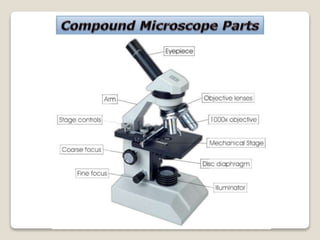
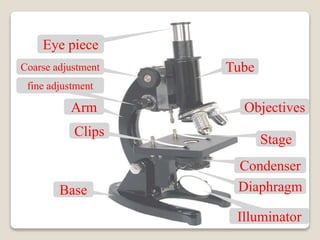
Eye piece
TubeCoarse adjustment
fine adjustment
Arm
Clips
Base
Illuminator
Condenser
Diaphragm
Stage
Objectives
Eyepiece magnification power 10X
Objective magnification power 10X ( low power) or
40X (high power)
Total Magnification = Eyepiece M.P x Objective M.P
= 10×40 = 400 X
Magnification power
Preparation of powder slide
1.Add two drops of water on the powder
2.Put a small amount of powder on it
3.Spread the powder by the brush and put the cover
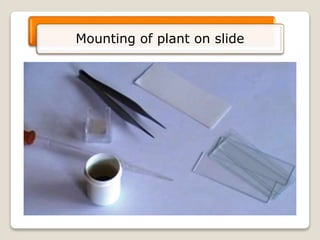
Mounting of plant on slide
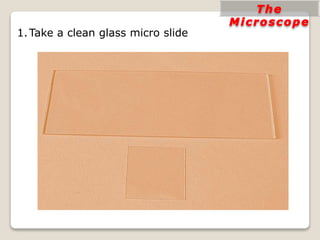
1.Take a clean glass micro slide
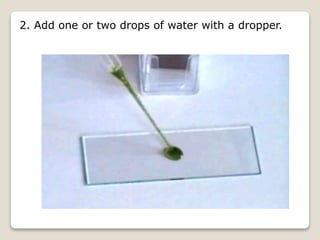
2. Add one or two drops of water with a dropper.
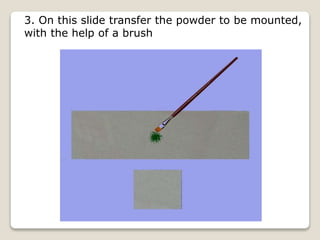
3. On this slide transfer the powder to be mounted,
with the help of a brush
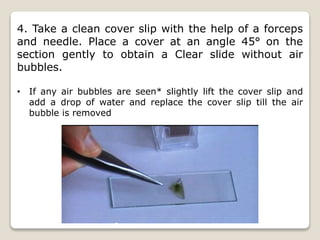
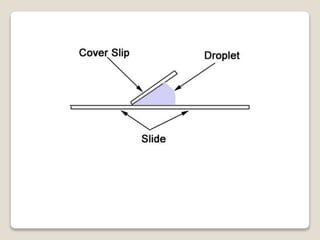
4. Take a clean cover slip with the help of a forceps
and needle. Place a cover at an angle 45° on the
section gently to obtain a Clear slide without air
bubbles.

• If any air bubbles are seen* slightly lift the cover slip and
add a drop of water and replace the cover slip till the air
bubble is removed
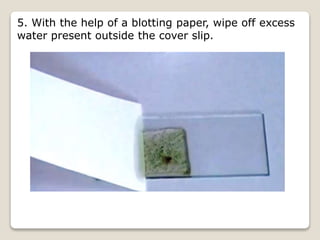
5. With the help of a blotting paper, wipe off excess
water present outside the cover slip.
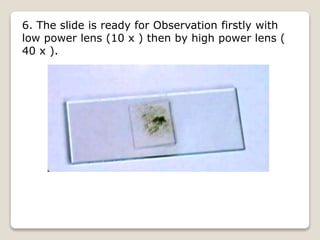
6. The slide is ready for Observation firstly with
low power lens (10 x ) then by high power lens (
40 x ).
Starch
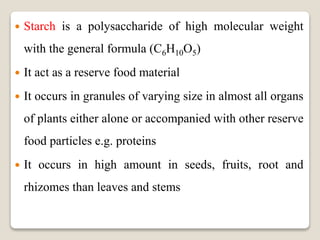
 Starch is a polysaccharide of high molecular weight
with the general formula (C6H10O5)
 It act as a reserve food material
 It occurs in granules of varying size in almost all organs
of plants either alone or accompanied with other reserve
food particles e.g. proteins
 It occurs in high amount in seeds, fruits, root and
rhizomes than leaves and stems
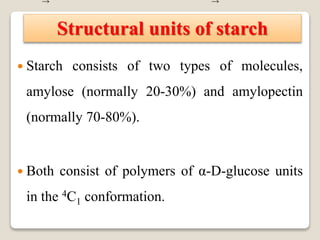
Structural units of starch
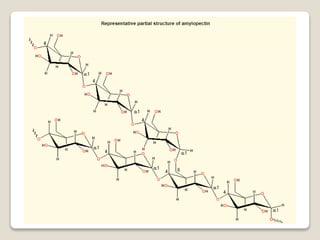
 Starch consists of two types of molecules,
amylose (normally 20-30%) and amylopectin
(normally 70-80%).
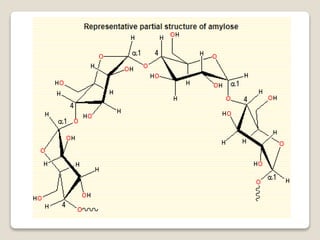
 Both consist of polymers of α-D-glucose units
in the 4C1 conformation.
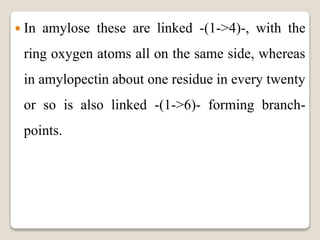
 In amylose these are linked -(1->4)-, with the
ring oxygen atoms all on the same side, whereas
in amylopectin about one residue in every twenty
or so is also linked -(1->6)- forming branch-
points.
Microscopical characters
 Starch granules have the same characters in the one and the
same plant but differ in different plants, so they furnish an
important mean for identification of drug
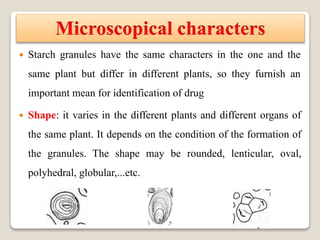
 Shape: it varies in the different plants and different organs of
the same plant. It depends on the condition of the formation of
the granules. The shape may be rounded, lenticular, oval,
polyhedral, globular,...etc.
 Size: it varies in the different plants.
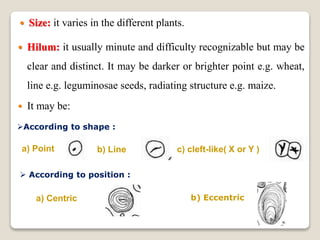
 Hilum: it usually minute and difficulty recognizable but may be
clear and distinct. It may be darker or brighter point e.g. wheat,
line e.g. leguminosae seeds, radiating structure e.g. maize.
 It may be:
According to shape :
a) Point b) Line c) cleft-like( X or Y )
a) Centric b) Eccentric
 According to position :
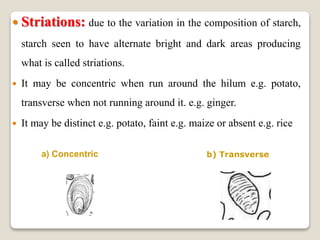
 Striations: due to the variation in the composition of starch,
starch seen to have alternate bright and dark areas producing
what is called striations.
 It may be concentric when run around the hilum e.g. potato,
transverse when not running around it. e.g. ginger.
 It may be distinct e.g. potato, faint e.g. maize or absent e.g. rice
b) Transversea) Concentric
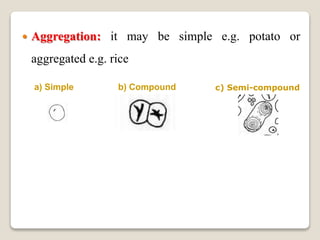
 Aggregation: it may be simple e.g. potato or
aggregated e.g. rice
a) Simple b) Compound c) Semi-compound
Commercial starches
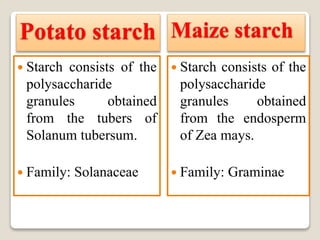
Potato starch
 Starch consists of the
polysaccharide
granules obtained
from the tubers of
Solanum tubersum.
 Family: Solanaceae
Maize starch
 Starch consists of the
polysaccharide
granules obtained
from the endosperm
of Zea mays.
 Family: Graminae
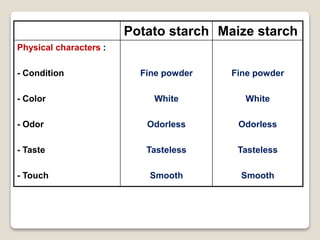
Maize starchPotato starch
Fine powder
White
Odorless
Tasteless
Smooth
Fine powder
White
Odorless
Tasteless
Smooth
Physical characters :
- Condition
- Color
- Odor
- Taste
- Touch
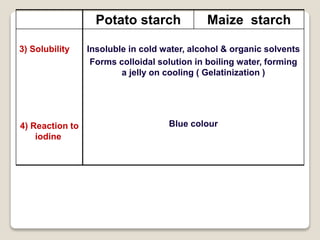
Maize starchPotato starch
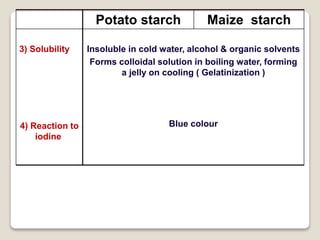
Insoluble in cold water, alcohol & organic solvents
Forms colloidal solution in boiling water, forming
a jelly on cooling ( Gelatinization )
Blue colour
3) Solubility
4) Reaction to
iodine
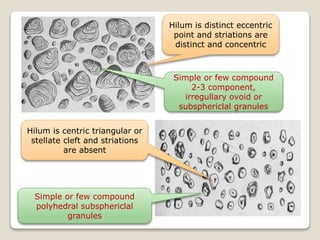
Hilum is distinct eccentric
point and striations are
distinct and concentric
Simple or few compound
2-3 component,
irregullary ovoid or
subsphericlal granules
Hilum is centric triangular or
stellate cleft and striations
are absent
Simple or few compound
polyhedral subsphericlal
granules
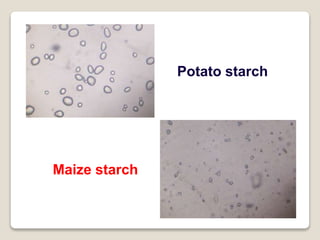
Potato starch
Maize starch
Wheat starch
 Starch consists of the
polysaccharide
granules obtained
from obtained from
the endosperm of
Triticum vulgare.
 Family: Graminae
Rice starch
 Starch consists of the
polysaccharide
granules obtained
from the endosperm
of Orayaza sativa.
 Family: Graminae
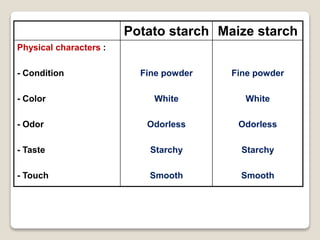
Maize starchPotato starch
Fine powder
White
Odorless
Starchy
Smooth
Fine powder
White
Odorless
Starchy
Smooth
Physical characters :
- Condition
- Color
- Odor
- Taste
- Touch
Maize starchPotato starch
Insoluble in cold water, alcohol & organic solvents
Forms colloidal solution in boiling water, forming
a jelly on cooling ( Gelatinization )
Blue colour
3) Solubility
4) Reaction to
iodine
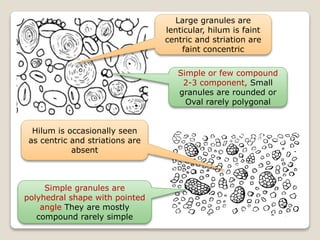
Large granules are
lenticular, hilum is faint
centric and striation are
faint concentric
Simple or few compound
2-3 component, Small
granules are rounded or
Oval rarely polygonal
Hilum is occasionally seen
as centric and striations are
absent
Simple granules are
polyhedral shape with pointed
angle They are mostly
compound rarely simple
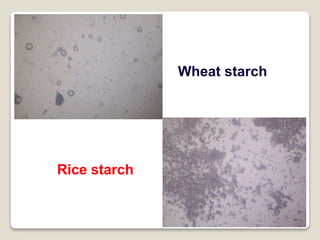
Wheat starch
Rice starch
1. microscope, potato, maize

1. microscope, potato, maize

  • 2.
    The purpose ofa microscope is to magnify a small object or to magnify the fine details of a larger object in order to examine minute specimens that cannot be seen by the naked eye.
  • 4.
    Eye piece TubeCoarse adjustment fineadjustment Arm Clips Base Illuminator Condenser Diaphragm Stage Objectives
  • 5.
    Eyepiece magnification power10X Objective magnification power 10X ( low power) or 40X (high power) Total Magnification = Eyepiece M.P x Objective M.P = 10×40 = 400 X Magnification power
  • 6.
    Preparation of powderslide 1.Add two drops of water on the powder 2.Put a small amount of powder on it 3.Spread the powder by the brush and put the cover
  • 7.
  • 8.
    1.Take a cleanglass micro slide
  • 9.
    2. Add oneor two drops of water with a dropper.
  • 10.
    3. On thisslide transfer the powder to be mounted, with the help of a brush
  • 11.
    4. Take aclean cover slip with the help of a forceps and needle. Place a cover at an angle 45° on the section gently to obtain a Clear slide without air bubbles. • If any air bubbles are seen* slightly lift the cover slip and add a drop of water and replace the cover slip till the air bubble is removed
  • 13.
    5. With thehelp of a blotting paper, wipe off excess water present outside the cover slip.
  • 14.
    6. The slideis ready for Observation firstly with low power lens (10 x ) then by high power lens ( 40 x ).
  • 15.
  • 16.
     Starch isa polysaccharide of high molecular weight with the general formula (C6H10O5)  It act as a reserve food material  It occurs in granules of varying size in almost all organs of plants either alone or accompanied with other reserve food particles e.g. proteins  It occurs in high amount in seeds, fruits, root and rhizomes than leaves and stems
  • 17.
    Structural units ofstarch  Starch consists of two types of molecules, amylose (normally 20-30%) and amylopectin (normally 70-80%).  Both consist of polymers of α-D-glucose units in the 4C1 conformation.
  • 18.
     In amylosethese are linked -(1->4)-, with the ring oxygen atoms all on the same side, whereas in amylopectin about one residue in every twenty or so is also linked -(1->6)- forming branch- points.
  • 21.
    Microscopical characters  Starchgranules have the same characters in the one and the same plant but differ in different plants, so they furnish an important mean for identification of drug  Shape: it varies in the different plants and different organs of the same plant. It depends on the condition of the formation of the granules. The shape may be rounded, lenticular, oval, polyhedral, globular,...etc.
  • 22.
     Size: itvaries in the different plants.  Hilum: it usually minute and difficulty recognizable but may be clear and distinct. It may be darker or brighter point e.g. wheat, line e.g. leguminosae seeds, radiating structure e.g. maize.  It may be: According to shape : a) Point b) Line c) cleft-like( X or Y ) a) Centric b) Eccentric  According to position :
  • 23.
     Striations: dueto the variation in the composition of starch, starch seen to have alternate bright and dark areas producing what is called striations.  It may be concentric when run around the hilum e.g. potato, transverse when not running around it. e.g. ginger.  It may be distinct e.g. potato, faint e.g. maize or absent e.g. rice b) Transversea) Concentric
  • 24.
     Aggregation: itmay be simple e.g. potato or aggregated e.g. rice a) Simple b) Compound c) Semi-compound
  • 25.
  • 26.
    Potato starch  Starchconsists of the polysaccharide granules obtained from the tubers of Solanum tubersum.  Family: Solanaceae Maize starch  Starch consists of the polysaccharide granules obtained from the endosperm of Zea mays.  Family: Graminae
  • 27.
    Maize starchPotato starch Finepowder White Odorless Tasteless Smooth Fine powder White Odorless Tasteless Smooth Physical characters : - Condition - Color - Odor - Taste - Touch
  • 28.
    Maize starchPotato starch Insolublein cold water, alcohol & organic solvents Forms colloidal solution in boiling water, forming a jelly on cooling ( Gelatinization ) Blue colour 3) Solubility 4) Reaction to iodine
  • 29.
    Hilum is distincteccentric point and striations are distinct and concentric Simple or few compound 2-3 component, irregullary ovoid or subsphericlal granules Hilum is centric triangular or stellate cleft and striations are absent Simple or few compound polyhedral subsphericlal granules
  • 30.
  • 31.
    Wheat starch  Starchconsists of the polysaccharide granules obtained from obtained from the endosperm of Triticum vulgare.  Family: Graminae Rice starch  Starch consists of the polysaccharide granules obtained from the endosperm of Orayaza sativa.  Family: Graminae
  • 32.
    Maize starchPotato starch Finepowder White Odorless Starchy Smooth Fine powder White Odorless Starchy Smooth Physical characters : - Condition - Color - Odor - Taste - Touch
  • 33.
    Maize starchPotato starch Insolublein cold water, alcohol & organic solvents Forms colloidal solution in boiling water, forming a jelly on cooling ( Gelatinization ) Blue colour 3) Solubility 4) Reaction to iodine
  • 34.
    Large granules are lenticular,hilum is faint centric and striation are faint concentric Simple or few compound 2-3 component, Small granules are rounded or Oval rarely polygonal Hilum is occasionally seen as centric and striations are absent Simple granules are polyhedral shape with pointed angle They are mostly compound rarely simple
  • 35.