Starbucks
Financial Ratio Analysis
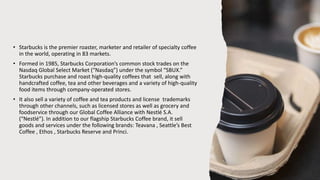
• Starbucks is the premier roaster, marketer and retailer of specialty coffee
in the world, operating in 83 markets.
• Formed in 1985, Starbucks Corporation’s common stock trades on the
Nasdaq Global Select Market (“Nasdaq”) under the symbol “SBUX.”
Starbucks purchase and roast high-quality coffees that sell, along with
handcrafted coffee, tea and other beverages and a variety of high-quality
food items through company-operated stores.
• It also sell a variety of coffee and tea products and license trademarks
through other channels, such as licensed stores as well as grocery and
foodservice through our Global Coffee Alliance with Nestlé S.A.
(“Nestlé”). In addition to our flagship Starbucks Coffee brand, it sell
goods and services under the following brands: Teavana , Seattle’s Best
Coffee , Ethos , Starbucks Reserve and Princi.
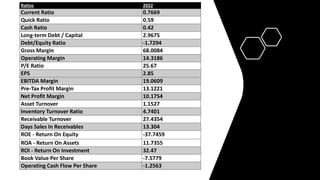
Ratios 2022
Current Ratio 0.7669
Quick Ratio 0.59
Cash Ratio 0.42
Long-term Debt / Capital 2.9675
Debt/Equity Ratio -1.7294
Gross Margin 68.0084
Operating Margin 14.3186
P/E Ratio 25.67
EPS 2.85
EBITDA Margin 19.0609
Pre-Tax Profit Margin 13.1221
Net Profit Margin 10.1754
Asset Turnover 1.1527
Inventory Turnover Ratio 4.7401
Receivable Turnover 27.4354
Days Sales In Receivables 13.304
ROE - Return On Equity -37.7459
ROA - Return On Assets 11.7355
ROI - Return On Investment 32.47
Book Value Per Share -7.5779
Operating Cash Flow Per Share -1.2563
Liquidity Ratios
Ratios 2022 Standard
Current Ratio 0.7669
1.5-2.0
Quick Ratio 0.59 1.0-1.2
Cash Ratio 0.42 0.5-1.0
CURRENT RATIO
The Current Ratio is a financial metric that assesses a
company’s ability to cover its short-term liabilities
with its short-term assets. It is calculated by dividing
the company’s current assets by its current liabilities.
- The current ratio of 0.7669 suggests that the
company may face challenges in meeting its short-
term obligations using its current assets alone.
- It indicates potential liquidity concerns, as the
company may not have sufficient current assets to
cover immediate liabilities.
Liquidity Ratios
QUICK RATIO
The Quick Ratio, also known as the Acid-Test Ratio,
is a financial metric that assesses a company’s
ability to cover its short-term liabilities using its
most liquid assets, excluding inventory. The
formula is (Current Assets – Inventory) divided by
Current Liabilities.
- The Quick Ratio of 0.59 indicates that the
company may face challenges in meeting its short-
term obligations without relying on the sale of
inventory.
- This ratio provides a more conservative view of
liquidity compared to the Current Ratio,
emphasizing the ability to cover immediate
liabilities with more liquid assets.
CASH RATIO
The Cash Ratio is a financial metric that assesses a
company’s ability to cover its short-term liabilities using
only its cash and cash equivalents. It is calculated by
dividing a company’s cash and cash equivalents by its
current liabilities.
- The Cash Ratio of 0.42 indicates that the company relies
heavily on non-cash current assets to meet its short-term
obligations.
- With a ratio of 0.42, the company has less than half of its
short-term liabilities covered by cash and cash equivalents
alone. This may suggest potential liquidity challenges, as
the company may face difficulty meeting immediate
obligations without relying on other forms of current
assets.
Efficiency Ratios
Ratios 2022 Standard
Asset Turnover 1.1527 1.5-2.0
Inventory Turnover Ratio 4.7401 4-6
Receivable Turnover 27.4354 15-20
Days Sales In Receivables 13.304 30-45
Efficiency Ratios
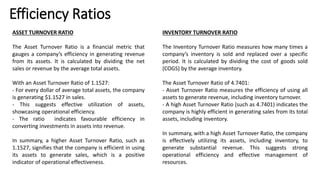
ASSET TURNOVER RATIO
The Asset Turnover Ratio is a financial metric that
gauges a company’s efficiency in generating revenue
from its assets. It is calculated by dividing the net
sales or revenue by the average total assets.
With an Asset Turnover Ratio of 1.1527:
- For every dollar of average total assets, the company
is generating $1.1527 in sales.
- This suggests effective utilization of assets,
showcasing operational efficiency.
- The ratio indicates favourable efficiency in
converting investments in assets into revenue.
In summary, a higher Asset Turnover Ratio, such as
1.1527, signifies that the company is efficient in using
its assets to generate sales, which is a positive
indicator of operational effectiveness.
INVENTORY TURNOVER RATIO
The Inventory Turnover Ratio measures how many times a
company’s inventory is sold and replaced over a specific
period. It is calculated by dividing the cost of goods sold
(COGS) by the average inventory.
The Asset Turnover Ratio of 4.7401:
- Asset Turnover Ratio measures the efficiency of using all
assets to generate revenue, including inventory turnover.
- A high Asset Turnover Ratio (such as 4.7401) indicates the
company is highly efficient in generating sales from its total
assets, including inventory.
In summary, with a high Asset Turnover Ratio, the company
is effectively utilizing its assets, including inventory, to
generate substantial revenue. This suggests strong
operational efficiency and effective management of
resources.
Efficiency Ratios
RECEIVABLE TURNOVER RATIO
The Receivables Turnover Ratio measures how many
times a company collects its average accounts
receivable during a specific period. It is calculated by
dividing the net credit sales by the average accounts
receivable.
The Receivables Turnover Ratio of 27.4354:
- This exceptionally high ratio indicates that the
company is collecting its accounts receivable much
faster than average.
- A higher ratio suggests efficient management of
receivables, quicker cash conversion, and effective
credit control.
In summary, a Receivables Turnover Ratio of 27.4354
signifies that the company is very efficient in collecting
payments from customers, highlighting strong cash
flow management and effective credit policies.
DAYS SALES IN RECEIVABLES
The Days Sales in Receivables, also known as Days Sales
Outstanding (DSO), measures the average number of days
it takes for a company to collect payment from its
customers after a sale. It is calculated by dividing the
number of days in the period by the Receivables Turnover
Ratio
The Days Sales in Receivables of 13.304:
- This figure indicates that, on average, it takes the
company approximately 13.304 days to collect payments
from its customers after making a sale.
- A lower DSO generally suggests efficient receivables
management and a quicker cash conversion cycle.
In summary, a Days Sales in Receivables of 13.304 implies
that the company efficiently converts credit sales into cash
within a relatively short time frame, reflecting effective
credit and collection practices.
Solvency Ratios
• Long-term Debt / Capital: This ratio is
2.9675 for Starbucks in 2022, which is
higher than the standard range of 1.5
to 2.0. This means that Starbucks has a
higher proportion of long-term debt to
capital than is typical for its industry.
• Debt/Equity Ratio: This ratio is -1.7294
for Starbucks in 2022, which is lower
than the standard range of 0.5 to
1.0. This means that Starbucks has a
lower proportion of debt to equity
than is typical for its industry.
Ratios 2022 Standard
Long-term Debt /
Capital
2.9675 1.5-2.0
Debt/Equity Ratio -1.7294 0.5-1.0
Profitability Ratios
• Gross Margin (68.0084%): Strong and comparable to industry standards,
showcasing Starbucks' ability to generate profit from core coffee products.
Highlight effective pricing and cost control.
• Operating Margin (14.3186%): Healthy and above average, indicating efficient
management of operating expenses. Emphasize operational excellence and
cost-cutting efforts.
• EBITDA Margin: Starbucks' EBITDA margin of 19.06% is above the average for
the coffee shop industry which typically ranges from 10% to 15%. This indicates
that the company is efficiently managing its operating costs and generating a
significant amount of cash from its operations.
• Pre-Tax Profit Margin: Despite being lower than the EBITDA margin, the pre-tax
profit margin of 13.12% is still within the acceptable range for the industry. This
suggests that Starbucks remains profitable even after considering financial
expenses.
• Net Profit Margin (10.1754%): Slightly above industry average, demonstrating
effective conversion of sales into income.
Ratios 2022 Standar
d
Gross Margin 68.0084 60-70%
Operating
Margin
14.3186 10-15%
EBITDA Margin 19.0609 10-15%
Pre-Tax Profit
Margin
13.1221 -
Net Profit
Margin
10.1754 5-10%
Return on Investment
• Starbucks' ROE of -37.7459% is significantly
below the industry standard of 15-20%. This
indicates that the company is not generating
enough profit relative to the shareholders'
equity invested in the business.
• Starbucks' ROA of 11.7355% is above the
industry standard of 5-10%. This suggests that
the company is using its assets efficiently to
generate profits.
• Starbucks' ROI of 32.47% is well above the
industry standard of 10-15%. This indicates
that the company is generating a high return
on its investments.
RATIOS 2022 STANDARD
ROE - Return On
Equity
-37.7459 15-20%
ROA - Return On
Assets
11.7355 5-10%
ROI - Return On
Investment
32.47 10-15%
Per Share Ratios
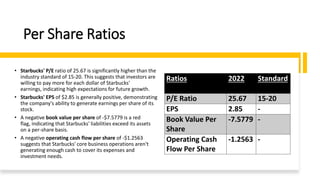
• Starbucks' P/E ratio of 25.67 is significantly higher than the
industry standard of 15-20. This suggests that investors are
willing to pay more for each dollar of Starbucks'
earnings, indicating high expectations for future growth.
• Starbucks' EPS of $2.85 is generally positive, demonstrating
the company's ability to generate earnings per share of its
stock.
• A negative book value per share of -$7.5779 is a red
flag, indicating that Starbucks' liabilities exceed its assets
on a per-share basis.
• A negative operating cash flow per share of -$1.2563
suggests that Starbucks' core business operations aren't
generating enough cash to cover its expenses and
investment needs.
Ratios 2022 Standard
P/E Ratio 25.67 15-20
EPS 2.85 -
Book Value Per
Share
-7.5779 -
Operating Cash
Flow Per Share
-1.2563 -
Strategies for Improvement:
• Reduce debt: Starbucks can prioritize debt repayment
through increased free cash flow generation or issuing equity.
This will improve ROE, book value, and reduce financial risk. .
• Optimize financial structure: Rebalance the capital structure
to find a better mix of debt and equity that minimizes
financing costs and maintains financial flexibility.
• Explore new revenue streams: Expand into new markets,
introduce innovative products and services, or leverage
existing brand value to diversify income sources.
• Focus on operational efficiency: Continue to improve
inventory and receivables management, optimize supply
chain, and implement cost-saving measures.
Starbucks SWOT Analysis
• Strengths
• Strong Market Position and Global Brand Recognition
• Products of the Highest Quality
• Location and Aesthetic appeal of its Stores
• Diverse Product Mix:
• Use of Technology and Mobile Outlet
• Customer base loyalty
• Opportunities
• Expansion into Emerging Markets:
• Expanding Product mix and offerings
• Expansion of retail operations
• New distribution channels
• Brand extension
• Weaknesses
• Expensive Products
• Self-Cannibalization through overcrowding
• Negative large corporation image
• American/European coffee culture clash with
that of other countries
• Threats
• Increased Competition:
• Price Volatility in the Global Coffee Market:
• Changing Consumer tastes and lifestyle
choices
• Developed Countries Market Saturation
Recent events in Starbucks
• The company repurchased 20.3 million shares in fiscal 2020 and 36.3 million shares in fiscal 2022.
• The share repurchase program was temporarily suspended in March 2020 due to the COVID-19 pandemic and resumed
in fiscal 2022.
• As of October 2, 2022, 52.6 million shares remained available for repurchase under current authorizations.
• Starbucks has engaged in share repurchases for several reasons, which can be broadly categorized into two main
motivations:
• Increasing shareholder value :-
O Boosting stock price
O Improving financial ratios
O Signaling confidence
• Strategic objectives:
O Reducing ownership dispersion
O Controlling dilution
• Critics argue that the money used for buybacks could be better invested in employees, stores, or research and
development. This is particularly relevant in Starbucks's case, where the company faced unionization movements
and employee concerns about wages and working conditions.
• Share repurchases can also increase a company's debt levels, potentially putting it at financial risk in times of
economic downturn.
• Starbucks Announces Triple Shot Reinvention Strategy
• Current strategy of Starbucks?
• Triple Shot Reinvention will focus on three priorities: elevating the Starbucks brand; strengthening the company's
digital capabilities; and becoming truly global; customized with “two pumps” unlocking efficiency and
reinvigorating partner culture
• Starbucks expresses a commitment to social and racial equity, sustainability, and being a resource-positive
company. Ambitious targets are set to reduce carbon, water, and waste footprints by 2030.
• Starbucks' mission: to inspire and nurture the human spirit one person, one cup, and one neighborhood at a time.
Recent events in Starbucks

Starbucks Ratio Analysis.pptx

  • 1.
  • 2.
    • Starbucks isthe premier roaster, marketer and retailer of specialty coffee in the world, operating in 83 markets. • Formed in 1985, Starbucks Corporation’s common stock trades on the Nasdaq Global Select Market (“Nasdaq”) under the symbol “SBUX.” Starbucks purchase and roast high-quality coffees that sell, along with handcrafted coffee, tea and other beverages and a variety of high-quality food items through company-operated stores. • It also sell a variety of coffee and tea products and license trademarks through other channels, such as licensed stores as well as grocery and foodservice through our Global Coffee Alliance with Nestlé S.A. (“Nestlé”). In addition to our flagship Starbucks Coffee brand, it sell goods and services under the following brands: Teavana , Seattle’s Best Coffee , Ethos , Starbucks Reserve and Princi.
  • 5.
    Ratios 2022 Current Ratio0.7669 Quick Ratio 0.59 Cash Ratio 0.42 Long-term Debt / Capital 2.9675 Debt/Equity Ratio -1.7294 Gross Margin 68.0084 Operating Margin 14.3186 P/E Ratio 25.67 EPS 2.85 EBITDA Margin 19.0609 Pre-Tax Profit Margin 13.1221 Net Profit Margin 10.1754 Asset Turnover 1.1527 Inventory Turnover Ratio 4.7401 Receivable Turnover 27.4354 Days Sales In Receivables 13.304 ROE - Return On Equity -37.7459 ROA - Return On Assets 11.7355 ROI - Return On Investment 32.47 Book Value Per Share -7.5779 Operating Cash Flow Per Share -1.2563
  • 6.
    Liquidity Ratios Ratios 2022Standard Current Ratio 0.7669 1.5-2.0 Quick Ratio 0.59 1.0-1.2 Cash Ratio 0.42 0.5-1.0 CURRENT RATIO The Current Ratio is a financial metric that assesses a company’s ability to cover its short-term liabilities with its short-term assets. It is calculated by dividing the company’s current assets by its current liabilities. - The current ratio of 0.7669 suggests that the company may face challenges in meeting its short- term obligations using its current assets alone. - It indicates potential liquidity concerns, as the company may not have sufficient current assets to cover immediate liabilities.
  • 7.
    Liquidity Ratios QUICK RATIO TheQuick Ratio, also known as the Acid-Test Ratio, is a financial metric that assesses a company’s ability to cover its short-term liabilities using its most liquid assets, excluding inventory. The formula is (Current Assets – Inventory) divided by Current Liabilities. - The Quick Ratio of 0.59 indicates that the company may face challenges in meeting its short- term obligations without relying on the sale of inventory. - This ratio provides a more conservative view of liquidity compared to the Current Ratio, emphasizing the ability to cover immediate liabilities with more liquid assets. CASH RATIO The Cash Ratio is a financial metric that assesses a company’s ability to cover its short-term liabilities using only its cash and cash equivalents. It is calculated by dividing a company’s cash and cash equivalents by its current liabilities. - The Cash Ratio of 0.42 indicates that the company relies heavily on non-cash current assets to meet its short-term obligations. - With a ratio of 0.42, the company has less than half of its short-term liabilities covered by cash and cash equivalents alone. This may suggest potential liquidity challenges, as the company may face difficulty meeting immediate obligations without relying on other forms of current assets.
  • 8.
    Efficiency Ratios Ratios 2022Standard Asset Turnover 1.1527 1.5-2.0 Inventory Turnover Ratio 4.7401 4-6 Receivable Turnover 27.4354 15-20 Days Sales In Receivables 13.304 30-45
  • 9.
    Efficiency Ratios ASSET TURNOVERRATIO The Asset Turnover Ratio is a financial metric that gauges a company’s efficiency in generating revenue from its assets. It is calculated by dividing the net sales or revenue by the average total assets. With an Asset Turnover Ratio of 1.1527: - For every dollar of average total assets, the company is generating $1.1527 in sales. - This suggests effective utilization of assets, showcasing operational efficiency. - The ratio indicates favourable efficiency in converting investments in assets into revenue. In summary, a higher Asset Turnover Ratio, such as 1.1527, signifies that the company is efficient in using its assets to generate sales, which is a positive indicator of operational effectiveness. INVENTORY TURNOVER RATIO The Inventory Turnover Ratio measures how many times a company’s inventory is sold and replaced over a specific period. It is calculated by dividing the cost of goods sold (COGS) by the average inventory. The Asset Turnover Ratio of 4.7401: - Asset Turnover Ratio measures the efficiency of using all assets to generate revenue, including inventory turnover. - A high Asset Turnover Ratio (such as 4.7401) indicates the company is highly efficient in generating sales from its total assets, including inventory. In summary, with a high Asset Turnover Ratio, the company is effectively utilizing its assets, including inventory, to generate substantial revenue. This suggests strong operational efficiency and effective management of resources.
  • 10.
    Efficiency Ratios RECEIVABLE TURNOVERRATIO The Receivables Turnover Ratio measures how many times a company collects its average accounts receivable during a specific period. It is calculated by dividing the net credit sales by the average accounts receivable. The Receivables Turnover Ratio of 27.4354: - This exceptionally high ratio indicates that the company is collecting its accounts receivable much faster than average. - A higher ratio suggests efficient management of receivables, quicker cash conversion, and effective credit control. In summary, a Receivables Turnover Ratio of 27.4354 signifies that the company is very efficient in collecting payments from customers, highlighting strong cash flow management and effective credit policies. DAYS SALES IN RECEIVABLES The Days Sales in Receivables, also known as Days Sales Outstanding (DSO), measures the average number of days it takes for a company to collect payment from its customers after a sale. It is calculated by dividing the number of days in the period by the Receivables Turnover Ratio The Days Sales in Receivables of 13.304: - This figure indicates that, on average, it takes the company approximately 13.304 days to collect payments from its customers after making a sale. - A lower DSO generally suggests efficient receivables management and a quicker cash conversion cycle. In summary, a Days Sales in Receivables of 13.304 implies that the company efficiently converts credit sales into cash within a relatively short time frame, reflecting effective credit and collection practices.
  • 11.
    Solvency Ratios • Long-termDebt / Capital: This ratio is 2.9675 for Starbucks in 2022, which is higher than the standard range of 1.5 to 2.0. This means that Starbucks has a higher proportion of long-term debt to capital than is typical for its industry. • Debt/Equity Ratio: This ratio is -1.7294 for Starbucks in 2022, which is lower than the standard range of 0.5 to 1.0. This means that Starbucks has a lower proportion of debt to equity than is typical for its industry. Ratios 2022 Standard Long-term Debt / Capital 2.9675 1.5-2.0 Debt/Equity Ratio -1.7294 0.5-1.0
  • 12.
    Profitability Ratios • GrossMargin (68.0084%): Strong and comparable to industry standards, showcasing Starbucks' ability to generate profit from core coffee products. Highlight effective pricing and cost control. • Operating Margin (14.3186%): Healthy and above average, indicating efficient management of operating expenses. Emphasize operational excellence and cost-cutting efforts. • EBITDA Margin: Starbucks' EBITDA margin of 19.06% is above the average for the coffee shop industry which typically ranges from 10% to 15%. This indicates that the company is efficiently managing its operating costs and generating a significant amount of cash from its operations. • Pre-Tax Profit Margin: Despite being lower than the EBITDA margin, the pre-tax profit margin of 13.12% is still within the acceptable range for the industry. This suggests that Starbucks remains profitable even after considering financial expenses. • Net Profit Margin (10.1754%): Slightly above industry average, demonstrating effective conversion of sales into income. Ratios 2022 Standar d Gross Margin 68.0084 60-70% Operating Margin 14.3186 10-15% EBITDA Margin 19.0609 10-15% Pre-Tax Profit Margin 13.1221 - Net Profit Margin 10.1754 5-10%
  • 13.
    Return on Investment •Starbucks' ROE of -37.7459% is significantly below the industry standard of 15-20%. This indicates that the company is not generating enough profit relative to the shareholders' equity invested in the business. • Starbucks' ROA of 11.7355% is above the industry standard of 5-10%. This suggests that the company is using its assets efficiently to generate profits. • Starbucks' ROI of 32.47% is well above the industry standard of 10-15%. This indicates that the company is generating a high return on its investments. RATIOS 2022 STANDARD ROE - Return On Equity -37.7459 15-20% ROA - Return On Assets 11.7355 5-10% ROI - Return On Investment 32.47 10-15%
  • 14.
    Per Share Ratios •Starbucks' P/E ratio of 25.67 is significantly higher than the industry standard of 15-20. This suggests that investors are willing to pay more for each dollar of Starbucks' earnings, indicating high expectations for future growth. • Starbucks' EPS of $2.85 is generally positive, demonstrating the company's ability to generate earnings per share of its stock. • A negative book value per share of -$7.5779 is a red flag, indicating that Starbucks' liabilities exceed its assets on a per-share basis. • A negative operating cash flow per share of -$1.2563 suggests that Starbucks' core business operations aren't generating enough cash to cover its expenses and investment needs. Ratios 2022 Standard P/E Ratio 25.67 15-20 EPS 2.85 - Book Value Per Share -7.5779 - Operating Cash Flow Per Share -1.2563 -
  • 15.
    Strategies for Improvement: •Reduce debt: Starbucks can prioritize debt repayment through increased free cash flow generation or issuing equity. This will improve ROE, book value, and reduce financial risk. . • Optimize financial structure: Rebalance the capital structure to find a better mix of debt and equity that minimizes financing costs and maintains financial flexibility. • Explore new revenue streams: Expand into new markets, introduce innovative products and services, or leverage existing brand value to diversify income sources. • Focus on operational efficiency: Continue to improve inventory and receivables management, optimize supply chain, and implement cost-saving measures.
  • 16.
    Starbucks SWOT Analysis •Strengths • Strong Market Position and Global Brand Recognition • Products of the Highest Quality • Location and Aesthetic appeal of its Stores • Diverse Product Mix: • Use of Technology and Mobile Outlet • Customer base loyalty • Opportunities • Expansion into Emerging Markets: • Expanding Product mix and offerings • Expansion of retail operations • New distribution channels • Brand extension • Weaknesses • Expensive Products • Self-Cannibalization through overcrowding • Negative large corporation image • American/European coffee culture clash with that of other countries • Threats • Increased Competition: • Price Volatility in the Global Coffee Market: • Changing Consumer tastes and lifestyle choices • Developed Countries Market Saturation
  • 17.
    Recent events inStarbucks • The company repurchased 20.3 million shares in fiscal 2020 and 36.3 million shares in fiscal 2022. • The share repurchase program was temporarily suspended in March 2020 due to the COVID-19 pandemic and resumed in fiscal 2022. • As of October 2, 2022, 52.6 million shares remained available for repurchase under current authorizations. • Starbucks has engaged in share repurchases for several reasons, which can be broadly categorized into two main motivations: • Increasing shareholder value :- O Boosting stock price O Improving financial ratios O Signaling confidence • Strategic objectives: O Reducing ownership dispersion O Controlling dilution
  • 18.
    • Critics arguethat the money used for buybacks could be better invested in employees, stores, or research and development. This is particularly relevant in Starbucks's case, where the company faced unionization movements and employee concerns about wages and working conditions. • Share repurchases can also increase a company's debt levels, potentially putting it at financial risk in times of economic downturn. • Starbucks Announces Triple Shot Reinvention Strategy • Current strategy of Starbucks? • Triple Shot Reinvention will focus on three priorities: elevating the Starbucks brand; strengthening the company's digital capabilities; and becoming truly global; customized with “two pumps” unlocking efficiency and reinvigorating partner culture • Starbucks expresses a commitment to social and racial equity, sustainability, and being a resource-positive company. Ambitious targets are set to reduce carbon, water, and waste footprints by 2030. • Starbucks' mission: to inspire and nurture the human spirit one person, one cup, and one neighborhood at a time. Recent events in Starbucks