SCHOOL OF ARCHITECTURE, BUILDING & DESIGN 
Foundation of Natural & Built Environments (FNBE) 
BASIC ACCOUNTING 
Lecturer: Chang Jau Hau 
Assignment: Financial Ratio Analysis 
Company: Starbucks Corporation 
Group Members: William Goh Ming Hann 
Erik Ong Chia Hong 
Tan Ken Ric 
1
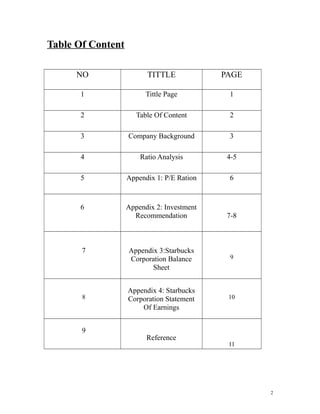
Table Of Content 
NO TITTLE PAGE 
1 Tittle Page 1 
2 Table Of Content 2 
3 Company Background 3 
4 Ratio Analysis 4-5 
5 Appendix 1: P/E Ration 6 
6 Appendix 2: Investment 
Recommendation 7-8 
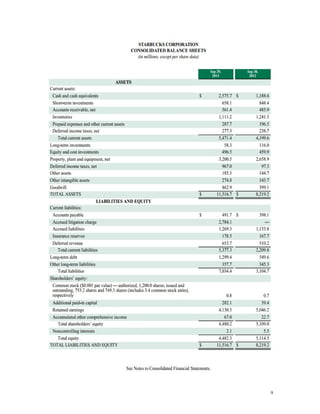
7 Appendix 3:Starbucks 
Corporation Balance 
Sheet 
9 
8 
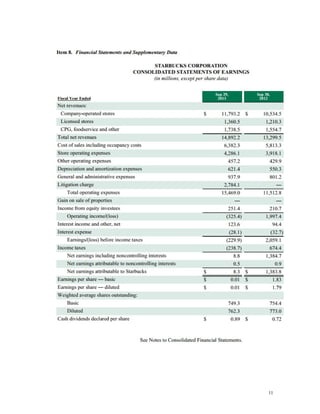
Appendix 4: Starbucks 
Corporation Statement 
Of Earnings 
10 
9 
Reference 
11 
2
Company Background 
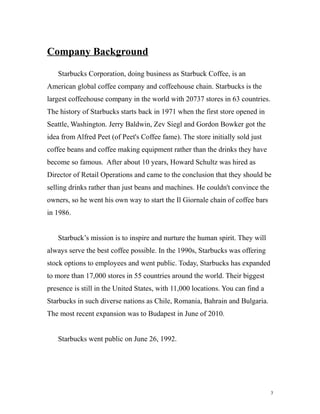
Starbucks Corporation, doing business as Starbuck Coffee, is an 
American global coffee company and coffeehouse chain. Starbucks is the 
largest coffeehouse company in the world with 20737 stores in 63 countries. 
The history of Starbucks starts back in 1971 when the first store opened in 
Seattle, Washington. Jerry Baldwin, Zev Siegl and Gordon Bowker got the 
idea from Alfred Peet (of Peet's Coffee fame). The store initially sold just 
coffee beans and coffee making equipment rather than the drinks they have 
become so famous. After about 10 years, Howard Schultz was hired as 
Director of Retail Operations and came to the conclusion that they should be 
selling drinks rather than just beans and machines. He couldn't convince the 
owners, so he went his own way to start the Il Giornale chain of coffee bars 
in 1986. 
Starbuck’s mission is to inspire and nurture the human spirit. They will 
always serve the best coffee possible. In the 1990s, Starbucks was offering 
stock options to employees and went public. Today, Starbucks has expanded 
to more than 17,000 stores in 55 countries around the world. Their biggest 
presence is still in the United States, with 11,000 locations. You can find a 
Starbucks in such diverse nations as Chile, Romania, Bahrain and Bulgaria. 
The most recent expansion was to Budapest in June of 2010. 
Starbucks went public on June 26, 1992. 
3
RATIO ANALYSIS 
(In Millions) 
Profitability 
Ratios 
2012 2013 Interpretation 
Return on Equity 
(ROE) 
Net profit × 100% 
Average O/E 
= 1383.8 × 100% 
4798.4 
= 28.8% 
Net profit × 100% 
Average O/E 
= 8.3 × 100% 
4798.4 
= 0.2% 
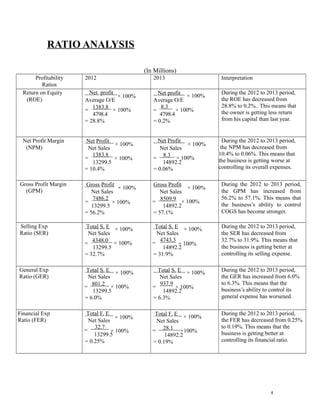
During the 2012 to 2013 period, 
the ROE has decreased from 
28.8% to 0.2%.. This means that 
the owner is getting less return 
from his capital than last year. 
Net Profit Margin 
(NPM) 
Net P rofit × 100% 
Net Sales 
= 1383.8 × 100% 
13299.5 
= 10.4% 
Net P rofit × 100% 
Net Sales 
= 8.3 × 100% 
14892.2 
= 0.06% 
During the 2012 to 2013 period, 
the NPM has decreased from 
10.4% to 0.06%. This means that 
the business is getting worse at 
controlling its overall expenses. 
Gross Profit Margin 
(GPM) 
Gross P rofit × 100% 
Net Sales 
= 7486.2 
13299.5 × 100% 
= 56.2% 
Gross P rofit × 100% 
Net Sales 
= 8509.9 × 100% 
14892.2 
= 57.1% 
During the 2012 to 2013 period, 
the GPM has increased from 
56.2% to 57.1%. This means that 
the business’s ability to control 
COGS has become stronger. 
Selling Exp 
Ratio (SER) 
Total S . E × 100% 
Net Sales 
= 4348.0 × 100% 
13299.5 
= 32.7% 
Total S . E × 100% 
Net Sales 
= 4743.3 
14892.×2 100% 
= 31.9% 
During the 2012 to 2013 period, 
the SER has decreased from 
32.7% to 31.9%. This means that 
the business is getting better at 
controlling its selling expense. 
General Exp 
Ratio (GER) 
Total S . E × 100% 
Net Sales 
= 801.2 × 100% 
13299.5 
= 6.0% 
Total S . E × 100% 
Net Sales 
= 937.9 × 100% 
14892.2 
= 6.3% 
During the 2012 to 2013 period, 
the GER has increased from 6.0% 
to 6.3%. This means that the 
business’s ability to control its 
general expense has worsened. 
Financial Exp 
Ratio (FER) 
Total F. E 
Net Sales × 100% 
= 32.7 
13299.5× 100% 
= 0.25% 
Total F. E × 100% 
Net Sales 
= 28.1 ×100% 
14892.2 
= 0.19% 
During the 2012 to 2013 period, 
the FER has decreased from 0.25% 
to 0.19%. This means that the 
business is getting better at 
controlling its financial ratio. 
4
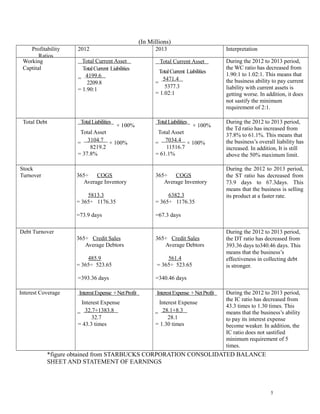
(In Millions) 
Profitability 
Ratios 
2012 2013 Interpretation 
Working 
Captital 
Total Current Asset 
Total Current Liabilities 
= 4199.6 
2209.8 
= 1.90:1 
Total Current Asset 
Total Current Liabilities 
= 5471.4 
5377.3 
= 1.02:1 
During the 2012 to 2013 period, 
the WC ratio has decreased from 
1.90:1 to 1.02:1. This means that 
the business ability to pay current 
liability with current assets is 
getting worse. In addition, it does 
not sastify the minimum 
requirement of 2:1. 
Total Debt Total Liabilities × 100% 
Total Asset 
= 3104.7 × 100% 
8219.2 
= 37.8% 
Total Liabilities × 100% 
Total Asset 
= 7034.4 × 100% 
11516.7 
= 61.1% 
During the 2012 to 2013 period, 
the Td ratio has increased from 
37.8% to 61.1%. This means that 
the business’s overall liability has 
increased. In addition, It is still 
above the 50% maximum limit. 
Stock 
Turnover 365÷ COGS 
Average Inventory 
5813.3 
= 365÷ 1176.35 
=73.9 days 
365÷ COGS 
Average Inventory 
6382.3 
= 365÷ 1176.35 
=67.3 days 
During the 2012 to 2013 period, 
the ST ratio has decreased from 
73.9 days to 67.3days. This 
means that the business is selling 
its product at a faster rate. 
Debt Turnover 
365÷ Credit Sales 
Average Debtors 
485.9 
= 365÷ 523.65 
=393.36 days 
365÷ Credit Sales 
Average Debtors 
561.4 
= 365÷ 523.65 
=340.46 days 
During the 2012 to 2013 period, 
the DT ratio has decreased from 
393.36 days to340.46 days. This 
means that the business’s 
effectiveness in collecting debt 
is stronger. 
Interest Coverage Interest Expense + Net Profit 
Interest Expense 
= 32.7+1383.8 
32.7 
= 43.3 times 
Interest Expense + Net Profit 
Interest Expense 
= 28.1+8.3 
28.1 
= 1.30 times 
During the 2012 to 2013 period, 
the IC ratio has decreased from 
43.3 times to 1.30 times. This 
means that the business’s ability 
to pay its interest expense 
become weaker. In addition, the 
IC ratio does not sastified 
minimum requirement of 5 
times. 
*figure obtained from STARBUCKS CORPORATION CONSOLIDATED BALANCE 
SHEET AND STATEMENT OF EARNINGS 
5
Appendix 1: P/E Ration 
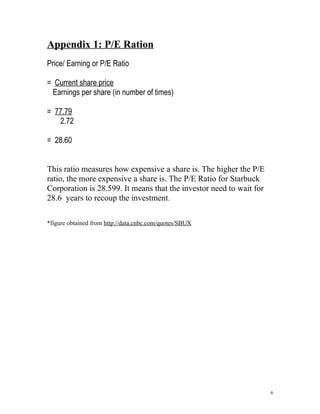
Price/ Earning or P/E Ratio 
= Current share price 
Earnings per share (in number of times) 
= 77.79 
2.72 
= 28.60 
This ratio measures how expensive a share is. The higher the P/E 
ratio, the more expensive a share is. The P/E Ratio for Starbuck 
Corporation is 28.599. It means that the investor need to wait for 
28.6 years to recoup the investment. 
*figure obtained from http://data.cnbc.com/quotes/SBUX 
6
APPENDIX 2: INVESTMENT RECCOMENDATION 
(a)PROFITABILITY 
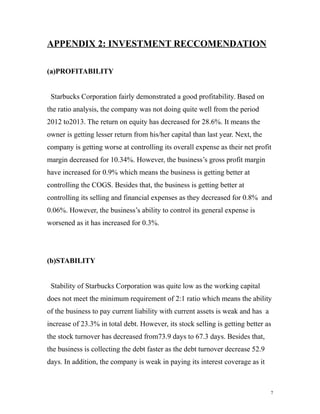
Starbucks Corporation fairly demonstrated a good profitability. Based on 
the ratio analysis, the company was not doing quite well from the period 
2012 to2013. The return on equity has decreased for 28.6%. It means the 
owner is getting lesser return from his/her capital than last year. Next, the 
company is getting worse at controlling its overall expense as their net profit 
margin decreased for 10.34%. However, the business’s gross profit margin 
have increased for 0.9% which means the business is getting better at 
controlling the COGS. Besides that, the business is getting better at 
controlling its selling and financial expenses as they decreased for 0.8% and 
0.06%. However, the business’s ability to control its general expense is 
worsened as it has increased for 0.3%. 
(b)STABILITY 
Stability of Starbucks Corporation was quite low as the working capital 
does not meet the minimum requirement of 2:1 ratio which means the ability 
of the business to pay current liability with current assets is weak and has a 
increase of 23.3% in total debt. However, its stock selling is getting better as 
the stock turnover has decreased from73.9 days to 67.3 days. Besides that, 
the business is collecting the debt faster as the debt turnover decrease 52.9 
days. In addition, the company is weak in paying its interest coverage as it 
7
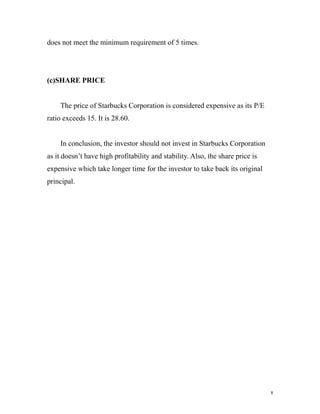
does not meet the minimum requirement of 5 times. 
(c)SHARE PRICE 
The price of Starbucks Corporation is considered expensive as its P/E 
ratio exceeds 15. It is 28.60. 
In conclusion, the investor should not invest in Starbucks Corporation 
as it doesn’t have high profitability and stability. Also, the share price is 
expensive which take longer time for the investor to take back its original 
principal. 
8
9
10
11
REFERENCE 
Starbucks (2012) (2013), Annual Report. 
http://investor.starbucks.com/phoenix.zhtml?c=99518&p=irol-reportsannual 
Starbucks (background) 
http://www.organicconsumers.org/starbucks/coffback.htm 
CNBC (share price and earnings per share) 
http://data.cnbc.com/quotes/SBUX 
Income Statement 
http://www.nasdaq.com/symbol/sbux/financials?query=income-statement 
12

Account assignment

  • 1.
    SCHOOL OF ARCHITECTURE,BUILDING & DESIGN Foundation of Natural & Built Environments (FNBE) BASIC ACCOUNTING Lecturer: Chang Jau Hau Assignment: Financial Ratio Analysis Company: Starbucks Corporation Group Members: William Goh Ming Hann Erik Ong Chia Hong Tan Ken Ric 1
  • 2.
    Table Of Content NO TITTLE PAGE 1 Tittle Page 1 2 Table Of Content 2 3 Company Background 3 4 Ratio Analysis 4-5 5 Appendix 1: P/E Ration 6 6 Appendix 2: Investment Recommendation 7-8 7 Appendix 3:Starbucks Corporation Balance Sheet 9 8 Appendix 4: Starbucks Corporation Statement Of Earnings 10 9 Reference 11 2
  • 3.
    Company Background StarbucksCorporation, doing business as Starbuck Coffee, is an American global coffee company and coffeehouse chain. Starbucks is the largest coffeehouse company in the world with 20737 stores in 63 countries. The history of Starbucks starts back in 1971 when the first store opened in Seattle, Washington. Jerry Baldwin, Zev Siegl and Gordon Bowker got the idea from Alfred Peet (of Peet's Coffee fame). The store initially sold just coffee beans and coffee making equipment rather than the drinks they have become so famous. After about 10 years, Howard Schultz was hired as Director of Retail Operations and came to the conclusion that they should be selling drinks rather than just beans and machines. He couldn't convince the owners, so he went his own way to start the Il Giornale chain of coffee bars in 1986. Starbuck’s mission is to inspire and nurture the human spirit. They will always serve the best coffee possible. In the 1990s, Starbucks was offering stock options to employees and went public. Today, Starbucks has expanded to more than 17,000 stores in 55 countries around the world. Their biggest presence is still in the United States, with 11,000 locations. You can find a Starbucks in such diverse nations as Chile, Romania, Bahrain and Bulgaria. The most recent expansion was to Budapest in June of 2010. Starbucks went public on June 26, 1992. 3
  • 4.
    RATIO ANALYSIS (InMillions) Profitability Ratios 2012 2013 Interpretation Return on Equity (ROE) Net profit × 100% Average O/E = 1383.8 × 100% 4798.4 = 28.8% Net profit × 100% Average O/E = 8.3 × 100% 4798.4 = 0.2% During the 2012 to 2013 period, the ROE has decreased from 28.8% to 0.2%.. This means that the owner is getting less return from his capital than last year. Net Profit Margin (NPM) Net P rofit × 100% Net Sales = 1383.8 × 100% 13299.5 = 10.4% Net P rofit × 100% Net Sales = 8.3 × 100% 14892.2 = 0.06% During the 2012 to 2013 period, the NPM has decreased from 10.4% to 0.06%. This means that the business is getting worse at controlling its overall expenses. Gross Profit Margin (GPM) Gross P rofit × 100% Net Sales = 7486.2 13299.5 × 100% = 56.2% Gross P rofit × 100% Net Sales = 8509.9 × 100% 14892.2 = 57.1% During the 2012 to 2013 period, the GPM has increased from 56.2% to 57.1%. This means that the business’s ability to control COGS has become stronger. Selling Exp Ratio (SER) Total S . E × 100% Net Sales = 4348.0 × 100% 13299.5 = 32.7% Total S . E × 100% Net Sales = 4743.3 14892.×2 100% = 31.9% During the 2012 to 2013 period, the SER has decreased from 32.7% to 31.9%. This means that the business is getting better at controlling its selling expense. General Exp Ratio (GER) Total S . E × 100% Net Sales = 801.2 × 100% 13299.5 = 6.0% Total S . E × 100% Net Sales = 937.9 × 100% 14892.2 = 6.3% During the 2012 to 2013 period, the GER has increased from 6.0% to 6.3%. This means that the business’s ability to control its general expense has worsened. Financial Exp Ratio (FER) Total F. E Net Sales × 100% = 32.7 13299.5× 100% = 0.25% Total F. E × 100% Net Sales = 28.1 ×100% 14892.2 = 0.19% During the 2012 to 2013 period, the FER has decreased from 0.25% to 0.19%. This means that the business is getting better at controlling its financial ratio. 4
  • 5.
    (In Millions) Profitability Ratios 2012 2013 Interpretation Working Captital Total Current Asset Total Current Liabilities = 4199.6 2209.8 = 1.90:1 Total Current Asset Total Current Liabilities = 5471.4 5377.3 = 1.02:1 During the 2012 to 2013 period, the WC ratio has decreased from 1.90:1 to 1.02:1. This means that the business ability to pay current liability with current assets is getting worse. In addition, it does not sastify the minimum requirement of 2:1. Total Debt Total Liabilities × 100% Total Asset = 3104.7 × 100% 8219.2 = 37.8% Total Liabilities × 100% Total Asset = 7034.4 × 100% 11516.7 = 61.1% During the 2012 to 2013 period, the Td ratio has increased from 37.8% to 61.1%. This means that the business’s overall liability has increased. In addition, It is still above the 50% maximum limit. Stock Turnover 365÷ COGS Average Inventory 5813.3 = 365÷ 1176.35 =73.9 days 365÷ COGS Average Inventory 6382.3 = 365÷ 1176.35 =67.3 days During the 2012 to 2013 period, the ST ratio has decreased from 73.9 days to 67.3days. This means that the business is selling its product at a faster rate. Debt Turnover 365÷ Credit Sales Average Debtors 485.9 = 365÷ 523.65 =393.36 days 365÷ Credit Sales Average Debtors 561.4 = 365÷ 523.65 =340.46 days During the 2012 to 2013 period, the DT ratio has decreased from 393.36 days to340.46 days. This means that the business’s effectiveness in collecting debt is stronger. Interest Coverage Interest Expense + Net Profit Interest Expense = 32.7+1383.8 32.7 = 43.3 times Interest Expense + Net Profit Interest Expense = 28.1+8.3 28.1 = 1.30 times During the 2012 to 2013 period, the IC ratio has decreased from 43.3 times to 1.30 times. This means that the business’s ability to pay its interest expense become weaker. In addition, the IC ratio does not sastified minimum requirement of 5 times. *figure obtained from STARBUCKS CORPORATION CONSOLIDATED BALANCE SHEET AND STATEMENT OF EARNINGS 5
  • 6.
    Appendix 1: P/ERation Price/ Earning or P/E Ratio = Current share price Earnings per share (in number of times) = 77.79 2.72 = 28.60 This ratio measures how expensive a share is. The higher the P/E ratio, the more expensive a share is. The P/E Ratio for Starbuck Corporation is 28.599. It means that the investor need to wait for 28.6 years to recoup the investment. *figure obtained from http://data.cnbc.com/quotes/SBUX 6
  • 7.
    APPENDIX 2: INVESTMENTRECCOMENDATION (a)PROFITABILITY Starbucks Corporation fairly demonstrated a good profitability. Based on the ratio analysis, the company was not doing quite well from the period 2012 to2013. The return on equity has decreased for 28.6%. It means the owner is getting lesser return from his/her capital than last year. Next, the company is getting worse at controlling its overall expense as their net profit margin decreased for 10.34%. However, the business’s gross profit margin have increased for 0.9% which means the business is getting better at controlling the COGS. Besides that, the business is getting better at controlling its selling and financial expenses as they decreased for 0.8% and 0.06%. However, the business’s ability to control its general expense is worsened as it has increased for 0.3%. (b)STABILITY Stability of Starbucks Corporation was quite low as the working capital does not meet the minimum requirement of 2:1 ratio which means the ability of the business to pay current liability with current assets is weak and has a increase of 23.3% in total debt. However, its stock selling is getting better as the stock turnover has decreased from73.9 days to 67.3 days. Besides that, the business is collecting the debt faster as the debt turnover decrease 52.9 days. In addition, the company is weak in paying its interest coverage as it 7
  • 8.
    does not meetthe minimum requirement of 5 times. (c)SHARE PRICE The price of Starbucks Corporation is considered expensive as its P/E ratio exceeds 15. It is 28.60. In conclusion, the investor should not invest in Starbucks Corporation as it doesn’t have high profitability and stability. Also, the share price is expensive which take longer time for the investor to take back its original principal. 8
  • 9.
  • 10.
  • 11.
  • 12.
    REFERENCE Starbucks (2012)(2013), Annual Report. http://investor.starbucks.com/phoenix.zhtml?c=99518&p=irol-reportsannual Starbucks (background) http://www.organicconsumers.org/starbucks/coffback.htm CNBC (share price and earnings per share) http://data.cnbc.com/quotes/SBUX Income Statement http://www.nasdaq.com/symbol/sbux/financials?query=income-statement 12