Marketing Project by
Arifa Fatima
Aakash Kumar
Basla Sultan
Salman Anis
Veer Kumar
NESTLÉ’S MISSION
“At Nestlé, our research makes it possible for
everyone to enjoy better food for a better life.”
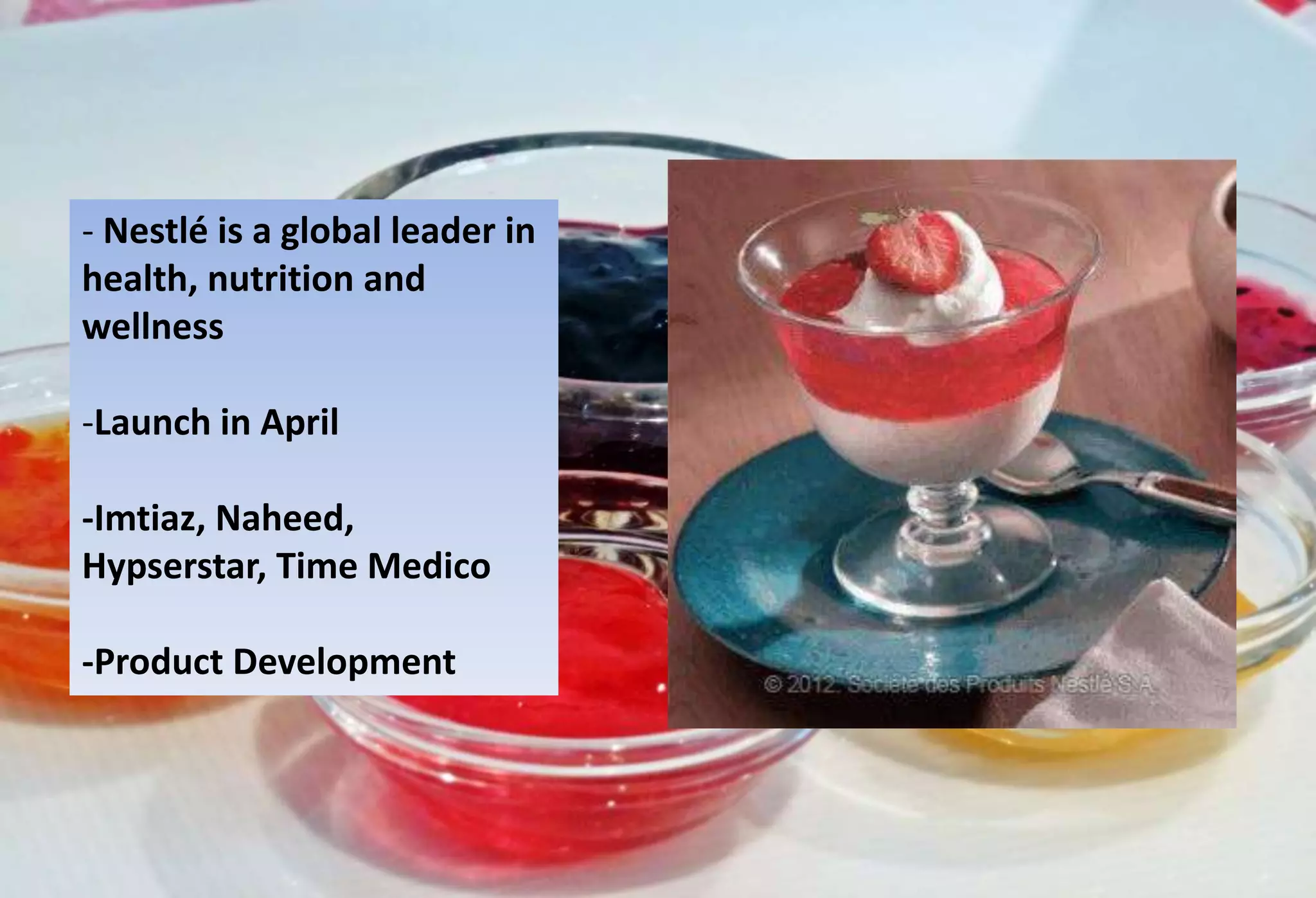
- Nestlé is a global leader in
health, nutrition and
wellness
-Launch in April
-Imtiaz, Naheed,
Hypserstar, Time Medico
-Product Development
SEGMENTATION STRATEGY
CURRENT MARKET SITUATION
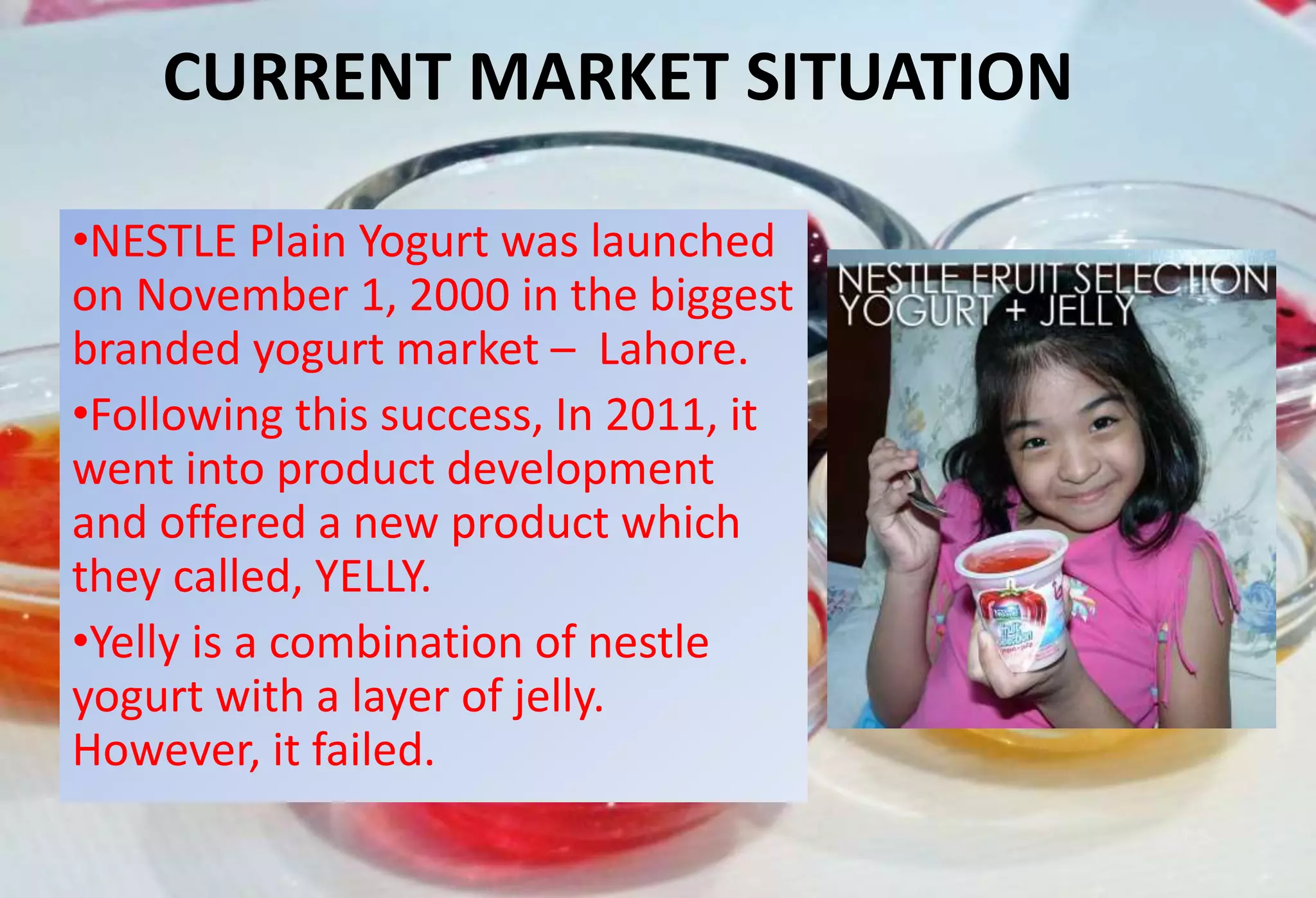
•NESTLE Plain Yogurt was launched
on November 1, 2000 in the biggest
branded yogurt market – Lahore.
•Following this success, In 2011, it
went into product development
and offered a new product which
they called, YELLY.
•Yelly is a combination of nestle
yogurt with a layer of jelly.
However, it failed.
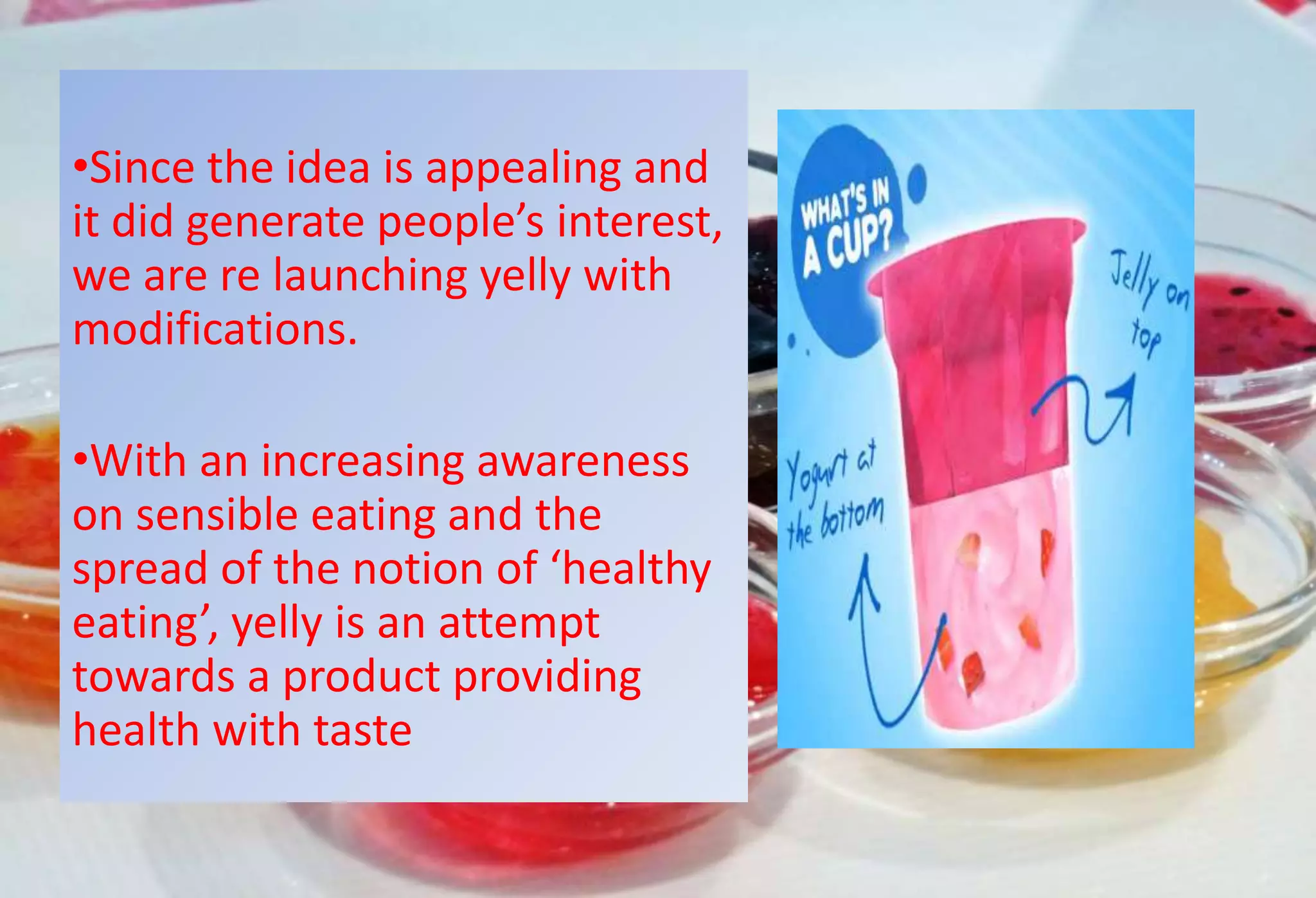
•Since the idea is appealing and
it did generate people’s interest,
we are re launching yelly with
modifications.
•With an increasing awareness
on sensible eating and the
spread of the notion of ‘healthy
eating’, yelly is an attempt
towards a product providing
health with taste
MARKET DESCRIPTION
•Nestlé’s market consists of kids at the mainstream
and people who are health conscious, at the same
time also are keen to satisfy their taste buds.
•Specific segments being targeted are kids, teenagers,
and adult complying the health factor trend, middle
and upper middle classes.
PRODUCT REVIEW
Strawberry yogurt with chunks of strawberry and
layer of jelly.
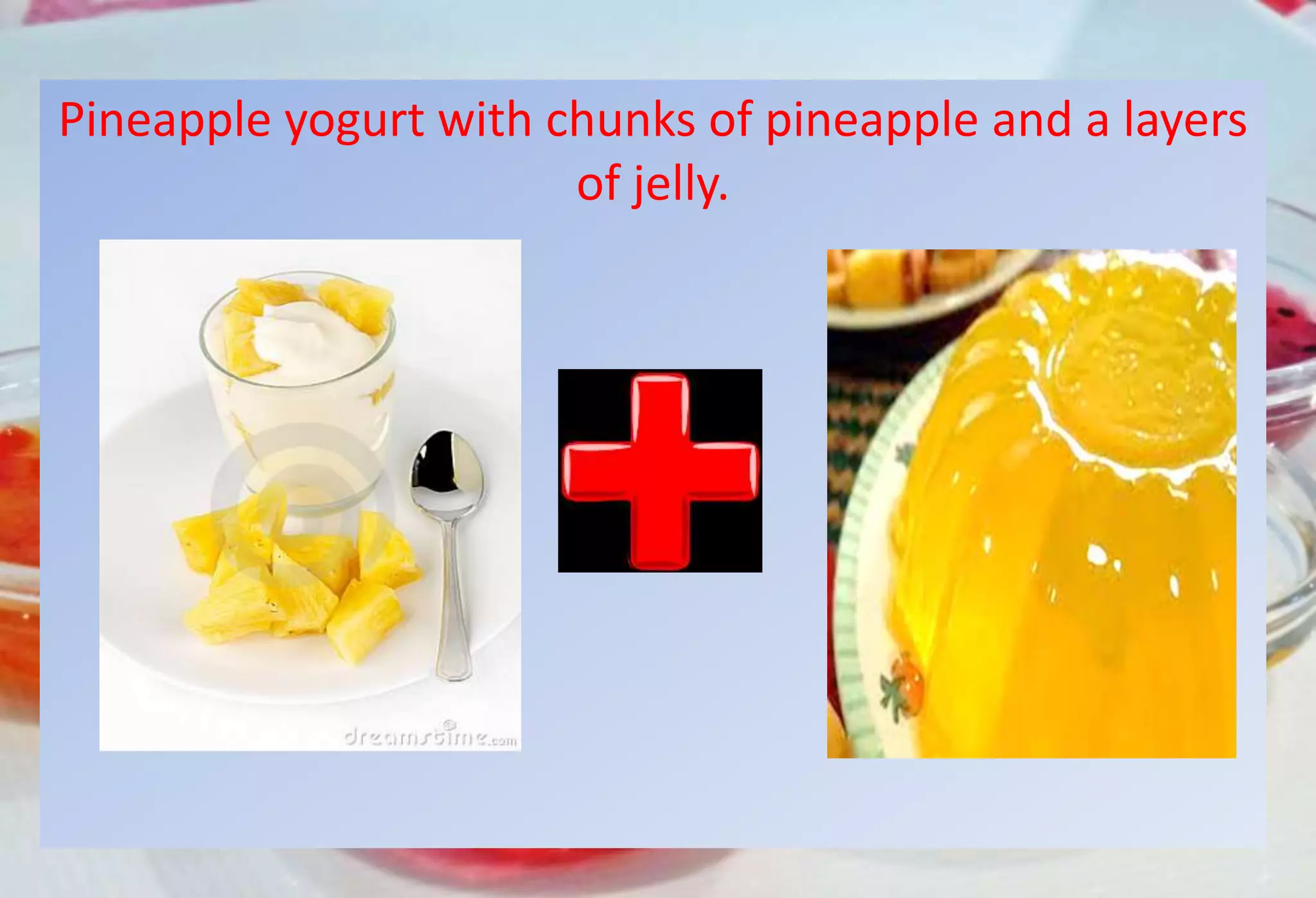
Pineapple yogurt with chunks of pineapple and a layers
of jelly.
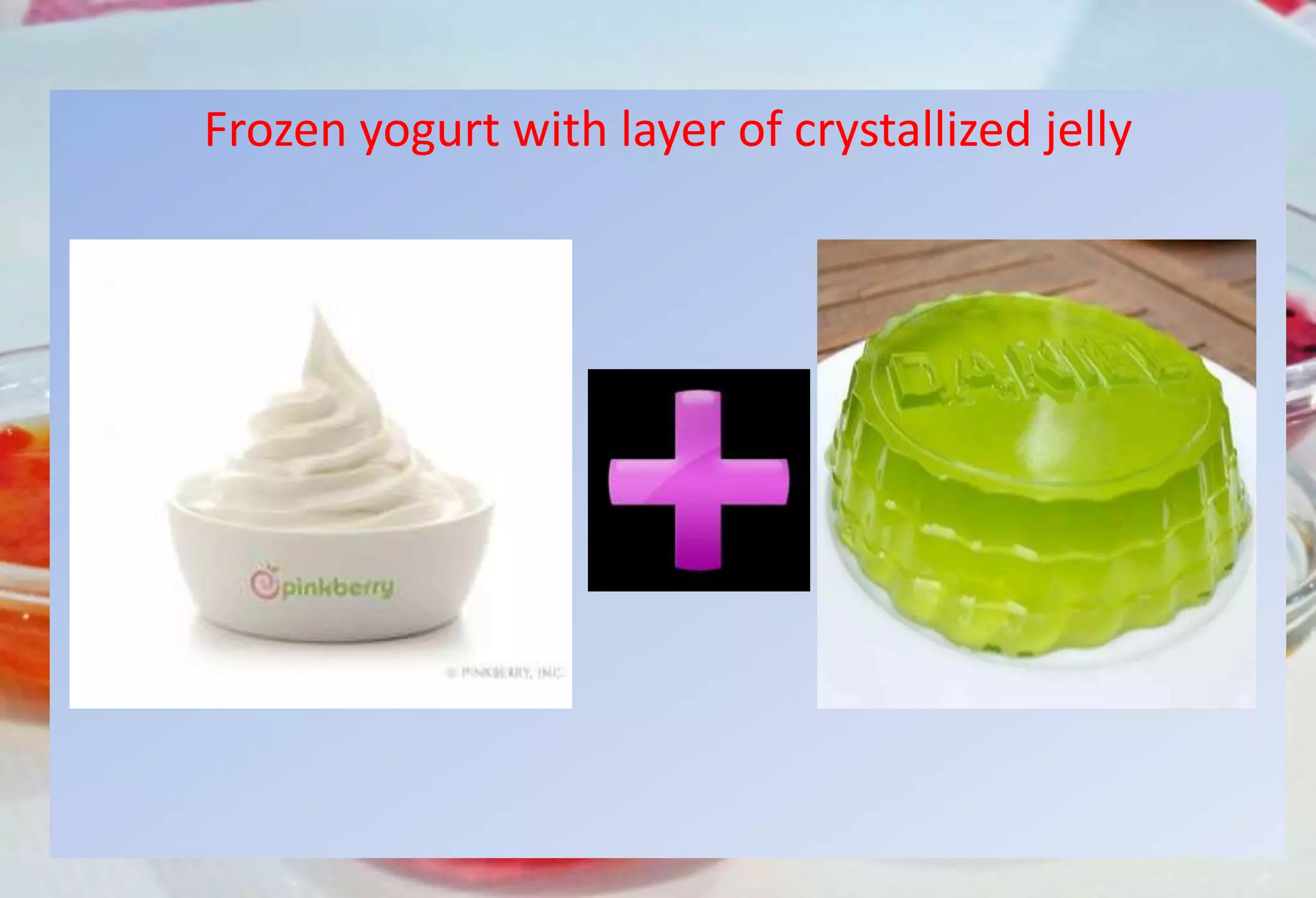
Frozen yogurt with layer of crystallized jelly
COMPETITIVE REVIEW
Yelly having unique
features, do not face
fierce competition. The
only competitors that
come close are local
frozen yogurt shops
such as Tutti Fruiti.
The challenge that Yelly
faces is creating its
demand in the market.
CHANNELS AND LOGISTICS REVIEW
•Agha’s super market.
•EBCO, the forum
•HYPERSTAR
•MY SUPER STORE, park
towers
•Naheed super market
•Imtiaz super store
•Metro
•Makro
Marketing Mix
Product
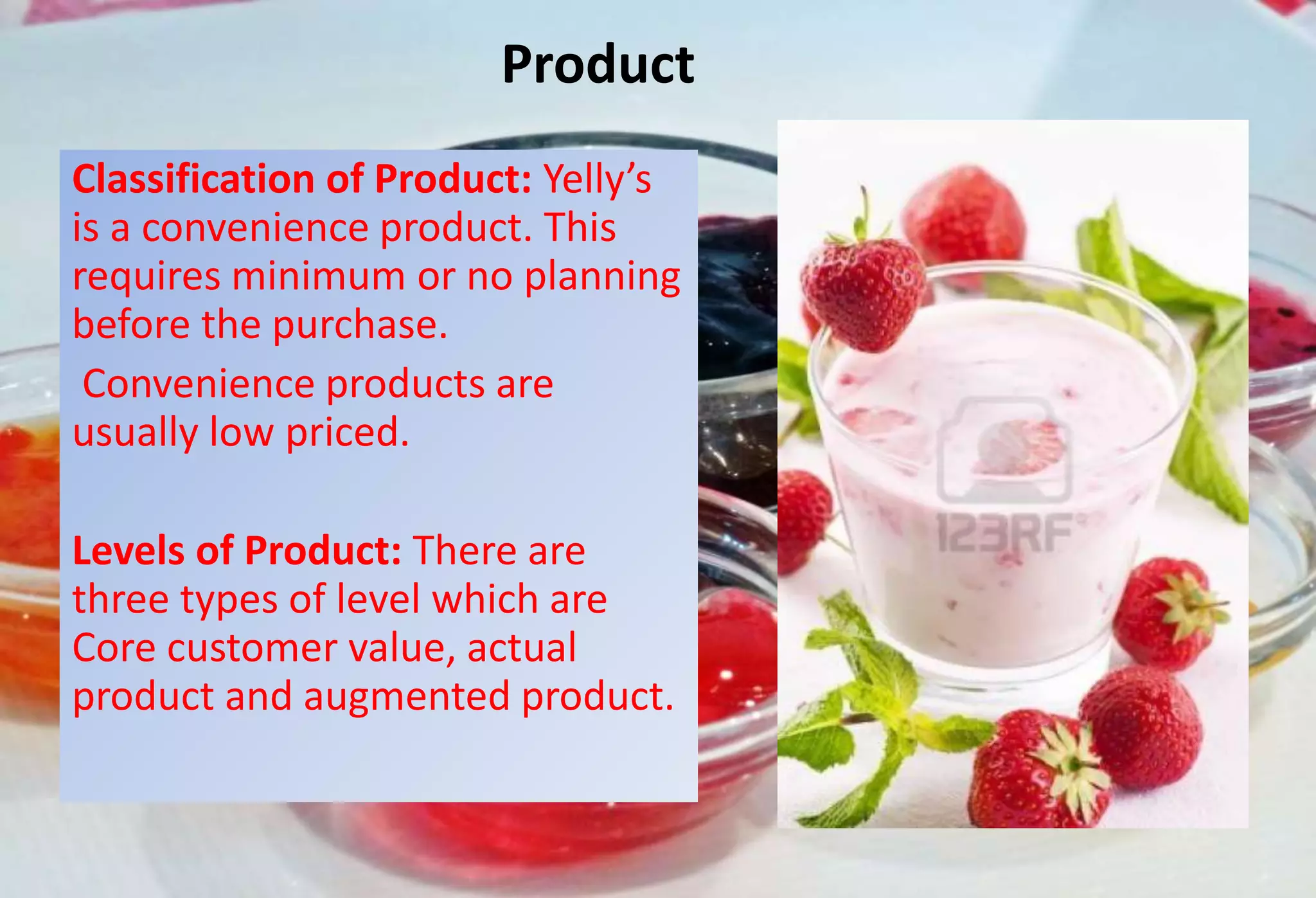
Classification of Product: Yelly’s
is a convenience product. This
requires minimum or no planning
before the purchase.
Convenience products are
usually low priced.
Levels of Product: There are
three types of level which are
Core customer value, actual
product and augmented product.
1. Core Customer Value: the intangible benefit
Jelly with nutritional benefits of yogurt.
2. Actual Product: tangible and physical benefit
Features:
 Colours: Red, Green, Yellow.
Frozen or Non-Frozen yogurt.
Fruit Chunks:1)Mango 2) Pineapple & 3)
Strawberry
Packaging
Inner packing: Plastic Cup 36g/cup
Recycling effort.
 Nestle logo.
Quality level: highest quality of fresh fruits chunks.
Brand: Good Food, Good Life.
3. Augmented Product: extra add on, value or
service one gets.
 After-sale service.
 Interactive Website.
Individual Product Decision
Product Attributes: Developing a product involves defining the
benefits that it will offer
1.Quality – Quality consistency
 Training period
 Quality Control
2.Features – tools that differentiate product from competitors’
 the jelly and frozen yogurt with fresh fruit chunks.
3.Style – Pleasing Aesthetics
 Colorful
4.Design – Aesthetics: contribute to product usefulness & looks
 handy and transparent
Branding: nestle is
renowned brand.
Packaging:
 Environmentally
friendly .
 Creates instant
consumer recognition.
Labelling: Nestlé’s logo
will be embossed on cup
of Yelly.
Pricing: Our pricing strategy is market-
penetration pricing. Setting a low price
for a Yelly’s in order to attract a large
number of buyers and a large market
share.
Promotion Mix Strategies: Marketers can
choose from two basic promotion mix
strategies-push promotion or pull
promotion. For pull strategy, advertising.
For push, personal selling and sales
promotion & public relations.
Place: Our channel strategy is to use
selective distribution. In first year, we will
add channel partners. Also, special
payment terms for retailers.
•Swot analysis is conducted to evaluate the overall
Strengths, Weaknesses, Opportunities and Threats to the
company
•Strengths include the internal capabilities and resources
combined with positive situational factors that help the
company to achieve its objectives
•Weaknesses are internal limitation and negative
situational factors that hinder the company’s performance.
•Opportunities are the advantages that the company can
have due to positive factors or trends in the external
environment
•Threats are the possible challenges that the company faces
due to negative external factors.
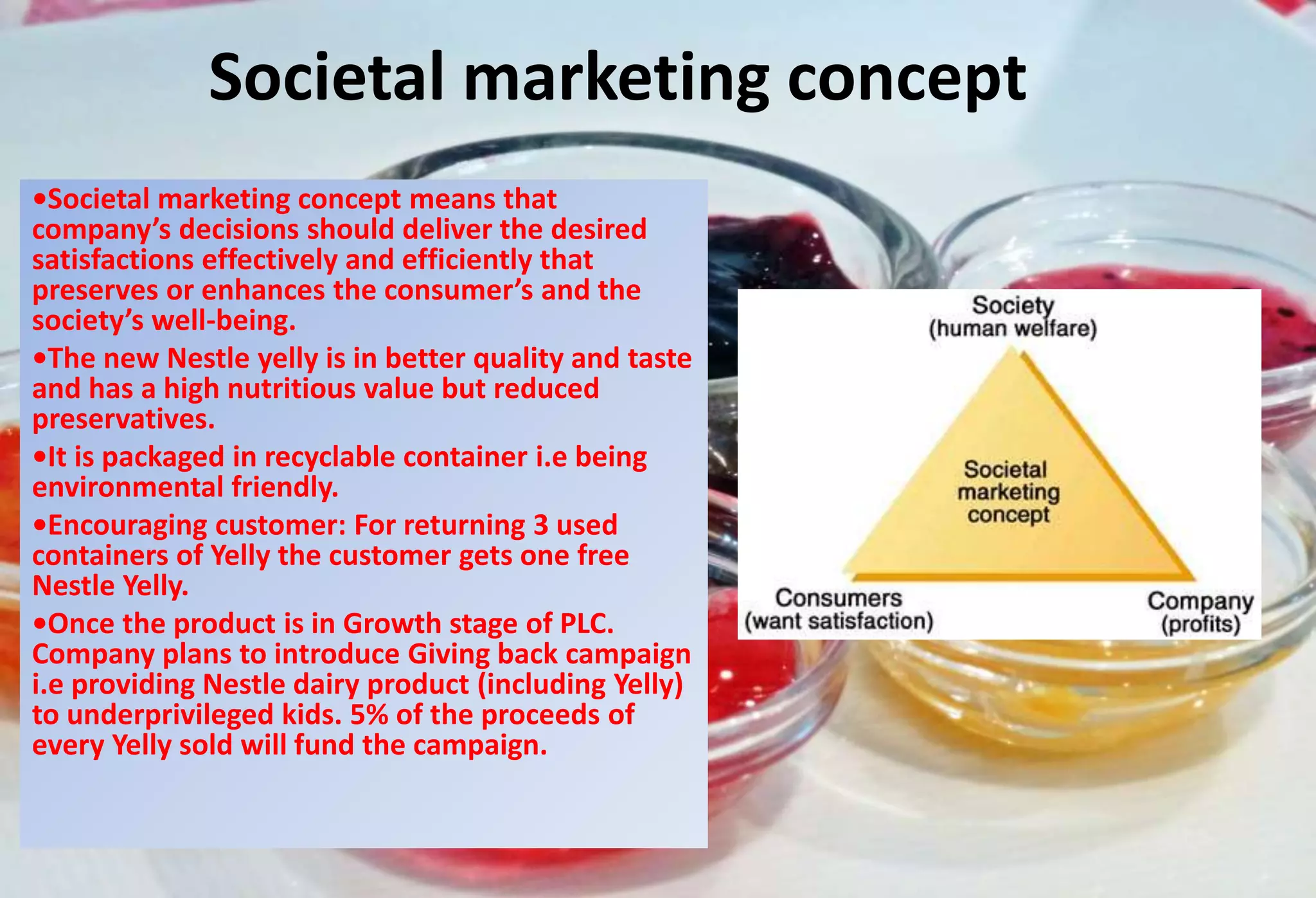
Societal marketing concept
•Societal marketing concept means that
company’s decisions should deliver the desired
satisfactions effectively and efficiently that
preserves or enhances the consumer’s and the
society’s well-being.
•The new Nestle yelly is in better quality and taste
and has a high nutritious value but reduced
preservatives.
•It is packaged in recyclable container i.e being
environmental friendly.
•Encouraging customer: For returning 3 used
containers of Yelly the customer gets one free
Nestle Yelly.
•Once the product is in Growth stage of PLC.
Company plans to introduce Giving back campaign
i.e providing Nestle dairy product (including Yelly)
to underprivileged kids. 5% of the proceeds of
every Yelly sold will fund the campaign.
Action Plan
March: pre sales promotion
April: Launching of product
May: aim for breakeven
June: Make profits, contests
July: Go to schools, get surveys
to improve product.
BUDGET AND CONTROLS
I HAVE MY PRODUCT, BUT HOW MUCH IS IT WORTH
BUDGET
Managers use budgets to project
profitability and plan for each
marketing program’s expenditures,
scheduling and operations.
Fixed cost = Rs 199,680
Variable cost = Rs 773,800
Sales = Rs 1,200,000
Selling price = RS 40
Sales/selling price = Rs 30,000 expected units.
Sales/estimated units = Rs 40 each packet of yelly.
Variable cost each packet = Variable cost/Estimated
units = Rs 26 variable cost each packet.
Markup Pricing
Sales - variable cost = margin per
unit = Rs 14 margin per unit
Break-even point
Break-even volume = Fixed
cost/Price – Variable cost =
199,680/40-26 = 14,263
CONTROLS
Controls help
management assess
results after the plan is
implemented, identify
any problems or
performance variations,
and initiate corrective
action.
• We will closely check the quality and customer
satisfaction. Through this we will be able to react quickly and
correct any problem that may occur.
• We would also monitor the response of competitors or
new technology and alter our marketing, pricing and
distribution strategies as needed.
• Warning signals that show deviation from the plans that
include monthly sales and monthly expenses will also be
monitored
• We will also evaluate the market response and develop
more variations to our product or target different segments as
the needs develop.
THANK
YOU!

Nestle Yelly

  • 2.
    Marketing Project by ArifaFatima Aakash Kumar Basla Sultan Salman Anis Veer Kumar
  • 4.
    NESTLÉ’S MISSION “At Nestlé,our research makes it possible for everyone to enjoy better food for a better life.”
  • 5.
    - Nestlé isa global leader in health, nutrition and wellness -Launch in April -Imtiaz, Naheed, Hypserstar, Time Medico -Product Development
  • 6.
  • 7.
    CURRENT MARKET SITUATION •NESTLEPlain Yogurt was launched on November 1, 2000 in the biggest branded yogurt market – Lahore. •Following this success, In 2011, it went into product development and offered a new product which they called, YELLY. •Yelly is a combination of nestle yogurt with a layer of jelly. However, it failed.
  • 8.
    •Since the ideais appealing and it did generate people’s interest, we are re launching yelly with modifications. •With an increasing awareness on sensible eating and the spread of the notion of ‘healthy eating’, yelly is an attempt towards a product providing health with taste
  • 9.
    MARKET DESCRIPTION •Nestlé’s marketconsists of kids at the mainstream and people who are health conscious, at the same time also are keen to satisfy their taste buds. •Specific segments being targeted are kids, teenagers, and adult complying the health factor trend, middle and upper middle classes.
  • 10.
    PRODUCT REVIEW Strawberry yogurtwith chunks of strawberry and layer of jelly.
  • 11.
    Pineapple yogurt withchunks of pineapple and a layers of jelly.
  • 12.
    Frozen yogurt withlayer of crystallized jelly
  • 13.
    COMPETITIVE REVIEW Yelly havingunique features, do not face fierce competition. The only competitors that come close are local frozen yogurt shops such as Tutti Fruiti. The challenge that Yelly faces is creating its demand in the market.
  • 14.
    CHANNELS AND LOGISTICSREVIEW •Agha’s super market. •EBCO, the forum •HYPERSTAR •MY SUPER STORE, park towers •Naheed super market •Imtiaz super store •Metro •Makro
  • 15.
  • 16.
    Product Classification of Product:Yelly’s is a convenience product. This requires minimum or no planning before the purchase. Convenience products are usually low priced. Levels of Product: There are three types of level which are Core customer value, actual product and augmented product.
  • 17.
    1. Core CustomerValue: the intangible benefit Jelly with nutritional benefits of yogurt. 2. Actual Product: tangible and physical benefit Features:  Colours: Red, Green, Yellow. Frozen or Non-Frozen yogurt. Fruit Chunks:1)Mango 2) Pineapple & 3) Strawberry
  • 18.
    Packaging Inner packing: PlasticCup 36g/cup Recycling effort.  Nestle logo. Quality level: highest quality of fresh fruits chunks. Brand: Good Food, Good Life. 3. Augmented Product: extra add on, value or service one gets.  After-sale service.  Interactive Website.
  • 19.
    Individual Product Decision ProductAttributes: Developing a product involves defining the benefits that it will offer 1.Quality – Quality consistency  Training period  Quality Control 2.Features – tools that differentiate product from competitors’  the jelly and frozen yogurt with fresh fruit chunks. 3.Style – Pleasing Aesthetics  Colorful 4.Design – Aesthetics: contribute to product usefulness & looks  handy and transparent
  • 20.
    Branding: nestle is renownedbrand. Packaging:  Environmentally friendly .  Creates instant consumer recognition. Labelling: Nestlé’s logo will be embossed on cup of Yelly.
  • 21.
    Pricing: Our pricingstrategy is market- penetration pricing. Setting a low price for a Yelly’s in order to attract a large number of buyers and a large market share. Promotion Mix Strategies: Marketers can choose from two basic promotion mix strategies-push promotion or pull promotion. For pull strategy, advertising. For push, personal selling and sales promotion & public relations. Place: Our channel strategy is to use selective distribution. In first year, we will add channel partners. Also, special payment terms for retailers.
  • 23.
    •Swot analysis isconducted to evaluate the overall Strengths, Weaknesses, Opportunities and Threats to the company •Strengths include the internal capabilities and resources combined with positive situational factors that help the company to achieve its objectives •Weaknesses are internal limitation and negative situational factors that hinder the company’s performance. •Opportunities are the advantages that the company can have due to positive factors or trends in the external environment •Threats are the possible challenges that the company faces due to negative external factors.
  • 25.
    Societal marketing concept •Societalmarketing concept means that company’s decisions should deliver the desired satisfactions effectively and efficiently that preserves or enhances the consumer’s and the society’s well-being. •The new Nestle yelly is in better quality and taste and has a high nutritious value but reduced preservatives. •It is packaged in recyclable container i.e being environmental friendly. •Encouraging customer: For returning 3 used containers of Yelly the customer gets one free Nestle Yelly. •Once the product is in Growth stage of PLC. Company plans to introduce Giving back campaign i.e providing Nestle dairy product (including Yelly) to underprivileged kids. 5% of the proceeds of every Yelly sold will fund the campaign.
  • 26.
    Action Plan March: presales promotion April: Launching of product May: aim for breakeven June: Make profits, contests July: Go to schools, get surveys to improve product.
  • 27.
    BUDGET AND CONTROLS IHAVE MY PRODUCT, BUT HOW MUCH IS IT WORTH
  • 28.
    BUDGET Managers use budgetsto project profitability and plan for each marketing program’s expenditures, scheduling and operations. Fixed cost = Rs 199,680 Variable cost = Rs 773,800 Sales = Rs 1,200,000 Selling price = RS 40
  • 29.
    Sales/selling price =Rs 30,000 expected units. Sales/estimated units = Rs 40 each packet of yelly. Variable cost each packet = Variable cost/Estimated units = Rs 26 variable cost each packet.
  • 30.
    Markup Pricing Sales -variable cost = margin per unit = Rs 14 margin per unit Break-even point Break-even volume = Fixed cost/Price – Variable cost = 199,680/40-26 = 14,263
  • 31.
    CONTROLS Controls help management assess resultsafter the plan is implemented, identify any problems or performance variations, and initiate corrective action.
  • 32.
    • We willclosely check the quality and customer satisfaction. Through this we will be able to react quickly and correct any problem that may occur. • We would also monitor the response of competitors or new technology and alter our marketing, pricing and distribution strategies as needed. • Warning signals that show deviation from the plans that include monthly sales and monthly expenses will also be monitored • We will also evaluate the market response and develop more variations to our product or target different segments as the needs develop.
  • 33.