Nisha Prabhu - (123)
Pranav Rane - (128)
Manasi Raut - (129)
Brinda Sanghavi - (139)
Toshish Sarode - (140)
Charmi Shah - (146)
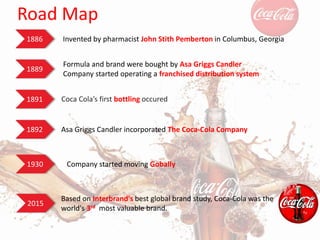
Road Map
1886
1889
1891
1892
1930
2015
Invented by pharmacist John Stith Pemberton in Columbus, Georgia
Formula and brand were bought by Asa Griggs Candler
Company started operating a franchised distribution system
Coca Cola’s first bottling occured
Asa Griggs Candler incorporated The Coca-Cola Company
Company started moving Gobally
Based on Interbrand's best global brand study, Coca-Cola was the
world's 3rd most valuable brand.
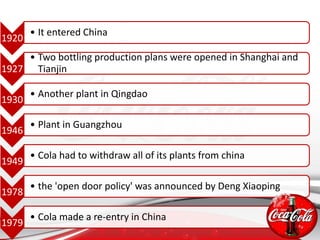
1920
• It entered China
1927
• Two bottling production plans were opened in Shanghai and
Tianjin
1930
• Another plant in Qingdao
1946
• Plant in Guangzhou
1949
• Cola had to withdraw all of its plants from china
1978
• the 'open door policy' was announced by Deng Xiaoping
1979
• Cola made a re-entry in China
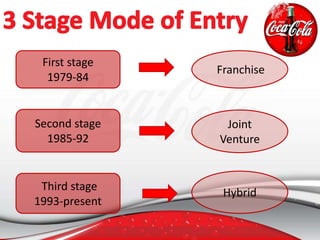
First stage
1979-84
Second stage
1985-92
Third stage
1993-present
Franchise
Joint
Venture
Hybrid
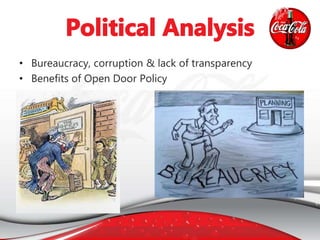
• Bureaucracy, corruption & lack of transparency
• Benefits of Open Door Policy
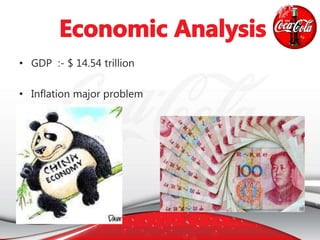
• GDP :- $ 14.54 trillion
• Inflation major problem
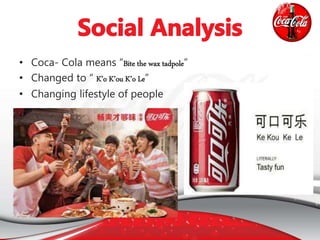
• Coca- Cola means “Bite the wax tadpole”
• Changed to “ K’o K’ou K’o Le”
• Changing lifestyle of people
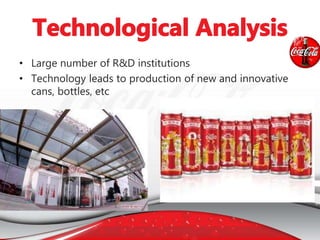
• Large number of R&D institutions
• Technology leads to production of new and innovative
cans, bottles, etc
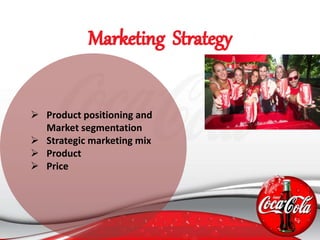
 Product positioning and
Market segmentation
 Strategic marketing mix
 Product
 Price
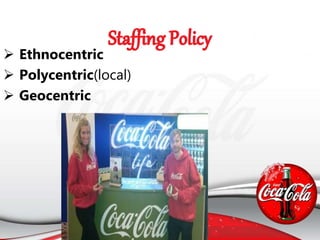
 Ethnocentric
 Polycentric(local)
 Geocentric
AIM RESULT
EXECUTION
1950-
52
1977
1993
1999
2002
Set up the
first
bottling
plant in ND
Leaves
India
Acquires Parle
brands and
Thums Up
Introduces
Sprite,
Diet Coke
Thums Up
emerges as
the country's
No.1 SD
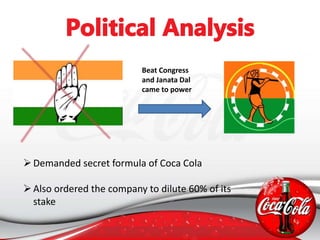
Beat Congress
and Janata Dal
came to power
Demanded secret formula of Coca Cola
Also ordered the company to dilute 60% of its
stake
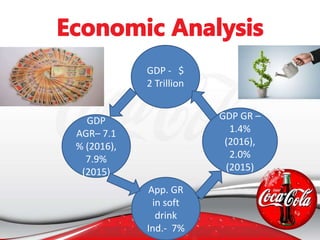
GDP
AGR– 7.1
% (2016),
7.9%
(2015)
GDP - $
2 Trillion
GDP GR –
1.4%
(2016),
2.0%
(2015)
App. GR
in soft
drink
Ind.- 7%
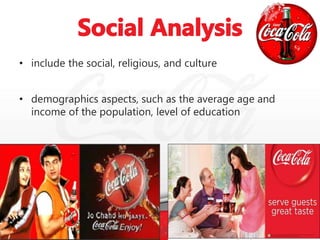
• include the social, religious, and culture
• demographics aspects, such as the average age and
income of the population, level of education
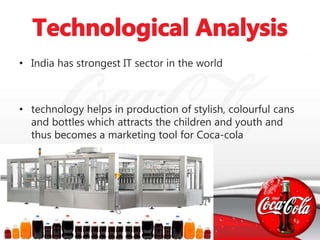
• India has strongest IT sector in the world
• technology helps in production of stylish, colourful cans
and bottles which attracts the children and youth and
thus becomes a marketing tool for Coca-cola
• On Aug 5, 2003 CSE issued a news that states soft drink
brand contain a deadly cocktail of pesticides
• Pesticide residue was 24 times above limit set by BIS
• In Calcutta , the level of pesticide exceed the bureau’s
standard by 140 times
1. Price strategy
 Trade Promotion
• incentives given to the middle men
• Agreements with shop keepers and stores
 Different price in different seasons
• Product prices are changed according to the
season
• Reduce the price in winters
2. Promotion strategies
• CSR activities
Eg support my school
• Endorsing through top celebrities
• Associating with Mcdonalds
• Associating with cricket, cinema and music
• Adopted dual strategy of jingles and
celebrity endorsement
Operations
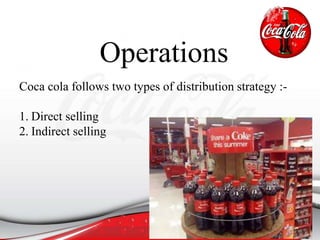
Coca cola follows two types of distribution strategy :-
1. Direct selling
2. Indirect selling
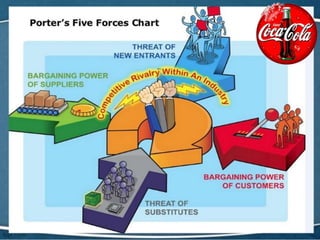
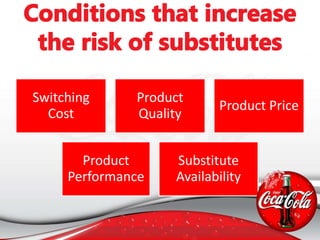
Switching
Cost
Product
Quality
Product Price
Product
Performance
Substitute
Availability
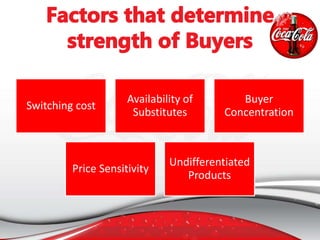
Switching cost
Availability of
Substitutes
Buyer
Concentration
Price Sensitivity
Undifferentiated
Products
• If the firms in the industry are profitable
then, the industry becomes a magnet to
new entrants.
• Loyalty of end users
• Access distribution channels
• Skilled labour
• Capital requirement
• Supplier industry dominated by few firms
• Suppliers’ product has few substitutes
• Suppliers’ product is important to the
buyer
• Buyer is not important to the supplier
• Suppliers’ product has high level of
switching cost
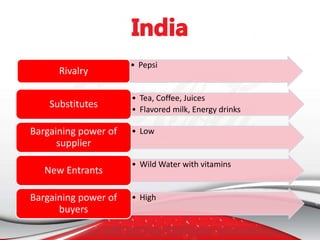
• Pepsi
Rivalry
• Tea, Coffee, Juices
• Flavored milk, Energy drinks
Substitutes
• LowBargaining power of
supplier
• Wild Water with vitamins
New Entrants
• HighBargaining power of
buyers
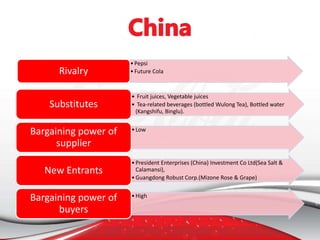
•Pepsi
•Future ColaRivalry
• Fruit juices, Vegetable juices
• Tea-related beverages (bottled Wulong Tea), Bottled water
(Kangshifu, Binglu).
Substitutes
•LowBargaining power of
supplier
•President Enterprises (China) Investment Co Ltd(Sea Salt &
Calamansi),
•Guangdong Robust Corp.(Mizone Rose & Grape)
New Entrants
•HighBargaining power of
buyers
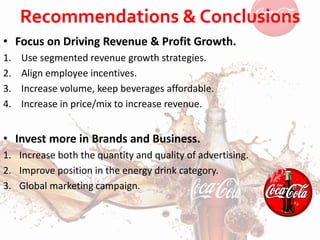
Recommendations & Conclusions
• Focus on Driving Revenue & Profit Growth.
1. Use segmented revenue growth strategies.
2. Align employee incentives.
3. Increase volume, keep beverages affordable.
4. Increase in price/mix to increase revenue.
• Invest more in Brands and Business.
1. Increase both the quantity and quality of advertising.
2. Improve position in the energy drink category.
3. Global marketing campaign.
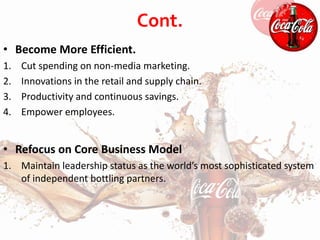
Cont.
• Become More Efficient.
1. Cut spending on non-media marketing.
2. Innovations in the retail and supply chain.
3. Productivity and continuous savings.
4. Empower employees.
• Refocus on Core Business Model
1. Maintain leadership status as the world’s most sophisticated system
of independent bottling partners.
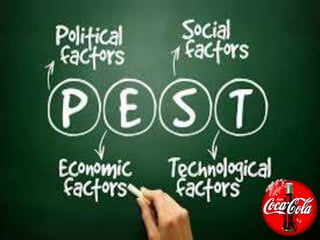
PESTEL ON COCA COLA

PESTEL ON COCA COLA

  • 2.
    Nisha Prabhu -(123) Pranav Rane - (128) Manasi Raut - (129) Brinda Sanghavi - (139) Toshish Sarode - (140) Charmi Shah - (146)
  • 3.
    Road Map 1886 1889 1891 1892 1930 2015 Invented bypharmacist John Stith Pemberton in Columbus, Georgia Formula and brand were bought by Asa Griggs Candler Company started operating a franchised distribution system Coca Cola’s first bottling occured Asa Griggs Candler incorporated The Coca-Cola Company Company started moving Gobally Based on Interbrand's best global brand study, Coca-Cola was the world's 3rd most valuable brand.
  • 6.
    1920 • It enteredChina 1927 • Two bottling production plans were opened in Shanghai and Tianjin 1930 • Another plant in Qingdao 1946 • Plant in Guangzhou 1949 • Cola had to withdraw all of its plants from china 1978 • the 'open door policy' was announced by Deng Xiaoping 1979 • Cola made a re-entry in China
  • 7.
    First stage 1979-84 Second stage 1985-92 Thirdstage 1993-present Franchise Joint Venture Hybrid
  • 9.
    • Bureaucracy, corruption& lack of transparency • Benefits of Open Door Policy
  • 10.
    • GDP :-$ 14.54 trillion • Inflation major problem
  • 11.
    • Coca- Colameans “Bite the wax tadpole” • Changed to “ K’o K’ou K’o Le” • Changing lifestyle of people
  • 12.
    • Large numberof R&D institutions • Technology leads to production of new and innovative cans, bottles, etc
  • 14.
     Product positioningand Market segmentation  Strategic marketing mix  Product  Price
  • 15.
  • 16.
  • 19.
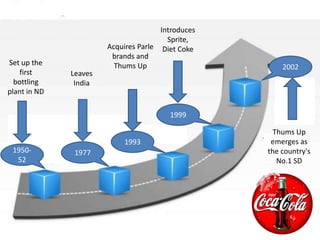
    1950- 52 1977 1993 1999 2002 Set up the first bottling plantin ND Leaves India Acquires Parle brands and Thums Up Introduces Sprite, Diet Coke Thums Up emerges as the country's No.1 SD
  • 21.
    Beat Congress and JanataDal came to power Demanded secret formula of Coca Cola Also ordered the company to dilute 60% of its stake
  • 22.
    GDP AGR– 7.1 % (2016), 7.9% (2015) GDP- $ 2 Trillion GDP GR – 1.4% (2016), 2.0% (2015) App. GR in soft drink Ind.- 7%
  • 23.
    • include thesocial, religious, and culture • demographics aspects, such as the average age and income of the population, level of education
  • 24.
    • India hasstrongest IT sector in the world • technology helps in production of stylish, colourful cans and bottles which attracts the children and youth and thus becomes a marketing tool for Coca-cola
  • 26.
    • On Aug5, 2003 CSE issued a news that states soft drink brand contain a deadly cocktail of pesticides • Pesticide residue was 24 times above limit set by BIS • In Calcutta , the level of pesticide exceed the bureau’s standard by 140 times
  • 29.
    1. Price strategy Trade Promotion • incentives given to the middle men • Agreements with shop keepers and stores  Different price in different seasons • Product prices are changed according to the season • Reduce the price in winters
  • 30.
    2. Promotion strategies •CSR activities Eg support my school • Endorsing through top celebrities • Associating with Mcdonalds • Associating with cricket, cinema and music • Adopted dual strategy of jingles and celebrity endorsement
  • 36.
    Operations Coca cola followstwo types of distribution strategy :- 1. Direct selling 2. Indirect selling
  • 41.
  • 42.
  • 43.
    • If thefirms in the industry are profitable then, the industry becomes a magnet to new entrants. • Loyalty of end users • Access distribution channels • Skilled labour • Capital requirement
  • 44.
    • Supplier industrydominated by few firms • Suppliers’ product has few substitutes • Suppliers’ product is important to the buyer • Buyer is not important to the supplier • Suppliers’ product has high level of switching cost
  • 45.
    • Pepsi Rivalry • Tea,Coffee, Juices • Flavored milk, Energy drinks Substitutes • LowBargaining power of supplier • Wild Water with vitamins New Entrants • HighBargaining power of buyers
  • 46.
    •Pepsi •Future ColaRivalry • Fruitjuices, Vegetable juices • Tea-related beverages (bottled Wulong Tea), Bottled water (Kangshifu, Binglu). Substitutes •LowBargaining power of supplier •President Enterprises (China) Investment Co Ltd(Sea Salt & Calamansi), •Guangdong Robust Corp.(Mizone Rose & Grape) New Entrants •HighBargaining power of buyers
  • 47.
    Recommendations & Conclusions •Focus on Driving Revenue & Profit Growth. 1. Use segmented revenue growth strategies. 2. Align employee incentives. 3. Increase volume, keep beverages affordable. 4. Increase in price/mix to increase revenue. • Invest more in Brands and Business. 1. Increase both the quantity and quality of advertising. 2. Improve position in the energy drink category. 3. Global marketing campaign.
  • 48.
    Cont. • Become MoreEfficient. 1. Cut spending on non-media marketing. 2. Innovations in the retail and supply chain. 3. Productivity and continuous savings. 4. Empower employees. • Refocus on Core Business Model 1. Maintain leadership status as the world’s most sophisticated system of independent bottling partners.