EMBA 5202 Brand Management Home Work IV
Tuna Taş Executive MBA Student No: 1168106
Starbucks: MANAGING A HIGH GROWTH BRAND
IntroductionIntroduction
(*)http://www.starbucks.com/about-us/company-information/mission-statement
World’s largest coffeehouse company, with more than 17000 stores in more
than 50 countries
Founded in 1971 in Seattle with the name Starbucks Coffee Tea and Spice
Till 1982, (Howard Schultz joined the company in 1982) only recognized as a
selling bean coffee and brewing machines company
After Schultz, name has been changed to Starbucks and the company
changed its image from a bean selling company to a coffeehouse company
Mission
…to inspire and nurture the human spirit – one person, one cup and one
neighborhood at a time(*)
Vertical Expansions with co-marketing and company acquisitions
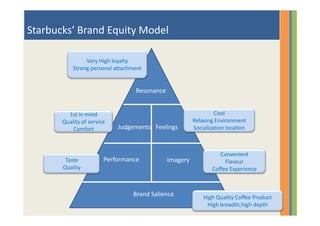
Brand Salience
ImageryPerformance
FeelingsJudgements
Resonance
1st in mind
Quality of service
Comfort
Very High loyalty
Strong personal attachment
Starbucks’ Brand Equity ModelStarbucks’ Brand Equity Model
High Quality Coffee Product
High breadth,high depth
Convenient
Flavour
Coffee Experience
Taste
Quality
Cool
Relaxing Environment
Socialization location
Key Success FactorsKey Success Factors
(*)http://www.starbucks.com/about-us/company-information/mission-statement
Always High Quality (*)
Starbucks’s mission is followed by six main principles. The first of these
principles is:
Our Coffee
It has always been, and will always be, about quality. We’re passionate about
ethically sourcing the finest coffee beans, roasting them with great care, and
improving the lives of people who grow them. We care deeply about all of this;
our work is never done.
Quality is more important than anything according to Schultz because he believed good
quality will keep the customers loyal to the brand.
Worked directly with the best growers to purchase high quality coffee beans. Applied
the highest standards for operational excellence to roast and brew the beans.
Key Success FactorsKey Success Factors
(*)http://www.starbucks.com/about-us/company-information/mission-statement
“Third Place” Concept
Starbucks aimed to be a “third place” for its customers as well as their
workplace and home which should provide a cozy, relaxing environment.
Each Starbucks store is carefully designed with best of class coffee making
equipment,furniture,music and artwork.
Howard Schultz describes this as; “Each Starbucks store is carefully designed
to enhance the quality of everything the customers see, touch, hear, smell or
taste”.
Starbucks symbolize not just a coffehouse ,but a pleasurable coffee-centered
experience
Key Success FactorsKey Success Factors
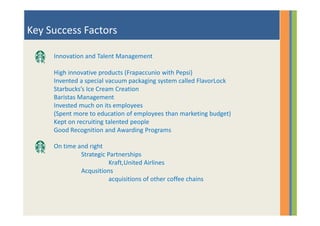
Innovation and Talent Management
High innovative products (Frapaccunio with Pepsi)
Invented a special vacuum packaging system called FlavorLock
Starbucks’s Ice Cream Creation
Baristas Management
Invested much on its employees
(Spent more to education of employees than marketing budget)
Kept on recruiting talented people
Good Recognition and Awarding Programs
On time and right
Strategic Partnerships
Kraft,United Airlines
Acqusitions
acquisitions of other coffee chains
Evaluation of the growth strategyEvaluation of the growth strategy
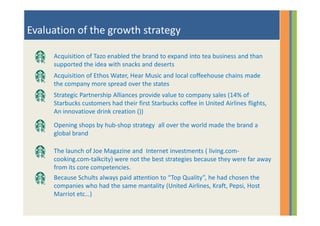
Acquisition of Tazo enabled the brand to expand into tea business and than
supported the idea with snacks and deserts
The launch of Joe Magazine and Internet investments ( living.com-
cooking.com-talkcity) were not the best strategies because they were far away
from its core competencies.
Acquisition of Ethos Water, Hear Music and local coffeehouse chains made
the company more spread over the states
Strategic Partnership Alliances provide value to company sales (14% of
Starbucks customers had their first Starbucks coffee in United Airlines flights,
An innovatiove drink creation ())
Opening shops by hub-shop strategy all over the world made the brand a
global brand
Because Schults always paid attention to “Top Quality”, he had chosen the
companies who had the same mantality (United Airlines, Kraft, Pepsi, Host
Marriot etc…)
Starbucks..A global brand?Starbucks..A global brand?
Yes because it operates with 19555 stores in 58 countries
http://en.wikipedia.org/wiki/Starbucks
Starbucks..A global brand?Starbucks..A global brand?
Operates with 19555 stores in 58 countries
Starbucks challenges to stay as a global brand?Starbucks challenges to stay as a global brand?
Keeping the same level of quality in all operating stores is hard
Has to deal with the local competitor drinks
Tea is also very common in England and in Turkey (Brewed tea is a
must for majority f Turks and is the first drink rather than coffee)
Turkey has its own private coffee (Turkish coffee)
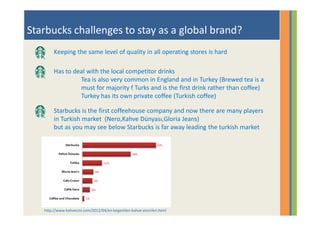
Starbucks is the first coffeehouse company and now there are many players
in Turkish market (Nero,Kahve Dünyası,Gloria Jeans)
but as you may see below Starbucks is far away leading the turkish market
http://www.kahvecini.com/2012/04/en-begenilen-kahve-zincirleri.html
Extension into non-coffee areas?Extension into non-coffee areas?
Starbucks has aimed to become a “lifestyle brand”(3rd place)
Provided Starbucks Card to increase loyalty
Entered entertaintment industry (Film(Akeelah) ) and sold the DVD at stores
I think Starbucks will focus to its core business and extension of its core
business keeping the coffee in the centre of its business.
Introduced Coffee Master Certification Programme
Purchased alternative music retailer “Hear Music” and also invested in digital
music
Since Starbucks created a relaxing and refreshing atmosphere it can use this
as the places to organize some corporate events
International ExpansionInternational Expansion
Although there should be some local resistance and operational problems
suchas
•Anti Americanism in some countries like Cuba
•Declining sales in Japan
•Shutdown of stores in Israel because of security
•High local competitor threats in England
•Saturation of Germany market by Starbucks like companies
It should continue to international expansion because it is profitable
especially expanding in the emerging markets
This is also in line with Schults plan because he plans
•To invest in China (6500 locations in Asia)
•To open 6000 stores in EMEA
•To open1500 stores in Latin America
•To double the number of stores in Canada
Threats on competitionThreats on competition
Dunkin’ Donuts is the biggest threat for Starbucks.
The company has more than 10,000 locations in 32 countries worldwide [2],
which include more than 6,700 Dunkin’ Donuts locations throughout the
United States and more than 3000 international locations(*)
Founded in 1950
The company has a huge product portfolio
In 2010, Dunkin' Donuts' global system-wide sales were $6 billion.(*)
In 2011, Dunkin' Donuts earned the No. 1 ranking for customer loyalty in the
coffee category by Brand Keys for the fifth year in a row.(*)
http://en.wikipedia.org/wiki/Dunkin'_Donuts
Coffee Drinking ExperienceCoffee Drinking Experience
Although customers are willing to pay for Starbucks Experience, the price of
the coffee is elastic so there has to be a market equal value of Starbucks
products. (Declining sales in Japan and situation in England clearly shows that
customers are sensitive to price changes)
400+ USD is much for a coffee maker while you can find good coffee makers
less than 400 USD

Starbucks

  • 1.
    EMBA 5202 BrandManagement Home Work IV Tuna Taş Executive MBA Student No: 1168106 Starbucks: MANAGING A HIGH GROWTH BRAND
  • 2.
    IntroductionIntroduction (*)http://www.starbucks.com/about-us/company-information/mission-statement World’s largest coffeehousecompany, with more than 17000 stores in more than 50 countries Founded in 1971 in Seattle with the name Starbucks Coffee Tea and Spice Till 1982, (Howard Schultz joined the company in 1982) only recognized as a selling bean coffee and brewing machines company After Schultz, name has been changed to Starbucks and the company changed its image from a bean selling company to a coffeehouse company Mission …to inspire and nurture the human spirit – one person, one cup and one neighborhood at a time(*) Vertical Expansions with co-marketing and company acquisitions
  • 3.
    Brand Salience ImageryPerformance FeelingsJudgements Resonance 1st inmind Quality of service Comfort Very High loyalty Strong personal attachment Starbucks’ Brand Equity ModelStarbucks’ Brand Equity Model High Quality Coffee Product High breadth,high depth Convenient Flavour Coffee Experience Taste Quality Cool Relaxing Environment Socialization location
  • 4.
    Key Success FactorsKeySuccess Factors (*)http://www.starbucks.com/about-us/company-information/mission-statement Always High Quality (*) Starbucks’s mission is followed by six main principles. The first of these principles is: Our Coffee It has always been, and will always be, about quality. We’re passionate about ethically sourcing the finest coffee beans, roasting them with great care, and improving the lives of people who grow them. We care deeply about all of this; our work is never done. Quality is more important than anything according to Schultz because he believed good quality will keep the customers loyal to the brand. Worked directly with the best growers to purchase high quality coffee beans. Applied the highest standards for operational excellence to roast and brew the beans.
  • 5.
    Key Success FactorsKeySuccess Factors (*)http://www.starbucks.com/about-us/company-information/mission-statement “Third Place” Concept Starbucks aimed to be a “third place” for its customers as well as their workplace and home which should provide a cozy, relaxing environment. Each Starbucks store is carefully designed with best of class coffee making equipment,furniture,music and artwork. Howard Schultz describes this as; “Each Starbucks store is carefully designed to enhance the quality of everything the customers see, touch, hear, smell or taste”. Starbucks symbolize not just a coffehouse ,but a pleasurable coffee-centered experience
  • 6.
    Key Success FactorsKeySuccess Factors Innovation and Talent Management High innovative products (Frapaccunio with Pepsi) Invented a special vacuum packaging system called FlavorLock Starbucks’s Ice Cream Creation Baristas Management Invested much on its employees (Spent more to education of employees than marketing budget) Kept on recruiting talented people Good Recognition and Awarding Programs On time and right Strategic Partnerships Kraft,United Airlines Acqusitions acquisitions of other coffee chains
  • 7.
    Evaluation of thegrowth strategyEvaluation of the growth strategy Acquisition of Tazo enabled the brand to expand into tea business and than supported the idea with snacks and deserts The launch of Joe Magazine and Internet investments ( living.com- cooking.com-talkcity) were not the best strategies because they were far away from its core competencies. Acquisition of Ethos Water, Hear Music and local coffeehouse chains made the company more spread over the states Strategic Partnership Alliances provide value to company sales (14% of Starbucks customers had their first Starbucks coffee in United Airlines flights, An innovatiove drink creation ()) Opening shops by hub-shop strategy all over the world made the brand a global brand Because Schults always paid attention to “Top Quality”, he had chosen the companies who had the same mantality (United Airlines, Kraft, Pepsi, Host Marriot etc…)
  • 8.
    Starbucks..A global brand?Starbucks..Aglobal brand? Yes because it operates with 19555 stores in 58 countries http://en.wikipedia.org/wiki/Starbucks http://en.wikipedia.org/wiki/Starbucks
  • 9.
    Starbucks..A global brand?Starbucks..Aglobal brand? Operates with 19555 stores in 58 countries
  • 10.
    Starbucks challenges tostay as a global brand?Starbucks challenges to stay as a global brand? Keeping the same level of quality in all operating stores is hard Has to deal with the local competitor drinks Tea is also very common in England and in Turkey (Brewed tea is a must for majority f Turks and is the first drink rather than coffee) Turkey has its own private coffee (Turkish coffee) Starbucks is the first coffeehouse company and now there are many players in Turkish market (Nero,Kahve Dünyası,Gloria Jeans) but as you may see below Starbucks is far away leading the turkish market http://www.kahvecini.com/2012/04/en-begenilen-kahve-zincirleri.html
  • 11.
    Extension into non-coffeeareas?Extension into non-coffee areas? Starbucks has aimed to become a “lifestyle brand”(3rd place) Provided Starbucks Card to increase loyalty Entered entertaintment industry (Film(Akeelah) ) and sold the DVD at stores I think Starbucks will focus to its core business and extension of its core business keeping the coffee in the centre of its business. Introduced Coffee Master Certification Programme Purchased alternative music retailer “Hear Music” and also invested in digital music Since Starbucks created a relaxing and refreshing atmosphere it can use this as the places to organize some corporate events
  • 12.
    International ExpansionInternational Expansion Althoughthere should be some local resistance and operational problems suchas •Anti Americanism in some countries like Cuba •Declining sales in Japan •Shutdown of stores in Israel because of security •High local competitor threats in England •Saturation of Germany market by Starbucks like companies It should continue to international expansion because it is profitable especially expanding in the emerging markets This is also in line with Schults plan because he plans •To invest in China (6500 locations in Asia) •To open 6000 stores in EMEA •To open1500 stores in Latin America •To double the number of stores in Canada
  • 13.
    Threats on competitionThreatson competition Dunkin’ Donuts is the biggest threat for Starbucks. The company has more than 10,000 locations in 32 countries worldwide [2], which include more than 6,700 Dunkin’ Donuts locations throughout the United States and more than 3000 international locations(*) Founded in 1950 The company has a huge product portfolio In 2010, Dunkin' Donuts' global system-wide sales were $6 billion.(*) In 2011, Dunkin' Donuts earned the No. 1 ranking for customer loyalty in the coffee category by Brand Keys for the fifth year in a row.(*) http://en.wikipedia.org/wiki/Dunkin'_Donuts
  • 14.
    Coffee Drinking ExperienceCoffeeDrinking Experience Although customers are willing to pay for Starbucks Experience, the price of the coffee is elastic so there has to be a market equal value of Starbucks products. (Declining sales in Japan and situation in England clearly shows that customers are sensitive to price changes) 400+ USD is much for a coffee maker while you can find good coffee makers less than 400 USD