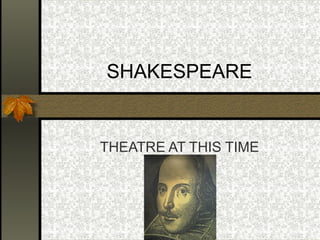
SHAKESPEARE

THEATRE AT THIS TIME
Shakespeare’s life
 Where and when was he born?

He was born in Stratford-upon-Avon in
1564, xvi century.
2.When did he go to London?
After getting married to Anne Hathaway,
at a certain moment in his life.
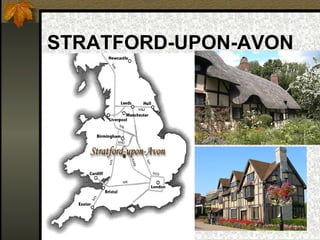
STRATFORD-UPON-AVON

Anne’s cottage
In London: actor and
playwright
 What did he do in London?

He performed as an actor and wrote plays
and poetry. He wrote: tragedies,
comedies and historical plays.
 Why were theatres so important at that
time?
They were the only type of entertainment
The Globe: characteristics
 Many of his plays were performed in the

Globe.Theatres at that time were
different from today’s.
 The plays took place in the open air in
daylight when the weather was
good.There was no scenery on the
stage. Boys played the female parts
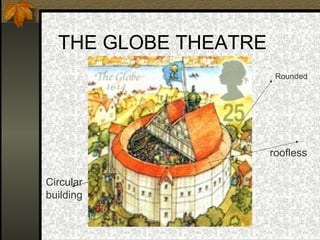
THE GLOBE THEATRE
Rounded

roofless
Circular
building
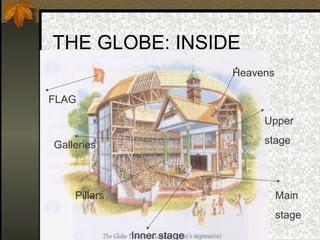
THE GLOBE: INSIDE
Heavens
FLAG
Upper
stage

Galleries

Pillars

Main
stage
Inner stage
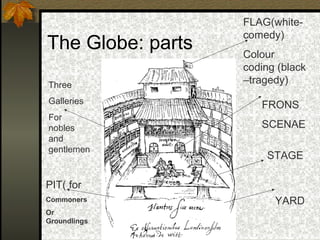
The Globe: parts
Three
Galleries
For
nobles
and
gentlemen

FLAG(whitecomedy)
Colour
coding (black
–tragedy)
FRONS
SCENAE
STAGE

PIT( for
Commoners
Or
Groundlings

YARD
THEATRE: MORE DETAILS
 Between two and three thousand

people, from all classes of society, were
in the audience.Toilets didn’t exist.
 Did women go to the theatre?
Yes, they did though it was considered
immoral. That’s why many attended
performances with masks (not to be
recognised)
Theatre: more information
Even legend says Queen Elizabeth I
attended the Globe secretly sometimes.
 How much did it cost?(depended on the
comfort of the seats):
To stand in the yard-one penny
To sit in the gallery- two pennies
To have a cushion- three pennies
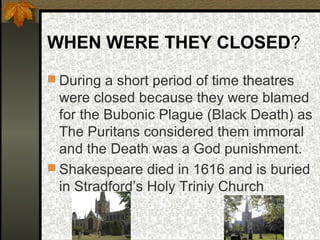
WHEN WERE THEY CLOSED?
 During a short period of time theatres

were closed because they were blamed
for the Bubonic Plague (Black Death) as
The Puritans considered them immoral
and the Death was a God punishment.
 Shakespeare died in 1616 and is buried
in Stradford’s Holy Triniy Church
TYPES OF PLAYS
 Shakespeare wrote poetry and 38

plays: tragedies, comedies and
historical plays.
 Tragedies:
Hamlet, King Lear, Othello and
Macbeth are the most important ones.
In tragedies: the ending is sad, many
TRAGEDIES
Characters die.
Time is against the characters
The main characters are men, and they
belong to aristocracy or monarchy( they
are queen, kings,nobles etc)
Lady Macbeth is an exception since she
is a main character with an important
role.
Comedies
 They have a happy ending.
 Time helps the characters to solve

problems
 Women have important parts and help
to find solutions (cross-dressing)
 Characters don’t belong to monarchy.
Shakespeare’s time
 This period of time xvi was called the

Renaissance period: ( the culture of
Greece and Rome was rediscovered)
 For these reason many of his plays are
settled in Europe and Italy mainly:
Romeo and Juliet, Othello etc.
HIS TIME: RENAISSANCE
 The printing press resulted in more

books, more education and knowledge.
• Humanism is also essential. God leaves his
place to man: the most important being in the
universe.We find characters who want
something: to be richer, to be more powerful, to
be more intelligent etc. These are humanist
characters.
LITERARY IMPORTANCE
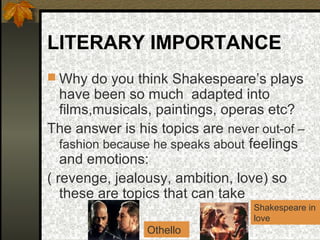
 Why do you think Shakespeare’s plays

have been so much adapted into
films,musicals, paintings, operas etc?
The answer is his topics are never out-of –
fashion because he speaks about feelings
and emotions:
( revenge, jealousy, ambition, love) so
these are topics that can take
Shakespeare in
love

Othello
IMPORTANCE
Place in the XVI century or nowadays.
 Shakespeare is also famous for his
quotations (citas) sentences that have
become so famous that take part of our
language, culture and everybody knows:
Hamlet’s : “to be or not to be; that’s the
question.”
Othello: “Be aware of the green-eyed monster
that mocks of the meat he feeds on
( refering to jealousy)”
Shakespeare’s importance
 It’s essential to understand other literary

works since authors quote him
constantly.
 Most of his characters have become
symbols: Othello is the symbol of
jealousy, Hamlet is the permanent
doubt, Macbeth is personified ambition
and so on.

Shakespeare. Theatre at his Time

  • 1.
  • 2.
    Shakespeare’s life  Whereand when was he born? He was born in Stratford-upon-Avon in 1564, xvi century. 2.When did he go to London? After getting married to Anne Hathaway, at a certain moment in his life.
  • 3.
  • 4.
    In London: actorand playwright  What did he do in London? He performed as an actor and wrote plays and poetry. He wrote: tragedies, comedies and historical plays.  Why were theatres so important at that time? They were the only type of entertainment
  • 5.
    The Globe: characteristics Many of his plays were performed in the Globe.Theatres at that time were different from today’s.  The plays took place in the open air in daylight when the weather was good.There was no scenery on the stage. Boys played the female parts
  • 6.
  • 7.
  • 8.
    The Globe: parts Three Galleries For nobles and gentlemen FLAG(whitecomedy) Colour coding(black –tragedy) FRONS SCENAE STAGE PIT( for Commoners Or Groundlings YARD
  • 9.
    THEATRE: MORE DETAILS Between two and three thousand people, from all classes of society, were in the audience.Toilets didn’t exist.  Did women go to the theatre? Yes, they did though it was considered immoral. That’s why many attended performances with masks (not to be recognised)
  • 10.
    Theatre: more information Evenlegend says Queen Elizabeth I attended the Globe secretly sometimes.  How much did it cost?(depended on the comfort of the seats): To stand in the yard-one penny To sit in the gallery- two pennies To have a cushion- three pennies
  • 11.
    WHEN WERE THEYCLOSED?  During a short period of time theatres were closed because they were blamed for the Bubonic Plague (Black Death) as The Puritans considered them immoral and the Death was a God punishment.  Shakespeare died in 1616 and is buried in Stradford’s Holy Triniy Church
  • 12.
    TYPES OF PLAYS Shakespeare wrote poetry and 38 plays: tragedies, comedies and historical plays.  Tragedies: Hamlet, King Lear, Othello and Macbeth are the most important ones. In tragedies: the ending is sad, many
  • 13.
    TRAGEDIES Characters die. Time isagainst the characters The main characters are men, and they belong to aristocracy or monarchy( they are queen, kings,nobles etc) Lady Macbeth is an exception since she is a main character with an important role.
  • 14.
    Comedies  They havea happy ending.  Time helps the characters to solve problems  Women have important parts and help to find solutions (cross-dressing)  Characters don’t belong to monarchy.
  • 15.
    Shakespeare’s time  Thisperiod of time xvi was called the Renaissance period: ( the culture of Greece and Rome was rediscovered)  For these reason many of his plays are settled in Europe and Italy mainly: Romeo and Juliet, Othello etc.
  • 16.
    HIS TIME: RENAISSANCE The printing press resulted in more books, more education and knowledge. • Humanism is also essential. God leaves his place to man: the most important being in the universe.We find characters who want something: to be richer, to be more powerful, to be more intelligent etc. These are humanist characters.
  • 17.
    LITERARY IMPORTANCE  Whydo you think Shakespeare’s plays have been so much adapted into films,musicals, paintings, operas etc? The answer is his topics are never out-of – fashion because he speaks about feelings and emotions: ( revenge, jealousy, ambition, love) so these are topics that can take Shakespeare in love Othello
  • 18.
    IMPORTANCE Place in theXVI century or nowadays.  Shakespeare is also famous for his quotations (citas) sentences that have become so famous that take part of our language, culture and everybody knows: Hamlet’s : “to be or not to be; that’s the question.” Othello: “Be aware of the green-eyed monster that mocks of the meat he feeds on ( refering to jealousy)”
  • 19.
    Shakespeare’s importance  It’sessential to understand other literary works since authors quote him constantly.  Most of his characters have become symbols: Othello is the symbol of jealousy, Hamlet is the permanent doubt, Macbeth is personified ambition and so on.