CHAPTER2:DRAMA
Performance
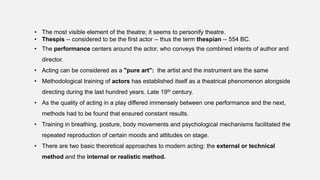
• The most visible element of the theatre; it seems to personify theatre.
• Thespis -- considered to be the first actor -- thus the term thespian -- 554 BC.
• The performance centers around the actor, who conveys the combined intents of author and
director.
• Acting can be considered as a "pure art": the artist and the instrument are the same
• Methodological training of actors has established itself as a theatrical phenomenon alongside
directing during the last hundred years. Late 19th century.
• As the quality of acting in a play differed immensely between one performance and the next,
methods had to be found that ensured constant results.
• Training in breathing, posture, body movements and psychological mechanisms facilitated the
repeated reproduction of certain moods and attitudes on stage.
• There are two basic theoretical approaches to modern acting: the external or technical
method and the internal or realistic method.
THE INTERNAL METHOD
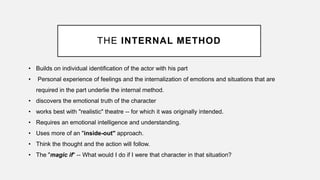
• Builds on individual identification of the actor with his part
• Personal experience of feelings and the internalization of emotions and situations that are
required in the part underlie the internal method.
• discovers the emotional truth of the character
• works best with "realistic" theatre -- for which it was originally intended.
• Requires an emotional intelligence and understanding.
• Uses more of an "inside-out" approach.
• Think the thought and the action will follow.
• The "magic if" -- What would I do if I were that character in that situation?
THE INTERNAL METHOD
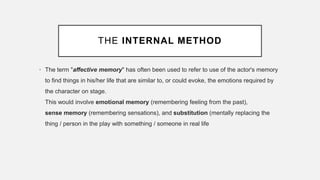
• The term "affective memory" has often been used to refer to use of the actor's memory
to find things in his/her life that are similar to, or could evoke, the emotions required by
the character on stage.
This would involve emotional memory (remembering feeling from the past),
sense memory (remembering sensations), and substitution (mentally replacing the
thing / person in the play with something / someone in real life
THE EXTERNAL METHOD
• Russian director Konstantin Stanislavsky (1863–1938), and his pupil Lee Strasberg (1901–82)
• the actor is supposed to be able to imitate the moods required in his part by using certain
techniques, but without actually feeling these moods
• Discovering ways to convey emotions vocally and physically and project to the audience
• Requires an intellectual understanding
• Uses more of an "outside-in" approach
• Do the action and then the feeling will follow - physical actions can lead to emotional reactions..
• Emphasis on Body language
• It relies on impersonation and simulation
• This technique, known as The Method, stresses “showing” rather than “being.”
• Marlon Brando (*1924), James Dean (1931–55), Paul Newman (*1925) and Julie Harris
(*1925).
• Most actors use a combination of both
REPRESENTATIONAL
VS PRESENTATIONAL ACTING
• Representational: actors want to make us "believe" they are the character; they "pretend.
• Dustin Hoffman, Meryl Streep, Robert DeNiro, Samuel L. Jackson
• Presentational: rather than "pretending" they are the character, actors "present" the
character to us,
• almost as if saying, "Hi, this is the actor speaking, and I'm going to present the ideas of this
character to you; I don't really believe I'm anything other than myself, but you can believe it if
you want.“ Paul Newman, Denzel Washington
• In the later 20th century, there have been reinterpretations and rejections of this "method.“
• A "revolt" against Stanislavsky's "method" acting: Brecht's "Alienation-effect" asks actors
to "present" their characters to the audience and specifically NOT to get involved

Drama performance

  • 1.
  • 2.
    • The mostvisible element of the theatre; it seems to personify theatre. • Thespis -- considered to be the first actor -- thus the term thespian -- 554 BC. • The performance centers around the actor, who conveys the combined intents of author and director. • Acting can be considered as a "pure art": the artist and the instrument are the same • Methodological training of actors has established itself as a theatrical phenomenon alongside directing during the last hundred years. Late 19th century. • As the quality of acting in a play differed immensely between one performance and the next, methods had to be found that ensured constant results. • Training in breathing, posture, body movements and psychological mechanisms facilitated the repeated reproduction of certain moods and attitudes on stage. • There are two basic theoretical approaches to modern acting: the external or technical method and the internal or realistic method.
  • 3.
    THE INTERNAL METHOD •Builds on individual identification of the actor with his part • Personal experience of feelings and the internalization of emotions and situations that are required in the part underlie the internal method. • discovers the emotional truth of the character • works best with "realistic" theatre -- for which it was originally intended. • Requires an emotional intelligence and understanding. • Uses more of an "inside-out" approach. • Think the thought and the action will follow. • The "magic if" -- What would I do if I were that character in that situation?
  • 4.
    THE INTERNAL METHOD •The term "affective memory" has often been used to refer to use of the actor's memory to find things in his/her life that are similar to, or could evoke, the emotions required by the character on stage. This would involve emotional memory (remembering feeling from the past), sense memory (remembering sensations), and substitution (mentally replacing the thing / person in the play with something / someone in real life
  • 5.
    THE EXTERNAL METHOD •Russian director Konstantin Stanislavsky (1863–1938), and his pupil Lee Strasberg (1901–82) • the actor is supposed to be able to imitate the moods required in his part by using certain techniques, but without actually feeling these moods • Discovering ways to convey emotions vocally and physically and project to the audience • Requires an intellectual understanding • Uses more of an "outside-in" approach • Do the action and then the feeling will follow - physical actions can lead to emotional reactions.. • Emphasis on Body language • It relies on impersonation and simulation • This technique, known as The Method, stresses “showing” rather than “being.” • Marlon Brando (*1924), James Dean (1931–55), Paul Newman (*1925) and Julie Harris (*1925). • Most actors use a combination of both
  • 6.
    REPRESENTATIONAL VS PRESENTATIONAL ACTING •Representational: actors want to make us "believe" they are the character; they "pretend. • Dustin Hoffman, Meryl Streep, Robert DeNiro, Samuel L. Jackson • Presentational: rather than "pretending" they are the character, actors "present" the character to us, • almost as if saying, "Hi, this is the actor speaking, and I'm going to present the ideas of this character to you; I don't really believe I'm anything other than myself, but you can believe it if you want.“ Paul Newman, Denzel Washington • In the later 20th century, there have been reinterpretations and rejections of this "method.“ • A "revolt" against Stanislavsky's "method" acting: Brecht's "Alienation-effect" asks actors to "present" their characters to the audience and specifically NOT to get involved