Chapter 10 | Lesson 4
Interacting Waves
Prepared by:
Teacher Evelyn A. Asuncion
Grade10 Physics
Objectives:
• Describe how overlapping waves
interfere constructively and
destructively.
• Explain how standing waves are formed.
In some ways, waves are like ghosts—they pass through one another and keep going!
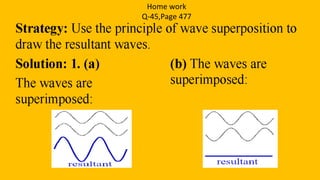
When two or more waves overlap, they combine to form a resultant wave. The
principle of superposition states that a resultant wave is simply the sum of the
individual waves that make it up.
Interacting waves
Interference
Interactive simulation
https://phet.colorado.edu/sims/html/wave-interference/latest/wave-interference_en.html
Click the link above for
Interactive simulation
Constructive Interference
When two wave pulses combine, the resulting pulse has a larger amplitude, equal to the
sum of the amplitudes of the individual pulses.
Whenever waves combine to form a larger wave, the result is referred to as constructive
interference.
The positive displacement of one wave adds to the negative displacement of the other to
crease a net displacement of zero. When waves superpose to form a smaller wave, the
result is referred to as destructive interference.
In both constructive and destructive interference, the waves are not changed when they
pass through one another. This makes sense from an energy point of view, since energy
cannot simply vanish.
Destructive Interference
Home work
Q-45,Page 477
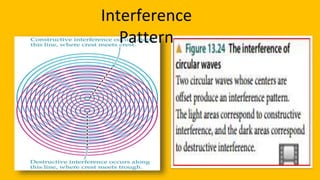
Interference effects are not limited to waves on a string. In fact,
interference is one of the key characteristics that define waves. In
general, when waves combine, they form interference patterns that
include regions of constructive interference and regions of destructive
interference.
Interference
Pattern
Interference
Pattern
A wave that oscillates in a fixed position is called a standing wave.
The strings assume a wavelike shape, but the wave stays in the same place.
All standing waves are the result of interference
Standing wave
Nodes and antinodes
The ends of the plucked string are fixed and do not move. Points that do
not move are called nodes.
Halfway between any two nodes is a point of maximum displacement
known as an antinode.
First harmonic
When a string is tied down at
both ends and plucked in the
middle, a standing wave results.
This is the string's fundamental
mode of vibration, or first
harmonic. The fundamental
mode corresponds to a half a
wavelength of a usual wave on a
string.
λ = 2L
First harmonic
The first harmonic is formed by a wave that
reflects back and forth between the fixed ends
of a string. When the frequency is just right, the
reflected waves interfere constructively, and
the standing wave is formed.
If the frequency differs from the first-harmonic
frequency, then the reflections result in
destructive interference, and a standing wave
does not form.
First harmonic
https://forms.office.com/Pages/ResponsePage.aspx?id=DQSIkWdsW0yxEjajBLZtrQAAAAAAAAAAAAN__jN
TFT9UMVlCVVJPVkpYMUNPV1I4NTRWU0JBUzJRQy4u
Pop Quiz
Click the link below for a quick assessment.
Second harmonic
λ = L
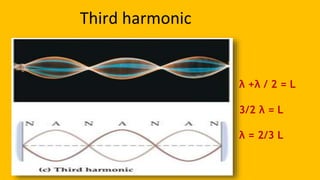
Third harmonic
λ +λ / 2 = L
3/2 λ = L
λ = 2/3 L
Q-47,Page 480(Home Work)
Q-48,Page 480
When you pluck a guitar string, it vibrates primarily in its
fundamental mode. Higher harmonics make only small
contributions to the sound produced. The same is true for
strings on a piano, a violin, and other string instruments.
Assuming that all other variables remain the same, longer
strings (larger L) produce lower frequencies and shorter
strings (smaller L) produce higher frequencies.
The frequency of the second harmonic is twice the frequency
of the first harmonic, and the frequency of the third harmonic
is three times that of the first. This pattern continues for all
higher harmonics.
The frequency range of an
instrument is directly related to the
instrument's size. The figure below
shows a violin, a cello, and a double
bass. The smallest of these string
instruments, the violin, has the
highest frequency range. The largest
instrument, the double bass,
produces the lowest frequency
range.
Instrument size and frequency
Frets on a guitar
Lesson Check(Page 482)
Q-49
Lesson Check(Page 482)
Q-50 A standing wave is formed when two waves of the
same frequency pass through the same medium but
in opposite directions. At some times the crests will
overlap troughs and produce destructive
interference. At other times the crests will overlap
crests and create crests with double amplitude
(constructive interference). Therefore your
classmate is correct to say that standing waves
involve both constructive and destructive
interference.
Lesson Check(Page 482)
Q-51
Every musical instrument creates standing waves of
sound. A wind instrument creates a standing wave
along an air column that is composed of the
generated wave (produced by the musician’s lips or
by a reed) propagating in one direction and a
reflected wave traveling in the other direction. A
string instrument creates standing waves on a string
that is fixed at both ends. Lasers create standing
waves of light, and a radio tuner can be thought of as
an electrical oscillator caused by counter-propagating
electrical waves
Lesson Check(Page 482)
Q-52 Yes. A higher harmonic of a standing wave always
consists of a greater number of nodes and
antinodes along the same length of a medium than
a lower harmonic. That fact implies that the
wavelength of a higher harmonic is always shorter
than the wavelength of a lower harmonic. Because
the wave speed is the same for both harmonics, we
conclude that the frequency of a higher harmonic
must always be greater than the frequency of a
lower harmonic.
Lesson Check(Page 482)
Q-53(Home work)
Lesson Check(Page 482)
Q-54
Lesson Check(Page 482)
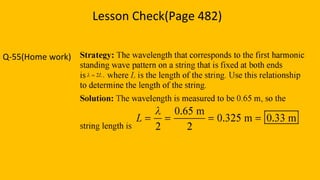
Q-55(Home work)
Interacting Waves_Grade 10.pptx

Interacting Waves_Grade 10.pptx

  • 1.
    Chapter 10 |Lesson 4 Interacting Waves Prepared by: Teacher Evelyn A. Asuncion Grade10 Physics
  • 2.
    Objectives: • Describe howoverlapping waves interfere constructively and destructively. • Explain how standing waves are formed.
  • 3.
    In some ways,waves are like ghosts—they pass through one another and keep going! When two or more waves overlap, they combine to form a resultant wave. The principle of superposition states that a resultant wave is simply the sum of the individual waves that make it up. Interacting waves
  • 4.
  • 5.
    Constructive Interference When twowave pulses combine, the resulting pulse has a larger amplitude, equal to the sum of the amplitudes of the individual pulses. Whenever waves combine to form a larger wave, the result is referred to as constructive interference.
  • 6.
    The positive displacementof one wave adds to the negative displacement of the other to crease a net displacement of zero. When waves superpose to form a smaller wave, the result is referred to as destructive interference. In both constructive and destructive interference, the waves are not changed when they pass through one another. This makes sense from an energy point of view, since energy cannot simply vanish. Destructive Interference
  • 8.
  • 9.
    Interference effects arenot limited to waves on a string. In fact, interference is one of the key characteristics that define waves. In general, when waves combine, they form interference patterns that include regions of constructive interference and regions of destructive interference. Interference Pattern
  • 10.
  • 11.
    A wave thatoscillates in a fixed position is called a standing wave. The strings assume a wavelike shape, but the wave stays in the same place. All standing waves are the result of interference Standing wave
  • 12.
    Nodes and antinodes Theends of the plucked string are fixed and do not move. Points that do not move are called nodes. Halfway between any two nodes is a point of maximum displacement known as an antinode.
  • 13.
    First harmonic When astring is tied down at both ends and plucked in the middle, a standing wave results. This is the string's fundamental mode of vibration, or first harmonic. The fundamental mode corresponds to a half a wavelength of a usual wave on a string. λ = 2L
  • 14.
    First harmonic The firstharmonic is formed by a wave that reflects back and forth between the fixed ends of a string. When the frequency is just right, the reflected waves interfere constructively, and the standing wave is formed. If the frequency differs from the first-harmonic frequency, then the reflections result in destructive interference, and a standing wave does not form.
  • 15.
  • 16.
  • 17.
  • 18.
    Third harmonic λ +λ/ 2 = L 3/2 λ = L λ = 2/3 L
  • 20.
  • 21.
  • 22.
    When you plucka guitar string, it vibrates primarily in its fundamental mode. Higher harmonics make only small contributions to the sound produced. The same is true for strings on a piano, a violin, and other string instruments. Assuming that all other variables remain the same, longer strings (larger L) produce lower frequencies and shorter strings (smaller L) produce higher frequencies. The frequency of the second harmonic is twice the frequency of the first harmonic, and the frequency of the third harmonic is three times that of the first. This pattern continues for all higher harmonics.
  • 24.
    The frequency rangeof an instrument is directly related to the instrument's size. The figure below shows a violin, a cello, and a double bass. The smallest of these string instruments, the violin, has the highest frequency range. The largest instrument, the double bass, produces the lowest frequency range. Instrument size and frequency
  • 25.
    Frets on aguitar
  • 26.
  • 27.
    Lesson Check(Page 482) Q-50A standing wave is formed when two waves of the same frequency pass through the same medium but in opposite directions. At some times the crests will overlap troughs and produce destructive interference. At other times the crests will overlap crests and create crests with double amplitude (constructive interference). Therefore your classmate is correct to say that standing waves involve both constructive and destructive interference.
  • 28.
    Lesson Check(Page 482) Q-51 Everymusical instrument creates standing waves of sound. A wind instrument creates a standing wave along an air column that is composed of the generated wave (produced by the musician’s lips or by a reed) propagating in one direction and a reflected wave traveling in the other direction. A string instrument creates standing waves on a string that is fixed at both ends. Lasers create standing waves of light, and a radio tuner can be thought of as an electrical oscillator caused by counter-propagating electrical waves
  • 29.
    Lesson Check(Page 482) Q-52Yes. A higher harmonic of a standing wave always consists of a greater number of nodes and antinodes along the same length of a medium than a lower harmonic. That fact implies that the wavelength of a higher harmonic is always shorter than the wavelength of a lower harmonic. Because the wave speed is the same for both harmonics, we conclude that the frequency of a higher harmonic must always be greater than the frequency of a lower harmonic.
  • 30.
  • 31.
  • 32.